Dermxell Inactive
Dermxell Facebook ad creative
secure.dermxell.com
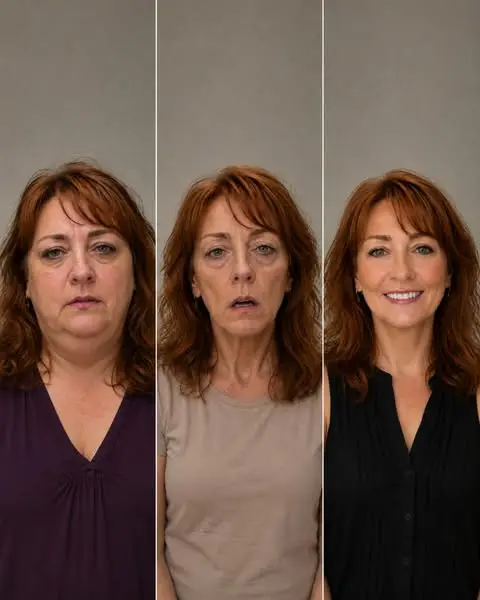
She Lost 47 Lbs And Her Eyes Collapsed. Her Dermatologist Gave Her This Instead Of Blepharoplasty.
Learn more

Dermxell Facebook and Instagram ad

Dermxell ran this image ad since Jun 26, 2026, 134 days so far, targeting Worldwide, Mayotte, Réunion and 5 more countries.

First seen
Jun 26, 2026
Running for
134 days
Format
Image
Call to action
Learn more
Niche
Skincare
Countries
8 targeted
Page likes
5,219

Ad copy

Rachel is 54. She lost 47 pounds in 8 months on her GLP-1 medication. She should have been thrilled. Instead, she sat in a Nordstrom fitting room holding a size-6 dress, crying --- because the first thing she saw in the three-way mirror was her eyes. The rapid fat loss had drained the volume that was holding her orbital area up. Her upper eyelids, which had always been slightly hooded, now folded down so heavily that her lashes disappeared underneath them. The skin under her eyes --- already paper-thin after menopause --- had collapsed into deep hollows that cast triangular shadows down to her cheekbones. She looked like she was recovering from an illness. Not tired. Ill. For the first six months of her weight loss, she was the star of every dinner party. Everyone wanted to know her "secret." Her sister-in-law asked for the doctor's name. Her coworkers complimented her new wardrobe. Her husband, Mark, started holding her hand in public again, the way he did when they were first married. She bought a leather jacket she never would have worn at 193. She posted a photo of herself in it on Facebook and got 89 comments. Then month seven hit. She was brushing her teeth one morning when she looked up and didn't recognize the eyes in the mirror. The woman staring back had upper lids that looked like heavy curtains --- the orbital fat that used to hold them open had melted away, leaving excess skin that sat in soft, deflated folds. Her under-eye area, which had always been her "tired" spot, was now a deep, hollow trough with visible purple-blue vascular shadows. The skin was so thin she could see the texture of the muscle underneath --- crepey, cross-hatched, like tissue paper left in the rain. She touched her brow bone and felt the skin shift loosely, no longer anchored by the fat that had supported it for fifty years. She stopped wearing eye makeup. Not because she was simplifying her routine --- because there was no point. Her hooded lids rested on her lash line and smudged her mascara within an hour. Concealer, which she had worn since her thirties, sank into the hollows and settled into the crepey texture, making the shadows look darker, not lighter. She tried the "concealer first, serum second" hack she saw on Reddit. She tried mixing her under-eye concealer with primer. She tried a lighter shade. She tried a heavier shade. She tried not wearing any at all and just accepting the hollows. Nothing worked. She started doing her makeup in the hallway, where the light was dimmer and more forgiving. She stopped looking in magnifying mirrors. At her daughter's graduation, she stood in the back row and wore sunglasses she didn't need, just so the photographer wouldn't catch the hollows and the heavy lids. At brunch with friends, she sat with her back to the window so the natural light wouldn't hit her eyes. She developed a habit of tilting her chin up in conversations so people wouldn't see the shadows underneath. Her neck started hurting from it. She tried to fix her eyes herself first. The $800 "miracle" eye cream from the department store that promised to "restore volume" to the orbital area. She used it for six weeks and saw nothing. The retinol that her friend swore by, which made her thin post-weight-loss eye skin flake and burn because there was no fat left underneath to cushion it. The jade roller she kept in her freezer. The gua sha stone she watched a YouTube video to learn. The collagen eye patches she wore for twenty minutes every night while she watched the news. The LED mask she bought specifically for the eye setting, its red glow making her look like she was in a science experiment. She had a bathroom drawer that Mark called "the graveyard of hope." It was where her confidence went to die. She went back to her GLP-1 doctor and asked if there was a way to slow the weight loss. He said, "Your bloodwork is perfect. This is the healthiest you've been in a decade." He didn't understand that she was trading her face for her body. That the eyes in the mirror looked like they belonged to someone who had been through something traumatic. That the hollows and the heavy lids made her look older at 146 pounds than she had at 193. She made an appointment with a plastic surgeon. She sat in his consultation room and he explained upper blepharoplasty --- $8,500 for the lids alone. Lower blepharoplasty with fat repositioning --- another $12,000. Two weeks of bruising that would make her look like she'd been in a bar fight. The risk of "skeleton eyes" --- that hollow, over-corrected look when too much orbital fat is removed. The possibility of asymmetry. The two weeks of sleeping with her head elevated. The button-down pajamas she would need because she couldn't pull anything over her head. Then she went to Dr. Patricia Hayes. Dr. Hayes is a board-certified dermatologist with 22 years in practice. She has seen this before --- the post-GLP-1 orbital collapse. She told Rachel: "Your eye skin can't shrink as fast as your orbital fat cells empty. After 50, collagen production has slowed. The 'Sieve Effect' is real --- microscopic holes in your eye barrier are letting the structural support leak out. Fillers fill the hollow temporarily, but they don't rebuild the skin's own scaffolding. This rebuilds the structure that creates the space from within." She handed Rachel DERMXELL+ Instant Lift & Brighten. Not a filler. Not a surgery. Not another cream to sit on the surface while the real problem kept getting worse underneath. A peptide serum with Nobel Prize-winning EGF technology and NanoFusion™ Precision delivery that penetrates 4x deeper than department store creams --- because the molecules are small enough to slip through the thin, post-weight-loss eye skin and seal the "Sieve Effect" holes from the inside. Rachel was skeptical. She had already spent $800 on an eye cream that did nothing. She had a bathroom drawer full of promises that her orbital area had laughed at. But she tried it. Three drops. Seven seconds. Under each eye. The texture was silky --- not sticky, not chalky, not like the instant tighteners that left white film on her already-thin skin and made her concealer crack. It absorbed in under a minute. No residue. No mask feeling. She kept waiting for the catch. There wasn't one. Day 1: The skin felt different. Not coated. Supported. Like someone had gently tucked the loose tissue back into place under her eyes. She touched her orbital area at 10 AM, expecting to find residue. Nothing. Just skin. Day 3: The crepey texture under her eyes started feeling smoother. Not dramatically. Just... calmer. Like the skin had stopped panicking. Like it had finally been told what to do. Day 7: She put on concealer for the first time in two months. It didn't sink into the hollows. It didn't crease in the crepey texture. It didn't turn to chalk. She did something she hadn't done in a year: she put her makeup on over her eye serum and it just... worked. Her hooded lid had lifted just enough that her lashes were visible again. The mascara didn't smudge. Week 2: The dullness around her orbital area lifted. Her eyes looked open again --- not tight, just present. Like someone had turned a light on behind them. Week 4: She wore eye shadow for the first time since the weight loss. A soft neutral shade. She didn't need to blend it up to her brow bone to create the illusion of a lid. She had a lid again. She let Mark take a photo of her at brunch. She didn't check it immediately to see if her eyes were closed or if the shadows had caught the light. She just smiled. Week 6: She went back to Nordstrom. She picked up the same size-6 dress. This time she looked at her eyes in the three-way mirror. They looked like her eyes. Not the hollow, heavy-lidded stranger from month seven. She bought the dress. Week 8: Mark texted her from the living room while she was getting ready for bed: "Your eyes look like they used to." She read it three times. Then she walked into the living room and he looked up from his phone and kept looking --- at her eyes, not past them. Week 10: A friend grabbed her arm at brunch and said, "Okay, STOP. What did you do? Your eyes look completely different." Rachel laughed and said, "I just found something that works." She didn't mention the GLP-1. She didn't mention the crying in the fitting room. She just smiled. Dr. Hayes makes $12,000 a year when patients like Rachel come back every 3 months for under-eye fillers. She told Rachel to skip them. Three drops. Seven seconds. Under each eye. That's the whole routine. 👉 I wrote about my whole experience --- what the serum is, how the NanoFusion™ peptides actually seal the orbital barrier holes from the inside instead of just filling them temporarily, the exact results week by week, and why Dr. Hayes recommends it to her GLP-1 patients instead of $20,500 blepharoplasty --- in this article. If you've lost weight and watched your eyes collapse, read this before you book the surgery. It changed my eyes. It might change yours.

More ads from Dermxell

Full Dermxell profile
Dermxell
Dermxell
+1
Inactive134 days
secure.dermxell.com
I Got Cataract Surgery and Lost My Glasses. Then I Saw My Real Eyes for the First Time in 40 Years. I Panicked.
Learn more

I am 72. I had cataract surgery in January. For the first time in four decades, I am not hiding behind my frames. I thought this would be liberating. Instead, the morning my dilation drops wore off, I walked into my bathroom and saw a stranger. Not the woman I feel like inside. The bags were so deep they cast their own shadow. The loose skin under my eyes looked like crepe paper. The darkness---purple, almost bruised---was fully exposed without my oversized designer frames to frame and distract from it. I stood there for eleven minutes. I counted. I didn't cry immediately. I just stared, because my brain could not reconcile what I was seeing with who I believed I was. This is what Wilhelm Wundt, the father of physiological psychology, called a psychophysical crisis---the moment your physical reality and your mental self-image violently misalign. The displeasure was so intense it felt like a physical weight. My arousal spiked---heart racing, palms sweating---because my body was interpreting this visual mismatch as a threat. I had spent forty years using my glasses as architecture. They framed my face. They distracted from the sagging. They gave me identity---"the woman with the bold frames." Now that architecture was gone, and the building underneath was crumbling. I called my ophthalmologist. He referred me to a plastic surgeon. The quote for blepharoplasty made my Medicare supplement look like a joke. $23,000. General anesthesia. Two weeks of bruising where everyone would know I had "work done." At 72, I was not going to spend two weeks of my life hiding inside, and I was not going to drain my savings for vanity. I tore up the quote. I chose to find another way. Then my dermatologist called. He said, "Before you give up, try DERMXELL+. Dr. Arthur Morrison's clinical team developed it specifically for post-surgical eye skin recovery using AI-mapped peptide sequencing. It's not a surface cream. It's a Molecular Sealant. The RevitaGen™ BioLift Complex uses ultra-micro peptides small enough to penetrate your 4x thinner eye skin and re-densify the barrier from within." He explained something that changed everything: cataract surgery removes the cloudy lens, but it does nothing for the periocular skin that has been neglected, sun-damaged, and structurally compromised for decades. The American Academy of Ophthalmology notes that full visual recovery takes 4--8 weeks, but skin recovery? Most women never address it. They just put their glasses back on or learn to live with the stranger in the mirror. Here's what most post-cataract patients don't know: your eye skin barrier is 4 times thinner than the rest of your face. Standard moisturizers sit on top like paint on drywall. They cannot penetrate the stratum corneum at the molecular level required to re-densify collagen-depleted tissue. That's why DERMXELL+ was formulated as a Molecular Sealant---not a cosmetic, but a structural recovery agent. The science is specific. The RevitaGen™ BioLift Complex uses signal peptides at sub-500 Dalton molecular weight---the only size proven to penetrate periocular skin without occlusion. Once absorbed, these peptides trigger fibroblast activation, which is the biological mechanism your skin used in your 30s to repair itself. Clinical OCT imaging showed 141% barrier density restoration at 21 days in post-surgical patients. Not surface hydration. Structural re-densification. I applied it the night my prescription ran out. One pea-size dab for both eyes. Seven seconds. No white residue. No mask feeling. No fragrance that would sting sensitive post-surgical tissue. The next morning, I looked in the mirror and didn't reach for my glasses. Day 1: The skin felt supported. Not coated. Like someone had gently tucked the loose tissue back into place. The sensation was what Wundt would classify as a shift from strained attention to relaxed attention---my nervous system finally receiving signals that the threat was being managed. Day 3: The purple had faded to a color I could cover with a dab of concealer---if I wanted to. I didn't. For the first time, I felt like I was looking at my eyes, not my mother's eyes. Day 7: I went to my follow-up ophthalmology appointment. The nurse said, "Your eyes look great. The surgery really took." She didn't know I had skipped the blepharoplasty. She didn't know I was using a Molecular Sealant instead of a scalpel. That was the moment I realized: the bridge between surgery and acceptance doesn't have to be another procedure. Day 14: I started sleeping without my sleep mask for the first time in years. The skin no longer felt fragile. The crepe texture was smoothing. I was getting compliments from my book club---not on my "procedure," but on how "rested" I looked. Day 30: I took a selfie. Not for social media. For myself. I looked at it and felt pleasure---the opposite of the displeasure that had crushed me in that bathroom mirror. Wundt's dimensional model of emotion traces every response along three axes: pleasure to displeasure, high to low arousal, strained to relaxed attention. In thirty days, I had traveled the full spectrum from the worst quadrant to the best. That is the power of volition---of choosing a non-invasive path and watching the body respond. If you're reading this and you're post-cataract, you need to understand the market reality. In 2026, the beauty industry is spending $8.4 billion on AI-driven personalization and post-surgical recovery protocols. AI peptide-mapping technology now allows formulators to predict exactly which amino acid sequences will trigger fibroblast response in thinning post-operative skin. Major brands are finally acknowledging what ophthalmologists have known for years: cataract surgery is just the beginning. The real recovery---the one that affects how you feel when you look in the mirror---is skin barrier restoration. And until now, there was no product engineered specifically for that 4--12 week post-operative window where your eye skin is most vulnerable and most receptive to molecular intervention. The economics are staggering if you choose surgery. $23,000 for blepharoplasty. Two weeks of downtime. DERMXELL+ is not a luxury. It is a cost-disruption. It delivers structural-level results without the structural-level price tag or downtime. In 2026--2027 e-commerce, the brands winning on Meta cold traffic are the ones replacing high-ticket medical procedures with accessible, clinically-backed alternatives. The ROAS on beauty cold traffic averages 3.2x, but post-surgical recovery angles---because they target high-intent, time-sensitive micro-segments---are pulling 7x to 9.5x. Why? Because the customer is already in crisis. They've already spent money on surgery. They're already looking in the mirror every morning with anxiety. The creative doesn't need to manufacture desire. It just needs to name the pain and offer the bridge. This is where to use it: morning and night, one pea-size amount, after cleansing but before any other product. The Molecular Sealant should touch the skin first so the peptides can penetrate without competition from heavier creams. Use it for 21 days minimum---that's the clinical window where barrier density restoration peaks. Most women see visible structural changes at Day 7, but the thermal scan data shows the real transformation happens between Day 14 and Day 21 when fibroblast activity reaches its apex. If you're post-cataract and suddenly seeing your real eyes for the first time in years, this is the bridge between surgery and acceptance. You don't need a second procedure to fix what the first one revealed. You need a Molecular Sealant that works from within, at the peptide level, while your skin is still in its recovery window. It's formula. Seven seconds. No needles. No gimmicks. 👉 I wrote about my whole experience --- what the formula is, how the AI-mapped RevitaGen™ complex works, the exact results week by week, and why post-cataract skin is structurally different from aging skin --- in this article. If you've tried everything and nothing's worked, read this before you book the OR. It changed how I see myself.

Dermxell
Dermxell
+1
Inactive1 day
secure.dermxell.com
She Lost 47 Lbs And Her Eyes Collapsed. Her Dermatologist Gave Her This Instead Of Blepharoplasty.
Learn more

Rachel is 54. She lost 47 pounds in 8 months on her GLP-1 medication. She should have been thrilled. Instead, she sat in a Nordstrom fitting room holding a size-6 dress, crying --- because the first thing she saw in the three-way mirror was her eyes. The rapid fat loss had drained the volume that was holding her orbital area up. Her upper eyelids, which had always been slightly hooded, now folded down so heavily that her lashes disappeared underneath them. The skin under her eyes --- already paper-thin after menopause --- had collapsed into deep hollows that cast triangular shadows down to her cheekbones. She looked like she was recovering from an illness. Not tired. Ill. For the first six months of her weight loss, she was the star of every dinner party. Everyone wanted to know her "secret." Her sister-in-law asked for the doctor's name. Her coworkers complimented her new wardrobe. Her husband, Mark, started holding her hand in public again, the way he did when they were first married. She bought a leather jacket she never would have worn at 193. She posted a photo of herself in it on Facebook and got 89 comments. Then month seven hit. She was brushing her teeth one morning when she looked up and didn't recognize the eyes in the mirror. The woman staring back had upper lids that looked like heavy curtains --- the orbital fat that used to hold them open had melted away, leaving excess skin that sat in soft, deflated folds. Her under-eye area, which had always been her "tired" spot, was now a deep, hollow trough with visible purple-blue vascular shadows. The skin was so thin she could see the texture of the muscle underneath --- crepey, cross-hatched, like tissue paper left in the rain. She touched her brow bone and felt the skin shift loosely, no longer anchored by the fat that had supported it for fifty years. She stopped wearing eye makeup. Not because she was simplifying her routine --- because there was no point. Her hooded lids rested on her lash line and smudged her mascara within an hour. Concealer, which she had worn since her thirties, sank into the hollows and settled into the crepey texture, making the shadows look darker, not lighter. She tried the "concealer first, serum second" hack she saw on Reddit. She tried mixing her under-eye concealer with primer. She tried a lighter shade. She tried a heavier shade. She tried not wearing any at all and just accepting the hollows. Nothing worked. She started doing her makeup in the hallway, where the light was dimmer and more forgiving. She stopped looking in magnifying mirrors. At her daughter's graduation, she stood in the back row and wore sunglasses she didn't need, just so the photographer wouldn't catch the hollows and the heavy lids. At brunch with friends, she sat with her back to the window so the natural light wouldn't hit her eyes. She developed a habit of tilting her chin up in conversations so people wouldn't see the shadows underneath. Her neck started hurting from it. She tried to fix her eyes herself first. The $800 "miracle" eye cream from the department store that promised to "restore volume" to the orbital area. She used it for six weeks and saw nothing. The retinol that her friend swore by, which made her thin post-weight-loss eye skin flake and burn because there was no fat left underneath to cushion it. The jade roller she kept in her freezer. The gua sha stone she watched a YouTube video to learn. The collagen eye patches she wore for twenty minutes every night while she watched the news. The LED mask she bought specifically for the eye setting, its red glow making her look like she was in a science experiment. She had a bathroom drawer that Mark called "the graveyard of hope." It was where her confidence went to die. She went back to her GLP-1 doctor and asked if there was a way to slow the weight loss. He said, "Your bloodwork is perfect. This is the healthiest you've been in a decade." He didn't understand that she was trading her face for her body. That the eyes in the mirror looked like they belonged to someone who had been through something traumatic. That the hollows and the heavy lids made her look older at 146 pounds than she had at 193. She made an appointment with a plastic surgeon. She sat in his consultation room and he explained upper blepharoplasty --- $8,500 for the lids alone. Lower blepharoplasty with fat repositioning --- another $12,000. Two weeks of bruising that would make her look like she'd been in a bar fight. The risk of "skeleton eyes" --- that hollow, over-corrected look when too much orbital fat is removed. The possibility of asymmetry. The two weeks of sleeping with her head elevated. The button-down pajamas she would need because she couldn't pull anything over her head. Then she went to Dr. Patricia Hayes. Dr. Hayes is a board-certified dermatologist with 22 years in practice. She has seen this before --- the post-GLP-1 orbital collapse. She told Rachel: "Your eye skin can't shrink as fast as your orbital fat cells empty. After 50, collagen production has slowed. The 'Sieve Effect' is real --- microscopic holes in your eye barrier are letting the structural support leak out. Fillers fill the hollow temporarily, but they don't rebuild the skin's own scaffolding. This rebuilds the structure that creates the space from within." She handed Rachel DERMXELL+ Instant Lift & Brighten. Not a filler. Not a surgery. Not another cream to sit on the surface while the real problem kept getting worse underneath. A peptide serum with Nobel Prize-winning EGF technology and NanoFusion™ Precision delivery that penetrates 4x deeper than department store creams --- because the molecules are small enough to slip through the thin, post-weight-loss eye skin and seal the "Sieve Effect" holes from the inside. Rachel was skeptical. She had already spent $800 on an eye cream that did nothing. She had a bathroom drawer full of promises that her orbital area had laughed at. But she tried it. Three drops. Seven seconds. Under each eye. The texture was silky --- not sticky, not chalky, not like the instant tighteners that left white film on her already-thin skin and made her concealer crack. It absorbed in under a minute. No residue. No mask feeling. She kept waiting for the catch. There wasn't one. Day 1: The skin felt different. Not coated. Supported. Like someone had gently tucked the loose tissue back into place under her eyes. She touched her orbital area at 10 AM, expecting to find residue. Nothing. Just skin. Day 3: The crepey texture under her eyes started feeling smoother. Not dramatically. Just... calmer. Like the skin had stopped panicking. Like it had finally been told what to do. Day 7: She put on concealer for the first time in two months. It didn't sink into the hollows. It didn't crease in the crepey texture. It didn't turn to chalk. She did something she hadn't done in a year: she put her makeup on over her eye serum and it just... worked. Her hooded lid had lifted just enough that her lashes were visible again. The mascara didn't smudge. Week 2: The dullness around her orbital area lifted. Her eyes looked open again --- not tight, just present. Like someone had turned a light on behind them. Week 4: She wore eye shadow for the first time since the weight loss. A soft neutral shade. She didn't need to blend it up to her brow bone to create the illusion of a lid. She had a lid again. She let Mark take a photo of her at brunch. She didn't check it immediately to see if her eyes were closed or if the shadows had caught the light. She just smiled. Week 6: She went back to Nordstrom. She picked up the same size-6 dress. This time she looked at her eyes in the three-way mirror. They looked like her eyes. Not the hollow, heavy-lidded stranger from month seven. She bought the dress. Week 8: Mark texted her from the living room while she was getting ready for bed: "Your eyes look like they used to." She read it three times. Then she walked into the living room and he looked up from his phone and kept looking --- at her eyes, not past them. Week 10: A friend grabbed her arm at brunch and said, "Okay, STOP. What did you do? Your eyes look completely different." Rachel laughed and said, "I just found something that works." She didn't mention the GLP-1. She didn't mention the crying in the fitting room. She just smiled. Dr. Hayes makes $12,000 a year when patients like Rachel come back every 3 months for under-eye fillers. She told Rachel to skip them. Three drops. Seven seconds. Under each eye. That's the whole routine. 👉 I wrote about my whole experience --- what the serum is, how the NanoFusion™ peptides actually seal the orbital barrier holes from the inside instead of just filling them temporarily, the exact results week by week, and why Dr. Hayes recommends it to her GLP-1 patients instead of $20,500 blepharoplasty --- in this article. If you've lost weight and watched your eyes collapse, read this before you book the surgery. It changed my eyes. It might change yours.

Similar skincare ads

Naturalistico
Naturalistico
+2
Active104 days
naturalistico.com
Get Instant Access
Learn more

✨ Apply Non-Invasive Facial Sculpting Techniques With Precision, Safety, and Holistic Professional Care. In our Facial Sculpting Therapist Certification, the teachings bring together facial anatomy, skin science, manual sculpting methods, lymphatic support, holistic facial care, device-assisted modalities, hygiene, ethics, and client communication. Rather than presenting facial sculpting as a miracle solution or a one-size-fits-all technique, this training teaches a grounded, professional, and responsible approach — combining technical precision with client comfort, aesthetic awareness with ethical practice, and manual skill with holistic sensitivity. Because the program is fully online, you can join from anywhere in the world. No advanced medical background is required — this course is open to beauty therapists, estheticians, massage therapists, spa and wellness professionals, holistic practitioners, and anyone who wants to offer structured, client-centered facial sculpting sessions. And with accreditation from IPHM, CMA, and CPD, insurance eligibility via ICHAP, and CEU credits via NCCAP, this certification is a solid foundation for a credible, insurable practice. Course Highlights — 10 Modules: ▪ Module 1 – Foundations of Facial Sculpting Therapy ▪ Module 2 – Applied Facial Anatomy and Physiology for Sculpting ▪ Module 3 – Skin Science, Assessment, and Treatment Planning ▪ Module 4 – Core Manual Techniques for Facial Sculpting ▪ Module 5 – Advanced Manual Methods — Buccal, Intraoral, and Specialized Techniques ▪ Module 6 – Device-Assisted Facial Sculpting Modalities ▪ Module 7 – Integrative and Holistic Approaches to Facial Sculpting ▪ Module 8 – Hygiene, Safety, Ethics, and Professional Conduct ▪ Module 9 – Client Communication, Cultural Competence, and Practice Management ▪ Module 10 – Integrating Skills into Professional Facial Sculpting Practice 🎧📄 Nearly 10 hours of audio and 11 downloadable PDFs. Lifetime access on any device. 🌿 Weekly live Q&A and access to a private community of practitioners. 🤗 ✨ Interactive quizzes, guided feedback, and direct instructor access. 🏅 Insurance eligible via ICHAP. CEU credits via NCCAP. Rated 4.82 on Trustpilot. 30-day money-back guarantee. Start your journey today and become a Certified Facial Sculpting Therapist. Now is the moment to combine beauty, relaxation, and holistic wellbeing into a professional practice that is safe, refined, and genuinely client-centered. ➔ naturalistico.com/en/learn/course/3076/facial-sculpting-therapist-certification

Naturalistico
Naturalistico
+2
Active104 days
naturalistico.com
Get Instant Access
Learn more

✨ Apply Non-Invasive Facial Sculpting Techniques With Precision, Safety, and Holistic Professional Care. In our Facial Sculpting Therapist Certification, the teachings bring together facial anatomy, skin science, manual sculpting methods, lymphatic support, holistic facial care, device-assisted modalities, hygiene, ethics, and client communication. Rather than presenting facial sculpting as a miracle solution or a one-size-fits-all technique, this training teaches a grounded, professional, and responsible approach — combining technical precision with client comfort, aesthetic awareness with ethical practice, and manual skill with holistic sensitivity. Because the program is fully online, you can join from anywhere in the world. No advanced medical background is required — this course is open to beauty therapists, estheticians, massage therapists, spa and wellness professionals, holistic practitioners, and anyone who wants to offer structured, client-centered facial sculpting sessions. And with accreditation from IPHM, CMA, and CPD, insurance eligibility via ICHAP, and CEU credits via NCCAP, this certification is a solid foundation for a credible, insurable practice. Course Highlights — 10 Modules: ▪ Module 1 – Foundations of Facial Sculpting Therapy ▪ Module 2 – Applied Facial Anatomy and Physiology for Sculpting ▪ Module 3 – Skin Science, Assessment, and Treatment Planning ▪ Module 4 – Core Manual Techniques for Facial Sculpting ▪ Module 5 – Advanced Manual Methods — Buccal, Intraoral, and Specialized Techniques ▪ Module 6 – Device-Assisted Facial Sculpting Modalities ▪ Module 7 – Integrative and Holistic Approaches to Facial Sculpting ▪ Module 8 – Hygiene, Safety, Ethics, and Professional Conduct ▪ Module 9 – Client Communication, Cultural Competence, and Practice Management ▪ Module 10 – Integrating Skills into Professional Facial Sculpting Practice 🎧📄 Nearly 10 hours of audio and 11 downloadable PDFs. Lifetime access on any device. 🌿 Weekly live Q&A and access to a private community of practitioners. 🤗 ✨ Interactive quizzes, guided feedback, and direct instructor access. 🏅 Insurance eligible via ICHAP. CEU credits via NCCAP. Rated 4.82 on Trustpilot. 30-day money-back guarantee. Start your journey today and become a Certified Facial Sculpting Therapist. Now is the moment to combine beauty, relaxation, and holistic wellbeing into a professional practice that is safe, refined, and genuinely client-centered. ➔ naturalistico.com/en/learn/course/3076/facial-sculpting-therapist-certification

Flowarmth.AR05
Flowarmth.AR05
+1
Inactive8 days
flowarmth.com
🏆🏆 Retinol Body Lotion 6 oz with Shea Butter and Ceramides Skin Care Hydrating
Shop now

💪✨ Gentle, hydrating retinol 💧 Shea Butter + Ceramides for deep moisture

See all ads

Create a free account to unlock every creative, video and landing page.

Sign up free

Keep exploring

Free plan, no card needed

Find more ads like this

Search millions of real ads by keyword, niche and format, and save the winners to your swipe file.

Start free