My Doctor Said Quit Ozempic or Accept the Constipation. I Did Neither, Here's What Happened.
I've been a nurse for 38 years, and GLP-1 constipation is one of the hardest side effects I see patients struggle with. The bloating that makes them feel like a balloon. The backed-up feeling when nothing's moving through. That fear of eating because everything just... stopped. I've had patients tell me they go 7, 8, 9 days without a bowel movement. Day and night, they feel stuck.
About two years ago, it happened to me. My doctor started me on Ozempic for weight management. I was thrilled. The appetite control kicked in within the first week. I started losing weight steadily. For the first time in years, I felt like I had control over my body again.
Then the constipation hit. Week three.
At first it was just feeling uncomfortably full after meals. Like the food was sitting there, refusing to move. Then came the bloating. By five o'clock every evening my stomach was so distended I was unbuttoning my scrubs during my shift because the pressure was unbearable. Then my bowel movements just stopped. I went from going every morning to maybe once a week. Sometimes longer. And when I finally went, it was painful. Incomplete. I'd sit there with my elbows on my knees, pressing on my lower abdomen, trying to will something to happen. Twenty minutes. Nothing.
The worst part was the dread. Every morning I'd wake up and the first thought in my head was about my stomach. Not whether I slept well. Not what I had to do that day. Just... is today the day something moves? That thought followed me every waking minute.
Now I was the one living with it. And let me tell you, every patient I'd ever listened to was right. It's miserable in a way nobody warns you about when they hand you that prescription.
My doctor told me to take Miralax every day. He said it the way doctors say things they've said a thousand times, like it was the most obvious thing in the world.
But I knew I wasn't going to do that long-term. I've watched too many of my patients go down the laxative road. The gut dependence where your body forgets how to do the work on its own. The cramping that gets worse over time, not better. The day you realize you can't go at all without it. And for what? Most of them tell me it stops working after a few months and they need something stronger. Then something stronger than that.
I wasn't about to trade one problem for another.
So I just dealt with it. More fruits and vegetables with every meal. Psyllium husk in my smoothie every morning. Magnesium citrate at night. Probiotics. Chia seeds soaked in water. Stool softeners when things got really bad. Over a hundred ounces of water a day and a long walk every evening. Nothing really worked, but what else was I supposed to do?
Then about four months ago, one of my regular patients came in for her follow-up. She'd been on Mounjaro for almost a year and the constipation had been her biggest complaint every single visit. She'd been miserable. I always felt terrible for her because she'd lost over thirty pounds but was in my office nearly in tears every month about what the medication was doing to her gut.
But this time she seemed different. Comfortable somehow.
I asked her how she was managing, and she said something I didn't expect. She told me her gut had actually started working again. She'd found astaxanthin, a natural antioxidant. Been taking it every morning for about six weeks. And for the first time since starting her medication, she was going regularly without pain, without cramping, without laxatives.
I'll be honest, I was very skeptical. I've heard every gut health miracle story you can imagine. But she seemed so genuinely relieved. Like she'd finally gotten her body back.
That same night, I was lying in bed with the bloating pressing against my ribs, unable to get comfortable on any side. And I kept thinking about what she'd said. So I looked it up.
Turns out, astaxanthin is one of the most powerful natural antioxidants ever measured. And it does something fiber and laxatives can't. GLP-1 medications slow your entire digestive system on purpose. That's how they control appetite. But when everything slows that much, waste sits too long, free radicals build up in your gut lining, and the inflammation that follows makes the muscles even weaker. It's a vicious cycle. Fiber doesn't fix any of that. Fiber adds bulk to a system that's already stalled. It's like adding more cars to a traffic jam. Astaxanthin gets inside the gut lining cells where the damage is happening and calms the inflammation that's making everything seize up. It doesn't force a bowel movement the way a laxative does. It fixes the reason your gut stopped moving in the first place. The science actually made sense.
I ordered some. A generic brand from the drugstore. Figured I had nothing to lose. Worst case, it wouldn't work and I'd be out a few dollars.
When it arrived, I took the recommended dose. I didn't expect much. Just another thing to try.
After about two weeks, the bloating was maybe slightly better by evening. I went from going once a week to maybe twice. Better. But not the kind of change that makes you believe.
So I ordered a different brand. This one was marketed for gut health. Lower dose, cheaper. After three weeks, I could barely tell a difference. Still going about twice a week. Still uncomfortable.
I was getting frustrated. My patient had raved about it. But it wasn't working for me.
So I went back and started reading more carefully. That's when I noticed something. People weren't just saying "take astaxanthin." They were getting specific about which astaxanthin.
One woman said she tried four different brands before finding one that actually worked. Another mentioned that most astaxanthin on the shelf is synthetic, made in a lab from chemicals, and doesn't have the strength to reach the gut lining where it needs to work.
I started researching. Turns out, most astaxanthin supplements are:
- Synthetic (made in a lab, not from nature)
- Low dose (4mg, a fraction of what the studies used)
- No oil carrier (so your body can't absorb it where it needs to go)
- Made from yeast, not microalgae (weaker compounds, lower potency)
- Bulked with fillers
The astaxanthin that actually worked had to be:
- Natural from microalgae (the actual source, not lab-made)
- Therapeutic dose (12mg per softgel, two a day for 24mg total)
- Suspended in MCT oil (carries it into the gut lining cells where the damage is)
- Single-origin Hawaiian microalgae (not blended from cheap sources)
- Third-party tested for purity and potency
I kept seeing the same brand mentioned over and over in the GLP-1 communities and patient forums. NutraWell.
I ordered it. It was more expensive than the others I'd tried, but at that point I didn't care.
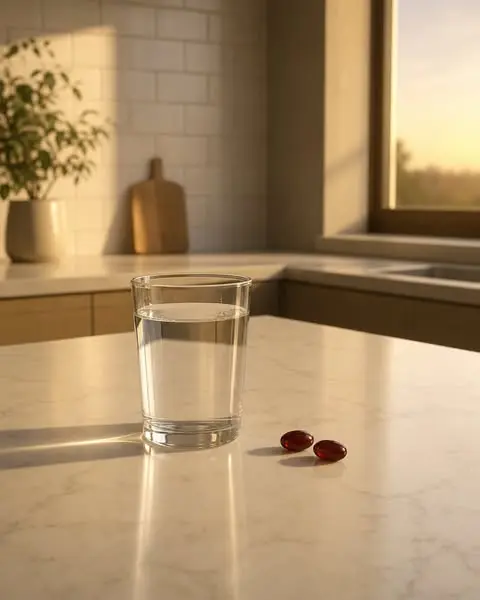
When it arrived, I could tell the difference immediately. The softgels were deep ruby red. Not pale pink like the synthetic ones. Not orange like the yeast-derived brand. Ruby red. That's the actual pigment at full strength.
I took two that first morning with my coffee. I didn't expect much. I'd already tried two other brands.
But around day four, something shifted. I woke up and the first thought in my head wasn't about my stomach. That hadn't happened in months. The constant fullness under my ribs had eased. And then I went to the bathroom and had a complete, normal bowel movement. No cramping. No straining. No sitting there for twenty minutes hoping. Just normal. The way it used to work before I ever started Ozempic.
I put my hand over my mouth. Not because anything was wrong. Because I'd forgotten what normal felt like.
By the end of week three, I was going every morning. Every morning. The bloating that made me feel like a balloon by evening? Gone. I could eat a meal without the dread of knowing it was just going to sit in me for a week. The cramping that would hit mid-shift? Cleared up almost completely. And my weight loss, which had completely stalled for almost two months, started moving again. Because my body was actually processing and eliminating properly instead of letting everything sit and ferment.
It's been sixty days now. I go every morning. Like clockwork. The way it was before Ozempic. The bloating is gone. The cramping is gone. I wake up and my first thought is about my day, not about my stomach. And I'm still on my full dose, still losing weight, still getting every benefit of the medication without the side effect that nearly made me quit.
I saw my patient last week and thanked her. She just smiled and said she was glad it helped someone else.
Look, for almost two years I thought I had to choose. The weight loss, or a functioning gut. Stay on the medication and suffer, or quit and gain the weight back. I was wrong.
And here's the thing. Not all astaxanthin is created equal. I wasted weeks on synthetic, low-dose brands that barely touched my symptoms. NutraWell's natural microalgae astaxanthin at 24mg a day was the only one that actually resolved it.
If my patient hadn't mentioned astaxanthin that day, I'd still be bloated, uncomfortable, and seriously thinking about quitting the medication that was changing my health.
I've told six of my patients with GLP-1 constipation about NutraWell specifically. Every one of them has come back saying they're going regularly again. One woman who'd been on Mounjaro for eight months and hadn't had a normal bowel movement the entire time called me in tears. She said it was the first time in eight months she went to the bathroom and it just worked. Her exact words: "I forgot what normal felt like."
I'm sharing this because I hope it can help someone else the way it helped me. After 38 years as a nurse, I thought I knew every option out there. Turns out, my patient knew something I didn't.
Here's where I got mine: https://shop.trynutrawell.com/as/sp
(They're running a sale right now, significant savings. I just ordered 3 more bottles)
~ Janet M.
P.S. - A few things I wish I'd known before ordering:
When I first ordered NutraWell, I didn't know they had a 90-day money-back guarantee. If it doesn't work for you, you get your money back. No questions asked. I wish I'd known that earlier. Would've saved me from wasting time on those cheaper brands that didn't do anything.
Most people buy it at regular price, but right now they're running a promotion where you can get it at a significant discount. That's actually how I was able to stock up on three bottles. The savings made it possible.
The only problem is that NutraWell is a small company. They make this in small single-origin batches and they can't always keep up with demand. Especially now that GLP-1 prescriptions have exploded and more people are finding out about this.
I want to apologize in advance because when you click the link below, you might see that they're sold out. I've had patients wait weeks before NutraWell was back in stock. But I'd still suggest clicking to see if they have any left.
If you're on Ozempic, Wegovy, Mounjaro, or any GLP-1 and the constipation has you miserable, if the bloating has you unbuttoning your pants by noon, if you're going days without a movement and the fiber and Miralax aren't doing anything, if you're afraid to eat because everything just sits there, I'd grab some before they're gone again.
I went from once a week to every single morning in sixty days. If there's even a chance this could work for you, it's worth trying.
👉 Check if NutraWell is in stock https://shop.trynutrawell.com/as/sp
Right now you have two choices.
You can close this page and keep doing what you've been doing. The fiber that makes the bloating worse. The Miralax that stops working after a few months. The hoping it gets better on its own while you wake up every morning thinking about your stomach instead of your life.
Or you can try what worked for me and six of my patients. Two softgels a day. 24mg of natural astaxanthin. The same thing that took me from once a week to every single morning.
NutraWell has a 90-day money-back guarantee. If it doesn't work, every penny back. No questions asked. You have nothing to lose except the bloating.
I know which one I'd choose. I already did.
👉 Check if NutraWell is in stock https://shop.trynutrawell.com/as/sp