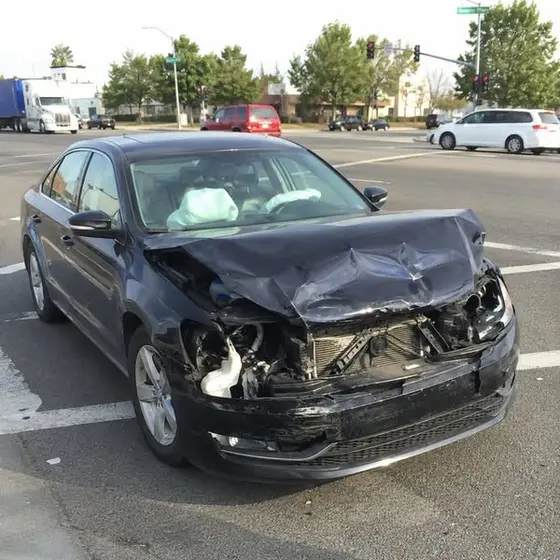
A woman I know ran a red light last month and T-boned a minivan. She wasn't on her phone. She wasn't changing the radio. She wasn't tired or distracted or reaching for her coffee. She was looking directly at the road. Both hands on the wheel. Eyes open. Focused. And she drove straight through a red light at 35 miles an hour like it wasn't there.
The light was red. She saw the light. Her brain just... didn't register that red means stop. Not for two seconds. Not for one second. She looked at a red light the way you'd look at a smudge on the windshield — something in her field of vision that her brain processed as background noise. Then the crunch of metal and she was sitting in the intersection wondering what happened.
Everyone was okay. Barely. The woman in the minivan had two kids in the back seat. But that's not the part that keeps me up at night. The part that keeps me up at night is that my husband had three of those moments this week. Not at intersections. Not at 35 miles an hour. But the same blank. The same gap. The same look in his eyes where something that should register just... doesn't. And nobody is calling it what it is.
I met Linda through my neighbor Carol. Or I should say I heard about Linda through Carol — I didn't actually meet her until three weeks later, and by then I'd already ripped apart everything I thought I knew about what was happening to my husband.
Carol and I walk together on Tuesday and Thursday mornings. Have for six years. The kind of walks where you cover two miles and solve zero problems but feel better anyway. We were on our second lap around the park when she brought it up.
"Did you hear about Linda Novak?"
I hadn't.
"She ran a red light on Route 9 last week. T-boned a minivan. Two kids in the back seat."
I stopped walking. "Is everyone okay?"
"Everyone's fine. Few bruises. Linda's car is totaled. But here's the thing —" Carol looked at me with this expression I couldn't read. "She wasn't on her phone. She wasn't distracted. She told the officer she was looking directly at the road. Both hands on the wheel. She saw the light. Her brain just didn't register that it was red."
I stood on the walking path with my coffee cooling in my hand and my stomach dropped into my knees. Not because of Linda — I barely knew her. Because of David. Because I'd watched my husband do some version of that exact thing three times in the past week and I'd been calling it "a senior moment" because the alternative made me want to throw up.
Carol kept talking. About the intersection. About the minivan. About how Linda's daughter was trying to get her to stop driving. I heard all of it and none of it because my brain was doing what it does now — cataloging. Comparing. Running David's last six months against what Carol just described and watching the pattern line up like a zipper closing.
David's 64. We've been married 38 years. He was an electrical engineer for a defense contractor until he took early retirement at 61 — his choice, he said. Good pension. Good timing. I believed him then. I'm not sure I believe him now.
Three years ago I started noticing things. Small things. The kind of things you shrug off because admitting they scare you is worse than pretending they don't.
He'd leave the garage door open overnight. Not once — regularly. He'd start making coffee and walk away before the water finished. He'd be telling me something and stop mid-sentence. Not a dramatic pause. A gap. Like someone hit a skip button on a record and he had to find the groove again.
I told myself it was retirement. Told myself his brain wasn't getting the same stimulation it got at work. Told myself that a man who spent 35 years solving complex wiring problems was bound to be a little foggy when the biggest decision in his day was whether to mow the lawn before or after lunch.
But it got worse. Not in a straight line — in bursts. Weeks where he seemed fine, then a cluster of things that made my stomach tighten.
The stove. He left a pot of water boiling and walked to the living room. I found it 40 minutes later — water gone, pot black, smoke alarm screaming six feet from where he was sitting in his chair. He said he didn't hear it. A smoke alarm. In the same room. While he was awake.
The stop sign. I was behind him in my car one afternoon — we'd taken separate vehicles to our daughter's house. He sat at a stop sign for 11 seconds at a dead intersection. No cross traffic. No pedestrians. Just sat there staring at the sign like it was written in a language he'd forgotten. Then he drove through it and turned left like nothing happened. When I asked him about it later he said "What stop sign?"
The grandson. Our 7-year-old grandson was talking to David at Thanksgiving dinner. Asking him about something — airplanes, I think, one of those why-why-why conversations kids do. And David's face went blank. Not for a second. For maybe four seconds. His eyes were open. He was looking at our grandson. But he wasn't there. Then he blinked and said "What was the question, buddy?" and our grandson looked at me with this expression on his face that I carry around like a stone in my pocket.
That look. A 7-year-old looking at his grandfather and seeing something he couldn't name but knew wasn't right.
I took David to the specialist over a year ago. Not our regular guy — a specialist Carol recommended. I sat in the waiting room flipping through a magazine I wasn't reading while David sat in a little room doing memory tests and attention exercises and whatever else they do when a wife drags her husband in and says "something is wrong."
The specialist came out after 45 minutes. Sat us both down.
"A little slowing down is normal at your age, David. Your test results are in the range we'd expect for a man in his mid-sixties. I'd say stay active, do some puzzles, maybe try a fish oil supplement."
He delivered it the way someone delivers a line they've rehearsed a thousand times. Smooth. Automatic. The kind of sentence that closes a conversation without opening it.
David looked at me in the parking lot with the expression of a man who's been proven right. "See? Normal. I told you I was fine."
He said "I'm fine" the way he always does. Not like a man who's convinced. Like a man who's holding the words in front of himself like a shield.
I let it go. You can't fight a man whose specialist just told him everything is normal. Even when you watched that man sit at a stop sign for 11 seconds like his brain forgot what stop signs are for.
But I didn't let it go either. The specialist said normal. My eyes said otherwise. So I went home and started fixing it myself — the way you fix things when the system shrugs and tells you there's nothing to fix.
I bought ginkgo biloba first. The brain health one from the pharmacy — the bottle with the leaf on it and the word "clarity" in a font designed to look scientific. Two capsules a day. I gave it three months. Three months of watching David take the capsules with his morning vitamins and three months of watching the exact same blanks, the same gaps, the same pot on the stove. Nothing changed. Not one thing.
Then I tried a "brain health" supplement from one of those companies that advertises during the news. 20 different ingredients. Secret blend. $60 a bottle. David took it for two months. The only difference I noticed was that the bottle sat on the counter getting emptier while my husband sat in his chair getting foggier.
I tried caffeine next — not the supplement kind, just more coffee. I'd read somewhere that caffeine could help with focus. So I started making David a second cup in the afternoon when I noticed him fading. It helped his alertness. For about 45 minutes. Then the anxiety kicked in. David's been a mild worrier his whole life — the kind of man who checks the doors twice and keeps a flashlight in every room. The extra caffeine turned mild worry into a vibrating tension that sat in his chest. His hands shook at dinner. He couldn't fall asleep until midnight. And the processing lapses didn't change at all. His brain was more awake and still couldn't convert a boiling pot into "turn off the stove."
Three solutions. Three failures. And each one taught me the same lesson — you can't fix a production problem by throwing random ingredients at it any more than you can fix a car engine by pouring different fluids in the tank and hoping one of them is oil.
That was eight months ago. It got worse. Not dramatically — insidiously. Like a faucet dripping. One drip doesn't seem like much. A hundred drips doesn't seem like much. But one morning you wake up and there's water on the floor and you realize it's been dripping the whole time and you just kept putting a towel down instead of fixing the pipe.
Then Carol told me about Linda. And the towel wasn't enough anymore.
The night after Carol told me about Linda, I couldn't sleep.
I lay in bed next to David — listening to him breathe, which is something I've started doing at night the way you check a child's breathing without meaning to, that involuntary pulse of "are you still okay" that runs underneath everything now — and I replayed the last three years.
Not the big incidents. The small ones. The ones I'd filed away under "just David being David" because that hurt less than looking at them head-on.
The time he drove to the hardware store and came back with nothing because he forgot why he went. The time he put the milk in the cupboard and the cereal in the fridge and didn't notice until I pointed it out the next morning. The time he called our daughter by her sister's name — not a slip, he genuinely looked confused when she corrected him. The time I found his car keys in the bathroom cabinet. The time he asked me what day it was three times in one afternoon.
None of these were catastrophic. None of them were dangerous. But they were all the same thing — his brain receiving information and failing to process it correctly. Seeing the milk and not registering "this goes in the fridge." Hearing our daughter's name and not connecting it to the right face. Looking at a stop sign and not converting "stop" into "press the brake."
The same thing Linda's brain did at that intersection. The same blank. The same gap. Just quieter.
I lay there thinking about velocity. Not literally — more like a sick equation my brain wouldn't let go of. David's lapses were happening at zero miles an hour. The stove. The stop sign where he was already stopped. The conversation blanks. But Linda's lapse happened at 35 miles an hour. Same brain failure. Different speed.
What happens when David's version happens at 35 miles an hour?
What happens when he's driving to the pharmacy and his brain doesn't register the school zone sign? What happens when he's backing out of the driveway and our grandson is behind the car and his brain has one of those four-second blanks?
I got out of bed at 1:30 AM. Went downstairs. Made tea. Sat at the kitchen table gripping the mug and forced myself to face what'd been scaring me in a way I hadn't let myself feel.
Because here's the truth I'd been hiding from myself. The specialist said David was normal. And maybe he was — by whatever metric they used to measure normal in a 45-minute office visit. But I've been with this man for 38 years. I know every version of David there's been. I know the man who could rewire an entire building's electrical system from memory. Who could hold six-digit part numbers in his head for hours. Who used to do the crossword in pen because pencils were for people who weren't sure.
That man is NOT this man. This man puts the milk in the cupboard. This man stares at stop signs. This man's 7-year-old grandson gives him a look that says "something is wrong with Grandpa" and David doesn't even notice because his brain is doing the exact thing the look was about.
And the specialist said "NORMAL for his age."
NORMAL. That word. I sat at the kitchen table at 2 AM and I hated that word more than I've hated anything in a long time. Normal for his age means "yes, we see what you see, but we've decided it's acceptable." Normal for his age means "this is what happens and there's nothing to do about it." Normal for his age means I should go home and stop worrying and let the towel catch the drips until the floor gives way.
I thought about Carol's mother. 82. Sharp as a tack. Does her crosswords and volunteers at the library three days a week and remembers every birthday in the family without writing them down. David's 64 and he went blank on a 7-year-old asking him about airplanes.
64 is not the age you lose the ability to process what's in front of you. Not if something else isn't happening.
I picked up my phone. I'd been avoiding this for months — the way you avoid Googling a symptom because you know the results will either terrify you or give you twelve contradictory answers that leave you more confused than before.
But I was past that. Linda drove through a red light with her eyes open and my husband sat at a stop sign for 11 seconds because his brain couldn't figure out what to do with the information. The not-knowing was worse than anything Google could say.
I typed: "Why would someone look directly at something and their brain not register it."
The first thing I found was a list of symptoms for early-onset dementia.
My whole body went cold. I read it sitting at the kitchen table at 2 AM with my tea going cold and my heart hammering and I checked every symptom against David like I was filling out a medical form. Forgetting recent events. Check. Difficulty concentrating. Check. Confusion with time or place. Partial check. Losing things. Check.
I sat there for ten minutes believing my husband had dementia. Ten minutes of the worst silence I've ever experienced. The house was dark except for the kitchen light and the blue glow of my phone screen and I was already planning. Already running the mental math on care facilities and power of attorney and whether our daughter would help and how many good years we had left.
Then I kept scrolling. And I hit a line that made my hands go still.
"Many of these symptoms overlap significantly with adult ADHD, which is frequently underdiagnosed in adults over 50 and routinely misattributed to normal aging."
ADHD. In a 64-year-old man.
That sounded wrong. ADHD was a kid thing. Hyper boys who couldn't sit still in class. Not my husband — a quiet, methodical man who worked as an engineer for 35 years. David wasn't hyper. David was the opposite of hyper. David was slow. Getting slower.
But I kept reading because it was 2:30 AM and sleep wasn't happening and the alternative was lying in bed staring at the ceiling wondering if my husband had dementia.
And the more I read, the more the temperature in the room changed.
Because the symptoms of ADHD in older adults — the real symptoms, not the stereotype — weren't about hyperactivity. They were about processing. The brain receiving information and failing to convert it into action. Seeing something and not registering it. Hearing something and not retaining it. Knowing what needs to happen and being completely unable to make it happen.
Object permanence. That's what one article called it. The ability to keep something in your mental awareness when you're not directly looking at it. You put the milk on the counter. You walk away. A brain with normal processing keeps the milk in its awareness — "I need to put that away." David's brain lets it go the instant he looks at something else. Like trying to hold water in a colander.
Time blindness. The inability to accurately perceive how much time is passing. David sitting at a stop sign for 11 seconds and experiencing it as — what? Two seconds? Half a second? His brain not registering the gap between "I stopped" and "I should go."
Task completion failure. Starting something — making coffee, telling a story, driving to the hardware store — and the brain dropping the thread partway through. Not distraction. Not choosing to do something else. The signal just... stops. Like a text message that shows "delivered" but was never read.
I read for three hours. I read about adults diagnosed in their 50s and 60s. Men who'd been engineers and accountants and electricians — high-functioning their entire careers because the structure of work held them together. Deadlines. Routines. Meetings. External systems that compensated for what their brains couldn't do on their own. Then they retired. And the structure vanished. And everything fell apart.
David retired at 61. He said it was his choice.
Three years later his brain can't process a stop sign.
I thought about the specialist. "Normal for his age." Normal. The standard screening doesn't test for ADHD. Doesn't look for it. Doesn't account for it. It checks one box — dementia — and if that comes back empty, you get sent home. If the test only looks for one thing, it only finds one thing — or nothing.
I went to bed at 5 AM. David's alarm went off at 6:30. I heard him sit on the edge of the bed. Heard him open and close his hands — that thing he does now, flexing his fingers like he's warming up for something, getting his brain and his body to agree that it's time to move. He sat there for four minutes. I timed it. Four minutes sitting on the edge of the bed before he stood up and shuffled to the bathroom.
I lay there pretending to be asleep and my jaw clenched so hard my teeth hurt. Not fear anymore. Fury. Not at David. At the system that looked at a man whose brain can't handle stop signs and red lights and boiling water and his own grandson's voice and said "normal for your age."
Because the next question — the one I couldn't stop asking — was the one that had been under everything since the moment Carol told me about Linda: Why? Why was David's brain doing this? If it wasn't aging and it wasn't dementia, what was actually failing? What is the difference between a brain that sees a red light and stops, and a brain that sees a red light and drives through it?
I went back to my phone the next night. Same kitchen table. Same 1 AM silence. But this time I wasn't looking for a label. I was looking for the broken part.
I typed: "What causes the brain to fail to process visual information it's receiving."
And what came back flipped everything on its head.
Your brain doesn't just "see" things. Seeing is a two-step process. Step one: the eyes capture the image. Step two: the brain processes the image into meaning. A red light hits your retina. Your retina sends the signal. Your brain receives the signal and converts it into "red means stop, press the brake." That conversion — the step between receiving and acting — runs on brain chemicals. Dopamine, mainly. That word kept showing up in everything I read.
I read that paragraph three times.
Dopamine doesn't just make you feel good. That's the version everyone knows — the happy chemical, the reward chemical. But that's less than half the story. Dopamine is the signal processor. It's the chemical your brain uses to decide what's important and what's background noise. Every piece of information that enters your brain — every sound, every sight, every word someone says to you — dopamine is what flags it as "this matters, pay attention" or "this doesn't matter, ignore it."
When dopamine levels are normal, the system works. Red light comes in. Dopamine flags it: important. Brain processes: stop. Foot moves to the brake.
When dopamine levels are low, the system breaks. Red light comes in. Not enough dopamine to flag it. Brain processes it as background noise. Foot stays on the gas.
I sat there staring at my phone. Then I looked across the kitchen at the stove where David left the pot boiling last week. Same thing. Pot boiling. Visual information entering his brain. Not enough dopamine to flag it as "this is important, this is dangerous." Brain files it as background. David walks away.
The stop sign. Same thing. Information enters. Not enough dopamine to process it as "this requires action." Brain files it as scenery. David sits there for 11 seconds.
Our grandson asking him about airplanes. Same thing. Words going in. Not enough dopamine to make sense of them fast enough. Brain stalls out. Four-second blank. Then he snaps back.
I kept calling it aging. Or David just not trying hard enough — God, the number of times I'd thought that. But it was a brain running on empty. Like a factory where every machine works but the shelves are bare — the line is ready, the workers show up, but nothing comes off the belt because there's nothing to build with. And I still didn't know why.
But that raised the question that kept me reading until 3 AM. If dopamine is the problem — why? Why would David's brain be running low on the chemical it needs to process reality?
Because the brain doesn't just have dopamine. It builds dopamine. Every day. From raw materials. Your brain constructs dopamine and norepinephrine from amino acids, vitamins, and minerals — the same way your body builds bone from calcium or blood cells from iron. If the raw materials are there, production runs. If the raw materials are missing, production drops.
And here's the part that made me want to pick up the phone at 2 AM and ask that specialist why he didn't know this.
Most people over 50 — and that probably includes you — are running short on the exact materials the brain needs to build dopamine. Not because they're eating poorly. Because absorption slows down with age. Because stress burns through brain chemicals faster than they can be rebuilt. Because the brain's production naturally slows — not by a lot, but by enough. Enough that a man who was sharp at 55 starts blanking at stop signs at 64. Enough that a woman who drove safely for 40 years looks at a red light and her brain processes it as nothing.
The processing lapses aren't random. They're not mysterious. They're a brain running out of raw materials the same way a factory runs out of parts. The production line slows. The output drops. And the signals that used to get processed instantly — stop sign, stove is on, your grandson is asking you a question — start falling through the gaps.
I found a word that night that I'd never heard before. Not from a supplement website. Not from some wellness blog. From a research paper published in a medical journal about adults over 50 with ADHD symptoms who had never been diagnosed.
The word was "subclinical." It means below the threshold of clinical detection. David's specialist ran standard tests. David scored "within normal range." But "normal range" is a wide river. You can be drowning in the shallows and still technically be in the river.
David wasn't scoring as broken because his brain was faking it. 35 years of engineering habits. Routines he'd built. Systems he'd made. A lifetime of working around the gaps without knowing they were gaps. The specialist's test measured what David could do when he was trying — in a quiet room, with full attention, for 45 minutes. It didn't measure what David does at 4 PM on a Tuesday when his brain chemicals are burned up from a full day of normal life and a pot of water is boiling on the stove six feet away.
The test measured capacity. It didn't measure supply. And the supply is what's running out.
That night I found the studies. Not one — a bunch of them. Real research showing that certain natural ingredients can help the brain make more dopamine and norepinephrine on its own. Not by forcing more out — not like stimulant meds that crank everything to the max and burn through what's left. By giving the brain the raw materials it needs to build its own supply. Like restocking the factory shelves instead of running the machines harder.
One extract kept appearing across multiple trials.
A natural ingredient that'd been tested directly against stimulant pills in real studies. The bottom line: it worked just as well. But how it worked was totally different.
Stimulant meds force your brain to squeeze every last drop of dopamine it's got — burning through the supply faster, making you crash, killing your appetite, flattening you out, leaving you worse off when it wears off. This stuff didn't force anything. It fed the brain what it needed to make its own supply. Gave it the raw materials. Let the brain do what it already knows how to do — just with enough fuel to actually do it.
And one finding specifically stopped me cold. In people taking this extract, the time it took to fall asleep was cut roughly in half.
Stimulant pills made sleep worse. This made sleep better. Because it wasn't overstimulating the brain — it was feeding it. A fed brain can wind down. A stimulated brain can't.
I sat in the kitchen at 3 AM and I thought about David. His sleep has been terrible for years. He lies in bed with his eyes closed and his brain running. I can hear it — not literally, but the restlessness, the shifting, the tension in his body. He's not sleeping. He's lying there while his brain tries to process the day with chemicals it doesn't have.
The extract was saffron. Not the kind you cook with — a concentrated form of the same plant. The way one article put it, it helps your brain hold onto the dopamine it already makes instead of burning through it too fast. Like the difference between a battery that drains in an hour and one that holds its charge all day. Same power. Just not wasted.
And it doesn't work alone.
The research I found used saffron as the lead, but the brain's production system needs more than one input. Magnesium — most people with focus issues are running low on it. L-theanine — promotes calm focus without the jittery edge. Ashwagandha — lowers the stress hormone that burns through brain chemicals faster than they can be rebuilt. Vitamin C — helps convert dopamine into norepinephrine. Rhodiola — fights the mental fatigue that piles on top of everything else.
Each one supports a different part of the production chain. Like a factory that doesn't just need steel — it needs steel and rivets and welding wire and electricity and coolant. Missing any one of them slows the whole line. And if you've only been supplementing one thing — say, just fish oil, or just a multivitamin — you're restocking one shelf in a warehouse that's empty across the board.
I thought about the ginkgo biloba. The brain supplement from the pharmacy. The $60 bottle with 20 ingredients. None of them went after the actual problem. They were throwing darts in the dark. Random ingredients at random amounts hoping something would stick. No wonder nothing changed. It was like David trying to fix a broken circuit by swapping every wire in the building — you might hit the right one eventually, but you'll burn through time and money and hope before you get there. And hope doesn't grow back. Not at 62. Not when you're watching your husband disappear.
That specialist David saw a year ago. He tested David's output — how his brain performed in a controlled setting. He NEVER looked at the inputs. Never asked what David's brain was running on. Never checked whether the production line had what it needed. He measured the speed of the car and never opened the hood.
If anybody had told David three years ago that his brain was running low on the materials it needs to process information — that the gaps and blanks and boiling-pot moments weren't aging, they were a supply problem with a supply solution — he could have been restocking the factory since he was 61. Instead he spent three years losing processing speed while a specialist watched the standard tests and said "normal for your age."
I spent two more nights reading. Checking claims against studies. Looking for the catch. The skeptic in me kept waiting for the "but" — the fine print, the caveat, the part where it turns out to be too good or too simple.
What I found instead was that the research was small. Every study. 50 people here. 80 there. Maybe 150 at the largest. Promising results, no massive follow-ups. And I spent an hour trying to understand why before I figured it out.
You can't patent a plant. And if there's no patent, nobody's spending millions to run the kind of big trial that lands in your specialist's office. The whole system that decides what they know — what goes on the posters in the waiting room, what the reps come in and pitch, what ends up in the guidelines — that system runs on money. And there's no money in proving something natural works when a pill already "handles" it.
Stimulant meds are a multi-billion-dollar market. Every refill. Every monthly appointment required just to maintain access. Every prior authorization. Every dosage adjustment. Every person who tolerates the side effects because the alternative is going back to the way things were. The system doesn't need saffron to work. It needs saffron to stay unknown.
David's specialist didn't know about this. The research never made it into his office — nobody paid to put it there.
I stumbled on it the fourth night.
I wasn't looking for a supplement. I was looking for a way to get the specific ingredients I'd been reading about into David's system — saffron extract at the amount used in the research, plus the supporting pieces that the production chain needs. I'd been ready to buy everything separately and figure out amounts myself. I'm stubborn enough.
I kept scrolling one night and landed on a company called Savaly that had already put it together. Saffron Plus. The saffron at the studied amount. Magnesium. L-theanine. Ashwagandha. Rhodiola. Vitamin C. Turmeric for brain inflammation. Nine ingredients, each one going after a different part of the brain's assembly line.
Two capsules before bed. It works while you sleep — restocks what the brain burns through during the day so it's there when you wake up. It builds up over time. Weeks, not days. Which made it more believable, not less. Anything that promises results by morning is lying. The brain doesn't rebuild its supply chain in one night.
90-day money-back guarantee. Every penny back if it doesn't work. No questions.
I placed the order that night. The box showed up Thursday.
I didn't tell David what they were. I set the bottle on the kitchen counter next to his vitamins. He takes a handful of things every morning — a multivitamin, fish oil, the usual. Two more capsules wasn't going to raise questions.
"What are these?" he asked, holding up the bottle.
"Something new. Just take them with your other stuff."
"What's it for?"
"David. Please. Just take them. Do it for me."
He looked at me the way he looks at me when he knows arguing is pointless and the fastest path to his morning coffee is compliance. He took two capsules. Set the bottle down. Picked up his iPad again.
I wrote down the date. I write down everything now.
Nothing happened for five days. Not nothing — same. The same mornings. The same slow start. The same 4-minute sit on the edge of the bed. I watched like I always watch and I saw what I always saw and the small part of me that had hoped for a visible shift by day three tried not to feel stupid.
Day six. A Saturday. David woke up at 6:15. Normal. But he sat on the edge of the bed for maybe a minute instead of four. Stood up. Walked to the bathroom. Didn't flex his hands first. I lay there with my eyes mostly closed and my heart doing something I didn't trust yet because hope is the cruelest thing when you've been watching someone decline.
It could have been nothing. A good night's sleep. A coincidence. I wrote it down and told myself not to read into it.
But the next morning was the same. And the one after that.
By the end of the first week, his sleep was different. I know because I've been lying awake cataloging his sleep patterns for three years like some kind of deranged human sleep tracker. The restlessness was less. The shifting. The tension. He was falling asleep faster — not by hours, but noticeably. And he was staying asleep. Twice that week I woke up at 3 AM out of habit and realized he hadn't moved. Just lying there. Breathing slow and even. Like his brain had finally stopped trying to process the day with chemicals it didn't have and just... let go.
Week two. The mornings got different in a way that's hard to explain if you haven't been watching someone start their day like they're negotiating a ceasefire with their own body. David was up faster. Not bouncing out of bed — just not sitting there in that foggy limbo where his brain and his body argued about whether it was time to move. He was getting up and going. Making coffee. Feeding the dog. Starting his day like a person who wakes up with enough fuel in the tank to function.
I noticed something else. He remembered things. Small things. I told him on Tuesday that the cable guy was coming Thursday between 1 and 3. On Thursday at 12:45 he said "The cable guy's coming soon, right?" I almost dropped the plate I was holding. That hasn't happened in — I don't even know how long. Two years? Three? The David I'd gotten used to would have looked at me blankly when the doorbell rang.
Week three. I came downstairs on a Saturday morning and David was standing at the stove. Making eggs. Actually standing at the stove and watching the eggs cook. Not walking away. Not blanking. Standing there with a spatula, flipping eggs, the way a person cooks breakfast when their brain is connected to what they're doing.
I stood in the doorway and stared at him for probably too long.
"What?" he said.
"Nothing. Your eggs are burning."
They weren't burning. I just needed to say something because the alternative was crying in the kitchen doorway at 7 AM and that seemed like an overreaction for a man making eggs. Except it wasn't an overreaction. It was the first time in a year he'd cooked something and stayed in the room while it cooked.
Week four. David drove to the hardware store. By himself. I didn't follow him.
Let me explain why that matters. Six months ago — before Linda, before the research, before any of this — I started doing something I'm not proud of. When David left the house to drive somewhere, I would wait five minutes and then get in my car and follow him. Not close. A few cars back. Just far enough to see his car. I'd follow him to the store, watch him pull into the parking lot, and then drive home.
I did this for four months. Four months of secretly tailing my own husband like a private investigator because I was terrified he'd have one of his blanks at the wrong moment. I'd sit in the grocery store parking lot watching his car and hating myself for doing it and knowing I couldn't stop because the fear of what would happen if I didn't watch was worse than the shame of watching.
That's not something you do because your husband is "just getting older." That's something you do because you know — in the part of yourself you won't say out loud — that his brain is failing to process things and one day the thing it fails to process is going to be a red light or a school zone sign or a kid on a bicycle.
Week four. He said he was going to the hardware store for lightbulbs. I said "okay." He left. I sat at the kitchen table with my coffee. And I didn't get up. I didn't go to the window. I didn't time how long he was gone. I didn't reach for my keys.
I just sat there. Drinking coffee. Not tracking him.
I didn't even realize I'd stopped until he walked back in the door 40 minutes later with lightbulbs and a new drill bit he didn't need. I looked up from my coffee and it hit me — I hadn't thought about him once while he was gone. Not his route. Not his speed. Not whether he was processing red lights correctly. The monitoring system I'd built inside myself — the one that ran 24 hours a day, seven days a week, scanning for the next lapse — had gone quiet.
Not because I'd decided to stop worrying. Because there was less to worry about. The lapses were spacing out. The gaps were shorter. The man sitting across from me at dinner was answering questions without a delay. His face didn't go blank mid-conversation. He followed stories. He remembered what we talked about yesterday. He was David. Not all the way back — but closer to the man I married than the man I'd been secretly following to the hardware store.
Week five. Our daughter Ellie called on a Sunday. I could hear David on the phone in the other room. Normally I'd hover nearby — not eavesdropping, just monitoring. Making sure the conversation didn't go off the rails, that he didn't lose the thread and leave her hanging on the line wondering if the call dropped. This time I didn't hover. I went outside and pulled weeds in the front bed for 20 minutes. When I came back inside David was still on the phone. Laughing. Actually laughing — that deep laugh that starts in his chest and makes his eyes crinkle. He was telling Ellie about something he'd read — an article about electric cars, I think, one of his old engineering interests. Following a thought. Building an argument. Making connections. The kind of conversation he used to have before the gaps started stealing the middle of his sentences.
Ellie called me that night after David went to bed. "Mom. What's going on with Dad?"
My stomach dropped. "What do you mean?"
"He was... different today. In a good way. He remembered that Jake has a science fair next month. I mentioned it like three weeks ago. And he brought it up. He asked if Jake needed help with his project."
I didn't know what to say. So I said "He's been sleeping better" which was true and also the smallest fraction of the truth.
"Whatever it is, keep doing it. That was the best conversation I've had with Dad in a year."
I hung up the phone and sat on the edge of my bed for a while. My daughter noticed. My daughter who lives an hour away and talks to David once a week — she noticed the difference in a phone call. That's how far he'd fallen and how far he was climbing back.
Week six. I was standing in the bedroom getting ready for bed and I realized I was about to go downstairs to check the stove. David had made dinner that night — chicken and rice, nothing complicated. And my body was on autopilot, ready to walk down and make sure every burner was off, the way I've done every night for two years because leaving David's cooking unsupervised felt like leaving a candle burning next to a curtain.
I was halfway to the bedroom door when I stopped. And I stood there for a moment. And I realized I hadn't checked the stove. Not tonight. Not last night. Not for maybe ten days.
Not because I'd decided to trust him. Because I'd just... forgotten. The fear that used to run underneath everything — the constant background hum of "did he turn it off, is it safe, should I check" — had gotten so quiet I couldn't hear it anymore.
I went back to bed. I didn't go downstairs. For the first time in two years, I let it go.
That's what it feels like when the brain you've been watching fail starts working again. You don't celebrate. You don't throw a party. You just notice, one quiet night, that the thing you've been bracing for didn't happen. The checking stops. The tracking stops. The knot in your gut — the one that's been there so long you forgot it wasn't normal — just loosens. And you almost can't recognize the feeling because you've been clenched so long you forgot what letting go felt like.
Week ten. I asked David to go back to the specialist. Not because something was wrong — because I needed to see numbers. I needed the same kind of testing he'd had the year before so I could compare.
David resisted. "I feel fine, you know that."
"I know. Humor me."
He went. Same specialist. Same tests. Same 45 minutes in the little room.
The specialist came out. Sat us down. Looked at the results and then looked at David with an expression I hadn't seen on that face before.
"Your processing speed scores improved significantly. Attention metrics are notably better across the board. Whatever you're doing, keep doing it."
He didn't ask what David was doing. Specialists don't ask — they tell. But I could see him recalculating. The man he'd sent home a year ago with "normal for your age" had come back measurably sharper. His own tests proved it. And the specialist was sitting there trying to reconcile the numbers he was seeing with the verdict he'd already delivered.
I wanted to tell him everything. About the dopamine research. About the processing failures. About the saffron and the magnesium and the factory that had been running on empty for three years while he watched the standard tests and said "normal." About a woman named Linda who ran a red light because her brain didn't have enough dopamine to flag it as important. About my husband sitting at a stop sign for 11 seconds because the same thing was happening to him at a lower volume. About four months of secretly following David to the hardware store because I was terrified the next lapse would be the one that mattered.
I didn't say any of it. Some fights aren't worth having. Instead I looked at David — who was sitting straighter in his chair than he had in months, whose eyes were clear, whose hands were still — and I said "Thank you for seeing him again."
We walked to the car. David opened my door for me. He hasn't done that in years. Not because he stopped being kind. Because his brain stopped prompting him. The little social signals — hold the door, offer the seat, carry the bag — those are all processing. Small, fast, automatic processing that runs on the same fuel as everything else. When the fuel runs out, the gestures disappear first because they're the least essential. When the fuel comes back, they come back with it.
He opened my door. I got in. He walked around to the driver's side. Got in. Started the car.
"I feel different," he said. Not looking at me. Looking out the windshield.
"I know."
"It's been — I don't know. A while since I felt like this." He was quiet for a second. "Like things are actually getting through. Like I'm not watching everything through a dirty window."
I reached over and took his hand. His grip was firm. Steady. The grip of a man whose brain is processing the signal "your wife's hand is in your hand, squeeze it" without a four-second delay.
We drove home. I didn't track his driving. I didn't count the seconds at stop signs. I just sat in the passenger seat and held his hand and let myself feel something I hadn't felt in three years.
Not happiness. Not yet. Relief. The kind that makes your hands shake and your eyes burn — watching someone you love come back from a place you'd started to believe they couldn't come back from.
I'm telling you this because nobody told me.
Nobody told me that a brain running low on dopamine can look straight at a red light and not even see it. Nobody told me that the same brain chemical problem that makes you forget the stove is on is the same one that makes you blow through an intersection like it isn't there. Nobody told me that "normal for your age" is what they say when they've only checked for one thing and come up empty because they weren't looking for the right thing.
If your husband is having these moments — the blanks, the gaps, the times he looks at something and his brain doesn't register it — it's not aging. It might not be dementia. It might be a brain that's running out of the raw materials it needs to process reality. And there's a fix for that. Not a pill that forces the brain to run harder on an empty tank. A supplement that restocks the tank.
If you've spent years watching the person you love fade — missing things, losing seconds of awareness — and you've been telling yourself it's normal, it's aging, everyone gets foggy — trust the part of you that knows it's not right. I sat with that feeling for three years. I wasted three years calling it "just David being David" while his brain got worse because nobody looked past the standard tests.
Savaly Saffron Plus. 9 ingredients. Saffron at the studied amount, plus magnesium, L-theanine, ashwagandha, rhodiola, vitamin C, and the rest — each one supporting a different part of the brain's chemical production system. 2 capsules before bed. Builds up over time. 90-day guarantee — every penny back if it doesn't work. No questions.
https://shop.savaly.com/slp2
P.S. — David's been taking it for four months now. He replaced the light switch in the hallway last weekend — not because it was hard, but because it was the first electrical project he's done since he retired. He was in there for maybe 20 minutes, came out with sawdust on his shirt — wait, no, drywall dust, he always corrects me — and this look on his face. That look. The one a man gets when his hands remember what they're built for and his brain is right there with them. He drove to our daughter's house last Thursday. An hour each way. I didn't follow him. I didn't check his location. I made dinner and he walked in the door at 6:15 with a bag of her homemade cookies and said "Ellie says hi" and that was it. Normal. The kind of normal that used to be normal before normal became something I tracked and measured and feared losing. Our grandson hasn't given me that look in two months. The one that says "something is wrong with Grandpa." Because there isn't. Not anymore.
P.P.S. — You'll notice before the numbers confirm it. Sleep shifts first. The tossing and turning quiets down inside the first couple weeks. Then mornings get sharper — less fog, less of that long pause between opening his eyes and actually being present. Then the processing catches up. Full conversations without blanks. Following a story all the way through. Driving to the store without you white-knuckling the armrest or checking his location on your phone. If you've spent years adjusting to the decline, you've forgotten what normal looked like. When it starts coming back — even a little — you'll feel it in your chest before you can put words on it. Because somewhere underneath all the fear, you still remember who he was. And he's still in there. His brain didn't break. It ran out of fuel. This fills the tank.
P.P.P.S. — 90-day money-back guarantee. Full refund. No questions. In the three years David was declining, nobody offered me a refund on the specialist visit that missed everything. Nobody offered to give back the months I lost between that first appointment and the night I finally found the research on my own. The medical system has never given a dime back for getting it wrong. Savaly puts their money where their mouth is. Ask yourself who's actually confident in what they sell.
P.P.P.P.S. — I've heard from other people that Savaly sometimes runs low on stock. I keep two bottles at a time — one we're using, one sealed in the cabinet. Because David takes it every night and I've started taking it too. I'm 62. My brain isn't exempt from the same production slowdown his had. If the next couple of months matter — if there's a specialist visit coming up, or a driving test, or just the quiet private hope that the person you love will start processing the world correctly again — check if they have it now. Don't wait. David spent three years slipping when there was a fix the whole time. Linda drove through a red light because nobody told her. I'm telling you now.
P.P.P.P.P.S. — Remember: 90-day money-back guarantee. Every penny.
https://shop.savaly.com/slp2