I'm a retired physiotherapist. 27 years in private practice. I watched hundreds of patients cycle through the same pattern.
I thought I understood why neck pain kept coming back.
I was wrong about the most important part.
My own neck had been getting worse for four years. I found out how bad it actually was on a Tuesday evening. I was sitting in my own treatment room when a junior colleague asked me why I kept tilting my head to one side during clinic hours.
I said I hadn't noticed.
She said: "Sarah. How long has it been sitting like that?"
I didn't know.
She pulled up my own old intake photos from four years earlier. We take them of every new staff member for the posture training file. She put them side by side on the screen.
2021: head sitting roughly in line with my shoulders.
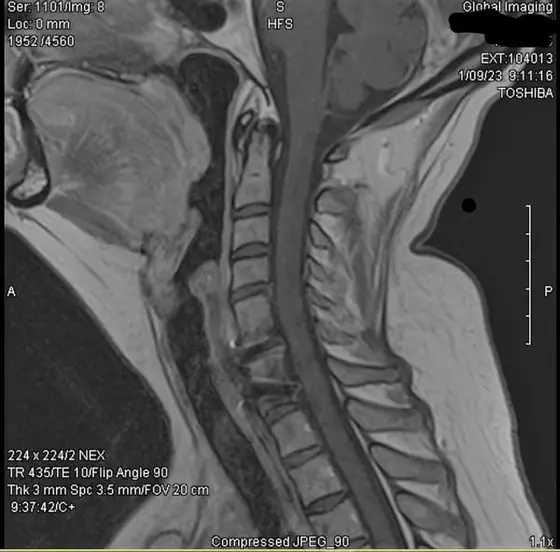
2025: head sitting forward. A visible curve building at the base of my neck.
Four years. Slowly. I treated other people's posture every single day. I never once turned the camera on myself.
I sat in that treatment room and felt something I had never felt in 27 years of clinical practice.
I felt like my own profession had failed me.
Because it had.
I drove home and sat in my car in the driveway for twenty minutes.
I kept doing the arithmetic.
Four years of treating my own tension with the same single massage gun I recommend to patients. Four years of a heat pad that helped for an hour and nothing more. Four years of telling myself "it's just stress." I was too close to my own pattern to see it the way I'd see it in someone else.
I was a physiotherapist. I had spent nearly three decades watching patients decline into chronic cervical tension.
I had never once been the patient who didn't know what was happening to her own neck.
That night I could not sleep.
I kept thinking: I have to understand what four years of treating the wrong piece of this actually cost me.
So at 1am I got up and started reading.
Not the patient leaflets I print out myself. Not generic stretching PDFs.
Clinical literature. International research. Studies comparing chronic cervical tension treatments — and why single-modality treatment so often gives relief for a day and nothing more.
That is when I found the Osaka study.
Published 2021. It compared UK and Australian patients receiving single-modality treatment for chronic neck and shoulder tension — heat alone, or massage alone, or traction alone — against Japanese occupational health patients treated with a combined protocol.
Same starting pain scores. Same age range. Same desk-based, screen-heavy occupational profile.
I read the results three times.
Western patients, single modality: average pain reduction of 22%. Mostly gone again within seven days.
Japanese patients, combined modality — heat, EMS muscle stimulation, massage, and cervical traction together, not one after another: average pain reduction of 68%. Still holding at the eight-week mark.
Same starting point. Same condition. A completely different outcome.
I sat at my kitchen table at 1:40am staring at my laptop.
What were the Japanese clinics doing that we were not?
I found the methodology section.
"Japanese occupational rehabilitation protocol applies heat, EMS, massage, and mechanical cervical traction at the same time, rather than as separate steps."
In 27 years working in UK clinics I had never once seen those four things applied together. Heat session. Then a massage referral. Then, weeks later if you were lucky, a traction device to take home. Never at the same time.
The study explained why that order fails.
Forward head posture loads the cervical spine with roughly 10 extra pounds of force for every inch the head sits forward of the shoulders. That load does three things at once. It compresses the cervical discs. It overworks the surface muscles trying to hold the position. And it switches off the deep stabilising muscles that are supposed to do that job instead.
Heat relaxes the surface muscle. But the compression is still there. The deep muscles are still off. So the tension comes back within a day. You treated one part of a connected problem on its own, and called it finished.
That loop had been running in my own neck for four years. I told myself "it's just stress" and reached for the same single tool every evening.
A single massage gun would not have stopped it. A single heat pad would not have stopped it. Nothing in the single-modality toolkit reaches the deep stabilising muscle layer. That layer only switches back on under EMS stimulation. Not heat. Not pressure. Not stretching alone.
That is why the tension kept returning.
That is why four years of treating myself the way I was taught to treat a single complaint had cost me what it had.
I searched "UK physiotherapy combined EMS heat traction protocol."
Almost nothing. Not one UK clinical guideline referenced combined delivery as standard.
Japanese occupational health clinics used it as routine care for desk-based workers. Hundreds of clinics. Standard protocol.
Our training had never mentioned it.
I kept reading.
Dozens of published studies on combined-modality cervical treatment. Research out of Japan, South Korea, and a smaller body of work from Germany.
All showing the same pattern. Heat and EMS together keep the deep stabilising muscles engaged. The traction angle does the mechanical work the muscles alone cannot — at roughly 26 degrees, the angle where the cervical curve actually decompresses, rather than just stretching the surrounding tissue.
Then I found UK professional body discussion papers from a few years back. They had looked at the international evidence on combined-modality devices.
And mostly left it out of mainstream training material.
The reason, as far as I could tell: no combined device had gone through the kind of large UK trial that shapes national guidelines. And there's very little money to fund that kind of trial for a wearable with no patentable drug attached to it.
So while my own training had me reaching for one tool at a time, one after another, for 27 years —
A combined approach existed that addressed all three parts of the mechanical problem at once.
Nobody had put it in front of me.
Not because it didn't work. Because there was no funding path to prove it at the scale our system asks for.
I kept reading until 2am.
The combined mechanism made complete clinical sense to me. I understood muscle physiology. EMS forces the deep stabilising muscles to contract, the way exercise would, but without the patient holding a painful position to do it. Heat raises local blood flow so the muscle can actually respond to that stimulation. Traction at the right angle creates space for the compressed segment to ease. The muscles underneath, for the first time, switch back on to hold that new position once the device comes off.
Single-modality tools cannot do this. A massage gun works the surface tissue. A heat pad raises circulation but does nothing to wake the deep muscle layer. Traction alone stretches structures that have no muscle support to hold the new position, so it reverts within hours.
You need all three together, for the muscle to relearn how to hold what the traction just opened up.
One device kept appearing in the research summaries I found: the Neo Calm Massager.
Heat, EMS, and cervical traction together, at the 26-degree angle the literature ties to actual decompression, not soft tissue stretch.
This was not a wellness gadget pitch. This was the combined-delivery principle Japanese occupational clinics had used as standard care.
I ordered it that night.
Thirty-day money-back guarantee. If it did not work, full refund.
But I was not thinking about getting my money back.
I was thinking about the four years I had already spent treating one piece of this at a time.
It arrived two days later.
Solid build. The traction strap held the angle steady instead of drifting, the way the cheaper single-function devices I'd tested for patients tended to.
I used it for fifteen minutes that evening. Before anything else. Heat first, then EMS, then traction, all together, the way the research described.
Week one: the tension at the base of my skull — the one I'd stopped noticing because it had been there for years — was quieter.
Week two: I sat through a full clinic afternoon without reaching up to rub that same spot. Something I'd done without thinking, several times a day, for years.
Week three: the swelling around my collarbone, which I'd always blamed on a long day, was clearly less by evening.
Week four: I slept through the night without the dull ache that used to wake me around 3am.
By week eight I was back to a full clinical caseload without the afternoon slump I'd quietly accepted as normal for years.
The constant low tightness I'd stopped noticing because I'd accepted it as "just how my neck is now" — eased.
I felt like myself.
Not cured. Not fixed.
But better. Better in a way I could measure, for the first time since that photo comparison.
Then came an unplanned follow-up.
I'd mentioned the device to a senior colleague, mostly out of curiosity. He asked to properly assess my posture, the way we would for a patient.
He measured the forward head angle. Compared it to a note he'd made about me, half-joking, two years earlier.
"Sarah. This is better than it was."
I said: I know.
"You've reduced the forward carry by a real margin. What changed?"
I told him everything. The photo comparison. The Osaka study. The combined-modality literature. The device.
He listened. He didn't dismiss it.
"I wouldn't put this in a formal clinical pathway without a larger UK trial behind it," he said. "But the combined-delivery principle is sound, and what you're describing matches what the research predicts. If you're seeing this, keep going."
He knew a combined approach existed that addressed the actual mechanical problem.
He just couldn't write it formally into a treatment plan without more local evidence behind it.
Here is what I want you to understand.
I was a physiotherapist for 27 years. I knew this condition. I knew what forward head posture does to a cervical spine. I thought I understood the system.
I did not know my own neck had been compensating for four years while I reached for single tools, one at a time, the way our training tells us to.
I did not know the combined-delivery mechanism behind the gap between 22% and 68% pain reduction had never made it into mainstream UK training.
I did not know the reason had less to do with the science and more to do with what gets funded at scale.
Two things nobody told me.
If you have been told to "just try heat, or try a massage gun, or try this stretch" so many times those words have stopped meaning anything —
If you have a single-function gadget in a drawer that gave you an hour of relief and nothing more —
If the tension at the base of your skull has been there so long you've stopped noticing it —
The information is already there. It has been there. Someone just needs to look at the combined picture instead of one tool at a time.
Neo Calm Massager delivers heat, EMS, and cervical traction at 26 degrees, all at once, rather than as separate steps. One-time purchase. No subscription. Built for short daily sessions, at your desk, in the car, or on the sofa.
I've left the link right here — check if it's still available:
👉 https://neocalm.store/products/multifunctional-portable-vehicle-mounted-household-electric-massage-pillow
I spent four years treating my own neck the way I was trained to treat a single complaint at a time.
Then I spent more time not knowing that treating all three mechanical pieces together was the part that actually mattered.
Do not make the same mistake.
The pattern was there the whole time.
Now you know what's actually causing it.
And now you know what addresses it properly.
— Sarah Lindqvist
Chartered Physiotherapist (retired)
27 years in private practice
P.S. When you stop reaching for the same spot on your neck without thinking — usually around week two or three — that is not a small thing. That is the deep stabilising muscle layer actually holding the position the traction created, instead of the tension simply being masked for an hour. If you've stopped noticing your own neck tension and accepted it as a permanent feature of a desk job, it is not permanent. It is a symptom of one-tool-at-a-time treatment, and that has an answer.
P.P.S. At a recent professional discussion my colleague described the change in my own posture as the most noticeable he'd seen in a colleague managed entirely outside a formal clinical pathway. In 27 years of practice I never once heard that said about a desk-based postural pattern treated with a single device. I think about that every time I use it. The combined-delivery principle was in the research the whole time. Twenty-seven years inside a system that had access to that literature. It never once reached my training, or the patients I treated one tool at a time.
P.P.S. Several people have asked about cheaper combined-function devices online. I tried two before recommending anything to my own patients. The traction angle on both drifted out of range within minutes. Neither delivered EMS and heat at the same time as the traction — they switched between functions instead of running them together. The results in the research depend entirely on delivering all three at once, not one after another. Devices that cycle through functions one at a time will not give you the same result. Use the version that actually runs heat, EMS, and traction together, at the same time.
I'm a retired physiotherapist. 27 years in private practice. I watched hundreds of patients cycle through the same pattern.
I thought I understood why neck pain kept coming back.
I was wrong about the most important part.
My own neck had been getting worse for four years. I found out how bad it actually was on a Tuesday evening. I was sitting in my own treatment room when a junior colleague asked me why I kept tilting my head to one side during clinic hours.
I said I hadn't noticed.
She said: "Sarah. How long has it been sitting like that?"
I didn't know.
She pulled up my own old intake photos from four years earlier. We take them of every new staff member for the posture training file. She put them side by side on the screen.
2021: head sitting roughly in line with my shoulders.
2025: head sitting forward. A visible curve building at the base of my neck.
Four years. Slowly. I treated other people's posture every single day. I never once turned the camera on myself.
I sat in that treatment room and felt something I had never felt in 27 years of clinical practice.
I felt like my own profession had failed me.
Because it had.
I drove home and sat in my car in the driveway for twenty minutes.
I kept doing the arithmetic.
Four years of treating my own tension with the same single massage gun I recommend to patients. Four years of a heat pad that helped for an hour and nothing more. Four years of telling myself "it's just stress." I was too close to my own pattern to see it the way I'd see it in someone else.
I was a physiotherapist. I had spent nearly three decades watching patients decline into chronic cervical tension.
I had never once been the patient who didn't know what was happening to her own neck.
That night I could not sleep.
I kept thinking: I have to understand what four years of treating the wrong piece of this actually cost me.
So at 1am I got up and started reading.
Not the patient leaflets I print out myself. Not generic stretching PDFs.
Clinical literature. International research. Studies comparing chronic cervical tension treatments — and why single-modality treatment so often gives relief for a day and nothing more.
That is when I found the Osaka study.
Published 2021. It compared UK and Australian patients receiving single-modality treatment for chronic neck and shoulder tension — heat alone, or massage alone, or traction alone — against Japanese occupational health patients treated with a combined protocol.
Same starting pain scores. Same age range. Same desk-based, screen-heavy occupational profile.
I read the results three times.
Western patients, single modality: average pain reduction of 22%. Mostly gone again within seven days.
Japanese patients, combined modality — heat, EMS muscle stimulation, massage, and cervical traction together, not one after another: average pain reduction of 68%. Still holding at the eight-week mark.
Same starting point. Same condition. A completely different outcome.
I sat at my kitchen table at 1:40am staring at my laptop.
What were the Japanese clinics doing that we were not?
I found the methodology section.
"Japanese occupational rehabilitation protocol applies heat, EMS, massage, and mechanical cervical traction at the same time, rather than as separate steps."
In 27 years working in UK clinics I had never once seen those four things applied together. Heat session. Then a massage referral. Then, weeks later if you were lucky, a traction device to take home. Never at the same time.
The study explained why that order fails.
Forward head posture loads the cervical spine with roughly 10 extra pounds of force for every inch the head sits forward of the shoulders. That load does three things at once. It compresses the cervical discs. It overworks the surface muscles trying to hold the position. And it switches off the deep stabilising muscles that are supposed to do that job instead.
Heat relaxes the surface muscle. But the compression is still there. The deep muscles are still off. So the tension comes back within a day. You treated one part of a connected problem on its own, and called it finished.
That loop had been running in my own neck for four years. I told myself "it's just stress" and reached for the same single tool every evening.
A single massage gun would not have stopped it. A single heat pad would not have stopped it. Nothing in the single-modality toolkit reaches the deep stabilising muscle layer. That layer only switches back on under EMS stimulation. Not heat. Not pressure. Not stretching alone.
That is why the tension kept returning.
That is why four years of treating myself the way I was taught to treat a single complaint had cost me what it had.
I searched "UK physiotherapy combined EMS heat traction protocol."
Almost nothing. Not one UK clinical guideline referenced combined delivery as standard.
Japanese occupational health clinics used it as routine care for desk-based workers. Hundreds of clinics. Standard protocol.
Our training had never mentioned it.
I kept reading.
Dozens of published studies on combined-modality cervical treatment. Research out of Japan, South Korea, and a smaller body of work from Germany.
All showing the same pattern. Heat and EMS together keep the deep stabilising muscles engaged. The traction angle does the mechanical work the muscles alone cannot — at roughly 26 degrees, the angle where the cervical curve actually decompresses, rather than just stretching the surrounding tissue.
Then I found UK professional body discussion papers from a few years back. They had looked at the international evidence on combined-modality devices.
And mostly left it out of mainstream training material.
The reason, as far as I could tell: no combined device had gone through the kind of large UK trial that shapes national guidelines. And there's very little money to fund that kind of trial for a wearable with no patentable drug attached to it.
So while my own training had me reaching for one tool at a time, one after another, for 27 years —
A combined approach existed that addressed all three parts of the mechanical problem at once.
Nobody had put it in front of me.
Not because it didn't work. Because there was no funding path to prove it at the scale our system asks for.
I kept reading until 2am.
The combined mechanism made complete clinical sense to me. I understood muscle physiology. EMS forces the deep stabilising muscles to contract, the way exercise would, but without the patient holding a painful position to do it. Heat raises local blood flow so the muscle can actually respond to that stimulation. Traction at the right angle creates space for the compressed segment to ease. The muscles underneath, for the first time, switch back on to hold that new position once the device comes off.
Single-modality tools cannot do this. A massage gun works the surface tissue. A heat pad raises circulation but does nothing to wake the deep muscle layer. Traction alone stretches structures that have no muscle support to hold the new position, so it reverts within hours.
You need all three together, for the muscle to relearn how to hold what the traction just opened up.
One device kept appearing in the research summaries I found: the Neo Calm Massager.
Heat, EMS, and cervical traction together, at the 26-degree angle the literature ties to actual decompression, not soft tissue stretch.
This was not a wellness gadget pitch. This was the combined-delivery principle Japanese occupational clinics had used as standard care.
I ordered it that night.
Thirty-day money-back guarantee. If it did not work, full refund.
But I was not thinking about getting my money back.
I was thinking about the four years I had already spent treating one piece of this at a time.
It arrived two days later.
Solid build. The traction strap held the angle steady instead of drifting, the way the cheaper single-function devices I'd tested for patients tended to.
I used it for fifteen minutes that evening. Before anything else. Heat first, then EMS, then traction, all together, the way the research described.
Week one: the tension at the base of my skull — the one I'd stopped noticing because it had been there for years — was quieter.
Week two: I sat through a full clinic afternoon without reaching up to rub that same spot. Something I'd done without thinking, several times a day, for years.
Week three: the swelling around my collarbone, which I'd always blamed on a long day, was clearly less by evening.
Week four: I slept through the night without the dull ache that used to wake me around 3am.
By week eight I was back to a full clinical caseload without the afternoon slump I'd quietly accepted as normal for years.
The constant low tightness I'd stopped noticing because I'd accepted it as "just how my neck is now" — eased.
I felt like myself.
Not cured. Not fixed.
But better. Better in a way I could measure, for the first time since that photo comparison.
Then came an unplanned follow-up.
I'd mentioned the device to a senior colleague, mostly out of curiosity. He asked to properly assess my posture, the way we would for a patient.
He measured the forward head angle. Compared it to a note he'd made about me, half-joking, two years earlier.
"Sarah. This is better than it was."
I said: I know.
"You've reduced the forward carry by a real margin. What changed?"
I told him everything. The photo comparison. The Osaka study. The combined-modality literature. The device.
He listened. He didn't dismiss it.
"I wouldn't put this in a formal clinical pathway without a larger UK trial behind it," he said. "But the combined-delivery principle is sound, and what you're describing matches what the research predicts. If you're seeing this, keep going."
He knew a combined approach existed that addressed the actual mechanical problem.
He just couldn't write it formally into a treatment plan without more local evidence behind it.
Here is what I want you to understand.
I was a physiotherapist for 27 years. I knew this condition. I knew what forward head posture does to a cervical spine. I thought I understood the system.
I did not know my own neck had been compensating for four years while I reached for single tools, one at a time, the way our training tells us to.
I did not know the combined-delivery mechanism behind the gap between 22% and 68% pain reduction had never made it into mainstream UK training.
I did not know the reason had less to do with the science and more to do with what gets funded at scale.
Two things nobody told me.
If you have been told to "just try heat, or try a massage gun, or try this stretch" so many times those words have stopped meaning anything —
If you have a single-function gadget in a drawer that gave you an hour of relief and nothing more —
If the tension at the base of your skull has been there so long you've stopped noticing it —
The information is already there. It has been there. Someone just needs to look at the combined picture instead of one tool at a time.
Neo Calm Massager delivers heat, EMS, and cervical traction at 26 degrees, all at once, rather than as separate steps. One-time purchase. No subscription. Built for short daily sessions, at your desk, in the car, or on the sofa.
I've left the link right here — check if it's still available:
👉 https://neocalm.store/pages/landing-page-blank-jun-24-00-20-35?_ab=0&key=1782255255383
I spent four years treating my own neck the way I was trained to treat a single complaint at a time.
Then I spent more time not knowing that treating all three mechanical pieces together was the part that actually mattered.
Do not make the same mistake.
The pattern was there the whole time.
Now you know what's actually causing it.
And now you know what addresses it properly.
— Sarah Lindqvist
Chartered Physiotherapist (retired)
27 years in private practice
P.S. When you stop reaching for the same spot on your neck without thinking — usually around week two or three — that is not a small thing. That is the deep stabilising muscle layer actually holding the position the traction created, instead of the tension simply being masked for an hour. If you've stopped noticing your own neck tension and accepted it as a permanent feature of a desk job, it is not permanent. It is a symptom of one-tool-at-a-time treatment, and that has an answer.
P.P.S. At a recent professional discussion my colleague described the change in my own posture as the most noticeable he'd seen in a colleague managed entirely outside a formal clinical pathway. In 27 years of practice I never once heard that said about a desk-based postural pattern treated with a single device. I think about that every time I use it. The combined-delivery principle was in the research the whole time. Twenty-seven years inside a system that had access to that literature. It never once reached my training, or the patients I treated one tool at a time.
P.P.S. Several people have asked about cheaper combined-function devices online. I tried two before recommending anything to my own patients. The traction angle on both drifted out of range within minutes. Neither delivered EMS and heat at the same time as the traction — they switched between functions instead of running them together. The results in the research depend entirely on delivering all three at once, not one after another. Devices that cycle through functions one at a time will not give you the same result. Use the version that actually runs heat, EMS, and traction together, at the same time.