The Neck Journal Facebook ad creative
neocalm.store
Read this if your neck pain keeps coming back.
Learn more

The Neck Journal Facebook and Instagram ad

The Neck Journal ran this carousel ad since Jun 24, 2026, 2 days so far.

First seen
Jun 24, 2026
Running for
2 days
Format
Carousel
Call to action
Learn more
Niche
Fitness
Countries
Not disclosed
Page likes
0

Ad copy

I'm a retired physiotherapist. 27 years in private practice. I watched hundreds of patients cycle through the same pattern. I thought I understood why neck pain kept coming back. I was wrong about the most important part. My own neck had been getting worse for four years. I found out how bad it actually was on a Tuesday evening. I was sitting in my own treatment room when a junior colleague asked me why I kept tilting my head to one side during clinic hours. I said I hadn't noticed. She said: "Sarah. How long has it been sitting like that?" I didn't know. She pulled up my own old intake photos from four years earlier. We take them of every new staff member for the posture training file. She put them side by side on the screen. 2021: head sitting roughly in line with my shoulders. 2025: head sitting forward. A visible curve building at the base of my neck. Four years. Slowly. I treated other people's posture every single day. I never once turned the camera on myself. I sat in that treatment room and felt something I had never felt in 27 years of clinical practice. I felt like my own profession had failed me. Because it had. I drove home and sat in my car in the driveway for twenty minutes. I kept doing the arithmetic. Four years of treating my own tension with the same single massage gun I recommend to patients. Four years of a heat pad that helped for an hour and nothing more. Four years of telling myself "it's just stress." I was too close to my own pattern to see it the way I'd see it in someone else. I was a physiotherapist. I had spent nearly three decades watching patients decline into chronic cervical tension. I had never once been the patient who didn't know what was happening to her own neck. That night I could not sleep. I kept thinking: I have to understand what four years of treating the wrong piece of this actually cost me. So at 1am I got up and started reading. Not the patient leaflets I print out myself. Not generic stretching PDFs. Clinical literature. International research. Studies comparing chronic cervical tension treatments — and why single-modality treatment so often gives relief for a day and nothing more. That is when I found the Osaka study. Published 2021. It compared UK and Australian patients receiving single-modality treatment for chronic neck and shoulder tension — heat alone, or massage alone, or traction alone — against Japanese occupational health patients treated with a combined protocol. Same starting pain scores. Same age range. Same desk-based, screen-heavy occupational profile. I read the results three times. Western patients, single modality: average pain reduction of 22%. Mostly gone again within seven days. Japanese patients, combined modality — heat, EMS muscle stimulation, massage, and cervical traction together, not one after another: average pain reduction of 68%. Still holding at the eight-week mark. Same starting point. Same condition. A completely different outcome. I sat at my kitchen table at 1:40am staring at my laptop. What were the Japanese clinics doing that we were not? I found the methodology section. "Japanese occupational rehabilitation protocol applies heat, EMS, massage, and mechanical cervical traction at the same time, rather than as separate steps." In 27 years working in UK clinics I had never once seen those four things applied together. Heat session. Then a massage referral. Then, weeks later if you were lucky, a traction device to take home. Never at the same time. The study explained why that order fails. Forward head posture loads the cervical spine with roughly 10 extra pounds of force for every inch the head sits forward of the shoulders. That load does three things at once. It compresses the cervical discs. It overworks the surface muscles trying to hold the position. And it switches off the deep stabilising muscles that are supposed to do that job instead. Heat relaxes the surface muscle. But the compression is still there. The deep muscles are still off. So the tension comes back within a day. You treated one part of a connected problem on its own, and called it finished. That loop had been running in my own neck for four years. I told myself "it's just stress" and reached for the same single tool every evening. A single massage gun would not have stopped it. A single heat pad would not have stopped it. Nothing in the single-modality toolkit reaches the deep stabilising muscle layer. That layer only switches back on under EMS stimulation. Not heat. Not pressure. Not stretching alone. That is why the tension kept returning. That is why four years of treating myself the way I was taught to treat a single complaint had cost me what it had. I searched "UK physiotherapy combined EMS heat traction protocol." Almost nothing. Not one UK clinical guideline referenced combined delivery as standard. Japanese occupational health clinics used it as routine care for desk-based workers. Hundreds of clinics. Standard protocol. Our training had never mentioned it. I kept reading. Dozens of published studies on combined-modality cervical treatment. Research out of Japan, South Korea, and a smaller body of work from Germany. All showing the same pattern. Heat and EMS together keep the deep stabilising muscles engaged. The traction angle does the mechanical work the muscles alone cannot — at roughly 26 degrees, the angle where the cervical curve actually decompresses, rather than just stretching the surrounding tissue. Then I found UK professional body discussion papers from a few years back. They had looked at the international evidence on combined-modality devices. And mostly left it out of mainstream training material. The reason, as far as I could tell: no combined device had gone through the kind of large UK trial that shapes national guidelines. And there's very little money to fund that kind of trial for a wearable with no patentable drug attached to it. So while my own training had me reaching for one tool at a time, one after another, for 27 years — A combined approach existed that addressed all three parts of the mechanical problem at once. Nobody had put it in front of me. Not because it didn't work. Because there was no funding path to prove it at the scale our system asks for. I kept reading until 2am. The combined mechanism made complete clinical sense to me. I understood muscle physiology. EMS forces the deep stabilising muscles to contract, the way exercise would, but without the patient holding a painful position to do it. Heat raises local blood flow so the muscle can actually respond to that stimulation. Traction at the right angle creates space for the compressed segment to ease. The muscles underneath, for the first time, switch back on to hold that new position once the device comes off. Single-modality tools cannot do this. A massage gun works the surface tissue. A heat pad raises circulation but does nothing to wake the deep muscle layer. Traction alone stretches structures that have no muscle support to hold the new position, so it reverts within hours. You need all three together, for the muscle to relearn how to hold what the traction just opened up. One device kept appearing in the research summaries I found: the Neo Calm Massager. Heat, EMS, and cervical traction together, at the 26-degree angle the literature ties to actual decompression, not soft tissue stretch. This was not a wellness gadget pitch. This was the combined-delivery principle Japanese occupational clinics had used as standard care. I ordered it that night. Thirty-day money-back guarantee. If it did not work, full refund. But I was not thinking about getting my money back. I was thinking about the four years I had already spent treating one piece of this at a time. It arrived two days later. Solid build. The traction strap held the angle steady instead of drifting, the way the cheaper single-function devices I'd tested for patients tended to. I used it for fifteen minutes that evening. Before anything else. Heat first, then EMS, then traction, all together, the way the research described. Week one: the tension at the base of my skull — the one I'd stopped noticing because it had been there for years — was quieter. Week two: I sat through a full clinic afternoon without reaching up to rub that same spot. Something I'd done without thinking, several times a day, for years. Week three: the swelling around my collarbone, which I'd always blamed on a long day, was clearly less by evening. Week four: I slept through the night without the dull ache that used to wake me around 3am. By week eight I was back to a full clinical caseload without the afternoon slump I'd quietly accepted as normal for years. The constant low tightness I'd stopped noticing because I'd accepted it as "just how my neck is now" — eased. I felt like myself. Not cured. Not fixed. But better. Better in a way I could measure, for the first time since that photo comparison. Then came an unplanned follow-up. I'd mentioned the device to a senior colleague, mostly out of curiosity. He asked to properly assess my posture, the way we would for a patient. He measured the forward head angle. Compared it to a note he'd made about me, half-joking, two years earlier. "Sarah. This is better than it was." I said: I know. "You've reduced the forward carry by a real margin. What changed?" I told him everything. The photo comparison. The Osaka study. The combined-modality literature. The device. He listened. He didn't dismiss it. "I wouldn't put this in a formal clinical pathway without a larger UK trial behind it," he said. "But the combined-delivery principle is sound, and what you're describing matches what the research predicts. If you're seeing this, keep going." He knew a combined approach existed that addressed the actual mechanical problem. He just couldn't write it formally into a treatment plan without more local evidence behind it. Here is what I want you to understand. I was a physiotherapist for 27 years. I knew this condition. I knew what forward head posture does to a cervical spine. I thought I understood the system. I did not know my own neck had been compensating for four years while I reached for single tools, one at a time, the way our training tells us to. I did not know the combined-delivery mechanism behind the gap between 22% and 68% pain reduction had never made it into mainstream UK training. I did not know the reason had less to do with the science and more to do with what gets funded at scale. Two things nobody told me. If you have been told to "just try heat, or try a massage gun, or try this stretch" so many times those words have stopped meaning anything — If you have a single-function gadget in a drawer that gave you an hour of relief and nothing more — If the tension at the base of your skull has been there so long you've stopped noticing it — The information is already there. It has been there. Someone just needs to look at the combined picture instead of one tool at a time. Neo Calm Massager delivers heat, EMS, and cervical traction at 26 degrees, all at once, rather than as separate steps. One-time purchase. No subscription. Built for short daily sessions, at your desk, in the car, or on the sofa. I've left the link right here — check if it's still available: 👉 https://neocalm.store/products/multifunctional-portable-vehicle-mounted-household-electric-massage-pillow I spent four years treating my own neck the way I was trained to treat a single complaint at a time. Then I spent more time not knowing that treating all three mechanical pieces together was the part that actually mattered. Do not make the same mistake. The pattern was there the whole time. Now you know what's actually causing it. And now you know what addresses it properly. — Sarah Lindqvist Chartered Physiotherapist (retired) 27 years in private practice P.S. When you stop reaching for the same spot on your neck without thinking — usually around week two or three — that is not a small thing. That is the deep stabilising muscle layer actually holding the position the traction created, instead of the tension simply being masked for an hour. If you've stopped noticing your own neck tension and accepted it as a permanent feature of a desk job, it is not permanent. It is a symptom of one-tool-at-a-time treatment, and that has an answer. P.P.S. At a recent professional discussion my colleague described the change in my own posture as the most noticeable he'd seen in a colleague managed entirely outside a formal clinical pathway. In 27 years of practice I never once heard that said about a desk-based postural pattern treated with a single device. I think about that every time I use it. The combined-delivery principle was in the research the whole time. Twenty-seven years inside a system that had access to that literature. It never once reached my training, or the patients I treated one tool at a time. P.P.S. Several people have asked about cheaper combined-function devices online. I tried two before recommending anything to my own patients. The traction angle on both drifted out of range within minutes. Neither delivered EMS and heat at the same time as the traction — they switched between functions instead of running them together. The results in the research depend entirely on delivering all three at once, not one after another. Devices that cycle through functions one at a time will not give you the same result. Use the version that actually runs heat, EMS, and traction together, at the same time.
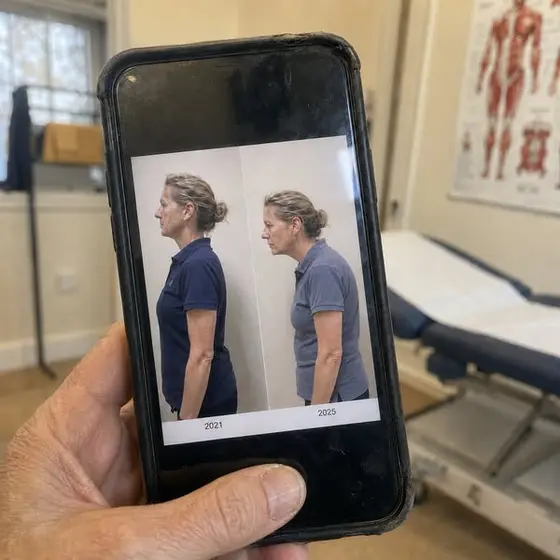
I'm a retired physiotherapist. 27 years in private practice. I watched hundreds of patients cycle through the same pattern. I thought I understood why neck pain kept coming back. I was wrong about the most important part. My own neck had been getting worse for four years. I found out how bad it actually was on a Tuesday evening. I was sitting in my own treatment room when a junior colleague asked me why I kept tilting my head to one side during clinic hours. I said I hadn't noticed. She said: "Sarah. How long has it been sitting like that?" I didn't know. She pulled up my own old intake photos from four years earlier. We take them of every new staff member for the posture training file. She put them side by side on the screen. 2021: head sitting roughly in line with my shoulders. 2025: head sitting forward. A visible curve building at the base of my neck. Four years. Slowly. I treated other people's posture every single day. I never once turned the camera on myself. I sat in that treatment room and felt something I had never felt in 27 years of clinical practice. I felt like my own profession had failed me. Because it had. I drove home and sat in my car in the driveway for twenty minutes. I kept doing the arithmetic. Not just the years. The actual cost. Four years of treating my own tension with the same single massage gun I recommend to patients. Four years of a heat pad that helped for an hour and nothing more. Four years of private physio sessions at £45 each, because the NHS waiting list near me was four months long and I couldn't wait that long to find out what was actually wrong. Somewhere around £1,200 over four years. On treatments that gave me a day of relief, then needed booking again the following week. I was a physiotherapist. I had spent nearly three decades watching patients decline into chronic cervical tension. I had never once been the patient who didn't know what was happening to her own neck. That night I could not sleep. I kept thinking: I have to understand what four years of treating the wrong piece of this actually cost me. So at 1am I got up and started reading. Not the patient leaflets I print out myself. Not generic stretching PDFs. Clinical literature. International research. Studies comparing chronic cervical tension treatments — and why single-modality treatment so often gives relief for a day and nothing more. That is when I found the Osaka study. Published 2021. It compared UK and Australian patients receiving single-modality treatment for chronic neck and shoulder tension — heat alone, or massage alone, or traction alone — against Japanese occupational health patients treated with a combined protocol. Same starting pain scores. Same age range. Same desk-based, screen-heavy occupational profile. I read the results three times. Western patients, single modality: average pain reduction of 22%. Mostly gone again within seven days. Japanese patients, combined modality — heat, EMS muscle stimulation, massage, and cervical traction together, not one after another: average pain reduction of 68%. Still holding at the eight-week mark. Same starting point. Same condition. A completely different outcome. I sat at my kitchen table at 1:40am staring at my laptop. What were the Japanese clinics doing that we were not? I found the methodology section. "Japanese occupational rehabilitation protocol applies heat, EMS, massage, and mechanical cervical traction at the same time, rather than as separate steps." In 27 years working in UK clinics I had never once seen those four things applied together. Heat session. Then a massage referral. Then, weeks later if you were lucky, a traction device to take home. Never at the same time. The study explained why that order fails. Forward head posture loads the cervical spine with roughly 10 extra pounds of force for every inch the head sits forward of the shoulders. That load does three things at once. It compresses the cervical discs. It overworks the surface muscles trying to hold the position. And it switches off the deep stabilising muscles that are supposed to do that job instead. Heat relaxes the surface muscle. But the compression is still there. The deep muscles are still off. So the tension comes back within a day. You treated one part of a connected problem on its own, and called it finished. That loop had been running in my own neck for four years. I told myself "it's just stress" and reached for the same single tool every evening, and paid for the same private appointments when the tool wasn't enough. A single massage gun would not have stopped it. A single heat pad would not have stopped it. Nothing in the single-modality toolkit reaches the deep stabilising muscle layer. That layer only switches back on under EMS stimulation. Not heat. Not pressure. Not stretching alone. That is why the tension kept returning. That is why four years of treating myself the way I was taught to treat a single complaint had cost me what it had. And here's the part that actually frightened me, not just frustrated me. Left unaddressed long enough, this isn't a problem that just plateaus. The deep muscle layer keeps compensating, the discs keep absorbing load they were never built to carry, and at some point the conversation stops being about a stretch routine and starts being about whether you need surgery. Nobody wants that conversation. A cervical procedure means general anaesthetic, weeks of restricted movement afterwards, a recovery that isn't guaranteed to fully resolve the underlying instability even once you're healed, and a waiting list that can run past twelve months before you even get a date. I have watched patients spend a year getting worse while they waited for an operation none of them actually wanted in the first place. Nobody had ever told me that the thing sitting upstream of all of that, the deep stabilising muscle layer, could have been addressed years earlier, at home, in fifteen minutes a day, long before surgery was ever a word anyone used. I searched "UK physiotherapy combined EMS heat traction protocol." Almost nothing. Not one UK clinical guideline referenced combined delivery as standard. Japanese occupational health clinics used it as routine care for desk-based workers. Hundreds of clinics. Standard protocol. Our training had never mentioned it. I kept reading. Dozens of published studies on combined-modality cervical treatment. Research out of Japan, South Korea, and a smaller body of work from Germany. All showing the same pattern. Heat and EMS together keep the deep stabilising muscles engaged. The traction angle does the mechanical work the muscles alone cannot — at roughly 26 degrees, the angle where the cervical curve actually decompresses, rather than just stretching the surrounding tissue. Then I found UK professional body discussion papers from a few years back. They had looked at the international evidence on combined-modality devices. And mostly left it out of mainstream training material. The reason, once I sat down and actually looked at it properly, made me genuinely angry, in a way I wasn't expecting from my own industry. No combined device had gone through the kind of large UK trial that shapes national guidelines, because there's very little money to fund that kind of trial for a wearable with no patentable drug attached to it. No patent, no pharmaceutical sponsor, no large trial, no guideline update. But the second reason is the one I genuinely did not want to admit about my own profession. A private physio session in this country runs somewhere between £40 and £60. A chiropractic course is often sold as a block of six or twelve sessions up front. None of that comes from anyone being dishonest. It is simply how the private musculoskeletal market is built. The entire model runs on the patient coming back. A device you buy once, that you use at home, and that you never need to rebook, does not fit anywhere into that model. There is no recurring appointment in fifteen minutes a day with your own equipment. So nobody inside that pathway, myself included, for 27 years, had any actual reason to put it in front of a patient sooner. So while my own training had me reaching for one tool at a time, one appointment at a time, for 27 years — A combined approach existed that addressed all three parts of the mechanical problem at once, in a single session, that you only ever had to buy once. Nobody had put it in front of me. Not because it didn't work. Because nothing about how it's funded, researched, or sold gives anyone in the existing pathway a reason to mention it. I kept reading until 2am. The combined mechanism made complete clinical sense to me. I understood muscle physiology. EMS forces the deep stabilising muscles to contract, the way exercise would, but without the patient holding a painful position to do it. Heat raises local blood flow so the muscle can actually respond to that stimulation. Traction at the right angle creates space for the compressed segment to ease. The muscles underneath, for the first time, switch back on to hold that new position once the device comes off. Single-modality tools cannot do this. A massage gun works the surface tissue. A heat pad raises circulation but does nothing to wake the deep muscle layer. Traction alone stretches structures that have no muscle support to hold the new position, so it reverts within hours. You need all three together, for the muscle to relearn how to hold what the traction just opened up. One device kept appearing in the research summaries I found: the Neo Calm Massager. Heat, EMS, and cervical traction together, at the 26-degree angle the literature ties to actual decompression, not soft tissue stretch. This was not a wellness gadget pitch. This was the combined-delivery principle Japanese occupational clinics had used as standard care. I ordered it that night. Thirty-day money-back guarantee. If it did not work, full refund. But I was not thinking about getting my money back. I was thinking about the four years and roughly £1,200 in private appointments I had already spent treating one piece of this at a time. And about how close, in the long run, I might have come to a referral conversation I would have done almost anything to avoid. It arrived two days later. Solid build. The traction strap held the angle steady instead of drifting, the way the cheaper single-function devices I'd tested for patients tended to. I used it for fifteen minutes that evening. Before anything else. Heat first, then EMS, then traction, all together, the way the research described. Week one: the tension at the base of my skull — the one I'd stopped noticing because it had been there for years — was quieter. Week two: I sat through a full clinic afternoon without reaching up to rub that same spot. Something I'd done without thinking, several times a day, for years. Week three: the swelling around my collarbone, which I'd always blamed on a long day, was clearly less by evening. Week four: I slept through the night without the dull ache that used to wake me around 3am. By week eight I was back to a full clinical caseload without the afternoon slump I'd quietly accepted as normal for years. The constant low tightness I'd stopped noticing because I'd accepted it as "just how my neck is now" — eased. I felt like myself. Not cured. Not fixed. But better. Better in a way I could measure, for the first time since that photo comparison. Then came an unplanned follow-up. I'd mentioned the device to a senior colleague, mostly out of curiosity. He asked to properly assess my posture with the same standardised goniometer measurement we use to assess range of motion in every patient, then asked me to forward an old measurement so he could compare without me describing how it had changed first. He measured. Then measured again, the way you do when you don't quite believe the first number. "Sarah, this isn't a small change. This is a 14-degree increase in your forward head angle correction since the note from two years ago. I don't see that kind of shift in a desk-based postural pattern from a single intervention. Not without surgery, and not normally even then without months of rehab on top of it." I told him everything. The photo comparison. The Osaka study. The combined-modality literature. The device. He didn't dismiss it. "I wouldn't put this in a formal clinical pathway without a larger UK trial behind it," he said. "But I've just measured a result I'd associate with a surgical case, not a desk job. Whatever you're doing, keep doing it." He knew a combined approach existed that addressed the actual mechanical problem. He just couldn't write it formally into a treatment plan without more local evidence behind it. Here is what I want you to understand. I was a physiotherapist for 27 years. I knew this condition. I knew what forward head posture does to a cervical spine. I thought I understood the system. I did not know my own neck had been compensating for four years while I reached for single tools, one at a time, the way our training tells us to. I did not know the combined-delivery mechanism behind the gap between 22% and 68% pain reduction had never made it into mainstream UK training, because no pharmaceutical company has any reason to fund the trial that would put it there. I did not know that the private treatment model I'd worked inside of for 27 years runs on the patient coming back, and a one-time device that actually closes the gap has no natural place inside that model. Three things nobody told me. If you have been told to "just try heat, or try a massage gun, or try this stretch" so many times those words have stopped meaning anything — If you have a single-function gadget in a drawer that gave you an hour of relief and nothing more — If you've spent money on private sessions, booked again and again, because the NHS wait felt longer than you could stand — If the tension at the base of your skull has been there so long you've stopped noticing it — The information is already there. It has been there. Someone just needs to look at the combined picture instead of one tool at a time, before this becomes the kind of case nobody wants to become: the one having the surgery conversation, instead of the one who fixed it at a desk fifteen minutes a day. Neo Calm Massager delivers heat, EMS, and cervical traction at 26 degrees, all at once, rather than as separate steps. One-time purchase. No subscription. Built for short daily sessions, at your desk, in the car, or on the sofa. I've left the link right here — check if it's still available: 👉 https://neocalm.store/pages/landing-page-blank-jun-24-00-20-35?_ab=0&key=1782255255383 I spent four years and roughly £1,200 treating my own neck the way I was trained to treat a single complaint at a time. Then I spent more time not knowing that treating all three mechanical pieces together was the part that actually mattered, and that almost nobody in the system I worked inside of had any real reason to tell me sooner. Do not make the same mistake. The pattern was there the whole time. Now you know what's actually causing it. And now you know what addresses it properly. — Sarah Lindqvist Chartered Physiotherapist (retired) 27 years in private practice P.S. When you stop reaching for the same spot on your neck without thinking — usually around week two or three — that is not a small thing. That is the deep stabilising muscle layer actually holding the position the traction created, instead of the tension simply being masked for an hour. If you've stopped noticing your own neck tension and accepted it as a permanent feature of a desk job, it is not permanent. It is a symptom of one-tool-at-a-time treatment, and that has an answer. P.P.S. My colleague's exact words stayed with me: "I don't see that kind of shift in a desk-based postural pattern from a single intervention. Not without surgery." In 27 years of practice I never once heard that said about a device used at home, unsupervised, with no referral, no waiting list, and no recovery period. The combined-delivery principle was in the research the whole time. Twenty-seven years inside a system that had access to that literature, and inside a private treatment model that simply has no natural reason to mention a one-time purchase to you before the next appointment. P.P.S. Several people have asked about cheaper combined-function devices online. I tried two before recommending anything to my own patients. The traction angle on both drifted out of range within minutes. Neither delivered EMS and heat at the same time as the traction — they switched between functions instead of running them together. The results in the research depend entirely on delivering all three at once, not one after another. Devices that cycle through functions one at a time will not give you the same result. Use the version that actually runs heat, EMS, and traction together, at the same time.

Placements and targeting

FacebookInstagramAudience NetworkMessengerThreads

More ads from The Neck Journal

Full The Neck Journal profile
The Neck Journal
The Neck Journal
+1
Inactive1 day
neocalm.store
Read this if your neck pain keeps coming back.
Learn more

My son told me to post this. I said no. Too personal. Too embarrassing for a man my age to talk about his own neck on the internet. He said: "Dad, you almost couldn't get out of the car. Nobody warned you this was coming. People need to hear this." So here I am. My name is Graham. I'm 61 years old. Spent 34 years as a long-haul lorry driver. Two million miles. Never had so much as a speeding ticket. I drove through it all. Then one Tuesday I couldn't turn my head far enough to check my mirror, and I nearly pulled out into a motorway lane with a car already in it. I need to back up. Because before that Tuesday, my body had been warning me for three years. And I ignored every single one of those warnings. Just like you might be ignoring yours right now. It started with the stiffness. First thing in the morning, before I'd even got out of bed — a tightness at the base of my skull that took twenty minutes to ease off. Then the headaches. Dull, sitting right behind my eyes by mid-afternoon, every single shift. My shoulders started rolling forward. My wife mentioned it twice. I told her it was just tiredness. And a numbness in my right hand that came and went, especially after a long stretch on the motorway. I told myself it was the job. My GP told me the same thing. Then that Tuesday morning, sitting in the cab waiting to pull out, I went to check my blind spot and my neck simply would not turn that far. I tried again. Nothing. A car was already coming up the inside lane. I'd gone to pull out anyway, by feel, the way you do after thirty years behind the wheel. I caught it at the last second. Horn blaring. My heart going like a hammer. I sat there in the cab afterward, hands still on the wheel, properly shaking. That evening I told my son, Mark, what had happened. Just the near miss. I didn't tell him about the three years before it. He went quiet for a long moment. "Dad. How long has your neck been like this?" I told him the truth. Years. On and off. Getting worse. He looked at me the way you look at someone you're worried about. "You have to actually do something about this. Not just push through another shift." I went to the GP that week. He had a look, asked me to turn my head, watched how far it went. "Cervical tension. Most likely forward head posture from the driving position, year on year." He gave me a leaflet on neck stretches and told me to come back if it got worse. It got worse. I tried physiotherapy. Six sessions through my GP referral, eight-week wait between booking and the first appointment. It helped for about a day after each session. Then back to where I started. I tried a chiropractor privately. Forty pounds a visit. Felt looser walking out the door. By the next morning, the same tightness was back. I bought a cheap heated neck wrap off Amazon. Helped while it was on. Nothing once it came off. I tried sleeping with two pillows, then one, then a special "cervical" pillow my wife found online. None of it held. Nothing worked. And by this point I was properly frightened. Because every shift I drove, checking that blind spot got a little harder, and I drive an HGV for a living. If my neck can't turn, I am not safe on that road, and neither is anyone else on it. My son came round one Sunday. He'd been quiet since the near miss. Holding it together, the way he does. But this time he sat down at our kitchen table and just said it straight. "Dad. You could have killed someone. Or yourself. I keep thinking about that." His voice went a bit tight saying it. "I can't get a call from your depot one day telling me there's been an accident. I can't." He looked at me. "You have to actually fix this. Whatever's going on with your neck. Properly. Now." He'd been reading about it for weeks. Forums for drivers with the exact same problem. "There's loads of you saying the same thing, Dad. Stiff neck, can't check the mirror properly, headaches by mid-shift. And loads of you saying physio alone never holds." Then he found something different. "There's a device people keep mentioning. Combines heat, electrical muscle stimulation, and traction together, not one after another. People are saying it's the opposite of what you've been through." He showed me what he'd found. "Used it in the cab on my break, fifteen minutes, blind spot check was easier by the end of the week." "Two weeks. Morning stiffness completely gone." "My physio asked what I'd changed because my range of motion improved more than six sessions managed." That last one stopped me. Because six sessions hadn't shifted mine at all. And if this thing could move someone past that — "How's it different from the heated wrap I already tried?" I asked. "Or the cheap massage gun?" He'd done his homework. "That massage gun you bought? Works the surface muscle only. Doesn't touch the deep muscles holding your head up — those only switch on properly with electrical stimulation, not vibration. And the heated wrap on its own does nothing for the muscles that have actually gone weak. It just relaxes what's already tight and leaves the cause exactly where it was." "This device runs heat, EMS, and traction at the same time. Not one then the other. At the same time. That's apparently the bit that actually matters." "No tablets. No appointments to book eight weeks out. Just the cab, your break, fifteen minutes." Fifteen minutes in the cab. For a man who spends ten hours a day in that seat, that sentence meant more than he knew. He ordered it that week. When it arrived, I tried it that evening at home first. Heat, then the EMS pulses kicking in, then the traction pulling gently into position. Fifteen minutes, lying back on the sofa. I want to be honest — the first few minutes felt strange. Little electrical pulses in muscles I didn't know were that tight. Then it eased off and just felt like proper heat and traction. Day 1 — Strange sensation. Slightly sceptical. But the tightness at the base of my skull was noticeably less by the time I went to bed. Day 4 — Turned my head to check the wing mirror without thinking about it. Realised halfway through the motion that I hadn't braced for it the way I normally would. Day 7 — Woke up without the morning stiffness for the first time in longer than I could remember. Got straight out of bed instead of lying there for twenty minutes first. Day 14 — Checked my blind spot properly on the motorway. Full turn. No hesitation. Sat there afterward and just thought about it for a minute. Day 21 — My wife mentioned my shoulders were sitting differently. I hadn't said anything to her about using the device at all. Day 30 — Mark rang me on a Sunday morning. "Dad, you sound different on the phone lately." "Different how?" "Like you're not tired all the time. Like you, before all this." I had to end the call early because I didn't much fancy him hearing me go a bit emotional about a neck device. At my next physio check-up, the one I'd booked privately just to be sure, she measured my range of motion against the notes from six months earlier. She looked at the numbers. Then at me. "This is a proper improvement. More than I'd expect from six sessions alone." She leaned forward. "What have you actually been doing?" I told her everything. The near miss. The forums. The device. Fifteen minutes a day in the cab. She wrote it down. Then she said: "I might start mentioning this to some of my other patients who drive for a living." A physiotherapist, writing down the name of a neck device. Because the numbers in front of her didn't lie. Last week Mark came round for Sunday dinner. He watched me get up from the table without my usual hand going to the back of my neck first. "You look better, Dad." "I feel better." "You scared me. With the near miss." "I know, son. I'm sorry." "Don't be sorry. Just keep using the thing." "Every day." He nodded. First time since that Tuesday he looked at me without that worry sitting behind his eyes. If you spend your working life in a seat, hear me. I'm not a doctor. I'm not a physio. I'm a lorry driver who very nearly caused an accident because nobody warned me what thirty years in that driving position was doing to my neck. You're managing your neck wrong. Not because you're careless. Because nobody told you the actual problem. A heat pad doesn't reach the deep muscles. A massage gun doesn't reach them either. The stretches your GP leaflet gave you haven't been updated to reflect what combined-modality research has shown for years. And the muscles that have switched off while you compensate for them right now — every shift, every long drive — are the reason it keeps coming back no matter what you try on its own. The stiffness you're blaming on a bad mattress? I blamed mine on tiredness too. The headaches by mid-afternoon? My GP said that was just the job. The numbness in your hand? I thought that was just what driving does to you after thirty years. None of it was just the job. All of it was deep neck muscles that had switched off, compensating for years of forward head posture, and nothing I tried on its own ever reached them. Don't waste money on a single-function gadget. I tried one. Heat only. Helped for an hour. Did nothing for the actual cause, and I very nearly caused an accident because of it. Neo Calm Massager runs heat, EMS, and cervical traction together, at the same time, not one after another. Fifteen minutes. No appointments. No tablets. It's the only thing I tried that actually reached what was making my neck fail me. 👉 https://neocalm.store/products/multifunctional-portable-vehicle-mounted-household-electric-massage-pillow 💙 30-Day Money-Back Guarantee — use it daily, then decide 🏥 Heat, EMS, and traction delivered at the same time, not in sequence 🇬🇧 Built for desk workers and drivers alike 🔒 One-time purchase — no subscription Please don't wait. Don't tell yourself your neck is fine because you've been managing it for years. Mine was "fine" for three years. Until one Tuesday morning when I couldn't turn my head far enough to check a blind spot, and a car was already there. Every shift you drive, every day you sit at that desk without addressing the actual muscle layer that's switched off — the compensation is building. The risk is rising. Nobody warned me. I'm warning you. 👉 https://neocalm.store/products/multifunctional-portable-vehicle-mounted-household-electric-massage-pillow — Graham, 61 HGV driver, 34 years One near miss And not one more shift managing it the way that nearly cost someone their life

The Neck Journal
The Neck Journal
+1
Inactive1 day
neocalm.store
Read this if your neck pain keeps coming back.
Learn more

Stop treating your neck pain one tool at a time. I'm a retired physiotherapist. I just realised I'd been doing exactly that to my own neck for four years. 27 years in private practice. I watched hundreds of patients cycle through the same pattern. I thought I understood why neck pain kept coming back. I was wrong about the most important part. My own neck had been getting worse for four years. I found out how bad it actually was on a Tuesday evening. I was sitting in my own treatment room when a junior colleague asked me why I kept tilting my head to one side during clinic hours. I said I hadn't noticed. She said: "Sarah. How long has it been sitting like that?" I didn't know. She pulled up my own old intake photos from four years earlier. We take them of every new staff member for the posture training file. She put them side by side on the screen. 2021: head sitting roughly in line with my shoulders. 2025: head sitting forward. A visible curve building at the base of my neck. Four years. Slowly. I treated other people's posture every single day. I never once turned the camera on myself. I sat in that treatment room and felt something I had never felt in 27 years of clinical practice. I felt like my own profession had failed me. Because it had. I drove home and sat in my car in the driveway for twenty minutes. I kept doing the arithmetic. Four years of treating my own tension with the same single massage gun I recommend to patients. Four years of a heat pad that helped for an hour and nothing more. Four years of telling myself "it's just stress." I was too close to my own pattern to see it the way I'd see it in someone else. I was a physiotherapist. I had spent nearly three decades watching patients decline into chronic cervical tension. I had never once been the patient who didn't know what was happening to her own neck. That night I could not sleep. I kept thinking: I have to understand what four years of treating the wrong piece of this actually cost me. So at 1am I got up and started reading. Not the patient leaflets I print out myself. Not generic stretching PDFs. Clinical literature. International research. Studies comparing chronic cervical tension treatments — and why single-modality treatment so often gives relief for a day and nothing more. That is when I found the Osaka study. Published 2021. It compared UK and Australian patients receiving single-modality treatment for chronic neck and shoulder tension — heat alone, or massage alone, or traction alone — against Japanese occupational health patients treated with a combined protocol. Same starting pain scores. Same age range. Same desk-based, screen-heavy occupational profile. I read the results three times. Western patients, single modality: average pain reduction of 22%. Mostly gone again within seven days. Japanese patients, combined modality — heat, EMS muscle stimulation, massage, and cervical traction together, not one after another: average pain reduction of 68%. Still holding at the eight-week mark. Same starting point. Same condition. A completely different outcome. I sat at my kitchen table at 1:40am staring at my laptop. What were the Japanese clinics doing that we were not? I found the methodology section. "Japanese occupational rehabilitation protocol applies heat, EMS, massage, and mechanical cervical traction at the same time, rather than as separate steps." In 27 years working in UK clinics I had never once seen those four things applied together. Heat session. Then a massage referral. Then, weeks later if you were lucky, a traction device to take home. Never at the same time. The study explained why that order fails. Forward head posture loads the cervical spine with roughly 10 extra pounds of force for every inch the head sits forward of the shoulders. That load does three things at once. It compresses the cervical discs. It overworks the surface muscles trying to hold the position. And it switches off the deep stabilising muscles that are supposed to do that job instead. Heat relaxes the surface muscle. But the compression is still there. The deep muscles are still off. So the tension comes back within a day. You treated one part of a connected problem on its own, and called it finished. That loop had been running in my own neck for four years. I told myself "it's just stress" and reached for the same single tool every evening. A single massage gun would not have stopped it. A single heat pad would not have stopped it. Nothing in the single-modality toolkit reaches the deep stabilising muscle layer. That layer only switches back on under EMS stimulation. Not heat. Not pressure. Not stretching alone. That is why the tension kept returning. That is why four years of treating myself the way I was taught to treat a single complaint had cost me what it had. I searched "UK physiotherapy combined EMS heat traction protocol." Almost nothing. Not one UK clinical guideline referenced combined delivery as standard. Japanese occupational health clinics used it as routine care for desk-based workers. Hundreds of clinics. Standard protocol. Our training had never mentioned it. I kept reading. Dozens of published studies on combined-modality cervical treatment. Research out of Japan, South Korea, and a smaller body of work from Germany. All showing the same pattern. Heat and EMS together keep the deep stabilising muscles engaged. The traction angle does the mechanical work the muscles alone cannot — at roughly 26 degrees, the angle where the cervical curve actually decompresses, rather than just stretching the surrounding tissue. Then I found UK professional body discussion papers from a few years back. They had looked at the international evidence on combined-modality devices. And mostly left it out of mainstream training material. The reason, as far as I could tell: no combined device had gone through the kind of large UK trial that shapes national guidelines. And there's very little money to fund that kind of trial for a wearable with no patentable drug attached to it. So while my own training had me reaching for one tool at a time, one after another, for 27 years — A combined approach existed that addressed all three parts of the mechanical problem at once. Nobody had put it in front of me. Not because it didn't work. Because there was no funding path to prove it at the scale our system asks for. I kept reading until 2am. The combined mechanism made complete clinical sense to me. I understood muscle physiology. EMS forces the deep stabilising muscles to contract, the way exercise would, but without the patient holding a painful position to do it. Heat raises local blood flow so the muscle can actually respond to that stimulation. Traction at the right angle creates space for the compressed segment to ease. The muscles underneath, for the first time, switch back on to hold that new position once the device comes off. Single-modality tools cannot do this. A massage gun works the surface tissue. A heat pad raises circulation but does nothing to wake the deep muscle layer. Traction alone stretches structures that have no muscle support to hold the new position, so it reverts within hours. You need all three together, for the muscle to relearn how to hold what the traction just opened up. One device kept appearing in the research summaries I found: the Neo Calm Massager. Heat, EMS, and cervical traction together, at the 26-degree angle the literature ties to actual decompression, not soft tissue stretch. This was not a wellness gadget pitch. This was the combined-delivery principle Japanese occupational clinics had used as standard care. I ordered it that night. Thirty-day money-back guarantee. If it did not work, full refund. But I was not thinking about getting my money back. I was thinking about the four years I had already spent treating one piece of this at a time. It arrived two days later. Solid build. The traction strap held the angle steady instead of drifting, the way the cheaper single-function devices I'd tested for patients tended to. I used it for fifteen minutes that evening. Before anything else. Heat first, then EMS, then traction, all together, the way the research described. Week one: the tension at the base of my skull — the one I'd stopped noticing because it had been there for years — was quieter. Week two: I sat through a full clinic afternoon without reaching up to rub that same spot. Something I'd done without thinking, several times a day, for years. Week three: the swelling around my collarbone, which I'd always blamed on a long day, was clearly less by evening. Week four: I slept through the night without the dull ache that used to wake me around 3am. By week eight I was back to a full clinical caseload without the afternoon slump I'd quietly accepted as normal for years. The constant low tightness I'd stopped noticing because I'd accepted it as "just how my neck is now" — eased. I felt like myself. Not cured. Not fixed. But better. Better in a way I could measure, for the first time since that photo comparison. Then came an unplanned follow-up. I'd mentioned the device to a senior colleague, mostly out of curiosity. He asked to properly assess my posture, the way we would for a patient. He measured the forward head angle. Compared it to a note he'd made about me, half-joking, two years earlier. "Sarah. This is better than it was." I said: I know. "You've reduced the forward carry by a real margin. What changed?" I told him everything. The photo comparison. The Osaka study. The combined-modality literature. The device. He listened. He didn't dismiss it. "I wouldn't put this in a formal clinical pathway without a larger UK trial behind it," he said. "But the combined-delivery principle is sound, and what you're describing matches what the research predicts. If you're seeing this, keep going." He knew a combined approach existed that addressed the actual mechanical problem. He just couldn't write it formally into a treatment plan without more local evidence behind it. Here is what I want you to understand. I was a physiotherapist for 27 years. I knew this condition. I knew what forward head posture does to a cervical spine. I thought I understood the system. I did not know my own neck had been compensating for four years while I reached for single tools, one at a time, the way our training tells us to. I did not know the combined-delivery mechanism behind the gap between 22% and 68% pain reduction had never made it into mainstream UK training. I did not know the reason had less to do with the science and more to do with what gets funded at scale. Two things nobody told me. If you have been told to "just try heat, or try a massage gun, or try this stretch" so many times those words have stopped meaning anything — If you have a single-function gadget in a drawer that gave you an hour of relief and nothing more — If the tension at the base of your skull has been there so long you've stopped noticing it — The information is already there. It has been there. Someone just needs to look at the combined picture instead of one tool at a time. Neo Calm Massager delivers heat, EMS, and cervical traction at 26 degrees, all at once, rather than as separate steps. One-time purchase. No subscription. Built for short daily sessions, at your desk, in the car, or on the sofa. I've left the link right here — check if it's still available: 👉 https://neocalm.store/products/multifunctional-portable-vehicle-mounted-household-electric-massage-pillow I spent four years treating my own neck the way I was trained to treat a single complaint at a time. Then I spent more time not knowing that treating all three mechanical pieces together was the part that actually mattered. Do not make the same mistake. The pattern was there the whole time. Now you know what's actually causing it. And now you know what addresses it properly. — Sarah Lindqvist Chartered Physiotherapist (retired) 27 years in private practice P.S. When you stop reaching for the same spot on your neck without thinking — usually around week two or three — that is not a small thing. That is the deep stabilising muscle layer actually holding the position the traction created, instead of the tension simply being masked for an hour. If you've stopped noticing your own neck tension and accepted it as a permanent feature of a desk job, it is not permanent. It is a symptom of one-tool-at-a-time treatment, and that has an answer. P.P.S. At a recent professional discussion my colleague described the change in my own posture as the most noticeable he'd seen in a colleague managed entirely outside a formal clinical pathway. In 27 years of practice I never once heard that said about a desk-based postural pattern treated with a single device. I think about that every time I use it. The combined-delivery principle was in the research the whole time. Twenty-seven years inside a system that had access to that literature. It never once reached my training, or the patients I treated one tool at a time. P.P.S. Several people have asked about cheaper combined-function devices online. I tried two before recommending anything to my own patients. The traction angle on both drifted out of range within minutes. Neither delivered EMS and heat at the same time as the traction — they switched between functions instead of running them together. The results in the research depend entirely on delivering all three at once, not one after another. Devices that cycle through functions one at a time will not give you the same result. Use the version that actually runs heat, EMS, and traction together, at the same time.

The Neck Journal
The Neck Journal
+1
Inactive2 days
neocalm.store
Read this if your neck pain keeps coming back.
Learn more

I'm a retired physiotherapist. 27 years in private practice. I watched hundreds of patients cycle through the same pattern. I thought I understood why neck pain kept coming back. I was wrong about the most important part. My own neck had been getting worse for four years. I found out how bad it actually was on a Tuesday evening. I was sitting in my own treatment room when a junior colleague asked me why I kept tilting my head to one side during clinic hours. I said I hadn't noticed. She said: "Sarah. How long has it been sitting like that?" I didn't know. She pulled up my own old intake photos from four years earlier. We take them of every new staff member for the posture training file. She put them side by side on the screen. 2021: head sitting roughly in line with my shoulders. 2025: head sitting forward. A visible curve building at the base of my neck. Four years. Slowly. I treated other people's posture every single day. I never once turned the camera on myself. I sat in that treatment room and felt something I had never felt in 27 years of clinical practice. I felt like my own profession had failed me. Because it had. I drove home and sat in my car in the driveway for twenty minutes. I kept doing the arithmetic. Four years of treating my own tension with the same single massage gun I recommend to patients. Four years of a heat pad that helped for an hour and nothing more. Four years of telling myself "it's just stress." I was too close to my own pattern to see it the way I'd see it in someone else. I was a physiotherapist. I had spent nearly three decades watching patients decline into chronic cervical tension. I had never once been the patient who didn't know what was happening to her own neck. That night I could not sleep. I kept thinking: I have to understand what four years of treating the wrong piece of this actually cost me. So at 1am I got up and started reading. Not the patient leaflets I print out myself. Not generic stretching PDFs. Clinical literature. International research. Studies comparing chronic cervical tension treatments — and why single-modality treatment so often gives relief for a day and nothing more. That is when I found the Osaka study. Published 2021. It compared UK and Australian patients receiving single-modality treatment for chronic neck and shoulder tension — heat alone, or massage alone, or traction alone — against Japanese occupational health patients treated with a combined protocol. Same starting pain scores. Same age range. Same desk-based, screen-heavy occupational profile. I read the results three times. Western patients, single modality: average pain reduction of 22%. Mostly gone again within seven days. Japanese patients, combined modality — heat, EMS muscle stimulation, massage, and cervical traction together, not one after another: average pain reduction of 68%. Still holding at the eight-week mark. Same starting point. Same condition. A completely different outcome. I sat at my kitchen table at 1:40am staring at my laptop. What were the Japanese clinics doing that we were not? I found the methodology section. "Japanese occupational rehabilitation protocol applies heat, EMS, massage, and mechanical cervical traction at the same time, rather than as separate steps." In 27 years working in UK clinics I had never once seen those four things applied together. Heat session. Then a massage referral. Then, weeks later if you were lucky, a traction device to take home. Never at the same time. The study explained why that order fails. Forward head posture loads the cervical spine with roughly 10 extra pounds of force for every inch the head sits forward of the shoulders. That load does three things at once. It compresses the cervical discs. It overworks the surface muscles trying to hold the position. And it switches off the deep stabilising muscles that are supposed to do that job instead. Heat relaxes the surface muscle. But the compression is still there. The deep muscles are still off. So the tension comes back within a day. You treated one part of a connected problem on its own, and called it finished. That loop had been running in my own neck for four years. I told myself "it's just stress" and reached for the same single tool every evening. A single massage gun would not have stopped it. A single heat pad would not have stopped it. Nothing in the single-modality toolkit reaches the deep stabilising muscle layer. That layer only switches back on under EMS stimulation. Not heat. Not pressure. Not stretching alone. That is why the tension kept returning. That is why four years of treating myself the way I was taught to treat a single complaint had cost me what it had. I searched "UK physiotherapy combined EMS heat traction protocol." Almost nothing. Not one UK clinical guideline referenced combined delivery as standard. Japanese occupational health clinics used it as routine care for desk-based workers. Hundreds of clinics. Standard protocol. Our training had never mentioned it. I kept reading. Dozens of published studies on combined-modality cervical treatment. Research out of Japan, South Korea, and a smaller body of work from Germany. All showing the same pattern. Heat and EMS together keep the deep stabilising muscles engaged. The traction angle does the mechanical work the muscles alone cannot — at roughly 26 degrees, the angle where the cervical curve actually decompresses, rather than just stretching the surrounding tissue. Then I found UK professional body discussion papers from a few years back. They had looked at the international evidence on combined-modality devices. And mostly left it out of mainstream training material. The reason, as far as I could tell: no combined device had gone through the kind of large UK trial that shapes national guidelines. And there's very little money to fund that kind of trial for a wearable with no patentable drug attached to it. So while my own training had me reaching for one tool at a time, one after another, for 27 years — A combined approach existed that addressed all three parts of the mechanical problem at once. Nobody had put it in front of me. Not because it didn't work. Because there was no funding path to prove it at the scale our system asks for. I kept reading until 2am. The combined mechanism made complete clinical sense to me. I understood muscle physiology. EMS forces the deep stabilising muscles to contract, the way exercise would, but without the patient holding a painful position to do it. Heat raises local blood flow so the muscle can actually respond to that stimulation. Traction at the right angle creates space for the compressed segment to ease. The muscles underneath, for the first time, switch back on to hold that new position once the device comes off. Single-modality tools cannot do this. A massage gun works the surface tissue. A heat pad raises circulation but does nothing to wake the deep muscle layer. Traction alone stretches structures that have no muscle support to hold the new position, so it reverts within hours. You need all three together, for the muscle to relearn how to hold what the traction just opened up. One device kept appearing in the research summaries I found: the Neo Calm Massager. Heat, EMS, and cervical traction together, at the 26-degree angle the literature ties to actual decompression, not soft tissue stretch. This was not a wellness gadget pitch. This was the combined-delivery principle Japanese occupational clinics had used as standard care. I ordered it that night. Thirty-day money-back guarantee. If it did not work, full refund. But I was not thinking about getting my money back. I was thinking about the four years I had already spent treating one piece of this at a time. It arrived two days later. Solid build. The traction strap held the angle steady instead of drifting, the way the cheaper single-function devices I'd tested for patients tended to. I used it for fifteen minutes that evening. Before anything else. Heat first, then EMS, then traction, all together, the way the research described. Week one: the tension at the base of my skull — the one I'd stopped noticing because it had been there for years — was quieter. Week two: I sat through a full clinic afternoon without reaching up to rub that same spot. Something I'd done without thinking, several times a day, for years. Week three: the swelling around my collarbone, which I'd always blamed on a long day, was clearly less by evening. Week four: I slept through the night without the dull ache that used to wake me around 3am. By week eight I was back to a full clinical caseload without the afternoon slump I'd quietly accepted as normal for years. The constant low tightness I'd stopped noticing because I'd accepted it as "just how my neck is now" — eased. I felt like myself. Not cured. Not fixed. But better. Better in a way I could measure, for the first time since that photo comparison. Then came an unplanned follow-up. I'd mentioned the device to a senior colleague, mostly out of curiosity. He asked to properly assess my posture, the way we would for a patient. He measured the forward head angle. Compared it to a note he'd made about me, half-joking, two years earlier. "Sarah. This is better than it was." I said: I know. "You've reduced the forward carry by a real margin. What changed?" I told him everything. The photo comparison. The Osaka study. The combined-modality literature. The device. He listened. He didn't dismiss it. "I wouldn't put this in a formal clinical pathway without a larger UK trial behind it," he said. "But the combined-delivery principle is sound, and what you're describing matches what the research predicts. If you're seeing this, keep going." He knew a combined approach existed that addressed the actual mechanical problem. He just couldn't write it formally into a treatment plan without more local evidence behind it. Here is what I want you to understand. I was a physiotherapist for 27 years. I knew this condition. I knew what forward head posture does to a cervical spine. I thought I understood the system. I did not know my own neck had been compensating for four years while I reached for single tools, one at a time, the way our training tells us to. I did not know the combined-delivery mechanism behind the gap between 22% and 68% pain reduction had never made it into mainstream UK training. I did not know the reason had less to do with the science and more to do with what gets funded at scale. Two things nobody told me. If you have been told to "just try heat, or try a massage gun, or try this stretch" so many times those words have stopped meaning anything — If you have a single-function gadget in a drawer that gave you an hour of relief and nothing more — If the tension at the base of your skull has been there so long you've stopped noticing it — The information is already there. It has been there. Someone just needs to look at the combined picture instead of one tool at a time. Neo Calm Massager delivers heat, EMS, and cervical traction at 26 degrees, all at once, rather than as separate steps. One-time purchase. No subscription. Built for short daily sessions, at your desk, in the car, or on the sofa. I've left the link right here — check if it's still available: 👉 https://neocalm.store/products/multifunctional-portable-vehicle-mounted-household-electric-massage-pillow I spent four years treating my own neck the way I was trained to treat a single complaint at a time. Then I spent more time not knowing that treating all three mechanical pieces together was the part that actually mattered. Do not make the same mistake. The pattern was there the whole time. Now you know what's actually causing it. And now you know what addresses it properly. — Sarah Lindqvist Chartered Physiotherapist (retired) 27 years in private practice P.S. When you stop reaching for the same spot on your neck without thinking — usually around week two or three — that is not a small thing. That is the deep stabilising muscle layer actually holding the position the traction created, instead of the tension simply being masked for an hour. If you've stopped noticing your own neck tension and accepted it as a permanent feature of a desk job, it is not permanent. It is a symptom of one-tool-at-a-time treatment, and that has an answer. P.P.S. At a recent professional discussion my colleague described the change in my own posture as the most noticeable he'd seen in a colleague managed entirely outside a formal clinical pathway. In 27 years of practice I never once heard that said about a desk-based postural pattern treated with a single device. I think about that every time I use it. The combined-delivery principle was in the research the whole time. Twenty-seven years inside a system that had access to that literature. It never once reached my training, or the patients I treated one tool at a time. P.P.S. Several people have asked about cheaper combined-function devices online. I tried two before recommending anything to my own patients. The traction angle on both drifted out of range within minutes. Neither delivered EMS and heat at the same time as the traction — they switched between functions instead of running them together. The results in the research depend entirely on delivering all three at once, not one after another. Devices that cycle through functions one at a time will not give you the same result. Use the version that actually runs heat, EMS, and traction together, at the same time.

See all 22 ads

Create a free account to unlock every creative, video and landing page.

Sign up free

Similar fitness ads

Search a Labz- Health & Fitness
Inactive1 day
tunefulsoul.com
Adult Event Organization: Venue Guide
Learn more

Exploring adult event organization ideas? 🪩 This guide explains venue layouts, theme planning, and guest experience considerations. Learn More.

Search a Labz- Health & Fitness
Inactive1 day
tunefulsoul.com
Discover more information about Online Income Strategies✨
Learn more

🌟 Explore practical ways people are learning to create sustainable online revenue streams. Understand different methods, tools, and skills that can help you build a flexible digital career over time. Learn more. 💪

Svelte Media
Svelte Media
+1
Inactive16 days
get.riseworkouts.com
7-Minute A Day | Natural Metabolic Multipliers
Learn more

Introducing the One&Done Workout – a 7 minute S.I.T. routine helps activate the body’s natural metabolic multipliers. 👉 https://get.riseworkouts.com/fb/quiz-ds/ 👈

Svelte Media
Svelte Media
+1
Inactive16 days
get.riseworkouts.com
7-Minute A Day | Natural Metabolic Multipliers
Learn more

Introducing the One&Done Workout – a 7 minute S.I.T. routine helps activate the body’s natural metabolic multipliers. 👉 https://get.riseworkouts.com/fb/quiz-ds/ 👈

See all ads

Create a free account to unlock every creative, video and landing page.

Sign up free

Keep exploring

Free plan, no card needed

Find more ads like this

Search millions of real ads by keyword, niche and format, and save the winners to your swipe file.

Start free