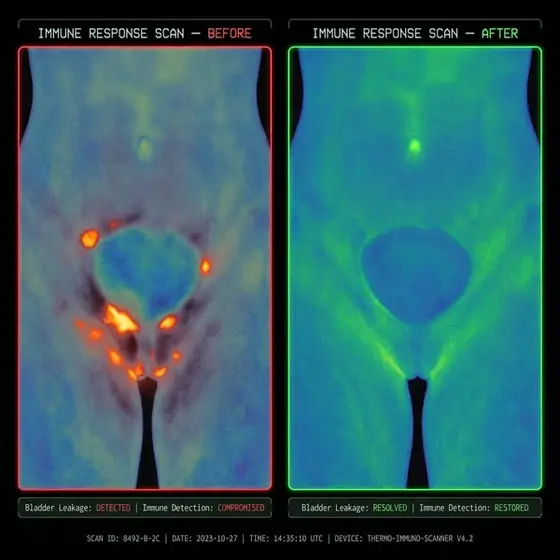
At 63, my bladder scan showed a lining so worn the technician asked me to go and empty my bladder for the second time, just to make sure her machine wasn't broken. She was in her late thirties. Calm. Professional. The kind of person who had done thousands of these. She was sitting next to the machine. She had the probe pressed gently against my lower belly. She was looking at the screen. She stopped. She looked at the screen for a long moment. Then she said, "Mrs. Hale. I'm going to ask you to go and empty your bladder for me. Then come back and lie down. I want to take this reading again." I did what she said. She took the reading again. She looked at the screen for a long moment. Then she said it again. "One more time. Go and empty it. Come back. Lie down." I did it again. She took the third reading. She set the probe down. She turned to me. She said, "Okay. We're finished with this part. Let me check one more thing." She did not tell me what the machine had shown her. She did not need to. I had been a primary school teacher for 36 years. I knew when somebody was working hard not to let their face show something. I lay there while she moved the probe across my lower belly again. I waited for her to ask me to get up and empty it once more. She didn't. She just took the reading once. She set the probe down. She wrote something on a clipboard. She said, "The specialist will go over the results with you when they're ready." She walked out of the room. I lay there on the table for ten minutes. Alone. In a small exam room with the paper crinkling under me. I'm 63 years old. My name is Margaret. I had booked the bladder scan myself. My GP hadn't asked me to. The NHS hadn't offered it. I had paid out of pocket at a private women's health clinic because I had been telling myself for four years that something was wrong with my bladder, and nobody had been able to tell me what. Four years of urgency that hit with no warning. Four years of getting up three and four times a night. Four years of leaking when I laughed, or coughed, or lifted the shopping. Four years of finding the toilet the moment I walked into anywhere. Four years of that constant pressure, the feeling I needed to go again two minutes after I'd just gone. I had been to two different doctors. I had been on oxybutynin for five years. I had been on vaginal oestrogen cream for three. I had done pelvic floor exercises every day for seven years. I had seen a pelvic floor physiotherapist. I had cut out the caffeine. I had cut out the fizzy drinks. I had stopped drinking water after six in the evening. I had tried bladder training. I had tried cranberry capsules. Pumpkin seed oil. Magnesium. D-mannose. AZO. Three different "bladder support" blends from the health food shop. A green powder my daughter found that tasted like a wet field. Nothing moved. The specialist came in twenty minutes later. She sat down across from me. She had a printout. She pulled up the scan on a monitor. I saw the outline of my own bladder. The wall was thin in places. Ragged in others. The lining looked worn, like cloth rubbed too many times in the same spot. She pointed at the screen. She said, "Mrs. Hale. The technical phrase for what we're seeing is detrusor overactivity with a compromised mucosal lining. In plain English, the protective coating inside your bladder has worn thin, and the muscle underneath is firing on its own." I said, "I knew it." She nodded. She said, "What you have is not yet what we'd call an unstable bladder needing surgery. But it's on a trajectory." I asked her what to do. She paused for a long moment. She said, "Honestly. The medication you're already on is doing the job it was designed for. It's quieting the signal. It is not rebuilding the lining of your bladder. That's a different problem. And mainstream care doesn't have a particularly elegant tool for it." She didn't have anything else. She said she wanted to scan me again in six months. I drove home that afternoon. I parked on the drive. I sat in the car for a long time. I thought about the technician asking me to empty my bladder a second time. I thought about her face when she set the probe down. I thought about the worn lining on the screen. I went inside. I told my husband I had a headache. I went into the spare room. I closed the door. I opened my laptop. I started reading. Not about supplements. I had tried all the supplements. I started reading about what the specialist had said. The lining of the bladder. I read for five hours straight. That evening, I found a long piece written by a woman who had researched the bladder lining at a university for 31 years. She had retired three years before she wrote the piece. It was on a women's health site I had never heard of. The piece was about the difference between treating a symptom and treating a lining. Here is what she said. When most women think about leaks, they think about a weak pelvic floor. That picture is incomplete. The real story is happening at the lining of your bladder. That lining is called the GAG layer. It is a thin protective coating. It is the most important layer in your whole urinary system. A healthy GAG layer holds a slick protective coating over the bladder wall. That coating is what keeps urine off the raw tissue and the nerves underneath. When the coating is intact, the bladder stays calm. It fills without sounding the alarm. It holds when you laugh or cough. It lets you sleep through the night. The scan in your specialist's office shows a smooth, healthy wall. When that coating thins, urine reaches tissue it was never meant to touch. The nerves underneath fire. The bladder overreacts to almost nothing. The urgency. The leaks. The waking at 3am to pass barely a thimbleful. That is what a compromised lining actually is. Not a weak bladder. A worn-lining problem. After menopause, oestrogen drops, and the lining thins dramatically. Three things accelerate it. Oestrogen withdrawal strips the lining of what keeps it plump. Magnesium depletion lets the bladder muscle misfire on its own. And chronic low-grade inflammation keeps the whole system irritated. She listed every single thing I had tried. Cranberry helps with bacteria, but doesn't rebuild the lining. Pumpkin seed supports the muscle a little, but doesn't reach the coating. Magnesium calms the muscle, but can't restore the lining on its own. D-mannose is for infections, a different problem entirely. The medication blocks the signal, but rebuilds nothing. None of them feed the GAG layer itself. None of them restore the coating the bladder needs to stay calm. That was why my lining had looked worn on the screen. That was why the technician had asked me to empty my bladder a second time. That was why my specialist had said mainstream care didn't have an elegant tool. The supplements were chasing different problems. None of them were reaching the lining where the actual trouble lived. She then described what does. A specific set of nutrients that rebuild the lining and settle the muscle at the same time. Led by one in particular. Hyaluronic acid. The very substance the GAG layer is built from. She cited a long list of studies. Hyaluronic acid helps rebuild the protective coating directly. It supports a calmer, less reactive bladder wall. It supports the lining that keeps urine off the nerves. Alongside it, five more. Magnesium to steady the muscle. Red clover to support the oestrogen-sensitive tissue. Pumpkin seed for the bladder neck. Sea buckthorn for the mucosal tissue. Cranberry to calm the surface and reduce irritation. She said there is more published research on rebuilding the bladder lining this way than on almost any other natural approach to leaks. She then explained the trap. Almost every bladder product on a shelf is built to look good on a label, not to rebuild a lining. Most give you one trendy ingredient at a fairy-dust dose. Or they hide the amounts inside a "proprietary blend" so you can never tell how little is really in there. The pumpkin seed capsules I had taken for a year had given me a label. Not a lining. She said the formula that works has to be: All six nutrients. At the doses used in the actual studies. Every amount printed on the label. No proprietary blend. No fillers. Third-party tested. She named one small company that hit every criterion. A company called UroControl, made by Lovi. The only one she had found that disclosed the actual dose of every ingredient right on the label. All six. Clinical doses. Third-party tested. No proprietary blend. No fillers. I ordered it that night. It arrived three days later. I took two capsules every morning with breakfast. The first week, nothing dramatic. By week two, my husband rolled over in the morning and said, "You didn't get up last night." I lay there for a second. I worked it out. He was right. I hadn't. Not once. By week four, the urgency that used to hit with no warning had nearly stopped. By week six, I stopped reaching for the liners "just in case." By week eight, I sat through a two-hour film without once thinking about the toilet, for the first time in four years. Six months after my first scan, I went back to the clinic. Same technician. She had taken thousands of scans since mine. She did not recognise me. She set up the probe. She pressed it against my lower belly. She looked at the screen. She didn't ask me to empty my bladder. She just took the reading once. She moved the probe. She took the next reading once. She set the probe down. She made a small note on her clipboard. She said, "The specialist will go over the results with you when they're ready." The specialist came in twenty minutes later. She pulled up my new scan on the monitor. She pulled up my old scan next to it. The wall on the new scan was not thin anymore. The ragged places had filled in. The lining looked smooth, where it had once looked worn. She looked at the screen. She looked at me. She said, "Mrs. Hale. What have you been doing." I told her. She wrote it down. She said, "I want to see you again in another six months." I drove home that afternoon. I parked on the drive. I sat in the car for a minute. I noticed I wasn't rushing. For four years I had hurried from the car to the front door to the toilet, every single time. This time I just sat. Calm. Dry. Free. I went inside. My husband was at the kitchen table. I held up the printout. He walked over. He read it. He didn't say anything. He just put his arm around me and stood there for a long time. I want to tell you something if you are reading this. If you have had a scan, an ultrasound, a urodynamics test, anything that came back showing a worn lining or a bladder firing on its own. If a technician has ever asked you to empty your bladder a second time. If a doctor has ever told you that the medication you are on is quieting a signal, not rebuilding a lining. You are not stuck. The worn lining on your scan can fill back in. The ragged places can heal. The wall can look smooth again. Your GAG layer can rebuild its coating if you feed it what it needs. And the supplements and routines you have tried so far have not been able to reach the lining where the actual problem lives. UroControl offers a 90-day money-back guarantee. That was the only reason I had the nerve to order it. If it doesn't work, they refund every penny. They are a small company. They sell out. The last time I reordered, my parcel was delayed by nine days, and I rationed the bottom of the bottle into the smallest doses I could. If you click below and they are out of stock, the wait will not be long. But if they have it, order it. Tomorrow morning, take the two capsules. See what your next scan looks like in six months. See what it feels like to sit in the car and not rush. Calm. Dry. Free. The link is below. https://www.trylovi.com/pages/urocontrol
The Daily Edit Facebook and Instagram ad
The Daily Edit ran this carousel ad since Jun 26, 2026, 134 days so far.
Ad copy
I've been a theatre nurse for 27 years, and bladder leakage is one of those things nobody talks about in the NHS. Not in the staff room. Not in the changing room. Not even with your closest colleagues. You just deal with it. The frantic loo runs between cases. The extra padding you tuck into your knickers before a six-hour list because you know, you absolutely know, that somewhere around hour three you're going to feel that warmth spreading and there's nothing you can do about it. The dark scrubs you started requesting specifically so it wouldn't show. The way you stopped laughing at jokes in theatre because a real laugh, the kind that comes from your belly, meant a leak. Every single time. I've watched patients recover from surgeries I scrubbed for. Watched them walk out of hospital with their lives changed for the better. Meanwhile I'm standing there in a wet pad, praying nobody notices the smell, counting the minutes until I can get to the changing room. About four years ago, it crossed a line. I sneezed during a procedure. Not a big sneeze. Just a normal, human sneeze. And I felt it. That rush. Right there in theatre. Standing over an open patient. I couldn't leave. I couldn't move. I stood there for another forty-five minutes, finishing the case, feeling the wetness against my skin, praying nobody could see it running down my leg under the theatre gown. When I got to the changing room afterwards, I sat on the bench and cried. I was 54 years old. I'd had two children, both delivered naturally. My pelvic floor had been through a war. But this. Standing in an operating theatre in a puddle of my own urine. This was something else entirely. That night I told my husband. First time I'd ever said it out loud. "I'm leaking, Tom. During surgery. I can't control it any more." He didn't say anything for a long time. Then: "What does your GP say?" My GP. Right. I'd already been down that road. She'd started me on Kegels, which I did religiously for eight months. Three sets a day. Morning, lunch, and before bed. Didn't miss a single day. Still leaked. Then she referred me to a urogynaecologist who prescribed Oxybutynin. The anticholinergic. "It'll calm the bladder spasms," he said. What he didn't mention was the dry mouth so severe I couldn't swallow food without water. The constipation that had me in tears. The brain fog that made me feel like I was working through a haze. Dangerous for someone who hands instruments to surgeons for a living. I took it for four months. The leaking slowed slightly. But I felt like I was losing my mind. Literally. I'd forget instrument names I'd known for two decades. I'd blank on procedure protocols mid-operation. My charge nurse pulled me aside. "Pat, are you all right? You seem off." I stopped the medication that night. Then the urogynaecologist suggested the next option. A mid-urethral sling. TVT. He said it casually. Like he was suggesting I try a different brand of tea. "It's day surgery. You'd be back on the wards in two to three weeks." But I'm a theatre nurse. I know what happens in operating rooms. I know about the Cumberlege Review. I know the complication rates that aren't in the leaflet. Mesh erosion. Chronic pelvic pain. Nerve damage. Infections that come back again and again. I've seen women come in for revision surgeries years later, worse off than before. My mother had the sling done in 2010. By 2013, the mesh had eroded into her bladder wall. She had three additional surgeries to fix it. Three. She still leaks. She still hurts. So when he handed me the referral letter, I smiled and said I'd think about it. But I knew I wasn't doing it. I just kept buying pads. Industrial ones. The kind that could absorb a small flood. I'd go through four or five a shift. I kept a plastic bag in my locker for the used ones. Every day I'd walk into the hospital, a place where I help people heal, while hiding my own body's failure under layers of padding and dark fabric and shame. Then about five months ago, something happened. I was prepping a patient for a routine cholecystectomy. Margaret. Lovely woman, early sixties. Chatting to keep her calm before the anaesthetic. She mentioned she'd been anxious about the surgery because of her bladder. "I used to leak terribly," she said. "Couldn't cough, couldn't sneeze, couldn't even bend over to pick something up without an accident. Wore pads for six years." My hands paused over the cannula. "Used to?" She smiled. "Found something that actually works. A supplement. But not the regular bladder ones. I tried those. Did absolutely nothing. This one was different." I must have looked sceptical, because she laughed. "I know. I sounded just like you do now when my friend told me. But love, I'm not wearing a pad today. First time in six years I've come to a hospital appointment without one." I finished prepping her. The surgery went fine. But I couldn't stop thinking about what she'd said. That night, my scrubs in the wash again because they were damp again, I sat down with my laptop and started reading. It turned out the science on chronic bladder problems after the menopause was far more nuanced than my GP had ever explained. The bladder isn't just a muscle. It has an inner protective lining, a layer rich in compounds called glycosaminoglycans, the GAG layer. That lining is designed to keep urinary irritants away from the muscle and the nerves underneath. And to keep harmful bacteria from latching onto the wall. When oestrogen drops at the menopause, that lining thins. The wall becomes permeable. Irritants reach tissue that was never meant to be exposed. The bladder muscle starts firing on its own. The nerves go into what one paper called a state of permanent alarm. That was what was happening to me. To Margaret before she'd fixed it. To my mother before the sling. Not weak muscles. A failing lining. Real research. Peer-reviewed urology journals. Not blog posts. The work has been published in specialist urology for decades. It just isn't in the GP prescribing pathway. And the existing supplements I'd seen on the shelves at Boots, at Holland & Barrett, on Amazon? They were all aimed at the muscle. Pumpkin seed on its own. Magnesium on its own. Cranberry on its own. Targeting the symptom and ignoring the lining entirely. One woman on a forum said she'd tried three different brands from Amazon. Nothing. Another said she bought a popular one from Boots on a 3-for-2 offer. Took it for two months. No improvement at all. Someone else said most bladder supplements are basically useless. Because they're single-ingredient products at a fraction of the clinical dose, with none of the lining-rebuilding compounds. I started digging deeper. Most supplements use one ingredient. Typically pumpkin seed at 500mg, when the clinical studies used 2000mg. They contain none of the hyaluronic acid that rebuilds the GAG layer. None of the sea buckthorn that regenerates the mucosal membrane. None of the red clover phytoestrogens that signal the oestrogen-sensitive tissue to repair itself. So you're taking what you think is bladder support, but you're really getting a single underdosed ingredient targeting the muscle while the lining keeps thinning underneath. No wonder the supplements people try from the chemist never seem to do anything. I ordered one of the popular brands anyway. Took it for six weeks. Didn't miss a day. My leaking? Exactly the same. Four to five pads per shift. I tried another brand. The premium one with the magazine adverts. Eight weeks. Still leaking. Still wearing dark scrubs. Still hiding. I was ready to give up. Accept that this was just my life now. That I'd spend the rest of my career, however long I could keep going, wearing adult pads under my theatre gown. Then I remembered what Margaret had said. She'd been very specific about the brand. Said most of them didn't work. But this one did. UroControl. By a small UK company called Lovi. I looked them up, expecting another disappointment. But they were different. Hyaluronic acid for the GAG layer. The same compound used in intravesical instillations across European hospitals to rebuild the bladder lining directly. Sea buckthorn for the mucosal membrane. Red clover for the oestrogen-sensitive tissue. Cranberry for the chronic inflammation that keeps the wall hypersensitive. Pumpkin seed at the dose the research actually used, 2000mg, not 500mg. Magnesium citrate in the absorbable form, not the cheap oxide most brands use. Not one ingredient. Six. The full stack, at clinical doses. Third-party tested. Published certificates of analysis. You could see exactly what was in each capsule. No fillers. No unnecessary additives. Made by a small UK company who actually answered the phone when I rang to ask a question. My next theatre list was in five days. If this didn't work, I was going to ring the urogynaecologist back. I was going to follow my mother's path. I didn't see another option. I ordered it. When the bottle arrived, I took two capsules with breakfast. Didn't expect anything. I'd already been let down twice. But something felt different within the first few days. Not dramatic. Not a miracle. Just a shift. Like the urgency that usually hit me mid-morning, that sudden desperate need to find a loo NOW, was quieter. Still there. But quieter. By the end of the first week, I noticed I wasn't clenching any more. You know what I mean if you deal with this. That constant low-grade tension in your pelvic floor, bracing for a leak. It wasn't gone. But it was softer. One week in: I used three pads instead of five during a ten-hour shift. Two weeks in: two pads. And one of them was barely damp. I sneezed at home. A real sneeze. And nothing happened. I stood there in the kitchen, frozen. Then checked. Dry. Tom looked up from his paper. "You all right, love?" "I just sneezed." "...And?" "Tom. I sneezed and nothing happened." He didn't understand. How could he? But I stood there with tears running down my face because I'd sneezed and my knickers were dry. Three weeks: one thin liner per shift. Just in case. Four weeks: I laughed in theatre. A proper laugh. The consultant told a daft joke and I laughed without clenching, without bracing, without that split-second calculation of how much was going to come out. And nothing came out. Nothing. Six weeks in, I walked into work without a pad for the first time in four years. Just normal knickers. The kind I used to wear before all this started. I made it through a seven-hour list. A full shift. Not a single drop. When I got to the changing room afterwards, I checked. Dry. I sat on that bench, the same bench where I'd cried four years ago, and I cried again. But these were different tears. At my next appointment, I told my urogynaecologist what I'd been taking. He looked at the bottle. Read the label. Pulled up some of the research on his computer. "Well," he said, closing the laptop. "We can take the sling off the table. Whatever this is doing for you, keep doing it." No surgery. No sling. No mesh. I rang Tom from the car park. "He said no surgery." Silence. Then: "Thank God, Pat. Thank God." That was five months ago. This morning I sneezed three times in a row, hayfever, and didn't leak a single drop. Last month I went to my niece's wedding. I danced. I danced for two hours. In a dress. Not scrubs. Not dark trousers. A pale green dress. No pad. No liner. No backup plan. I danced and I laughed and I didn't think about my bladder once. And my hair. I have to mention this because I wasn't expecting it. About two months in, my hairdresser asked what I was doing differently. She said the thin spot at my crown, the one I'd been trying to hide with a strategic parting for three years, was filling in. New growth. Little baby hairs standing straight up. I honestly hadn't noticed. But she was right. And now, five months later, my hair is thicker than it's been since my forties. I'm sharing this because I know there are women reading this right now who are living the life I was living. Wearing pads every day. Making excuses for why you can't go on long car journeys. Turning down invitations because you're terrified of leaking in public. Refusing to laugh. Refusing to sneeze. Refusing to live. If you've tried other bladder supplements and they didn't work, now you know why. Most of them are single-ingredient products at a fraction of the clinical dose, targeting only the muscle. None of them rebuild the lining that's actually failed. UroControl is different. Six compounds at clinical doses. The full stack the research actually used. Third-party tested. After 27 years as a theatre nurse, I thought I'd end up on the operating table myself. Turns out, my patient knew something I didn't. Here's where I got mine: https://www.trylovi.com/pages/urocontrol (They're running an offer at the moment and I just ordered three more bottles.) — Pat Sullivan, RGN P.S. A few things I wish I'd known before ordering: UroControl has a 90-day money-back guarantee. If it doesn't work for you, you get your money back. I wish I'd known that before wasting months on those other brands that did nothing. Most people pay full price, but right now they're running a Buy Two Get One Free offer with significant savings. That's how I was able to stock up. The only catch is that Lovi is a smaller UK company. They've been getting a lot of attention lately, probably because nurses and patients keep telling each other about it, and they sometimes can't keep up with demand. I want to apologise in advance because when you click the link, you might see they're sold out. I've had colleagues wait a few weeks for it to come back in stock. But I'd still suggest checking. If you're living in pads. If you've tried Kegels and they didn't work. If your consultant is suggesting a sling and you're terrified of going under. If you've tried other bladder supplements and got nothing. I went from five pads a shift to zero in six weeks. I'm not following my mother's path. If there's even a chance this could work for you, it's worth a try. 👉 Check if UroControl is in stock here: https://www.trylovi.com/pages/urocontrol
Placements and targeting
More ads from The Daily Edit
If you're dealing with bladder leaks, waking up multiple times a night, and your doctor keeps telling you it's just part of getting older... There's something most women are never told. And by the end of this, you may find yourself frustrated — not because the information is complicated, but because it's surprisingly simple. ===== Because there are three things happening right now. One — your bladder is trying to tell you something. Two — you've been told the leaks are simply a normal part of aging. And three — millions of women are managing symptoms every single day without ever learning what may actually be happening inside their bladder. ===== Let me tell you what happened to my mother. Because her story completely changed the way I look at bladder leaks. For years — and I mean years — she dealt with them. At first it was just a small leak when she laughed. Nothing major. Just enough to make her feel embarrassed. Then it started happening when she sneezed. Then when she coughed. Then it became those sudden urges that seemed to come out of nowhere. One minute she felt completely fine. The next minute she was desperately looking for the nearest bathroom. And sometimes she didn't make it in time. At first she thought it was temporary. Then she thought it was stress. Then she convinced herself it was simply part of getting older. ===== But little by little, her entire life started changing. She started carrying pads everywhere. Extra pads in her purse. Extra pads in the car. Extra pads beside her bed. She stopped taking long drives. Stopped sitting too far from restrooms. Stopped going on day trips with friends. Stopped enjoying simple things she used to love. She began planning every outing around bathrooms. Think about how exhausting that is. Imagine walking into every restaurant and immediately looking for the restroom. Imagine getting on a bus and wondering where the next bathroom will be. Imagine sitting through a movie and constantly worrying whether you'll make it to the restroom in time. That became her reality. And the worst part? She never told anyone how bad it had gotten. Because like so many women, she was embarrassed. Embarrassed by something affecting millions of women every single day. ===== So eventually she went to her doctor. Then another doctor. Then another. And every single time she heard the same things. "You're getting older." "These things happen." "Try Kegel exercises." "Wear pads." "Limit fluids before bed." "Cut back on coffee." "Learn to manage it." Manage it. Think about that word for a second. Not solve it. Not improve it. Not understand it. Manage it. As if bladder leaks were just something women were expected to accept. ===== So she did exactly what they told her. She bought the pads. She did the exercises. She stopped drinking water after dinner. She avoided coffee. She avoided tea. She stopped drinking anything before leaving the house. And for a while she thought maybe it was helping. But deep down, she knew it wasn't. Because the leaks were still happening. The urgency was still there. The nighttime bathroom trips were still there. The anxiety was still there. In fact, over time, things seemed to be getting worse. Not better. She was waking up two times a night. Then three. Sometimes four. Imagine being in your sixties or seventies and never getting a full night's sleep. Imagine waking up exhausted every morning. Imagine planning your day around fatigue because your bladder keeps interrupting your sleep. That's what she was dealing with. And nobody seemed interested in explaining why. ===== Maybe you've done some of these things yourself. Carried a spare pad in every bag you own — just in case. Chosen your seat at a restaurant based on how close it is to the restroom. Said no to a long drive because you weren't sure you'd make it. Memorized the location of every restroom in the shops you visit regularly. Woken up two, three, sometimes four times a night and lain there wondering if this is just how life is now. Planned an entire day around what you were going to drink and when. If any of that sounds familiar, you're not alone. And you're not broken. But there may be something happening inside your bladder that most women — and many doctors — simply never discuss. ===== That's When I Started Looking For Answers. Because nobody seemed willing to ask the right questions. Why do so many women suddenly develop bladder leaks after menopause? Why do so many women who were perfectly fine in their forties suddenly struggle in their sixties? Why do pads only hide the problem? Why do Kegel exercises help some women but leave millions of others disappointed? And why does every solution seem focused on managing symptoms instead of understanding what's causing them? The more I asked, the more frustrated I became. Because nobody seemed to have a real answer. Every conversation eventually circled back to the same thing. "It's aging." "It's normal." "Just live with it." But I couldn't accept that. Because aging itself doesn't explain anything. It's not an answer. It's an excuse. Something changes. Something inside the body changes. And I wanted to know what it was. ===== What I Found in the Research Surprised Me. So I started reading. Not just articles. Actual research. Studies on bladder function, tissue health, and what happens to the urinary system as women age — particularly after menopause. And the deeper I went, the more a specific pattern started to emerge. Something that almost nobody was talking about publicly. Something researchers had been quietly studying for years. Inside the bladder, there is a delicate inner lining. Scientists refer to it as the glycosaminoglycan layer — or GAG layer. It's a thin, protective shield that coats the inside of the bladder wall. And according to researchers, this protective bladder lining plays a critical role in how comfortable and functional the bladder feels on a daily basis. Think of it like the protective coating inside a quality non-stick pan. When the coating is intact, everything works smoothly. But when it becomes compromised — when tiny gaps appear — things that should simply pass through begin irritating the surface beneath. What surprised me was how little this was discussed in mainstream conversations about bladder health. Because researchers have spent years studying how this protective barrier behaves — and what can cause it to weaken over time. ===== What Happens When the Protective Lining Weakens. According to researchers, several factors can gradually affect the integrity of the GAG layer. Hormonal changes — particularly the decline in estrogen that comes with menopause — are believed to play a significant role. Studies suggest that estrogen helps maintain the health of mucosal tissues throughout the body, including those associated with the bladder's protective lining. As estrogen levels fall, researchers believe the protective shield can become thinner and less effective. This may help explain something that many women notice but rarely connect: Why bladder problems so often seem to worsen after menopause. Not because aging itself is the problem. But because something specific is changing inside the bladder. And once I understood that, the questions I'd been asking started to make a lot more sense. Why do Kegel exercises help some women but not others? Because Kegel exercises strengthen the pelvic floor muscles. They don't address the protective bladder lining. For women whose primary issue involves the integrity of that inner protective barrier, strengthening muscles alone may not be enough. That was a significant moment for me. Because it reframed the entire conversation. ===== So I started digging into the research behind specific ingredients. And honestly, this is where I expected everything to fall apart. Because the supplement industry isn't exactly known for transparency. Every company claims their formula is the best. Every label seems to feature some new ingredient nobody has heard of. So I was skeptical. I wasn't looking for marketing. I wanted to know one thing: What ingredients were researchers actually studying in connection with bladder tissue health and the protective bladder lining? So I kept reading. And after a while, I noticed something interesting. The same ingredients kept appearing across multiple independent studies. Not dozens of ingredients. Just a handful. And one appeared more than almost any other. Hyaluronic acid. Most people associate hyaluronic acid with skincare. But what surprised me was how extensively researchers have studied its role in supporting healthy mucosal tissues throughout the body — including tissues associated with the bladder's protective shield. Then I found cranberry extract. Not for the reason most people assume. What caught my attention was the growing body of research around urinary tract support and bladder comfort — research that goes well beyond the traditional reputation. Then came pumpkin seed extract. Study after study pointed to its potential role in supporting normal urinary function and bladder health, particularly as women age. And then sea buckthorn — a plant rich in compounds that researchers believe help support healthy mucosal tissues, including those that depend on moisture and structural integrity. ===== At that point, one realization changed everything. If researchers were right, the goal wasn't simply managing leaks. It was supporting the bladder itself — the tissues, the protective lining, the internal environment that allows the bladder to function as it should. That reframed everything I'd been reading. And it made the next question obvious. Did anything actually exist that was built around that idea? ===== That's when I called my mother. I told her what I'd found. She was interested. But she immediately pointed out a practical problem. Even if these ingredients made sense — how was she supposed to actually use them? Buy four separate products? Research dosages herself? Figure out which brands were trustworthy? Spend hours comparing labels? Most women aren't going to do that. And honestly, I couldn't blame her. ===== So I tried to build the routine myself. One company had cranberry. Another had pumpkin seed. A third had hyaluronic acid. A fourth had sea buckthorn. Different strengths. Different standards. Different prices. And by the time everything was added together, the monthly cost was significant — before even knowing whether the quality was right or whether the amounts made sense together. That's when I started thinking there had to be a simpler way. A company that had already done this work. A formula built specifically around bladder tissue support. Everything in one place. ===== I spent weeks looking. Most of what I found was disappointing. Some formulas contained one relevant ingredient but not the others. Some used amounts so small they were unlikely to be meaningful. Others seemed built around marketing first and formulation second. I almost stopped looking entirely. Then I came across a formula called UroControl. At first I moved past it. I'd already seen too many products making big promises. But something made me stop. The ingredient profile. It contained the exact types of ingredients I had been researching — not just one, but several of them, combined in a single daily formula. That made me look closer. And the more I read, the more the philosophy behind it stood out. UroControl wasn't built around hiding leaks. It wasn't built around helping women simply cope. The approach was different. The goal, as I understood it, was supporting bladder health from the inside — the tissues, the comfort, the protective environment that allows the bladder to function as it should. That was the first time in months of searching that something actually made sense to me. ===== But finding a formula that looked right on paper was only the beginning. Because the real question was what would actually happen when my mother tried it. After everything she'd already been through. After all the disappointment. After all the years of planning her life around bathrooms. Neither of us knew. But we decided to find out. ===== So my mother started taking UroControl. Her expectations were low — and I understood why. She'd already tried too many things that sounded promising and changed very little. She'd managed her fluids. She'd done the exercises. She'd avoided coffee, avoided tea, stopped drinking anything before leaving the house. And while some of those adjustments helped a little, none of them gave her what she actually wanted. The ability to leave the house without her bladder being the first thing on her mind. So when she started, she told me: "If I notice anything at all, I'll be happy." That was the mindset. No dramatic expectations. Just a willingness to try something different. ===== The first week, she said something felt different. She couldn't quite put it into words. She simply felt a little calmer. Less focused on her bladder. Less tense every time she left the house. She thought she might be imagining it. But the feeling continued. Then came week two. She started noticing something more concrete. She wasn't rushing to the bathroom as frequently. The urgency didn't feel as intense. Those sudden "I need to go right now" moments weren't happening quite as often. Nothing dramatic. Just enough that she started paying attention. For the first time in years, she felt like her bladder wasn't constantly demanding her attention. ===== By the end of the first month, the changes were harder to ignore. She was sleeping longer stretches. Not perfectly. But better than she had in years. She wasn't getting up as many times during the night. She felt more rested in the mornings. More willing to make plans. And something else shifted. She stopped automatically scanning every room she walked into for the nearest exit. That habit — built over years of anxiety — had become so automatic she barely noticed it anymore. But now it was quietly fading. She wasn't mentally mapping escape routes. She wasn't calculating how long she could stay somewhere before needing a bathroom. For the first time in a long time, she felt at ease. ===== Then came the moment I'll never forget. About three months in. My mother took a long day trip with friends. A trip that involved hours away from home. Long stretches between bathroom stops. The kind of trip she would have quietly declined before. The anxiety alone would have stopped her. But she went. And when she came home, she wasn't talking about bathrooms or leaks or urgency. She was talking about the places she'd seen. The people she'd spent time with. The day she'd had. That was the moment it became clear to me. This wasn't really about leaks. It was about everything leaks had quietly taken away. The small freedoms. The spontaneous decisions. The ability to simply enjoy a day without planning it around a bathroom schedule. And slowly, those things were coming back. ===== I decided to share this because there are millions of women living exactly the way my mother was living. Women who think they're alone in this. Women who have been told — again and again — that this is simply what getting older looks like. Women who have quietly adapted their entire lives without ever questioning whether there was another way. But what if supporting the bladder's protective lining could make a meaningful difference? What if the answer wasn't more pads, more restrictions, more managing? That's why more than 52,000 women have already tried UroControl. Not because they were looking for another temporary fix. But because they were looking for a genuinely different approach — one focused on supporting the bladder itself, rather than simply working around the symptoms. And while every woman is different, the experiences reported are remarkably consistent. Sleeping longer. Feeling more at ease leaving home. Less urgency. More confidence. More control. ===== Because bladder leaks aren't just a physical issue. They affect sleep. They affect relationships. They affect independence. They affect the quiet, everyday decisions most people never even think about. And when you spend years adapting around a bladder you don't trust, it gradually reshapes your entire life — often without you fully realizing it. It doesn't have to stay that way. ===== Now, if you've been reading this and recognizing yourself in any part of it — the planning, the pads, the interrupted sleep, the trips you've said no to — here's what I'd suggest. Click the button below and take a closer look at UroControl. Read about the ingredients. See whether the approach makes sense for you. Because the sooner you begin supporting your bladder from the inside, the sooner you may start feeling a genuine difference in your daily life. Right now, there may be a special introductory discount available for new customers. And every order is protected by a full 90-day money-back guarantee. That means three full months to see how your body responds. If you're not satisfied, simply contact customer support for a refund. There is virtually no risk in finding out whether this approach is right for you. ===== Growing older is inevitable. But spending your days planning around your bladder doesn't have to be. Take a closer look at UroControl today. And maybe — just maybe — the next chapter feels a great deal more like the life you actually want to be living. Click below to learn more while supplies are still available. https://www.trylovi.com/pages/urocontrol
Similar health and supplements ads
NO GYM, NO STRESS JUST DANCING! BOOST YOUR MOOD QUICKLY BURN CALORIES Take a quiz and get your dance plan in DanceFitMe
Keep exploring
Find more ads like this
Search millions of real ads by keyword, niche and format, and save the winners to your swipe file.
