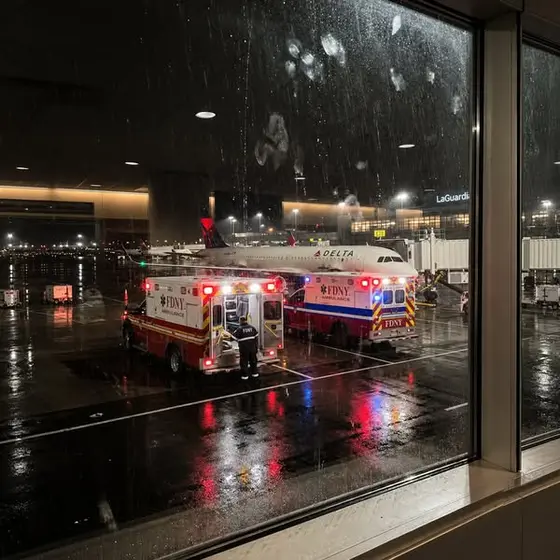
A 61-year-old woman died at LaGuardia last Wednesday. She wasn't sick. She wasn't in a hurry. She stood up to get off the plane and collapsed before she reached the aisle. No warning. No chest pain. No dramatic moment. She was there, and then she was on the floor. The paramedics said it was a pulmonary embolism. A blood clot that had been forming silently in her leg for hours — the entire flight — broke loose the moment she stood up. It traveled to her lungs in seconds. Her body shut down faster than anyone around her could understand what was happening. She made it to the trauma center ali
The Confident Travelers Facebook and Instagram ad
The Confident Travelers ran this image ad since Nov 19, 2026, 9 days so far, targeting United Kingdom.
Ad copy
A 61-year-old woman died at LaGuardia last Wednesday. She wasn't sick. She wasn't in a hurry. She stood up to get off the plane and collapsed before she reached the aisle. No warning. No chest pain. No dramatic moment. She was there, and then she was on the floor. The paramedics said it was a pulmonary embolism. A blood clot that had been forming silently in her leg for hours — the entire flight — broke loose the moment she stood up. It traveled to her lungs in seconds. Her body shut down faster than anyone around her could understand what was happening. She made it to the trauma center alive, fighting for her life. She died six hours later from cardiac arrest they couldn't reverse in time. She was flying to hold her first grandchild. Her daughter was waiting at the gate with a car seat and a welcome home sign. She never made it off the plane. I've been an ER nurse for 19 years. I work at a Level 1 trauma center in Atlanta, eleven miles from the busiest airport in the world. I was on shift the night they brought her in. Her chart was clean. No clotting disorder. No heart condition. No history of DVT. The kind of medical history most women her age would be proud of. Annual checkups. Normal bloodwork. She walked every morning. She did everything right. The cases that keep me up at night aren't the patients who ignored their doctor or skipped their checkups. They're the ones who did everything right. Stayed active. Ate well. Got the "looking good, see you in six months" from their physician. And still ended up on my stretcher because of something that had been building silently inside their body the entire flight. No warning. No symptom. Nothing they could have felt or acted on. That's what a pulmonary embolism does. It doesn't announce itself. It forms while you sit still, and by the time your body tells you something is wrong, it's already too late. Because it didn't come out of nowhere. It had been building for years. Silently. Underneath bloodwork their doctors called "normal." And almost every time, when we pulled their chart, the same thing was sitting there. A woman who flew regularly. Who stayed active. Who did everything she was supposed to do. A 57-year-old teacher from Phoenix. Flew four times a year to visit her kids. Started noticing her ankles swelling after flights about three years ago. Mentioned it to her doctor. Was told to stay hydrated and walk the aisle when she could. She was on my stretcher eighteen months later. A 62-year-old grandmother from Nashville. No prior clotting history. Had been noticing small spider veins appearing on her calves for the past two years. Wrote it off as aging. Her sister had them too. DVT in her left leg. Caught it early. She was one of the lucky ones. Every single time, when I'd ask them about symptoms they'd noticed before the flight, they'd describe the same things. Legs that felt heavier than they used to. Ankles that stayed puffy longer after a long day. Small veins appearing on their calves that weren't there ten years ago. A dullness in their skin below the knee that no amount of lotion seemed to fix. And almost every single one of them said the same thing. "I just thought that was normal menopause. I thought that was just a part of aging." After the hundredth time I heard that, I realized something. Those aren't signs of aging. Those are signs of circulation that has already started to slow down. Visible signs that your veins are working harder than they should be just to move blood back up from your legs. Flying doesn't create the problem. It accelerates one that's already there. And nobody is telling women this. The truth is, most are afraid of the wrong moment. They worry about turbulence. About the landing. About the recycled air and whether they're drinking enough water. Nobody tells them that the most dangerous moment of their entire flight is the second they stand up. Here's what's been happening to your body the entire time you've been sitting still. At cruising altitude, cabin air is pressurized to roughly the equivalent of 8,000 feet. Oxygen levels drop. The air is drier than a desert. Your blood thickens in response. And your calf muscles — the same muscles responsible for pumping blood back up from your legs to your heart — go completely inactive the moment you sit down and stay that way for hours. Blood pools in the deep veins of your legs. Silently. Without a single symptom you can feel or act on. A clot forms the same way. No pain. No swelling you'd recognize as dangerous. No warning your body gives you that anything is wrong. Just a clot, sitting in the deep vein of your calf, waiting. Then you stand up. That sudden movement is all it takes to dislodge it. The clot travels through your circulatory system, reaches your lungs, and blocks blood flow to your heart. That's a pulmonary embolism. 1 in 4 people who have one die suddenly. No chest pain incoming. No warning signs. No second chance. Over 100,000 Am
Placements and targeting
More ads from The Confident Travelers
19 dead from pulmonary embolisms in my ICU this month. 17 of them were women who had gotten off a flight within the last 48 hours. Every single one had a clean chart. Every single one had been told at her last checkup that everything looked good. Every single one did everything right. I've been an ICU nurse for 20 years. I work at a Level 1 trauma center eleven miles from one of the busiest airports in the country. I have read every one of those charts. Normal bloodwork. Stable vitals. No clotting disorder. No cardiac history. No prior DVT. The kind of medical history most women their ag
A family is suing American Airlines after a 64-year-old grandmother was found unresponsive on a domestic flight last Tuesday and pronounced dead the following morning. A physician on board had begged the crew to land. They refused twice. READ MORE: The silent risk a vascular specialist says most women over 50 have never been warned about — and why a routine flight may be the last one they ever take. Barbara Langley had one thing on her mind when she pulled into the long-term parking at Portland International Airport on a Tuesday morning in October. A trip to Boston to her daughter. After h
I've been a flight physician for 22 years. I work in the medical facility inside one of the busiest airports in the country. And there's something I need to tell you that most women will never hear until it's too late. Last Tuesday I responded to a 64-year-old woman who collapsed on the jet bridge at gate B7. She wasn't sick. She wasn't in a hurry. She had just gotten off a six hour flight from London, stood up to deplane, and made it as far as the jet bridge before her legs gave out. No warning. No chest pain. No dramatic moment. She was walking and then she was on the floor. By the time
Similar baby and kids ads
TL;DR: My eyes were swollen shut in court, and my son told the judge I'm senile. Courtroom 4B, 9 in the morning. My 3 grown kids on one side, me on the other, and their lawyer asking a judge to take my house, my checkbook and my car keys. Exhibit A was a face brush. My daughter found it in my freezer, behind the frozen corn. Exhibit B was 40 photos of my face, all taken before breakfast. Eyes swollen half shut, jaw hanging heavy, a 71-year-old woman who looked 90. My son read from his notes. "It seemed to happen quite suddenly, Your Honor. She buys things off internet ads, and she keeps ha
Set de pistolets laser infrarouges pour enfants « Encore cinq minutes.» La tablette a encore gagné. 📱 Vous n'avez pas acheté d'écrans pour élever votre enfant, mais le fameux « Je m'ennuie » se termine toujours de la même façon. Voici une alternative qui a du punch ! 🎯 2 pistolets + 1 projecteur : projette des cibles mobiles sur le mur, permettant à un enfant de jouer seul. 💥 LED + retour sonore : chaque impact est instantanément enregistré. 👨 Mode bataille en équipe : dans n'importe quelle pièce, sans installation. 🏠 Idéal pour l'intérieur : pas de balles qui volent, pas de lampes cass
Soft silicone, one gentle tap, instant warm glow. A thoughtful little gift that lights up their room – and their face.
Up to 50% off selected bundles 🧸. Stock up on the kids favourites before Black Friday ends 🛒.
Keep exploring
Find more ads like this
Search millions of real ads by keyword, niche and format, and save the winners to your swipe file.
