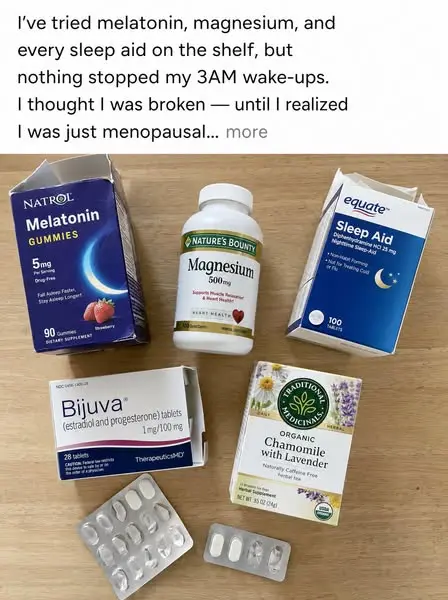
I sat on the paper-covered table for forty minutes. Gown open at the back. Feet dangling like a kid. Waiting to be told, one more time, that it was all in my head. I'm 54. For three years I fell asleep fine, then snapped awake at 3am like someone flipped a switch. Heart slamming. Pillow damp. Brain wide awake and sprinting on nothing. By the time the doctor walked in, I'd rehearsed it twenty times so I wouldn't cry. I told her about the 3am wake-ups. The soaked sheets. The 2pm wall, where my brain just quit in the middle of a sentence. She looked at the screen. Not at me. "Your bloodwork is normal," she said. "It's just menopause. Try to relax before bed." She printed a pamphlet about hot flashes and told me to come back in six months. I sat in my car in the parking lot and didn't move for ten minutes. Normal. Every test, normal. Thyroid, normal. Iron, normal. The morning cortisol draw, normal. And every single day, I didn't know the woman in the mirror. Here's what "normal" looked like at my house. Asleep by 10:30, because I was destroyed by 9. Awake at 3:07. Then 3:11. Then I'd watch the ceiling fan turn until 5. Up at 6:30 feeling like I'd been in a fight I lost. Second coffee by 9. Brain still underwater. By 2pm I couldn't remember the word for "Tuesday." I'd been the person who ran the meeting. Now I was the person hoping no one called on me. I snapped at my husband over a dishwasher. I went to the guest room so he wouldn't hear me cry at 4am. I stopped saying yes to anything after 7pm, because I knew what the night would cost me. I missed my niece's graduation. I'd been up since 3 and there was nothing left in me by noon. I tried everything they tell you to try. Magnesium. Then melatonin, which left me groggy until lunch and gave me dreams like horror films. Chamomile tea. A cooling pillow. Blackout curtains. A 10pm phone ban that made me feel twelve years old. I cut wine. I cut sugar. I cut coffee after noon, then cut it completely. I tried the breathing app. The weighted blanket. The magnesium spray on my feet. Nothing held. I started to believe this was just my life now. That I'd spend the next twenty years watching everyone else live while I tried to survive the day. Then my neighbor said the thing no doctor ever had. She runs a sleep clinic. We were talking over the fence while I dragged the bins out. I told her I'd basically given up on evenings. She didn't nod along. She frowned. "Has anyone ever explained what your nervous system is actually doing at 3am?" she said. "They keep telling me it's menopause," I said. "Menopause is the trigger," she said. "But the reason you wake up wired is a brake that stopped working." She picked up a stick and drew it in the dirt. "Estrogen and progesterone don't just run your periods. They help run the off-switch on your stress system. The calm signal. The brake." "As they drop, the brake wears down. Like pads worn to the metal." "So at 3am, when your body is supposed to be in its deepest repair, you get a surge of cortisol with nothing to stop it. It's an alarm that won't switch off." "That's why you wake up hot and racing for no reason. It isn't a reason. It's an alarm with a dead off-switch." I just stood there. "And the 2pm wall?" I asked. "Same alarm," she said. "It ran all night. So your tank is empty before lunch." "But I sleep eight hours," I said. "You lie in bed eight hours," she said. "Your nervous system stands guard for most of them. Then it's supposed to carry you through the day too. With what?" That night I couldn't stop thinking about it. At 11:30 I started reading. Not the chamomile-tea articles. The real ones. Papers showing menopausal sleep disruption is driven as much by an over-alert nervous system as by the hormones. That melatonin only tells your brain it's bedtime. That sleeping pills force the body down while the alarm keeps running underneath, then wears off at 3am and drops you right back into it. Every word matched my life. I texted her the next morning. "Okay. Say you're right. What do I actually do?" She called me on her lunch break. "You support the calm-down your hormones used to do," she said. "Without melatonin. Without sedation. You quiet the alarm instead of knocking yourself out." "We started using one at the clinic last year, mostly for women in menopause. The change in them was not subtle." "You can't grab any sleep gummy off the shelf," she said. "Most are loaded with melatonin, which is the exact thing that leaves you foggy. The one we use is called Sloom. It's melatonin-free. Two gummies. Magnesium glycinate and L-theanine to quiet the mind, passionflower and valerian to help you settle and stay settled." It was none of the things I was afraid of. Not a sleeping pill. Not a hormone. Not melatonin. There was a money-back guarantee. They don't even ask for the jar back. After three years of pamphlets, what was one more try. Night one, I noticed nothing. Night two, I woke at 3am, and went back to sleep. Not instantly. But I was confused when the alarm went off and I hadn't watched the ceiling fan once. That hadn't happened in three years. By day four I made it past 2pm without the wall. I looked up and it was 4:30 and I'd forgotten my second coffee. By the end of week two, I woke up before my alarm and lay there waiting for the dread. The drenched pillow. The slamming heart. The heaviness behind my eyes. It wasn't there. It just wasn't there. I'm not going to tell you I sleep like I'm 25. I don't. I wake up some nights. I just fall back asleep now, instead of starting my day at 3am. Last week my husband looked at me across the kitchen and said, "you seem like you again." That's the part the pamphlet never mentioned. I still have menopause. I always will. But I didn't have the menopause they told me I had. I had an alarm with a worn-out off-switch, and not one person in a white coat thought to look for it. If you've been handed the pamphlet and sent home. If your tests keep coming back normal while you fall apart a little more each day. If you wake at 3am wired and drenched and wide awake. You're not broken, and you're not imagining it. You just have an off-switch that needs help, not a stronger sedative. Here's the part I think about now. It isn't the three years of bad sleep that haunts me. It's the things I said no to. The graduation. The dinners. The version of me my family kept waiting for. You don't get those nights back. But you don't have to keep losing the next ones. Sloom is melatonin-free, hormone-free, and every ingredient and dose is on the label. They back it with a money-back guarantee, so the only thing you risk is one more normal night. P.S. By night two I slept through a 3am wake-up for the first time in three years. If your sleep is "fine" until 3am and then it isn't, that's the part this was built for. Read who it's for before you decide it's just you.
Susan Whitmore Facebook and Instagram ad
Susan Whitmore ran this image ad since Jun 24, 2026, 136 days so far, targeting United Kingdom.
Ad copy
I cleaned out my nightstand drawer last month and counted eleven different things I'd bought to help me sleep. Two kinds of melatonin. Magnesium. A bottle of valerian capsules. An OTC sleep aid. A half-used HRT patch box. Three different "sleepy" teas. A lavender spray. A bottle of something a $90-a-month subscription sent me. Eleven products. Hundreds of dollars. And I was still waking up at 3am every single night. I'm 59. For four years I fought to get even four hours, and I was losing. If you're reading this at 3:15 in the morning, I already know your drawer. Mine was the same. Let me walk you through the graveyard. The melatonin. I started at 1mg. Then 3. Then 5. Then 10. It stopped doing anything except making my mornings feel like wet cement and giving me dreams I'd wake up rattled from. The magnesium. Helped my legs, maybe. Did nothing for the 3am wake-up. The OTC sleep aids. They knocked me out for a few hours, then I'd surface at 3 with a dry mouth and a head full of cotton. The prescription my GP finally offered. I watched my mother spend a decade on those. I said no. The teas, the sprays, the apps, the cooling pillow, the weighted blanket. The cut caffeine. The cut wine. The earlier bedtime that just gave me more hours to lie awake. Four years of it. And the pattern never changed. Asleep by 11. Wide awake at 3. Wrecked by 9. I'd lie there with my heart going, brain replaying a conversation from a week ago, doing the cruel little math. Three hours left. Now two and a half. By 2pm the next day I'd hit a wall so hard I could feel the energy drain out of me like water from a tub. I started to believe I was just broken. That this was the rest of my life, and I should make peace with it. I wasn't broken. I was pouring water into a glass with a crack in it. Every single thing in that drawer was going into the wrong place. I found that out from my brother's wife, who'd been exactly where I was. We were at a barbecue and I made a joke about my sleep-aid collection. She didn't laugh. She said, "none of that was ever going to work, and it's not your fault." I asked her what she meant. "Think about what each of those actually does," she said. "Melatonin tells your brain it's nighttime. But you don't have trouble falling asleep. You have trouble staying asleep. So it's solving a problem you don't have." "The sleeping pills just sedate you. They press the body down for a few hours, but they don't fix the thing waking you up. So the second they wear off, around 3am, you're right back where you started." "You kept buying things that pour into a glass with a crack in it," she said. "The water runs straight out. The crack is the thing nobody was treating." "What's the crack?" I asked. "Your nervous system," she said. "In menopause, when estrogen and progesterone drop, you lose the calming brake that's supposed to switch your body off at night. So cortisol, which should be at its lowest at 3am, surges instead. That's your wake-up. Not falling asleep. Staying asleep. None of your eleven products even touched it." I felt two things at once. Furious, that four years and hundreds of dollars had gone into the wrong system. And relieved, because for the first time, somebody was describing the actual leak. That night I read until 1am. It held up. Menopausal sleep disruption is a hormone shift and a nervous system stuck on high alert. Melatonin and sedatives miss the second part completely. You have to help the system calm down and stay down. You have to seal the crack, not keep pouring. I asked her what she finally used. "I threw out the melatonin," she said. "I use one called Sloom. It's melatonin-free, which is the whole point. Two gummies. Magnesium glycinate and L-theanine to quiet the racing, passionflower and valerian to actually calm the system and keep it calm. No hormones. Nothing to wean off of." After eleven failed products, I'll admit I expected number twelve to fail too. But this one was different on the label, where it counts. No melatonin. No hormones. Every ingredient and every dose printed right there, no mystery blend. There was a money-back guarantee, so the only thing I risked was a few more nights I was losing anyway. The first night, I didn't feel much. The second night, I woke up at 3am, and I did not feel drugged or knocked out. I just felt quiet. I rolled over and the next thing I knew it was 7:30 and I hadn't been up since midnight. That had not happened in four years. By the end of the first week I was getting back to sleep in minutes instead of hours. By week two I made it to 4pm without the wall, looked up, and realized I'd forgotten to dread the night. It's been three months. I'm not going to lie and say every night is perfect. Some nights I still wake up. I just fall back asleep now, the way I used to. But the fog's gone. The afternoons are mine again. I emptied that nightstand drawer into the trash and didn't miss a single bottle. Here's what I want you to take from a woman with a four-year graveyard. If you've tried everything and nothing holds, it's not because you're broken. It's because you've been treating the wrong problem with the wrong tools. You took the melatonin. You tried the magnesium. You cut the wine and went to bed early. You did everything right. You were just pouring it all into a cracked glass. That's not your fault. If you wake at 3am wired and drenched. If your sleep-aid drawer looks like mine did. If you've started to believe this is just who you are now. It probably isn't a willpower problem and it probably isn't permanent. Sloom is melatonin-free, hormone-free, every dose on the label, with a money-back guarantee. The only thing you're risking is product number twelve doing what the first eleven couldn't. P.S. The second night, I slept through a 3am wake-up for the first time in four years. If you've got a drawer full of things that didn't work, the reason isn't you. It's that none of them sealed the crack. Read what's actually in this one before you decide it belongs in the drawer.
Placements and targeting
More ads from Susan Whitmore
I cleaned out my nightstand drawer last month and counted eleven different things I'd bought to help me sleep. Two kinds of melatonin. Magnesium. A bottle of valerian capsules. An OTC sleep aid. A half-used HRT patch box. Three different "sleepy" teas. A lavender spray. A bottle of something a $90-a-month subscription sent me. Eleven products. Hundreds of dollars. And I was still waking up at 3am every single night. I'm 59. For four years I fought to get even four hours, and I was losing. If you're reading this at 3:15 in the morning, I already know your drawer. Mine was the same. Let me walk you through the graveyard. The melatonin. I started at 1mg. Then 3. Then 5. Then 10. It stopped doing anything except making my mornings feel like wet cement and giving me dreams I'd wake up rattled from. The magnesium. Helped my legs, maybe. Did nothing for the 3am wake-up. The OTC sleep aids. They knocked me out for a few hours, then I'd surface at 3 with a dry mouth and a head full of cotton. The prescription my GP finally offered. I watched my mother spend a decade on those. I said no. The teas, the sprays, the apps, the cooling pillow, the weighted blanket. The cut caffeine. The cut wine. The earlier bedtime that just gave me more hours to lie awake. Four years of it. And the pattern never changed. Asleep by 11. Wide awake at 3. Wrecked by 9. I'd lie there with my heart going, brain replaying a conversation from a week ago, doing the cruel little math. Three hours left. Now two and a half. By 2pm the next day I'd hit a wall so hard I could feel the energy drain out of me like water from a tub. I started to believe I was just broken. That this was the rest of my life, and I should make peace with it. I wasn't broken. I was pouring water into a glass with a crack in it. Every single thing in that drawer was going into the wrong place. I found that out from my brother's wife, who'd been exactly where I was. We were at a barbecue and I made a joke about my sleep-aid collection. She didn't laugh. She said, "none of that was ever going to work, and it's not your fault." I asked her what she meant. "Think about what each of those actually does," she said. "Melatonin tells your brain it's nighttime. But you don't have trouble falling asleep. You have trouble staying asleep. So it's solving a problem you don't have." "The sleeping pills just sedate you. They press the body down for a few hours, but they don't fix the thing waking you up. So the second they wear off, around 3am, you're right back where you started." "You kept buying things that pour into a glass with a crack in it," she said. "The water runs straight out. The crack is the thing nobody was treating." "What's the crack?" I asked. "Your nervous system," she said. "In menopause, when estrogen and progesterone drop, you lose the calming brake that's supposed to switch your body off at night. So cortisol, which should be at its lowest at 3am, surges instead. That's your wake-up. Not falling asleep. Staying asleep. None of your eleven products even touched it." I felt two things at once. Furious, that four years and hundreds of dollars had gone into the wrong system. And relieved, because for the first time, somebody was describing the actual leak. That night I read until 1am. It held up. Menopausal sleep disruption is a hormone shift and a nervous system stuck on high alert. Melatonin and sedatives miss the second part completely. You have to help the system calm down and stay down. You have to seal the crack, not keep pouring. I asked her what she finally used. "I threw out the melatonin," she said. "I use one called Sloom. It's melatonin-free, which is the whole point. Two gummies. Magnesium glycinate and L-theanine to quiet the racing, passionflower and valerian to actually calm the system and keep it calm. No hormones. Nothing to wean off of." After eleven failed products, I'll admit I expected number twelve to fail too. But this one was different on the label, where it counts. No melatonin. No hormones. Every ingredient and every dose printed right there, no mystery blend. There was a money-back guarantee, so the only thing I risked was a few more nights I was losing anyway. The first night, I didn't feel much. The second night, I woke up at 3am, and I did not feel drugged or knocked out. I just felt quiet. I rolled over and the next thing I knew it was 7:30 and I hadn't been up since midnight. That had not happened in four years. By the end of the first week I was getting back to sleep in minutes instead of hours. By week two I made it to 4pm without the wall, looked up, and realized I'd forgotten to dread the night. It's been three months. I'm not going to lie and say every night is perfect. Some nights I still wake up. I just fall back asleep now, the way I used to. But the fog's gone. The afternoons are mine again. I emptied that nightstand drawer into the trash and didn't miss a single bottle. Here's what I want you to take from a woman with a four-year graveyard. If you've tried everything and nothing holds, it's not because you're broken. It's because you've been treating the wrong problem with the wrong tools. You took the melatonin. You tried the magnesium. You cut the wine and went to bed early. You did everything right. You were just pouring it all into a cracked glass. That's not your fault. If you wake at 3am wired and drenched. If your sleep-aid drawer looks like mine did. If you've started to believe this is just who you are now. It probably isn't a willpower problem and it probably isn't permanent. Sloom is melatonin-free, hormone-free, every dose on the label, with a money-back guarantee. The only thing you're risking is product number twelve doing what the first eleven couldn't. P.S. The second night, I slept through a 3am wake-up for the first time in four years. If you've got a drawer full of things that didn't work, the reason isn't you. It's that none of them sealed the crack. Read what's actually in this one before you decide it belongs in the drawer.
I sat on the paper-covered table for forty minutes. Gown open at the back. Feet dangling like a kid. Waiting to be told, one more time, that it was all in my head. I'm 54. For three years I fell asleep fine, then snapped awake at 3am like someone flipped a switch. Heart slamming. Pillow damp. Brain wide awake and sprinting on nothing. By the time the doctor walked in, I'd rehearsed it twenty times so I wouldn't cry. I told her about the 3am wake-ups. The soaked sheets. The 2pm wall, where my brain just quit in the middle of a sentence. She looked at the screen. Not at me. "Your bloodwork is normal," she said. "It's just menopause. Try to relax before bed." She printed a pamphlet about hot flashes and told me to come back in six months. I sat in my car in the parking lot and didn't move for ten minutes. Normal. Every test, normal. Thyroid, normal. Iron, normal. The morning cortisol draw, normal. And every single day, I didn't know the woman in the mirror. Here's what "normal" looked like at my house. Asleep by 10:30, because I was destroyed by 9. Awake at 3:07. Then 3:11. Then I'd watch the ceiling fan turn until 5. Up at 6:30 feeling like I'd been in a fight I lost. Second coffee by 9. Brain still underwater. By 2pm I couldn't remember the word for "Tuesday." I'd been the person who ran the meeting. Now I was the person hoping no one called on me. I snapped at my husband over a dishwasher. I went to the guest room so he wouldn't hear me cry at 4am. I stopped saying yes to anything after 7pm, because I knew what the night would cost me. I missed my niece's graduation. I'd been up since 3 and there was nothing left in me by noon. I tried everything they tell you to try. Magnesium. Then melatonin, which left me groggy until lunch and gave me dreams like horror films. Chamomile tea. A cooling pillow. Blackout curtains. A 10pm phone ban that made me feel twelve years old. I cut wine. I cut sugar. I cut coffee after noon, then cut it completely. I tried the breathing app. The weighted blanket. The magnesium spray on my feet. Nothing held. I started to believe this was just my life now. That I'd spend the next twenty years watching everyone else live while I tried to survive the day. Then my neighbor said the thing no doctor ever had. She runs a sleep clinic. We were talking over the fence while I dragged the bins out. I told her I'd basically given up on evenings. She didn't nod along. She frowned. "Has anyone ever explained what your nervous system is actually doing at 3am?" she said. "They keep telling me it's menopause," I said. "Menopause is the trigger," she said. "But the reason you wake up wired is a brake that stopped working." She picked up a stick and drew it in the dirt. "Estrogen and progesterone don't just run your periods. They help run the off-switch on your stress system. The calm signal. The brake." "As they drop, the brake wears down. Like pads worn to the metal." "So at 3am, when your body is supposed to be in its deepest repair, you get a surge of cortisol with nothing to stop it. It's an alarm that won't switch off." "That's why you wake up hot and racing for no reason. It isn't a reason. It's an alarm with a dead off-switch." I just stood there. "And the 2pm wall?" I asked. "Same alarm," she said. "It ran all night. So your tank is empty before lunch." "But I sleep eight hours," I said. "You lie in bed eight hours," she said. "Your nervous system stands guard for most of them. Then it's supposed to carry you through the day too. With what?" That night I couldn't stop thinking about it. At 11:30 I started reading. Not the chamomile-tea articles. The real ones. Papers showing menopausal sleep disruption is driven as much by an over-alert nervous system as by the hormones. That melatonin only tells your brain it's bedtime. That sleeping pills force the body down while the alarm keeps running underneath, then wears off at 3am and drops you right back into it. Every word matched my life. I texted her the next morning. "Okay. Say you're right. What do I actually do?" She called me on her lunch break. "You support the calm-down your hormones used to do," she said. "Without melatonin. Without sedation. You quiet the alarm instead of knocking yourself out." "We started using one at the clinic last year, mostly for women in menopause. The change in them was not subtle." "You can't grab any sleep gummy off the shelf," she said. "Most are loaded with melatonin, which is the exact thing that leaves you foggy. The one we use is called Sloom. It's melatonin-free. Two gummies. Magnesium glycinate and L-theanine to quiet the mind, passionflower and valerian to help you settle and stay settled." It was none of the things I was afraid of. Not a sleeping pill. Not a hormone. Not melatonin. There was a money-back guarantee. They don't even ask for the jar back. After three years of pamphlets, what was one more try. Night one, I noticed nothing. Night two, I woke at 3am, and went back to sleep. Not instantly. But I was confused when the alarm went off and I hadn't watched the ceiling fan once. That hadn't happened in three years. By day four I made it past 2pm without the wall. I looked up and it was 4:30 and I'd forgotten my second coffee. By the end of week two, I woke up before my alarm and lay there waiting for the dread. The drenched pillow. The slamming heart. The heaviness behind my eyes. It wasn't there. It just wasn't there. I'm not going to tell you I sleep like I'm 25. I don't. I wake up some nights. I just fall back asleep now, instead of starting my day at 3am. Last week my husband looked at me across the kitchen and said, "you seem like you again." That's the part the pamphlet never mentioned. I still have menopause. I always will. But I didn't have the menopause they told me I had. I had an alarm with a worn-out off-switch, and not one person in a white coat thought to look for it. If you've been handed the pamphlet and sent home. If your tests keep coming back normal while you fall apart a little more each day. If you wake at 3am wired and drenched and wide awake. You're not broken, and you're not imagining it. You just have an off-switch that needs help, not a stronger sedative. Here's the part I think about now. It isn't the three years of bad sleep that haunts me. It's the things I said no to. The graduation. The dinners. The version of me my family kept waiting for. You don't get those nights back. But you don't have to keep losing the next ones. Sloom is melatonin-free, hormone-free, and every ingredient and dose is on the label. They back it with a money-back guarantee, so the only thing you risk is one more normal night. P.S. By night two I slept through a 3am wake-up for the first time in three years. If your sleep is "fine" until 3am and then it isn't, that's the part this was built for. Read who it's for before you decide it's just you.
Similar health and supplements ads
NO GYM, NO STRESS JUST DANCING! BOOST YOUR MOOD QUICKLY BURN CALORIES Take a quiz and get your dance plan in DanceFitMe
Keep exploring
Find more ads like this
Search millions of real ads by keyword, niche and format, and save the winners to your swipe file.
