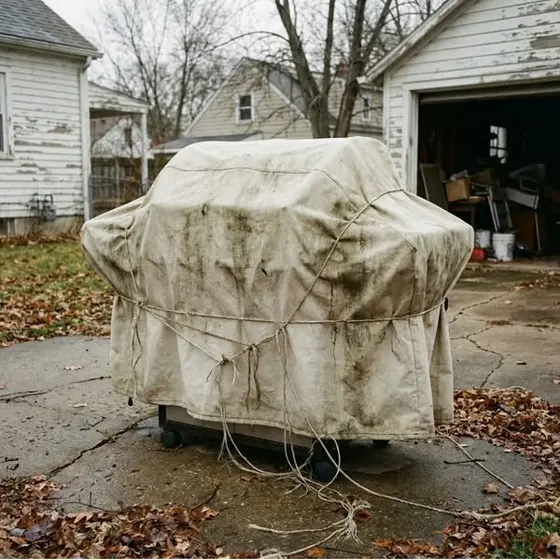
My husband covered his grill on April 8th, 2024. Gave away every cut of meat in the freezer. Went on the Mediterranean diet. Cut the carbs. Walked three miles a day. Started juicing spinach, of all things. Did everything the doctor told him. He died of liver failure on July 16th at 4:08 in the morning. He was 63. He covered the grill on April 8th. Gave up the Friday takeout. Gave up the Sunday cookouts he'd run every week for twenty-eight years. Lost 27 pounds. Walked three miles every morning, rain or shine. The hospital bill was $66,418. The funeral was $10,240. His grill is still on the patio, covered, right where he left it. I can't move it. If I move it, he's really gone. I need to tell you what happened to Dale. Because I'm seeing the same posts on Facebook that I was writing just months before he died... "my husband's fibroscan came back high, the doctor says fatty liver, any advice?"... and it makes me physically sick. If you're over 40, or someone you love is, and food was always your thing... please read this whole thing. I know it's long. I know you're scrolling. I know you've got things to do. Fourteen months ago I would have given anything... everything... for someone to tell me what I'm about to tell you. Dale didn't even go to the doctor about his liver. He went in for a CT scan over a kidney stone, late January 2024. He felt fine. Better than fine. He'd just turned 62. Still split his own firewood. Still fired up the grill every weekend. Thought he was indestructible and honestly so did I. The tech went quiet halfway through the scan. Two days later the doctor called. "Dale, your kidneys are fine. But the scan caught your liver. We ran bloodwork. Your ALT is 184. There's significant fat buildup, and there's already some scarring. This is non-alcoholic fatty liver disease." Dale went quiet on the call. I was in the kitchen pretending not to listen. "But I barely drink," he said. "I know. This isn't from alcohol, Dale. It's years of how you've eaten. The grilling. The takeout. The weight around the middle. We need to change all of it. Mediterranean diet. Lose the weight. Nothing fried, no processed meat, no sugar, cut the carbs. We'll retest in three months." Dale hung up the phone and sat at the kitchen table for forty minutes without saying anything. Then he got up, walked out to the patio, and pulled the cover over the grill. That grill was him. Carne asada every Saturday that you could smell down the whole block. Ribs the grandkids fought over. Burgers with everything on them. Our daughter still came every Sunday with the kids for his cooking... the ribs, the baked potatoes, the whole spread. "That's it," he said. "I'm done." And he was. For 98 days, he didn't touch it. No grilling. No ribs. No Friday takeout. Nothing at his cousin's retirement party in May, where the whole table ate steak and he had a plain grilled chicken breast with a side of vegetables. Nothing at the cookout he used to host... he stopped hosting it altogether, because he couldn't stand to be at his own grill cooking for everyone and then eat a dry piece of fish off a paper plate. He lost the thing everyone knew him for. His buddies from the neighborhood grill group stopped calling. The Sunday dinners got quieter... the kids still came, but he sat there with his sad little plate while they ate the food he used to make, and you could see what it cost him. He lost a piece of himself he'd carried for thirty years. And he did it anyway. Because the doctor told him to. He lost 27 pounds in those three months. He bought a juicer... Dale, with a juicer, I still can't picture it. He started walking three miles every morning before work. He took the milk thistle his doctor "wasn't against." He took a multivitamin. He ate fish and steamed vegetables every night, the man who used to call salad "bird food." He did everything right. The follow-up labs came back on July 6th. ALT: 172. His fibroscan had barely moved. The fat was still there. The scarring the same. He'd given up everything he loved for three months and the numbers had barely moved. The doctor said "give it more time. The liver heals slowly. A lifetime of eating doesn't undo in a few months. Keep doing what you're doing, we'll retest in six." Dale came home that night and sat back down at the kitchen table. The same table he sat at after the first call. He didn't say anything for a long time. Then he said: "Becki, I gave up everything. Everything. And it didn't work." I told him to give it time. I told him the doctor said six months. I told him to trust the process. He nodded. He kept walking. He kept juicing. He kept eating the fish and the vegetables. He kept taking the milk thistle. Five days later... five days... he woke up at 2 in the morning with a pain in his right side that doubled him over. I drove him to the ER. By the time they admitted him at 4:30 in the morning, the whites of his eyes were yellow. Not "a little off." Yellow. Like a highlighter. Like someone had switched off a light behind them. The ER doctor... a young woman, couldn't have been 35... looked at Dale's bloodwork and her face did this thing. "Mr. Whitfield, your bilirubin is 9.1. Your liver is in acute decompensation. The scarring is much further along than the scan showed. We're admitting you to intensive care." "But I changed everything three months ago," Dale said. The doctor just looked at him. "I know, Mr. Whitfield. I'm sorry." Dale spent 12 days in intensive care. I learned things about the liver I never wanted to know. I learned that when a liver shuts down, the toxins your body makes every single day... ammonia, mostly... start building up in your blood and crossing into your brain. They call it hepatic encephalopathy. It means your husband stops being your husband. On day 7, Dale asked me twice in ten minutes if he'd turned off the grill. The grill had been covered for three months. He didn't know where he was. I learned that they inject something called NAC into the vein when a liver is shutting down. The nurse told me it's the same compound they use in overdose cases. She said it forces the liver to start rebuilding the master antioxidant it uses to protect itself... something called glutathione. She said it's the only thing they've got, and at that point they were hoping it would buy him time. It bought him 12 days. On day 9, his kidneys started to fail. They talked about a transplant. Then they talked about how he wasn't a candidate because of how fast he was going down. Then they stopped talking about transplants at all. On day 11, his belly swelled up like he was nine months pregnant. They drained almost 4 liters of fluid out of his abdomen. The nurse called it ascites. I called my daughter. On day 12... July 16th... they asked me to step out while they intubated him. At 4:01 in the morning I heard the long beep. At 4:08, a doctor I'd never seen walked into the family room. I already knew. "I'm so sorry. We did everything we could." I drove home at 5:30 in the morning. The juicer was still on the counter. His walking shoes were still by the back door. The milk thistle was still on the windowsill over the sink, next to the multivitamin. His apron was still hanging on the hook in the pantry. And the grill was still on the patio under its cover. Where it still is today. I sat in his recliner and didn't move for six hours. The house was so quiet I could hear the refrigerator hum. 36 years. And now the only sound in my house was the refrigerator. The funeral was July 30th. I heard it twice. Two different people, lowering their voices: "I didn't know Dale drank." He didn't. That's the part that breaks me. People hear "liver failure" and they assume. He gave up the grilling, the ribs, the Sunday dinners... and they still buried him under an assumption that wasn't even true. Dale's brother flew in from Oregon for the funeral. Our daughter drove up from Nashville. The grandkids wore suits that were too big for them. My four-year-old granddaughter asked me: "Grandma, when is Grandpa coming home?" I told her Grandpa was in heaven now. She said: "Can we call him there?" I had to leave the room. After the funeral, I tried to go back to normal. I couldn't. Because every time I opened my phone I saw people my age, men Dale's age, writing "doctor says I have fatty liver, anyone tried milk thistle?" or "fibroscan came back borderline, started the Mediterranean diet, we'll see." And I knew... I KNEW... some of them were doing exactly what Dale did. Giving up the food they love. Eating clean. Walking. Juicing. Taking the milk thistle. And dying anyway. So I started researching. Not because I wanted to. Because I had to. Because if Dale gave up everything for nothing... if I can't save even one person from what happened to him... then I can't live with that. I read for weeks. Medical journals I barely understood. Hepatology forums. Studies out of Japan and Germany. And one thing kept coming up, over and over, that no doctor ever told us. The reason Dale's numbers didn't come down is that changing your diet only stops adding new damage. It doesn't restore the one thing his liver had been running on for sixty years. Specifically: glutathione. Glutathione is the master antioxidant your liver uses to process everything that passes through your body... every meal, every medication, every toxin, every greasy plate, every breath of polluted air. Every cell in your liver depends on it. And here's what nobody told us. Glutathione depletes slowly, quietly, over decades. Every meal Dale's liver processed over sixty years used a little. Every medication. Every toxin. Every stressful year. Bit by bit the reserve got stripped faster than his body could rebuild it. By his late 50s and into his 60s, Dale was running a severe glutathione deficit, not enough to show up on a standard panel, but enough to explain why his liver was failing despite three months of doing everything right. When glutathione runs low, the liver can't process and clear fat the way it used to. The fat that's supposed to get packaged up and moved out of the liver cells has nowhere to go. It stays. It oxidizes. It inflames. It hardens into scar tissue. Dale's liver wasn't damaged because he ate too much grilled meat. It was damaged because there wasn't enough glutathione left to process the food he'd eaten his whole life. Read that again. His liver wasn't broken by the meat. It was broken by the empty tank the meat was being processed through. And here's why cutting the food alone didn't save him. Cutting the food stops new fat coming in. It doesn't refill the tank, and it doesn't move out the fat already stuck in there hardening. His tank was already empty by the time the doctor told him to change. Losing 27 pounds, juicing spinach, walking three miles... those things slow down how fast you burn through what's left. They don't put back what's already gone. That's why his numbers wouldn't move. He gave up everything he loved to stop feeding a fire that was already burning on the inside. I sat with that for three days. Then I started looking at what I'd been doing. I threw out Dale's milk thistle the week after the funeral. But I bought a new bottle for myself. Because I'm 57. Because my labs came back "borderline" at my last checkup. Because I was scared. I took it for three weeks. My doctor... a different one than Dale's, one I called because I trusted her... was blunt when I told her. "Becki, milk thistle puts a shield around the liver cells. It does not give the liver the raw material to rebuild glutathione. It's protecting cells that are already drowning in what they can't clear. It was never going to refill what Dale was running out of." Then she said something I'll never forget. "If Dale had been on something that actually rebuilt his glutathione... that gave his liver the raw material it had been running without for years... the picture might have been very different." I stopped breathing for a second. "Why didn't his doctor tell him that?" She was quiet for a long time. "Because we don't prescribe supplements. And the one that actually works isn't a prescription." I went to the pharmacy the next day. I stood in that aisle for forty minutes. Milk thistle. Liver detox tea. Dandelion root capsules. A 30-day "liver cleanse" program. Multivitamins with "liver support." I read every single label. Not one of them gave the liver the raw material to actually rebuild glutathione. They were all the same thing Dale's milk thistle was. A shield around cells that were already starving. Nothing that refilled the empty tank. I walked out of that aisle without buying anything. About a week later I was reading a thread in one of those fatty liver groups... full of people like Dale was, "non-alcoholic fatty liver" people, "high ALT" people... and a man wrote something that stopped me cold. He said he'd been diagnosed with fatty liver at 56. Cleaned up his diet, lost weight, took generic milk thistle for months, and his numbers barely moved... sound familiar?... and then he found a formula that did the one thing none of it had done. It gave his liver the raw material to rebuild glutathione, and it refueled his liver cells at the same time. His ALT dropped from 162 to 34 in eleven weeks. Without a stricter diet. Without doing anything else different. I read that post six times. Here's what I learned. And this is the part I wish someone had told us before Dale covered his grill. A liver that's been processing food, stress, and toxins for decades isn't running out of willpower. It's running out of two things at the same time. And unless you put both of them back, nothing changes. The numbers don't move. The fat stays stuck. The scarring keeps growing. Think of your liver like an oil filter. When it's clean, everything that passes through gets processed and cleared. Every meal, every toxin, handled, gone, no problem. When the filter is choked, it doesn't matter what you stop pouring in. The exit is closed, and everything that can't get out starts to accumulate. That's what fatty liver actually is. Not too much food going in. A filter that can no longer process what's already there, because the thing it needs to do the job has run out. And the thing it needs is glutathione. But here's the second half nobody told us. At the same time the glutathione runs out, a second system is failing right alongside it. NAD+. It's a coenzyme every cell in your body uses to make energy. In your 20s it's at its peak. By your late 40s and 50s it's dropped by roughly half. Dale's liver cells were trying to do the hardest job in the body... processing everything he took in, clearing the fat, repairing the damage... on half the cellular energy they used to have. A liver running on empty glutathione AND depleted NAD+ can't process fat. Can't clear what's stuck. Can't repair itself. No matter how clean he ate. No matter how much weight he lost. Two systems. Failing at the same time. And the only tool anyone gave him was a milk thistle pill that couldn't touch either one. That's why his numbers wouldn't move. That's why losing 27 pounds didn't save him. That's why 98 days of giving up everything he loved was never going to be enough. He was scrubbing the counters in a kitchen where the drain was clogged and the power was half off. The kitchen was never going to come clean. That's when I found The Vital Labs NAC600 + NAD+. It was buried in a forum thread. Not a flashy ad. Just someone sharing what worked when nothing else did. When I saw the formula, I understood in about sixty seconds why it was different from everything in that pharmacy aisle. 600mg of NAC. N-Acetyl Cysteine. The clinical dose, not the token 200mg most brands hide behind. NAC is the direct precursor to glutathione, the raw material the liver uses to rebuild it. It's the exact compound the ICU was putting into Dale's vein at the end. It refills the tank that Dale's was running on empty. That's the first system. NAD+ in the same formula. Because rebuilding the glutathione without refueling the cells is half a solution... a full tank with a dead battery still doesn't drive. The NAD+ restores the cellular energy his liver cells were running without. That's the second system. And it's not dry powder. It's coconut MCT oil softgels. Dry powder NAC has that sulfur smell, the burps, the stomach upset that makes most people quit within ten days before it can do anything, and it degrades in digestion anyway. The oil softgels get rid of all of it and actually absorb. Third-party tested. Every batch. Certificate of analysis published. No proprietary blends. No hidden underdosing. Two systems. Both restored. At the doses the research actually uses. Two softgels a day with breakfast. Not one problem. Two. Not a shield around the cells. The actual raw material they were starving for. I almost didn't order it. After the pharmacy aisle. After the milk thistle. After Dale. After everything. But I had a brother who eats exactly like Dale ate. I had a son-in-law with "borderline" fatty liver. I had myself. I ordered it. My brother Ed came back from a routine appointment with an ALT of 155 and a fibroscan that scared him. He's the one with the grill now that Dale's gone... ribs every weekend, won't give up his food for anybody. I sent him a bottle. I didn't ask. I just sent it. I wrote a note that said "If you don't take this every day, I will never speak to you again, Ed, I mean it." He took it. He kept eating exactly the same... wouldn't change his diet, stubborn the way Dale was stubborn... but he took two softgels every day with breakfast. He went back to his doctor five weeks ago for a follow-up. ALT: 38. Down from 155. In eleven weeks. He hadn't given up the ribs. He hadn't changed his diet. He hadn't started exercising. The only thing he changed was the softgel he took in the morning. He called me crying. My brother. 55 years old. Crying on the phone like a kid. He said: "Becki, I think Dale died because nobody told him about this." I had to hang up. Then there's my son-in-law. 42, two kids, "borderline fatty liver" at his last checkup. Started taking it eight weeks ago. He says his afternoon energy is back. He says the dull ache he'd had under his right rib for two years... the one his doctor said was "probably nothing"... is gone. His numbers came back in normal range. My neighbor Linda. Her husband died of cirrhosis five months before Dale. Two widows on the same street. She started taking it two days after I told her. She says it's the first time since he died that she doesn't feel like she's waiting for a phone call about her own liver. I'm not a doctor. I'm not a scientist. I'm not selling anything and I don't get a penny from any of this. I'm a 57-year-old widow sitting in my dead husband's recliner at 2 in the morning because I can't sleep and I can't stop thinking about my brother and whether he's going to end up where Dale ended up. Here's what I know because I lived it. Changing your diet stops adding new damage. It doesn't refill what's already run out. It doesn't clear the fat that's already stuck. Milk thistle puts a shield around the cells. It doesn't give the liver the raw material to rebuild what it's running out of. And it doesn't touch the second system at all. Dale gave up everything he loved for 98 days and it didn't save him, because nobody told him what was actually broken... that his liver had two systems running on empty at the same time, and the only thing he was taking couldn't touch either one. The Vital Labs NAC600 + NAD+ restores both. Glutathione and cellular energy. The raw material and the fuel. At the doses the research actually uses. Two softgels a day. And they back it with a money-back guarantee. If your numbers don't improve, you get every penny back. No forms. No return required. I wish someone had told us before that CT scan. Before the grill got covered. Before the 98 days of plain grilled chicken. Before July 16th at 4:08 in the morning. I can't go back. Dale can't come back. His grill is still under its cover on the patio and that's where it's going to stay. But you can still go forward. Your husband can. Your brother can. You can. Not just protecting. Restoring. Both systems. At the right dose. That's the line that finally made it click for me. The link is below. thevitallabs.com/products/nac600-nad I want you to read it. Not for me. For whoever you'd leave behind. Dale used to say, standing at that grill: "Good food can't be rushed, Becki." Healing your liver takes patience too. But you have to give it what it actually needs. Both systems. Not just one. Becki Whitfield, 57, Knoxville, TN P.S. The grill is still under its cover on the patio. I still can't move it. Every Saturday I walk past it and for a second I forget. For a second I think he's about to come out the back door with the tongs to tell me he's putting the meat on. He's not. $66,000 in hospital bills. $10,200 for the funeral. 98 days of him giving up everything he loved for nothing. And a softgel that costs less than a rack of his weekend ribs... a softgel that has the exact thing the ICU nurse told me his liver had been starving for. Please. Don't end up here. Don't let someone you love end up here. P.P.S. I don't work for The Vital Labs. I don't get a penny from this. And before anyone writes to me about the alcohol... he barely drank. This is the kind that comes from food, from weight, from the years. Most people don't even know that kind exists until it's them. Share this with anyone you love who's ever been told their liver numbers are "a little high." Even if they've already cleaned up their diet. Even if they've already lost weight. Even if they're already taking milk thistle. Especially if they're already taking milk thistle. Because what's actually depleted isn't something milk thistle can refill. Please.

Susan Bennett Facebook and Instagram ad
Susan Bennett ran this image ad since Jun 21, 2026, 1 days so far, targeting United Kingdom.
Ad copy
My husband covered his grill on April 8th, 2024. Gave away every cut of meat in the freezer. Went on the Mediterranean diet. Cut the carbs. Walked three miles a day. Started juicing spinach, of all things. Did everything the doctor told him. He died of liver failure on July 16th at 4:08 in the morning. He was 63. He covered the grill on April 8th. Gave up the Friday takeout. Gave up the Sunday cookouts he'd run every week for twenty-eight years. Lost 27 pounds. Walked three miles every morning, rain or shine. The hospital bill was $66,418. The funeral was $10,240. His grill is still on the patio, covered, right where he left it. I can't move it. If I move it, he's really gone. I need to tell you what happened to Dale. Because I'm seeing the same posts on Facebook that I was writing just months before he died... "my husband's fibroscan came back high, the doctor says fatty liver, any advice?"... and it makes me physically sick. If you're over 40, or someone you love is, and food was always your thing... please read this whole thing. I know it's long. I know you're scrolling. I know you've got things to do. Fourteen months ago I would have given anything... everything... for someone to tell me what I'm about to tell you. Dale didn't even go to the doctor about his liver. He went in for a CT scan over a kidney stone, late January 2024. He felt fine. Better than fine. He'd just turned 62. Still split his own firewood. Still fired up the grill every weekend. Thought he was indestructible and honestly so did I. The tech went quiet halfway through the scan. Two days later the doctor called. "Dale, your kidneys are fine. But the scan caught your liver. We ran bloodwork. Your ALT is 184. There's significant fat buildup, and there's already some scarring. This is non-alcoholic fatty liver disease." Dale went quiet on the call. I was in the kitchen pretending not to listen. "But I barely drink," he said. "I know. This isn't from alcohol, Dale. It's years of how you've eaten. The grilling. The takeout. The weight around the middle. We need to change all of it. Mediterranean diet. Lose the weight. Nothing fried, no processed meat, no sugar, cut the carbs. We'll retest in three months." Dale hung up the phone and sat at the kitchen table for forty minutes without saying anything. Then he got up, walked out to the patio, and pulled the cover over the grill. That grill was him. Carne asada every Saturday that you could smell down the whole block. Ribs the grandkids fought over. Burgers with everything on them. Our daughter still came every Sunday with the kids for his cooking... the ribs, the baked potatoes, the whole spread. "That's it," he said. "I'm done." And he was. For 98 days, he didn't touch it. No grilling. No ribs. No Friday takeout. Nothing at his cousin's retirement party in May, where the whole table ate steak and he had a plain grilled chicken breast with a side of vegetables. Nothing at the cookout he used to host... he stopped hosting it altogether, because he couldn't stand to be at his own grill cooking for everyone and then eat a dry piece of fish off a paper plate. He lost the thing everyone knew him for. His buddies from the neighborhood grill group stopped calling. The Sunday dinners got quieter... the kids still came, but he sat there with his sad little plate while they ate the food he used to make, and you could see what it cost him. He lost a piece of himself he'd carried for thirty years. And he did it anyway. Because the doctor told him to. He lost 27 pounds in those three months. He bought a juicer... Dale, with a juicer, I still can't picture it. He started walking three miles every morning before work. He took the milk thistle his doctor "wasn't against." He took a multivitamin. He ate fish and steamed vegetables every night, the man who used to call salad "bird food." He did everything right. The follow-up labs came back on July 6th. ALT: 172. His fibroscan had barely moved. The fat was still there. The scarring the same. He'd given up everything he loved for three months and the numbers had barely moved. The doctor said "give it more time. The liver heals slowly. A lifetime of eating doesn't undo in a few months. Keep doing what you're doing, we'll retest in six." Dale came home that night and sat back down at the kitchen table. The same table he sat at after the first call. He didn't say anything for a long time. Then he said: "Becki, I gave up everything. Everything. And it didn't work." I told him to give it time. I told him the doctor said six months. I told him to trust the process. He nodded. He kept walking. He kept juicing. He kept eating the fish and the vegetables. He kept taking the milk thistle. Five days later... five days... he woke up at 2 in the morning with a pain in his right side that doubled him over. I drove him to the ER. By the time they admitted him at 4:30 in the morning, the whites of his eyes were yellow. Not "a little off." Yellow. Like a highlighter. Like someone had switched off a light behind them. The ER doctor... a young woman, couldn't have been 35... looked at Dale's bloodwork and her face did this thing. "Mr. Whitfield, your bilirubin is 9.1. Your liver is in acute decompensation. The scarring is much further along than the scan showed. We're admitting you to intensive care." "But I changed everything three months ago," Dale said. The doctor just looked at him. "I know, Mr. Whitfield. I'm sorry." Dale spent 12 days in intensive care. I learned things about the liver I never wanted to know. I learned that when a liver shuts down, the toxins your body makes every single day... ammonia, mostly... start building up in your blood and crossing into your brain. They call it hepatic encephalopathy. It means your husband stops being your husband. On day 7, Dale asked me twice in ten minutes if he'd turned off the grill. The grill had been covered for three months. He didn't know where he was. I learned that they inject something called NAC into the vein when a liver is shutting down. The nurse told me it's the same compound they use in overdose cases. She said it forces the liver to start rebuilding the master antioxidant it uses to protect itself... something called glutathione. She said it's the only thing they've got, and at that point they were hoping it would buy him time. It bought him 12 days. On day 9, his kidneys started to fail. They talked about a transplant. Then they talked about how he wasn't a candidate because of how fast he was going down. Then they stopped talking about transplants at all. On day 11, his belly swelled up like he was nine months pregnant. They drained almost 4 liters of fluid out of his abdomen. The nurse called it ascites. I called my daughter. On day 12... July 16th... they asked me to step out while they intubated him. At 4:01 in the morning I heard the long beep. At 4:08, a doctor I'd never seen walked into the family room. I already knew. "I'm so sorry. We did everything we could." I drove home at 5:30 in the morning. The juicer was still on the counter. His walking shoes were still by the back door. The milk thistle was still on the windowsill over the sink, next to the multivitamin. His apron was still hanging on the hook in the pantry. And the grill was still on the patio under its cover. Where it still is today. I sat in his recliner and didn't move for six hours. The house was so quiet I could hear the refrigerator hum. 36 years. And now the only sound in my house was the refrigerator. The funeral was July 30th. I heard it twice. Two different people, lowering their voices: "I didn't know Dale drank." He didn't. That's the part that breaks me. People hear "liver failure" and they assume. He gave up the grilling, the ribs, the Sunday dinners... and they still buried him under an assumption that wasn't even true. Dale's brother flew in from Oregon for the funeral. Our daughter drove up from Nashville. The grandkids wore suits that were too big for them. My four-year-old granddaughter asked me: "Grandma, when is Grandpa coming home?" I told her Grandpa was in heaven now. She said: "Can we call him there?" I had to leave the room. After the funeral, I tried to go back to normal. I couldn't. Because every time I opened my phone I saw people my age, men Dale's age, writing "doctor says I have fatty liver, anyone tried milk thistle?" or "fibroscan came back borderline, started the Mediterranean diet, we'll see." And I knew... I KNEW... some of them were doing exactly what Dale did. Giving up the food they love. Eating clean. Walking. Juicing. Taking the milk thistle. And dying anyway. So I started researching. Not because I wanted to. Because I had to. Because if Dale gave up everything for nothing... if I can't save even one person from what happened to him... then I can't live with that. I read for weeks. Medical journals I barely understood. Hepatology forums. Studies out of Japan and Germany. And one thing kept coming up, over and over, that no doctor ever told us. The reason Dale's numbers didn't come down is that changing your diet only stops adding new damage. It doesn't restore the one thing his liver had been running on for sixty years. Specifically: glutathione. Glutathione is the master antioxidant your liver uses to process everything that passes through your body... every meal, every medication, every toxin, every greasy plate, every breath of polluted air. Every cell in your liver depends on it. And here's what nobody told us. Glutathione depletes slowly, quietly, over decades. Every meal Dale's liver processed over sixty years used a little. Every medication. Every toxin. Every stressful year. Bit by bit the reserve got stripped faster than his body could rebuild it. By his late 50s and into his 60s, Dale was running a severe glutathione deficit, not enough to show up on a standard panel, but enough to explain why his liver was failing despite three months of doing everything right. When glutathione runs low, the liver can't process and clear fat the way it used to. The fat that's supposed to get packaged up and moved out of the liver cells has nowhere to go. It stays. It oxidizes. It inflames. It hardens into scar tissue. Dale's liver wasn't damaged because he ate too much grilled meat. It was damaged because there wasn't enough glutathione left to process the food he'd eaten his whole life. Read that again. His liver wasn't broken by the meat. It was broken by the empty tank the meat was being processed through. And here's why cutting the food alone didn't save him. Cutting the food stops new fat coming in. It doesn't refill the tank, and it doesn't move out the fat already stuck in there hardening. His tank was already empty by the time the doctor told him to change. Losing 27 pounds, juicing spinach, walking three miles... those things slow down how fast you burn through what's left. They don't put back what's already gone. That's why his numbers wouldn't move. He gave up everything he loved to stop feeding a fire that was already burning on the inside. I sat with that for three days. Then I started looking at what I'd been doing. I threw out Dale's milk thistle the week after the funeral. But I bought a new bottle for myself. Because I'm 57. Because my labs came back "borderline" at my last checkup. Because I was scared. I took it for three weeks. My doctor... a different one than Dale's, one I called because I trusted her... was blunt when I told her. "Becki, milk thistle puts a shield around the liver cells. It does not give the liver the raw material to rebuild glutathione. It's protecting cells that are already drowning in what they can't clear. It was never going to refill what Dale was running out of." Then she said something I'll never forget. "If Dale had been on something that actually rebuilt his glutathione... that gave his liver the raw material it had been running without for years... the picture might have been very different." I stopped breathing for a second. "Why didn't his doctor tell him that?" She was quiet for a long time. "Because we don't prescribe supplements. And the one that actually works isn't a prescription." I went to the pharmacy the next day. I stood in that aisle for forty minutes. Milk thistle. Liver detox tea. Dandelion root capsules. A 30-day "liver cleanse" program. Multivitamins with "liver support." I read every single label. Not one of them gave the liver the raw material to actually rebuild glutathione. They were all the same thing Dale's milk thistle was. A shield around cells that were already starving. Nothing that refilled the empty tank. I walked out of that aisle without buying anything. About a week later I was reading a thread in one of those fatty liver groups... full of people like Dale was, "non-alcoholic fatty liver" people, "high ALT" people... and a man wrote something that stopped me cold. He said he'd been diagnosed with fatty liver at 56. Cleaned up his diet, lost weight, took generic milk thistle for months, and his numbers barely moved... sound familiar?... and then he found a formula that did the one thing none of it had done. It gave his liver the raw material to rebuild glutathione, and it refueled his liver cells at the same time. His ALT dropped from 162 to 34 in eleven weeks. Without a stricter diet. Without doing anything else different. I read that post six times. Here's what I learned. And this is the part I wish someone had told us before Dale covered his grill. A liver that's been processing food, stress, and toxins for decades isn't running out of willpower. It's running out of two things at the same time. And unless you put both of them back, nothing changes. The numbers don't move. The fat stays stuck. The scarring keeps growing. Think of your liver like an oil filter. When it's clean, everything that passes through gets processed and cleared. Every meal, every toxin, handled, gone, no problem. When the filter is choked, it doesn't matter what you stop pouring in. The exit is closed, and everything that can't get out starts to accumulate. That's what fatty liver actually is. Not too much food going in. A filter that can no longer process what's already there, because the thing it needs to do the job has run out. And the thing it needs is glutathione. But here's the second half nobody told us. At the same time the glutathione runs out, a second system is failing right alongside it. NAD+. It's a coenzyme every cell in your body uses to make energy. In your 20s it's at its peak. By your late 40s and 50s it's dropped by roughly half. Dale's liver cells were trying to do the hardest job in the body... processing everything he took in, clearing the fat, repairing the damage... on half the cellular energy they used to have. A liver running on empty glutathione AND depleted NAD+ can't process fat. Can't clear what's stuck. Can't repair itself. No matter how clean he ate. No matter how much weight he lost. Two systems. Failing at the same time. And the only tool anyone gave him was a milk thistle pill that couldn't touch either one. That's why his numbers wouldn't move. That's why losing 27 pounds didn't save him. That's why 98 days of giving up everything he loved was never going to be enough. He was scrubbing the counters in a kitchen where the drain was clogged and the power was half off. The kitchen was never going to come clean. That's when I found The Vital Labs NAC600 + NAD+. It was buried in a forum thread. Not a flashy ad. Just someone sharing what worked when nothing else did. When I saw the formula, I understood in about sixty seconds why it was different from everything in that pharmacy aisle. 600mg of NAC. N-Acetyl Cysteine. The clinical dose, not the token 200mg most brands hide behind. NAC is the direct precursor to glutathione, the raw material the liver uses to rebuild it. It's the exact compound the ICU was putting into Dale's vein at the end. It refills the tank that Dale's was running on empty. That's the first system. NAD+ in the same formula. Because rebuilding the glutathione without refueling the cells is half a solution... a full tank with a dead battery still doesn't drive. The NAD+ restores the cellular energy his liver cells were running without. That's the second system. And it's not dry powder. It's coconut MCT oil softgels. Dry powder NAC has that sulfur smell, the burps, the stomach upset that makes most people quit within ten days before it can do anything, and it degrades in digestion anyway. The oil softgels get rid of all of it and actually absorb. Third-party tested. Every batch. Certificate of analysis published. No proprietary blends. No hidden underdosing. Two systems. Both restored. At the doses the research actually uses. Two softgels a day with breakfast. Not one problem. Two. Not a shield around the cells. The actual raw material they were starving for. I almost didn't order it. After the pharmacy aisle. After the milk thistle. After Dale. After everything. But I had a brother who eats exactly like Dale ate. I had a son-in-law with "borderline" fatty liver. I had myself. I ordered it. My brother Ed came back from a routine appointment with an ALT of 155 and a fibroscan that scared him. He's the one with the grill now that Dale's gone... ribs every weekend, won't give up his food for anybody. I sent him a bottle. I didn't ask. I just sent it. I wrote a note that said "If you don't take this every day, I will never speak to you again, Ed, I mean it." He took it. He kept eating exactly the same... wouldn't change his diet, stubborn the way Dale was stubborn... but he took two softgels every day with breakfast. He went back to his doctor five weeks ago for a follow-up. ALT: 38. Down from 155. In eleven weeks. He hadn't given up the ribs. He hadn't changed his diet. He hadn't started exercising. The only thing he changed was the softgel he took in the morning. He called me crying. My brother. 55 years old. Crying on the phone like a kid. He said: "Becki, I think Dale died because nobody told him about this." I had to hang up. Then there's my son-in-law. 42, two kids, "borderline fatty liver" at his last checkup. Started taking it eight weeks ago. He says his afternoon energy is back. He says the dull ache he'd had under his right rib for two years... the one his doctor said was "probably nothing"... is gone. His numbers came back in normal range. My neighbor Linda. Her husband died of cirrhosis five months before Dale. Two widows on the same street. She started taking it two days after I told her. She says it's the first time since he died that she doesn't feel like she's waiting for a phone call about her own liver. I'm not a doctor. I'm not a scientist. I'm not selling anything and I don't get a penny from any of this. I'm a 57-year-old widow sitting in my dead husband's recliner at 2 in the morning because I can't sleep and I can't stop thinking about my brother and whether he's going to end up where Dale ended up. Here's what I know because I lived it. Changing your diet stops adding new damage. It doesn't refill what's already run out. It doesn't clear the fat that's already stuck. Milk thistle puts a shield around the cells. It doesn't give the liver the raw material to rebuild what it's running out of. And it doesn't touch the second system at all. Dale gave up everything he loved for 98 days and it didn't save him, because nobody told him what was actually broken... that his liver had two systems running on empty at the same time, and the only thing he was taking couldn't touch either one. The Vital Labs NAC600 + NAD+ restores both. Glutathione and cellular energy. The raw material and the fuel. At the doses the research actually uses. Two softgels a day. And they back it with a money-back guarantee. If your numbers don't improve, you get every penny back. No forms. No return required. I wish someone had told us before that CT scan. Before the grill got covered. Before the 98 days of plain grilled chicken. Before July 16th at 4:08 in the morning. I can't go back. Dale can't come back. His grill is still under its cover on the patio and that's where it's going to stay. But you can still go forward. Your husband can. Your brother can. You can. Not just protecting. Restoring. Both systems. At the right dose. That's the line that finally made it click for me. The link is below. thevitallabs.com/products/nac600-nad I want you to read it. Not for me. For whoever you'd leave behind. Dale used to say, standing at that grill: "Good food can't be rushed, Becki." Healing your liver takes patience too. But you have to give it what it actually needs. Both systems. Not just one. Becki Whitfield, 57, Knoxville, TN P.S. The grill is still under its cover on the patio. I still can't move it. Every Saturday I walk past it and for a second I forget. For a second I think he's about to come out the back door with the tongs to tell me he's putting the meat on. He's not. $66,000 in hospital bills. $10,200 for the funeral. 98 days of him giving up everything he loved for nothing. And a softgel that costs less than a rack of his weekend ribs... a softgel that has the exact thing the ICU nurse told me his liver had been starving for. Please. Don't end up here. Don't let someone you love end up here. P.P.S. I don't work for The Vital Labs. I don't get a penny from this. And before anyone writes to me about the alcohol... he barely drank. This is the kind that comes from food, from weight, from the years. Most people don't even know that kind exists until it's them. Share this with anyone you love who's ever been told their liver numbers are "a little high." Even if they've already cleaned up their diet. Even if they've already lost weight. Even if they're already taking milk thistle. Especially if they're already taking milk thistle. Because what's actually depleted isn't something milk thistle can refill. Please.
Placements and targeting
More ads from Susan Bennett
You don't drink, you don't smoke, you eat clean, you exercise. And your liver is still failing. Your doctor looked at you across the desk and said they could not explain it. Said your numbers should be normal given your lifestyle. Said it might be genetic. Said to keep doing what you are doing and they would monitor it. You drove home from that appointment and sat in your car for 20 minutes, furious, because you have spent the last 10 years doing every single thing the wellness industry told you to do and your body is still failing in the one place you cannot see. I am writing this letter because I was you 8 months ago. My name is Susan Bennett. I am 47. I have not had a drink of alcohol in 11 years. I have never smoked. I have done yoga or strength training 4 days a week for the last 6 years. I cook from scratch. I shop the perimeter of the grocery store. I read every label on every product I buy because I have been told my whole adult life that if I just ate clean enough, my body would take care of itself. And last year my ALT came back at 142. I sat in that doctor's office and felt the rage rise up in my chest. Because I had done everything. Every single thing. And the chart in front of me was telling me my liver was failing anyway. I want to be honest about what those months actually looked like, because I did not let myself add it up until later. I stopped doing the Saturday farmers market walk with my sister because by mid-morning I'd already hit a wall and didn't want to drag her through the rest of it with me. I declined a trip I'd been looking forward to for a year because the thought of three days "on" felt like more than I had in me. My husband stopped asking if I wanted to take the dog around the block after dinner because he already knew the couch was where I was going to end up. None of it felt dramatic in the moment. It just quietly became the shape of my life. And somewhere in there I started doing the math on what another five years of "we'll monitor it" actually meant if nothing ever moved. I did not like where that math landed. I am not the only one who went through this. A man in my running club, Mark, 51, hadn't had a beer in nine years, ran 20 miles a week, ate cleaner than anyone I knew. His ALT came back at 128 with the same shrug from his doctor. "Could be genetic. We'll keep an eye on it." He told me later he'd stopped pushing his pace on long runs because he could feel himself running out of gas earlier and earlier, and he'd convinced himself it was just age catching up with a 51-year-old body. It wasn't age. It was the same thing that was happening to me. I am going to tell you what I figured out in the last 8 months because the answer was hiding in plain sight and the entire wellness industry has spent decades making sure you never put it together. I started reading. Not the wellness blogs that have been telling everyone to eat more leafy greens since 2014. The actual research. What does the liver actually run out of? What does it look like when a liver is overloaded but the person is not a drinker. Why are clean-living men and women in their 40s and 50s showing up at doctor's offices with bad labs at higher rates than ever before. And the answer kept coming back to one thing nobody at my doctor's office had asked me about. Not what I was putting in. What my liver had run out of. Here is what almost nobody explains properly. Every single thing your liver processes, alcohol, sugar, processed food, medications, even normal daily metabolism, gets converted into a byproduct your liver has to neutralize before it builds up and damages liver cells. This is happening whether or not you drink. Whether or not you smoke. Whether you eat clean or you don't. Whether you're a man or a woman. To neutralize that load, your liver runs on two specific resources. The first is glutathione. Your body's master antioxidant. The molecule your liver uses to clear oxidative damage before it accumulates in liver tissue. The second is NAD+. The coenzyme every cell uses to produce energy. The fuel that powers the enzymes responsible for actually breaking that toxic load down in the first place. Your liver produced both of these in abundance when you were younger. Glutathione was strong. NAD+ was plentiful. The clearance was fast. Damage did not accumulate. Here is the part nobody at my doctor's office ever mentioned. After 40, both of these decline whether you drink or not, and whether you're male or female. Glutathione production drops roughly 10 percent every year after 40. NAD+ falls to about half of what it was at 30. This happens in clean-living people exactly the same way it happens in heavy drinkers. The decline is not caused by what you put in. It is caused by time. I had done everything to reduce my input. I quit alcohol 11 years ago. I never smoked. I ate clean for a decade. Mark had done the same. And none of that touched the actual problem, which was that our livers' capacity to clear and repair was running on empty regardless of how little we were asking them to process. That is the part that should make you sit down. I sat in my kitchen the night I figured this out and I felt something shift. Not relief exactly. Something closer to fury. Because cutting inputs does not fix what years of declining glutathione and NAD+ have already done. When you remove something from your diet, you stop adding more on top of what is already there. You do not refill what is already depleted. And what is already there, in every man or woman over 40, is a liver running its filtering and repair work with a fraction of the resources it had at 30. The daily load gets processed slower. The byproducts linger longer. Inflammation builds in the tissue. Within years, the liver is doing its job in an environment that is chronically under-resourced. This is why my numbers were bad even though my inputs were clean. The inputs were never the problem. The depletion was the problem. And the entire wellness industry has been talking to all of us about inputs. Eat clean. Cut sugar. Cut alcohol. Add greens. Add protein. Lift weights. Drink more water. Every one of these is about what you put in. Almost nobody is talking about what your liver has actually run out of. There is a reason for that. The wellness industry sells inputs. It sells food, supplements, cleanses, diets, programs. Cellular depletion is not a food. It is not a cleanse. It is two specific molecules running low inside your liver cells, and you have likely never been told either one exists. My next step was clear. Not panic. But I knew exactly where this was heading if nothing changed. I tried what most people in my position try. I doubled down on diet, which I genuinely thought was the variable. Nothing moved. I added a basic milk thistle supplement, the premium kind, twice daily. My ALT moved a few points and then plateaued. I tried a generic dry powder NAC capsule someone in a wellness group recommended. I took it for six weeks and felt nothing. I assumed it was overhyped and stopped. My numbers stayed stable but not improving. The fatigue stayed exactly where it was. Nothing was reversing the underlying depletion causing it. Mark told me he'd been through almost the same sequence. Diet overhaul, a milk thistle supplement his doctor "wasn't against," and a basic NAC capsule from the running club's go-to supplement brand. Same plateau. Same frustration. I spent 3 weeks reading hepatology research on cellular oxidative stress and liver enzyme function in low-risk patients. The medical research is real. NAD+ decline and glutathione depletion have been studied for over a decade in hepatology and metabolic research journals. The mechanism is established. The treatment for it in standard outpatient care basically does not exist because there is no billing code for "restore cellular fuel" and most general practitioners are not trained to look at it. And I kept thinking about something that made no sense. Liver inflammation can reverse. Enzyme levels can normalize. The research proves it. So why wasn't mine moving? I found a study comparing NAC absorption rates between standard dry powder capsules and a formulation suspended in a fat-based carrier. Standard dry powder NAC absorbs so poorly that most of what you swallow degrades before it ever reaches meaningful levels in the bloodstream. That was exactly why my earlier NAC attempt had done nothing. The compound never arrived in a dose that mattered. And I found the second piece I had never connected. NAC rebuilds glutathione from the inside. But without NAD+ to fuel the actual repair process, even restored glutathione has no power source behind it. The two had to be addressed together or the mechanism stayed half-broken. I found a small operation called The Vital Labs. The only brand I could find that puts a clinical dose of NAC and NAD+ precursors into a single softgel suspended in coconut MCT oil at the doses the actual research used. Formulated specifically to solve the absorption problem standard dry powder capsules have, where most of the active compound degrades in the gut before it ever reaches the bloodstream. USA-made. Third-party tested. No proprietary blends, no fillers, doses disclosed in full on the label. I did not order it that night. I had already been disappointed too many times to buy something the moment I read about it. So I spent a few more evenings checking the actual dose and delivery format against what the research described. Clinical 600mg NAC. NAD+ precursors at a meaningful dose. MCT oil suspension instead of dry powder. Third-party tested. It looked more complete than anything I had tried. I ordered 2 bottles. I started taking two softgels every morning with breakfast. Week 1, I felt almost nothing. I almost stopped. Week 2, the puffiness in my face in the morning started to go down. My husband noticed before I did. He said I looked less swollen. Week 4, the dull ache I had been feeling under my right rib for a year quieted. I had stopped noticing it because I had been carrying it for so long. One morning making coffee I realized it was gone. Week 6, I went back for follow-up labs. ALT: 78. Down from 142 in 6 weeks. My doctor ran the panel twice. Asked me what I had changed. I told her. NAC and NAD+. Glutathione depletion. The cellular fuel that had been running low for years, regardless of how clean I'd been living. She was quiet for a long moment. Then she wrote something in my chart and told me to come back in 8 weeks. Week 10. ALT 41. In range for the first time in 4 years. I told Mark what I'd found. He was skeptical, the way he is about most things that don't involve a stopwatch, but he ordered a bottle that week. Mark started the same protocol two weeks after me. By week three, he told me his long runs felt different. Not faster necessarily, but the fade he'd been fighting in the back half of every run was gone. At his eight-week follow-up, his ALT came back at 33. Down from 128. His doctor asked him the same question mine had asked me. I am not the only woman this happened to, and Mark is not the only man. A friend from my book club, 52, also non-drinking, also clean-eating, ALT stuck in the 90s for three years despite milk thistle and every dietary change her doctor suggested. Eight weeks on the same formula: ALT 36. A guy from Mark's running club, 47, two failed years of "watch and monitor," fatigue he'd been blaming on getting older. Six weeks in, his energy returned before his labs did. By week eight, his ALT had normalized for the first time since his diagnosis. I do not say this to promise a guarantee. Every body responds differently, and I tell everyone that directly. But the pattern across the people I've since told about this has been consistent enough that I no longer think it was a fluke in my own case, or in Mark's. It has been 8 months. I take 2 softgels of The Vital Labs every morning. My energy is back. My morning face looks like it did when I was 38. The afternoon crash that I had been writing off as just being 47 is gone. I did the Saturday farmers market walk with my sister two weekends ago. Start to finish. I was not the one slowing her down. Mark is back to pushing his pace on long runs. He says it stopped feeling like negotiating with his own body somewhere around week six and just started feeling like running again. I am sharing this letter because I am furious that nobody told either of us what was actually going on. We did everything right and our bodies were still failing. The problem was never our discipline. The problem was that the wellness industry has spent decades selling everyone cleaner inputs while nobody told us about the two molecules our livers had actually run out of. If your labs are bad and you have been doing everything right, this is for you. Man or woman, drinker or not, it does not matter. The mechanism is the same. Your fatty liver or elevated enzymes are not the whole problem. They are the visible symptom. Your liver cells are running out of glutathione and NAD+, the two resources they need to clear oxidative damage and repair themselves, and that depletion happens with age regardless of how clean you live. The Vital Labs NAC600 + NAD. Clinical dose of NAC suspended in coconut MCT oil for actual absorption, combined with NAD+ precursors, because both depletions need addressing at the same time or the mechanism stays half-broken. It comes with a 60-day money-back guarantee. Take it for two months. Get your next round of labs. If your numbers haven't moved, you owe nothing. → https://thevitallabs.com/nac600-nad This is a small company. They produce in small batches to maintain the clinical dose, and they sell out between runs. You did the work. You earned the result. The variable nobody addressed is not your fault. It is just the variable nobody addressed. — Susan Bennett PS: An ALT that comes back elevated in a non-drinker, clean-living adult with "no real explanation" is the single most dismissed lab result I have come across in 8 months of talking to other people about this, men and women, runners and yogis, all the same story. It is also, in my experience, the most reversible, if it is addressed now instead of monitored for another six rechecks. The number is not the disease. It is the signal that two specific resources have run out. Address the mechanism, not just the input. PPS: The Vital Labs NAC600 + NAD is what Mark and I both take. If your labs are elevated and your doctor has no explanation, ask about NAC and NAD+ specifically, not just milk thistle. Try restoring both for 8 to 12 weeks. Get follow-up labs. You can always go back to "watch and monitor" if nothing moves. But you cannot get back the years you spend doing everything right while the actual problem goes unaddressed.
If you're a woman over 45, and by dinnertime your belly is so swollen people think you're pregnant, you're wiped out by 2pm every single day, and your doctor keeps waving it off as 'just your hormones' and handing you milk thistle... I'm about to tell you what they're not telling you, and why they will NEVER give you the real answer. And by the time you finish reading this, you're going to be furious. Because three things are happening right now: One: your body is screaming that decades of ordinary living have quietly drained the one molecule your liver needs to function. Two: the medical system is managing your decline instead of fixing what's actually broken. And three: there is a billion-dollar industry that makes money every single day your liver gets worse. Let me tell you what happened to my sister. Once you hear it, you'll understand how broken this really is. For three years my sister Carol slowly fell apart, and every doctor she saw told her it was normal. She's 53. Her ALT was 174. Her AST was 158. Her last fibroscan was creeping toward F3 fibrosis, one step from cirrhosis. At her final appointment her hepatologist said the word "transplant" out loud. Three years. And for most of those three years she was told it was menopause. Here's what menopause supposedly explained. The weight. Carol was eating less than she had in her whole life and her middle kept growing. She'd have a salad for lunch and skip dinner and step on the scale the next morning and it had gone up again. Her stomach pushed out so far by evening that a woman at church asked when she was due. Carol is 53. She went home and cried in the car before she could go inside. "Your weight and the fatigue are very common in perimenopause," the doctor said. "Let's recheck your thyroid, but this is almost certainly hormonal. Try to get the weight down and we'll keep monitoring." The clothes. She'd stopped wearing anything with a waistband two years earlier. Her closet was full of beautiful things she couldn't button, so she lived in the same three loose dresses and pulled a cardigan across her front in every photo. Her daughter's wedding was coming and she'd already decided she'd hate every picture she was in. The exhaustion. She'd get home from work and be asleep sitting up by 6pm. Her family learned to keep their voices down because Mom was down again. She slept ten hours and woke up feeling like she'd been hit by a truck. The 2pm crash came every single day and no amount of coffee touched it anymore. "You're a woman in your fifties juggling everything," they told her. "You're tired because you're doing too much. Have you tried magnesium? A multivitamin? Maybe an antidepressant?" The brain fog. This was the one that scared her most. Carol runs a busy medical office, she has held the whole calendar in her head for twenty years, and now she was losing the thread of sentences halfway through. She started writing everything on sticky notes because she couldn't trust her own memory. She forgot her best friend's daughter's name at a baby shower. She lay awake that night terrified it was early dementia. "It's hormonal," the doctor said again. "Brain fog is very common in menopause. It'll settle." The puffiness. She woke up every morning with a swollen face like she'd been crying or drinking all night, and she barely drank. A glass of wine on book club night. Two on a birthday. That was it. But she'd already started declining the wine because she felt so guilty, like surely this was her fault somehow. The ache. A dull, constant pressure under her right ribs that some days turned sharp enough to make her catch her breath getting out of the car. She mentioned it at three different appointments. Every time it got folded back into stress, or hormones, or "let's keep an eye on it." So she did what we're all trained to do. She trusted them. And she chased every single thing they gave her. They told her to lose weight. She'd been trying to lose weight for three years while her body did the opposite. They told her to cut back on wine. She'd already nearly quit. They put her on milk thistle, the thing every doctor and every website swears by. She took it twice a day, religiously, for eight months. Her next labs came back and her ALT had gone UP. They suggested a detox tea. It had her doubled over in the bathroom for two weeks and her numbers didn't move a single point. She did the Mediterranean diet to the letter for six months. No sugar, no fried food, nothing. The bloating got worse. The fatigue got worse. The next fibroscan showed she'd progressed. She was doing everything right and getting sicker by the appointment. That's when I stopped being worried and started being angry. Because I watched my sister, a woman who followed every instruction, spent thousands of dollars, took their supplements, ate their diet, get worse every six months while a parade of doctors patted her hand and blamed her hormones. Managing the decline. That's all they were doing. Not fixing it. Not reversing it. Not once asking the actual question, which was WHY is this woman's liver failing when she's doing everything we told her. So I started asking the questions they wouldn't. Why is "it's just menopause" the answer for every single thing that goes wrong with a woman over 45? Why do they reach for Vitamin E and Metformin and a statin to manage the numbers around the edges and never touch what's destroying the organ itself? Why does every liver supplement on the shelf have the same ingredients that clearly do nothing? And why does nobody ever talk about what's actually stopping the liver from healing itself? I went down a rabbit hole at 2am, the way you do when it's someone you love. Past the wellness blogs, past the same recycled "lose weight and exercise" advice, until I found a peer-reviewed hepatology paper that explained something I had never once heard connected to any of this. Your liver runs on one primary tool to process everything you put through it. Every glass of wine. Every medication. Every bit of hormonal fluctuation. Every processed meal. Every ounce of stress you absorb without noticing. That tool is called glutathione. It's your liver's master antioxidant, the molecule it uses to neutralize everything before it can damage liver cells, the thing that keeps the whole filter running clean. When you're young you make plenty of it. The liver clears everything, metabolizes fat the way it should, recovers fast. But here's what nobody tells women. Glutathione depletes slowly, silently, over decades. Every drink, every medication, every stressful year strips a little more, faster than the body can rebuild it. And the hormonal shifts of your late 40s and 50s accelerate it. By the time a woman hits this stage, most are running a deep glutathione deficit that doesn't even show up on a standard panel, but it's enough to explain exactly why Carol's liver was drowning despite three years of doing everything right. When glutathione runs low, the liver can't process and clear fat the way it used to. It can't neutralize the inflammatory waste of normal metabolism. So the fat deposits. The enzymes climb. The scar tissue forms. Not because too much was going in. Because the exit was closed. Think of an oil filter that's never been changed. The oil still flows, but it gets dirtier and slower every month until the engine can't run right. The engine isn't broken. The filter is choked. That's why cutting back did nothing. Carol reduced what was going in, which was smart, but she never restored the liver's ability to clear what had already built up. You can put the cleanest fuel in the world through a clogged filter and it changes nothing. That's why the milk thistle was useless. Milk thistle puts a shield around liver cells. It cannot rebuild glutathione. It was protecting cells that were already drowning. And that, finally, was why the weight would not move. A liver that can't process and clear fat will not let you out-diet it. The fat had nowhere to go because the organ that's supposed to move it out was running on empty. Carol wasn't failing the diet. The diet was never going to be enough. It was never her metabolism, never her willpower, never her hormones being weak. It was a starving liver, and not one doctor ever said so. Here's the part that made my blood boil. Doctors know about glutathione depletion. It's in the textbooks. There's exactly one situation where medicine acts on it urgently: acute liver failure from a Tylenol overdose. When a liver is dying and glutathione is catastrophically gone, what does the ER push into the IV? NAC. N-Acetyl Cysteine. The direct precursor to glutathione, the raw material the liver uses to rebuild it. It sits in every hospital pharmacy in the developed world. They use it in the emergency because it works. And then the patient goes home, and nobody ever tells her that the same depletion has been happening to her slowly, quietly, for years. Because there's no patent on glutathione restoration. No billion-dollar drug to prescribe. But there is money in keeping Carol on Vitamin E at $40 a month, Metformin at $80, a statin at $150, a $400 specialist visit every six months, a $300 fibroscan, ultrasounds, panels, and eventually a transplant evaluation worth tens of thousands. Bill every stage of the decline. Never fix the thing driving it. Then I found the second system that was failing right alongside the first. NAD+. A coenzyme every cell uses to make energy. In your twenties it's optimal. By your late 40s and 50s it's dropped by roughly half. Carol's liver cells were trying to clear fat, neutralize toxins, and repair themselves on half the energy they used to have. A liver low on glutathione AND low on NAD+ cannot process fat, cannot clear what's accumulated, cannot repair itself, no matter what she ate or how little she drank. Two systems, failing at the same time, in the same body, for years, while the fibroscan got worse and the doctors said it was menopause. And here's what most people miss. NAC alone isn't enough. Give the liver the raw material to rebuild glutathione but no energy to use it, and you've solved half the problem. A full tank with a dead battery. NAD+ alone isn't enough either, that's a charged battery and a clogged filter. Both have to be restored together. Most supplement companies know this and still sell you one or the other, charging you for half a solution every month. Carol finally found a functional medicine doctor who understood it, and she said almost exactly what I'd been reading at 2am: "Carol, your liver isn't failing because of your diet or your age. Your glutathione is chronically depleted and your liver cells are running on half their energy. Everything your liver is trying to process has nowhere to go because both systems that handle it have been empty for years. We have to restore both at once." For the first time in three years, someone explained what was actually wrong. Not lose weight. Not it's your hormones. An actual mechanism. But when Carol tried to buy the pieces separately it was a mess. NAC in the right dose, NAD+ in a form that absorbs, different brands, questionable quality. And the dry-powder NAC was awful, the sulfur smell before she'd even swallowed, the burping, the stomach upset that made her quit in ten days before it could do anything. She found out dry powder degrades in digestion anyway, and that most brands use 200 or 300mg, a fraction of the 600mg the research actually uses. They sell you the idea of NAC, not the dose that works. She was spending over $150 a month and getting nothing. Then one night I came across something in a liver health forum, "The Vital Labs," fully expecting to be disappointed again. They had both compounds in one formula. 600mg of NAC at the clinical dose, not a token amount. NAD+ combined in the same softgel, because depleted glutathione and depleted cellular energy are the same problem in two systems and treating one without the other is half a fix. And it wasn't dry powder, it was coconut MCT oil softgels, which kills the sulfur burping entirely and absorbs far better, because fat-soluble compounds need a lipid to carry them. Third-party tested, every batch, certificate of analysis published, no proprietary blends. Someone in that forum had posted their own bloodwork, ALT from 94 to 28 in eight weeks, with their doctor asking what on earth they'd changed. I sent Carol the link that night. She read everything on the site herself, twice, and ordered it before she went to bed. Two softgels with breakfast. About a week in, the bloating started to ease. For the first time in years she ate dinner and didn't look six months along afterward. Her husband noticed before she said a word. Around two weeks, the fog started lifting. She called me and said she'd run a full morning at the office and never reached for a sticky note once. She just knew the schedule again, the way she always had. Around five weeks, the ache under her ribs went quiet. She pressed the spot out of habit and there was nothing there. The 2pm wall stopped coming. She got to the end of a workday with something left in the tank. And the weight finally started moving the right way, without her changing one thing she ate, because her liver could finally clear fat the way it was built to. The dresses she'd packed away started fitting again. Her face stopped looking swollen every morning. Eight weeks in, she couldn't wait for the scheduled appointment. She drove to a walk-in lab on a Tuesday and paid out of pocket for a liver panel. The result posted online the next day. ALT: 27. Down from 174. She stared at it a long time before she called the office. Her doctor called back within the hour: "Carol, I'm looking at your results, I want to be sure the lab didn't mix up your sample. What have you been doing differently?" Three weeks later, a follow-up fibroscan. F1, down from nearly F3. The hepatologist looked at the screen, looked at Carol, looked at the screen again, and said, "I don't think we need to talk about cirrhosis anymore." Carol reached for her husband's hand and they both cried right there in the office. That's not milk thistle. That's not Vitamin E. That's not the Mediterranean diet. That's what happens when you restore the two systems that were actually failing instead of managing the decline and blaming a woman's hormones. My sister is 53. Last weekend she hosted dinner for ten, cooked all afternoon, wore something fitted, and stayed up laughing past eleven. She looked at me and said something I won't forget: "For three years I thought my body was just done. I thought this was what being a woman this age felt like. They had me believing it was my fault. I wasn't broken. My liver was starving. And not one of them ever told me I could feed it." This is what they don't tell you. The moment you restore your glutathione and refuel your liver cells with NAD+, the liver starts healing the way it was designed to. You don't need the Vitamin E. You don't need the next prescription. You need to give the organ what it's been running without. And here's what I need you to understand. Fibrosis does not wait for you to figure this out. Every month the depletion continues is another month of fat accumulating and scar tissue forming. F1 becomes F2 becomes F3 becomes cirrhosis, and by the time standard bloodwork catches it you're already years into damage that never had to happen. That's not a scare tactic. That's what happened to my sister while they told her it was menopause. So if any of this is you, the weight that won't move no matter how little you eat, the bloating that laughs at your diet, the exhaustion no amount of sleep fixes, the fog that scares you, the puffy face, the ache under your ribs, the numbers your doctor keeps blaming on your age, this is the time. Not next month when the labs come back worse. Not when they finally say cirrhosis. Now. I'm not going to tell you what to do. I'm going to tell you what I did. I watched my sister get worse for three years while doctors blamed her hormones. I went looking for answers at 2am because no one else would. I found something that finally made sense, she ordered it, and three months later her hepatologist stopped saying the word transplant. That's the whole story. If you're living what Carol was living, I'm not going to promise you the same result. I'm telling you it's exactly what I'd do if I were you. The link is below. 60 days. If nothing changes, you get your money back. No forms, no phone calls, just a refund. My sister nearly ran out of time before I found this. Don't let that be you. thevitallabs.com/products/nac600-nad P.S. Carol's ALT was 174 when she started. Three months later it was 27. Her fibroscan went from nearly F3 to F1. Her hepatologist used to say transplant. She doesn't anymore. I don't know what else to say. P.P.S. If there's a woman in your life whose numbers keep climbing while her doctors keep blaming her age and her hormones, send her this. I wish someone had sent it to us three years ago.
I am going to say something that nobody with liver problems wants to hear and I don't give a f*k if it upsets you. My husband quit drinking on July 2024. Poured every bottle down the sink. Went on the Mediterranean diet. Walked three miles a day. Started juicing kale, of all things. He did everything the doctor told him. He died of liver failure on October 19th at 4:17 AM. He was 61 years old. Quit drinking on July 8th. Ate nothing that wasn't approved. Lost 22 pounds. Walked three miles a day, rain or shine. The hospital bill was $63,000. The funeral was $11,200. His favourite Norlan glass is still on the shelf above the sink. I can't move it. If I move it, he's really gone. I need to tell you what happened to Robert. Because I'm seeing the same posts on Facebook that I was making just months before he died — "my husband's doctor told him his liver enzymes are too high, any tips?" — and it makes me physically ill. If you're over 50 and you drink, or someone you love does, please read this entire thing. I know it's long. I know you're scrolling. I know you have things to do. Fifteen months ago I would have given anything — everything — for someone to tell me what I'm about to tell you. Robert went in for a routine physical on June 28th, 2024. He felt fine. Better than fine. He'd just turned 60. He still split his own firewood. He still rode his motorcycle on the weekends. He thought he was indestructible and honestly so did I. Two days later his doctor called. ALT of 198. AST of 187. "Your liver enzymes are very elevated, Robert. We need to talk about your drinking." Robert was quiet on the call. I was in the kitchen pretending not to listen. "How much do you drink?" "Couple bourbons a few nights a week. Beer at the game on Sundays. Maybe whiskey at a wedding." "That's enough to do this. You need to stop. Completely. No exceptions. We'll retest in three months." Robert hung up the phone and sat at the kitchen table for forty minutes without saying anything. Then he stood up, walked to the bar cart, and took everything out. I watched him pour out a $180 bottle of Blanton's. A $90 bottle of Buffalo Trace. A $40 bottle of Maker's Mark. Two cases of beer down the kitchen sink. The whole bourbon shelf — gone in under an hour. "That's it," he said. "I'm done." And he was. For 103 days, he didn't touch a drop. No bourbon. No beer. No whiskey. Not at his nephew's wedding in August. Not at the Bears game in September. Not at his own 61st birthday dinner in October where his brother ordered an old fashioned right in front of him and Robert drank seltzer water with a lime. He stopped going to his Tuesday night poker game because he couldn't sit there sober while everyone else got loose. He lost his buddy Mike, who told him "you're no fun anymore" and stopped inviting him. He lost the Friday bar night at the country club. He lost a piece of himself he'd been carrying for 35 years. And he did it anyway. Because the doctor said to. He lost 22 pounds in those three months. He bought a juicer — Robert, with the juicer, I still can't picture it. He started walking three miles every morning before work. He took the milk thistle his doctor "wasn't against." He took a multivitamin. He ate a salad every day, the man who used to call it "cow food." He did everything right. The follow-up labs came back on October 7th. ALT: 184. AST: 176. He'd quit drinking entirely for 90 days and the numbers had barely moved. The doctor said "give it more time. The liver heals slowly. We'll retest in 6 months. Keep doing what you're doing." Robert came home that night and sat at the kitchen table again. The same table he'd sat at after the first call. He didn't say anything for a long time. Then he said: "Susan, I gave up everything. Everything. And it didn't work." I told him to give it time. I told him the doctor said six months. I told him to trust the process. He nodded. He kept walking. He kept juicing. He kept taking the milk thistle. Five days later — five days — he woke up at 2 AM with a pain in his right side that doubled him over. I drove him to the ER. By the time they admitted him at 4:30 AM, the whites of his eyes were yellow. Not "a little off." Yellow. Like a highlighter. Like someone had switched the lights out behind them. The ER doctor — a young guy, couldn't have been 35 — looked at Robert's bloodwork and his face did this thing. "Mr. Baker, your bilirubin is 8.2. Your ALT is now 847. Your liver is in acute decompensation. We're admitting you to the ICU." "But I quit drinking three months ago," Robert said. The doctor just looked at him. "I know, Mr. Baker. I'm sorry." Robert spent 11 days in the ICU. I learned things about the liver I never wanted to know. I learned that when a liver shuts down, the toxins your body produces every single day — ammonia, mostly — start building up in your blood and crossing into your brain. They call it hepatic encephalopathy. It means your husband stops being your husband. He looks at you like he's trying to remember who you are. He says things that don't connect. On day 6, Robert asked me three times in twenty minutes if I'd fed the dog. We don't have a dog. We haven't had a dog since 2009. I learned that they inject something called NAC intravenously when a liver is shutting down. The nurse told me it's the same compound they use for acetaminophen overdoses. She said it forces the liver to start rebuilding the master antioxidant it uses to protect itself — something called glutathione. She said without glutathione the liver cannot neutralize what's coming through. Without it the damage has nowhere to go. She also told me about NAD+. The coenzyme every cell uses to produce energy. The fuel that powers every repair process the liver runs. She said at Robert's stage both had been critically depleted for a long time — the glutathione that neutralizes the damage, and the NAD+ that powers the cells doing the repair work. She said by the time someone reaches acute decompensation, both have been running on empty for years. That's what they were trying to restore through the IV. That's all they had left to try. It bought him 11 days. Day 8, his kidneys started failing. The doctors talked about a transplant. Then they talked about him not being a candidate because of how fast he was declining. Then they stopped talking about transplants altogether. Day 10, his belly swelled up like he was nine months pregnant. They drained 4 liters of fluid out of his abdomen. Four liters. The nurse called it ascites. I called my daughter. Day 11 — October 19th — I was in the family room down the hall. They'd asked me to step out while they intubated him. At 4:09 AM I heard the long beep. At 4:17 AM, a doctor I'd never seen walked into the family room. I knew. "I'm so sorry. We did everything we could." I drove home at 6 AM. The juicer was still on the counter. The walking shoes were by the back door. The milk thistle was on the windowsill above the sink, next to the multivitamin. His favourite Norlan glass, the one he left because it was his favourite — was still on the shelf above the sink. Where it sits today. I sat in his recliner. I didn't move for six hours. The house was so quiet I could hear the refrigerator hum. 38 years. And now the only sound in my house was the refrigerator. The funeral was January 19th. Robert's brother flew in from Arizona. Our daughter drove up from Bloomington. The grandkids wore suits that were too big for them. My five-year-old granddaughter asked me: "Grammy, when is Pop-Pop coming home?" I told her Pop-Pop was in heaven now. She said: "Can we call him there?" I had to walk out of the room. After the funeral, I tried to go back to normal. I couldn't. Because every time I opened my phone I saw people my age, men Robert's age, posting things like "doctor said my numbers are a little elevated, anyone tried milk thistle?" or "annual physical, slightly fatty liver, no big deal." And I knew — I KNEW — some of them were doing exactly what Robert did. Quitting. Eating clean. Walking. Juicing. Taking the milk thistle. And dying anyway. I couldn't just sit there and watch it happen. So I started researching. Not because I wanted to. Because I had to. Because if Robert gave up everything for nothing — if I can't save even one person from what happened to him — then I can't live with that. I read for weeks. Medical journals I barely understood. Hepatology forums. Studies out of Japan and Germany. And one thing kept coming up, over and over, that no doctor ever told us: The reason Robert's numbers didn't come down is that quitting drinking only stops the damage. It doesn't restore what's already been depleted. Two things specifically. Glutathione. And NAD+. Glutathione is the master antioxidant your liver uses to filter everything that passes through your body — every medication, every toxin, every drink, every greasy meal, every breath of polluted air. Every cell in your liver depends on it to neutralize damage before it binds to liver cells and breaks them down. NAD+ is the coenzyme every cell uses to produce energy. The fuel that powers the enzymes responsible for breaking down toxic byproducts. Without adequate NAD+, even a liver trying to repair itself cannot power the process. The cells have the intent. They don't have the fuel. Both decline with age. Both get burned through faster when the liver is under chronic load. And here's what no one told us. After age 40, glutathione production drops by about ten percent every year. NAD+ declines on the same timeline — dropping to roughly half of what it was at thirty by the time most men reach their late fifties. Both depleting simultaneously. Silently. Without any standard panel measuring either one. When glutathione is low, the drink that's supposed to be neutralized harmlessly now starts damaging liver cells. When NAD+ is depleted, the repair process that's supposed to clear that damage cannot run at full capacity. Robert's liver wasn't damaged only because he drank. It was damaged because both tanks were already running low by the time the bourbon was being processed through them. Read that again. Quitting stopped how fast he drained what was left. It did not refill what was already gone. That is why his numbers wouldn't move. He gave up everything he loved to stop the bleeding from a wound that was already inside him. The bleeding slowed slightly. The tank stayed empty. The damage kept building underneath while the monitoring treadmill called it slow progress. I sat with that for three days. And then I started looking at what I'd been doing. I'd thrown out Robert's milk thistle the week after the funeral. But I bought a new bottle for myself. Because I'm 59. Because my labs were "borderline" at my last physical. Because I was scared. I took it for three weeks. My doctor — a different one to Robert's, who I called because I trusted her — was direct when I told her. "Susan, milk thistle protects the liver cells you still have working. But you can't protect cells running on empty tanks. It sits on the surface. It doesn't refill the glutathione. It doesn't restore the NAD+. It doesn't address either of the two things that were actually failing in Robert." Then she said something I'll never forget: "If Robert had been restoring his glutathione and his NAD+ consistently — addressing both depletions at the same time — the picture over those 103 days might have looked very different." I stopped breathing for a second. "Why didn't his doctor prescribe that?" She was quiet for a long time. "Because we don't prescribe supplements. And the version that works isn't a prescription." I went to CVS the next day. I stood in that aisle for forty minutes. Milk thistle. Liver detox tea. Dandelion root capsules. "Liver cleanse" 30-day program. Generic NAC capsules — $14.99, 600mg, the cheap stuff. I bought the cheap NAC. Took it for two weeks. No changes to my numbers. I started researching and what I found made me throw the bottle in the trash. Standard dry powder NAC capsules absorb so poorly that most of what you swallow degrades before it reaches meaningful levels in the bloodstream. A compromised liver cannot absorb a dry powder capsule properly before the compound is excreted. Most of what you pay for never makes it where it needs to go. NAC needs to be suspended in a fat-based carrier to reach the bloodstream at therapeutic levels. That's why the hospital used IV NAC and not NAC capsules when Robert's liver was shutting down. The right compound in the wrong format does not arrive. And without NAD+ alongside it — without restoring the cellular fuel that powers the repair process — even restored glutathione cannot fully do its job. Both systems were depleted. Both needed addressing at the same time. The cheap NAC capsule from CVS addressed neither properly. I was furious. I'm still furious. About a week later I was reading a thread on Facebook — one of those liver health groups, full of people like Robert was, "elevated enzymes" people, "borderline NAFLD" people — and a woman posted something that stopped me cold. She said her husband had been told to quit drinking at 58. He quit. His numbers barely moved for six months — sound familiar? — and then he found a formula that combined NAC and NAD+ precursors suspended in MCT oil so both compounds actually reached the bloodstream. His ALT went from 191 to 41 in ten weeks. Without going back to drinking. Without doing anything else different. I read that post six times. I started looking into what she described. And what I found is that there are two things a serious liver support has to address simultaneously or it is a waste of your money. NAC — N-Acetyl Cysteine — the same compound the ICU was putting into Robert's IV at the end. Not a vitamin. The direct precursor to glutathione. The raw material the liver needs to rebuild its primary detox molecule from the inside out. Not protection from outside the cell. Restoration from within it. NAD+ precursors — which restore the cellular energy that powers every repair process. When NAD+ is restored, the enzymes that break down toxic byproducts can run at full capacity again. The cells that are supposed to clear damage finally have the fuel to do their job. Without it, even restored glutathione has no power source behind it. Both compounds. Both depletions. Addressed simultaneously. And the delivery format is everything. Standard dry powder NAC capsules degrade in a compromised gut before arriving at meaningful levels. The right compound in the wrong format does not arrive. That is why the cheap CVS bottle did nothing. That is why the hospital used IV administration and not capsules when a liver is in crisis. The Vital Labs suspends both NAC and NAD+ precursors in coconut MCT oil — a fat-based carrier that allows both compounds to reach the bloodstream at therapeutic levels instead of degrading in the gut. Clinical dose of NAC. NAD+ precursors alongside it. Both systems addressed together. In a format that actually gets through. I went through every product I had looked at in CVS. Not one addressed both compounds. Not one used MCT oil suspension. Not one gave the liver what it was actually running out of. That is when I found The Vital Labs NAC600 + NAD. I almost didn't order it. After the CVS aisle. After the milk thistle. After Robert. After everything. But I had a brother who was still drinking like Robert used to drink. I had a son-in-law with "borderline" fatty liver. I had myself. I ordered it. My brother. Came back from a routine appointment with an ALT of 168. Didn't know what to do. I sent him a bottle. I didn't ask. I just sent it. Wrote a note that said "If you don't take this every day I will never speak to you again, Frank, I mean it." He took it. He kept drinking — he wouldn't quit, he's stubborn the way Robert was stubborn — but he took it every morning. He went back to his doctor four weeks ago for a follow-up. ALT: 32. Down from 168. In ten weeks. He hadn't stopped drinking. He hadn't changed his diet. He hadn't started exercising. The only thing he changed was the two softgels he took in the morning. He called me crying. My brother. 57 years old. Crying on the phone like a kid. He said: "Susan, I think Robert died because nobody told him about this." I had to hang up. Then there's my son-in-law. 44, two kids, "borderline fatty liver" at his last physical. Started taking it six weeks ago. He says his afternoon energy is back. He says the dull ache he'd been feeling under his right rib for two years — the one his doctor said was "probably nothing" — is gone. My neighbor Karen. Her husband died of cirrhosis four months before Robert. Two widows on the same street. She started taking it two days after I told her. She says it's the first time since he died that she doesn't feel like she's waiting for a phone call. I told my sister. I told Robert's brother. I told the women in my book club. I told the guys at Robert's old poker game when I went to drop off a casserole. I'm not a doctor. I'm not a scientist. I'm not selling anything and I don't get a penny from any of this. I'm a 59-year-old widow sitting in my dead husband's chair at 2 in the morning because I can't sleep and I can't stop thinking about my brother and whether he's going to end up where Robert ended up. Here's what I know because I lived it: Quitting drinking stops the damage. It does not refill what has been depleted. It does not restore what is already gone. Milk thistle protects cells. It does not rebuild the glutathione those cells run on. It does not restore the NAD+ that powers the repair process. Dry powder NAC capsules degrade in a compromised gut before reaching the bloodstream at meaningful levels. MCT oil suspension bypasses this. Robert gave up everything he loved for 103 days and it didn't save him because nobody told him what was actually running out underneath the numbers. Nobody gave him the two compounds his liver had been running without for years. Nobody restored the glutathione. Nobody addressed the NAD+ decline. I wish someone had told us before June 28th, 2024. Before the routine physical. Before the bourbon down the sink. Before the 103 days of seltzer water with lime. Before October 19th at 4:17 AM. I can't go back. Robert can't come back. His Norlan glass is still on the shelf and it's going to stay there. But you can still go forward. Your husband can. Your brother can. You can. Not protecting. Restoring. That is the line that finally made it click for me. The Vital Labs NAC600 + NAD. Clinical dose of NAC suspended in coconut MCT oil so it actually reaches the bloodstream. NAD+ precursors alongside it because both depletions needed addressing at the same time. Two softgels every morning. Sixty-day money-back guarantee — if your numbers don't move, every dollar comes back, no questions asked. I want you to read everything on their page. Not for me. For whoever you'd leave behind. → https://thevitallabs.com/nac600-nad Robert used to say: "You can't unring the bell, but you can stop ringing it." You can stop ringing it. — Susan Bennett, age 59, Springfield, IL PS: The Norlan glass is still on the shelf. I still can't move it. Every morning I walk past it and for one second I forget. For one second I think he's about to come down the stairs and tell me he's going for a walk before work. He's not. $63,000 in hospital bills. $11,200 for the funeral. 103 days of him giving up everything he loved for nothing. And a formula that costs less than his Tuesday night poker buy-in — a formula that addresses what 103 days of quitting and months of milk thistle never once touched. NAC in MCT oil so it reaches the bloodstream. NAD+ precursors alongside it because the liver needs both to restore itself and nobody was giving him either. Please. Don't end up here. Don't let someone you love end up here. → https://thevitallabs.com/nac600-nad PPS: I don't work for The Vital Labs. I don't get a penny from this. I'm writing this at 2:14 AM because I can't sleep and Robert's side of the bed is cold and my brother is 57 and stubborn and I'm scared every time the phone rings. Share this with anyone you love who drinks. Even a little. Even "responsibly." Even if they already quit. Please.
Similar health and supplements ads
NO GYM, NO STRESS JUST DANCING! BOOST YOUR MOOD QUICKLY BURN CALORIES Take a quiz and get your dance plan in DanceFitMe
Keep exploring
Find more ads like this
Search millions of real ads by keyword, niche and format, and save the winners to your swipe file.