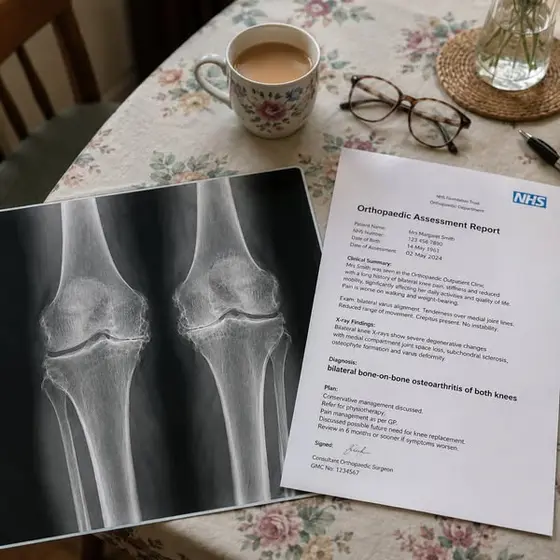
SurgeryMagazine Facebook ad creative
prohealt.shop
Read This If Knee Pain Is Stealing Your Life ☝️
Learn more

SurgeryMagazine Facebook and Instagram ad

SurgeryMagazine ran this image ad since Jun 27, 2026, 133 days so far.

First seen
Jun 27, 2026
Running for
133 days
Format
Image
Call to action
Learn more
Niche
Health and supplements
Countries
Not disclosed
Page likes
68

Ad copy

I never let them put me on the list for a knee replacement. The day I read that one in five people are still in chronic pain a year after the operation, and almost a third are left dissatisfied, I decided that surgery was the last thing I'd do, not the first. I'm sixty-four, bone-on-bone both knees. This is what I did instead. Let me go back to where it started, because saying no to surgery is easy. Living with the knees while you say no is the hard part. It began in 2022. A dull ache in the right knee on the stairs of our little terraced house. We thought it was wear and tear, a bit of rest and it would settle. It never settled. My GP sent me for an X-ray. Bone-on-bone osteoarthritis, both knees, advanced. Lose half a stone, take paracetamol, and we'll refer you for a replacement when you're ready. What no one said out loud was this. That X-ray was the best my knees would ever be. Every month from then on, they got a little worse. When the GP offered the referral, I went home and did what I always do. I read everything I could find first. That is when I found the two numbers. One in five UK knee replacement patients still has chronic pain twelve months after the operation. And almost a third are left dissatisfied with the result. But I didn't just read those numbers. I'd already watched them happen to my own sister. Linda is two years older than me. She had the same knees, the same diagnosis, the same bone-on-bone on both sides. She went on the list, waited her time, and had the right one replaced. The consultant told her the same thing they tell everyone. Very high success rate, walking again within weeks, kind and reassuring the whole way. The first six weeks nearly broke her, but she did every exercise. Then around week ten a different pain came. Deep and hot, around the new joint, not the old burning she'd had before. A year on, she was waking at three in the morning again, on the very side she'd had operated on. Her consultant said the implant was perfectly placed and called her unlucky. That was the word he used. Unlucky. Today my sister walks with a stick most days and can't kneel for her grandchildren. She was the one in five, and there is no undoing it. So when my GP offered me the referral, I already knew what those numbers looked like at my own kitchen table. I sat with it for a long time. They wanted me to wait somewhere between fourteen months and two years, in worsening pain, with no firm date, for the most painful operation in orthopaedic medicine. And the odds at the end of it were the ones Linda was living. So I told my GP I wouldn't be going on the list. Not yet. Surgery would be the last thing I tried, not the first. The trouble was, saying no left me with two bad knees and no plan. I still had to get through every day. So I did everything else they offer. By month nine I was on co-codamol most evenings. Then omeprazole, because the daily ibuprofen had burned my stomach. One pill for the pain, another to protect my stomach from the first. I did six sessions of NHS physiotherapy. Quad strengthening, glute bridges, ice and heat. I did every exercise I was given. Eight weeks later the pain was identical. I had a steroid injection. Four weeks of relief, then it all came back, worse if anything. I decided not to have another. I tried glucosamine, turmeric, magnesium tablets. Forty-two pounds a month from Holland and Barrett for over a year. My blood magnesium came back normal. The pain did not move. I tried Voltarol gel from Boots. Twelve pounds fifty a tube. It worked for ten minutes and never reached anything that mattered. So there I was. I'd refused the surgery, and the pain was getting worse anyway, and I was starting to wonder if I'd been a fool to say no. By then I was awake at three every single morning. Bone-on-bone burning down the side of the right knee, sometimes the left. I'd go downstairs, take a paracetamol, wait for it to take the edge off, and come back up. I'd moved into the spare room months before. I told my husband it was his snoring. It wasn't. I couldn't lie on my side anymore without the joint waking me at three. Forty years married, and I was sleeping down the landing so I wouldn't be a bother. Some nights I lay there wondering whether I should just join the list after all and take my chances with the one in five. Then, one of those nights, I sat up at the kitchen table at three in the morning and started searching properly. I read articles I should have read a year before. I read patient forums I'd never have looked at otherwise. I watched physiotherapists explain things no ten-minute appointment had ever had time to tell me. Then I found something specific. An article by a retired NHS consultant about the mechanical truth of a bone-on-bone knee, and why everything I'd tried had been aimed at the wrong place. He explained it plainly. Painkillers mask the signal but go through the gut and never reach the locked tissue around the joint. Physio strengthens muscles that are already over-firing trying to compensate for the missing cartilage. Injections calm things for a month, then fade. The magnesium tablets I'd taken for a year had spread evenly through my bloodstream. Less than one per cent ever reached the locked, starving muscle around the joint. My blood test was normal because my blood was normal. The tissue was not. As the cartilage thins, he wrote, the muscles around the joint lock in permanent over-firing, and that locked muscle starves the nerve endings two to three inches below the skin. That starving, inflamed nerve is the burning at three in the morning. He also set out the two numbers I'd refused the surgery over. One in five still in chronic pain at twelve months. Almost a third dissatisfied. Reading them in his words, from someone who'd spent a career in theatre, told me my instinct to wait had not been foolish at all. The article described a topical lotion built specifically for bone-on-bone knees. Magnesium chloride pulled through the skin, two to three inches deep, into the locked muscle. Arnica to drain the inflammation in the joint capsule, documented to match the anti-inflammatory effect of oral ibuprofen without touching the stomach. MSM to feed the damaged nerve endings. A peppermint penetrant carries all three through the fascia, into the deep tissue where my tablets and my Voltarol had never reached. The mechanism made sense in a way nothing else had in two years. I ordered a jar and told no one. I'd believed too many things by then. The first night I rubbed it into both knees before bed. Ninety seconds a side. A coolness, then a slow warmth. I slept four hours straight on my side, the first time in over a year. One night means nothing, I told myself. But the next morning I put it on again at nine without thinking. By week three I'd cut my evening ibuprofen by more than half. The omeprazole went in the bin a week later, because I didn't need it. My stomach began to settle for the first time in months. By week six I walked the dog round the village again. The full route. The first time in eighteen months. By month three I had my granddaughter for the afternoon, took her to the park on my own, and pushed her on the swing for twenty minutes. I came home, sat down, and cried. I wasn't crying because it hurt. I was crying because I felt like myself again, and because I'd come so close to gambling on an operation I never needed to. I went back to my GP for something unrelated a while later. She looked at how I was moving and asked what I'd been doing. When I told her, she said she was glad I'd found something that worked for me, and that we'd keep the referral on the shelf rather than take it down. I want to be honest about what this is. My knees are still arthritic. The scan hasn't changed. If one day I genuinely need the operation, I'll have it then, with my eyes open. But I refused to be rushed onto a table over odds I didn't like, in pain I was told to simply manage. My sister wasn't given that chance. I was, and I took it. If you've been offered a knee replacement, or told to join the list, and something in you is hesitating over those same numbers, please read what I found before you decide. I only wish someone had put it in front of me a year sooner. You can read the full article at the link below. https://prohealt.shop/pages/nhs-consultant-orthopaedic-surgeon-reveals-iccxfn I was told to wait and manage. It turned out there was another way the whole time.

Placements and targeting

FacebookInstagramAudience NetworkMessengerThreads

More ads from SurgeryMagazine

Full SurgeryMagazine profile
SurgeryMagazine
SurgeryMagazine
+1
Inactive133 days
prohealt.shop
Read This If Knee Pain Is Stealing Your Life ☝️
Learn more

A knee replacement is the most painful operations in orthopaedics, and one in five people are still in pain a year after going through it. I'm sixty-four, bone-on-bone both knees, and when I read that, I stopped seeing surgery as the only door. I started looking for the step everyone skips, the one they never mention in a ten-minute appointment. Let me explain what I mean by the step everyone skips, because it took me two years to even see it. The system offers you two things for an arthritic knee. Pills, to manage. And surgery, at the end of a long wait. There is nothing in between. You either cope, or you go under the knife. Nobody ever sat me down and said there might be something in the middle. I had to find that out on my own, at three in the morning, after I'd run out of road. It started in 2022. A dull ache in the right knee on the stairs of our little terraced house. We thought it was wear and tear, a bit of rest and it would settle. It never settled. My GP sent me for an X-ray. Bone-on-bone osteoarthritis, both knees, advanced. Lose half a stone, take paracetamol, try ibuprofen if it gets worse. What no one said out loud was this. That X-ray was the best my knees would ever be. Every month I waited from then on, they got a little worse. By month nine I was on co-codamol most evenings. Then omeprazole, because the daily ibuprofen had burned my stomach. One pill for the pain, another to protect my stomach from the first. That is door number one. Managing. And managing was quietly destroying my stomach while doing nothing for the knee. So I let them put me on the list for door number two. The NHS letter came thirteen months in. Surgery scheduled fourteen months after that. Pre-op in eight. In the meantime, please continue your current pain management plan. Fourteen months down. Fourteen to go. Twenty-eight months in worsening pain, and when I rang to ask if the date would hold, it was an answerphone that never rang back. That was when I read the number that stopped me cold. One in five knee replacement patients still has chronic pain twelve months after the surgery. And it is one of the most painful operations in the whole of orthopaedics. I sat at the kitchen table and did the sum. Wait two more years in pain, go through the most painful operation there is, and accept a one in five chance of coming out the other side no better. For the first time in two years, I let myself ask the question nobody had encouraged me to ask. Is this really my only option, or is there a step in between that nobody's offering me? So I started doing what I should have done from the beginning. I looked at everything, properly. I'd already tried most of door one. Six sessions of NHS physiotherapy. Quad strengthening, glute bridges, ice and heat. I did every exercise. Eight weeks later the pain was identical. I'd had a steroid injection. Four weeks of relief, then it all came back, worse if anything. I decided against another. I'd tried glucosamine, turmeric, magnesium tablets. Forty-two pounds a month from Holland and Barrett for over a year. My blood magnesium came back normal. The pain did not move. I'd tried Voltarol gel from Boots. Twelve pounds fifty a tube. It worked for ten minutes and never reached anything that mattered. Every single one of those was just door one in a different coat. Managing. None of them was the missing step. None of them reached whatever was actually causing the pain. By then I was awake at three every single morning. Bone-on-bone burning down the side of the right knee, sometimes the left. I'd go downstairs, take a paracetamol, wait for it to take the edge off, and come back up. I'd moved into the spare room months before. I told my husband it was his snoring. It wasn't. I couldn't lie on my side anymore without the joint waking me at three. Forty years married, and I was sleeping down the landing so I wouldn't be a bother. That was the night I sat up at the kitchen table and started searching in earnest. I read articles I should have read two years before. I read patient forums I'd never have looked at. I watched physiotherapists explain things no ten-minute appointment had ever had time to tell me. Then I found something specific. An article by a retired NHS consultant about the mechanical truth of a bone-on-bone knee, and it described, finally, the step in the middle that nobody had offered me. He explained why door one had never worked. Painkillers mask the signal but go through the gut and never reach the locked tissue around the joint. Physio strengthens muscles that are already over-firing trying to compensate for the missing cartilage. Injections calm things for a month, then fade. The magnesium tablets I'd taken for a year had spread evenly through my bloodstream. Less than one per cent ever reached the locked, starving muscle around the joint. My blood test was normal because my blood was normal. The tissue was not. As the cartilage thins, he wrote, the muscles around the joint lock in permanent over-firing, and that locked muscle starves the nerve endings two to three inches below the skin. That starving, inflamed nerve is the burning at three in the morning. Nothing I'd tried had ever reached that locked muscle. The pills went through the stomach. The gel sat on the surface. The exercises strengthened the wrong thing. That was the gap. That was the step everyone skips. The article described a topical lotion built specifically for bone-on-bone knees. Magnesium chloride pulled through the skin, two to three inches deep, into the locked muscle. Arnica to drain the inflammation in the joint capsule, documented to match the anti-inflammatory effect of oral ibuprofen without touching the stomach. MSM to feed the damaged nerve endings. A peppermint penetrant carries all three through the fascia, into the deep tissue where my tablets and my Voltarol had never reached. It wasn't door one and it wasn't door two. It was the thing in between. The step that addresses the actual mechanism, the one no ten-minute appointment has time to explain. I ordered a jar and told no one. I'd believed too many things by then. The first night I rubbed it into both knees before bed. Ninety seconds a side. A coolness, then a slow warmth. I slept four hours straight on my side, the first time in over a year. One night means nothing, I told myself. But the next morning I put it on again at nine without thinking. By week three I'd cut my evening ibuprofen by more than half. The omeprazole went in the bin a week later, because I didn't need it. My stomach began to settle for the first time in months. By week six I walked the dog round the village again. The full route. The first time in eighteen months. By month three I took my granddaughter to the park, lifted her onto the swing, and pushed her for twenty minutes. I came home, sat down, and cried. I wasn't crying because it hurt. I was crying because I felt like myself again, and because I'd nearly gone through the most painful operation there is without ever trying the step in between. My surgery date is still in the system. Last week I rang to ask about coming off the list. The consultant rang me back himself. He said he'd seen this before, with patients who found the right topical support during the wait, and told me to keep doing exactly what I was doing and come back in six months for a review. I want to be honest about what this is. My knees are still arthritic. The scan hasn't changed. If one day I genuinely need the operation, I'll have it. But I refuse to believe surgery was ever my only door, when the step in between worked this well and nobody had even mentioned it. If you're on that list, bone-on-bone, dreading the most painful operation in orthopaedics over odds you don't like, please read what I found before you decide it's your only choice. I only wish someone had put it in front of me two years sooner. You can read the full article at the link below. https://prohealt.shop/pages/nhs-consultant-orthopaedic-surgeon-reveals-iccxfn I was given two doors, manage or operate. It turned out there was a third the whole time.

SurgeryMagazine
SurgeryMagazine
+1
Inactive133 days
prohealt.shop
Read This If Knee Pain Is Stealing Your Life ☝️
Learn more

Knee arthritis isn't one problem. It's four. Running in a loop. Your GP treats one. I'm a nurse. I found what treats all four. Through the skin. My name is Carol. I've worked in an NHS pain clinic for nineteen years. I prep the rooms, pull the notes, hand people their paperwork on the way out. I see what gets prescribed. And I see what happens when they come back. Here's what nineteen years taught me about how the system handles an arthritic knee. Ibuprofen first. Every single patient. Six hundred milligrams, three times a day. Take it with food. Works for a few weeks. Then the knee stops responding. Then the stomach starts burning. Dose goes up. The GP adds omeprazole to protect the stomach. A year in, the pain is the same and the stomach is worse. Then a cortisone injection. First one, six weeks of relief. Second, four. Third, eleven days. Each one shorter than the last. Then they're told to lose a stone and manage their expectations. I've heard that phrase through the exam room wall a hundred times. It means they've run out of things to try, short of the waiting list. Every one of those treatments fails for the same reason. Knee arthritis isn't one problem. It's four. Running in a loop. And every treatment the protocol offers touches one. Here's what the loop looks like. Inflammation swells the tissue inside the joint. That's what ibuprofen treats. That's what cortisone treats. One problem. But as the cartilage wears and the joint starts to grind, the muscles around the knee clamp down to protect it. That's the stiffness. That's forty minutes on the edge of the bed every morning. No pill on the list touches it. Then that locked muscle chokes off the small vessels that feed the joint. Blood is how the tissue clears inflammation and how the nerves around the knee get oxygen. Cut the blood and the inflammation has nowhere to go. It sits there. The nerves around the joint start to fire. Which locks the muscle tighter. And the loop starts over. Worse than yesterday. Four problems. One loop. Getting worse every day. I knew this. And I still couldn't help my patients. Because knowing the loop doesn't break it. The protocol only treats one piece at a time. That's how it's designed. That's how it stays profitable. I have knee arthritis myself. Three years. I'm fifty-eight. I hid it at work. A hand on the counter to get up straight. Forty minutes every morning before my legs would carry me down the stairs. I was watching myself go through the same cycle I'd written into patient notes for nineteen years. Then I found the study. It was on Mr Bhatt's desk. A Swiss trial, published years ago in a respected journal. They had given an arnica gel to seventy-nine patients with knee arthritis, twice a day. Significant drops in pain and stiffness by week three. More by week six. Through the skin. Never enters the stomach. The study had been sitting there for weeks. He'd seen dozens of knee patients. Prescribed ibuprofen to every one. Never mentioned it. I asked him why. "It's one study. NICE hasn't changed the guidance. I can't prescribe outside the protocol." Then he said something I hadn't heard in nineteen years beside him. The only way to break the loop is to treat all four problems at once. Magnesium for the locked muscle. Arnica for the inflammation. And MSM to carry both deep enough to reach the muscle, two to three inches down, where no pill ever lands. All of it. Through the skin. At the same time. I asked why he doesn't tell patients. Same answer. The protocol. That night I searched for a formula with those exact ingredients. Most products have one. Maybe two. That's the whole problem. One ingredient against a four-problem loop is a guaranteed failure. I found one with the three that matter. Magnesium. Arnica. MSM. I ordered it without telling anyone. The system doesn't give you permission. You just do it quietly. First night. Worked it into both knees before bed. A cool, then a warmth. Went to sleep expecting nothing. The morning is the test. Fifteen minutes. Not forty. Fifteen. One morning doesn't mean anything. I know that. Day four. Stood up from the notes station in one motion. No bracing on the desk. I stood there staring at my own legs. Week two. My husband walked into the kitchen and stopped in the doorway. "What's going on with you?" I was making dinner. I hadn't stood long enough to cook a proper dinner in months. Week three. Got down to the bottom cupboard for a stack of files. Stood back up without thinking about it. Then I thought about Diane. Diane was my patient. Sixty-two. She'd been through the full cycle. Ibuprofen until her stomach gave out. Cortisone until it stopped working. On the waiting list with no date. Last autumn she sat in the waiting room and couldn't get up from the chair on her own. A young assistant helped her. Diane didn't say thank you. She just stared at the floor. I couldn't tell her as her nurse. But I told her as a person. She rang me three weeks later. Crying. She'd walked her dog around the whole block. By herself. First time in two years. Week five for me. My stomach stopped burning. Because nothing was going through it anymore. The study exists. The evidence exists. The protocol hasn't caught up. There's an article that explains everything. The four-problem loop. Why ibuprofen fails. Why each cortisone injection lasts shorter than the last. And what breaks all four through the skin. If your mornings start on the edge of the bed. If your stomach is paying for a knee that isn't getting better. If someone told you to lose a stone and manage your expectations and you're not ready to accept that. Read it. It's all there. https://prohealt.shop/pages/nhs-consultant-orthopaedic-surgeon-reveals-iccxfn The protocol will catch up eventually. You don't have to wait for it.

SurgeryMagazine
SurgeryMagazine
+1
Inactive133 days
prohealt.shop
Read This If Knee Pain Is Stealing Your Life ☝️
Learn more

A knee replacement isthe most painful operations in orthopaedics, and one in five people are still in pain a year after going through it. I'm sixty-four, bone-on-bone both knees, and when I read that, I stopped seeing surgery as the only door. I started looking for the step everyone skips, the one they never mention in a ten-minute appointment. Let me explain what I mean by the step everyone skips, because it took me two years to even see it. The system offers you two things for an arthritic knee. Pills, to manage. And surgery, at the end of a long wait. There is nothing in between. You either cope, or you go under the knife. Nobody ever sat me down and said there might be something in the middle. I had to find that out on my own, at three in the morning, after I'd run out of road. It started in 2022. A dull ache in the right knee on the stairs of our little terraced house. We thought it was wear and tear, a bit of rest and it would settle. It never settled. My GP sent me for an X-ray. Bone-on-bone osteoarthritis, both knees, advanced. Lose half a stone, take paracetamol, try ibuprofen if it gets worse. What no one said out loud was this. That X-ray was the best my knees would ever be. Every month I waited from then on, they got a little worse. By month nine I was on co-codamol most evenings. Then omeprazole, because the daily ibuprofen had burned my stomach. One pill for the pain, another to protect my stomach from the first. That is door number one. Managing. And managing was quietly destroying my stomach while doing nothing for the knee. So I let them put me on the list for door number two. The NHS letter came thirteen months in. Surgery scheduled fourteen months after that. Pre-op in eight. In the meantime, please continue your current pain management plan. Fourteen months down. Fourteen to go. Twenty-eight months in worsening pain, and when I rang to ask if the date would hold, it was an answerphone that never rang back. That was when I read the number that stopped me cold. One in five knee replacement patients still has chronic pain twelve months after the surgery. And it is one of the most painful operations in the whole of orthopaedics. I sat at the kitchen table and did the sum. Wait two more years in pain, go through the most painful operation there is, and accept a one in five chance of coming out the other side no better. For the first time in two years, I let myself ask the question nobody had encouraged me to ask. Is this really my only option, or is there a step in between that nobody's offering me? So I started doing what I should have done from the beginning. I looked at everything, properly. I'd already tried most of door one. Six sessions of NHS physiotherapy. Quad strengthening, glute bridges, ice and heat. I did every exercise. Eight weeks later the pain was identical. I'd had a steroid injection. Four weeks of relief, then it all came back, worse if anything. I decided against another. I'd tried glucosamine, turmeric, magnesium tablets. Forty-two pounds a month from Holland and Barrett for over a year. My blood magnesium came back normal. The pain did not move. I'd tried Voltarol gel from Boots. Twelve pounds fifty a tube. It worked for ten minutes and never reached anything that mattered. Every single one of those was just door one in a different coat. Managing. None of them was the missing step. None of them reached whatever was actually causing the pain. By then I was awake at three every single morning. Bone-on-bone burning down the side of the right knee, sometimes the left. I'd go downstairs, take a paracetamol, wait for it to take the edge off, and come back up. I'd moved into the spare room months before. I told my husband it was his snoring. It wasn't. I couldn't lie on my side anymore without the joint waking me at three. Forty years married, and I was sleeping down the landing so I wouldn't be a bother. That was the night I sat up at the kitchen table and started searching in earnest. I read articles I should have read two years before. I read patient forums I'd never have looked at. I watched physiotherapists explain things no ten-minute appointment had ever had time to tell me. Then I found something specific. An article by a retired NHS consultant about the mechanical truth of a bone-on-bone knee, and it described, finally, the step in the middle that nobody had offered me. He explained why door one had never worked. Painkillers mask the signal but go through the gut and never reach the locked tissue around the joint. Physio strengthens muscles that are already over-firing trying to compensate for the missing cartilage. Injections calm things for a month, then fade. The magnesium tablets I'd taken for a year had spread evenly through my bloodstream. Less than one per cent ever reached the locked, starving muscle around the joint. My blood test was normal because my blood was normal. The tissue was not. As the cartilage thins, he wrote, the muscles around the joint lock in permanent over-firing, and that locked muscle starves the nerve endings two to three inches below the skin. That starving, inflamed nerve is the burning at three in the morning. Nothing I'd tried had ever reached that locked muscle. The pills went through the stomach. The gel sat on the surface. The exercises strengthened the wrong thing. That was the gap. That was the step everyone skips. The article described a topical lotion built specifically for bone-on-bone knees. Magnesium chloride pulled through the skin, two to three inches deep, into the locked muscle. Arnica to drain the inflammation in the joint capsule, documented to match the anti-inflammatory effect of oral ibuprofen without touching the stomach. MSM to feed the damaged nerve endings. A peppermint penetrant carries all three through the fascia, into the deep tissue where my tablets and my Voltarol had never reached. It wasn't door one and it wasn't door two. It was the thing in between. The step that addresses the actual mechanism, the one no ten-minute appointment has time to explain. I ordered a jar and told no one. I'd believed too many things by then. The first night I rubbed it into both knees before bed. Ninety seconds a side. A coolness, then a slow warmth. I slept four hours straight on my side, the first time in over a year. One night means nothing, I told myself. But the next morning I put it on again at nine without thinking. By week three I'd cut my evening ibuprofen by more than half. The omeprazole went in the bin a week later, because I didn't need it. My stomach began to settle for the first time in months. By week six I walked the dog round the village again. The full route. The first time in eighteen months. By month three I took my granddaughter to the park, lifted her onto the swing, and pushed her for twenty minutes. I came home, sat down, and cried. I wasn't crying because it hurt. I was crying because I felt like myself again, and because I'd nearly gone through the most painful operation there is without ever trying the step in between. My surgery date is still in the system. Last week I rang to ask about coming off the list. The consultant rang me back himself. He said he'd seen this before, with patients who found the right topical support during the wait, and told me to keep doing exactly what I was doing and come back in six months for a review. I want to be honest about what this is. My knees are still arthritic. The scan hasn't changed. If one day I genuinely need the operation, I'll have it. But I refuse to believe surgery was ever my only door, when the step in between worked this well and nobody had even mentioned it. If you're on that list, bone-on-bone, dreading the most painful operation in orthopaedics over odds you don't like, please read what I found before you decide it's your only choice. I only wish someone had put it in front of me two years sooner. You can read the full article at the link below. https://prohealt.shop/pages/nhs-consultant-orthopaedic-surgeon-reveals-iccxfn I was given two doors, manage or operate. It turned out there was a third the whole time.

SurgeryMagazine
SurgeryMagazine
+1
Inactive133 days
prohealt.shop
Read This If Knee Pain Is Stealing Your Life ☝️
Learn more

I ran an NHS hospital, and we could not keep up with the knee replacements list. For every patient we operated on, two more joined the list. I signed off the waiting figures every month, and every month they got longer. I'm retired now, which means I can finally say it plainly. If you're on a list for a new knee, I owe you the truth about why you're still waiting. Let me start with the thing nobody at my level says out loud to a patient. The maths does not work. Under the NHS Constitution you have a legal right to treatment within eighteen weeks. We have not met that target, anywhere in the country, since 2015. I watched it slip year after year and there was nothing on my desk that could stop it. People assume the problem is lazy surgeons or empty theatres. It is neither. The surgeons I worked with would have operated morning to night if they could. The problem is that an ageing population needs more new knees every year than we have theatre time, beds and staff to deliver. The number coming in the door simply outruns the number we can get through it. And here is the part that decides who waits longest. A knee replacement, for all the agony it causes, is never an emergency. Nobody dies tonight from a bad knee. So when a more urgent case needs the theatre, and one always does, the knee comes off the list for that day. It happens again the next week, and the week after. That is why your operation, which was always coming, never quite arrives. I could see all of this from my desk. I could see exactly where each patient sat on the list. What I could never do was tell them when we would reach them. That is the cruelty of it. The person at the top has the whole picture, and still cannot give you the one thing you want, which is a date. Let me tell you about the kind of patient those figures actually describe, because for years they were just rows on a spreadsheet to me, and I'm ashamed of that now. A woman, sixty-four, bone-on-bone in both knees. It would have started years before with a dull ache on the stairs. Wear and tear, the GP would say. A few weeks of rest. It never settles. Then the X-ray. Bone-on-bone osteoarthritis, both knees, advanced. Lose half a stone, take paracetamol, try ibuprofen if it gets worse. What we never tell her, because the appointment is ten minutes long, is that the X-ray is the best her knees will ever be. Every month she waits on my list, they get a little worse. By month nine she's on co-codamol. Then omeprazole, because the daily ibuprofen has burned her stomach. One pill for the pain, another to protect her stomach from the first. The letter arrives thirteen months in. Surgery scheduled fourteen months after that. In the meantime, please continue your current pain management plan. When she rings to ask if the date will hold, she gets an answerphone that no one returns. I knew those answerphones existed. I never had the staff to put a person on the end of every one. By then she is awake at three every morning. The burning down the side of the knee. Downstairs for a paracetamol, wait for it to take the edge off, back to bed. She has moved into the spare room and told her husband it's his snoring. It isn't. She can't lie on her side without the joint waking her. Forty years married, sleeping down the landing so she won't be a bother. She has done everything we offered. Six sessions of physiotherapy. A steroid injection that helped for a month then faded. Glucosamine, turmeric, magnesium tablets for over a year, with normal blood results and no change in the pain. A tube of Voltarol gel that worked for ten minutes. Every option on our pathway, used, and not one of them reaching the thing that actually hurt. For most of my career, this is where my responsibility ended. She was on the list. The list was too long. Nothing to be done but wait. It was only after I retired, with time on my hands and a guilty conscience, that I started reading the things I should have read while I still ran the place. I found an article by a retired consultant explaining the mechanical truth of a bone-on-bone knee, the truth no ten-minute appointment ever has time for. He explained why everything on our pathway failed. Painkillers mask the signal but go through the gut and never reach the locked tissue around the joint. Physiotherapy strengthens muscles already over-firing to compensate for the lost cartilage. The injection fades. The magnesium tablets spread evenly through the bloodstream, and less than one per cent ever reaches the locked, starving muscle around the joint. The blood test comes back normal because the blood is normal. The tissue is not. As the cartilage thins, he wrote, the muscles around the joint lock in permanent over-firing, and that locked muscle starves the nerve endings two to three inches below the skin. That starving, inflamed nerve is the burning at three in the morning. Then he stated a figure I had seen in my own audit reports for years and never sat with properly. One in five knee replacement patients still has chronic pain twelve months after the operation. One in five. I had been sending people toward that operation as their only hope, knowing the number, and never once thinking about the step that might come before it. The article described a topical lotion built for bone-on-bone knees. Magnesium chloride pulled through the skin, two to three inches deep, into the locked muscle. Arnica to drain the inflammation in the joint capsule, documented to match the anti-inflammatory effect of oral ibuprofen without touching the stomach. MSM to feed the damaged nerve endings. A peppermint penetrant carries all three through the fascia, into the deep tissue where the tablets and the gel never reached. I gave it to a former colleague's mother, a woman exactly like the one on my spreadsheets, still on a list I used to manage. The first night she rubbed it into both knees before bed. Ninety seconds a side. She slept four hours straight on her side, the first time in over a year. By week three she had halved her evening ibuprofen. The omeprazole went in the bin. By week six she was walking the dog round the village again, the first time in eighteen months. By month three she took her granddaughter to the park and pushed her on the swing. She came home and cried, she told me, not from pain, but because she felt like herself again. Her surgery date is still in the system. She asked about coming off the list, and the consultant told her to keep going and review in six months. Let me be honest, because I'm too old now for anything else. This does not rebuild cartilage and it is not a cure. If a knee genuinely needs replacing, it should be replaced, and my old hospital will do it well. But I ran a list I could never make short enough, and the thing that finally helped the woman at the end of it was never on that list at all. I cannot stop thinking about how many years I sent people to wait, with nothing to offer in between. If you, or someone you love, is bone-on-bone and stuck on a list like the one I used to sign off, the article I found is worth your time. I should have found it while I still had the job. You can read it at the link below. https://prohealt.shop/pages/nhs-consultant-orthopaedic-surgeon-reveals-iccxfn The list will move when it can. While it does, nobody should have to spend the whole wait on the edge of the bed.

See all 21 ads

Create a free account to unlock every creative, video and landing page.

Sign up free

Similar health and supplements ads

28-Day Fun Weight Loss Challenge
+2
Inactive1 day
easy-quiz.dancefit.me
7 MIN HOME DANCE PLAN FOR BEGINNERS
Learn more

NO GYM, NO STRESS JUST DANCING! BOOST YOUR MOOD QUICKLY BURN CALORIES Take a quiz and get your dance plan in DanceFitMe

28-Day Fun Weight Loss Challenge
+2
Inactive7 days
easy-quiz.dancefit.me
7 MIN HOME DANCE PLAN FOR BEGINNERS
Learn more

NO GYM, NO STRESS JUST DANCING! BOOST YOUR MOOD QUICKLY BURN CALORIES Take a quiz and get your dance plan in DanceFitMe

28-Day Fun Weight Loss Challenge
+2
Inactive8 days
easy-quiz.dancefit.me
7 MIN HOME DANCE PLAN FOR BEGINNERS
Learn more

NO GYM, NO STRESS JUST DANCING! BOOST YOUR MOOD QUICKLY BURN CALORIES Take a quiz and get your dance plan in DanceFitMe

28-Day Fun Weight Loss Challenge
+2
Inactive4 days
easy-quiz.dancefit.me
7 MIN HOME DANCE PLAN FOR BEGINNERS
Learn more

NO GYM, NO STRESS JUST DANCING! BOOST YOUR MOOD QUICKLY BURN CALORIES Take a quiz and get your dance plan in DanceFitMe

See all ads

Create a free account to unlock every creative, video and landing page.

Sign up free

Keep exploring

Free plan, no card needed

Find more ads like this

Search millions of real ads by keyword, niche and format, and save the winners to your swipe file.

Start free