I need to tell you where this ends, if nothing changes. Because nobody in a 15-minute office visit is going to say it to you plainly. So I will. ⠀ I've spent 16 years as a vascular surgeon. And I have watched too many women who are on their feet all day walk this exact road, one pair of shoes at a time, to keep quiet about it. ⠀ I'm done being quiet. ⠀ You know the feeling. You're a nurse, a teacher, a cafeteria manager, a cashier — someone whose whole day happens standing up. And by evening your feet and ankles are so swollen your shoes feel two sizes too small. You loosen the laces. You slip
Senior Health Guide Facebook and Instagram ad
Senior Health Guide ran this image ad since Nov 17, 2026, 11 days so far, targeting United Kingdom.
Ad copy
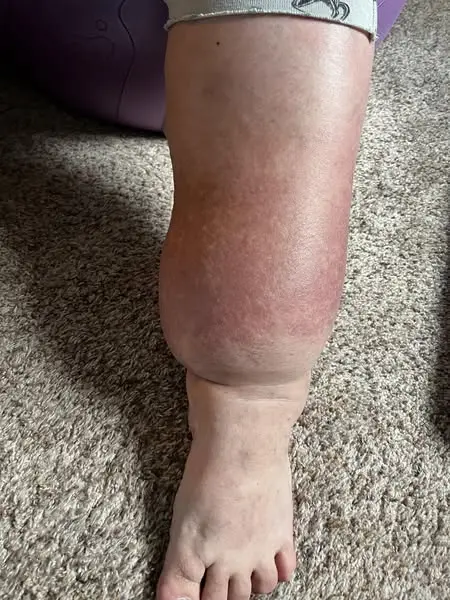
If you have swelling in your legs, there's a good chance you're doing everything you're supposed to. Elevating. Watching your salt. Wearing your compression most days. ⠀ That effort makes sense. But it may be masking a second problem developing underneath the swelling itself. ⠀ Press your finger into the front of your shin, right where the swelling is worst. Hold it for five seconds, then let go. ⠀ Does it leave a dent that slowly fills back in? Or does it barely dent at all anymore — like the tissue's gone too firm to press into? ⠀ If it barely dents, that's not actually a sign things are improving. That's tissue that's stopped being simple fluid retention and started becoming something firmer. ⠀ After 16 years working with venous and lymphatic patients, I can tell you something most people never get told. Swelling that stops pitting isn't swelling that's resolving. It's swelling that's changing into something else. ⠀ My name is Dr. Sarah Chen. Board-certified vascular surgeon, Fellow of the American College of Surgeons. ⠀ Here's what's actually happening. ⠀ When fluid sits in tissue for a long time, the body eventually responds to it — not by clearing it out, but by laying down structural fibers around it. Collagen deposits, slowly, in the tissue that's been under constant pressure. ⠀ That's fibrosis. ⠀ The same chronic fluid buildup that makes your legs swell also triggers that fibrotic response over time. ⠀ And here's the irony nobody explains. ⠀ Once the tissue fibroses, it holds its shape more, not less. It stops pitting the way it used to, which can look like the swelling is getting firmer or more "solid" instead of soft and puffy. ⠀ But that firmness isn't improvement. It's the tissue itself thickening around the fluid, and that thickened tissue restricts drainage even further than the fluid alone ever did. ⠀ This isn't some obscure idea. ⠀ The most well-known example is something vascular specialists sometimes call "brawny edema" — swelling that's gone from soft and pitting to firm, thickened, and often discolored, because the tissue itself has changed, not just the fluid inside it. That exact progression has been recognized for years. ⠀ What I started realizing is the same thing happens in smaller, less dramatic ways well before it's advanced enough to be called "brawny" — just nobody names it at that earlier stage. ⠀ I started paying attention to this after watching patient after patient do everything right and still feel like their legs were getting harder to manage, not easier. ⠀ One of them was Marion, 66. ⠀ She'd been managing leg swelling for four years. Consistent with her compression. Careful with her salt. Elevated every night like clockwork. ⠀ Her weight on the scale hadn't changed. Her diuretic dose hadn't changed. But something about her legs had. ⠀ I started asking questions, the way I always do. ⠀ Turns out Marion had noticed it herself, months earlier. Her legs didn't dent the way they used to when she pressed on them. She'd actually mentioned it to a friend as a good sign — "guess the swelling's finally going down." ⠀ But here's what nobody had connected. ⠀ It wasn't going down. It was hardening. ⠀ By the time she came to me, the skin over her shins had a texture I could feel without even looking — firm, slightly thickened, not moving the way healthy tissue should when I pressed on it. ⠀ That's when I found the fibrosis. ⠀ Months of fluid sitting in that tissue, months of her body quietly laying down structural fiber around it, months of the tissue slowly losing the softness it used to have. ⠀ Her swelling was being managed on paper. The thing that had actually changed in her legs was something nobody had ever looked at. ⠀ By the time Marion got to me, she'd already been doing the obvious things. ⠀ Elevation helps drain fluid while her legs are up. But it doesn't do anything for tissue that's already fibrosing. ⠀ Compression helps hold fluid back mechanically. But it doesn't reach the structural change happening in the tissue itself. ⠀ Diuretics reduce fluid volume systemically. But they were never going to touch fibrous tissue that's already formed. ⠀ I'm not against any of those. I just see this gap, over and over, in my own clinic. ⠀ I started looking at what actually shows up in real studies for supporting circulation and calming inflammation in tissue that's headed this direction. ⠀ What I was looking for wasn't another diuretic dose or another compression wrap. ⠀ She'd already been on those for years, with results that had plateaued. ⠀ I was looking for something that could work on the tissue itself, from the inside — before fibrosis had the chance to fully set in. ⠀ That search kept leading me back to a couple of specific botanicals. ⠀ Angelica Sinensis has documented effects on microcirculation, including improving blood flow in clinical research. ⠀ That's the piece diuretics and compression completely miss — actually supporting circulation to tissue that's under chronic st
Placements and targeting
More ads from Senior Health Guide
I'm a board-certified vascular surgeon, and I'm tired of watching my patients spend money on things that don't work. But that's not actually why I'm writing this. I'm writing this because of my mother. ⠀ My name is Dr. Sarah Chen. Board-certified vascular surgeon, Fellow of the American College of Surgeons, 16 years in practice. Over 4,000 patients with chronic venous insufficiency and swelling of the legs and feet. ⠀ My mother wore copper-infused compression stockings for nine years, right up until she passed. ⠀ She bought her first pair at a health expo when I was in medical school, from a b
I've read too many vascular ultrasounds to not share this with you. If you're dealing with swollen legs right now, I need to tell you something your doctor isn't seeing. I've read 3,800+ venous doppler studies in 16 years as a vascular surgeon. And when a woman walks into her primary care doctor's office complaining of swollen legs, I already know what her venous imaging will show 4-6 years before she ever develops venous ulcers. Advanced venous valve incompetence. The same inflammation causing her swelling is destroying her circulation right now. I'm Dr. Sarah Chen. I'm a vascular surgeon
I need to tell you where this ends, if nothing changes. Because nobody in a 15-minute office visit is going to say it to you plainly. So I will. ⠀ I've spent 16 years as a vascular surgeon. And I have watched too many women who are on their feet all day walk this exact road, one pair of shoes at a time, to keep quiet about it. ⠀ I'm done being quiet. ⠀ You know the feeling. You're a nurse, a teacher, a cafeteria manager, a cashier — someone whose whole day happens standing up. And by evening your feet and ankles are so swollen your shoes feel two sizes too small. You loosen the laces. You slip
Create a free account to unlock every creative, video and landing page.
Sign up freeSimilar skincare ads
Do you wake up looking like somebody pumped your face full of water? Your eyelids look swollen before you've even opened your mouth. Your cheeks look stuffed. Your jawline disappears the second somebody points a camera at you. And the concealer you bought to hide it just sits on top like a layer of plaster. So you look in the mirror and think, “Sh*t. Is this just my face now?” Then, hours later, the puffiness settles and you start looking like yourself again. Yet the advice is still to buy a stronger eye cream and wait for an anti-aging miracle. If your morning face changes that much be
TL;DR: At my best friend's open casket, the funeral director handed me a price list for mine. I'm 66. Marlene was my best friend since second grade. At her funeral, I got thrown out for my face. For 2 years I'd woken up swollen. Eyes puffed so tight I looked punched, and a jaw that hung like a turkey's. My blood work was perfect. 4 doctors, 4 shrugs. That morning was the worst ever. 2 layers of concealer just sat on top of the swelling like frosting on a rock. At the casket, the funeral director touched my elbow and slid a card into my hand. Pre-planning. "It's never too early, dear."
My husband told me he was gay. Then he blamed my face. "Look at yourself," he said. "The way you look, the way you act. You drove me away from women." Excuse the fu*k out of me? I can't even get my left eyebrow to match my right, but apparently I can change a grown man's sexual orientation. That is a LOT of responsibility to give a woman who hasn't had her coffee. I stood there in my pajamas wondering whether to call my sister or send my eye bags a cease-and-desist. For the record, my face had nothing to do with him being gay. He could have told me that without dragging my cheeks into th
The woman I'd spent the afternoon feeling threatened by looked at my husband and said, "You'd better go talk to your wife." She was his ex. I was the wife. And she'd just noticed something he'd stopped noticing years ago. I'd arrived at his college homecoming expecting to hear the same old stories. I didn't expect to end up crying beside a stranger and asking for her help. At six that morning, I was in our kitchen covering the last tray with foil while David looked for his college sweatshirt. I'm Denise. I'm fifty-four. In our house, I'm the person who remembers where everybody put every
Keep exploring
Find more ads like this
Search millions of real ads by keyword, niche and format, and save the winners to your swipe file.
