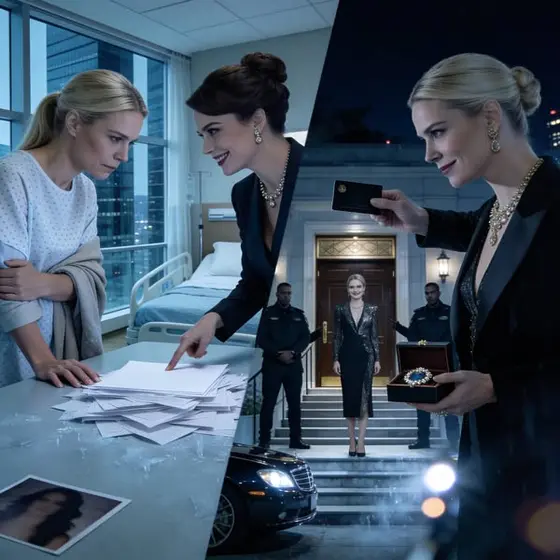
My husband signed my death certificate with the same hand he used to hold mine at the altar. I watched him do it through the gap in the morgue drawer—still breathing, still alive, paralyzed by the drug his mistress slipped into my wine. "Cause of death: cardiac arrest," the doctor read aloud. Adrian didn't even flinch. He just slid his pen across the paper and said, "Make it quick. My fiancée is waiting." Fiancée. We'd been married for six years, and he already had a fiancée. Her name was Celeste. She stood beside him in a white dress—white, at my supposed funeral—and rested her manicured hand on his arm like she'd won a prize. "Adrian," she purred, "are you sure she's really gone? She always was... stubborn." He looked down at my face. My eyes were open. I was screaming inside, every nerve in my body shrieking I'm alive, I'm ALIVE—but the toxin held me frozen. For one second, I thought he saw it. I thought I saw something flicker behind his eyes. Then he leaned down, close enough that I could smell Celeste's perfume on his collar, and whispered: "You should have just signed the company over to me, Maya. This is your own fault." The company. That's what this was about. My father's company—worth nine billion dollars—left entirely to me. They slid the drawer shut. Darkness swallowed me whole. But here's what Adrian didn't know. He didn't know my father's last gift to me wasn't the company at all. It was a name. A second identity. A man in the shadows who owed my father his life and had sworn to protect me until his last breath. He didn't know that the toxin Celeste used had a flaw—it wore off in exactly six hours. And he didn't know that the moment I clawed my way out of that morgue, I would stop being Maya Vance, the disposable wife. I would become someone he'd spent his whole career terrified of. The drawer was cold. My fingers twitched first. Then my hand. Then, finally, I screamed—out loud this time—and the sound echoed off the steel walls like a resurrection. I shoved the drawer open and crawled into the empty morgue, gasping, alive, furious. There was a phone on the attendant's desk. My hands shook as I dialed the only number I'd memorized for an emergency exactly like this. It rang once. A low, calm voice answered. "Miss Vance. Your father told me this day might come." "Adrian killed me," I whispered. "Or he thinks he did." A pause. Then: "Then let's make sure he regrets being wrong." I caught my reflection in the steel of the drawer—pale, hollow-eyed, a ghost. A ghost they would never see coming.
Sara Madison Smith Facebook and Instagram ad
Sara Madison Smith ran this image ad since Jun 27, 2026, 1 days so far.
Ad copy
"Sign the divorce papers, Vivienne. My son is dead because of you, and you still have the nerve to cry?" My mother-in-law threw the documents in my face as I lay handcuffed to the hospital bed, my newborn son screaming in the nurse's arms three feet away from me. They wouldn't let me hold him. Not even once. "Adrian, please—" I turned to my husband, the man who'd promised me forever just eleven months ago. "I didn't push your brother off that balcony. I swear on our baby's life, I was downstairs the whole time. Check the cameras, please—" Adrian Sinclair didn't even look at me. He stood by the window with his back turned, his shoulders carved from ice, the city lights of Manhattan glittering behind him like they were mocking everything I'd lost. "The footage shows you were the last person with him," he said quietly. "Stop performing. It's over." "That footage is fake!" My voice cracked. "Someone edited it. Adrian, look at me. Look at me. You know me. You married me. You—" "I married a liar." He finally turned. And the man I'd fallen asleep next to for almost a year looked at me like I was something he'd scraped off his shoe. "My brother is in a coma. My family is destroyed. And you," his jaw tightened, "you gave birth like nothing happened. Cold-blooded doesn't even begin to cover it." The nurse was already walking toward the door with my son. "Where are you taking him?" I lunged against the cuffs until my wrist tore open. "That's my baby! That's MY baby! Adrian, don't let them—ADRIAN!" He looked at the floor. "He's a Sinclair. He stays with the Sinclairs. You'll never see him again." The door clicked shut. And just like that, the only good thing I'd ever made in my life was carried out of the room while I screamed until my throat bled. I don't remember signing anything. I remember the pen in my shaking hand. I remember my mother-in-law's manicured fingers guiding mine across the line. I remember Adrian leaving without a single glance back. What he didn't know—what none of them knew—was that I had photographed something in that penthouse an hour before his brother fell. Something that would burn every last one of them to the ground. But they took my phone. They took my baby. They took twelve years of my freedom when the verdict came down: guilty of attempted murder. As the bailiff dragged me from the courtroom, I caught Adrian's eyes one final time. I smiled. Because the woman they were burying alive? She was going to claw her way out. And when she did, there would be nothing left of the Sinclair empire but ash.
Placements and targeting
More ads from Sara Madison Smith
I was signing my husband's death certificate when his brother walked in and said, "He's not dead. And you're going to marry me by Friday." Salvatore Ricci. The man my husband feared. The man who killed for a living. I stared at the pen in my hand, the ink still wet on the line where I'd written Marco Ricci, deceased. "He's lying," I whispered. "I identified the body. I saw the casket." "You saw what the family needed you to see." Salvatore crossed the funeral home in three slow steps, his black coat dragging cold air behind him. "Marco isn't dead, Elena. He ran. He took eight million dollars of family money and a woman named Bianca, and he left you holding the debt." The room tilted. Three years of marriage. Three years of pretending I didn't know what the Ricci name meant, of smiling at men with guns under their jackets, of never asking why Marco came home at 4 a.m. smelling of gunpowder and someone else's perfume. "I don't owe you anything," I said. "You owe me your life." Salvatore stopped in front of me, and for the first time I noticed his eyes — darker than Marco's, harder, the eyes of a man who had buried more people than he'd loved. "The Tessaro family is collecting what Marco stole. They've already taken your savings. Next, they take you. Unless you belong to someone they can't touch." "And that's you." "That's me." I laughed. It came out broken. "You want me to marry you. The man who terrifies the men who terrify everyone else. Because your coward of a brother ran off with his mistress and left me as collateral." "Yes." "And if I say no?" Salvatore reached into his coat. I flinched — but he only pulled out a photograph and set it on the table beside the death certificate. It was me. Taken that morning. Through the scope of a rifle. A red dot centered on my forehead. "Then by Friday," he said quietly, "you really will need that certificate. They just won't let you sign your own." I looked at the photo. At the red dot. At the man offering me a cage to escape a grave. My hands moved instinctively to my stomach — to the secret I hadn't told anyone, the secret that changed everything, the secret that made no impossible. Eight weeks. I was eight weeks pregnant with the child of a man who had faked his own death and left me to die. Salvatore's gaze followed my hand. Something flickered across his face — too fast to name. "Elena," he said slowly. "Is there something you're not telling me?" I closed my eyes. Then I picked up the pen, drew a line through Marco Ricci, deceased, and looked the most dangerous man in the city dead in the eye. "Friday," I said. "But I have one condition."
For three years, I sang on stage while my sister lip-synced to my voice and collected the awards. I signed away my name. I hid in a soundproof booth behind a curtain. On the night she accepted a Grammy for "her" album, she thanked everyone in the world except the woman who'd actually sung it. Then she leaned into the microphone, looked straight at the wings where I stood, and called me "the little helper who handles my errands." By midnight, I was alone in a parking garage with a torn contract in my hands. By morning, I was finished being anyone's ghost. But let me start at the end of the lie. The Staples Center was a wall of light that night. Gold dresses, flashing cameras, a banner that read PIPER LANE — VOICE OF A GENERATION. The voice was mine. The face was hers. My sister Piper swept past me backstage in white sequins, untouched by the vocal nodules that had nearly cost me my throat, untouched by the eighteen-hour studio days that had broken me. She squeezed my shoulder like a boss thanking the catering staff. "Wish me luck, Mira," she said. She didn't wait for it. When they called her name, two hundred million people watched her cry. She clutched the statue for the song I'd written at 3 a.m. about the father who left us. She thanked her producer. Her stylist. Her "incredible team." Then she found me in the dark. "And to the little helper who handles my errands," she said, smiling that famous smile. "What would I do without my assistant?" Assistant. Three years. My voice on every track. My lyrics in her mouth. The crowd laughed warmly. Someone clapped. I stood in the shadows in a black staff polo while my sister introduced me to the world as the girl who fetched her coffee. Her manager, Damon — the man I'd once trusted — pressed a hand to his heart and mouthed be a professional at me. He'd practiced that look. I know now that he'd practiced everything. Backstage, Piper found me before the cameras could. "Don't make a face," she hissed, all the warmth gone. "You signed the deal. Nobody knows you exist, and that's the whole point. You're shy, remember? You hate stages. I'm doing you a favor." A favor. My ruined throat. My buried name. Every dream of my own music swallowed so hers could shine. "Just one song," I whispered. "On the next album. With my name on it. You promised—" "God, you're exhausting." She turned to Damon. "Get her out of my sightline. She's bringing the mood down." Damon took my arm and steered me toward the exit like a security incident. In the parking garage, with my ears still ringing from the applause that should've been mine, my phone lit up. A number I'd been too scared to call for two years. A lawyer's number. My late mother's old friend, who'd told me again and again: When you're ready to stop being their instrument, call me. He answered on the first ring. "Ms. Lane?" "For now," I said, my voice steadying with every word. "Mr. Reyes. Call him. Tell Sebastian Cross my answer is yes." A pause. Then, quietly: "He's been waiting two years to hear that, Mira." So had I. I just hadn't let myself know it.
The wedding was mine. The bride wasn't. I stood at the top of the marble staircase in my mother's pearl-white gown, and I watched my fiancé slide the ring onto another woman's finger. Three hundred guests applauded. Not one of them looked at me. "Adeline?" My maid of honor touched my arm. "You're shaking." I wasn't shaking. I was memorizing. The exact tilt of Julian Hawthorne's smile as he kissed Vivienne Cross under the chandelier I had picked. The way his hand settled on her waist like it had never belonged anywhere else. Six hours ago, this had been my rehearsal dinner. My ceremony. My life. Then Vivienne had walked in—pregnant, weeping, beautiful—and Julian's mother had pulled me into the cloakroom and pressed a check into my palm. "Be reasonable, dear," Eleanor Hawthorne had said. "Vivienne is carrying the heir. You're carrying nothing but his charity." I'd looked down at the check. Two million dollars. The price of three years of my life. I should have screamed. I should have flipped the table, torn the gown, told all three hundred guests that Julian Hawthorne had begged me to marry him when his empire was drowning in scandal—that I was the one who'd saved his company, signed away my own inheritance, smiled through every cold night. Instead, I'd done what I always did. I went silent. Now I stood on the staircase, and Julian's eyes finally lifted. Found mine. Held them. And he mouthed two words across the ballroom, soft and final. Thank you. Thank you. For stepping aside. For making it easy. For loving him enough to disappear. Something inside my chest cracked so cleanly I almost heard it. I pressed a hand to my stomach—to the secret only my doctor and I knew. The secret I'd been planning to whisper to Julian tonight, in the dark, when the music stopped. Six weeks. I was six weeks pregnant with the child of the man marrying another woman. A waiter passed with champagne. I took a glass I couldn't drink, lifted it toward the happy couple, and smiled like my heart wasn't bleeding out across the floor. Then I turned, and I walked down the staircase, and out the doors, and into the cold. Behind me, the orchestra swelled into the first dance. I didn't look back. The night air hit my face like a slap, and for the first time in three years, I let myself feel it—all of it—the humiliation, the grief, the rage rising under the calm. By the time my heels hit the wet pavement, I'd made a decision. Julian Hawthorne would get his heir. But he would never know it was mine. And one day—I swore it on the life growing inside me—he would stand exactly where I was standing now. On the outside. Watching everything he wanted belong to someone else.
Similar baby and kids ads
🌊 Grief isn’t always just sadness. Sometimes it’s anger, guilt, anxiety, numbness, shock, and love all mixed together — and that doesn’t mean you’re grieving wrong. Healing After Loss is a guided grief recovery workbook that helps you understand those feelings without judging them. It walks you through grief stages, primary and secondary loss, support systems, setbacks, resilience, coping, memory keeping, letters, values mapping, affirmations, and growing around grief. 🧭 It gives language to the emotions that can feel confusing, heavy, or impossible to explain. A gentle workbook to help you realize you’re not grieving wrong — you’re grieving deeply. 👉 https://thinkovia.com/products/healing-after-loss-grief-recovery-workbook
🌫️ Grief can feel like ten emotions happening at once. Some days it feels like sadness. Other days it feels like anger, guilt, shock, anxiety, numbness, or a heaviness you can’t fully explain. Healing After Loss is a guided grief recovery workbook that helps you untangle those feelings and understand what you’re carrying. 🧶 It walks you through grief stages, primary and secondary loss, hidden emotions, support systems, setbacks, resilience, coping, memory keeping, letters, values mapping, affirmations, and growing around grief. It gives language to the parts of grief that feel confusing, heavy, and hard to explain. 👉 https://thinkovia.com/products/healing-after-loss-grief-recovery-workbook
🪔 Honoring someone you lost doesn’t mean you have to stay frozen in the pain. Healing After Loss is a guided grief recovery workbook that gives you space to write letters, save memories, create a memory jar, reflect on what you loved about them, and explore the values they passed on to you. At the same time, it gently guides you through the confusing parts of grief — grief waves, shock, denial, anger, sadness, acceptance, hidden grief, support, resilience, secondary losses, and coping. 🧭 It helps you remember them with love while still taking small steps forward. A gentle workbook for honoring memories, processing grief, and finding your way one page at a time. 👉 https://thinkovia.com/products/healing-after-loss-grief-recovery-workbook
🌀 Grief doesn’t always make sense from one minute to the next. One moment you miss them. The next, you feel angry, guilty, numb, or overwhelmed by love — all at the same time. Healing After Loss is a guided grief recovery workbook that helps you understand tangled feelings, grief stages, primary and secondary losses, support systems, setbacks, resilience, coping tools, memory keeping, letters, values mapping, affirmations, and growing around grief. 🕊️ It doesn’t make you feel like your grief is “wrong.” It helps you feel less alone in the messiness, and gives you a gentle way to keep going. 👉 https://thinkovia.com/products/healing-after-loss-grief-recovery-workbook
Keep exploring
Find more ads like this
Search millions of real ads by keyword, niche and format, and save the winners to your swipe file.
