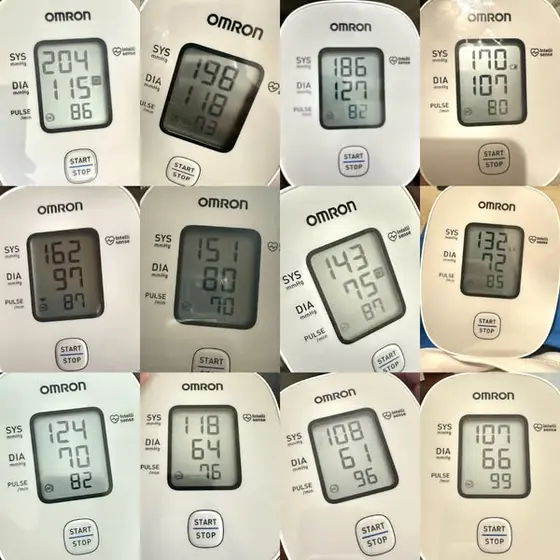
I'm a cardiac nurse. For fifteen years I told patients high blood pressure was a heart problem. Then my vet explained why dogs never get it — and I realized I'd been treating the wrong organ the entire time.
I'm Sandra. I've been a cardiac floor nurse for 15 years. I've watched blood pressure quietly wreck people. I've stood beside patients after the stroke. I've watched a man relearn his wife's name. I've held hands in the worst rooms in the hospital.
So when my vet said something that cut against everything fifteen years had taught me, my first instinct was to correct her.
She said, "Dogs don't get high blood pressure. Not the way humans do. Cats don't. Horses, cows, pigs — almost never."
I started to push back. I'd seen the cardiac textbooks. I'd watched the monitors. I knew this.
Then she said, "Why do you think that is?"
And I didn't have an answer.
I said, "Why not?"
She said, "Because they don't eat what you eat. They eat what their bodies were built to handle."
I took the pills and drove home and I could not let it go. Fifteen years on a cardiac floor and I had never once asked myself why our waiting room is full of humans and never full of animals. I'd just assumed high blood pressure was a human thing.
It's not a human thing. It's a human-diet thing.
I went back the next week. Not for the dog. For me.
I told her I wanted her to explain it like I'm a golden retriever. She laughed. Then she said something that reorganized everything I thought I understood about the disease I'd been watching destroy people for fifteen years.
"Your blood vessels are supposed to be soft. Flexible. They flex with every heartbeat. When the blood moving through them stays clean, they stay young. The problem isn't the heart pumping too hard. The problem is what's in the blood making it hard to pump."
I said, "What do you mean, what's in the blood?"
And she explained the thing no human doctor had ever explained to me.
"Every cell in the body has tiny doors on it," she said. "In animals — in people — those doors pull sugar out of the blood and bring it into the cell to burn for energy. There's a signal that opens them. Insulin. When the doors open, sugar leaves the blood, the vessels relax, and pressure stays normal."
"But feed a body decades of processed food it was never built for, and those doors stop responding. The signal fires and nothing opens. So the sugar just sits in the blood. Hour after hour."
"Here's the part your doctor never says out loud. Blood that's full of sugar is thicker. Heavier. Harder to push. So the heart has to shove harder just to move it. And all that sugar grinds against the vessel walls until they stiffen. The pressure climbs."
She looked at me. "It's not really a disease. It's a response to bad input. The blood got thick, so the pressure went up. Animals don't get it because their blood never gets thick in the first place. The doors keep working. The blood stays thin. The vessels stay young."
I stood there in a veterinary clinic getting the clearest explanation of high blood pressure I'd heard in fifteen years of cardiac nursing.
"So when a person's pressure is high," she went on, "it's not really about the heart at all. It's about sugar trapped in the blood, making it heavy, forcing the pump to work overtime. Fix the blood and the pressure fixes itself."
Then she said the part that made me angry.
I asked her why no human doctor had ever told me this.
She said, "Because in human medicine, there's no money in it. The thing that helps reopen those doors is a food compound. You can't patent a food. No drug company funds the research, so no rep ever walks it into a doctor's office, so it doesn't exist in their world. In my world — animal medicine — we don't have those politics. We just figure out what works and use it."
She wrote something on a slip of paper. Handed it to me. Said, "Don't tell your human doctor I told you this."
I went home and couldn't sleep.
My own pressure had been creeping for three years — 150s over low 90s on one medication, never quite where it should be. My fasting glucose had been parked at 130-something for just as long, and not one doctor had ever connected the two. I was tired all the time. Lightheaded standing up. Foggy by 2 PM every single afternoon.
I'd tried everything. Cut the salt to nothing. Walked 10,000 steps. Apple cider vinegar. Beet juice. The DASH diet. Nothing moved the needle more than a few points.
And here was a vet telling me my dog's vessels were younger than mine because his blood never got thick.
At 2:47 AM, still awake, I started researching what was on that slip of paper.
True Ceylon cinnamon. Cinnamomum verum. Grown in Sri Lanka. Not the cheap Cassia that fills supplement shelves — the real thing, used as medicine for centuries and now studied in clinical trials for exactly this.
The research matched what the vet had told me almost word for word.
Compounds in true Ceylon cinnamon appear to trigger those cellular doors — the GLUT4 transporters — directly. Not by forcing more insulin into a system that's stopped listening, but by going around the broken signal and waking the doors back up. A study in the Journal of the American College of Nutrition found one of its compounds was twenty times more effective at activating that pathway than any other natural compound tested. Another, in the Archives of Biochemistry and Biophysics, found Ceylon extract physically increases the number of those doors at the cell surface. And a study in Diabetes Care — a flagship journal — found an 18 to 29 percent reduction in fasting blood glucose across multiple doses.
Here's the mechanism, the way the vet would put it.
Blood pressure medication relaxes the vessel walls or slows the heart. It forces the number down. That's real, and your doctor isn't wrong to prescribe it. But it does nothing about the sugar still trapped in your blood. The blood stays thick. The vessels keep getting ground down. The pump keeps straining. The drug manages the symptom and never touches the cause.
Ceylon cinnamon works on the cause. When the doors open and sugar finally clears from the blood, the blood thins. It moves easily again. The heart stops having to shove. The grinding on your vessel walls slows down. The pressure drops — not because the walls were forced to relax, but because the blood inside them got lighter.
The medication runs the water harder. This unclogs the drain.
Both together is the full answer. Most people have only ever had half of it.
I ordered a bottle that morning.
Week 1, my energy leveled out. No more 2 PM crash where my brain just shut off mid-shift. Steady. Clear. And that night I went to bed at 10:30 and woke up at 6:45 — and hadn't woken up once. Not to pee, not with my heart pounding, not with my mind racing. First time I'd slept through the night in over a year.
Week 2, my fasting glucose dropped from 134 to 112. I tested three times because I didn't believe it.
Week 3, the fog lifted. I could get through afternoon rounds without re-reading the same chart twice. My home blood pressure readings were creeping down into the 130s.
Week 6, my glucose was consistently in the 90s and my pressure was reading around 132 over 80 — the lowest I'd seen in years.
Week 10, my doctor ran a full panel. Blood pressure averaging 126 over 78. Down from the 150s. My arterial stiffness markers had improved from my baseline.
She stared at it. Ran one of them again. Same number.
"Your blood pressure is the best it's been since I've known you. What did you change?"
"Ceylon cinnamon. Real Ceylon, concentrated, in MCT oil. There are studies. I brought them."
I handed her a folder with six papers. She read for five minutes. Closed it.
"Your fasting glucose came down too. These are moving together."
I nodded.
"Keep doing whatever you're doing."
I went back to the vet a month later to thank her. Told her my pressure was 126 over 78 for the first time in years.
She smiled and said, "Same reason your dog's is. The blood's not thick anymore."
His vessels weren't special. Mine weren't broken. The blood just needed to run clean again.
I've recommended it to six patients now. Every one came back with the same pattern.
Better sleep within the first week. Steady energy through the day. Lower fasting glucose within the first month. Blood pressure trending down by week three or four.
One patient — a woman on two medications, vascular age a decade ahead of her own — came back at her 90-day follow-up with her pressure down to 124 over 77 and her stiffness markers improved. She cried. Not about the number. Because she'd stopped lying awake afraid of the stroke that took her mother.
Another patient had been weeks from a third medication. Four months in, his cardiologist took one *off* and asked what he'd added.
But here's what you need to understand. Most cinnamon fails. I tried cheap capsules first — generic ones off Amazon — and my numbers barely moved.
Here's why most don't work.
They're not real Ceylon. What's sold as "cinnamon" in most supplements is Cassia — a different species from China, carrying up to 250 times more coumarin, a compound linked to liver damage with daily use. The clinical benefits were all for true Ceylon, Cinnamomum verum. Not Cassia.
They're underdosed. The studies used the equivalent of 6,000 to 7,200mg daily. Most capsules contain 500 to 1,500mg of raw powder. A fraction of what actually does anything.
They use the wrong delivery. Cinnamon's active compounds are fat-soluble — they need fat to absorb. A dry powder capsule has none, so it passes straight through. The right carrier is MCT oil.
They're not tested. Most aren't third-party verified, so you have no idea whether you're getting real Ceylon or mislabeled Cassia.
The one the research pointed to — the one I switched to — is Metabolae.
True Ceylon cinnamon. Cinnamomum verum, sourced from Sri Lanka. DNA-verified. Dosed at 7,200mg equivalent per softgel, a 12:1 concentrated extract — the amount that corresponds to clinical benefit. Suspended in MCT oil from coconuts for real absorption. Third-party tested, GMP-certified, every batch verified for purity, potency, and coumarin.
The difference between the generic I tried first and Metabolae was the difference between my pressure dropping three points and dropping thirty.
Same ingredient category. Completely different results.
If you're done watching your doctor warn you about strokes and heart attacks while your numbers stay stuck, try Metabolae risk-free.
90-day money-back guarantee. No questions asked. If your fasting glucose doesn't drop, if your pressure doesn't move, if you see no difference, you pay nothing.
Most people who see real movement in their vascular markers committed to at least three months — that's how long it takes stiffened arteries to soften and the numbers to meaningfully shift. The guarantee covers that window completely.
One softgel daily with breakfast. Most people notice better sleep within 3 to 7 days. Energy around week two. Blood sugar dropping between weeks 2 and 4. Blood pressure trending down by week three or four. Full benefits in 8 to 12 weeks.
They sell out. Small company sourcing verified Ceylon from Sri Lanka and doing it properly. If you see "Out of Stock," sign up for the notification. If it's in stock, order now. There's a promotion running right now — three bottles at a significant discount, which is the commitment window where the markers actually move.
If you're dealing with:
Blood pressure that won't reach normal no matter what they prescribe. Fasting glucose creeping up alongside it. Afternoon crashes that make you useless by 2 PM. Brain fog. Waking at 3 AM with your heart pounding. The quiet fear that a stroke or a heart attack is somewhere up ahead.
Give it 90 days. Track your fasting glucose every morning. Watch your readings. Watch your sleep.
If nothing moves, you get your money back.
But if it works the way it did for me — the way it's worked for the six patients I've recommended it to — you'll wonder why no one told you sooner.
I went from a pressure of 158 over 92 to 126 over 78. From foggy and exhausted to clear and steady. From a fasting glucose in the 130s to the 90s.
Animals don't get high blood pressure because their blood never gets thick.
Yours got thick. That's all. And that can be fixed.
Click below and get Metabolae while it's still available.
~ Sandra K., RN, Cardiac Floor, 15 years