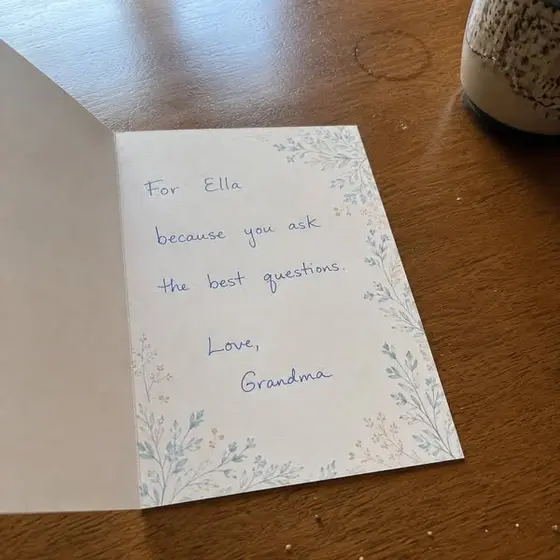
I'd spent $1,400 trying to matter to my granddaughter since she started school — and the thing that finally worked was something I put back on the shelf twice before I finally bought it.
My name is Barbara. I'm 64.
And I see Ella twice a year.
Thanksgiving. And her birthday in March.
Two visits. That's what I get.
I used to count the days between them.
I still do.
For years I tried to matter to her.
Not just send cards and sit quietly in the corner at Christmas.
I mean MATTER.
The kind of grandmother she thinks about on a random Tuesday and just... reaches for the phone.
So I bought things. Good things. Things I researched for hours.
The $180 art kit. Used twice, then shoved to the back of the closet.
The science set. Never even opened.
The craft subscription she canceled herself after two months.
Somehow that was the worst part.
I remember the art kit especially. I'd called my daughter beforehand, asked what Ella was into, took notes on the back of an envelope like it was a job interview. I had it gift-wrapped. I paid extra for the bow.
She opened it on a video call. Said "thank you, Grandma" in that polite little voice children use when they've been told to.
And I watched her set it down and look off-screen at something more interesting.
That was it. That was the whole moment I'd spent two weeks planning.
And every time I flew home after a visit, my chest would go tight, and I'd just sit at the gate until they called my row.
Not failure, exactly.
Something quieter than that.
Like pressing your hand flat against a cold window and watching everyone inside be warm.
9:40 PM, the last gate at Terminal B, everyone around me on the phone with someone who was waiting for them.
And I could see exactly how the rest of it would go.
Another gift. Another closet. Another airport gate.
Ella growing into a teenager who saw me at family dinners and ballgames and nowhere else.
No more one on one.
Just the grandmother who sends the cards.
That's the future I was bracing for.
Then last September, Ella started first grade.
I called her that week and asked what she'd learned.
She told me right away. Rattled it off, word for word. The planets, in order. She was proud of it.
Then I asked her why.
Why does the Earth go around the sun and not the other way?
And she went quiet.
"The teacher didn't say."
I sat with that a long time after we hung up.
The teacher didn't say.
She could name all eight planets. She just had no idea why a single one of them did what it did. And it hadn't occurred to her to ask.
And the more I read about it, the more it made sense.
When children are small, they ask why about everything. Why is the sky blue. Why do we sleep. Why, why, why, until you're worn out by it.
And then, somewhere in the school years, a lot of them just... stop.
Not because they get less clever.
Because school mostly rewards the right answer. How fast. How accurate.
Not the child who looks at rain running down a window and wonders why it does that.
The asking is a habit. And like any habit, if nothing feeds it, it fades.
I couldn't change her school.
But I had birthdays. And Christmases. And the occasional Tuesday.
And she's seven. Right in the stretch where that habit is still hers to keep.
So for her birthday I sent her a book called 100,000 Whys.
And I almost didn't.
I thought it was too simple. Too plain next to a kit with a hundred pieces.
That's why I stood in that aisle so long. Why I put it back twice.
A book felt like such a small thing. After $1,400, after all that research, after all those bows.
Then I picked it up one more time and just... kept walking.
It isn't clever. It's just every question a child actually asks, answered in two pages, with a picture.
A few weeks later my daughter called.
It was a Sunday night, near eleven, and I almost didn't pick up because I assumed something was wrong.
"Mom, are you up?"
"I am now. What's happened?"
"Nothing's happened. It's Ella."
I sat up in bed.
"Last night at dinner she explained why leaves change color. She had a whole theory about it. And then she said she wanted to check if she was right before school."
"She wanted to check it?"
"Mom, she's been asking questions all week. Where does the rain go after. Why do we have two ears and not one. I couldn't answer half of them."
"Where is this coming from?"
A pause.
"It's the book you sent her. She won't put it down."
She had a theory.
She wanted to check it before school.
Her teacher mentioned it too. Said she'd never seen a child this age get so caught up in the why of things.
My daughter was crying when she told me.
Not the sad kind.
The kind where your legs go soft and you have to sit down.
But here's what stayed with me even more than the teacher's call.
It was the small thing my daughter mentioned almost as an afterthought.
She'd found Ella at the kitchen table on a Saturday morning. No one had asked her to be there. She had the book open and a notepad next to it, and she was copying out a question she wanted to "find the answer to later."
Nobody told her to do that.
Nobody gave her a worksheet.
She just... wanted to know.
That was the moment the habit stopped being something I'd hoped for and became something that was actually hers.
And then there was the night my daughter put her to bed and turned the light off, and ten minutes later saw the glow back under the door.
Ella had the book open under the covers with a flashlight.
Not a comic. Not a toy.
A book of questions.
The kind of thing you'd usually have to fight a seven-year-old to read — and she was hiding it to get more of it.
Then in March, Ella called me on a Tuesday.
Not her birthday. Not a holiday.
She'd been thinking about something since the night before.
"Grandma, why is the sky blue and not purple?"
I didn't know. We looked it up together.
"Grandma, why do my fingers go wrinkly in the bath but not my arms?"
I didn't know. We looked it up together.
"Grandma, why can I see the moon in the daytime sometimes?"
I didn't know that one either. We looked it up together.
We talked for forty-seven minutes.
Forty-seven minutes with a seven-year-old who'd called me on her own, about nothing, about everything.
Do you know how long it had been since anyone in my family stayed on the phone with me for forty-seven minutes?
All those years I'd been trying to matter to her.
All those gifts I researched for hours.
And the one that finally worked was the book I almost left on the shelf.
It didn't just keep her wondering.
It gave her something to bring to me.
That's the part nobody warns you about.
Nine years of "the teacher didn't say" raises a child who can answer the question but never asks one.
Who knows what but never wonders why.
Who can name all eight planets and never once wonder how they got there.
And a book that costs less than one of those gifts I forgot about can do the opposite — if you catch the window while it's still open.
She's seven. This stretch doesn't last.
The years where you're still the one she reaches for, those are the ones to protect.
You're allowed to want to matter to her. That was never too much to ask.
And I'm not the only grandparent who nearly passed on it. A lot of us did, then watched our grandkids pick it up and not put it down.
It's 100,000 Whys.
Every question a child actually asks, answered two pages at a time. Fifteen minutes a night.
Over 200 topics. More than 1,000 illustrated entries, organized by the questions children actually have.
And if it ends up shoved in a closet like that art kit, you send it back. No hard feelings.
Don't give her another thing for the trash.
Give her something to bring to you.
Before "the teacher didn't say" becomes the only answer she knows.