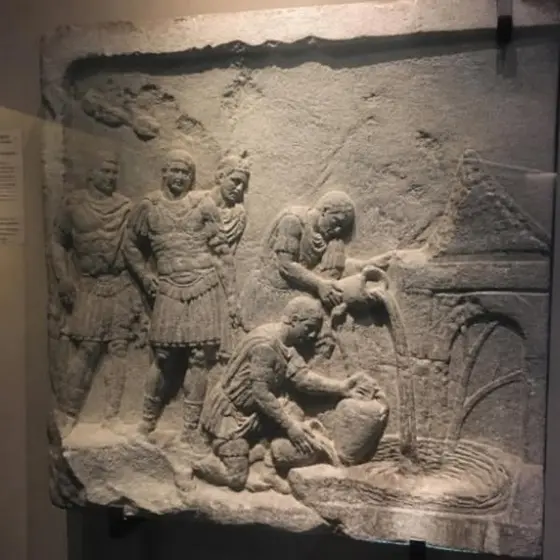
My son asked me a question about Roman soldiers for a school project and I haven't been able to stop thinking about what I found when I looked it up.
I don't understand how this isn't taught anywhere.
He's sixteen. AP World History. His assignment was on Roman military logistics — not battles, not emperors, but the supply chain.
How did legions of 5,000 men march 20 miles a day in 60 pounds of armor, fight, and then do it again the next morning? What kept them functioning?
Normal mom move — I helped him dig through sources after dinner. Found some good primary material. He was focusing on grain supply, road construction, camp engineering. Standard stuff.
But I found something else.
The Roman legions had physicians embedded with them. Not just for battlefield injuries — these were trained medical observers assigned to monitor the health of the soldiers over months and years of campaign. And they were meticulous.
They recorded everything. Pulse quality. Skin condition. Recovery times. Stamina on the march. Which soldiers could fight two days in a row and which ones couldn't.
One pattern kept showing up across multiple physicians' records. Commanders were deliberately routing their armies toward specific natural springs — not for drinking water, they had water — but for recovery. These weren't random stops.
They were strategic. Armies would march miles out of their way to reach particular springs, and the physicians documented what happened to the soldiers who bathed in and drank from those springs versus soldiers who didn't.
The differences were significant. Faster recovery. Better circulation. More endurance. Fewer ailments after long campaigns.
I read that part out loud to my son. He shrugged. "Cool. I'm focusing on the roads though."
I couldn't let it go.
Long after Ethan had gone to bed, I was still at the kitchen table with my laptop open. Not because of Roman soldiers anymore. Because of something else entirely.
Let me back up.
Three weeks before this school project, my husband Kevin went to his annual physical. He's 57. Hasn't missed an appointment in fifteen years.
Eats reasonably well. Works out three or four mornings a week before he goes into the office — nothing extreme, just the treadmill and some weights, enough to stay in the game. He coaches Ethan's club soccer team on weekends.
He's the dad who's still out there running drills with the kids, not the one sitting in a folding chair on the sideline. That matters to him. Being in it, not watching it.
Saturday mornings have been ours for twenty-two years. Before Ethan wakes up, before the soccer games start, before anyone needs anything from either of us — we walk. Three miles through the neighborhood, coffee in hand, no agenda.
Sometimes we talk the entire time. Sometimes we don't say ten words. It doesn't matter. What matters is the pace. Side by side.
Matching strides. Twenty-two years of that rhythm and I can feel when it changes the way you feel a piano slightly out of tune.
Last fall he stopped mid-route, turned to me, and said "I want to do this when we're eighty. I want us to still be walking this loop when Ethan has kids and they're wondering why Grandma and Grandpa disappear every Saturday morning." I laughed.
Told him we'd need better shoes. But I meant it. He meant it. That walk is the promise underneath our marriage.
This past spring, I felt it change.
Kevin started falling half a step behind. Not dramatically. Not enough that he'd notice if I pointed it out. But I'd reach the end of the block and realize I was walking alone for a second before he caught up.
He'd yawn at the turnaround point. He'd suggest we cut it short — "let's just do the loop today" — when we've always done the full three miles.
I didn't say anything. You don't, at first. You file it away and tell yourself it's nothing.
But those walks are the spine of my marriage. Every hard conversation we've ever had happened on that route. Every decision about Ethan, every job change, every fight that needed resolving — we walked it out.
If Kevin can't walk next to me at the same pace, something is wrong. Not with our marriage. With him. And I could feel it before any doctor confirmed it.
Dr. Pham called him back four days after the bloodwork.
I was in the kitchen when Kevin took the call. I could only hear his side.
"Uh huh."
"How high?"
"And that's... that's in the danger zone?"
Long pause.
"What about the exercise? The diet changes?"
"How long would I be on it?"
Silence.
"Okay. Let me think about it."
He hung up. Stood in the hallway for a few seconds. Came into the kitchen.
"LDL's 172. Total cholesterol 244. Pham wants to put me on Atorvastatin."
I put the dish towel down.
"What did you tell him?"
"I told him I'd think about it."
But the way he said it — flat, almost rehearsed — I knew something else was happening behind his eyes. And I knew what it was, because I'd been standing in this exact kitchen fourteen years ago when a different man got the same phone call.
Kevin's father, Dennis.
Dennis was 59 when his doctor started him on Lipitor. Cholesterol was 261.
He took that pill every single night for eleven years without missing a dose. Every bloodwork appointment, the doctor said the same thing. Numbers look great, Dennis. Keep it up.
And Dennis did keep it up. While his body quietly fell apart underneath those perfect numbers.
I watched it happen. I had a front-row seat because we lived twenty minutes away and I saw him every Sunday for dinner.
Year one was fine. Year two was fine. Year three, Dennis stopped suggesting we eat outside on the patio. Said his legs were bothering him. Thought he'd pulled something doing yard work.
Year four, he stopped doing yard work. Hired a kid from down the street.
Year five, I noticed his hands shaking when he passed the dinner rolls. Not a tremor exactly. More like his grip wasn't sure of itself anymore.
Dennis had been an electrician for 35 years. His hands were everything. He'd wired half the houses in our town.
Year six, he couldn't open a jar of pickles at Thanksgiving. Kevin did it for him. Dennis laughed it off. "Getting old, Kev." But he didn't laugh with his eyes.
Year seven, the fog started. He'd lose a word mid-sentence. Stop. Look at the ceiling. Wait for it to come back. Sometimes it did.
Sometimes he'd wave his hand and say "you know what I mean" and move on. I'd catch Kevin watching his father from across the table with an expression I'd never seen on him before.
Year eight, Dennis stopped driving at night. Said the headlights bothered him.
Year nine, he stopped driving altogether. Kevin started picking him up for Sunday dinner. Dennis would get in the car and sit quietly for the whole ride.
The man who used to narrate every road we passed — "I wired that house in '94, see that addition, I did the panel for that one" — just sat there.
Year ten, he fell. Getting out of the shower. Hit the tile floor so hard it cracked. Kevin got the call at work and broke every speed limit driving to the hospital.
Dennis was okay — bruised hip, nothing broken — but the doctor said his muscle mass had deteriorated significantly. Said it was consistent with aging.
Consistent with aging. Dennis was 69. He'd been strong as a horse at 58. Eleven years of "numbers look great, Dennis" and the man couldn't catch himself when he slipped in his own bathroom.
Year eleven, we moved him into assisted living. Not because he had to go. Because he'd stopped being the person who could stay. The house was too much. The stairs were too much. The silence was too much.
Kevin carried boxes out of that house on a Saturday in March. I watched him carry his father's toolbox — the big red Craftsman that Dennis had hauled to every job site for three decades — and set it in the bed of the truck. Kevin didn't say anything. Didn't need to. I could see it in the way he held the handle.
Dennis died at 72 of a heart attack. Cholesterol was "controlled" the entire time. The medication did exactly what it was supposed to do on paper. Every lab result said he was fine.
He wasn't fine. Not even close.
So when Kevin stood in our kitchen and said "Pham wants to put me on Atorvastatin" — I didn't hear a prescription recommendation. I heard a countdown.
And when Kevin said "I told him I'd think about it," I heard a man who watched his own father vanish into a recliner and a pill bottle, standing in the exact same spot in the exact same story, at almost the exact same age.
He didn't bring it up again that week. The prescription sat in the patient portal. Unfilled. Neither of us mentioned it.
Then Ethan's history project happened.
And I was sitting at the kitchen table at 11 PM reading about Roman military physicians, and I came across a name that changed everything I thought I knew.
Galen. The most influential physician in the Roman Empire — his medical texts were the Western standard for 1,500 years. And for over 30 years, he documented the same pattern at specific mineral springs across the Roman territories.
And here's what stopped me cold.
Galen documented a consistent pattern at these springs.
Improved circulation.
I thought about Kevin rubbing his calves on the edge of the bed last Sunday. Working his fingers into the muscle like he was trying to push blood through them by hand.
He used to come home from a run and stretch for five minutes. Now he sits on the bed and kneads his own legs like they belong to someone older.
Faster muscle recovery.
I thought about the weekend before, when Kevin played a half-hour scrimmage with Ethan's team and spent the next two days stiff.
Moving like his joints were rusted. Getting up from the couch in stages — hands on the armrests, lean forward, push. The way Dennis used to get up from the couch.
I stopped reading for a second when that thought crossed my mind.
Better endurance under physical strain.
Kevin fell asleep on the couch at 8:30 on a Wednesday last month. Not dozing. Out. Head back, mouth open, the kind of sleep that takes you against your will.
I put a blanket on him and sat in the kitchen and told myself he'd had a long day. But he'd had a normal day. The same day he'd had a thousand times before. It was just too much now.
Sharper mental function. Reduced fatigue.
I thought about the Saturday walks. The half-step behind. The yawns at the turnaround. The "let's just do the loop today." The way he'd lose the thread of a story at dinner and cover it with a laugh and a "sorry, where was I?"
My hands were still on the keyboard. I hadn't typed anything in ten minutes.
I was reading a 2,000-year-old physician's notes that described — in clinical detail — the opposite of what was happening to my husband. Every single observation. Improved where Kevin was declining. Stronger where Kevin was weakening. Sharper where Kevin was fading.
And Galen had documented it happening to soldiers younger than Kevin, in harder conditions than Kevin, over and over, for 30 years.
I didn't sleep that night.
Not because I was scared. Because I was thinking. Something about this wasn't random and I could feel it. Galen couldn't measure what was in those springs.
He didn't have the tools. But he spent 30 years documenting what the water did to people — and the effects he described didn't read like ancient superstition. They read like clinical observations that were just missing the mechanism.
What was in that water?
Over the next three days, I went deeper than I've gone into anything since college. After I dropped Ethan at school. During lunch breaks.
After Kevin went to sleep. I wasn't reading about Roman history anymore. I was reading about what modern science found when researchers went back to those springs.
Because they did go back. Multiple research teams. Starting in the early 2000s.
They tested the mineral springs that had been documented since Roman times — Nordenau in Germany. Springs in the French Alps. Sites across northern Italy that Roman legions had actually used. Springs in Lourdes. In Tlacote, Mexico.
In Nadana, India. Ancient healing sites on four continents that had been drawing people for centuries, sometimes thousands of years.
They tested the water. And what they found dissolved in every single one of them was the same thing.
Molecular hydrogen. At concentrations far beyond normal water.
H2. The smallest molecule in existence.
I stared at that sentence on my screen for a long time.
But the studies didn't stop at identifying what was in the water. They explained what it does.
And this is where everything Kevin's doctor told him — everything Dennis's doctor told him — started to fall apart.
Here's what I'd been told for years, what Kevin had been told, what every person sitting in a doctor's office staring at an LDL number has been told: cholesterol is the problem.
Too much LDL in your blood, and it sticks to your artery walls. Clogs them up. Causes heart attacks. Take a statin, bring the number down, problem solved.
That's the story. That's what Dennis's doctor believed for eleven years while Dennis disappeared.
But the research I was reading was saying something different. Something that rearranged my entire understanding of what was happening inside my husband's body.
Cholesterol is not poison. Your body makes it on purpose. Your brain needs it. Your hormones depend on it. Every cell membrane in your body is built with it.
LDL — the "bad" cholesterol — is just the delivery truck. It carries cholesterol through your bloodstream to the cells that need it. That's its job. That's all it does.
I thought about every Sunday dinner at Dennis's house. His wife pouring him decaf, passing him his pill, smiling and saying "he's doing great, numbers are perfect.
"Eleven years of that. Eleven years of "numbers are perfect" while the delivery trucks in his bloodstream were getting destroyed and nobody was looking.
The problem is not that LDL exists.
The problem is what happens to it.
There are free radicals in your body called hydroxyl radicals. They're the most destructive free radicals your body produces. And when hydroxyl radicals attack LDL particles — which they do, constantly, every day, more and more as you age — the LDL oxidizes.
Its structure changes. It becomes sticky. Damaged. Deformed. And that oxidized LDL is what gets trapped in your artery walls and triggers inflammation and plaque buildup.
Not regular LDL. Oxidized LDL.
I stopped reading. Looked at the hallway where Kevin had stood with his phone. LDL 172. Atorvastatin. Dr. Pham was about to put my husband on a drug that reduces the total number of delivery trucks — while the thing that's actually damaging them keeps running unchecked.
The same drug that "worked" for Dennis for eleven years while his arteries told a different story.
Your standard cholesterol test doesn't measure oxidized LDL. It just measures total LDL — the delivery trucks, damaged and undamaged together.
Like counting every car on the highway and blaming the traffic on the total number of vehicles instead of the ones with blown tires spinning out in the middle of the road.
Statins reduce the total number of trucks. Fewer LDL particles total. Your number drops. Your doctor says "numbers look great."
But statins don't stop the oxidation. The hydroxyl radicals are still there. The LDL you have left is still getting oxidized. And the oxidized LDL — the actual cause of arterial damage — can still be building up inside your arteries even while your total LDL number looks perfect on paper.
Numbers look great, Dennis. For eleven years. While the thing that was actually damaging his arteries was never tested for, never measured, and never addressed.
And I thought about Kevin. Standing in the hallway with his phone. LDL 172. Atorvastatin. "I told him I'd think about it."
What if the answer isn't reducing the trucks? What if the answer is stopping the thing that's damaging them?
That's when I went back to the springs.
Because that's exactly what the molecular hydrogen in those springs was doing.
H2 — molecular hydrogen — selectively neutralizes hydroxyl radicals. Not all free radicals. Your body needs some free radicals.
Your immune system uses them. Your cells use them for signaling. Most antioxidants are indiscriminate — they neutralize everything, including the ones your body needs.
I thought about the fish oil Kevin's mother had sent after Dennis's diagnosis. The CoQ10. The garlic capsules. Indiscriminate.
Throwing everything at the wall and hoping something stuck. None of it saved Dennis. None of it could have.
Molecular hydrogen doesn't work that way. It only targets hydroxyl radicals. The destructive ones. The ones that oxidize LDL cholesterol. The ones that damage brain cells and heart tissue and muscle fiber and joint cartilage.
It neutralizes the hydroxyl radicals before they can oxidize the LDL.
Stops the process at the source. And it's the smallest molecule in existence — small enough to cross the blood-brain barrier, small enough to penetrate cell membranes, small enough to reach mitochondria directly.
No other antioxidant molecule can get where H2 gets.
I looked up from my laptop. It was almost 2 AM. The house was dark. Kevin was asleep upstairs. Ethan was asleep down the hall. And I was sitting in my kitchen understanding for the first time what Galen had been looking at for 30 years without having the tools to name it.
Everything he documented — the circulation, the recovery, the endurance, the sharpness — was the downstream effect of molecular hydrogen neutralizing oxidative damage before it could take hold.
He recorded what the molecule did to the human body with the precision of a scientist. He just couldn't name the molecule.
The science has been published for over a decade. Peer-reviewed journals. Nature. The Journal of the American College of Cardiology. Research institutions in Japan, Korea, Germany, the United States. All documenting the same mechanism.
And somehow this isn't something your doctor mentions when they hand you a statin prescription.
I didn't tell Kevin what I'd found. Not yet. I needed to finish.
Because knowing that molecular hydrogen addresses the root cause of cholesterol problems doesn't help if you can't actually get therapeutic concentrations of it into your body.
Galen's soldiers drank directly from those springs — the water was saturated with hydrogen from the geological conditions that produced it. I can't relocate my family to a mineral spring in the German countryside.
So I started looking at molecular hydrogen products.
And almost gave up before I found the right one.
The first thing I found was hydrogen water bottles. Portable electrolysis machines that infuse water with hydrogen. They looked sleek. Good reviews. I had one in my Amazon cart before I stopped to check the concentrations.
Most hydrogen water bottles produce 1 to 3 parts per million. Some claim higher but independent testing shows they lose most of the hydrogen before you can drink it — because hydrogen is the smallest molecule in existence and it escapes through almost any container.
Plastic, glass, metal. By the time you pour it and bring it to your lips, most of the H2 is already gone.
The clinical studies showing cardiovascular results used concentrations of 10 to 12 PPM or higher.
I deleted the bottle from my cart.
Then I found hydrogen tablets. Magnesium-based effervescent tablets — you drop one in water, it reacts to generate molecular hydrogen on contact, and you drink it immediately.
The hydrogen generates in the glass and then in your stomach. Absorbs directly into your bloodstream through your stomach lining. No time to escape. No concentration loss.
That sounded right. I ordered the first brand I found with decent reviews. $32 on Amazon. It arrived in two days.
I tried it myself first. I wasn't going to give Kevin something I hadn't tested. One tablet every morning in a glass of water.
Day three, I felt something. A slight lift around mid-morning. Like the fog I usually hit by 10 AM pulled back a little. Not dramatic. Just enough to notice.
I got excited. Quietly, privately excited — the kind where you're afraid to say it out loud because you don't want to jinx it. I thought: it's working. The mechanism is real. Galen was right. The springs were right. This is it.
Day four, same thing. A slight clarity. A little more energy in the afternoon.
Day five — nothing. The lift was gone. Back to normal. I told myself it was a bad night's sleep.
Day six. Nothing. Day seven. Nothing. The slight improvement I'd felt on days three and four had completely plateaued. It wasn't building. It wasn't progressing. It just... stopped.
By day eleven I was standing in the kitchen holding that bottle and feeling the same helplessness I'd felt watching Dennis lower himself into a chair with both hands. The mechanism made sense.
The research was published. The clinical studies were real. Something had happened on days three and four — I hadn't imagined that. But it hit a ceiling and stalled. It wasn't enough.
I almost stopped. Almost told myself it was wishful thinking — a woman reading too much into a school project at midnight, seeing connections that weren't there.
But the fact that I'd felt something — even briefly — kept nagging at me. If molecular hydrogen didn't work at all, I wouldn't have felt anything. But I did. For two days. Then it stopped.
What if the molecule was right but the dose was wrong?
I went back to the studies. Not the mechanism. The dosages.
The clinical trials showing cardiovascular results used 10 to 12 PPM. I checked the label on the bottle I'd ordered.
3.5 PPM.
A third of the therapeutic concentration. And the dissolution was slow — the tablet took almost four minutes to fully react, meaning most of the hydrogen was escaping the glass before I could drink it.
The actual delivered concentration was probably closer to 1 to 2 PPM. A fraction of a fraction.
That explained everything. Days three and four, I'd gotten just enough hydrogen to feel a slight effect. But 1 to 2 PPM can't sustain anything. It's like filling a bathtub with a dripping faucet — you might feel dampness, but you're never going to get a bath.
I'd been taking a product that gave me a glimpse of what the molecule could do and then couldn't deliver enough of it to matter. Not because the science was wrong — because the product was underdosed. Like taking a quarter of an antibiotic and concluding that antibiotics don't work.
I threw the bottle away. But now I knew three things I didn't know before.
First: the molecule works. I'd felt it. Briefly, at a fraction of the therapeutic dose, but I'd felt it. That wasn't placebo. That was a biological response to a real compound.
Second: concentration is everything. 3.5 PPM gave me two days of a slight lift. The clinical studies used 10 to 12 PPM. The springs Galen documented tested at high concentrations naturally. If 3.5 gave me a glimpse, 12 might give Kevin his numbers back.
Third: I couldn't trust labels. The Amazon brand claimed "high potency" on the front. The back said 3.5 PPM. The clinical threshold is three times that. If I was going to find the right product, I needed third-party lab verification — not marketing claims. Proof that what's on the label is what's in the tablet.
I went back to the research forums with those three criteria. Must deliver 10+ PPM. Must dissolve fast enough that the hydrogen saturates the water before you drink it — under two minutes, not four. Must have independent third-party testing proving the concentration is real.
I spent three more days on this. Comparing lab reports. Reading independent analyses. Cross-referencing which products had certificates of analysis from outside labs versus which ones printed a number on the label and hoped nobody checked.
Most brands couldn't pass even one of the three criteria. A handful passed two. I'd already wasted eleven days on a product that promised what it couldn't deliver. I wasn't making that mistake again.
One product kept surfacing. In the research discussions. In the independent comparison threads. In the clinical study cross-references where people were matching product concentrations to published results.
PrimeCell H2.
12 parts per million. Eight times the concentration of what I'd been taking. Magnesium-based effervescent tablet that dissolves in under 90 seconds — not four minutes. Third-party lab verified with a published certificate of analysis. The concentration that actually matches what the clinical studies used.
It was the only product I found that passed all three criteria. The concentration. The dissolution speed. The independent verification.
I ordered it without telling Kevin. He trusts doctors the way his father trusted doctors, and I wasn't going to give him the chance to fill that prescription while I was still figuring this out.
The box arrived on a Thursday.
Friday morning, before Kevin came downstairs, I dropped a tablet into a glass of water. Watched it fizz. Set it on the table next to his coffee.
He came down in his workout clothes. Kissed the top of my head. Sat down. Looked at the glass.
"What's this?"
"Something I want you to try. Just drink it."
"What is it?"
"Kevin. Just drink it. Please. For me."
He looked at me. Thirty-one years of marriage. He knows when I'm asking something that matters.
He drank it.
"Fizzy," he said.
"Good. You'll have one of those every morning."
"Do I get to know what it is?"
"After."
He shook his head. Smiled. Went to the gym.
I cleaned the kitchen. Put the dishes away. Started a load of laundry. Normal morning. But I was watching the clock.
About twenty minutes after he'd drunk it, Kevin walked back through the kitchen on his way to the garage. He paused at the door. Rolled his shoulders. Looked at his hands — opened and closed them, the way you do when you're noticing something you can't quite name.
"You good?" I said.
"Yeah. I just feel... awake." He shook his head. "I don't know. Probably the coffee."
It wasn't the coffee. He drank the same coffee every morning. But I didn't say anything. I just watched him walk to his car with a stride that looked different. A little quicker. A little more like the man I married.
I didn't tell him what it was for the first two weeks. I wanted to see if anything changed before I explained. If it did nothing, he'd never have to know I'd spent three weeks at the kitchen table trying to save him from his father's story.
Day five, Kevin came home from the gym and said he felt good. Not "good" the way you say it when someone asks. Good the way you say it when something surprised you.
"I don't know. I just feel... clear. Like the reps were easier today."
Day eight, he played a full practice with Ethan's soccer team and didn't need to sit down afterward. He usually stretches on the sideline for ten minutes after practice, working out stiffness. That day he walked straight to the car.
Day twelve, I noticed it myself. He was sharper at dinner. Following Ethan's stories about school without losing the thread. Jumping back into a conversation after a tangent without that half-second delay I'd started noticing.
Day eighteen, he said something that stopped me.
"I don't know what that fizzy stuff is, but I feel like myself again. Like how I felt five years ago."
I could have told him then. But I wanted the numbers first.
Week six, I called Dr. Pham's office and scheduled bloodwork. Told them we wanted a full lipid panel. And I asked them to add one test that's not standard.
Oxidized LDL.
Kevin didn't know why I wanted the extra test. He just knew I wanted it. Thirty-one years.
The results came back on a Monday.
Kevin was at work. I was home. I opened the patient portal on my laptop.
Total cholesterol: 208. Down from 244.
LDL: 124. Down from 172.
HDL: 58. Up from 46.
Triglycerides: 112. Down from 164.
And the oxidized LDL — the number that actually measures whether the LDL in your blood is damaged and dangerous, the number Dennis's doctor never once tested in eleven years — 28 units per liter.
Normal is below 60. Elevated risk starts at 60-70. Kevin was at 28.
I closed the laptop. Opened it. Read the numbers again.
Closed it again.
Sat in my kitchen and cried. Big, heaving, embarrassing sobs that I was grateful nobody was home to see.
Not because the numbers were good. The numbers were incredible.
Because Dennis never got these numbers. Dennis got "numbers look great" while the thing that was actually destroying his arteries was never once measured.
Dennis got eleven years of a pill that managed a number on a chart while his hands stopped working and his brain went foggy and his legs couldn't hold him and he ended up in a room that wasn't his home, looking out a window at a yard that wasn't his yard, and he died there.
And Kevin — Kevin who was standing in the exact same spot, at almost the exact same age, hearing the exact same recommendation — Kevin's numbers were better than they'd been in a decade.
No Atorvastatin. No prescription. No muscle loss, no brain fog, no slow erasure of the man he is.
Just one tablet. Every morning. In a glass of water.
I closed the laptop and sat with it for a while. Let the numbers settle. Let Dennis settle.
Kevin's follow-up with Dr. Pham was the following week. I went with him. I never go to his appointments. He noticed. Didn't say anything.
Dr. Pham pulled up the results. Looked at the screen. Looked at Kevin. Back at the screen.
"You didn't fill the Atorvastatin."
"No."
He was quiet for a moment. Then he pulled up the original bloodwork from six weeks ago in a second window. Put them side by side on his screen. I could see both panels from where I was sitting.
"Your LDL was 172. It's 124." He said it slowly, like he was checking his own math.
Kevin glanced at me.
Dr. Pham scrolled down on the new results. Stopped at the oxidized LDL.
"Who ordered this test?"
"My wife asked for it," Kevin said.
Dr. Pham looked at me for the first time. Then back at the number. He leaned back in his chair.
"I was going to put you on Atorvastatin for this."
He said it half to Kevin, half to the screen. Like he was replaying a decision he'd already made and watching it land differently.
He was quiet for what felt like a long time. Then he closed one of the windows on his laptop and straightened up.
"Whatever you're doing. Keep doing it. I'd like to see you again in three months."
He didn't ask what it was. Didn't endorse it. Didn't argue with it. Just looked at numbers that were speaking for themselves and said keep going.
But that line — "I was going to put you on Atorvastatin for this" — stayed with me. Because he wasn't defending it. He was hearing himself say it out loud and sitting with what it meant.
In the parking lot, Kevin turned to me.
"Okay. What is it."
I told him everything. The school project. The Roman springs. Galen. The hydroxyl radicals and oxidized LDL. The molecular hydrogen research. The tablets. Everything I'd found at the kitchen table that night and every night after.
He listened. Didn't interrupt. When I finished, he was quiet for a minute.
Then he said: "You've been putting something in my water for six weeks because you didn't want me to end up like my dad."
"Yes."
He pulled me into a hug in the middle of the parking lot. Didn't say anything else for a while.
Then: "Thank you for not letting me think about it."
That was ten weeks ago.
Kevin's numbers at his three-month follow-up were even better. LDL 118. Oxidized LDL 24. Dr. Pham actually printed the results and compared them to the original bloodwork side by side.
Kevin coaches Ethan's team every Saturday. He's still the dad on the field, not the one in the chair. His energy is consistent. His recovery is fast. The sharpness that had started to fade is fully back — he's tracking conversations, juggling schedules, remembering every kid's name.
Ethan got an A on that history project. He has no idea what it set in motion. Someday I'll tell him. Not yet.
And our Saturday morning walks are back to three miles. Full route. Matching strides. Last week he was half a step ahead of me and I had to speed up to keep pace. I didn't mind. I didn't mind at all.
Eighty doesn't feel like a dream anymore. It feels like a plan.
He takes his tablet every morning now without being asked. Drops it in water before his coffee. It's just part of the routine.
Last Sunday we visited Dennis's grave. It was cool and overcast. The kind of morning where the grass is still wet and the cemetery is empty except for you.
Kevin walked ahead of me. Hands in his jacket pockets. He stopped at the headstone and stood there with his shoulders square and his head slightly bowed, the way men stand when they're holding something they can't say out loud.
I stayed back by the path. Close enough to see him. Far enough to let him have it.
He reached down and touched the top of the stone. Just rested his hand there for a moment. Then straightened up. Stood for another minute. Turned and walked back to me.
We got in the car. He didn't start it right away. Just sat with his hands on the wheel.
"Eleven years, and nobody ever tested for the thing that was actually hurting him. Not once."
I didn't say anything. There was nothing to say.
"If you hadn't stayed up that night reading about those springs — I'd be on that pill right now. Three months in. Feeling fine. Numbers look great, Kevin. And the same thing would be happening to me that happened to him. And I wouldn't even know."
He's right. He would be. And I almost let it happen. If Ethan's teacher hadn't assigned a project on Roman logistics. If I hadn't been the kind of person who reads past the part my son needed. If that one detail about the springs hadn't caught my eye.
I think about how close we came to not knowing this.
Two thousand years ago, the most powerful army in the world considered these springs a strategic military advantage. Commanders marched legions miles out of their way to reach them.
Galen documented the results for three decades. The science identifying what was actually in those springs was published starting in the 2000s and has been peer-reviewed for over a decade.
And somehow, Kevin's doctor — a smart, well-meaning doctor — had never heard of it. Was going to prescribe Atorvastatin and send Kevin down the same road that took Dennis from a man who could wire a house in a day to a man who couldn't open a jar of pickles.
I'm not a doctor. I'm not a researcher. I'm a mother who was helping her son with a school project and couldn't stop reading. But I know what I watched happen to Dennis.
And I know what the numbers say about Kevin. And those two things cannot both be true unless something about the standard approach is deeply, fundamentally incomplete.
If your husband is sitting with a cholesterol number that made his doctor's tone change — if there's a prescription waiting in the patient portal that neither of you have talked about — if you've been watching him slow down and telling yourself it's just aging — I'm not telling you what to do.
I'm telling you what I did.
One path leads to the prescription. The statin. The numbers that look great on paper while the thing that's actually causing the damage is never measured, never tested for, and never addressed.
The slow erosion that doesn't show up on a chart. The hands that shake. The words that won't come. The energy that drains away so gradually you convince yourself it was always like this.
The morning walks where he falls a step behind. Then two steps. Then he suggests you shorten the route. Then he stops coming altogether.
The Sunday dinners where you watch him from across the table and wonder when exactly he became someone else.
I watched that path for eleven years. I know where it ends. It ends in a room that isn't his. Looking out a window at a yard that isn't his. With perfect numbers on a chart that nobody reads anymore.
The other path is a glass of water with a fizzy tablet in it. Every morning. 90 days.
At the end of 90 days, run the bloodwork. Ask for the oxidized LDL test — your insurance almost certainly covers it, your doctor just doesn't order it because it's not standard. See the numbers. Show them to his doctor.
If the numbers don't move, you get every penny back. 90-day money-back guarantee. Nothing lost but 90 days of putting a tablet in water.
If the numbers do move — the way Kevin's did, the way the clinical research says they should — then you caught it. Before the prescription. Before the countdown. Before it started.
PrimeCell H2. 12 PPM molecular hydrogen. Magnesium-based effervescent tablet. Dissolves in under 90 seconds.
I keep two bottles in the house now.
Two thousand years ago, the most powerful army in the world considered this a strategic advantage worth marching miles to reach. Now you can drop a tablet in a glass of water.
Don't let him think about it. I almost did. The thinking is how you lose eleven years.
P.S. — If you're wondering whether this works for women too — it does. I tested the first product on myself before giving it to Kevin, and when I switched to PrimeCell the difference was obvious. My energy is different. My sleep is deeper. My last bloodwork was the best it's been in years. The oxidative damage molecular hydrogen targets doesn't care about gender. It's happening in your cells the same way it's happening in his. But I wrote this about Kevin because I know what it's like to be the wife watching it happen. Watching the man you married slowly become someone else while every doctor says he's fine. If that's you right now, trust what you're seeing. You're not imagining it.
P.P.S. — You'll know it's working within 20 minutes of his first glass. Not the cholesterol benefit — that takes weeks to show up on bloodwork. But the clarity. The energy lift. The fog pulling back. That's the molecular hydrogen reaching his cells. If he's been taking other supplements and feeling nothing, that's because nothing else he's taken can get where H2 gets. It's the smallest molecule in existence. It goes everywhere. He'll feel the difference and so will you.
P.P.P.S. — Ask for the oxidized LDL test at his next bloodwork. This is the single most important thing in this entire post. Oxidized LDL is what actually predicts cardiovascular risk — not total LDL, not total cholesterol, not any of the numbers on the standard panel. It's a simple add-on to a regular blood draw. Your insurance covers it. Your doctor will add it if you ask. And when those numbers come back, you'll have proof — not hope, not a feeling, proof — that the oxidation is being addressed. Dennis's doctor never ordered this test. Not once in eleven years. Don't let Kevin's story and Dennis's story end the same way.
P.P.P.P.S. — PrimeCell has a 90-day money-back guarantee. If his numbers don't improve, you get every penny back. No questions asked. Compare that to the Atorvastatin sitting in his patient portal — which comes with a lifetime commitment, guaranteed CoQ10 depletion, and a doctor who monitors a number that doesn't measure the thing that's actually causing the damage. I wasted eleven days on a 3.5 PPM tablet from Amazon — felt a slight lift for two days and then it stalled completely. A third of the clinical concentration. I almost gave up on the entire mechanism because the first product I tried was underdosed. Don't make that mistake. PrimeCell was the only one that matched the clinical study concentrations.
P.P.P.P.P.S. — PrimeCell is a small company. They sell out frequently. I had to wait nine days on my second order because they were out of stock. If his next bloodwork is in 30 to 60 days and you want real numbers instead of the same conversation, check if they have stock now. Every day without addressing the oxidation is another day the damage accumulates. Dennis waited eleven years. Kevin almost waited too. Don't let your husband be next.
P.P.P.P.P.P.S. — Do not forget about their 90-day money-back guarantee.
👉