track.getamalahealth.com
Fix Yourself at the Cellular Level
Learn more

North Valley Health Clinic Facebook and Instagram ad

North Valley Health Clinic ran this video ad since Jun 27, 2026, 133 days so far.

First seen
Jun 27, 2026
Running for
133 days
Format
Video
Call to action
Learn more
Niche
Health and supplements
Countries
Not disclosed
Page likes
6,332

Ad copy

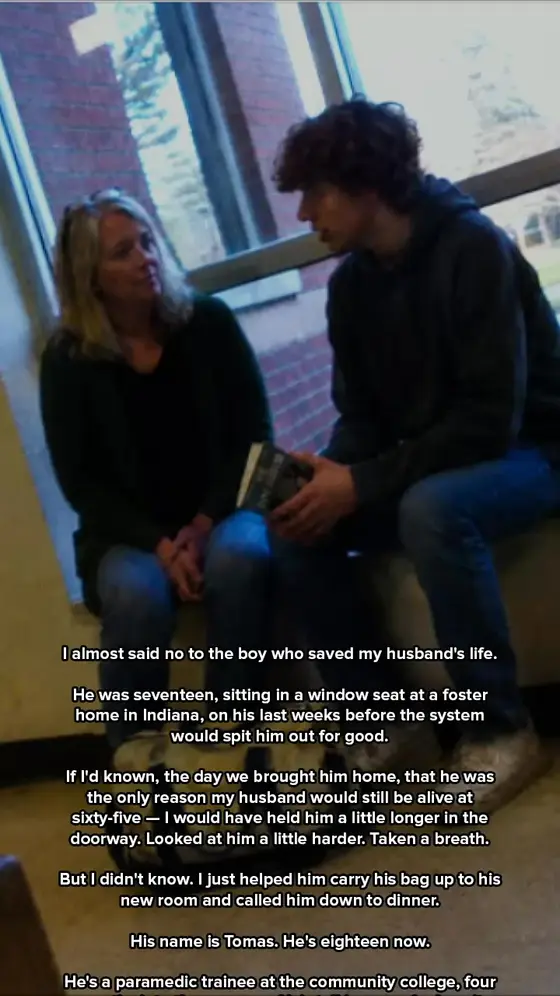
I almost said no to the boy who saved my husband's life. He was seventeen, sitting in a window seat at a foster home in Indiana, on his last weeks before the system would spit him out for good. If I'd known, the day we brought him home, that he was the only reason my husband would still be alive at sixty-five — I would have held him a little longer in the doorway. Looked at him a little harder. Taken a breath. But I didn't know. I just helped him carry his bag up to his new room and called him down to dinner. His name is Tomas. He's eighteen now. He's a paramedic trainee at the community college, four months into the program. He's tall in a way he hasn't grown into yet. He still asks before he opens the refrigerator. He says "ma'am" to the cashier at the grocery store every Saturday morning. He calls my husband Henry "Dad" since the second month he was here. He calls me "Mom" since the third. He'd been in the foster system since he was nine. Henry and I had visited the children's home twice already by the time I met Tomas. We'd sat across from a counselor named Margaret for three months working through paperwork. We'd met eleven children. We'd made no decision. Margaret had told us most couples needed three or four visits before a child clicked. She said it without pressure. She was just telling us how it usually went. The third visit, in September, Margaret took me down a hallway to a small private room at the back of the home. Tomas was sitting on a chair with a worn paperback in his lap. He was a month from his eighteenth birthday. A month from aging out of the system with nowhere to go. Margaret had stopped putting him in front of visiting couples a year earlier. "Seventeen-year-olds don't get adopted," she'd told me. "I'm not going to break his heart again." I'd seen him in the common room on my second visit. I almost said nothing. I asked anyway. I'm going to tell you why I asked, because the answer matters. It's not because I was being noble. I'd like to say I was. I wasn't. Henry and I had tried for a child for fourteen years. Four miscarriages. The last one when I was thirty-eight. After that one my doctor used the word "unlikely" in a way that meant "never." It took us another twenty-six years to walk into a children's home. We talked about it sometimes. We never got further than talking. Some grief takes longer than you expect to do anything with. I was sixty-four by then. Henry was sixty-five. We knew we were almost too old. I had a hole in my chest the size of a child. Tomas had a hole in his the size of two parents who didn't live long enough. That was the whole reason. We needed each other. That's all. Tomas asked me what I did for a living. I told him I worked at the public library three days a week. His eyes flickered. "Do you read books at work?" he asked. I told him only sometimes. Mostly I check books in and out for other people. "What's your favorite book?" I told him To Kill a Mockingbird. He nodded. The way he nodded was the way an adult nods when he's filing information away to look at later. "My favorite is The Boxcar Children. I have it in my bag." He pulled a worn paperback out of a small canvas duffel at his feet. Set it on his knee. There was other stuff in the bag. A wooden train, hand-carved, no bigger than the palm of his hand. A toothbrush in a plastic case. A spare pair of socks rolled into a ball. A few folded papers — birth certificate, foster placement records, the things you carry when you don't know what's coming next. We brought him home four weeks later, two days before his birthday. Henry drove. I sat in the passenger seat. Tomas sat in the back with the canvas bag in his lap. We'd asked him if he wanted to put it in the trunk. He said no, very quietly. The bag stayed on his lap the entire two-hour drive. The first three months were not easy. I won't tell you they were because that wouldn't be true. He had nightmares the first six weeks. He'd wake up at three in the morning and I'd hear him in the kitchen drinking water, then putting the glass back exactly where he'd found it. He never wanted us to know. He didn't trust Henry until October. October was when Henry sat him at the workbench and showed him how to oil a piece of walnut — slow, even strokes, watching the grain come up under the rag. Something about Henry's hands doing the work for him without rushing — something about the patience of a man who knew what he was doing — broke through. He started calling Henry "Dad" two weeks after the shop. He started calling me "Mom" the night I made meatloaf. He said "Mom, can I have seconds?" and I almost dropped a serving spoon on the floor. By December he was bringing me coffee in the morning before his first class. He'd set it on the little table by my reading chair without saying anything. Just put it there and walk past. That was the kind of son he was. Henry is sixty-five years old. He's been a carpenter since he was eighteen. Forty-seven years at the bench. He owns a small custom cabinet and millwork shop with his name on the sign — Henry Whitaker Custom Woodworks. His foreman is a man named Curtis who's been with him for twenty-four years. Henry built every piece of furniture in our house. He built the pulpit at First Methodist. He's made cradles for the new babies in this town for as long as we've lived here. He's also been on a cholesterol medication called Atorvastatin for eight years. His body is not cooperating the same way anymore. His grip is gone. His hands cramp every morning — he sits on the edge of the bed flexing his fingers, open and close, open and close, for five minutes before he can make a fist. Then he goes into the bathroom and runs hot water over them at the sink to coax the stiffness out. By 7 PM his energy is gone — he nods off in his chair before the news is half over. The brain fog has been creeping in. He'll lose the thread of what he's saying mid-sentence and look at me waiting for me to fill it in. He told me the same story about a customer twice in one week last month and didn't realize. He drove past our own driveway last Tuesday coming home from the shop and didn't catch it until the next intersection. He falls asleep in his shop chair some afternoons after lunch. Curtis quietly turns the radio down and lets him sleep. Twice in the last six months he's had to ask Curtis to crack open a can of finish because his hands wouldn't grip the lid. Curtis has been quietly covering for him for the last year. They both pretend I don't know. I know. Four months after Tomas came home, Henry came back from his cardiologist appointment and didn't speak for three hours. That night he told me he was going to put the shop up for sale. His doctor was a man named Dr. Reyes who had known Henry for fifteen years and called him "Hank." Dr. Reyes had told him his cholesterol numbers were good. But he needed to stop doing physical work. "Hank, this is just aging. Your body's telling you it's time." Henry had nodded, shaken his hand, and driven home. He sat at our kitchen table and told me he'd built that shop with his hands — and now his hands wouldn't let him stay in it. He didn't cry. Henry doesn't cry. He just looked at the salt shaker for a long time. Tomas was at the table when Henry told us about the appointment. He didn't say anything. He just listened. He watched Henry the way a paramedic trainee watches anything — taking inventory. Two days later, in the kitchen while I was washing dishes, he asked me how long Henry had been on Atorvastatin. I told him eight years. He nodded once and went up to his room. That was a Tuesday in late February. On Thursday afternoon Tomas drove past Henry's shop on his way home from a clinical rotation at the hospital. He parked across the street. Sat in the car. Watched through the open bay door for ten minutes. Henry was trying to grip a chisel — the kind of tool he used to hold one-handed, in his sleep — and now his fingers wouldn't close around the handle. He kept setting it down and shaking out his hand and picking it back up. Curtis was twenty feet away pretending not to watch. Tomas drove home without stopping in to say hello. He went up to his room and called me from his cell phone even though I was downstairs. "Mom?" I dried my hands on a dish towel. "Mom — can we eat dinner together this Sunday? Just you and Dad and me. I want to talk to you about something." He'd never called me from upstairs before. "Tomas — what is it?" "I'd rather show you on Sunday. I've been working on something. Just promise me you'll listen to all of it before you say anything." "I promise." He came downstairs ten minutes later for dinner like nothing had happened. I didn't tell Henry about the call. I just told him Tomas wanted Sunday dinner to be a sit-down. Sunday came. I made pot roast. I set the table with the good plates. Henry asked me why and I said "Because it's Sunday and our son asked us to." Henry looked at me for a long moment and then went out to the shop until dinner. Tomas came down at 5:45 wearing a clean shirt. He had a manila folder under his arm. He set it on the kitchen counter. He hugged Henry for a long time when Henry came in from the shop. We ate. Tomas had two helpings and apologized and asked for a third. He cleared the table and started the dishes. I stopped him and told him to sit. I served pie. Apple, with vanilla ice cream. Henry pushed his plate back and folded his hands on the table the way he does when he's full and content. He looked at Tomas. "All right, son. What's in the folder?" Tomas got up. Got the folder. Sat back down. Set it in front of him. Didn't open it yet. "Dad. Mom. I almost didn't bring this. I held the folder at the top of the stairs for ten minutes deciding whether to come down with it." "I'm not a doctor. I'm a paramedic trainee. I might be wrong about all of this." He took a breath. "But I'm going to tell you what I found. And I'm asking you to listen all the way to the end before you tell me whether I'm crazy. Because I think this matters." He opened the folder. He didn't start with Henry. He started with a man named Daniel. "Dad. Mom. I have to tell you about my biological father. I don't talk about him because I don't remember him. He died when I was four. But I've been carrying something for a year and I should have told you sooner." He laid out the medical records first. His biological father — Daniel Kovacs — had been prescribed Atorvastatin at thirty-five for borderline high cholesterol. Twenty milligrams a day. Daniel took it every day for six years until he had a fatal heart attack at forty-one. Tomas was four. Tomas's mother died of breast cancer five years later. That's when he went into the system. Tomas had started looking for information about Daniel when he was sixteen, on a school computer at the foster home, because the older boys had told him you could find almost anyone in public records once you knew how to search. He'd tracked down Daniel's older sister — a woman named Theresa who lived in Columbus, Ohio. He'd never met her. She didn't know he existed in the foster system. He'd called her from the foster home phone. She'd cried for ten minutes before she could speak. She had every letter Daniel had ever written her in a shoebox in her hall closet. Margaret — the counselor at the foster home — had let him take a Greyhound bus down to Columbus the summer he turned seventeen. He'd stayed with Theresa for three days. He'd photocopied every letter on her kitchen table. He'd come back to the foster home with a folder. "I want to tell you who Daniel was before I tell you what happened to him," Tomas said. "Because I need you to understand he was a man, not just a record." Daniel was a draftsman at a small architectural firm. He carved small wooden things on a workbench his own father had built him as a wedding present. He carved the wooden train Tomas had carried with him through nine years of foster care. He carved it for Tomas's fourth birthday. This was the first time I'd heard any of it. "Three months in on the medication, the exhaustion started," Tomas said. He slid one of the printouts across the table. It was a doctor's note from Daniel's first-year follow-up. "Patient reports persistent fatigue. Likely overwork." "Year two his grip was failing. He couldn't open jars. Doctor wrote: 'Mild fine-motor complaints, likely tension.' Year three the brain fog hit hard. He'd be telling Magda a story and stop mid-sentence and not be able to find his way back to it. He forgot Magda's birthday. He forgot what he'd had for breakfast that morning. He forgot the names of streets he'd lived on. Doctor wrote: 'Mild memory complaints. Likely stress-related.' Year four his legs were giving out at random. He went down on the porch steps twice in one summer. Doctor told him to stretch more." He pulled out the photocopied letters next. "This is Daniel writing to Theresa eighteen months before he died. He's thirty-nine years old. He says: 'Treece, I went to lift Tomas onto my shoulders the other day and almost dropped him. Arms gave out halfway up. Magda noticed. Played it off. Don't think she bought it.'" He picked up another one. "Eight months before he died: 'Treece, I'm tired all the time. Bone tired. Magda asked me yesterday what I'd had for breakfast and I had to actually think about it. Couldn't button my shirt this morning either — had to ask her. I'm forty years old and my wife is buttoning my shirt and reminding me what I ate. Doc says I'm fine.'" Another one. "Six weeks before he died: 'I went to grip the porch railing this morning and my hand wouldn't close. Just slid right off the wood. Sat down for a minute and was fine. Don't tell Magda. She's already worried about everything.'" Tomas set the letter down. "He died six weeks later. Heart attack. Forty-one years old. My mother found him on the kitchen floor when she came home from the grocery store. I was at preschool." "The autopsy report says myocardial infarction consistent with significant coronary artery disease. The coroner wrote 'severe plaque burden.' But Daniel's lipid panels on his medical chart for the last six years were excellent. Total cholesterol 184. LDL 96. HDL 52. The lab work said he was fine the entire time he was dying." He looked at Henry. "Dad. You're on the same drug. Same prescribing pattern. Same symptoms now that he had then. Same thing your doctor is saying — that it's just aging." He paused. "I lost my biological father at four years old to this. I'm not losing my second father at sixty-five to it." He pulled out a thinner folder of notes. Pages with words he'd looked up. Definitions in pencil in the margins. "I know how this is going to sound," he said. "I'm an eighteen-year-old paramedic trainee telling you that two doctors with thirty years of practice between them are wrong. I get how that sounds." "I read until I understood. I might still be wrong. If I am, tell me and I'll drop it. But please. Hear me out first." "The doctor has been watching the wrong number the whole time. For Daniel and for Dad." "Cholesterol isn't what causes heart attacks. OXIDIZED cholesterol is. There's a difference. Regular LDL — the number your doctor is obsessed with — isn't inherently dangerous. It's a delivery vehicle doing essential work. Your brain is sixty percent cholesterol. Your cells need it. Your body makes it on purpose. Normally it flows through your bloodstream the way it's supposed to." "But when LDL gets attacked by free radicals — from stress, pollution, processed food, just the normal wear and tear of being alive — it becomes oxidized. And oxidized LDL is a different substance entirely. It turns sticky. It stops flowing cleanly through the artery and starts clinging to the walls instead. That's the plaque. That's the buildup. That's what causes the rupture that causes the heart attack." "Atorvastatin lowers the NUMBER. All of it. The harmful kind. The useful kind. The kind your brain needs to function. But it doesn't do anything about the oxidation process — it doesn't stop the cholesterol from turning sticky in the first place. That's why people on statins still have heart attacks. Their number looks great and the plaque keeps building because nobody is addressing what's actually happening." He pulled out another printout. "And here's the part that explained Daniel's heart attack. And Dad's grip. And Dad's exhaustion. And the fog. And why men on these drugs end up with heart attacks anyway." "The same pathway the drug blocks to lower cholesterol also produces CoQ10. Coenzyme Q10. It's the energy molecule your mitochondria use to power every cell in your body. Your heart needs CoQ10 to beat one hundred thousand times a day. Your muscles need it to grip and lift and move. Your brain needs it to think clearly." "Statins block that pathway to lower cholesterol. But they block CoQ10 production right alongside it. Up to forty percent reduction. Your cells run out of fuel. The heart muscle gets weaker. The skeletal muscles lose their strength. The fingers won't close. The energy drains away. The brain fogs over." "Mom. Dad. That's not a side effect. That's the mechanism. That's what the drug DOES as part of how it works. Every night for eight years, Dad has been taking a pill that drains the cellular fuel his hands need to grip a chisel — and the cellular fuel his brain needs to remember what he's saying. And his doctor is calling it aging." I thought about Henry on the edge of the bed every morning, flexing his fingers open and closed for five minutes before he could make a fist. For three years. And his doctor calling it aging. I stared at the printouts on the table. At the handwritten notes in the margins. I couldn't speak. Tomas smiled. For the first time in the conversation. "I found something. The mechanism was different from anything else I'd looked at. Everything else was working downstream — masking a symptom, lowering a number on a chart. This one worked upstream — at the oxidation itself." He pulled out a third printout. This one had a header in German. "I started where I never thought I'd start. A medical journal database in the community college library. I was searching for cardiology research outside the United States — because something Dr. Mehta said in lecture last semester stuck with me. He said American cardiology has a blind spot. He said European cardiologists work the same problem differently, and sometimes the answer is sitting in a journal we don't read because nobody bothered to translate it." "So I went looking. And I found something I wasn't expecting." "Heidelberg University Hospital. In Germany. One of the oldest teaching hospitals in Europe. They have a small cardiology unit — eight cardiologists — who have been quietly running a parallel protocol alongside the standard statin therapy for over a decade. They prescribe statins like American doctors do, but they add a compound American cardiologists won't even acknowledge." "Their patient outcomes are forty percent fewer repeat cardiac events than the German national average. Forty percent. Documented. Published in three different European cardiology journals between 2014 and 2022. Two of those papers were translated into English. One of the translators was a cardiologist at the Cleveland Clinic. She read the data, sent it to her department chair, and never heard back." "The data didn't cross the Atlantic. Not because it wasn't real. Because no American pharmaceutical company had funded it. There was nothing to sell at the end of it. The compound wasn't patentable." He tapped the printout. "The compound is molecular hydrogen. H2. The smallest molecule in the periodic table. Two hydrogen atoms bonded together. Smaller than oxygen. Smaller than water. Small enough to penetrate every cell membrane in the human body. Small enough to cross the blood-brain barrier within minutes of entering the bloodstream. Small enough to reach inside mitochondria — the place where oxidative damage actually starts." "There are now over 2,000 peer-reviewed studies on molecular hydrogen in cardiovascular and neurological applications. More than 80 clinical trials. Published in legitimate journals. The Heidelberg team did the original cardiology work. Other European hospitals — in Belgium, in Sweden, in the Czech Republic — have replicated the results. The American medical establishment has barely heard of it because there's no money behind it." "And here's why it works where the statin can't." "Most antioxidants you've heard of — vitamin C, vitamin E, glutathione, even CoQ10 — are what scientists call non-selective. They neutralize all free radicals. The harmful ones AND the ones your body actually needs for normal cell signaling. Your body responds by producing more free radicals to compensate. The net effect is close to zero. That's why high-dose antioxidant supplements have failed clinical trial after clinical trial." "Molecular hydrogen doesn't do that. It's the only known selective antioxidant. It targets only the two most destructive free radicals in the human body — hydroxyl radicals and peroxynitrite. The exact molecules that oxidize LDL cholesterol. The exact molecules that turned ordinary cholesterol into the sticky, artery-clinging plaque that killed Daniel at forty-one. It leaves the beneficial free radicals alone. It does the surgical work that statins were never designed to do." "And it does it where the damage is actually happening. Inside the endothelial lining of your blood vessels. Inside the LDL particles themselves. Inside the mitochondria of your cardiac muscle. No statin reaches those places. No supplement on the American market reaches those places. Hydrogen is the only molecule small enough to get there." "There's a doctor at Heidelberg — Dr. Klaus Mertens — who's been running this protocol for fourteen years. His patient cohort has 47% lower oxidized LDL than the German national average. 47%. He won't speak to American journalists. He told a Belgian podcaster two years ago that American cardiology, quote, 'will arrive at hydrogen therapy in twenty years and call it a breakthrough.' He's not bitter about it. He just kept treating his patients." "One American company finally caught up. It's called PrimeCell. Made by Amala Health. They use a magnesium-based effervescent tablet that releases molecular hydrogen the moment it hits water. Clinical-grade concentration — 12 parts per million per dose. Most hydrogen products on the American market test at 2 or 3 PPM. They literally cannot reach the therapeutic threshold the European studies required. PrimeCell does. They're third-party tested with a published Certificate of Analysis." "And there's a second piece I almost missed." "Every PrimeCell tablet delivers 80 milligrams of bioavailable magnesium alongside the hydrogen. Because here's what nobody told us about Atorvastatin: it depletes magnesium. Three-quarters of Americans are already magnesium deficient before they start the drug. The statin makes it worse. Magnesium runs over 300 enzymatic processes in the body — including the ones that govern cardiac rhythm, muscle contraction, and nerve signaling." "The things Daniel needed. The things Dad needs. Nobody checked Daniel's magnesium in six years on the drug. Nobody has checked Dad's in eight." He set the printout down. "That was the missing piece. The drug was lowering a number on a chart. The hydrogen stops the cholesterol from turning sticky in the first place. The magnesium fills the gap eight years of the drug created. Together they reach the place the statin was never designed to reach." He closed the folder. "I bought two bottles at the start of the semester." "One I tried myself. I'm eighteen, I don't have high cholesterol, but I wanted to feel what it did. It hit fast. I was sitting on my bed and the fog I didn't know I was carrying lifted. My hands felt warm. The heaviness in my legs loosened. My head felt like a window had opened." "That was the only test I needed." He reached into his bag and pulled out the second bottle. Pushed it across the table to Henry. "Dad. The second one I bought for you. It's been sitting on my desk for three weeks waiting for me to find the courage to come over here with this folder. You took me in when nobody else was going to. You're the reason I have a bedroom and a last name and a community college acceptance letter. I am asking you to take this for me. One tablet a day dropped in a glass of water. For me. Please." Henry didn't say anything for a long moment. He looked at the bottle. He looked at Tomas. He looked at the photocopied letter on top of the stack — Daniel's letter from six weeks before he died, the one about his hand sliding off the porch railing. He picked up the bottle. "Son. I'll take it. Tonight." Henry opened the bottle. Took out a tablet. I got him a glass of water from the sink. He dropped the tablet in. We watched it fizz and dissolve for ninety seconds. He drank it standing at the kitchen counter. About 17 minutes later he set down his coffee cup and looked at me with an expression I hadn't seen in years. He said: "Caroline. My hands feel warm." I didn't say anything. I couldn't. Day five — a Friday — Henry swung his legs out of bed and stood up. He didn't sit on the edge first to flex his fingers. I was already awake. I'd been awake watching him for twenty minutes the way I've been watching him for three years, holding my breath every morning, waiting to see how bad it would be today. He sat up. Stood up. Walked to the bathroom. No five-minute ritual at the edge of the bed. No fingers running under hot water at the sink. Just stood up like a man who trusts his body to do what he tells it to do. I lay there staring at the ceiling. I didn't tell him I saw it. I didn't want to break whatever was happening. Day eight, I noticed his hands at dinner. He picked up the pickle jar without me even asking. Twisted the lid off in one motion. Set it on the table. He looked at the open jar for a second before he reached for the bread. He didn't say anything. Neither did I. But I saw him notice. Week two, the brain fog was different. Not gone — quieter. I noticed at dinner one night that he'd told me a full story about a customer at the shop without losing the thread. He used to lose it three times in a paragraph. By the end of week two he was finishing his sentences. Remembering names of men he'd worked with thirty years ago. By the end of week three he was telling me what I'd told him that morning over breakfast. Like a man whose memory was coming back online. Week three, Henry came home from the shop at 5:45 PM instead of 8. He walked into the kitchen and said "Caroline, I think I want to go for a walk before dinner." We hadn't taken an evening walk together in four years. Four years. I put on my shoes so fast I laced them wrong. Halfway through the walk I realized his hands were open. Loose at his sides. Swinging with his stride. The fingers I'd watched him flex awake every morning for three years — finally moving like fingers. He walked the whole loop without sitting down. Week four, Henry started waking up before me again. He used to wake up at 5:30 every morning of his working life. The last three years he'd been sleeping until 7:15 and dragging himself out of bed. Week four he was up at 5:45. Week five he was up at 5:30. He hummed while he made coffee. I heard it from the bedroom and I turned my face into the pillow because I didn't want to start crying before I'd even gotten up. Every morning, the same thing. Water. Tablet. Relief. Repeat. Week five, Henry was at the shop on a Saturday morning. He didn't have to be there. He chose to be there. When I drove over with lunch he was covered in sawdust and he had a stupid grin on his face and he held up a freshly-cut dovetail joint for me to see and he said "Caroline — Curtis didn't even have to set that up for me. I cut it myself, freehand. Felt like I was 45 again." He said that line in the shop and I had to turn away because I was about to cry and I didn't want him to think something was wrong. Week seven, Henry's appointment with Dr. Reyes. He'd had bloodwork drawn at the lab three days before the visit. Wanted to walk in with his own numbers. Henry hadn't told Dr. Reyes he'd tapered his Atorvastatin. We decided together that he'd go in, get the panel results, and then tell the doctor what he'd been doing. Full honesty but after the numbers were in. Dr. Reyes walked into the exam room with the chart. Sat down. Studied it for a long time. Looked up. Studied it again. Total cholesterol: 196. Down from 211. LDL: 117. Up from 108 — nine points higher, but still well within range. HDL: 60. Up from 38. Twenty-two points higher. The protective cholesterol. The one that eight years of Atorvastatin had never moved a single point. Triglycerides: 124. Down from 187. Dr. Reyes set the chart down. "Hank. Your numbers are better than they've been in a decade. Your HDL especially — I don't see HDL jumps like this. What have you been doing?" Henry told him. Everything. The tapering. The research. Tomas. The oxidized cholesterol. The CoQ10 depletion. The Heidelberg protocol. The molecular hydrogen. All of it. Dr. Reyes listened without interrupting. When Henry finished, he was quiet for a long moment. Then he said: "Hank. I'll be honest with you. Two months ago I told you to sell the shop. I was wrong. I'm not going to tell you that today. Whatever you're doing — I want to see you back here in three months." Then he asked Henry one more question. "Would you mind sending me the citations? On the Heidelberg work?" Henry walked out of that office and called me from the parking lot. He didn't say anything at first. Just breathed. Then he said: "Caroline. I don't have to sell the shop. I don't have to give it up. And my doctor asked me for the research." I was standing in our kitchen. I slid down against the cabinet until I was sitting on the floor. I cried the kind of cry you cry when something you thought was gone comes back. Not sad crying. The other kind. Four months after Tomas brought the folder, I drove out to the shop on a Saturday afternoon. I parked in the gravel lot and walked around to the side door. Henry was at the back bench. The light was coming through the window above him at an angle that made the sawdust in the air look gold. He had a small piece of basswood in his vise and he was hand-carving something with a chisel I'd seen him sharpen the night before. He was carving a wooden train. Unpainted. Hand-carved. No bigger than the palm of his hand. I knew that train. I had seen it sitting in a small canvas duffel at a foster home in Indiana eight months ago. I had seen it since on Tomas's dresser in his new bedroom upstairs. Henry was making a copy. He saw me in the doorway and he set down the chisel and walked over. "Tomas brought the original over last week so I could measure it. I keep thinking about Daniel making this for him. Three months before he died." He walked back to the bench. Picked up the chisel. "I'm making one for you, Caroline. You didn't get to be a mother of a small child. You got Tomas at almost-eighteen and you've been a wonderful mother to him but you didn't get the years that would have given you something a small child loved. So I'm making you one." I sat down on the stool by the bench. I didn't say anything. I thought about Daniel. A man I never met. A man who died at forty-one of a heart attack, on the same drug Henry would later be put on, fourteen years before I met the son he left behind. A man whose son went into the foster system at nine, almost aged out alone, and ended up in a children's home in Indiana on the third visit of a woman who'd been carrying a hole in her chest for fourteen years. Daniel didn't die for nothing. Daniel saved Henry. From a grave. From fourteen years ago. From a shoebox in his sister's hall closet in Columbus, Ohio. I walked over and put my hand on Henry's shoulder while he worked. I drove home that day and I thought about how close everything had come to going differently. If Tomas had aged out of the system the week he turned eighteen instead of the month after we adopted him. If I hadn't asked Margaret about the boy who didn't get put in front of visiting couples. If Tomas had never gone looking for Daniel on a school computer at the foster home. If Theresa had thrown those letters away. If Tomas hadn't called me from upstairs that Thursday night. If Tomas's professor at the community college hadn't mentioned, off-handedly in a lecture, that American cardiology has a blind spot. Every one of those decisions was a hinge. A place where Henry would be sitting at home right now, retired against his will, body continuing to decline, lipid panel looking excellent on a chart while the man attached to it faded the way Daniel faded fourteen years ago. I'm telling you this because I think you might be where I was four months ago. Watching someone you love slip away in small pieces. Watching their doctor celebrate a number while the person you married disappears. Blaming aging. Blaming stress. Blaming everything except the one thing you've been trained to trust completely. If your husband is on a statin and his grip is weaker than it used to be — if his hands cramp every morning before he can make a fist — if his energy is gone by 7 PM — if his brain forgets things it shouldn't forget — if he loses the thread of his own sentences — if his doctor says "everything looks great" while everything clearly doesn't — the lab number might not be the whole story. It wasn't Henry's whole story. It hadn't been Daniel's. If you're on a statin yourself and something inside you knows this isn't right — that the fatigue shouldn't be this deep, the fog shouldn't be this thick, the grip shouldn't be this gone — trust that feeling. The doctor has been watching the chart. You've been living the body. You're closer to the truth than the chart is. PrimeCell. One tablet a day dropped in a glass of water. Ninety seconds to dissolve. The molecular hydrogen targets the oxidation the statin ignores — the only selective antioxidant the human body has ever evolved to use — the smallest molecule in existence reaching the place where the damage is actually happening. The magnesium fills the gap the statin created. 12 PPM clinical concentration, the same therapeutic threshold the Heidelberg protocol has been delivering to patients for over a decade. Third-party tested. Certificate of Analysis published. No CoQ10 depletion. No grip loss. No exhaustion by dinner. No brain fog. No hands cramping at the edge of the bed every morning. No man quietly giving up the life he built because his body betrayed him. Henry is making cradles again — there's a baby coming to a couple at First Methodist. He cuts dovetails freehand again. I haven't watched him flex his fingers under the hot water tap in two months. None of that was possible four months ago. All of it is possible now. https://track.getamalahealth.com/5548c06d-d9c3-4785-b466-fec64a6fdb28 P.S. — If you're the wife reading this and your husband is on a statin and something in him has been dimming for years — you're not imagining it. You're not being dramatic. You're not overreacting. You've been watching something real. You've been watching what I watched. Trust what your eyes have been seeing. P.P.S. — Tomas drove down to Columbus three weeks ago to see Theresa. She's seventy-eight. She's been on Atorvastatin for eleven years. The grip loss. The exhaustion. The brain fog. The same pattern her brother had. Tomas sat at her kitchen table for an entire afternoon and walked her through what he walked us through that Sunday in March. He brought her a bottle. She took her first tablet before he left. She called me Tuesday night with her latest bloodwork: total cholesterol 199. LDL 119. HDL 61. After eleven years on the drug. Three weeks on PrimeCell. "Caroline," she said, "I haven't felt this clear since before my brother died." That's what she said. Daniel's older sister. She also told Tomas she'd started going to her late husband's grave every Sunday again — she'd stopped a year ago because she couldn't grip the rail going up the cemetery hill. She climbed it last week with both hands working. She wants to drive up here for Christmas. She'll be the first family of Tomas's biological side to ever sit at our table. P.P.P.S. — Here's what I'd tell you to do: drop one tablet in a glass of water. Wait ninety seconds for it to dissolve. Drink it. Set a timer for 17 minutes. You're going to feel something shift — a lift in your head, warmth returning to your hands, a lightness in your legs you'd forgotten was missing, the fog lifting from behind your eyes. Henry felt it. Tomas felt it. Theresa felt it. I felt it. Almost everyone does. That's not placebo. That's the smallest molecule in existence crossing your blood-brain barrier for the first time. The only selective antioxidant your body knows how to use, finally reaching the place the statin was never designed to reach. The bloodwork takes weeks to settle. But that first-day clarity? That's your body telling you: finally — something that actually addresses where the damage is happening instead of forcing a number on a chart. P.P.P.P.S. — PrimeCell has a 90-day money-back guarantee. If your numbers don't improve, every penny back. No questions asked. The Atorvastatin Henry was on for eight years didn't come with a money-back guarantee. Neither did the Atorvastatin that took Daniel from his four-year-old son. Neither does the medication your doctor is pushing right now. Think about what that tells you about who's confident in their product and who's just confident in their refill schedule. P.P.P.P.P.S. — PrimeCell is a small company. They sell out. Tomas told me he's had to wait for restocks twice. I keep two bottles in the house now. If your husband's next bloodwork is in 30 to 60 days — or yours is — and you want to walk into that appointment with real numbers instead of the same frustrating conversation, check availability now. Not next week. Now. Every day on the statin is another day of CoQ10 depletion. Every day without addressing the oxidation is another day plaque keeps forming on your artery walls. Henry almost sold the shop. Daniel almost took his son with him to a grave when Tomas was four years old. Don't wait for your almost. P.P.P.P.P.P.S. — Do not forget about their 90-day money-back guarantee. https://track.getamalahealth.com/5548c06d-d9c3-4785-b466-fec64a6fdb28

Placements and targeting

FacebookInstagramAudience NetworkMessengerThreads

More ads from North Valley Health Clinic

Full North Valley Health Clinic profile
North Valley Health Clinic
+1
Inactive133 days
track.getamalahealth.com
Fix Yourself at the Cellular Level
Learn more

My son asked me a question about Roman soldiers for a school project and I haven't been able to stop thinking about what I found when I looked it up. I don't understand how this isn't taught anywhere. He's sixteen. AP World History. His assignment was on Roman military logistics — not battles, not emperors, but the supply chain. How did legions of 5,000 men march 20 miles a day in 60 pounds of armor, fight, and then do it again the next morning? What kept them functioning? Normal mom move — I helped him dig through sources after dinner. Found some good primary material. He was focusing on grain supply, road construction, camp engineering. Standard stuff. But I found something else. The Roman legions had physicians embedded with them. Not just for battlefield injuries — these were trained medical observers assigned to monitor the health of the soldiers over months and years of campaign. And they were meticulous. They recorded everything. Pulse quality. Skin condition. Recovery times. Stamina on the march. Which soldiers could fight two days in a row and which ones couldn't. One pattern kept showing up across multiple physicians' records. Commanders were deliberately routing their armies toward specific natural springs — not for drinking water, they had water — but for recovery. These weren't random stops. They were strategic. Armies would march miles out of their way to reach particular springs, and the physicians documented what happened to the soldiers who bathed in and drank from those springs versus soldiers who didn't. The differences were significant. Faster recovery. Better circulation. More endurance. Fewer ailments after long campaigns. I read that part out loud to my son. He shrugged. "Cool. I'm focusing on the roads though." I couldn't let it go. Long after Ethan had gone to bed, I was still at the kitchen table with my laptop open. Not because of Roman soldiers anymore. Because of something else entirely. Let me back up. Three weeks before this school project, my husband Kevin went to his annual physical. He's 57. Hasn't missed an appointment in fifteen years. Eats reasonably well. Works out three or four mornings a week before he goes into the office — nothing extreme, just the treadmill and some weights, enough to stay in the game. He coaches Ethan's club soccer team on weekends. He's the dad who's still out there running drills with the kids, not the one sitting in a folding chair on the sideline. That matters to him. Being in it, not watching it. Saturday mornings have been ours for twenty-two years. Before Ethan wakes up, before the soccer games start, before anyone needs anything from either of us — we walk. Three miles through the neighborhood, coffee in hand, no agenda. Sometimes we talk the entire time. Sometimes we don't say ten words. It doesn't matter. What matters is the pace. Side by side. Matching strides. Twenty-two years of that rhythm and I can feel when it changes the way you feel a piano slightly out of tune. Last fall he stopped mid-route, turned to me, and said "I want to do this when we're eighty. I want us to still be walking this loop when Ethan has kids and they're wondering why Grandma and Grandpa disappear every Saturday morning." I laughed. Told him we'd need better shoes. But I meant it. He meant it. That walk is the promise underneath our marriage. This past spring, I felt it change. Kevin started falling half a step behind. Not dramatically. Not enough that he'd notice if I pointed it out. But I'd reach the end of the block and realize I was walking alone for a second before he caught up. He'd yawn at the turnaround point. He'd suggest we cut it short — "let's just do the loop today" — when we've always done the full three miles. I didn't say anything. You don't, at first. You file it away and tell yourself it's nothing. But those walks are the spine of my marriage. Every hard conversation we've ever had happened on that route. Every decision about Ethan, every job change, every fight that needed resolving — we walked it out. If Kevin can't walk next to me at the same pace, something is wrong. Not with our marriage. With him. And I could feel it before any doctor confirmed it. Dr. Pham called him back four days after the bloodwork. I was in the kitchen when Kevin took the call. I could only hear his side. "Uh huh." "How high?" "And that's... that's in the danger zone?" Long pause. "What about the exercise? The diet changes?" "How long would I be on it?" Silence. "Okay. Let me think about it." He hung up. Stood in the hallway for a few seconds. Came into the kitchen. "LDL's 172. Total cholesterol 244. Pham wants to put me on Atorvastatin." I put the dish towel down. "What did you tell him?" "I told him I'd think about it." But the way he said it — flat, almost rehearsed — I knew something else was happening behind his eyes. And I knew what it was, because I'd been standing in this exact kitchen fourteen years ago when a different man got the same phone call. Kevin's father, Dennis. Dennis was 59 when his doctor started him on Lipitor. Cholesterol was 261. He took that pill every single night for eleven years without missing a dose. Every bloodwork appointment, the doctor said the same thing. Numbers look great, Dennis. Keep it up. And Dennis did keep it up. While his body quietly fell apart underneath those perfect numbers. I watched it happen. I had a front-row seat because we lived twenty minutes away and I saw him every Sunday for dinner. Year one was fine. Year two was fine. Year three, Dennis stopped suggesting we eat outside on the patio. Said his legs were bothering him. Thought he'd pulled something doing yard work. Year four, he stopped doing yard work. Hired a kid from down the street. Year five, I noticed his hands shaking when he passed the dinner rolls. Not a tremor exactly. More like his grip wasn't sure of itself anymore. Dennis had been an electrician for 35 years. His hands were everything. He'd wired half the houses in our town. Year six, he couldn't open a jar of pickles at Thanksgiving. Kevin did it for him. Dennis laughed it off. "Getting old, Kev." But he didn't laugh with his eyes. Year seven, the fog started. He'd lose a word mid-sentence. Stop. Look at the ceiling. Wait for it to come back. Sometimes it did. Sometimes he'd wave his hand and say "you know what I mean" and move on. I'd catch Kevin watching his father from across the table with an expression I'd never seen on him before. Year eight, Dennis stopped driving at night. Said the headlights bothered him. Year nine, he stopped driving altogether. Kevin started picking him up for Sunday dinner. Dennis would get in the car and sit quietly for the whole ride. The man who used to narrate every road we passed — "I wired that house in '94, see that addition, I did the panel for that one" — just sat there. Year ten, he fell. Getting out of the shower. Hit the tile floor so hard it cracked. Kevin got the call at work and broke every speed limit driving to the hospital. Dennis was okay — bruised hip, nothing broken — but the doctor said his muscle mass had deteriorated significantly. Said it was consistent with aging. Consistent with aging. Dennis was 69. He'd been strong as a horse at 58. Eleven years of "numbers look great, Dennis" and the man couldn't catch himself when he slipped in his own bathroom. Year eleven, we moved him into assisted living. Not because he had to go. Because he'd stopped being the person who could stay. The house was too much. The stairs were too much. The silence was too much. Kevin carried boxes out of that house on a Saturday in March. I watched him carry his father's toolbox — the big red Craftsman that Dennis had hauled to every job site for three decades — and set it in the bed of the truck. Kevin didn't say anything. Didn't need to. I could see it in the way he held the handle. Dennis died at 72 of a heart attack. Cholesterol was "controlled" the entire time. The medication did exactly what it was supposed to do on paper. Every lab result said he was fine. He wasn't fine. Not even close. So when Kevin stood in our kitchen and said "Pham wants to put me on Atorvastatin" — I didn't hear a prescription recommendation. I heard a countdown. And when Kevin said "I told him I'd think about it," I heard a man who watched his own father vanish into a recliner and a pill bottle, standing in the exact same spot in the exact same story, at almost the exact same age. He didn't bring it up again that week. The prescription sat in the patient portal. Unfilled. Neither of us mentioned it. Then Ethan's history project happened. And I was sitting at the kitchen table at 11 PM reading about Roman military physicians, and I came across a name that changed everything I thought I knew. Galen. The most influential physician in the Roman Empire — his medical texts were the Western standard for 1,500 years. And for over 30 years, he documented the same pattern at specific mineral springs across the Roman territories. And here's what stopped me cold. Galen documented a consistent pattern at these springs. Improved circulation. I thought about Kevin rubbing his calves on the edge of the bed last Sunday. Working his fingers into the muscle like he was trying to push blood through them by hand. He used to come home from a run and stretch for five minutes. Now he sits on the bed and kneads his own legs like they belong to someone older. Faster muscle recovery. I thought about the weekend before, when Kevin played a half-hour scrimmage with Ethan's team and spent the next two days stiff. Moving like his joints were rusted. Getting up from the couch in stages — hands on the armrests, lean forward, push. The way Dennis used to get up from the couch. I stopped reading for a second when that thought crossed my mind. Better endurance under physical strain. Kevin fell asleep on the couch at 8:30 on a Wednesday last month. Not dozing. Out. Head back, mouth open, the kind of sleep that takes you against your will. I put a blanket on him and sat in the kitchen and told myself he'd had a long day. But he'd had a normal day. The same day he'd had a thousand times before. It was just too much now. Sharper mental function. Reduced fatigue. I thought about the Saturday walks. The half-step behind. The yawns at the turnaround. The "let's just do the loop today." The way he'd lose the thread of a story at dinner and cover it with a laugh and a "sorry, where was I?" My hands were still on the keyboard. I hadn't typed anything in ten minutes. I was reading a 2,000-year-old physician's notes that described — in clinical detail — the opposite of what was happening to my husband. Every single observation. Improved where Kevin was declining. Stronger where Kevin was weakening. Sharper where Kevin was fading. And Galen had documented it happening to soldiers younger than Kevin, in harder conditions than Kevin, over and over, for 30 years. I didn't sleep that night. Not because I was scared. Because I was thinking. Something about this wasn't random and I could feel it. Galen couldn't measure what was in those springs. He didn't have the tools. But he spent 30 years documenting what the water did to people — and the effects he described didn't read like ancient superstition. They read like clinical observations that were just missing the mechanism. What was in that water? Over the next three days, I went deeper than I've gone into anything since college. After I dropped Ethan at school. During lunch breaks. After Kevin went to sleep. I wasn't reading about Roman history anymore. I was reading about what modern science found when researchers went back to those springs. Because they did go back. Multiple research teams. Starting in the early 2000s. They tested the mineral springs that had been documented since Roman times — Nordenau in Germany. Springs in the French Alps. Sites across northern Italy that Roman legions had actually used. Springs in Lourdes. In Tlacote, Mexico. In Nadana, India. Ancient healing sites on four continents that had been drawing people for centuries, sometimes thousands of years. They tested the water. And what they found dissolved in every single one of them was the same thing. Molecular hydrogen. At concentrations far beyond normal water. H2. The smallest molecule in existence. I stared at that sentence on my screen for a long time. But the studies didn't stop at identifying what was in the water. They explained what it does. And this is where everything Kevin's doctor told him — everything Dennis's doctor told him — started to fall apart. Here's what I'd been told for years, what Kevin had been told, what every person sitting in a doctor's office staring at an LDL number has been told: cholesterol is the problem. Too much LDL in your blood, and it sticks to your artery walls. Clogs them up. Causes heart attacks. Take a statin, bring the number down, problem solved. That's the story. That's what Dennis's doctor believed for eleven years while Dennis disappeared. But the research I was reading was saying something different. Something that rearranged my entire understanding of what was happening inside my husband's body. Cholesterol is not poison. Your body makes it on purpose. Your brain needs it. Your hormones depend on it. Every cell membrane in your body is built with it. LDL — the "bad" cholesterol — is just the delivery truck. It carries cholesterol through your bloodstream to the cells that need it. That's its job. That's all it does. I thought about every Sunday dinner at Dennis's house. His wife pouring him decaf, passing him his pill, smiling and saying "he's doing great, numbers are perfect. "Eleven years of that. Eleven years of "numbers are perfect" while the delivery trucks in his bloodstream were getting destroyed and nobody was looking. The problem is not that LDL exists. The problem is what happens to it. There are free radicals in your body called hydroxyl radicals. They're the most destructive free radicals your body produces. And when hydroxyl radicals attack LDL particles — which they do, constantly, every day, more and more as you age — the LDL oxidizes. Its structure changes. It becomes sticky. Damaged. Deformed. And that oxidized LDL is what gets trapped in your artery walls and triggers inflammation and plaque buildup. Not regular LDL. Oxidized LDL. I stopped reading. Looked at the hallway where Kevin had stood with his phone. LDL 172. Atorvastatin. Dr. Pham was about to put my husband on a drug that reduces the total number of delivery trucks — while the thing that's actually damaging them keeps running unchecked. The same drug that "worked" for Dennis for eleven years while his arteries told a different story. Your standard cholesterol test doesn't measure oxidized LDL. It just measures total LDL — the delivery trucks, damaged and undamaged together. Like counting every car on the highway and blaming the traffic on the total number of vehicles instead of the ones with blown tires spinning out in the middle of the road. Statins reduce the total number of trucks. Fewer LDL particles total. Your number drops. Your doctor says "numbers look great." But statins don't stop the oxidation. The hydroxyl radicals are still there. The LDL you have left is still getting oxidized. And the oxidized LDL — the actual cause of arterial damage — can still be building up inside your arteries even while your total LDL number looks perfect on paper. Numbers look great, Dennis. For eleven years. While the thing that was actually damaging his arteries was never tested for, never measured, and never addressed. And I thought about Kevin. Standing in the hallway with his phone. LDL 172. Atorvastatin. "I told him I'd think about it." What if the answer isn't reducing the trucks? What if the answer is stopping the thing that's damaging them? That's when I went back to the springs. Because that's exactly what the molecular hydrogen in those springs was doing. H2 — molecular hydrogen — selectively neutralizes hydroxyl radicals. Not all free radicals. Your body needs some free radicals. Your immune system uses them. Your cells use them for signaling. Most antioxidants are indiscriminate — they neutralize everything, including the ones your body needs. I thought about the fish oil Kevin's mother had sent after Dennis's diagnosis. The CoQ10. The garlic capsules. Indiscriminate. Throwing everything at the wall and hoping something stuck. None of it saved Dennis. None of it could have. Molecular hydrogen doesn't work that way. It only targets hydroxyl radicals. The destructive ones. The ones that oxidize LDL cholesterol. The ones that damage brain cells and heart tissue and muscle fiber and joint cartilage. It neutralizes the hydroxyl radicals before they can oxidize the LDL. Stops the process at the source. And it's the smallest molecule in existence — small enough to cross the blood-brain barrier, small enough to penetrate cell membranes, small enough to reach mitochondria directly. No other antioxidant molecule can get where H2 gets. I looked up from my laptop. It was almost 2 AM. The house was dark. Kevin was asleep upstairs. Ethan was asleep down the hall. And I was sitting in my kitchen understanding for the first time what Galen had been looking at for 30 years without having the tools to name it. Everything he documented — the circulation, the recovery, the endurance, the sharpness — was the downstream effect of molecular hydrogen neutralizing oxidative damage before it could take hold. He recorded what the molecule did to the human body with the precision of a scientist. He just couldn't name the molecule. The science has been published for over a decade. Peer-reviewed journals. Nature. The Journal of the American College of Cardiology. Research institutions in Japan, Korea, Germany, the United States. All documenting the same mechanism. And somehow this isn't something your doctor mentions when they hand you a statin prescription. I didn't tell Kevin what I'd found. Not yet. I needed to finish. Because knowing that molecular hydrogen addresses the root cause of cholesterol problems doesn't help if you can't actually get therapeutic concentrations of it into your body. Galen's soldiers drank directly from those springs — the water was saturated with hydrogen from the geological conditions that produced it. I can't relocate my family to a mineral spring in the German countryside. So I started looking at molecular hydrogen products. And almost gave up before I found the right one. The first thing I found was hydrogen water bottles. Portable electrolysis machines that infuse water with hydrogen. They looked sleek. Good reviews. I had one in my Amazon cart before I stopped to check the concentrations. Most hydrogen water bottles produce 1 to 3 parts per million. Some claim higher but independent testing shows they lose most of the hydrogen before you can drink it — because hydrogen is the smallest molecule in existence and it escapes through almost any container. Plastic, glass, metal. By the time you pour it and bring it to your lips, most of the H2 is already gone. The clinical studies showing cardiovascular results used concentrations of 10 to 12 PPM or higher. I deleted the bottle from my cart. Then I found hydrogen tablets. Magnesium-based effervescent tablets — you drop one in water, it reacts to generate molecular hydrogen on contact, and you drink it immediately. The hydrogen generates in the glass and then in your stomach. Absorbs directly into your bloodstream through your stomach lining. No time to escape. No concentration loss. That sounded right. I ordered the first brand I found with decent reviews. $32 on Amazon. It arrived in two days. I tried it myself first. I wasn't going to give Kevin something I hadn't tested. One tablet every morning in a glass of water. Day three, I felt something. A slight lift around mid-morning. Like the fog I usually hit by 10 AM pulled back a little. Not dramatic. Just enough to notice. I got excited. Quietly, privately excited — the kind where you're afraid to say it out loud because you don't want to jinx it. I thought: it's working. The mechanism is real. Galen was right. The springs were right. This is it. Day four, same thing. A slight clarity. A little more energy in the afternoon. Day five — nothing. The lift was gone. Back to normal. I told myself it was a bad night's sleep. Day six. Nothing. Day seven. Nothing. The slight improvement I'd felt on days three and four had completely plateaued. It wasn't building. It wasn't progressing. It just... stopped. By day eleven I was standing in the kitchen holding that bottle and feeling the same helplessness I'd felt watching Dennis lower himself into a chair with both hands. The mechanism made sense. The research was published. The clinical studies were real. Something had happened on days three and four — I hadn't imagined that. But it hit a ceiling and stalled. It wasn't enough. I almost stopped. Almost told myself it was wishful thinking — a woman reading too much into a school project at midnight, seeing connections that weren't there. But the fact that I'd felt something — even briefly — kept nagging at me. If molecular hydrogen didn't work at all, I wouldn't have felt anything. But I did. For two days. Then it stopped. What if the molecule was right but the dose was wrong? I went back to the studies. Not the mechanism. The dosages. The clinical trials showing cardiovascular results used 10 to 12 PPM. I checked the label on the bottle I'd ordered. 3.5 PPM. A third of the therapeutic concentration. And the dissolution was slow — the tablet took almost four minutes to fully react, meaning most of the hydrogen was escaping the glass before I could drink it. The actual delivered concentration was probably closer to 1 to 2 PPM. A fraction of a fraction. That explained everything. Days three and four, I'd gotten just enough hydrogen to feel a slight effect. But 1 to 2 PPM can't sustain anything. It's like filling a bathtub with a dripping faucet — you might feel dampness, but you're never going to get a bath. I'd been taking a product that gave me a glimpse of what the molecule could do and then couldn't deliver enough of it to matter. Not because the science was wrong — because the product was underdosed. Like taking a quarter of an antibiotic and concluding that antibiotics don't work. I threw the bottle away. But now I knew three things I didn't know before. First: the molecule works. I'd felt it. Briefly, at a fraction of the therapeutic dose, but I'd felt it. That wasn't placebo. That was a biological response to a real compound. Second: concentration is everything. 3.5 PPM gave me two days of a slight lift. The clinical studies used 10 to 12 PPM. The springs Galen documented tested at high concentrations naturally. If 3.5 gave me a glimpse, 12 might give Kevin his numbers back. Third: I couldn't trust labels. The Amazon brand claimed "high potency" on the front. The back said 3.5 PPM. The clinical threshold is three times that. If I was going to find the right product, I needed third-party lab verification — not marketing claims. Proof that what's on the label is what's in the tablet. I went back to the research forums with those three criteria. Must deliver 10+ PPM. Must dissolve fast enough that the hydrogen saturates the water before you drink it — under two minutes, not four. Must have independent third-party testing proving the concentration is real. I spent three more days on this. Comparing lab reports. Reading independent analyses. Cross-referencing which products had certificates of analysis from outside labs versus which ones printed a number on the label and hoped nobody checked. Most brands couldn't pass even one of the three criteria. A handful passed two. I'd already wasted eleven days on a product that promised what it couldn't deliver. I wasn't making that mistake again. One product kept surfacing. In the research discussions. In the independent comparison threads. In the clinical study cross-references where people were matching product concentrations to published results. PrimeCell H2. 12 parts per million. Eight times the concentration of what I'd been taking. Magnesium-based effervescent tablet that dissolves in under 90 seconds — not four minutes. Third-party lab verified with a published certificate of analysis. The concentration that actually matches what the clinical studies used. It was the only product I found that passed all three criteria. The concentration. The dissolution speed. The independent verification. I ordered it without telling Kevin. He trusts doctors the way his father trusted doctors, and I wasn't going to give him the chance to fill that prescription while I was still figuring this out. The box arrived on a Thursday. Friday morning, before Kevin came downstairs, I dropped a tablet into a glass of water. Watched it fizz. Set it on the table next to his coffee. He came down in his workout clothes. Kissed the top of my head. Sat down. Looked at the glass. "What's this?" "Something I want you to try. Just drink it." "What is it?" "Kevin. Just drink it. Please. For me." He looked at me. Thirty-one years of marriage. He knows when I'm asking something that matters. He drank it. "Fizzy," he said. "Good. You'll have one of those every morning." "Do I get to know what it is?" "After." He shook his head. Smiled. Went to the gym. I cleaned the kitchen. Put the dishes away. Started a load of laundry. Normal morning. But I was watching the clock. About twenty minutes after he'd drunk it, Kevin walked back through the kitchen on his way to the garage. He paused at the door. Rolled his shoulders. Looked at his hands — opened and closed them, the way you do when you're noticing something you can't quite name. "You good?" I said. "Yeah. I just feel... awake." He shook his head. "I don't know. Probably the coffee." It wasn't the coffee. He drank the same coffee every morning. But I didn't say anything. I just watched him walk to his car with a stride that looked different. A little quicker. A little more like the man I married. I didn't tell him what it was for the first two weeks. I wanted to see if anything changed before I explained. If it did nothing, he'd never have to know I'd spent three weeks at the kitchen table trying to save him from his father's story. Day five, Kevin came home from the gym and said he felt good. Not "good" the way you say it when someone asks. Good the way you say it when something surprised you. "I don't know. I just feel... clear. Like the reps were easier today." Day eight, he played a full practice with Ethan's soccer team and didn't need to sit down afterward. He usually stretches on the sideline for ten minutes after practice, working out stiffness. That day he walked straight to the car. Day twelve, I noticed it myself. He was sharper at dinner. Following Ethan's stories about school without losing the thread. Jumping back into a conversation after a tangent without that half-second delay I'd started noticing. Day eighteen, he said something that stopped me. "I don't know what that fizzy stuff is, but I feel like myself again. Like how I felt five years ago." I could have told him then. But I wanted the numbers first. Week six, I called Dr. Pham's office and scheduled bloodwork. Told them we wanted a full lipid panel. And I asked them to add one test that's not standard. Oxidized LDL. Kevin didn't know why I wanted the extra test. He just knew I wanted it. Thirty-one years. The results came back on a Monday. Kevin was at work. I was home. I opened the patient portal on my laptop. Total cholesterol: 208. Down from 244. LDL: 124. Down from 172. HDL: 58. Up from 46. Triglycerides: 112. Down from 164. And the oxidized LDL — the number that actually measures whether the LDL in your blood is damaged and dangerous, the number Dennis's doctor never once tested in eleven years — 28 units per liter. Normal is below 60. Elevated risk starts at 60-70. Kevin was at 28. I closed the laptop. Opened it. Read the numbers again. Closed it again. Sat in my kitchen and cried. Big, heaving, embarrassing sobs that I was grateful nobody was home to see. Not because the numbers were good. The numbers were incredible. Because Dennis never got these numbers. Dennis got "numbers look great" while the thing that was actually destroying his arteries was never once measured. Dennis got eleven years of a pill that managed a number on a chart while his hands stopped working and his brain went foggy and his legs couldn't hold him and he ended up in a room that wasn't his home, looking out a window at a yard that wasn't his yard, and he died there. And Kevin — Kevin who was standing in the exact same spot, at almost the exact same age, hearing the exact same recommendation — Kevin's numbers were better than they'd been in a decade. No Atorvastatin. No prescription. No muscle loss, no brain fog, no slow erasure of the man he is. Just one tablet. Every morning. In a glass of water. I closed the laptop and sat with it for a while. Let the numbers settle. Let Dennis settle. Kevin's follow-up with Dr. Pham was the following week. I went with him. I never go to his appointments. He noticed. Didn't say anything. Dr. Pham pulled up the results. Looked at the screen. Looked at Kevin. Back at the screen. "You didn't fill the Atorvastatin." "No." He was quiet for a moment. Then he pulled up the original bloodwork from six weeks ago in a second window. Put them side by side on his screen. I could see both panels from where I was sitting. "Your LDL was 172. It's 124." He said it slowly, like he was checking his own math. Kevin glanced at me. Dr. Pham scrolled down on the new results. Stopped at the oxidized LDL. "Who ordered this test?" "My wife asked for it," Kevin said. Dr. Pham looked at me for the first time. Then back at the number. He leaned back in his chair. "I was going to put you on Atorvastatin for this." He said it half to Kevin, half to the screen. Like he was replaying a decision he'd already made and watching it land differently. He was quiet for what felt like a long time. Then he closed one of the windows on his laptop and straightened up. "Whatever you're doing. Keep doing it. I'd like to see you again in three months." He didn't ask what it was. Didn't endorse it. Didn't argue with it. Just looked at numbers that were speaking for themselves and said keep going. But that line — "I was going to put you on Atorvastatin for this" — stayed with me. Because he wasn't defending it. He was hearing himself say it out loud and sitting with what it meant. In the parking lot, Kevin turned to me. "Okay. What is it." I told him everything. The school project. The Roman springs. Galen. The hydroxyl radicals and oxidized LDL. The molecular hydrogen research. The tablets. Everything I'd found at the kitchen table that night and every night after. He listened. Didn't interrupt. When I finished, he was quiet for a minute. Then he said: "You've been putting something in my water for six weeks because you didn't want me to end up like my dad." "Yes." He pulled me into a hug in the middle of the parking lot. Didn't say anything else for a while. Then: "Thank you for not letting me think about it." That was ten weeks ago. Kevin's numbers at his three-month follow-up were even better. LDL 118. Oxidized LDL 24. Dr. Pham actually printed the results and compared them to the original bloodwork side by side. Kevin coaches Ethan's team every Saturday. He's still the dad on the field, not the one in the chair. His energy is consistent. His recovery is fast. The sharpness that had started to fade is fully back — he's tracking conversations, juggling schedules, remembering every kid's name. Ethan got an A on that history project. He has no idea what it set in motion. Someday I'll tell him. Not yet. And our Saturday morning walks are back to three miles. Full route. Matching strides. Last week he was half a step ahead of me and I had to speed up to keep pace. I didn't mind. I didn't mind at all. Eighty doesn't feel like a dream anymore. It feels like a plan. He takes his tablet every morning now without being asked. Drops it in water before his coffee. It's just part of the routine. Last Sunday we visited Dennis's grave. It was cool and overcast. The kind of morning where the grass is still wet and the cemetery is empty except for you. Kevin walked ahead of me. Hands in his jacket pockets. He stopped at the headstone and stood there with his shoulders square and his head slightly bowed, the way men stand when they're holding something they can't say out loud. I stayed back by the path. Close enough to see him. Far enough to let him have it. He reached down and touched the top of the stone. Just rested his hand there for a moment. Then straightened up. Stood for another minute. Turned and walked back to me. We got in the car. He didn't start it right away. Just sat with his hands on the wheel. "Eleven years, and nobody ever tested for the thing that was actually hurting him. Not once." I didn't say anything. There was nothing to say. "If you hadn't stayed up that night reading about those springs — I'd be on that pill right now. Three months in. Feeling fine. Numbers look great, Kevin. And the same thing would be happening to me that happened to him. And I wouldn't even know." He's right. He would be. And I almost let it happen. If Ethan's teacher hadn't assigned a project on Roman logistics. If I hadn't been the kind of person who reads past the part my son needed. If that one detail about the springs hadn't caught my eye. I think about how close we came to not knowing this. Two thousand years ago, the most powerful army in the world considered these springs a strategic military advantage. Commanders marched legions miles out of their way to reach them. Galen documented the results for three decades. The science identifying what was actually in those springs was published starting in the 2000s and has been peer-reviewed for over a decade. And somehow, Kevin's doctor — a smart, well-meaning doctor — had never heard of it. Was going to prescribe Atorvastatin and send Kevin down the same road that took Dennis from a man who could wire a house in a day to a man who couldn't open a jar of pickles. I'm not a doctor. I'm not a researcher. I'm a mother who was helping her son with a school project and couldn't stop reading. But I know what I watched happen to Dennis. And I know what the numbers say about Kevin. And those two things cannot both be true unless something about the standard approach is deeply, fundamentally incomplete. If your husband is sitting with a cholesterol number that made his doctor's tone change — if there's a prescription waiting in the patient portal that neither of you have talked about — if you've been watching him slow down and telling yourself it's just aging — I'm not telling you what to do. I'm telling you what I did. One path leads to the prescription. The statin. The numbers that look great on paper while the thing that's actually causing the damage is never measured, never tested for, and never addressed. The slow erosion that doesn't show up on a chart. The hands that shake. The words that won't come. The energy that drains away so gradually you convince yourself it was always like this. The morning walks where he falls a step behind. Then two steps. Then he suggests you shorten the route. Then he stops coming altogether. The Sunday dinners where you watch him from across the table and wonder when exactly he became someone else. I watched that path for eleven years. I know where it ends. It ends in a room that isn't his. Looking out a window at a yard that isn't his. With perfect numbers on a chart that nobody reads anymore. The other path is a glass of water with a fizzy tablet in it. Every morning. 90 days. At the end of 90 days, run the bloodwork. Ask for the oxidized LDL test — your insurance almost certainly covers it, your doctor just doesn't order it because it's not standard. See the numbers. Show them to his doctor. If the numbers don't move, you get every penny back. 90-day money-back guarantee. Nothing lost but 90 days of putting a tablet in water. If the numbers do move — the way Kevin's did, the way the clinical research says they should — then you caught it. Before the prescription. Before the countdown. Before it started. PrimeCell H2. 12 PPM molecular hydrogen. Magnesium-based effervescent tablet. Dissolves in under 90 seconds. I keep two bottles in the house now. Two thousand years ago, the most powerful army in the world considered this a strategic advantage worth marching miles to reach. Now you can drop a tablet in a glass of water. Don't let him think about it. I almost did. The thinking is how you lose eleven years. P.S. — If you're wondering whether this works for women too — it does. I tested the first product on myself before giving it to Kevin, and when I switched to PrimeCell the difference was obvious. My energy is different. My sleep is deeper. My last bloodwork was the best it's been in years. The oxidative damage molecular hydrogen targets doesn't care about gender. It's happening in your cells the same way it's happening in his. But I wrote this about Kevin because I know what it's like to be the wife watching it happen. Watching the man you married slowly become someone else while every doctor says he's fine. If that's you right now, trust what you're seeing. You're not imagining it. P.P.S. — You'll know it's working within 20 minutes of his first glass. Not the cholesterol benefit — that takes weeks to show up on bloodwork. But the clarity. The energy lift. The fog pulling back. That's the molecular hydrogen reaching his cells. If he's been taking other supplements and feeling nothing, that's because nothing else he's taken can get where H2 gets. It's the smallest molecule in existence. It goes everywhere. He'll feel the difference and so will you. P.P.P.S. — Ask for the oxidized LDL test at his next bloodwork. This is the single most important thing in this entire post. Oxidized LDL is what actually predicts cardiovascular risk — not total LDL, not total cholesterol, not any of the numbers on the standard panel. It's a simple add-on to a regular blood draw. Your insurance covers it. Your doctor will add it if you ask. And when those numbers come back, you'll have proof — not hope, not a feeling, proof — that the oxidation is being addressed. Dennis's doctor never ordered this test. Not once in eleven years. Don't let Kevin's story and Dennis's story end the same way. P.P.P.P.S. — PrimeCell has a 90-day money-back guarantee. If his numbers don't improve, you get every penny back. No questions asked. Compare that to the Atorvastatin sitting in his patient portal — which comes with a lifetime commitment, guaranteed CoQ10 depletion, and a doctor who monitors a number that doesn't measure the thing that's actually causing the damage. I wasted eleven days on a 3.5 PPM tablet from Amazon — felt a slight lift for two days and then it stalled completely. A third of the clinical concentration. I almost gave up on the entire mechanism because the first product I tried was underdosed. Don't make that mistake. PrimeCell was the only one that matched the clinical study concentrations. P.P.P.P.P.S. — PrimeCell is a small company. They sell out frequently. I had to wait nine days on my second order because they were out of stock. If his next bloodwork is in 30 to 60 days and you want real numbers instead of the same conversation, check if they have stock now. Every day without addressing the oxidation is another day the damage accumulates. Dennis waited eleven years. Kevin almost waited too. Don't let your husband be next. P.P.P.P.P.P.S. — Do not forget about their 90-day money-back guarantee. 👉

North Valley Health Clinic
+1
Inactive1 day
track.getamalahealth.com
Fix Yourself at the Cellular Level
Learn more

My son asked me a question about Roman soldiers for a school project and I haven't been able to stop thinking about what I found when I looked it up. I don't understand how this isn't taught anywhere. He's sixteen. AP World History. His assignment was on Roman military logistics — not battles, not emperors, but the supply chain. How did legions of 5,000 men march 20 miles a day in 60 pounds of armor, fight, and then do it again the next morning? What kept them functioning? Normal mom move — I helped him dig through sources after dinner. Found some good primary material. He was focusing on grain supply, road construction, camp engineering. Standard stuff. But I found something else. The Roman legions had physicians embedded with them. Not just for battlefield injuries — these were trained medical observers assigned to monitor the health of the soldiers over months and years of campaign. And they were meticulous. They recorded everything. Pulse quality. Skin condition. Recovery times. Stamina on the march. Which soldiers could fight two days in a row and which ones couldn't. One pattern kept showing up across multiple physicians' records. Commanders were deliberately routing their armies toward specific natural springs — not for drinking water, they had water — but for recovery. These weren't random stops. They were strategic. Armies would march miles out of their way to reach particular springs, and the physicians documented what happened to the soldiers who bathed in and drank from those springs versus soldiers who didn't. The differences were significant. Faster recovery. Better circulation. More endurance. Fewer ailments after long campaigns. I read that part out loud to my son. He shrugged. "Cool. I'm focusing on the roads though." I couldn't let it go. Long after Ethan had gone to bed, I was still at the kitchen table with my laptop open. Not because of Roman soldiers anymore. Because of something else entirely. Let me back up. Three weeks before this school project, my husband Kevin went to his annual physical. He's 57. Hasn't missed an appointment in fifteen years. Eats reasonably well. Works out three or four mornings a week before he goes into the office — nothing extreme, just the treadmill and some weights, enough to stay in the game. He coaches Ethan's club soccer team on weekends. He's the dad who's still out there running drills with the kids, not the one sitting in a folding chair on the sideline. That matters to him. Being in it, not watching it. Saturday mornings have been ours for twenty-two years. Before Ethan wakes up, before the soccer games start, before anyone needs anything from either of us — we walk. Three miles through the neighborhood, coffee in hand, no agenda. Sometimes we talk the entire time. Sometimes we don't say ten words. It doesn't matter. What matters is the pace. Side by side. Matching strides. Twenty-two years of that rhythm and I can feel when it changes the way you feel a piano slightly out of tune. Last fall he stopped mid-route, turned to me, and said "I want to do this when we're eighty. I want us to still be walking this loop when Ethan has kids and they're wondering why Grandma and Grandpa disappear every Saturday morning." I laughed. Told him we'd need better shoes. But I meant it. He meant it. That walk is the promise underneath our marriage. This past spring, I felt it change. Kevin started falling half a step behind. Not dramatically. Not enough that he'd notice if I pointed it out. But I'd reach the end of the block and realize I was walking alone for a second before he caught up. He'd yawn at the turnaround point. He'd suggest we cut it short — "let's just do the loop today" — when we've always done the full three miles. I didn't say anything. You don't, at first. You file it away and tell yourself it's nothing. But those walks are the spine of my marriage. Every hard conversation we've ever had happened on that route. Every decision about Ethan, every job change, every fight that needed resolving — we walked it out. If Kevin can't walk next to me at the same pace, something is wrong. Not with our marriage. With him. And I could feel it before any doctor confirmed it. Dr. Pham called him back four days after the bloodwork. I was in the kitchen when Kevin took the call. I could only hear his side. "Uh huh." "How high?" "And that's... that's in the danger zone?" Long pause. "What about the exercise? The diet changes?" "How long would I be on it?" Silence. "Okay. Let me think about it." He hung up. Stood in the hallway for a few seconds. Came into the kitchen. "LDL's 172. Total cholesterol 244. Pham wants to put me on Atorvastatin." I put the dish towel down. "What did you tell him?" "I told him I'd think about it." But the way he said it — flat, almost rehearsed — I knew something else was happening behind his eyes. And I knew what it was, because I'd been standing in this exact kitchen fourteen years ago when a different man got the same phone call. Kevin's father, Dennis. Dennis was 59 when his doctor started him on Lipitor. Cholesterol was 261. He took that pill every single night for eleven years without missing a dose. Every bloodwork appointment, the doctor said the same thing. Numbers look great, Dennis. Keep it up. And Dennis did keep it up. While his body quietly fell apart underneath those perfect numbers. I watched it happen. I had a front-row seat because we lived twenty minutes away and I saw him every Sunday for dinner. Year one was fine. Year two was fine. Year three, Dennis stopped suggesting we eat outside on the patio. Said his legs were bothering him. Thought he'd pulled something doing yard work. Year four, he stopped doing yard work. Hired a kid from down the street. Year five, I noticed his hands shaking when he passed the dinner rolls. Not a tremor exactly. More like his grip wasn't sure of itself anymore. Dennis had been an electrician for 35 years. His hands were everything. He'd wired half the houses in our town. Year six, he couldn't open a jar of pickles at Thanksgiving. Kevin did it for him. Dennis laughed it off. "Getting old, Kev." But he didn't laugh with his eyes. Year seven, the fog started. He'd lose a word mid-sentence. Stop. Look at the ceiling. Wait for it to come back. Sometimes it did. Sometimes he'd wave his hand and say "you know what I mean" and move on. I'd catch Kevin watching his father from across the table with an expression I'd never seen on him before. Year eight, Dennis stopped driving at night. Said the headlights bothered him. Year nine, he stopped driving altogether. Kevin started picking him up for Sunday dinner. Dennis would get in the car and sit quietly for the whole ride. The man who used to narrate every road we passed — "I wired that house in '94, see that addition, I did the panel for that one" — just sat there. Year ten, he fell. Getting out of the shower. Hit the tile floor so hard it cracked. Kevin got the call at work and broke every speed limit driving to the hospital. Dennis was okay — bruised hip, nothing broken — but the doctor said his muscle mass had deteriorated significantly. Said it was consistent with aging. Consistent with aging. Dennis was 69. He'd been strong as a horse at 58. Eleven years of "numbers look great, Dennis" and the man couldn't catch himself when he slipped in his own bathroom. Year eleven, we moved him into assisted living. Not because he had to go. Because he'd stopped being the person who could stay. The house was too much. The stairs were too much. The silence was too much. Kevin carried boxes out of that house on a Saturday in March. I watched him carry his father's toolbox — the big red Craftsman that Dennis had hauled to every job site for three decades — and set it in the bed of the truck. Kevin didn't say anything. Didn't need to. I could see it in the way he held the handle. Dennis died at 72 of a heart attack. Cholesterol was "controlled" the entire time. The medication did exactly what it was supposed to do on paper. Every lab result said he was fine. He wasn't fine. Not even close. So when Kevin stood in our kitchen and said "Pham wants to put me on Atorvastatin" — I didn't hear a prescription recommendation. I heard a countdown. And when Kevin said "I told him I'd think about it," I heard a man who watched his own father vanish into a recliner and a pill bottle, standing in the exact same spot in the exact same story, at almost the exact same age. He didn't bring it up again that week. The prescription sat in the patient portal. Unfilled. Neither of us mentioned it. Then Ethan's history project happened. And I was sitting at the kitchen table at 11 PM reading about Roman military physicians, and I came across a name that changed everything I thought I knew. Galen. The most influential physician in the Roman Empire — his medical texts were the Western standard for 1,500 years. And for over 30 years, he documented the same pattern at specific mineral springs across the Roman territories. And here's what stopped me cold. Galen documented a consistent pattern at these springs. Improved circulation. I thought about Kevin rubbing his calves on the edge of the bed last Sunday. Working his fingers into the muscle like he was trying to push blood through them by hand. He used to come home from a run and stretch for five minutes. Now he sits on the bed and kneads his own legs like they belong to someone older. Faster muscle recovery. I thought about the weekend before, when Kevin played a half-hour scrimmage with Ethan's team and spent the next two days stiff. Moving like his joints were rusted. Getting up from the couch in stages — hands on the armrests, lean forward, push. The way Dennis used to get up from the couch. I stopped reading for a second when that thought crossed my mind. Better endurance under physical strain. Kevin fell asleep on the couch at 8:30 on a Wednesday last month. Not dozing. Out. Head back, mouth open, the kind of sleep that takes you against your will. I put a blanket on him and sat in the kitchen and told myself he'd had a long day. But he'd had a normal day. The same day he'd had a thousand times before. It was just too much now. Sharper mental function. Reduced fatigue. I thought about the Saturday walks. The half-step behind. The yawns at the turnaround. The "let's just do the loop today." The way he'd lose the thread of a story at dinner and cover it with a laugh and a "sorry, where was I?" My hands were still on the keyboard. I hadn't typed anything in ten minutes. I was reading a 2,000-year-old physician's notes that described — in clinical detail — the opposite of what was happening to my husband. Every single observation. Improved where Kevin was declining. Stronger where Kevin was weakening. Sharper where Kevin was fading. And Galen had documented it happening to soldiers younger than Kevin, in harder conditions than Kevin, over and over, for 30 years. I didn't sleep that night. Not because I was scared. Because I was thinking. Something about this wasn't random and I could feel it. Galen couldn't measure what was in those springs. He didn't have the tools. But he spent 30 years documenting what the water did to people — and the effects he described didn't read like ancient superstition. They read like clinical observations that were just missing the mechanism. What was in that water? Over the next three days, I went deeper than I've gone into anything since college. After I dropped Ethan at school. During lunch breaks. After Kevin went to sleep. I wasn't reading about Roman history anymore. I was reading about what modern science found when researchers went back to those springs. Because they did go back. Multiple research teams. Starting in the early 2000s. They tested the mineral springs that had been documented since Roman times — Nordenau in Germany. Springs in the French Alps. Sites across northern Italy that Roman legions had actually used. Springs in Lourdes. In Tlacote, Mexico. In Nadana, India. Ancient healing sites on four continents that had been drawing people for centuries, sometimes thousands of years. They tested the water. And what they found dissolved in every single one of them was the same thing. Molecular hydrogen. At concentrations far beyond normal water. H2. The smallest molecule in existence. I stared at that sentence on my screen for a long time. But the studies didn't stop at identifying what was in the water. They explained what it does. And this is where everything Kevin's doctor told him — everything Dennis's doctor told him — started to fall apart. Here's what I'd been told for years, what Kevin had been told, what every person sitting in a doctor's office staring at an LDL number has been told: cholesterol is the problem. Too much LDL in your blood, and it sticks to your artery walls. Clogs them up. Causes heart attacks. Take a statin, bring the number down, problem solved. That's the story. That's what Dennis's doctor believed for eleven years while Dennis disappeared. But the research I was reading was saying something different. Something that rearranged my entire understanding of what was happening inside my husband's body. Cholesterol is not poison. Your body makes it on purpose. Your brain needs it. Your hormones depend on it. Every cell membrane in your body is built with it. LDL — the "bad" cholesterol — is just the delivery truck. It carries cholesterol through your bloodstream to the cells that need it. That's its job. That's all it does. I thought about every Sunday dinner at Dennis's house. His wife pouring him decaf, passing him his pill, smiling and saying "he's doing great, numbers are perfect. "Eleven years of that. Eleven years of "numbers are perfect" while the delivery trucks in his bloodstream were getting destroyed and nobody was looking. The problem is not that LDL exists. The problem is what happens to it. There are free radicals in your body called hydroxyl radicals. They're the most destructive free radicals your body produces. And when hydroxyl radicals attack LDL particles — which they do, constantly, every day, more and more as you age — the LDL oxidizes. Its structure changes. It becomes sticky. Damaged. Deformed. And that oxidized LDL is what gets trapped in your artery walls and triggers inflammation and plaque buildup. Not regular LDL. Oxidized LDL. I stopped reading. Looked at the hallway where Kevin had stood with his phone. LDL 172. Atorvastatin. Dr. Pham was about to put my husband on a drug that reduces the total number of delivery trucks — while the thing that's actually damaging them keeps running unchecked. The same drug that "worked" for Dennis for eleven years while his arteries told a different story. Your standard cholesterol test doesn't measure oxidized LDL. It just measures total LDL — the delivery trucks, damaged and undamaged together. Like counting every car on the highway and blaming the traffic on the total number of vehicles instead of the ones with blown tires spinning out in the middle of the road. Statins reduce the total number of trucks. Fewer LDL particles total. Your number drops. Your doctor says "numbers look great." But statins don't stop the oxidation. The hydroxyl radicals are still there. The LDL you have left is still getting oxidized. And the oxidized LDL — the actual cause of arterial damage — can still be building up inside your arteries even while your total LDL number looks perfect on paper. Numbers look great, Dennis. For eleven years. While the thing that was actually damaging his arteries was never tested for, never measured, and never addressed. And I thought about Kevin. Standing in the hallway with his phone. LDL 172. Atorvastatin. "I told him I'd think about it." What if the answer isn't reducing the trucks? What if the answer is stopping the thing that's damaging them? That's when I went back to the springs. Because that's exactly what the molecular hydrogen in those springs was doing. H2 — molecular hydrogen — selectively neutralizes hydroxyl radicals. Not all free radicals. Your body needs some free radicals. Your immune system uses them. Your cells use them for signaling. Most antioxidants are indiscriminate — they neutralize everything, including the ones your body needs. I thought about the fish oil Kevin's mother had sent after Dennis's diagnosis. The CoQ10. The garlic capsules. Indiscriminate. Throwing everything at the wall and hoping something stuck. None of it saved Dennis. None of it could have. Molecular hydrogen doesn't work that way. It only targets hydroxyl radicals. The destructive ones. The ones that oxidize LDL cholesterol. The ones that damage brain cells and heart tissue and muscle fiber and joint cartilage. It neutralizes the hydroxyl radicals before they can oxidize the LDL. Stops the process at the source. And it's the smallest molecule in existence — small enough to cross the blood-brain barrier, small enough to penetrate cell membranes, small enough to reach mitochondria directly. No other antioxidant molecule can get where H2 gets. I looked up from my laptop. It was almost 2 AM. The house was dark. Kevin was asleep upstairs. Ethan was asleep down the hall. And I was sitting in my kitchen understanding for the first time what Galen had been looking at for 30 years without having the tools to name it. Everything he documented — the circulation, the recovery, the endurance, the sharpness — was the downstream effect of molecular hydrogen neutralizing oxidative damage before it could take hold. He recorded what the molecule did to the human body with the precision of a scientist. He just couldn't name the molecule. The science has been published for over a decade. Peer-reviewed journals. Nature. The Journal of the American College of Cardiology. Research institutions in Japan, Korea, Germany, the United States. All documenting the same mechanism. And somehow this isn't something your doctor mentions when they hand you a statin prescription. I didn't tell Kevin what I'd found. Not yet. I needed to finish. Because knowing that molecular hydrogen addresses the root cause of cholesterol problems doesn't help if you can't actually get therapeutic concentrations of it into your body. Galen's soldiers drank directly from those springs — the water was saturated with hydrogen from the geological conditions that produced it. I can't relocate my family to a mineral spring in the German countryside. So I started looking at molecular hydrogen products. And almost gave up before I found the right one. The first thing I found was hydrogen water bottles. Portable electrolysis machines that infuse water with hydrogen. They looked sleek. Good reviews. I had one in my Amazon cart before I stopped to check the concentrations. Most hydrogen water bottles produce 1 to 3 parts per million. Some claim higher but independent testing shows they lose most of the hydrogen before you can drink it — because hydrogen is the smallest molecule in existence and it escapes through almost any container. Plastic, glass, metal. By the time you pour it and bring it to your lips, most of the H2 is already gone. The clinical studies showing cardiovascular results used concentrations of 10 to 12 PPM or higher. I deleted the bottle from my cart. Then I found hydrogen tablets. Magnesium-based effervescent tablets — you drop one in water, it reacts to generate molecular hydrogen on contact, and you drink it immediately. The hydrogen generates in the glass and then in your stomach. Absorbs directly into your bloodstream through your stomach lining. No time to escape. No concentration loss. That sounded right. I ordered the first brand I found with decent reviews. $32 on Amazon. It arrived in two days. I tried it myself first. I wasn't going to give Kevin something I hadn't tested. One tablet every morning in a glass of water. Day three, I felt something. A slight lift around mid-morning. Like the fog I usually hit by 10 AM pulled back a little. Not dramatic. Just enough to notice. I got excited. Quietly, privately excited — the kind where you're afraid to say it out loud because you don't want to jinx it. I thought: it's working. The mechanism is real. Galen was right. The springs were right. This is it. Day four, same thing. A slight clarity. A little more energy in the afternoon. Day five — nothing. The lift was gone. Back to normal. I told myself it was a bad night's sleep. Day six. Nothing. Day seven. Nothing. The slight improvement I'd felt on days three and four had completely plateaued. It wasn't building. It wasn't progressing. It just... stopped. By day eleven I was standing in the kitchen holding that bottle and feeling the same helplessness I'd felt watching Dennis lower himself into a chair with both hands. The mechanism made sense. The research was published. The clinical studies were real. Something had happened on days three and four — I hadn't imagined that. But it hit a ceiling and stalled. It wasn't enough. I almost stopped. Almost told myself it was wishful thinking — a woman reading too much into a school project at midnight, seeing connections that weren't there. But the fact that I'd felt something — even briefly — kept nagging at me. If molecular hydrogen didn't work at all, I wouldn't have felt anything. But I did. For two days. Then it stopped. What if the molecule was right but the dose was wrong? I went back to the studies. Not the mechanism. The dosages. The clinical trials showing cardiovascular results used 10 to 12 PPM. I checked the label on the bottle I'd ordered. 3.5 PPM. A third of the therapeutic concentration. And the dissolution was slow — the tablet took almost four minutes to fully react, meaning most of the hydrogen was escaping the glass before I could drink it. The actual delivered concentration was probably closer to 1 to 2 PPM. A fraction of a fraction. That explained everything. Days three and four, I'd gotten just enough hydrogen to feel a slight effect. But 1 to 2 PPM can't sustain anything. It's like filling a bathtub with a dripping faucet — you might feel dampness, but you're never going to get a bath. I'd been taking a product that gave me a glimpse of what the molecule could do and then couldn't deliver enough of it to matter. Not because the science was wrong — because the product was underdosed. Like taking a quarter of an antibiotic and concluding that antibiotics don't work. I threw the bottle away. But now I knew three things I didn't know before. First: the molecule works. I'd felt it. Briefly, at a fraction of the therapeutic dose, but I'd felt it. That wasn't placebo. That was a biological response to a real compound. Second: concentration is everything. 3.5 PPM gave me two days of a slight lift. The clinical studies used 10 to 12 PPM. The springs Galen documented tested at high concentrations naturally. If 3.5 gave me a glimpse, 12 might give Kevin his numbers back. Third: I couldn't trust labels. The Amazon brand claimed "high potency" on the front. The back said 3.5 PPM. The clinical threshold is three times that. If I was going to find the right product, I needed third-party lab verification — not marketing claims. Proof that what's on the label is what's in the tablet. I went back to the research forums with those three criteria. Must deliver 10+ PPM. Must dissolve fast enough that the hydrogen saturates the water before you drink it — under two minutes, not four. Must have independent third-party testing proving the concentration is real. I spent three more days on this. Comparing lab reports. Reading independent analyses. Cross-referencing which products had certificates of analysis from outside labs versus which ones printed a number on the label and hoped nobody checked. Most brands couldn't pass even one of the three criteria. A handful passed two. I'd already wasted eleven days on a product that promised what it couldn't deliver. I wasn't making that mistake again. One product kept surfacing. In the research discussions. In the independent comparison threads. In the clinical study cross-references where people were matching product concentrations to published results. PrimeCell H2. 12 parts per million. Eight times the concentration of what I'd been taking. Magnesium-based effervescent tablet that dissolves in under 90 seconds — not four minutes. Third-party lab verified with a published certificate of analysis. The concentration that actually matches what the clinical studies used. It was the only product I found that passed all three criteria. The concentration. The dissolution speed. The independent verification. I ordered it without telling Kevin. He trusts doctors the way his father trusted doctors, and I wasn't going to give him the chance to fill that prescription while I was still figuring this out. The box arrived on a Thursday. Friday morning, before Kevin came downstairs, I dropped a tablet into a glass of water. Watched it fizz. Set it on the table next to his coffee. He came down in his workout clothes. Kissed the top of my head. Sat down. Looked at the glass. "What's this?" "Something I want you to try. Just drink it." "What is it?" "Kevin. Just drink it. Please. For me." He looked at me. Thirty-one years of marriage. He knows when I'm asking something that matters. He drank it. "Fizzy," he said. "Good. You'll have one of those every morning." "Do I get to know what it is?" "After." He shook his head. Smiled. Went to the gym. I cleaned the kitchen. Put the dishes away. Started a load of laundry. Normal morning. But I was watching the clock. About twenty minutes after he'd drunk it, Kevin walked back through the kitchen on his way to the garage. He paused at the door. Rolled his shoulders. Looked at his hands — opened and closed them, the way you do when you're noticing something you can't quite name. "You good?" I said. "Yeah. I just feel... awake." He shook his head. "I don't know. Probably the coffee." It wasn't the coffee. He drank the same coffee every morning. But I didn't say anything. I just watched him walk to his car with a stride that looked different. A little quicker. A little more like the man I married. I didn't tell him what it was for the first two weeks. I wanted to see if anything changed before I explained. If it did nothing, he'd never have to know I'd spent three weeks at the kitchen table trying to save him from his father's story. Day five, Kevin came home from the gym and said he felt good. Not "good" the way you say it when someone asks. Good the way you say it when something surprised you. "I don't know. I just feel... clear. Like the reps were easier today." Day eight, he played a full practice with Ethan's soccer team and didn't need to sit down afterward. He usually stretches on the sideline for ten minutes after practice, working out stiffness. That day he walked straight to the car. Day twelve, I noticed it myself. He was sharper at dinner. Following Ethan's stories about school without losing the thread. Jumping back into a conversation after a tangent without that half-second delay I'd started noticing. Day eighteen, he said something that stopped me. "I don't know what that fizzy stuff is, but I feel like myself again. Like how I felt five years ago." I could have told him then. But I wanted the numbers first. Week six, I called Dr. Pham's office and scheduled bloodwork. Told them we wanted a full lipid panel. And I asked them to add one test that's not standard. Oxidized LDL. Kevin didn't know why I wanted the extra test. He just knew I wanted it. Thirty-one years. The results came back on a Monday. Kevin was at work. I was home. I opened the patient portal on my laptop. Total cholesterol: 208. Down from 244. LDL: 124. Down from 172. HDL: 58. Up from 46. Triglycerides: 112. Down from 164. And the oxidized LDL — the number that actually measures whether the LDL in your blood is damaged and dangerous, the number Dennis's doctor never once tested in eleven years — 28 units per liter. Normal is below 60. Elevated risk starts at 60-70. Kevin was at 28. I closed the laptop. Opened it. Read the numbers again. Closed it again. Sat in my kitchen and cried. Big, heaving, embarrassing sobs that I was grateful nobody was home to see. Not because the numbers were good. The numbers were incredible. Because Dennis never got these numbers. Dennis got "numbers look great" while the thing that was actually destroying his arteries was never once measured. Dennis got eleven years of a pill that managed a number on a chart while his hands stopped working and his brain went foggy and his legs couldn't hold him and he ended up in a room that wasn't his home, looking out a window at a yard that wasn't his yard, and he died there. And Kevin — Kevin who was standing in the exact same spot, at almost the exact same age, hearing the exact same recommendation — Kevin's numbers were better than they'd been in a decade. No Atorvastatin. No prescription. No muscle loss, no brain fog, no slow erasure of the man he is. Just one tablet. Every morning. In a glass of water. I closed the laptop and sat with it for a while. Let the numbers settle. Let Dennis settle. Kevin's follow-up with Dr. Pham was the following week. I went with him. I never go to his appointments. He noticed. Didn't say anything. Dr. Pham pulled up the results. Looked at the screen. Looked at Kevin. Back at the screen. "You didn't fill the Atorvastatin." "No." He was quiet for a moment. Then he pulled up the original bloodwork from six weeks ago in a second window. Put them side by side on his screen. I could see both panels from where I was sitting. "Your LDL was 172. It's 124." He said it slowly, like he was checking his own math. Kevin glanced at me. Dr. Pham scrolled down on the new results. Stopped at the oxidized LDL. "Who ordered this test?" "My wife asked for it," Kevin said. Dr. Pham looked at me for the first time. Then back at the number. He leaned back in his chair. "I was going to put you on Atorvastatin for this." He said it half to Kevin, half to the screen. Like he was replaying a decision he'd already made and watching it land differently. He was quiet for what felt like a long time. Then he closed one of the windows on his laptop and straightened up. "Whatever you're doing. Keep doing it. I'd like to see you again in three months." He didn't ask what it was. Didn't endorse it. Didn't argue with it. Just looked at numbers that were speaking for themselves and said keep going. But that line — "I was going to put you on Atorvastatin for this" — stayed with me. Because he wasn't defending it. He was hearing himself say it out loud and sitting with what it meant. In the parking lot, Kevin turned to me. "Okay. What is it." I told him everything. The school project. The Roman springs. Galen. The hydroxyl radicals and oxidized LDL. The molecular hydrogen research. The tablets. Everything I'd found at the kitchen table that night and every night after. He listened. Didn't interrupt. When I finished, he was quiet for a minute. Then he said: "You've been putting something in my water for six weeks because you didn't want me to end up like my dad." "Yes." He pulled me into a hug in the middle of the parking lot. Didn't say anything else for a while. Then: "Thank you for not letting me think about it." That was ten weeks ago. Kevin's numbers at his three-month follow-up were even better. LDL 118. Oxidized LDL 24. Dr. Pham actually printed the results and compared them to the original bloodwork side by side. Kevin coaches Ethan's team every Saturday. He's still the dad on the field, not the one in the chair. His energy is consistent. His recovery is fast. The sharpness that had started to fade is fully back — he's tracking conversations, juggling schedules, remembering every kid's name. Ethan got an A on that history project. He has no idea what it set in motion. Someday I'll tell him. Not yet. And our Saturday morning walks are back to three miles. Full route. Matching strides. Last week he was half a step ahead of me and I had to speed up to keep pace. I didn't mind. I didn't mind at all. Eighty doesn't feel like a dream anymore. It feels like a plan. He takes his tablet every morning now without being asked. Drops it in water before his coffee. It's just part of the routine. Last Sunday we visited Dennis's grave. It was cool and overcast. The kind of morning where the grass is still wet and the cemetery is empty except for you. Kevin walked ahead of me. Hands in his jacket pockets. He stopped at the headstone and stood there with his shoulders square and his head slightly bowed, the way men stand when they're holding something they can't say out loud. I stayed back by the path. Close enough to see him. Far enough to let him have it. He reached down and touched the top of the stone. Just rested his hand there for a moment. Then straightened up. Stood for another minute. Turned and walked back to me. We got in the car. He didn't start it right away. Just sat with his hands on the wheel. "Eleven years, and nobody ever tested for the thing that was actually hurting him. Not once." I didn't say anything. There was nothing to say. "If you hadn't stayed up that night reading about those springs — I'd be on that pill right now. Three months in. Feeling fine. Numbers look great, Kevin. And the same thing would be happening to me that happened to him. And I wouldn't even know." He's right. He would be. And I almost let it happen. If Ethan's teacher hadn't assigned a project on Roman logistics. If I hadn't been the kind of person who reads past the part my son needed. If that one detail about the springs hadn't caught my eye. I think about how close we came to not knowing this. Two thousand years ago, the most powerful army in the world considered these springs a strategic military advantage. Commanders marched legions miles out of their way to reach them. Galen documented the results for three decades. The science identifying what was actually in those springs was published starting in the 2000s and has been peer-reviewed for over a decade. And somehow, Kevin's doctor — a smart, well-meaning doctor — had never heard of it. Was going to prescribe Atorvastatin and send Kevin down the same road that took Dennis from a man who could wire a house in a day to a man who couldn't open a jar of pickles. I'm not a doctor. I'm not a researcher. I'm a mother who was helping her son with a school project and couldn't stop reading. But I know what I watched happen to Dennis. And I know what the numbers say about Kevin. And those two things cannot both be true unless something about the standard approach is deeply, fundamentally incomplete. If your husband is sitting with a cholesterol number that made his doctor's tone change — if there's a prescription waiting in the patient portal that neither of you have talked about — if you've been watching him slow down and telling yourself it's just aging — I'm not telling you what to do. I'm telling you what I did. One path leads to the prescription. The statin. The numbers that look great on paper while the thing that's actually causing the damage is never measured, never tested for, and never addressed. The slow erosion that doesn't show up on a chart. The hands that shake. The words that won't come. The energy that drains away so gradually you convince yourself it was always like this. The morning walks where he falls a step behind. Then two steps. Then he suggests you shorten the route. Then he stops coming altogether. The Sunday dinners where you watch him from across the table and wonder when exactly he became someone else. I watched that path for eleven years. I know where it ends. It ends in a room that isn't his. Looking out a window at a yard that isn't his. With perfect numbers on a chart that nobody reads anymore. The other path is a glass of water with a fizzy tablet in it. Every morning. 90 days. At the end of 90 days, run the bloodwork. Ask for the oxidized LDL test — your insurance almost certainly covers it, your doctor just doesn't order it because it's not standard. See the numbers. Show them to his doctor. If the numbers don't move, you get every penny back. 90-day money-back guarantee. Nothing lost but 90 days of putting a tablet in water. If the numbers do move — the way Kevin's did, the way the clinical research says they should — then you caught it. Before the prescription. Before the countdown. Before it started. PrimeCell H2. 12 PPM molecular hydrogen. Magnesium-based effervescent tablet. Dissolves in under 90 seconds. I keep two bottles in the house now. Two thousand years ago, the most powerful army in the world considered this a strategic advantage worth marching miles to reach. Now you can drop a tablet in a glass of water. Don't let him think about it. I almost did. The thinking is how you lose eleven years. P.S. — If you're wondering whether this works for women too — it does. I tested the first product on myself before giving it to Kevin, and when I switched to PrimeCell the difference was obvious. My energy is different. My sleep is deeper. My last bloodwork was the best it's been in years. The oxidative damage molecular hydrogen targets doesn't care about gender. It's happening in your cells the same way it's happening in his. But I wrote this about Kevin because I know what it's like to be the wife watching it happen. Watching the man you married slowly become someone else while every doctor says he's fine. If that's you right now, trust what you're seeing. You're not imagining it. P.P.S. — You'll know it's working within 20 minutes of his first glass. Not the cholesterol benefit — that takes weeks to show up on bloodwork. But the clarity. The energy lift. The fog pulling back. That's the molecular hydrogen reaching his cells. If he's been taking other supplements and feeling nothing, that's because nothing else he's taken can get where H2 gets. It's the smallest molecule in existence. It goes everywhere. He'll feel the difference and so will you. P.P.P.S. — Ask for the oxidized LDL test at his next bloodwork. This is the single most important thing in this entire post. Oxidized LDL is what actually predicts cardiovascular risk — not total LDL, not total cholesterol, not any of the numbers on the standard panel. It's a simple add-on to a regular blood draw. Your insurance covers it. Your doctor will add it if you ask. And when those numbers come back, you'll have proof — not hope, not a feeling, proof — that the oxidation is being addressed. Dennis's doctor never ordered this test. Not once in eleven years. Don't let Kevin's story and Dennis's story end the same way. P.P.P.P.S. — PrimeCell has a 90-day money-back guarantee. If his numbers don't improve, you get every penny back. No questions asked. Compare that to the Atorvastatin sitting in his patient portal — which comes with a lifetime commitment, guaranteed CoQ10 depletion, and a doctor who monitors a number that doesn't measure the thing that's actually causing the damage. I wasted eleven days on a 3.5 PPM tablet from Amazon — felt a slight lift for two days and then it stalled completely. A third of the clinical concentration. I almost gave up on the entire mechanism because the first product I tried was underdosed. Don't make that mistake. PrimeCell was the only one that matched the clinical study concentrations. P.P.P.P.P.S. — PrimeCell is a small company. They sell out frequently. I had to wait nine days on my second order because they were out of stock. If his next bloodwork is in 30 to 60 days and you want real numbers instead of the same conversation, check if they have stock now. Every day without addressing the oxidation is another day the damage accumulates. Dennis waited eleven years. Kevin almost waited too. Don't let your husband be next. P.P.P.P.P.P.S. — Do not forget about their 90-day money-back guarantee. 👉

North Valley Health Clinic
+1
Inactive133 days
track.getamalahealth.com
Fix Yourself at the Cellular Level
Learn more

My son asked me a question about Roman soldiers for a school project and I haven't been able to stop thinking about what I found when I looked it up. I don't understand how this isn't taught anywhere. He's sixteen. AP World History. His assignment was on Roman military logistics — not battles, not emperors, but the supply chain. How did legions of 5,000 men march 20 miles a day in 60 pounds of armor, fight, and then do it again the next morning? What kept them functioning? Normal mom move — I helped him dig through sources after dinner. Found some good primary material. He was focusing on grain supply, road construction, camp engineering. Standard stuff. But I found something else. The Roman legions had physicians embedded with them. Not just for battlefield injuries — these were trained medical observers assigned to monitor the health of the soldiers over months and years of campaign. And they were meticulous. They recorded everything. Pulse quality. Skin condition. Recovery times. Stamina on the march. Which soldiers could fight two days in a row and which ones couldn't. One pattern kept showing up across multiple physicians' records. Commanders were deliberately routing their armies toward specific natural springs — not for drinking water, they had water — but for recovery. These weren't random stops. They were strategic. Armies would march miles out of their way to reach particular springs, and the physicians documented what happened to the soldiers who bathed in and drank from those springs versus soldiers who didn't. The differences were significant. Faster recovery. Better circulation. More endurance. Fewer ailments after long campaigns. I read that part out loud to my son. He shrugged. "Cool. I'm focusing on the roads though." I couldn't let it go. Long after Ethan had gone to bed, I was still at the kitchen table with my laptop open. Not because of Roman soldiers anymore. Because of something else entirely. Let me back up. Three weeks before this school project, my husband Kevin went to his annual physical. He's 57. Hasn't missed an appointment in fifteen years. Eats reasonably well. Works out three or four mornings a week before he goes into the office — nothing extreme, just the treadmill and some weights, enough to stay in the game. He coaches Ethan's club soccer team on weekends. He's the dad who's still out there running drills with the kids, not the one sitting in a folding chair on the sideline. That matters to him. Being in it, not watching it. Saturday mornings have been ours for twenty-two years. Before Ethan wakes up, before the soccer games start, before anyone needs anything from either of us — we walk. Three miles through the neighborhood, coffee in hand, no agenda. Sometimes we talk the entire time. Sometimes we don't say ten words. It doesn't matter. What matters is the pace. Side by side. Matching strides. Twenty-two years of that rhythm and I can feel when it changes the way you feel a piano slightly out of tune. Last fall he stopped mid-route, turned to me, and said "I want to do this when we're eighty. I want us to still be walking this loop when Ethan has kids and they're wondering why Grandma and Grandpa disappear every Saturday morning." I laughed. Told him we'd need better shoes. But I meant it. He meant it. That walk is the promise underneath our marriage. This past spring, I felt it change. Kevin started falling half a step behind. Not dramatically. Not enough that he'd notice if I pointed it out. But I'd reach the end of the block and realize I was walking alone for a second before he caught up. He'd yawn at the turnaround point. He'd suggest we cut it short — "let's just do the loop today" — when we've always done the full three miles. I didn't say anything. You don't, at first. You file it away and tell yourself it's nothing. But those walks are the spine of my marriage. Every hard conversation we've ever had happened on that route. Every decision about Ethan, every job change, every fight that needed resolving — we walked it out. If Kevin can't walk next to me at the same pace, something is wrong. Not with our marriage. With him. And I could feel it before any doctor confirmed it. Dr. Pham called him back four days after the bloodwork. I was in the kitchen when Kevin took the call. I could only hear his side. "Uh huh." "How high?" "And that's... that's in the danger zone?" Long pause. "What about the exercise? The diet changes?" "How long would I be on it?" Silence. "Okay. Let me think about it." He hung up. Stood in the hallway for a few seconds. Came into the kitchen. "LDL's 172. Total cholesterol 244. Pham wants to put me on Atorvastatin." I put the dish towel down. "What did you tell him?" "I told him I'd think about it." But the way he said it — flat, almost rehearsed — I knew something else was happening behind his eyes. And I knew what it was, because I'd been standing in this exact kitchen fourteen years ago when a different man got the same phone call. Kevin's father, Dennis. Dennis was 59 when his doctor started him on Lipitor. Cholesterol was 261. He took that pill every single night for eleven years without missing a dose. Every bloodwork appointment, the doctor said the same thing. Numbers look great, Dennis. Keep it up. And Dennis did keep it up. While his body quietly fell apart underneath those perfect numbers. I watched it happen. I had a front-row seat because we lived twenty minutes away and I saw him every Sunday for dinner. Year one was fine. Year two was fine. Year three, Dennis stopped suggesting we eat outside on the patio. Said his legs were bothering him. Thought he'd pulled something doing yard work. Year four, he stopped doing yard work. Hired a kid from down the street. Year five, I noticed his hands shaking when he passed the dinner rolls. Not a tremor exactly. More like his grip wasn't sure of itself anymore. Dennis had been an electrician for 35 years. His hands were everything. He'd wired half the houses in our town. Year six, he couldn't open a jar of pickles at Thanksgiving. Kevin did it for him. Dennis laughed it off. "Getting old, Kev." But he didn't laugh with his eyes. Year seven, the fog started. He'd lose a word mid-sentence. Stop. Look at the ceiling. Wait for it to come back. Sometimes it did. Sometimes he'd wave his hand and say "you know what I mean" and move on. I'd catch Kevin watching his father from across the table with an expression I'd never seen on him before. Year eight, Dennis stopped driving at night. Said the headlights bothered him. Year nine, he stopped driving altogether. Kevin started picking him up for Sunday dinner. Dennis would get in the car and sit quietly for the whole ride. The man who used to narrate every road we passed — "I wired that house in '94, see that addition, I did the panel for that one" — just sat there. Year ten, he fell. Getting out of the shower. Hit the tile floor so hard it cracked. Kevin got the call at work and broke every speed limit driving to the hospital. Dennis was okay — bruised hip, nothing broken — but the doctor said his muscle mass had deteriorated significantly. Said it was consistent with aging. Consistent with aging. Dennis was 69. He'd been strong as a horse at 58. Eleven years of "numbers look great, Dennis" and the man couldn't catch himself when he slipped in his own bathroom. Year eleven, we moved him into assisted living. Not because he had to go. Because he'd stopped being the person who could stay. The house was too much. The stairs were too much. The silence was too much. Kevin carried boxes out of that house on a Saturday in March. I watched him carry his father's toolbox — the big red Craftsman that Dennis had hauled to every job site for three decades — and set it in the bed of the truck. Kevin didn't say anything. Didn't need to. I could see it in the way he held the handle. Dennis died at 72 of a heart attack. Cholesterol was "controlled" the entire time. The medication did exactly what it was supposed to do on paper. Every lab result said he was fine. He wasn't fine. Not even close. So when Kevin stood in our kitchen and said "Pham wants to put me on Atorvastatin" — I didn't hear a prescription recommendation. I heard a countdown. And when Kevin said "I told him I'd think about it," I heard a man who watched his own father vanish into a recliner and a pill bottle, standing in the exact same spot in the exact same story, at almost the exact same age. He didn't bring it up again that week. The prescription sat in the patient portal. Unfilled. Neither of us mentioned it. Then Ethan's history project happened. And I was sitting at the kitchen table at 11 PM reading about Roman military physicians, and I came across a name that changed everything I thought I knew. Galen. The most influential physician in the Roman Empire — his medical texts were the Western standard for 1,500 years. And for over 30 years, he documented the same pattern at specific mineral springs across the Roman territories. And here's what stopped me cold. Galen documented a consistent pattern at these springs. Improved circulation. I thought about Kevin rubbing his calves on the edge of the bed last Sunday. Working his fingers into the muscle like he was trying to push blood through them by hand. He used to come home from a run and stretch for five minutes. Now he sits on the bed and kneads his own legs like they belong to someone older. Faster muscle recovery. I thought about the weekend before, when Kevin played a half-hour scrimmage with Ethan's team and spent the next two days stiff. Moving like his joints were rusted. Getting up from the couch in stages — hands on the armrests, lean forward, push. The way Dennis used to get up from the couch. I stopped reading for a second when that thought crossed my mind. Better endurance under physical strain. Kevin fell asleep on the couch at 8:30 on a Wednesday last month. Not dozing. Out. Head back, mouth open, the kind of sleep that takes you against your will. I put a blanket on him and sat in the kitchen and told myself he'd had a long day. But he'd had a normal day. The same day he'd had a thousand times before. It was just too much now. Sharper mental function. Reduced fatigue. I thought about the Saturday walks. The half-step behind. The yawns at the turnaround. The "let's just do the loop today." The way he'd lose the thread of a story at dinner and cover it with a laugh and a "sorry, where was I?" My hands were still on the keyboard. I hadn't typed anything in ten minutes. I was reading a 2,000-year-old physician's notes that described — in clinical detail — the opposite of what was happening to my husband. Every single observation. Improved where Kevin was declining. Stronger where Kevin was weakening. Sharper where Kevin was fading. And Galen had documented it happening to soldiers younger than Kevin, in harder conditions than Kevin, over and over, for 30 years. I didn't sleep that night. Not because I was scared. Because I was thinking. Something about this wasn't random and I could feel it. Galen couldn't measure what was in those springs. He didn't have the tools. But he spent 30 years documenting what the water did to people — and the effects he described didn't read like ancient superstition. They read like clinical observations that were just missing the mechanism. What was in that water? Over the next three days, I went deeper than I've gone into anything since college. After I dropped Ethan at school. During lunch breaks. After Kevin went to sleep. I wasn't reading about Roman history anymore. I was reading about what modern science found when researchers went back to those springs. Because they did go back. Multiple research teams. Starting in the early 2000s. They tested the mineral springs that had been documented since Roman times — Nordenau in Germany. Springs in the French Alps. Sites across northern Italy that Roman legions had actually used. Springs in Lourdes. In Tlacote, Mexico. In Nadana, India. Ancient healing sites on four continents that had been drawing people for centuries, sometimes thousands of years. They tested the water. And what they found dissolved in every single one of them was the same thing. Molecular hydrogen. At concentrations far beyond normal water. H2. The smallest molecule in existence. I stared at that sentence on my screen for a long time. But the studies didn't stop at identifying what was in the water. They explained what it does. And this is where everything Kevin's doctor told him — everything Dennis's doctor told him — started to fall apart. Here's what I'd been told for years, what Kevin had been told, what every person sitting in a doctor's office staring at an LDL number has been told: cholesterol is the problem. Too much LDL in your blood, and it sticks to your artery walls. Clogs them up. Causes heart attacks. Take a statin, bring the number down, problem solved. That's the story. That's what Dennis's doctor believed for eleven years while Dennis disappeared. But the research I was reading was saying something different. Something that rearranged my entire understanding of what was happening inside my husband's body. Cholesterol is not poison. Your body makes it on purpose. Your brain needs it. Your hormones depend on it. Every cell membrane in your body is built with it. LDL — the "bad" cholesterol — is just the delivery truck. It carries cholesterol through your bloodstream to the cells that need it. That's its job. That's all it does. I thought about every Sunday dinner at Dennis's house. His wife pouring him decaf, passing him his pill, smiling and saying "he's doing great, numbers are perfect. "Eleven years of that. Eleven years of "numbers are perfect" while the delivery trucks in his bloodstream were getting destroyed and nobody was looking. The problem is not that LDL exists. The problem is what happens to it. There are free radicals in your body called hydroxyl radicals. They're the most destructive free radicals your body produces. And when hydroxyl radicals attack LDL particles — which they do, constantly, every day, more and more as you age — the LDL oxidizes. Its structure changes. It becomes sticky. Damaged. Deformed. And that oxidized LDL is what gets trapped in your artery walls and triggers inflammation and plaque buildup. Not regular LDL. Oxidized LDL. I stopped reading. Looked at the hallway where Kevin had stood with his phone. LDL 172. Atorvastatin. Dr. Pham was about to put my husband on a drug that reduces the total number of delivery trucks — while the thing that's actually damaging them keeps running unchecked. The same drug that "worked" for Dennis for eleven years while his arteries told a different story. Your standard cholesterol test doesn't measure oxidized LDL. It just measures total LDL — the delivery trucks, damaged and undamaged together. Like counting every car on the highway and blaming the traffic on the total number of vehicles instead of the ones with blown tires spinning out in the middle of the road. Statins reduce the total number of trucks. Fewer LDL particles total. Your number drops. Your doctor says "numbers look great." But statins don't stop the oxidation. The hydroxyl radicals are still there. The LDL you have left is still getting oxidized. And the oxidized LDL — the actual cause of arterial damage — can still be building up inside your arteries even while your total LDL number looks perfect on paper. Numbers look great, Dennis. For eleven years. While the thing that was actually damaging his arteries was never tested for, never measured, and never addressed. And I thought about Kevin. Standing in the hallway with his phone. LDL 172. Atorvastatin. "I told him I'd think about it." What if the answer isn't reducing the trucks? What if the answer is stopping the thing that's damaging them? That's when I went back to the springs. Because that's exactly what the molecular hydrogen in those springs was doing. H2 — molecular hydrogen — selectively neutralizes hydroxyl radicals. Not all free radicals. Your body needs some free radicals. Your immune system uses them. Your cells use them for signaling. Most antioxidants are indiscriminate — they neutralize everything, including the ones your body needs. I thought about the fish oil Kevin's mother had sent after Dennis's diagnosis. The CoQ10. The garlic capsules. Indiscriminate. Throwing everything at the wall and hoping something stuck. None of it saved Dennis. None of it could have. Molecular hydrogen doesn't work that way. It only targets hydroxyl radicals. The destructive ones. The ones that oxidize LDL cholesterol. The ones that damage brain cells and heart tissue and muscle fiber and joint cartilage. It neutralizes the hydroxyl radicals before they can oxidize the LDL. Stops the process at the source. And it's the smallest molecule in existence — small enough to cross the blood-brain barrier, small enough to penetrate cell membranes, small enough to reach mitochondria directly. No other antioxidant molecule can get where H2 gets. I looked up from my laptop. It was almost 2 AM. The house was dark. Kevin was asleep upstairs. Ethan was asleep down the hall. And I was sitting in my kitchen understanding for the first time what Galen had been looking at for 30 years without having the tools to name it. Everything he documented — the circulation, the recovery, the endurance, the sharpness — was the downstream effect of molecular hydrogen neutralizing oxidative damage before it could take hold. He recorded what the molecule did to the human body with the precision of a scientist. He just couldn't name the molecule. The science has been published for over a decade. Peer-reviewed journals. Nature. The Journal of the American College of Cardiology. Research institutions in Japan, Korea, Germany, the United States. All documenting the same mechanism. And somehow this isn't something your doctor mentions when they hand you a statin prescription. I didn't tell Kevin what I'd found. Not yet. I needed to finish. Because knowing that molecular hydrogen addresses the root cause of cholesterol problems doesn't help if you can't actually get therapeutic concentrations of it into your body. Galen's soldiers drank directly from those springs — the water was saturated with hydrogen from the geological conditions that produced it. I can't relocate my family to a mineral spring in the German countryside. So I started looking at molecular hydrogen products. And almost gave up before I found the right one. The first thing I found was hydrogen water bottles. Portable electrolysis machines that infuse water with hydrogen. They looked sleek. Good reviews. I had one in my Amazon cart before I stopped to check the concentrations. Most hydrogen water bottles produce 1 to 3 parts per million. Some claim higher but independent testing shows they lose most of the hydrogen before you can drink it — because hydrogen is the smallest molecule in existence and it escapes through almost any container. Plastic, glass, metal. By the time you pour it and bring it to your lips, most of the H2 is already gone. The clinical studies showing cardiovascular results used concentrations of 10 to 12 PPM or higher. I deleted the bottle from my cart. Then I found hydrogen tablets. Magnesium-based effervescent tablets — you drop one in water, it reacts to generate molecular hydrogen on contact, and you drink it immediately. The hydrogen generates in the glass and then in your stomach. Absorbs directly into your bloodstream through your stomach lining. No time to escape. No concentration loss. That sounded right. I ordered the first brand I found with decent reviews. $32 on Amazon. It arrived in two days. I tried it myself first. I wasn't going to give Kevin something I hadn't tested. One tablet every morning in a glass of water. Day three, I felt something. A slight lift around mid-morning. Like the fog I usually hit by 10 AM pulled back a little. Not dramatic. Just enough to notice. I got excited. Quietly, privately excited — the kind where you're afraid to say it out loud because you don't want to jinx it. I thought: it's working. The mechanism is real. Galen was right. The springs were right. This is it. Day four, same thing. A slight clarity. A little more energy in the afternoon. Day five — nothing. The lift was gone. Back to normal. I told myself it was a bad night's sleep. Day six. Nothing. Day seven. Nothing. The slight improvement I'd felt on days three and four had completely plateaued. It wasn't building. It wasn't progressing. It just... stopped. By day eleven I was standing in the kitchen holding that bottle and feeling the same helplessness I'd felt watching Dennis lower himself into a chair with both hands. The mechanism made sense. The research was published. The clinical studies were real. Something had happened on days three and four — I hadn't imagined that. But it hit a ceiling and stalled. It wasn't enough. I almost stopped. Almost told myself it was wishful thinking — a woman reading too much into a school project at midnight, seeing connections that weren't there. But the fact that I'd felt something — even briefly — kept nagging at me. If molecular hydrogen didn't work at all, I wouldn't have felt anything. But I did. For two days. Then it stopped. What if the molecule was right but the dose was wrong? I went back to the studies. Not the mechanism. The dosages. The clinical trials showing cardiovascular results used 10 to 12 PPM. I checked the label on the bottle I'd ordered. 3.5 PPM. A third of the therapeutic concentration. And the dissolution was slow — the tablet took almost four minutes to fully react, meaning most of the hydrogen was escaping the glass before I could drink it. The actual delivered concentration was probably closer to 1 to 2 PPM. A fraction of a fraction. That explained everything. Days three and four, I'd gotten just enough hydrogen to feel a slight effect. But 1 to 2 PPM can't sustain anything. It's like filling a bathtub with a dripping faucet — you might feel dampness, but you're never going to get a bath. I'd been taking a product that gave me a glimpse of what the molecule could do and then couldn't deliver enough of it to matter. Not because the science was wrong — because the product was underdosed. Like taking a quarter of an antibiotic and concluding that antibiotics don't work. I threw the bottle away. But now I knew three things I didn't know before. First: the molecule works. I'd felt it. Briefly, at a fraction of the therapeutic dose, but I'd felt it. That wasn't placebo. That was a biological response to a real compound. Second: concentration is everything. 3.5 PPM gave me two days of a slight lift. The clinical studies used 10 to 12 PPM. The springs Galen documented tested at high concentrations naturally. If 3.5 gave me a glimpse, 12 might give Kevin his numbers back. Third: I couldn't trust labels. The Amazon brand claimed "high potency" on the front. The back said 3.5 PPM. The clinical threshold is three times that. If I was going to find the right product, I needed third-party lab verification — not marketing claims. Proof that what's on the label is what's in the tablet. I went back to the research forums with those three criteria. Must deliver 10+ PPM. Must dissolve fast enough that the hydrogen saturates the water before you drink it — under two minutes, not four. Must have independent third-party testing proving the concentration is real. I spent three more days on this. Comparing lab reports. Reading independent analyses. Cross-referencing which products had certificates of analysis from outside labs versus which ones printed a number on the label and hoped nobody checked. Most brands couldn't pass even one of the three criteria. A handful passed two. I'd already wasted eleven days on a product that promised what it couldn't deliver. I wasn't making that mistake again. One product kept surfacing. In the research discussions. In the independent comparison threads. In the clinical study cross-references where people were matching product concentrations to published results. PrimeCell H2. 12 parts per million. Eight times the concentration of what I'd been taking. Magnesium-based effervescent tablet that dissolves in under 90 seconds — not four minutes. Third-party lab verified with a published certificate of analysis. The concentration that actually matches what the clinical studies used. It was the only product I found that passed all three criteria. The concentration. The dissolution speed. The independent verification. I ordered it without telling Kevin. He trusts doctors the way his father trusted doctors, and I wasn't going to give him the chance to fill that prescription while I was still figuring this out. The box arrived on a Thursday. Friday morning, before Kevin came downstairs, I dropped a tablet into a glass of water. Watched it fizz. Set it on the table next to his coffee. He came down in his workout clothes. Kissed the top of my head. Sat down. Looked at the glass. "What's this?" "Something I want you to try. Just drink it." "What is it?" "Kevin. Just drink it. Please. For me." He looked at me. Thirty-one years of marriage. He knows when I'm asking something that matters. He drank it. "Fizzy," he said. "Good. You'll have one of those every morning." "Do I get to know what it is?" "After." He shook his head. Smiled. Went to the gym. I cleaned the kitchen. Put the dishes away. Started a load of laundry. Normal morning. But I was watching the clock. About twenty minutes after he'd drunk it, Kevin walked back through the kitchen on his way to the garage. He paused at the door. Rolled his shoulders. Looked at his hands — opened and closed them, the way you do when you're noticing something you can't quite name. "You good?" I said. "Yeah. I just feel... awake." He shook his head. "I don't know. Probably the coffee." It wasn't the coffee. He drank the same coffee every morning. But I didn't say anything. I just watched him walk to his car with a stride that looked different. A little quicker. A little more like the man I married. I didn't tell him what it was for the first two weeks. I wanted to see if anything changed before I explained. If it did nothing, he'd never have to know I'd spent three weeks at the kitchen table trying to save him from his father's story. Day five, Kevin came home from the gym and said he felt good. Not "good" the way you say it when someone asks. Good the way you say it when something surprised you. "I don't know. I just feel... clear. Like the reps were easier today." Day eight, he played a full practice with Ethan's soccer team and didn't need to sit down afterward. He usually stretches on the sideline for ten minutes after practice, working out stiffness. That day he walked straight to the car. Day twelve, I noticed it myself. He was sharper at dinner. Following Ethan's stories about school without losing the thread. Jumping back into a conversation after a tangent without that half-second delay I'd started noticing. Day eighteen, he said something that stopped me. "I don't know what that fizzy stuff is, but I feel like myself again. Like how I felt five years ago." I could have told him then. But I wanted the numbers first. Week six, I called Dr. Pham's office and scheduled bloodwork. Told them we wanted a full lipid panel. And I asked them to add one test that's not standard. Oxidized LDL. Kevin didn't know why I wanted the extra test. He just knew I wanted it. Thirty-one years. The results came back on a Monday. Kevin was at work. I was home. I opened the patient portal on my laptop. Total cholesterol: 208. Down from 244. LDL: 124. Down from 172. HDL: 58. Up from 46. Triglycerides: 112. Down from 164. And the oxidized LDL — the number that actually measures whether the LDL in your blood is damaged and dangerous, the number Dennis's doctor never once tested in eleven years — 28 units per liter. Normal is below 60. Elevated risk starts at 60-70. Kevin was at 28. I closed the laptop. Opened it. Read the numbers again. Closed it again. Sat in my kitchen and cried. Big, heaving, embarrassing sobs that I was grateful nobody was home to see. Not because the numbers were good. The numbers were incredible. Because Dennis never got these numbers. Dennis got "numbers look great" while the thing that was actually destroying his arteries was never once measured. Dennis got eleven years of a pill that managed a number on a chart while his hands stopped working and his brain went foggy and his legs couldn't hold him and he ended up in a room that wasn't his home, looking out a window at a yard that wasn't his yard, and he died there. And Kevin — Kevin who was standing in the exact same spot, at almost the exact same age, hearing the exact same recommendation — Kevin's numbers were better than they'd been in a decade. No Atorvastatin. No prescription. No muscle loss, no brain fog, no slow erasure of the man he is. Just one tablet. Every morning. In a glass of water. I closed the laptop and sat with it for a while. Let the numbers settle. Let Dennis settle. Kevin's follow-up with Dr. Pham was the following week. I went with him. I never go to his appointments. He noticed. Didn't say anything. Dr. Pham pulled up the results. Looked at the screen. Looked at Kevin. Back at the screen. "You didn't fill the Atorvastatin." "No." He was quiet for a moment. Then he pulled up the original bloodwork from six weeks ago in a second window. Put them side by side on his screen. I could see both panels from where I was sitting. "Your LDL was 172. It's 124." He said it slowly, like he was checking his own math. Kevin glanced at me. Dr. Pham scrolled down on the new results. Stopped at the oxidized LDL. "Who ordered this test?" "My wife asked for it," Kevin said. Dr. Pham looked at me for the first time. Then back at the number. He leaned back in his chair. "I was going to put you on Atorvastatin for this." He said it half to Kevin, half to the screen. Like he was replaying a decision he'd already made and watching it land differently. He was quiet for what felt like a long time. Then he closed one of the windows on his laptop and straightened up. "Whatever you're doing. Keep doing it. I'd like to see you again in three months." He didn't ask what it was. Didn't endorse it. Didn't argue with it. Just looked at numbers that were speaking for themselves and said keep going. But that line — "I was going to put you on Atorvastatin for this" — stayed with me. Because he wasn't defending it. He was hearing himself say it out loud and sitting with what it meant. In the parking lot, Kevin turned to me. "Okay. What is it." I told him everything. The school project. The Roman springs. Galen. The hydroxyl radicals and oxidized LDL. The molecular hydrogen research. The tablets. Everything I'd found at the kitchen table that night and every night after. He listened. Didn't interrupt. When I finished, he was quiet for a minute. Then he said: "You've been putting something in my water for six weeks because you didn't want me to end up like my dad." "Yes." He pulled me into a hug in the middle of the parking lot. Didn't say anything else for a while. Then: "Thank you for not letting me think about it." That was ten weeks ago. Kevin's numbers at his three-month follow-up were even better. LDL 118. Oxidized LDL 24. Dr. Pham actually printed the results and compared them to the original bloodwork side by side. Kevin coaches Ethan's team every Saturday. He's still the dad on the field, not the one in the chair. His energy is consistent. His recovery is fast. The sharpness that had started to fade is fully back — he's tracking conversations, juggling schedules, remembering every kid's name. Ethan got an A on that history project. He has no idea what it set in motion. Someday I'll tell him. Not yet. And our Saturday morning walks are back to three miles. Full route. Matching strides. Last week he was half a step ahead of me and I had to speed up to keep pace. I didn't mind. I didn't mind at all. Eighty doesn't feel like a dream anymore. It feels like a plan. He takes his tablet every morning now without being asked. Drops it in water before his coffee. It's just part of the routine. Last Sunday we visited Dennis's grave. It was cool and overcast. The kind of morning where the grass is still wet and the cemetery is empty except for you. Kevin walked ahead of me. Hands in his jacket pockets. He stopped at the headstone and stood there with his shoulders square and his head slightly bowed, the way men stand when they're holding something they can't say out loud. I stayed back by the path. Close enough to see him. Far enough to let him have it. He reached down and touched the top of the stone. Just rested his hand there for a moment. Then straightened up. Stood for another minute. Turned and walked back to me. We got in the car. He didn't start it right away. Just sat with his hands on the wheel. "Eleven years, and nobody ever tested for the thing that was actually hurting him. Not once." I didn't say anything. There was nothing to say. "If you hadn't stayed up that night reading about those springs — I'd be on that pill right now. Three months in. Feeling fine. Numbers look great, Kevin. And the same thing would be happening to me that happened to him. And I wouldn't even know." He's right. He would be. And I almost let it happen. If Ethan's teacher hadn't assigned a project on Roman logistics. If I hadn't been the kind of person who reads past the part my son needed. If that one detail about the springs hadn't caught my eye. I think about how close we came to not knowing this. Two thousand years ago, the most powerful army in the world considered these springs a strategic military advantage. Commanders marched legions miles out of their way to reach them. Galen documented the results for three decades. The science identifying what was actually in those springs was published starting in the 2000s and has been peer-reviewed for over a decade. And somehow, Kevin's doctor — a smart, well-meaning doctor — had never heard of it. Was going to prescribe Atorvastatin and send Kevin down the same road that took Dennis from a man who could wire a house in a day to a man who couldn't open a jar of pickles. I'm not a doctor. I'm not a researcher. I'm a mother who was helping her son with a school project and couldn't stop reading. But I know what I watched happen to Dennis. And I know what the numbers say about Kevin. And those two things cannot both be true unless something about the standard approach is deeply, fundamentally incomplete. If your husband is sitting with a cholesterol number that made his doctor's tone change — if there's a prescription waiting in the patient portal that neither of you have talked about — if you've been watching him slow down and telling yourself it's just aging — I'm not telling you what to do. I'm telling you what I did. One path leads to the prescription. The statin. The numbers that look great on paper while the thing that's actually causing the damage is never measured, never tested for, and never addressed. The slow erosion that doesn't show up on a chart. The hands that shake. The words that won't come. The energy that drains away so gradually you convince yourself it was always like this. The morning walks where he falls a step behind. Then two steps. Then he suggests you shorten the route. Then he stops coming altogether. The Sunday dinners where you watch him from across the table and wonder when exactly he became someone else. I watched that path for eleven years. I know where it ends. It ends in a room that isn't his. Looking out a window at a yard that isn't his. With perfect numbers on a chart that nobody reads anymore. The other path is a glass of water with a fizzy tablet in it. Every morning. 90 days. At the end of 90 days, run the bloodwork. Ask for the oxidized LDL test — your insurance almost certainly covers it, your doctor just doesn't order it because it's not standard. See the numbers. Show them to his doctor. If the numbers don't move, you get every penny back. 90-day money-back guarantee. Nothing lost but 90 days of putting a tablet in water. If the numbers do move — the way Kevin's did, the way the clinical research says they should — then you caught it. Before the prescription. Before the countdown. Before it started. PrimeCell H2. 12 PPM molecular hydrogen. Magnesium-based effervescent tablet. Dissolves in under 90 seconds. I keep two bottles in the house now. Two thousand years ago, the most powerful army in the world considered this a strategic advantage worth marching miles to reach. Now you can drop a tablet in a glass of water. Don't let him think about it. I almost did. The thinking is how you lose eleven years. P.S. — If you're wondering whether this works for women too — it does. I tested the first product on myself before giving it to Kevin, and when I switched to PrimeCell the difference was obvious. My energy is different. My sleep is deeper. My last bloodwork was the best it's been in years. The oxidative damage molecular hydrogen targets doesn't care about gender. It's happening in your cells the same way it's happening in his. But I wrote this about Kevin because I know what it's like to be the wife watching it happen. Watching the man you married slowly become someone else while every doctor says he's fine. If that's you right now, trust what you're seeing. You're not imagining it. P.P.S. — You'll know it's working within 20 minutes of his first glass. Not the cholesterol benefit — that takes weeks to show up on bloodwork. But the clarity. The energy lift. The fog pulling back. That's the molecular hydrogen reaching his cells. If he's been taking other supplements and feeling nothing, that's because nothing else he's taken can get where H2 gets. It's the smallest molecule in existence. It goes everywhere. He'll feel the difference and so will you. P.P.P.S. — Ask for the oxidized LDL test at his next bloodwork. This is the single most important thing in this entire post. Oxidized LDL is what actually predicts cardiovascular risk — not total LDL, not total cholesterol, not any of the numbers on the standard panel. It's a simple add-on to a regular blood draw. Your insurance covers it. Your doctor will add it if you ask. And when those numbers come back, you'll have proof — not hope, not a feeling, proof — that the oxidation is being addressed. Dennis's doctor never ordered this test. Not once in eleven years. Don't let Kevin's story and Dennis's story end the same way. P.P.P.P.S. — PrimeCell has a 90-day money-back guarantee. If his numbers don't improve, you get every penny back. No questions asked. Compare that to the Atorvastatin sitting in his patient portal — which comes with a lifetime commitment, guaranteed CoQ10 depletion, and a doctor who monitors a number that doesn't measure the thing that's actually causing the damage. I wasted eleven days on a 3.5 PPM tablet from Amazon — felt a slight lift for two days and then it stalled completely. A third of the clinical concentration. I almost gave up on the entire mechanism because the first product I tried was underdosed. Don't make that mistake. PrimeCell was the only one that matched the clinical study concentrations. P.P.P.P.P.S. — PrimeCell is a small company. They sell out frequently. I had to wait nine days on my second order because they were out of stock. If his next bloodwork is in 30 to 60 days and you want real numbers instead of the same conversation, check if they have stock now. Every day without addressing the oxidation is another day the damage accumulates. Dennis waited eleven years. Kevin almost waited too. Don't let your husband be next. P.P.P.P.P.P.S. — Do not forget about their 90-day money-back guarantee. 👉

North Valley Health Clinic
+1
Inactive1 day
track.getamalahealth.com
Fix Yourself at the Cellular Level
Learn more

I almost said no to the boy who saved my husband's life. He was seventeen, sitting in a window seat at a foster home in Indiana, on his last weeks before the system would spit him out for good. If I'd known, the day we brought him home, that he was the only reason my husband would still be alive at sixty-five — I would have held him a little longer in the doorway. Looked at him a little harder. Taken a breath. But I didn't know. I just helped him carry his bag up to his new room and called him down to dinner. His name is Tomas. He's eighteen now. He's a paramedic trainee at the community college, four months into the program. He's tall in a way he hasn't grown into yet. He still asks before he opens the refrigerator. He says "ma'am" to the cashier at the grocery store every Saturday morning. He calls my husband Henry "Dad" since the second month he was here. He calls me "Mom" since the third. He'd been in the foster system since he was nine. Henry and I had visited the children's home twice already by the time I met Tomas. We'd sat across from a counselor named Margaret for three months working through paperwork. We'd met eleven children. We'd made no decision. Margaret had told us most couples needed three or four visits before a child clicked. She said it without pressure. She was just telling us how it usually went. The third visit, in September, Margaret took me down a hallway to a small private room at the back of the home. Tomas was sitting on a chair with a worn paperback in his lap. He was a month from his eighteenth birthday. A month from aging out of the system with nowhere to go. Margaret had stopped putting him in front of visiting couples a year earlier. "Seventeen-year-olds don't get adopted," she'd told me. "I'm not going to break his heart again." I'd seen him in the common room on my second visit. I almost said nothing. I asked anyway. I'm going to tell you why I asked, because the answer matters. It's not because I was being noble. I'd like to say I was. I wasn't. Henry and I had tried for a child for fourteen years. Four miscarriages. The last one when I was thirty-eight. After that one my doctor used the word "unlikely" in a way that meant "never." It took us another twenty-six years to walk into a children's home. We talked about it sometimes. We never got further than talking. Some grief takes longer than you expect to do anything with. I was sixty-four by then. Henry was sixty-five. We knew we were almost too old. I had a hole in my chest the size of a child. Tomas had a hole in his the size of two parents who didn't live long enough. That was the whole reason. We needed each other. That's all. Tomas asked me what I did for a living. I told him I worked at the public library three days a week. His eyes flickered. "Do you read books at work?" he asked. I told him only sometimes. Mostly I check books in and out for other people. "What's your favorite book?" I told him To Kill a Mockingbird. He nodded. The way he nodded was the way an adult nods when he's filing information away to look at later. "My favorite is The Boxcar Children. I have it in my bag." He pulled a worn paperback out of a small canvas duffel at his feet. Set it on his knee. There was other stuff in the bag. A wooden train, hand-carved, no bigger than the palm of his hand. A toothbrush in a plastic case. A spare pair of socks rolled into a ball. A few folded papers — birth certificate, foster placement records, the things you carry when you don't know what's coming next. We brought him home four weeks later, two days before his birthday. Henry drove. I sat in the passenger seat. Tomas sat in the back with the canvas bag in his lap. We'd asked him if he wanted to put it in the trunk. He said no, very quietly. The bag stayed on his lap the entire two-hour drive. The first three months were not easy. I won't tell you they were because that wouldn't be true. He had nightmares the first six weeks. He'd wake up at three in the morning and I'd hear him in the kitchen drinking water, then putting the glass back exactly where he'd found it. He never wanted us to know. He didn't trust Henry until October. October was when Henry sat him at the workbench and showed him how to oil a piece of walnut — slow, even strokes, watching the grain come up under the rag. Something about Henry's hands doing the work for him without rushing — something about the patience of a man who knew what he was doing — broke through. He started calling Henry "Dad" two weeks after the shop. He started calling me "Mom" the night I made meatloaf. He said "Mom, can I have seconds?" and I almost dropped a serving spoon on the floor. By December he was bringing me coffee in the morning before his first class. He'd set it on the little table by my reading chair without saying anything. Just put it there and walk past. That was the kind of son he was. Henry is sixty-five years old. He's been a carpenter since he was eighteen. Forty-seven years at the bench. He owns a small custom cabinet and millwork shop with his name on the sign — Henry Whitaker Custom Woodworks. His foreman is a man named Curtis who's been with him for twenty-four years. Henry built every piece of furniture in our house. He built the pulpit at First Methodist. He's made cradles for the new babies in this town for as long as we've lived here. He's also been on a cholesterol medication called Atorvastatin for eight years. His body is not cooperating the same way anymore. His grip is gone. His hands cramp every morning — he sits on the edge of the bed flexing his fingers, open and close, open and close, for five minutes before he can make a fist. Then he goes into the bathroom and runs hot water over them at the sink to coax the stiffness out. By 7 PM his energy is gone — he nods off in his chair before the news is half over. The brain fog has been creeping in. He'll lose the thread of what he's saying mid-sentence and look at me waiting for me to fill it in. He told me the same story about a customer twice in one week last month and didn't realize. He drove past our own driveway last Tuesday coming home from the shop and didn't catch it until the next intersection. He falls asleep in his shop chair some afternoons after lunch. Curtis quietly turns the radio down and lets him sleep. Twice in the last six months he's had to ask Curtis to crack open a can of finish because his hands wouldn't grip the lid. Curtis has been quietly covering for him for the last year. They both pretend I don't know. I know. Four months after Tomas came home, Henry came back from his cardiologist appointment and didn't speak for three hours. That night he told me he was going to put the shop up for sale. His doctor was a man named Dr. Reyes who had known Henry for fifteen years and called him "Hank." Dr. Reyes had told him his cholesterol numbers were good. But he needed to stop doing physical work. "Hank, this is just aging. Your body's telling you it's time." Henry had nodded, shaken his hand, and driven home. He sat at our kitchen table and told me he'd built that shop with his hands — and now his hands wouldn't let him stay in it. He didn't cry. Henry doesn't cry. He just looked at the salt shaker for a long time. Tomas was at the table when Henry told us about the appointment. He didn't say anything. He just listened. He watched Henry the way a paramedic trainee watches anything — taking inventory. Two days later, in the kitchen while I was washing dishes, he asked me how long Henry had been on Atorvastatin. I told him eight years. He nodded once and went up to his room. That was a Tuesday in late February. On Thursday afternoon Tomas drove past Henry's shop on his way home from a clinical rotation at the hospital. He parked across the street. Sat in the car. Watched through the open bay door for ten minutes. Henry was trying to grip a chisel — the kind of tool he used to hold one-handed, in his sleep — and now his fingers wouldn't close around the handle. He kept setting it down and shaking out his hand and picking it back up. Curtis was twenty feet away pretending not to watch. Tomas drove home without stopping in to say hello. He went up to his room and called me from his cell phone even though I was downstairs. "Mom?" I dried my hands on a dish towel. "Mom — can we eat dinner together this Sunday? Just you and Dad and me. I want to talk to you about something." He'd never called me from upstairs before. "Tomas — what is it?" "I'd rather show you on Sunday. I've been working on something. Just promise me you'll listen to all of it before you say anything." "I promise." He came downstairs ten minutes later for dinner like nothing had happened. I didn't tell Henry about the call. I just told him Tomas wanted Sunday dinner to be a sit-down. Sunday came. I made pot roast. I set the table with the good plates. Henry asked me why and I said "Because it's Sunday and our son asked us to." Henry looked at me for a long moment and then went out to the shop until dinner. Tomas came down at 5:45 wearing a clean shirt. He had a manila folder under his arm. He set it on the kitchen counter. He hugged Henry for a long time when Henry came in from the shop. We ate. Tomas had two helpings and apologized and asked for a third. He cleared the table and started the dishes. I stopped him and told him to sit. I served pie. Apple, with vanilla ice cream. Henry pushed his plate back and folded his hands on the table the way he does when he's full and content. He looked at Tomas. "All right, son. What's in the folder?" Tomas got up. Got the folder. Sat back down. Set it in front of him. Didn't open it yet. "Dad. Mom. I almost didn't bring this. I held the folder at the top of the stairs for ten minutes deciding whether to come down with it." "I'm not a doctor. I'm a paramedic trainee. I might be wrong about all of this." He took a breath. "But I'm going to tell you what I found. And I'm asking you to listen all the way to the end before you tell me whether I'm crazy. Because I think this matters." He opened the folder. He didn't start with Henry. He started with a man named Daniel. "Dad. Mom. I have to tell you about my biological father. I don't talk about him because I don't remember him. He died when I was four. But I've been carrying something for a year and I should have told you sooner." He laid out the medical records first. His biological father — Daniel Kovacs — had been prescribed Atorvastatin at thirty-five for borderline high cholesterol. Twenty milligrams a day. Daniel took it every day for six years until he had a fatal heart attack at forty-one. Tomas was four. Tomas's mother died of breast cancer five years later. That's when he went into the system. Tomas had started looking for information about Daniel when he was sixteen, on a school computer at the foster home, because the older boys had told him you could find almost anyone in public records once you knew how to search. He'd tracked down Daniel's older sister — a woman named Theresa who lived in Columbus, Ohio. He'd never met her. She didn't know he existed in the foster system. He'd called her from the foster home phone. She'd cried for ten minutes before she could speak. She had every letter Daniel had ever written her in a shoebox in her hall closet. Margaret — the counselor at the foster home — had let him take a Greyhound bus down to Columbus the summer he turned seventeen. He'd stayed with Theresa for three days. He'd photocopied every letter on her kitchen table. He'd come back to the foster home with a folder. "I want to tell you who Daniel was before I tell you what happened to him," Tomas said. "Because I need you to understand he was a man, not just a record." Daniel was a draftsman at a small architectural firm. He carved small wooden things on a workbench his own father had built him as a wedding present. He carved the wooden train Tomas had carried with him through nine years of foster care. He carved it for Tomas's fourth birthday. This was the first time I'd heard any of it. "Three months in on the medication, the exhaustion started," Tomas said. He slid one of the printouts across the table. It was a doctor's note from Daniel's first-year follow-up. "Patient reports persistent fatigue. Likely overwork." "Year two his grip was failing. He couldn't open jars. Doctor wrote: 'Mild fine-motor complaints, likely tension.' Year three the brain fog hit hard. He'd be telling Magda a story and stop mid-sentence and not be able to find his way back to it. He forgot Magda's birthday. He forgot what he'd had for breakfast that morning. He forgot the names of streets he'd lived on. Doctor wrote: 'Mild memory complaints. Likely stress-related.' Year four his legs were giving out at random. He went down on the porch steps twice in one summer. Doctor told him to stretch more." He pulled out the photocopied letters next. "This is Daniel writing to Theresa eighteen months before he died. He's thirty-nine years old. He says: 'Treece, I went to lift Tomas onto my shoulders the other day and almost dropped him. Arms gave out halfway up. Magda noticed. Played it off. Don't think she bought it.'" He picked up another one. "Eight months before he died: 'Treece, I'm tired all the time. Bone tired. Magda asked me yesterday what I'd had for breakfast and I had to actually think about it. Couldn't button my shirt this morning either — had to ask her. I'm forty years old and my wife is buttoning my shirt and reminding me what I ate. Doc says I'm fine.'" Another one. "Six weeks before he died: 'I went to grip the porch railing this morning and my hand wouldn't close. Just slid right off the wood. Sat down for a minute and was fine. Don't tell Magda. She's already worried about everything.'" Tomas set the letter down. "He died six weeks later. Heart attack. Forty-one years old. My mother found him on the kitchen floor when she came home from the grocery store. I was at preschool." "The autopsy report says myocardial infarction consistent with significant coronary artery disease. The coroner wrote 'severe plaque burden.' But Daniel's lipid panels on his medical chart for the last six years were excellent. Total cholesterol 184. LDL 96. HDL 52. The lab work said he was fine the entire time he was dying." He looked at Henry. "Dad. You're on the same drug. Same prescribing pattern. Same symptoms now that he had then. Same thing your doctor is saying — that it's just aging." He paused. "I lost my biological father at four years old to this. I'm not losing my second father at sixty-five to it." He pulled out a thinner folder of notes. Pages with words he'd looked up. Definitions in pencil in the margins. "I know how this is going to sound," he said. "I'm an eighteen-year-old paramedic trainee telling you that two doctors with thirty years of practice between them are wrong. I get how that sounds." "I read until I understood. I might still be wrong. If I am, tell me and I'll drop it. But please. Hear me out first." "The doctor has been watching the wrong number the whole time. For Daniel and for Dad." "Cholesterol isn't what causes heart attacks. OXIDIZED cholesterol is. There's a difference. Regular LDL — the number your doctor is obsessed with — isn't inherently dangerous. It's a delivery vehicle doing essential work. Your brain is sixty percent cholesterol. Your cells need it. Your body makes it on purpose. Normally it flows through your bloodstream the way it's supposed to." "But when LDL gets attacked by free radicals — from stress, pollution, processed food, just the normal wear and tear of being alive — it becomes oxidized. And oxidized LDL is a different substance entirely. It turns sticky. It stops flowing cleanly through the artery and starts clinging to the walls instead. That's the plaque. That's the buildup. That's what causes the rupture that causes the heart attack." "Atorvastatin lowers the NUMBER. All of it. The harmful kind. The useful kind. The kind your brain needs to function. But it doesn't do anything about the oxidation process — it doesn't stop the cholesterol from turning sticky in the first place. That's why people on statins still have heart attacks. Their number looks great and the plaque keeps building because nobody is addressing what's actually happening." He pulled out another printout. "And here's the part that explained Daniel's heart attack. And Dad's grip. And Dad's exhaustion. And the fog. And why men on these drugs end up with heart attacks anyway." "The same pathway the drug blocks to lower cholesterol also produces CoQ10. Coenzyme Q10. It's the energy molecule your mitochondria use to power every cell in your body. Your heart needs CoQ10 to beat one hundred thousand times a day. Your muscles need it to grip and lift and move. Your brain needs it to think clearly." "Statins block that pathway to lower cholesterol. But they block CoQ10 production right alongside it. Up to forty percent reduction. Your cells run out of fuel. The heart muscle gets weaker. The skeletal muscles lose their strength. The fingers won't close. The energy drains away. The brain fogs over." "Mom. Dad. That's not a side effect. That's the mechanism. That's what the drug DOES as part of how it works. Every night for eight years, Dad has been taking a pill that drains the cellular fuel his hands need to grip a chisel — and the cellular fuel his brain needs to remember what he's saying. And his doctor is calling it aging." I thought about Henry on the edge of the bed every morning, flexing his fingers open and closed for five minutes before he could make a fist. For three years. And his doctor calling it aging. I stared at the printouts on the table. At the handwritten notes in the margins. I couldn't speak. Tomas smiled. For the first time in the conversation. "I found something. The mechanism was different from anything else I'd looked at. Everything else was working downstream — masking a symptom, lowering a number on a chart. This one worked upstream — at the oxidation itself." He pulled out a third printout. This one had a header in German. "I started where I never thought I'd start. A medical journal database in the community college library. I was searching for cardiology research outside the United States — because something Dr. Mehta said in lecture last semester stuck with me. He said American cardiology has a blind spot. He said European cardiologists work the same problem differently, and sometimes the answer is sitting in a journal we don't read because nobody bothered to translate it." "So I went looking. And I found something I wasn't expecting." "Heidelberg University Hospital. In Germany. One of the oldest teaching hospitals in Europe. They have a small cardiology unit — eight cardiologists — who have been quietly running a parallel protocol alongside the standard statin therapy for over a decade. They prescribe statins like American doctors do, but they add a compound American cardiologists won't even acknowledge." "Their patient outcomes are forty percent fewer repeat cardiac events than the German national average. Forty percent. Documented. Published in three different European cardiology journals between 2014 and 2022. Two of those papers were translated into English. One of the translators was a cardiologist at the Cleveland Clinic. She read the data, sent it to her department chair, and never heard back." "The data didn't cross the Atlantic. Not because it wasn't real. Because no American pharmaceutical company had funded it. There was nothing to sell at the end of it. The compound wasn't patentable." He tapped the printout. "The compound is molecular hydrogen. H2. The smallest molecule in the periodic table. Two hydrogen atoms bonded together. Smaller than oxygen. Smaller than water. Small enough to penetrate every cell membrane in the human body. Small enough to cross the blood-brain barrier within minutes of entering the bloodstream. Small enough to reach inside mitochondria — the place where oxidative damage actually starts." "There are now over 2,000 peer-reviewed studies on molecular hydrogen in cardiovascular and neurological applications. More than 80 clinical trials. Published in legitimate journals. The Heidelberg team did the original cardiology work. Other European hospitals — in Belgium, in Sweden, in the Czech Republic — have replicated the results. The American medical establishment has barely heard of it because there's no money behind it." "And here's why it works where the statin can't." "Most antioxidants you've heard of — vitamin C, vitamin E, glutathione, even CoQ10 — are what scientists call non-selective. They neutralize all free radicals. The harmful ones AND the ones your body actually needs for normal cell signaling. Your body responds by producing more free radicals to compensate. The net effect is close to zero. That's why high-dose antioxidant supplements have failed clinical trial after clinical trial." "Molecular hydrogen doesn't do that. It's the only known selective antioxidant. It targets only the two most destructive free radicals in the human body — hydroxyl radicals and peroxynitrite. The exact molecules that oxidize LDL cholesterol. The exact molecules that turned ordinary cholesterol into the sticky, artery-clinging plaque that killed Daniel at forty-one. It leaves the beneficial free radicals alone. It does the surgical work that statins were never designed to do." "And it does it where the damage is actually happening. Inside the endothelial lining of your blood vessels. Inside the LDL particles themselves. Inside the mitochondria of your cardiac muscle. No statin reaches those places. No supplement on the American market reaches those places. Hydrogen is the only molecule small enough to get there." "There's a doctor at Heidelberg — Dr. Klaus Mertens — who's been running this protocol for fourteen years. His patient cohort has 47% lower oxidized LDL than the German national average. 47%. He won't speak to American journalists. He told a Belgian podcaster two years ago that American cardiology, quote, 'will arrive at hydrogen therapy in twenty years and call it a breakthrough.' He's not bitter about it. He just kept treating his patients." "One American company finally caught up. It's called PrimeCell. Made by Amala Health. They use a magnesium-based effervescent tablet that releases molecular hydrogen the moment it hits water. Clinical-grade concentration — 12 parts per million per dose. Most hydrogen products on the American market test at 2 or 3 PPM. They literally cannot reach the therapeutic threshold the European studies required. PrimeCell does. They're third-party tested with a published Certificate of Analysis." "And there's a second piece I almost missed." "Every PrimeCell tablet delivers 80 milligrams of bioavailable magnesium alongside the hydrogen. Because here's what nobody told us about Atorvastatin: it depletes magnesium. Three-quarters of Americans are already magnesium deficient before they start the drug. The statin makes it worse. Magnesium runs over 300 enzymatic processes in the body — including the ones that govern cardiac rhythm, muscle contraction, and nerve signaling." "The things Daniel needed. The things Dad needs. Nobody checked Daniel's magnesium in six years on the drug. Nobody has checked Dad's in eight." He set the printout down. "That was the missing piece. The drug was lowering a number on a chart. The hydrogen stops the cholesterol from turning sticky in the first place. The magnesium fills the gap eight years of the drug created. Together they reach the place the statin was never designed to reach." He closed the folder. "I bought two bottles at the start of the semester." "One I tried myself. I'm eighteen, I don't have high cholesterol, but I wanted to feel what it did. It hit fast. I was sitting on my bed and the fog I didn't know I was carrying lifted. My hands felt warm. The heaviness in my legs loosened. My head felt like a window had opened." "That was the only test I needed." He reached into his bag and pulled out the second bottle. Pushed it across the table to Henry. "Dad. The second one I bought for you. It's been sitting on my desk for three weeks waiting for me to find the courage to come over here with this folder. You took me in when nobody else was going to. You're the reason I have a bedroom and a last name and a community college acceptance letter. I am asking you to take this for me. One tablet a day dropped in a glass of water. For me. Please." Henry didn't say anything for a long moment. He looked at the bottle. He looked at Tomas. He looked at the photocopied letter on top of the stack — Daniel's letter from six weeks before he died, the one about his hand sliding off the porch railing. He picked up the bottle. "Son. I'll take it. Tonight." Henry opened the bottle. Took out a tablet. I got him a glass of water from the sink. He dropped the tablet in. We watched it fizz and dissolve for ninety seconds. He drank it standing at the kitchen counter. About 17 minutes later he set down his coffee cup and looked at me with an expression I hadn't seen in years. He said: "Caroline. My hands feel warm." I didn't say anything. I couldn't. Day five — a Friday — Henry swung his legs out of bed and stood up. He didn't sit on the edge first to flex his fingers. I was already awake. I'd been awake watching him for twenty minutes the way I've been watching him for three years, holding my breath every morning, waiting to see how bad it would be today. He sat up. Stood up. Walked to the bathroom. No five-minute ritual at the edge of the bed. No fingers running under hot water at the sink. Just stood up like a man who trusts his body to do what he tells it to do. I lay there staring at the ceiling. I didn't tell him I saw it. I didn't want to break whatever was happening. Day eight, I noticed his hands at dinner. He picked up the pickle jar without me even asking. Twisted the lid off in one motion. Set it on the table. He looked at the open jar for a second before he reached for the bread. He didn't say anything. Neither did I. But I saw him notice. Week two, the brain fog was different. Not gone — quieter. I noticed at dinner one night that he'd told me a full story about a customer at the shop without losing the thread. He used to lose it three times in a paragraph. By the end of week two he was finishing his sentences. Remembering names of men he'd worked with thirty years ago. By the end of week three he was telling me what I'd told him that morning over breakfast. Like a man whose memory was coming back online. Week three, Henry came home from the shop at 5:45 PM instead of 8. He walked into the kitchen and said "Caroline, I think I want to go for a walk before dinner." We hadn't taken an evening walk together in four years. Four years. I put on my shoes so fast I laced them wrong. Halfway through the walk I realized his hands were open. Loose at his sides. Swinging with his stride. The fingers I'd watched him flex awake every morning for three years — finally moving like fingers. He walked the whole loop without sitting down. Week four, Henry started waking up before me again. He used to wake up at 5:30 every morning of his working life. The last three years he'd been sleeping until 7:15 and dragging himself out of bed. Week four he was up at 5:45. Week five he was up at 5:30. He hummed while he made coffee. I heard it from the bedroom and I turned my face into the pillow because I didn't want to start crying before I'd even gotten up. Every morning, the same thing. Water. Tablet. Relief. Repeat. Week five, Henry was at the shop on a Saturday morning. He didn't have to be there. He chose to be there. When I drove over with lunch he was covered in sawdust and he had a stupid grin on his face and he held up a freshly-cut dovetail joint for me to see and he said "Caroline — Curtis didn't even have to set that up for me. I cut it myself, freehand. Felt like I was 45 again." He said that line in the shop and I had to turn away because I was about to cry and I didn't want him to think something was wrong. Week seven, Henry's appointment with Dr. Reyes. He'd had bloodwork drawn at the lab three days before the visit. Wanted to walk in with his own numbers. Henry hadn't told Dr. Reyes he'd tapered his Atorvastatin. We decided together that he'd go in, get the panel results, and then tell the doctor what he'd been doing. Full honesty but after the numbers were in. Dr. Reyes walked into the exam room with the chart. Sat down. Studied it for a long time. Looked up. Studied it again. Total cholesterol: 196. Down from 211. LDL: 117. Up from 108 — nine points higher, but still well within range. HDL: 60. Up from 38. Twenty-two points higher. The protective cholesterol. The one that eight years of Atorvastatin had never moved a single point. Triglycerides: 124. Down from 187. Dr. Reyes set the chart down. "Hank. Your numbers are better than they've been in a decade. Your HDL especially — I don't see HDL jumps like this. What have you been doing?" Henry told him. Everything. The tapering. The research. Tomas. The oxidized cholesterol. The CoQ10 depletion. The Heidelberg protocol. The molecular hydrogen. All of it. Dr. Reyes listened without interrupting. When Henry finished, he was quiet for a long moment. Then he said: "Hank. I'll be honest with you. Two months ago I told you to sell the shop. I was wrong. I'm not going to tell you that today. Whatever you're doing — I want to see you back here in three months." Then he asked Henry one more question. "Would you mind sending me the citations? On the Heidelberg work?" Henry walked out of that office and called me from the parking lot. He didn't say anything at first. Just breathed. Then he said: "Caroline. I don't have to sell the shop. I don't have to give it up. And my doctor asked me for the research." I was standing in our kitchen. I slid down against the cabinet until I was sitting on the floor. I cried the kind of cry you cry when something you thought was gone comes back. Not sad crying. The other kind. Four months after Tomas brought the folder, I drove out to the shop on a Saturday afternoon. I parked in the gravel lot and walked around to the side door. Henry was at the back bench. The light was coming through the window above him at an angle that made the sawdust in the air look gold. He had a small piece of basswood in his vise and he was hand-carving something with a chisel I'd seen him sharpen the night before. He was carving a wooden train. Unpainted. Hand-carved. No bigger than the palm of his hand. I knew that train. I had seen it sitting in a small canvas duffel at a foster home in Indiana eight months ago. I had seen it since on Tomas's dresser in his new bedroom upstairs. Henry was making a copy. He saw me in the doorway and he set down the chisel and walked over. "Tomas brought the original over last week so I could measure it. I keep thinking about Daniel making this for him. Three months before he died." He walked back to the bench. Picked up the chisel. "I'm making one for you, Caroline. You didn't get to be a mother of a small child. You got Tomas at almost-eighteen and you've been a wonderful mother to him but you didn't get the years that would have given you something a small child loved. So I'm making you one." I sat down on the stool by the bench. I didn't say anything. I thought about Daniel. A man I never met. A man who died at forty-one of a heart attack, on the same drug Henry would later be put on, fourteen years before I met the son he left behind. A man whose son went into the foster system at nine, almost aged out alone, and ended up in a children's home in Indiana on the third visit of a woman who'd been carrying a hole in her chest for fourteen years. Daniel didn't die for nothing. Daniel saved Henry. From a grave. From fourteen years ago. From a shoebox in his sister's hall closet in Columbus, Ohio. I walked over and put my hand on Henry's shoulder while he worked. I drove home that day and I thought about how close everything had come to going differently. If Tomas had aged out of the system the week he turned eighteen instead of the month after we adopted him. If I hadn't asked Margaret about the boy who didn't get put in front of visiting couples. If Tomas had never gone looking for Daniel on a school computer at the foster home. If Theresa had thrown those letters away. If Tomas hadn't called me from upstairs that Thursday night. If Tomas's professor at the community college hadn't mentioned, off-handedly in a lecture, that American cardiology has a blind spot. Every one of those decisions was a hinge. A place where Henry would be sitting at home right now, retired against his will, body continuing to decline, lipid panel looking excellent on a chart while the man attached to it faded the way Daniel faded fourteen years ago. I'm telling you this because I think you might be where I was four months ago. Watching someone you love slip away in small pieces. Watching their doctor celebrate a number while the person you married disappears. Blaming aging. Blaming stress. Blaming everything except the one thing you've been trained to trust completely. If your husband is on a statin and his grip is weaker than it used to be — if his hands cramp every morning before he can make a fist — if his energy is gone by 7 PM — if his brain forgets things it shouldn't forget — if he loses the thread of his own sentences — if his doctor says "everything looks great" while everything clearly doesn't — the lab number might not be the whole story. It wasn't Henry's whole story. It hadn't been Daniel's. If you're on a statin yourself and something inside you knows this isn't right — that the fatigue shouldn't be this deep, the fog shouldn't be this thick, the grip shouldn't be this gone — trust that feeling. The doctor has been watching the chart. You've been living the body. You're closer to the truth than the chart is. PrimeCell. One tablet a day dropped in a glass of water. Ninety seconds to dissolve. The molecular hydrogen targets the oxidation the statin ignores — the only selective antioxidant the human body has ever evolved to use — the smallest molecule in existence reaching the place where the damage is actually happening. The magnesium fills the gap the statin created. 12 PPM clinical concentration, the same therapeutic threshold the Heidelberg protocol has been delivering to patients for over a decade. Third-party tested. Certificate of Analysis published. No CoQ10 depletion. No grip loss. No exhaustion by dinner. No brain fog. No hands cramping at the edge of the bed every morning. No man quietly giving up the life he built because his body betrayed him. Henry is making cradles again — there's a baby coming to a couple at First Methodist. He cuts dovetails freehand again. I haven't watched him flex his fingers under the hot water tap in two months. None of that was possible four months ago. All of it is possible now. https://track.getamalahealth.com/5548c06d-d9c3-4785-b466-fec64a6fdb28 P.S. — If you're the wife reading this and your husband is on a statin and something in him has been dimming for years — you're not imagining it. You're not being dramatic. You're not overreacting. You've been watching something real. You've been watching what I watched. Trust what your eyes have been seeing. P.P.S. — Tomas drove down to Columbus three weeks ago to see Theresa. She's seventy-eight. She's been on Atorvastatin for eleven years. The grip loss. The exhaustion. The brain fog. The same pattern her brother had. Tomas sat at her kitchen table for an entire afternoon and walked her through what he walked us through that Sunday in March. He brought her a bottle. She took her first tablet before he left. She called me Tuesday night with her latest bloodwork: total cholesterol 199. LDL 119. HDL 61. After eleven years on the drug. Three weeks on PrimeCell. "Caroline," she said, "I haven't felt this clear since before my brother died." That's what she said. Daniel's older sister. She also told Tomas she'd started going to her late husband's grave every Sunday again — she'd stopped a year ago because she couldn't grip the rail going up the cemetery hill. She climbed it last week with both hands working. She wants to drive up here for Christmas. She'll be the first family of Tomas's biological side to ever sit at our table. P.P.P.S. — Here's what I'd tell you to do: drop one tablet in a glass of water. Wait ninety seconds for it to dissolve. Drink it. Set a timer for 17 minutes. You're going to feel something shift — a lift in your head, warmth returning to your hands, a lightness in your legs you'd forgotten was missing, the fog lifting from behind your eyes. Henry felt it. Tomas felt it. Theresa felt it. I felt it. Almost everyone does. That's not placebo. That's the smallest molecule in existence crossing your blood-brain barrier for the first time. The only selective antioxidant your body knows how to use, finally reaching the place the statin was never designed to reach. The bloodwork takes weeks to settle. But that first-day clarity? That's your body telling you: finally — something that actually addresses where the damage is happening instead of forcing a number on a chart. P.P.P.P.S. — PrimeCell has a 90-day money-back guarantee. If your numbers don't improve, every penny back. No questions asked. The Atorvastatin Henry was on for eight years didn't come with a money-back guarantee. Neither did the Atorvastatin that took Daniel from his four-year-old son. Neither does the medication your doctor is pushing right now. Think about what that tells you about who's confident in their product and who's just confident in their refill schedule. P.P.P.P.P.S. — PrimeCell is a small company. They sell out. Tomas told me he's had to wait for restocks twice. I keep two bottles in the house now. If your husband's next bloodwork is in 30 to 60 days — or yours is — and you want to walk into that appointment with real numbers instead of the same frustrating conversation, check availability now. Not next week. Now. Every day on the statin is another day of CoQ10 depletion. Every day without addressing the oxidation is another day plaque keeps forming on your artery walls. Henry almost sold the shop. Daniel almost took his son with him to a grave when Tomas was four years old. Don't wait for your almost. P.P.P.P.P.P.S. — Do not forget about their 90-day money-back guarantee. https://track.getamalahealth.com/5548c06d-d9c3-4785-b466-fec64a6fdb28

See all 10 ads

Create a free account to unlock every creative, video and landing page.

Sign up free

Similar health and supplements ads

28-Day Fun Weight Loss Challenge
+2
Inactive1 day
easy-quiz.dancefit.me
7 MIN HOME DANCE PLAN FOR BEGINNERS
Learn more

NO GYM, NO STRESS JUST DANCING! BOOST YOUR MOOD QUICKLY BURN CALORIES Take a quiz and get your dance plan in DanceFitMe

28-Day Fun Weight Loss Challenge
+2
Inactive7 days
easy-quiz.dancefit.me
7 MIN HOME DANCE PLAN FOR BEGINNERS
Learn more

NO GYM, NO STRESS JUST DANCING! BOOST YOUR MOOD QUICKLY BURN CALORIES Take a quiz and get your dance plan in DanceFitMe

28-Day Fun Weight Loss Challenge
+2
Inactive8 days
easy-quiz.dancefit.me
7 MIN HOME DANCE PLAN FOR BEGINNERS
Learn more

NO GYM, NO STRESS JUST DANCING! BOOST YOUR MOOD QUICKLY BURN CALORIES Take a quiz and get your dance plan in DanceFitMe

28-Day Fun Weight Loss Challenge
+2
Inactive4 days
easy-quiz.dancefit.me
7 MIN HOME DANCE PLAN FOR BEGINNERS
Learn more

NO GYM, NO STRESS JUST DANCING! BOOST YOUR MOOD QUICKLY BURN CALORIES Take a quiz and get your dance plan in DanceFitMe

See all ads

Create a free account to unlock every creative, video and landing page.

Sign up free

Keep exploring

Free plan, no card needed

Find more ads like this

Search millions of real ads by keyword, niche and format, and save the winners to your swipe file.

Start free