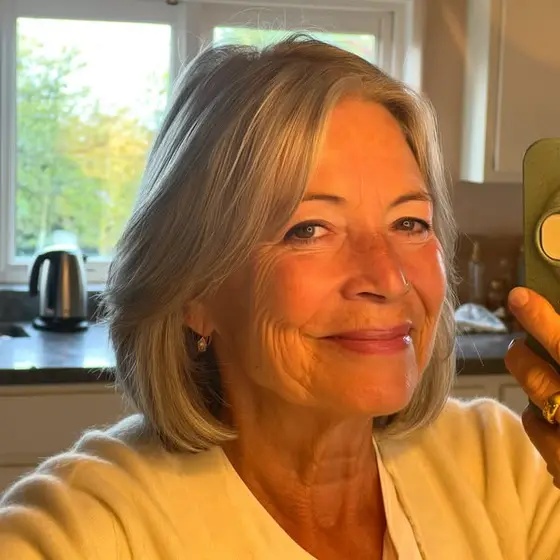
Are your hands getting shakier — and is your GP still telling you it's "just your age"? Most so-called solutions only calm the surface. They miss the one place the shake actually starts. Your bloodwork came back "normal" — but less than 1% of your body's magnesium even lives in your blood. The rest? It lives inside your brain cells. And the standard test your GP ordered was never designed to see it. Inside a small region of the brain called the cerebellum sits the pathway that sends the "hold steady" signal to your hands. That signal runs on GABA — your brain's natural calming messenger. And

Noemi Kaia Vance Facebook and Instagram ad
Noemi Kaia Vance ran this image ad since Jun 26, 2026, 155 days so far.
Ad copy
The trembling in both my hands has been there for about eleven years, since I turned 56. I'm 67 now. Three grown children, five grandchildren, and a husband who's started doing all the cooking because I'm a danger near a hot pan. The worst moment wasn't the diagnosis. The worst moment was a chap in Marks and Spencer's last March, watching me try to put my card into the machine. Two attempts. Three. He leaned in and said, very gently, "Have you been drinking, love?" It was ten in the morning. I'd been to the GP — twice — about the shake before I got prescribed anything. First time he said it was nerves. Second time he said it was probably menopausal and would settle. It didn't settle. It got worse. Propranolol came next. The fatigue was unbelievable. I could barely walk to the post box. My blood pressure dropped so low my GP took me off it himself. Primidone after that, from the consultant. I lasted six weeks. Felt like I was wading through treacle from the moment I woke up. I tried magnesium citrate because my sister read about it in a magazine. £40-odd a month for three months. All it did was send me to the loo five times a day. Hand carried on shaking. I stopped going to my book club. I stopped hosting at Christmas. I told my daughter I "didn't fancy it" when she invited me to her work do — but the truth was I couldn't bear another evening sitting on my hands so nobody'd notice. It was Janet, a former staff nurse from the surgery, who pulled me aside at a fundraiser. She'd seen me put the wine glass down and clamp my fingers round it like a vice. "Has anyone ever sat you down and explained what's actually going on?" I told her: aging, genetic, nothing to be done. The GP had said as much. She said two things go wrong at the same time. The cerebellum — the small bit of brain that sends smooth motor signals to your hands — runs on a chemical called GABA. GABA needs magnesium to work inside brain cells. When the magnesium inside the cerebellum runs low, GABA fails, and the "hold steady" signal goes haywire. Then she said the bit that genuinely stopped me in my tracks. "Janet, less than 1% of your body's magnesium lives in your blood. The blood test your GP runs only measures that 1%. There's no test in the standard panel that sees what's inside your brain cells." She showed me a piece of paper. Drew a car with two fuel tanks. The big one was labelled BLOOD. The little one was labelled BRAIN. The fuel gauge wire only went to the blood tank. "Your gauge says full. Your brain tank is empty. That's why the GP keeps telling you you're fine." Research published in Mayo Clinic Proceedings confirms it: a normal serum reading doesn't rule out moderate to severe deficiency. Then she explained the citrate disaster. Citrate magnesium causes the diarrhoea I'd suffered through because it pulls water into the gut and never makes it to the brain. Right mineral, wrong form, wrong destination. The protocol is the protocol. Mechanism. That word changed everything. She told me the only form of magnesium proven to cross the blood-brain barrier is called L-Threonate, developed at MIT and published in the journal Neuron in 2010. And on its own it's good — but for the tremor pathway specifically, you want it paired with Glycinate (which absorbs cleanly, no upset stomach) and Taurate (which carries magnesium to the motor nerves). Three forms. Three jobs. One mechanism. Research published in a major nutrition journal in 2022 reported that L-Threonate raised brain neuronal magnesium levels effectively in supplemented adults — the only form that does. I didn't tell my husband I'd ordered any. Couldn't bear another "I told you so" if it didn't work. Night one: slept a solid seven hours, which I hadn't done since 2017. Morning of day six: I made a pot of tea and poured Geoff's cup. Didn't spill any. Week two: I signed a birthday card for my grandson. Stared at the signature. It was mine. Month one: my daughter rang and said "Mum, you sound different on the phone." Month three: I held my newest grandchild for the first time. My daughter didn't hover. If you've been told to learn to live with it. If your bloods keep coming back normal and the GP can't explain why your hand still won't behave. If the magnesium you tried just sent you to the loo. If propranolol flattened you and you're nowhere near letting a surgeon near your head. A doctor called Adrian Castellano has written a piece on what he calls Cerebellar Magnesium Depletion. He's not gentle. He's furious. But he's the first one who explained it. Read it. It's the first thing that made sense. https://www.zifanna.com/UK/essential-tremor
Placements and targeting
More ads from Noemi Kaia Vance
Are your hands getting shakier — and is your GP still telling you it's "just your age"? Most so-called solutions only calm the surface. They miss the one place the shake actually starts. Your bloodwork came back "normal" — but less than 1% of your body's magnesium even lives in your blood. The rest? It lives inside your brain cells. And the standard test your GP ordered was never designed to see it. Inside a small region of the brain called the cerebellum sits the pathway that sends the "hold steady" signal to your hands. That signal runs on GABA — your brain's natural calming messenger. And
The shaking in my right hand started seven years ago. I'm 63, a former primary school teacher, and the moment I knew it had got too far was when I dropped my granddaughter's bottle. She was four months old. I caught it with my other hand before it hit the floor. My daughter said nothing. That silence was the worst bit. I'd been to the GP twice. Bloods "fine." Propranolol prescribed — gave it up after two months because my blood pressure dropped to 94/58. Tried magnesium citrate from Boots for ten weeks. All it did was send me running to the loo. Hand carried on shaking. Then a retired nurse
Are your hands getting shakier — and is your GP still telling you it's "just your age"? Most so-called solutions only calm the surface. They miss the one place the shake actually starts. Your bloodwork came back "normal" — but less than 1% of your body's magnesium even lives in your blood. The rest? It lives inside your brain cells. And the standard test your GP ordered was never designed to see it. Inside a small region of the brain called the cerebellum sits the pathway that sends the "hold steady" signal to your hands. That signal runs on GABA — your brain's natural calming messenger. And
Similar skincare ads
Do you wake up looking like somebody pumped your face full of water? Your eyelids look swollen before you've even opened your mouth. Your cheeks look stuffed. Your jawline disappears the second somebody points a camera at you. And the concealer you bought to hide it just sits on top like a layer of plaster. So you look in the mirror and think, “Sh*t. Is this just my face now?” Then, hours later, the puffiness settles and you start looking like yourself again. Yet the advice is still to buy a stronger eye cream and wait for an anti-aging miracle. If your morning face changes that much be
TL;DR: At my best friend's open casket, the funeral director handed me a price list for mine. I'm 66. Marlene was my best friend since second grade. At her funeral, I got thrown out for my face. For 2 years I'd woken up swollen. Eyes puffed so tight I looked punched, and a jaw that hung like a turkey's. My blood work was perfect. 4 doctors, 4 shrugs. That morning was the worst ever. 2 layers of concealer just sat on top of the swelling like frosting on a rock. At the casket, the funeral director touched my elbow and slid a card into my hand. Pre-planning. "It's never too early, dear."
My husband told me he was gay. Then he blamed my face. "Look at yourself," he said. "The way you look, the way you act. You drove me away from women." Excuse the fu*k out of me? I can't even get my left eyebrow to match my right, but apparently I can change a grown man's sexual orientation. That is a LOT of responsibility to give a woman who hasn't had her coffee. I stood there in my pajamas wondering whether to call my sister or send my eye bags a cease-and-desist. For the record, my face had nothing to do with him being gay. He could have told me that without dragging my cheeks into th
The woman I'd spent the afternoon feeling threatened by looked at my husband and said, "You'd better go talk to your wife." She was his ex. I was the wife. And she'd just noticed something he'd stopped noticing years ago. I'd arrived at his college homecoming expecting to hear the same old stories. I didn't expect to end up crying beside a stranger and asking for her help. At six that morning, I was in our kitchen covering the last tray with foil while David looked for his college sweatshirt. I'm Denise. I'm fifty-four. In our house, I'm the person who remembers where everybody put every
Keep exploring
Find more ads like this
Search millions of real ads by keyword, niche and format, and save the winners to your swipe file.