Are your hands getting shakier — and is your GP still telling you it's "just your age"? Most so-called solutions only calm the surface. They miss the one place the shake actually starts. Your bloodwork came back "normal" — but less than 1% of your body's magnesium even lives in your blood. The rest? It lives inside your brain cells. And the standard test your GP ordered was never designed to see it. Inside a small region of the brain called the cerebellum sits the pathway that sends the "hold steady" signal to your hands. That signal runs on GABA — your brain's natural calming messenger. And

Noemi Kaia Vance Facebook and Instagram ad
Noemi Kaia Vance ran this image ad since Jun 26, 2026, 155 days so far.
Ad copy
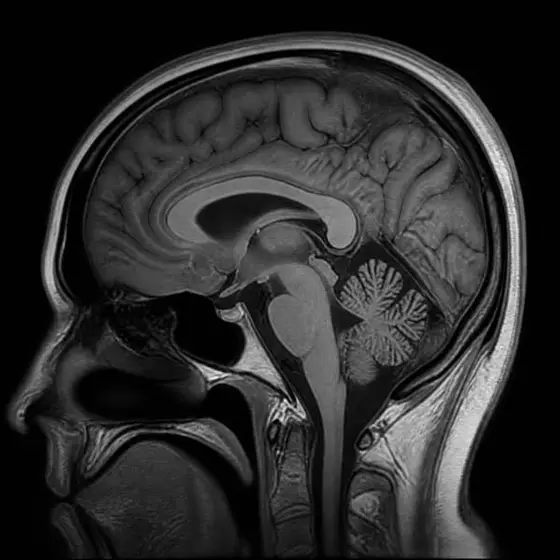
Specialists are trained to measure tremor severity. They're trained to titrate propranolol. They're trained to refer for focused ultrasound when things get bad enough. But they're not trained to explain why a 64-year-old woman's hands started shaking in the first place. And they're not trained to question whether the standard blood test was ever the right test. That gap — between what specialists are taught to do and what specialists are taught to understand — is the gap I want to talk about today. I'd like to tell you about a patient I'll call Brenda. She was 65, a retired district nurse from the Home Counties, with eleven years of slowly worsening essential tremor. Brenda had done everything she'd been asked to do. She'd attended every six-month follow-up. She'd tried propranolol — and given it up when her blood pressure dropped to 96/58 and her fatigue made her unsafe to drive. She'd tried primidone, and stopped because she felt "absent" the whole time she was on it. She'd taken magnesium citrate on her own initiative, £33 a month for over a year, because she'd read it could help — all she got was chronic diarrhoea. Her most recent consultant had quoted her £18,000 for private focused ultrasound. "It's not really brain surgery," he said. Brenda's response, exactly: "It's still my brain." When she sat down across from me, she said something that has stayed with me. "Nobody — in eleven years — has actually explained to me what's wrong. They just change the tablets." She was right. And the reason nobody had explained it is because the explanation isn't on the curriculum. Here's what the research actually shows. The cerebellum is the part of the brain responsible for smooth, steady motor output. It sends the "hold steady" signal to your hands. That signal is regulated by GABA — the brain's calming neurotransmitter. GABA, in turn, depends on magnesium to bind properly to its receptors inside cerebellar neurons. A 2020 study published in a major neurology journal found that cerebellar GABA dysfunction correlates with tremor severity at 0.70 — an extremely strong relationship. Now here's the part the standard medical training doesn't cover. Less than 1% of the body's total magnesium is in the blood. Effectively none of it is inside cerebellar cells. The standard blood test your GP orders — serum magnesium — measures only that 1%. Mayo Clinic Proceedings has stated plainly that a normal serum reading does not rule out moderate to severe magnesium deficiency. This is the central oversight. Brenda's bloodwork had been "normal" for eleven years. Her cerebellar magnesium had been quietly running down the whole time, and the test that was supposed to catch it was built to miss it. There is one form of magnesium — Magnesium L-Threonate, developed at a leading university in [country] and published in the journal Neuron in 2010 — that has been clinically shown to raise brain neuronal magnesium levels. It crosses the blood-brain barrier in a way no other form does. For the tremor pathway specifically, L-Threonate works best paired with Glycinate (which absorbs cleanly and supports the GABA pathway directly without the gut effects citrate causes) and Taurate (which carries magnesium to the motor nerves that deliver the signal from cerebellum to hand). Three forms. Three jobs. One mechanism. Brenda began taking a triple-magnesium complex called NerveMag™ — formulated around exactly this pathway — eleven weeks ago. Her husband noticed the change before she did. She's signed her own Christmas cards this year for the first time since 2019. Now to the question of cost. The private focused ultrasound quote Brenda had been given was £18,000. The standard NHS pathway, with all its hidden costs — repeated GP visits, prescription charges, time off, the toll of medication side effects — runs into the thousands over a decade. A three-month supply of a properly formulated triple-magnesium complex sits at roughly the price of a nice meal out for a couple per month. That comparison isn't about the money. It's about the proportionality of what you're being asked to weigh — major procedural intervention with documented side effects in over 65% of patients at three months, against a structured nutritional intervention based on peer-reviewed brain chemistry. The brand backs it with a 90-day money-back guarantee. That tells you something about their confidence in the mechanism. A doctor called Adrian Castellano has written a detailed piece on the underlying mechanism — what he terms Cerebellar Magnesium Depletion — and where the brand can be found. Read his article. You can decide from there. https://www.zifanna.com/UK/essential-tremor
Placements and targeting
More ads from Noemi Kaia Vance
Are your hands getting shakier — and is your GP still telling you it's "just your age"? Most so-called solutions only calm the surface. They miss the one place the shake actually starts. Your bloodwork came back "normal" — but less than 1% of your body's magnesium even lives in your blood. The rest? It lives inside your brain cells. And the standard test your GP ordered was never designed to see it. Inside a small region of the brain called the cerebellum sits the pathway that sends the "hold steady" signal to your hands. That signal runs on GABA — your brain's natural calming messenger. And
The shaking in my right hand started seven years ago. I'm 63, a former primary school teacher, and the moment I knew it had got too far was when I dropped my granddaughter's bottle. She was four months old. I caught it with my other hand before it hit the floor. My daughter said nothing. That silence was the worst bit. I'd been to the GP twice. Bloods "fine." Propranolol prescribed — gave it up after two months because my blood pressure dropped to 94/58. Tried magnesium citrate from Boots for ten weeks. All it did was send me running to the loo. Hand carried on shaking. Then a retired nurse
Are your hands getting shakier — and is your GP still telling you it's "just your age"? Most so-called solutions only calm the surface. They miss the one place the shake actually starts. Your bloodwork came back "normal" — but less than 1% of your body's magnesium even lives in your blood. The rest? It lives inside your brain cells. And the standard test your GP ordered was never designed to see it. Inside a small region of the brain called the cerebellum sits the pathway that sends the "hold steady" signal to your hands. That signal runs on GABA — your brain's natural calming messenger. And
Similar skincare ads
Do you wake up looking like somebody pumped your face full of water? Your eyelids look swollen before you've even opened your mouth. Your cheeks look stuffed. Your jawline disappears the second somebody points a camera at you. And the concealer you bought to hide it just sits on top like a layer of plaster. So you look in the mirror and think, “Sh*t. Is this just my face now?” Then, hours later, the puffiness settles and you start looking like yourself again. Yet the advice is still to buy a stronger eye cream and wait for an anti-aging miracle. If your morning face changes that much be
TL;DR: At my best friend's open casket, the funeral director handed me a price list for mine. I'm 66. Marlene was my best friend since second grade. At her funeral, I got thrown out for my face. For 2 years I'd woken up swollen. Eyes puffed so tight I looked punched, and a jaw that hung like a turkey's. My blood work was perfect. 4 doctors, 4 shrugs. That morning was the worst ever. 2 layers of concealer just sat on top of the swelling like frosting on a rock. At the casket, the funeral director touched my elbow and slid a card into my hand. Pre-planning. "It's never too early, dear."
My husband told me he was gay. Then he blamed my face. "Look at yourself," he said. "The way you look, the way you act. You drove me away from women." Excuse the fu*k out of me? I can't even get my left eyebrow to match my right, but apparently I can change a grown man's sexual orientation. That is a LOT of responsibility to give a woman who hasn't had her coffee. I stood there in my pajamas wondering whether to call my sister or send my eye bags a cease-and-desist. For the record, my face had nothing to do with him being gay. He could have told me that without dragging my cheeks into th
The woman I'd spent the afternoon feeling threatened by looked at my husband and said, "You'd better go talk to your wife." She was his ex. I was the wife. And she'd just noticed something he'd stopped noticing years ago. I'd arrived at his college homecoming expecting to hear the same old stories. I didn't expect to end up crying beside a stranger and asking for her help. At six that morning, I was in our kitchen covering the last tray with foil while David looked for his college sweatshirt. I'm Denise. I'm fifty-four. In our house, I'm the person who remembers where everybody put every
Keep exploring
Find more ads like this
Search millions of real ads by keyword, niche and format, and save the winners to your swipe file.