I've read too many MRIs to stay quiet about this. If you're on cortisone or Gabapentin right now, I need to tell you something your rheumatologist isn't saying.
I'm Dr. James Crawford. Board-certified neurologist. 25 years in practice. I still perform nerve conduction studies every day.
And when a patient walks into my office already on their fourth round of cortisone, I already know exactly where they're heading. Twelve to eighteen months before they end up in the orthopedic surgeon's office being told they need a joint replacement.
Surgery. Six months of rehabilitation. The walker. Physical therapy three times a week. And then the slow, careful rest of their life wondering if the new knee will hold.
The 64-year-old who took naproxen faithfully for six years. Never missed a dose. Did everything her rheumatologist told her.
The naproxen ate a hole in her stomach lining. They switched her to cortisone injections. Four rounds. Each one lasted a little shorter than the last.
By the third year, her husband was helping her out of the car because her knee couldn't bear her weight anymore.
Total knee replacement at 67. Eight months of recovery. She still can't kneel to play with her grandkids.
Her joint had been deteriorating the entire time she was on the medication.
The 68-year-old. Five years on Gabapentin for chronic back and hip pain. "Just managing it, Doc."
The brain fog so thick he'd forgotten his grandson's middle name. His wife drove him everywhere because his reaction time was gone.
Then the maximum dose stopped holding. MRI showed severe degeneration in both hips. His orthopedic gave him two options: live with it, or bilateral hip replacement.
The 71-year-old. Her rheumatologist actually laughed when she mentioned trying something natural.
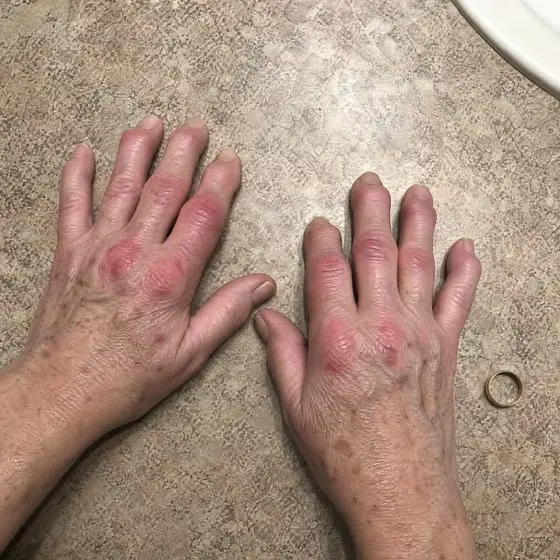
Nine years on methotrexate. Hands so swollen she hadn't worn her wedding ring in three years.
She told me she'd accepted that her body was just "winding down." She was 71, not 91.
I see these patients in follow-up. They're grateful for any help. They don't complain.
But I know what they lost.
They had years to address what was actually happening inside their joints. Years to reverse the damage while their body was still sending warning signals. Years to save themselves from a surgery that leaves 20% of patients still in pain afterward.
Their joint pain was giving them a warning the entire time. The medication just turned down the volume while the real problem kept destroying the joint underneath.
And I was part of the system doing it.
I've been running the same pain management protocol for 25 years.
I've seen thousands of patients start it. Thousands who felt some initial relief and thought their problem was being handled.
And I've seen what happens 3, 4, 5 years later.
The 64-year-old ends up in surgery. The 68-year-old loses his independence to brain fog before he loses his hips. The 71-year-old accepts that her body is done at 71.
Here's what pain management doesn't tell you, because we were never trained to look at it this way.
Your joint pain isn't random. There are three specific, identifiable root causes driving every case of chronic joint deterioration.
The first is Central Sensitization — now recognized across hundreds of peer-reviewed studies.
After years of chronic pain, your nervous system gets stuck in permanent alarm mode. The original injury may have healed years ago.
But your nervous system is still broadcasting emergency signals — amplifying every step, every movement, every temperature change into pain.
Gabapentin dulls the alarm. It doesn't reset it. The alarm keeps firing underneath, and your body keeps responding with inflammation it doesn't need.
The second is what I call Joint Suffocation.
Chronic inflammation constricts the tiny blood vessels feeding your joint. Year after year, layer after layer, those vessels narrow.
Less oxygen reaches your cartilage and surrounding tissue. Without oxygen, cells can't repair.
The inflammation worsens. The joint swells. Stiffens. Degrades.
Cortisone suppresses the inflammation for 6 to 12 weeks. Then it returns. Each round weakens the surrounding tendons.
Your joint keeps suffocating underneath while you feel just enough relief to think the shots are working.
The third is Vagal Tone Collapse.
Your body has a built-in repair system controlled by the vagus nerve — the same nerve the FDA approved a $50,000 surgical implant to target in 2025. It switches you from "fight or flight" into "rest and repair."
When vagal tone is healthy, your body enters repair mode during rest: inflammation drops, tissue heals, pain signals quiet down.
After years of chronic pain, vagal tone collapses. Your body gets stuck in fight-or-flight permanently. It cannot enter repair mode.
No amount of rest fixes this because the switch that initiates repair is broken. Nothing in the standard protocol addresses this. Nothing.
The pain management protocol addresses none of these three root causes. Zero.
NSAIDs reduce inflammation for 4 to 6 hours so you can get through the afternoon. Then it comes back. The vessels are still constricted. The alarm is still firing.
Cortisone suppresses inflammation at the injection site for 6 to 12 weeks. Each round weakens the tendons around the joint. The joint suffocates a little more each cycle.
Gabapentin dulls the nerve signals so you feel less. It also dulls your memory, your focus, your ability to follow a conversation at dinner.
Your nervous system is still stuck on alarm. The drug just turned down your ability to hear it.
Your joint keeps degrading while you feel just enough relief to think you're being treated.
That is not treatment. That is a ladder with one exit. And the exit is surgery.
When my own joint pain started at 56, I knew something patients don't.
The stiffness in both knees every morning. The ache in my hands after two hours of typing patient notes. The shoulder that caught when I reached for a cabinet.
My colleague looked at my symptoms and said what every doctor says to every patient.
"Standard protocol. Naproxen first. We'll talk about cortisone if it doesn't hold."
I knew it would help. That wasn't the point.
I'm a neurologist. I hold a 128 Hz weighted tuning fork in my hand every day. I place it on joints. I measure how the nerve responds to the vibration. I write down the results. I put the fork back in my drawer and prescribe more medication.
I'd been holding the answer in my hand for 25 years.
I went back to the research. Not pain management literature. Neuroscience. Mechanotransduction. Vagus nerve activation. Nitric oxide pathways.
March 14th. 10:23 PM.
I was reviewing a 2025 study on low-frequency mechanical vibration and cellular response.
Vibration in the 100-150 Hz range applied directly to tissue triggers the endothelial lining of blood vessels to release nitric oxide. The vessels dilate. Oxygen floods the area.
Inflammation drops — not because it's been chemically suppressed, but because blood flow is physically restored to the tissue that's been starving for years.
I looked at the instrument sitting in my desk drawer. The same 128 Hz weighted fork I'd placed on a patient's knee that morning.
It was vibrating at exactly the frequency the research described.
I pulled up more. In July 2025, the FDA approved a surgical implant — a $50,000 device — that stimulates the vagus nerve for rheumatoid arthritis patients. A 242-patient randomized trial.
The vagus nerve runs right under the skin at four specific points: behind the ear, the jawline, the base of the skull, the sacrum.
My fork reaches it through bone conduction at precisely those points. Same nerve. Same access route I use diagnostically every day. No surgery.
Then the RUNX2 pathway. Gene-level tissue repair activation through mechanotransduction. The signal that tells your body to rebuild bone and repair cartilage. Triggered by the exact type of low-frequency vibration a weighted 128 Hz fork delivers.
All three root causes. Simultaneously. With the instrument I'd been holding in my hand every morning and putting back in a drawer every afternoon.
I sat there at 10:23 PM looking at a tool I had placed on over 3,000 joints. I had never once treated with it.
I started the next morning.
Not as a diagnostic test. As a protocol. Three minutes per joint. Tap the fork with the mallet, place the weighted base directly on the joint, hold for 60 seconds, move to the next point.
Day 8. I woke up on a Saturday and walked to the kitchen. I was pouring coffee before I realized what hadn't happened.
The slow, careful first ten steps. The negotiation with my knees about whether today would be a good day or a bad day.
I had just walked. Like it was nothing.
It had been so long since I'd walked to the kitchen without thinking about it that I'd forgotten what normal felt like.
Week 3. Typing patient notes at the end of a long Thursday. I looked at the clock — 6:47 PM.
I'd been typing for two hours straight. The ache that usually showed up at the 30-minute mark and built into a fist by the end of the hour had not appeared.
I opened and closed my hands. No catch. No stiffness. I sat there flexing my fingers, staring at them.
Month 2. I ordered my own follow-up imaging. Inflammation markers around both knees had dropped measurably.
My colleague looked at the results and said: "James, what changed? These don't move like this on naproxen."
"I stopped the naproxen two months ago," I told him. "I've been using the tuning fork. On my own joints. Three minutes a day."
He thought I was joking.
I started recommending the protocol to patients heading toward surgery.
Margaret. 63. Ohio. Knee replacement scheduled for November. Cortisone injections for four years — each round lasting less than the one before. By the end, she was counting days between shots.
I showed her the protocol. Three minutes on the knee, twice a day. Two weeks, nothing dramatic.
Week 3, she called my office. "I walked down the stairs this morning. Both knees. No railing."
She sat on the bottom step and cried. Not from pain. From anger — at how many years she'd spent on the protocol that was never going to fix what was wrong.
By week 6, she called her orthopedic and cancelled the surgery.
Thomas. 68. Michigan. Five years on maximum-dose Gabapentin for lumbar and hip pain.
The brain fog had taken his independence — his wife drove him everywhere, managed his medications, answered questions for him at family dinners because he'd lose his train of thought mid-sentence.
I showed him the protocol. Lumbar spine, both hips, cervical points. Six weeks later he asked me to supervise a Gabapentin taper.
Eight months later, he's driving himself to my office. His wife told me: "I have my husband back. That's not nothing when you're 70."
Carol. 71. Pennsylvania. Rheumatoid arthritis. Nine years on methotrexate and adalimumab. Hands so swollen she'd stopped wearing her wedding ring three years ago.
Her rheumatologist told her the inflammation was "just something you manage for the rest of your life."
I showed her the vagus nerve protocol — fork behind the ear, base of skull, jawline, 60 seconds per point.
She sent me a photo six weeks later. Her hands. The swelling in her knuckles had visibly reduced. Her wedding ring was back on.
"My rheumatologist asked what changed," she wrote. "I told him. He wrote it down."
In 25 years I had never seen results like that without increasing medication or scheduling surgery.
I am not telling you this because I am against pain management.
NSAIDs reduce inflammation. Cortisone provides temporary relief. Gabapentin dulls nerve pain. Each one works exactly as designed.
But none of them reset a nervous system stuck on permanent alarm. None of them reopen the constricted vessels suffocating your joint. None of them restore the vagal tone your body needs to enter repair mode.
They temporarily manage each symptom while all three root causes keep destroying your joint underneath.
And I see what happens to the patients who stay on the protocol long enough.
A 2023 Journal of Arthroplasty analysis found that roughly one in three patients on long-term pain management for osteoarthritis eventually require joint replacement surgery.
After years of prescriptions, side effects, dose increases. Surgery anyway.
And surgery carries its own numbers. 20% of knee replacement patients report persistent pain post-surgery. Up to 8% need revision surgery within ten years.
Blood clots. Infection. Six to twelve months of rehabilitation. Permanent loss of range of motion.
Your symptoms right now — the morning stiffness, the ache that builds through the day, the catch when you stand up — they are your warning system.
And you have two choices.
Keep managing the symptoms one rung at a time while your joint degrades underneath. Or address all three root causes while there is still time.
I think about what I almost did.
Not just accepting a prescription. That's not the point.
I almost spent years climbing the same ladder I'd watched thousands of patients climb. Naproxen. Cortisone. Gabapentin. While my joints degraded silently toward the point of no return.
I almost became the patient I was referring to surgery, wishing someone had told me earlier that the answer was already in my hand.
Because once the cartilage is gone — once the bone-on-bone grinding is constant, once the surgeon says "there's nothing left to preserve" — the options narrow to one. And that one carries real, permanent consequences.
You do not get a second warning before that point. Your symptoms right now are the warning.
Use them.
The instrument I use is called the Nourial 128 Hz Healing Instrument. A precision-calibrated weighted tuning fork — the same frequency and weight class used in neurology offices for nerve conduction testing since the 1960s.
It costs $39.95. One time. Not monthly. Not a subscription.
Compare that to $400 per cortisone injection every 12 weeks that stops working after the fourth round.
$200 a month in Gabapentin that turns your brain to fog.
Or $30,000 to $50,000 for a joint replacement that one in five patients still report pain after.
It comes with a 60-day money-back guarantee. Use it for three months.
If your morning stiffness isn't reduced, if you're not sleeping better, if you're not moving more freely, send it back — even used. Full refund. No questions asked.
I have never had a pharmaceutical company offer that. I have never seen an orthopedic surgeon offer a money-back guarantee on a knee replacement.
That is how confident I am in what fixing all three root causes actually does.
Save your joints now, while they're still telling you something is wrong — instead of after they've stopped telling you anything at all.
Dr. James Crawford
Board-Certified Neurologist, 25 Years in Practice
P.S. Three minutes a day. $39.95. You have nothing to lose except 60 days and the cost of two cortisone copays. The upside is avoiding a surgery that permanently changes your mobility, your independence, and your quality of life.
P.P.S. You are not too late yet. You are still walking, even with stiffness. That means your joint has not completely degraded. Address all three root causes now — before the cortisone stops working entirely and surgery goes from being a conversation to being the only option left.