Megan’s Notes Facebook ad creative
orivelia.com
If fleas won't leave your home, this changes everything.
See details

Megan’s Notes Facebook and Instagram ad

Megan’s Notes ran this image ad since Jun 25, 2026, 1 days so far, targeting United Kingdom.

First seen
Jun 25, 2026
Running for
1 days
Format
Image
Call to action
See details
Niche
Pets
Countries
1 targeted
Page likes
1,453

Ad copy

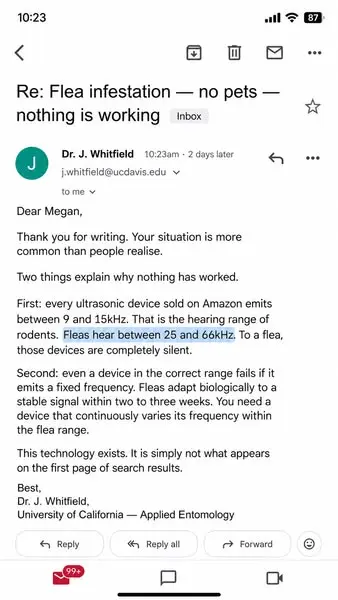
The first bite appeared on a Thursday evening in early June. I'd been in the garden most of the afternoon. The kind of day that finally feels like summer, warm enough to sit outside, windows open, bare feet on the grass. I noticed a small red mark on my ankle when I came inside. I assumed it was a mosquito. By Sunday I had seven. All below the knee. All on the same leg I'd been resting on the garden chair. The kind that itch differently from mosquito bites, sharper, more persistent, leaving a mark that stays for days. I still wasn't thinking fleas. I didn't have pets. I'd never had fleas. The word didn't even occur to me. It was my neighbour who said it first. We were talking over the fence on Monday morning. She mentioned her dog had been scratching badly since May. That she'd treated the whole house twice. That the vet had said it was a bad year for fleas in the area. I went inside and Googled it. I know what you're thinking right now. How can I have fleas if I don't have a pet? Here's what I didn't know until that Monday evening: fleas don't need a permanent host to survive. They live in grass, in soil, in the cracks of garden furniture. They jump onto anything warm that passes, a bare foot, a trouser leg, a shoe. Once inside, they find carpet fibres, sofa fabric, the gap between the floorboard and the skirting board. And there they reproduce. Quietly. While you're blaming the mosquitoes. My neighbour's dog had been crossing our shared fence line for months. The fleas hadn't stayed in her garden. They'd followed the warmth. And now they were in my house. I started treating it the way everyone treats it. I bought a household flea spray and did every room in one afternoon. I left, came back four hours later, washed everything at sixty degrees, didn't hoover for a week like the instructions said. Two weeks later the bites came back. I tried a different brand. I read that steam heat kills eggs so I borrowed a steam cleaner and went through every carpet twice. I bought diatomaceous earth and spread it along every skirting board. I sprayed the garden perimeter with an outdoor insect repellent that smelled like it was designed to clear a building. The bites came back. I bought an ultrasonic device on Amazon. Small, white, plastic. Nine dollars, four stars, three hundred reviews. I plugged it in by the back door — the main entry point from the garden — and waited. Three weeks later I found a bite on my forearm. I wasn't doing it wrong. I was doing exactly what I was supposed to do. I was just using the wrong tools. And nobody had told me that. I found Dr. James Whitfield that evening. A researcher at the University of California, specialising in domestic insect parasites. His profile mentioned he responded to public enquiries through a contact form. I wrote to him without expecting much. He replied within 48 hours. His answer started with something that reframed the entire problem. The garden is the entry point. The house is the infestation. By the time you're getting bitten indoors, the eggs and larvae are already in your carpet. Treating the garden slows the intake. It doesn't address what's already inside. That's why outdoor sprays feel like they're working and then stop. Then he explained the two things nobody talks about. Every ultrasonic device you find on Amazon, in supermarkets, in hardware stores, emits between 9 and 15kHz. That's the hearing range of mice and rats. The manufacturers aren't lying, those devices genuinely work on rodents. But fleas hear between 25 and 66kHz. For a flea, a device emitting at 12kHz is completely silent. It doesn't exist. You could have one plugged into every room and they would have absolutely no idea it was there. That's why the device by my back door had done nothing. Not because the technology was flawed. Because it was calibrated for the wrong insect entirely. The second point. Even a device in the correct frequency range stops working if it emits a fixed frequency. Fleas adapt biologically to a stable signal within two to three weeks. That's why some people report it seemed to work at first and then stopped. They learn to ignore it. An effective device needs to emit within the right range AND continuously vary its frequencies. Fleas can't adapt to something that keeps changing. There's nothing stable to ignore. He ended with: this technology exists. It simply isn't the one you find on the first page of search results. I thought about the white device still plugged in next to my back door. Wrong frequency. Fixed signal. It had never had a chance. I ordered one that night. I know what you're thinking right now. The device plugs into the wall. If the fleas are coming from the garden, how does something inside the house fix an outdoor problem? Here's what Dr. Whitfield explained, and what changed everything for me. By the time you're getting bitten, the garden is already the least of your problems. The fleas that followed you inside have been laying eggs in your carpet for weeks. Up to 50 eggs a day. Those eggs become larvae, then pupae, then adults, all inside your home, all invisible. What you see on your skin is maybe five percent of the actual infestation. The garden is the door. Your carpet is where they live. Cover the inside, every room where you spend time, and you break the cycle. No eggs, no larvae, no new adults. The outdoor population has nowhere to go because your home is no longer a viable environment. Stop it inside, and outside stops mattering. That's why one device per room. Ultrasonic waves don't pass through walls, you need coverage in every space where the infestation has taken hold. First week. I still checked my ankles every morning out of habit. Nothing. Second week. I sat in the garden for the first time since June without thinking about what might follow me back inside. I came in, looked down at my feet. Nothing. Third week. I walked across the living room carpet barefoot, the thing I'd stopped doing entirely. I stood there. Nothing. Not a bite, not a speck on the white tissue I dragged across the floor. The fourth week, I forgot to check. Not because I'd stopped caring. I just stopped thinking about it. And that was the moment I knew it was over. Two months later I mentioned it to my neighbour over the fence. The one with the dog. She was still dealing with it, third treatment that summer, second pest control visit booked. I told her about the frequency range. About the 9 to 15kHz that targets rodents, and the 25 to 66kHz that targets fleas. About the fixed signal that fleas adapt to in three weeks, and the variable sweep they can't adapt to. She looked at me for a moment. Then she said: nobody told me any of that. Not the vet. Not the pest control company. Nobody. That's the thing. The information exists. It's just not where anyone thinks to look. The devices that don't work and the device that does are sold side by side, described in the same language, reviewed by the same people. The only difference is the frequency. And nobody mentions the frequency. The 2+1 free pack covers a standard home. The 3+2 free pack covers the whole house with no blind spots. That's what most people go with when they want every room done before they stop thinking about it. Money back guarantee. If it doesn't work, you pay nothing. https://orivelia.com/products/orivelia-ultrasonic-pest-repeller P.S. My neighbour knocked on my door three weeks after our conversation over the fence. She'd ordered the same device after I sent her Dr. Whitfield's email. She said the scratching had stopped. Her dog was fine. The pest control visit she'd booked, she cancelled it. She asked me why nobody had ever explained the frequency issue to her in four years of dealing with this. I didn't have a good answer. Nobody had explained it to me either.

Placements and targeting

FacebookInstagramAudience NetworkMessengerThreads🇬🇧 United Kingdom

More ads from Megan’s Notes

Full Megan’s Notes profile
Megan’s Notes
Megan’s Notes
+1
Inactive1 day
orivelia.com
If fleas won't leave your home, this changes everything.
See details

The first bite appeared on a Thursday evening in early June. I'd been in the garden most of the afternoon. The kind of day that finally feels like summer, warm enough to sit outside, windows open, bare feet on the grass. I noticed a small red mark on my ankle when I came inside. I assumed it was a mosquito. By Sunday I had seven. All below the knee. All on the same leg I'd been resting on the garden chair. The kind that itch differently from mosquito bites, sharper, more persistent, leaving a mark that stays for days. I still wasn't thinking fleas. I didn't have pets. I'd never had fleas. The word didn't even occur to me. It was my neighbour who said it first. We were talking over the fence on Monday morning. She mentioned her dog had been scratching badly since May. That she'd treated the whole house twice. That the vet had said it was a bad year for fleas in the area. I went inside and Googled it. I know what you're thinking right now. How can I have fleas if I don't have a pet? Here's what I didn't know until that Monday evening: fleas don't need a permanent host to survive. They live in grass, in soil, in the cracks of garden furniture. They jump onto anything warm that passes, a bare foot, a trouser leg, a shoe. Once inside, they find carpet fibres, sofa fabric, the gap between the floorboard and the skirting board. And there they reproduce. Quietly. While you're blaming the mosquitoes. My neighbour's dog had been crossing our shared fence line for months. The fleas hadn't stayed in her garden. They'd followed the warmth. And now they were in my house. I started treating it the way everyone treats it. I bought a household flea spray and did every room in one afternoon. I left, came back four hours later, washed everything at sixty degrees, didn't hoover for a week like the instructions said. Two weeks later the bites came back. I tried a different brand. I read that steam heat kills eggs so I borrowed a steam cleaner and went through every carpet twice. I bought diatomaceous earth and spread it along every skirting board. I sprayed the garden perimeter with an outdoor insect repellent that smelled like it was designed to clear a building. The bites came back. I bought an ultrasonic device on Amazon. Small, white, plastic. Nine dollars, four stars, three hundred reviews. I plugged it in by the back door — the main entry point from the garden — and waited. Three weeks later I found a bite on my forearm. I wasn't doing it wrong. I was doing exactly what I was supposed to do. I was just using the wrong tools. And nobody had told me that. I found Dr. James Whitfield that evening. A researcher at the University of California, specialising in domestic insect parasites. His profile mentioned he responded to public enquiries through a contact form. I wrote to him without expecting much. He replied within 48 hours. His answer started with something that reframed the entire problem. The garden is the entry point. The house is the infestation. By the time you're getting bitten indoors, the eggs and larvae are already in your carpet. Treating the garden slows the intake. It doesn't address what's already inside. That's why outdoor sprays feel like they're working and then stop. Then he explained the two things nobody talks about. Every ultrasonic device you find on Amazon, in supermarkets, in hardware stores, emits between 9 and 15kHz. That's the hearing range of mice and rats. The manufacturers aren't lying, those devices genuinely work on rodents. But fleas hear between 25 and 66kHz. For a flea, a device emitting at 12kHz is completely silent. It doesn't exist. You could have one plugged into every room and they would have absolutely no idea it was there. That's why the device by my back door had done nothing. Not because the technology was flawed. Because it was calibrated for the wrong insect entirely. The second point. Even a device in the correct frequency range stops working if it emits a fixed frequency. Fleas adapt biologically to a stable signal within two to three weeks. That's why some people report it seemed to work at first and then stopped. They learn to ignore it. An effective device needs to emit within the right range AND continuously vary its frequencies. Fleas can't adapt to something that keeps changing. There's nothing stable to ignore. He ended with: this technology exists. It simply isn't the one you find on the first page of search results. I thought about the white device still plugged in next to my back door. Wrong frequency. Fixed signal. It had never had a chance. I ordered one that night. I know what you're thinking right now. The device plugs into the wall. If the fleas are coming from the garden, how does something inside the house fix an outdoor problem? Here's what Dr. Whitfield explained, and what changed everything for me. By the time you're getting bitten, the garden is already the least of your problems. The fleas that followed you inside have been laying eggs in your carpet for weeks. Up to 50 eggs a day. Those eggs become larvae, then pupae, then adults, all inside your home, all invisible. What you see on your skin is maybe five percent of the actual infestation. The garden is the door. Your carpet is where they live. Cover the inside, every room where you spend time, and you break the cycle. No eggs, no larvae, no new adults. The outdoor population has nowhere to go because your home is no longer a viable environment. Stop it inside, and outside stops mattering. That's why one device per room. Ultrasonic waves don't pass through walls, you need coverage in every space where the infestation has taken hold. First week. I still checked my ankles every morning out of habit. Nothing. Second week. I sat in the garden for the first time since June without thinking about what might follow me back inside. I came in, looked down at my feet. Nothing. Third week. I walked across the living room carpet barefoot, the thing I'd stopped doing entirely. I stood there. Nothing. Not a bite, not a speck on the white tissue I dragged across the floor. The fourth week, I forgot to check. Not because I'd stopped caring. I just stopped thinking about it. And that was the moment I knew it was over. Two months later I mentioned it to my neighbour over the fence. The one with the dog. She was still dealing with it, third treatment that summer, second pest control visit booked. I told her about the frequency range. About the 9 to 15kHz that targets rodents, and the 25 to 66kHz that targets fleas. About the fixed signal that fleas adapt to in three weeks, and the variable sweep they can't adapt to. She looked at me for a moment. Then she said: nobody told me any of that. Not the vet. Not the pest control company. Nobody. That's the thing. The information exists. It's just not where anyone thinks to look. The devices that don't work and the device that does are sold side by side, described in the same language, reviewed by the same people. The only difference is the frequency. And nobody mentions the frequency. The 2+1 free pack covers a standard home. The 3+2 free pack covers the whole house with no blind spots. That's what most people go with when they want every room done before they stop thinking about it. Money back guarantee. If it doesn't work, you pay nothing. https://orivelia.com/products/orivelia-ultrasonic-pest-repeller P.S. My neighbour knocked on my door three weeks after our conversation over the fence. She'd ordered the same device after I sent her Dr. Whitfield's email. She said the scratching had stopped. Her dog was fine. The pest control visit she'd booked, she cancelled it. She asked me why nobody had ever explained the frequency issue to her in four years of dealing with this. I didn't have a good answer. Nobody had explained it to me either.

Megan’s Notes
Megan’s Notes
+1
Inactive1 day
orivelia.com
If fleas won't leave your home, this changes everything.
See details

The first bite appeared on a Thursday evening in early June. I'd been in the garden most of the afternoon. The kind of day that finally feels like summer, warm enough to sit outside, windows open, bare feet on the grass. I noticed a small red mark on my ankle when I came inside. I assumed it was a mosquito. By Sunday I had seven. All below the knee. All on the same leg I'd been resting on the garden chair. The kind that itch differently from mosquito bites, sharper, more persistent, leaving a mark that stays for days. I still wasn't thinking fleas. I didn't have pets. I'd never had fleas. The word didn't even occur to me. It was my neighbour who said it first. We were talking over the fence on Monday morning. She mentioned her dog had been scratching badly since May. That she'd treated the whole house twice. That the vet had said it was a bad year for fleas in the area. I went inside and Googled it. I know what you're thinking right now. How can I have fleas if I don't have a pet? Here's what I didn't know until that Monday evening: fleas don't need a permanent host to survive. They live in grass, in soil, in the cracks of garden furniture. They jump onto anything warm that passes, a bare foot, a trouser leg, a shoe. Once inside, they find carpet fibres, sofa fabric, the gap between the floorboard and the skirting board. And there they reproduce. Quietly. While you're blaming the mosquitoes. My neighbour's dog had been crossing our shared fence line for months. The fleas hadn't stayed in her garden. They'd followed the warmth. And now they were in my house. I started treating it the way everyone treats it. I bought a household flea spray and did every room in one afternoon. I left, came back four hours later, washed everything at sixty degrees, didn't hoover for a week like the instructions said. Two weeks later the bites came back. I tried a different brand. I read that steam heat kills eggs so I borrowed a steam cleaner and went through every carpet twice. I bought diatomaceous earth and spread it along every skirting board. I sprayed the garden perimeter with an outdoor insect repellent that smelled like it was designed to clear a building. The bites came back. I bought an ultrasonic device on Amazon. Small, white, plastic. Nine dollars, four stars, three hundred reviews. I plugged it in by the back door — the main entry point from the garden — and waited. Three weeks later I found a bite on my forearm. I wasn't doing it wrong. I was doing exactly what I was supposed to do. I was just using the wrong tools. And nobody had told me that. I found Dr. James Whitfield that evening. A researcher at the University of California, specialising in domestic insect parasites. His profile mentioned he responded to public enquiries through a contact form. I wrote to him without expecting much. He replied within 48 hours. His answer started with something that reframed the entire problem. The garden is the entry point. The house is the infestation. By the time you're getting bitten indoors, the eggs and larvae are already in your carpet. Treating the garden slows the intake. It doesn't address what's already inside. That's why outdoor sprays feel like they're working and then stop. Then he explained the two things nobody talks about. Every ultrasonic device you find on Amazon, in supermarkets, in hardware stores, emits between 9 and 15kHz. That's the hearing range of mice and rats. The manufacturers aren't lying, those devices genuinely work on rodents. But fleas hear between 25 and 66kHz. For a flea, a device emitting at 12kHz is completely silent. It doesn't exist. You could have one plugged into every room and they would have absolutely no idea it was there. That's why the device by my back door had done nothing. Not because the technology was flawed. Because it was calibrated for the wrong insect entirely. The second point. Even a device in the correct frequency range stops working if it emits a fixed frequency. Fleas adapt biologically to a stable signal within two to three weeks. That's why some people report it seemed to work at first and then stopped. They learn to ignore it. An effective device needs to emit within the right range AND continuously vary its frequencies. Fleas can't adapt to something that keeps changing. There's nothing stable to ignore. He ended with: this technology exists. It simply isn't the one you find on the first page of search results. I thought about the white device still plugged in next to my back door. Wrong frequency. Fixed signal. It had never had a chance. I ordered one that night. I know what you're thinking right now. The device plugs into the wall. If the fleas are coming from the garden, how does something inside the house fix an outdoor problem? Here's what Dr. Whitfield explained, and what changed everything for me. By the time you're getting bitten, the garden is already the least of your problems. The fleas that followed you inside have been laying eggs in your carpet for weeks. Up to 50 eggs a day. Those eggs become larvae, then pupae, then adults, all inside your home, all invisible. What you see on your skin is maybe five percent of the actual infestation. The garden is the door. Your carpet is where they live. Cover the inside, every room where you spend time, and you break the cycle. No eggs, no larvae, no new adults. The outdoor population has nowhere to go because your home is no longer a viable environment. Stop it inside, and outside stops mattering. That's why one device per room. Ultrasonic waves don't pass through walls, you need coverage in every space where the infestation has taken hold. First week. I still checked my ankles every morning out of habit. Nothing. Second week. I sat in the garden for the first time since June without thinking about what might follow me back inside. I came in, looked down at my feet. Nothing. Third week. I walked across the living room carpet barefoot, the thing I'd stopped doing entirely. I stood there. Nothing. Not a bite, not a speck on the white tissue I dragged across the floor. The fourth week, I forgot to check. Not because I'd stopped caring. I just stopped thinking about it. And that was the moment I knew it was over. Two months later I mentioned it to my neighbour over the fence. The one with the dog. She was still dealing with it, third treatment that summer, second pest control visit booked. I told her about the frequency range. About the 9 to 15kHz that targets rodents, and the 25 to 66kHz that targets fleas. About the fixed signal that fleas adapt to in three weeks, and the variable sweep they can't adapt to. She looked at me for a moment. Then she said: nobody told me any of that. Not the vet. Not the pest control company. Nobody. That's the thing. The information exists. It's just not where anyone thinks to look. The devices that don't work and the device that does are sold side by side, described in the same language, reviewed by the same people. The only difference is the frequency. And nobody mentions the frequency. The 2+1 free pack covers a standard home. The 3+2 free pack covers the whole house with no blind spots. That's what most people go with when they want every room done before they stop thinking about it. Money back guarantee. If it doesn't work, you pay nothing. https://orivelia.com/products/orivelia-ultrasonic-pest-repeller P.S. My neighbour knocked on my door three weeks after our conversation over the fence. She'd ordered the same device after I sent her Dr. Whitfield's email. She said the scratching had stopped. Her dog was fine. The pest control visit she'd booked, she cancelled it. She asked me why nobody had ever explained the frequency issue to her in four years of dealing with this. I didn't have a good answer. Nobody had explained it to me either.

See all 8 ads

Create a free account to unlock every creative, video and landing page.

Sign up free

Similar pets ads

Differentce/p
Differentce/p
+1
Inactive1 day
differentce.com
Cat Pattern Stamp, 6 Counts/set Round Self-inking Stamp
Shop now

Add cute fun to every mark! 🐱💖 Cat Pattern Round Self-inking StampSelf-inking design, no ink pad needed, easy to Cute cat patterns make marking fun & Perfect for school, office, home, dormitory, crafts & daily Small, portable, clear imprint, a lovely little stationery must-have! #CatStamp #SelfInkingStamp #OfficeSupplies #SchoolStationery #CuteStationery

Puppy Tips for Training
+1
Inactive1 day
webapp.everydoggy.com
#1 app for dog training
See details

Struggle with puppy peeing and biting? Our simple, positive program turns stress into joy, helping you raise a calm and obedient pup! ⭐️ Potty train - in 3 days ⭐️ Stop biting - in 3 hours ⭐️ Stay in crate - in 5 hours ⭐️ Stop barking - in 1 day

Puppy Tips for Training
+1
Inactive6 days
webapp.everydoggy.com
⭐️⭐️⭐️⭐️⭐️
Learn more

Dog training doesn’t have to mean stress, barking, and guilt. With the right approach, your dog can build better habits through simple daily lessons — without pressure or confusion 🐶

Puppy Tips for Training
+1
Inactive1 day
webapp.everydoggy.com
#1 app for dog training
See details

Struggle with puppy peeing and biting? Our simple, positive program turns stress into joy, helping you raise a calm and obedient pup! ⭐️ Potty train - in 3 days ⭐️ Stop biting - in 3 hours ⭐️ Stay in crate - in 5 hours ⭐️ Stop barking - in 1 day

See all ads

Create a free account to unlock every creative, video and landing page.

Sign up free

Keep exploring

Free plan, no card needed

Find more ads like this

Search millions of real ads by keyword, niche and format, and save the winners to your swipe file.

Start free