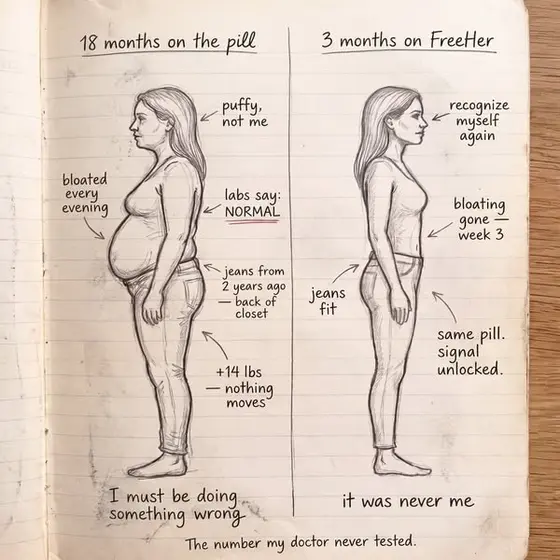
My gynecologist has been telling me my labs look perfect for two years. Turns out they were measuring the wrong number the entire time. --- I started Yasmin at 28. In the first 8 months, I gained 9 lbs. I hadn't changed anything. Same meals I'd been making for years. Same level of activity. Same everything. The weight just arrived. Quietly. Like it had always been there. By month 14, I was up 17 lbs. Month 14. Still on the same pill. Still eating the same way. I cut out alcohol for 6 weeks. I started walking 30 minutes every evening after dinner. I swapped my usual lunch for a salad. I stopped eating after 8pm. I lost 1 lb in 6 weeks. Then I gained it back. I tried cutting sugar. Three weeks. I felt less bloated day-to-day but the scale didn't move. I bought a magnesium supplement. £22 a month. Three months. I slept a little better. Nothing else changed. I bought a cortisol support blend — ashwagandha, rhodiola, holy basil. £65 a month. I took it for four months. £260. I felt slightly less wired by evening. My body didn't change. I followed a cycle syncing protocol for 8 weeks. I adjusted what I ate in each phase. I changed my workouts by cycle phase. I tracked everything. Nothing moved. I went to my GP and asked for a full hormone panel. She referred me to a private clinic instead. I paid £280. Ooestrogen: normal. Total testosterone: normal. Thyroid: "perfect." Cortisol: "slightly elevated — might be worth managing stress." "Everything looks absolutely fine," she said. "Maybe try being a bit more mindful about portion sizes." I was already being careful. I'd been careful for 18 months. I left that appointment and sat in my car for a few minutes before I could drive. Not because I was upset. Because I had just spent £280 to prove that the problem was me. That I wasn't trying hard enough. That whatever I was doing — the walks, the salads, the cutting out, the protocols, the supplements — apparently wasn't the right kind of trying. "Everything looks fine" wasn't reassurance. It was a verdict. I went home. I ate dinner. I went to bed. And somewhere around that point I stopped fighting it. I decided this was just my body now. I was 30. Maybe this was what 30 felt like on the pill. That decision — accepting it — was worse than the weight itself. I didn't know that at the time. --- The math had started around month 10. Not calories. A different kind of math. If I cook dinner tonight, I won't have energy to go for a walk. If I go to the work event on Thursday, Friday is lost. If I push through the afternoon without lying down, I'll be useless by 7pm. I was rationing myself in units I didn't have a name for. My partner came home from work and just lived. He went for runs. He cooked. He made plans for the weekend. I watched him from the couch. Same couch. Most evenings. I didn't say anything about it. There was nothing to say. The labs were normal. I just wasn't trying hard enough. I stopped saying yes to things. Dinners with friends. Weekend plans. A yoga class a colleague kept inviting me to. I told myself I was just being realistic about my energy. I didn't connect it to the pill. I connected it to myself. --- It was 2am on a Tuesday when I found the thread. I wasn't looking for it specifically. I'd typed "why can't I lose weight on birth control" into a search bar for probably the fourth time in two years, expecting the same results — eat less, move more, maybe it's stress, maybe try a different pill. I scrolled further than usual. There was a thread on a hormone health forum. About 200 comments deep. Mostly women trading symptoms. I'd read threads like this before. Partway down, someone had posted a link to a paper. No product. No supplement recommendation. No affiliate link. Just a paper, and three sentences. "This is why nothing you've tried has worked. The problem isn't your cortisol or your oestrogen. The problem is a protein you've probably never heard of. Read section 3." I clicked. --- It was a review paper on the hormonal effects of combined oral contraceptives. I read it for an hour. When I finished, I sat there for a while. I wasn't furious at my doctor. I was furious that nobody — not one person in two years of appointments and blood tests and supplement recommendations — had mentioned a single word of what I had just read. --- Here's what it said. The synthetic oestrogen in combined oral contraceptives — ethinylestradiol — signals the liver to produce dramatically more of a protein called SHBG. Sex Hormone Binding Globulin. The pill raises SHBG by 200 to 400% above pre-pill baseline. Read that again. 200 to 400%. SHBG has one function: it binds sex hormones — including testosterone — and holds them in an inactive, bound form in the bloodstream. Now here's the part that explained the £280 panel. There are two ways to measure testosterone. Total testosterone — everything in the blood, bound and free combined. Free testosterone — the fraction the body can actually access and use. The clinic measured total testosterone. It came back normal. Because the testosterone IS there. It's just bound to SHBG and completely locked away. Free testosterone — the active signal — falls 40 to 61% in women on combined oral contraceptives. While total testosterone reads completely normal on paper. 40 to 61%. And that free signal matters more than I had ever understood. It's the signal that connects effort to response. The signal that tells your body: the walk you just took registered. The way you've been eating is landing somewhere. What you're doing is being received. When SHBG locks it away — at 200 to 400% above your pre-pill level — that feedback loop breaks. You do the things. The signal never arrives. Your body doesn't respond as though anything happened. Think of it this way. Imagine you have money in your bank account. Real money. A statement proves it's there. But your card is frozen. Completely frozen. You can't use any of it. The money exists. The statement confirms it. You cannot access it. That is your free testosterone on the pill. Present. Proven by the total testosterone result your clinic ran. Inaccessible to your body. The walks I was taking — those were real effort. My body wasn't receiving the signal that effort was happening. That was checkpoint one. Checkpoint two was why it kept getting worse. Cortisol is an independent upstream driver of SHBG production. The low-grade chronic stress of watching nothing change — of trying and trying and seeing nothing move, of sitting with the conviction that the problem is you — elevates cortisol. And elevated cortisol drives the liver to produce more SHBG. The pill raised it through one pathway. The stress of nothing working raised it through another. Both running at the same time. The loop feeds itself. My cortisol panel had come back "slightly elevated." The doctor said: might be worth managing stress. What she didn't say — what the paper explained — was that elevated cortisol was independently amplifying the same protein that was locking the signal my body needed to respond. Two mechanisms. One loop. Neither of them on the standard order form. --- I went back through everything I'd tried. The magnesium: "Useful for the nervous system. But magnesium doesn't touch SHBG. It addresses stress downstream — not the protein upstream that's locking the signal." The cortisol blend with ashwagandha: "Ashwagandha can reduce cortisol. But the research on cortisol reduction was done on a specific extract — KSM-66, standardized to precise active compound ratios, at 600mg per day. What most blends use is generic ashwagandha root powder, often at 150mg or less, in a proprietary mix with no listed ratios. It's not the same product. Not the same dose. The research wasn't measuring what you took. The fuel couldn't reach the engine." The cycle syncing: "Cycle syncing works with your natural hormonal fluctuations. Under combined oral contraceptives, those fluctuations are suppressed. There's no natural cycle to sync with. You were optimising something that wasn't there." The salads and the cutting out and the portion sizes: "If the signal that tells your body 'your effort is registering' is locked, you can restrict indefinitely. Your body isn't receiving confirmation that anything changed. The restriction without the signal produces frustration, not results. That's not a failure of effort. That's a locked card." I sat with that for a while. I thought about the £280 blood test. The £260 in cortisol blends. The 8 weeks of cycle syncing. The evenings on the couch doing the math about energy I didn't have. "Everything looks fine." No. Everything was measuring the wrong thing. My body wasn't ignoring my efforts. It wasn't receiving the signal that my efforts were happening. --- I went looking for something that addressed what I'd just understood. Not "hormone balance." That phrase was everywhere and meant nothing. Not "cortisol support." I'd done that. Something built around the SHBG Lock specifically. Something with KSM-66 at 600mg — the actual dose, not a trace amount in a blend. Something that accounted for the depletions the pill creates — because the paper had mentioned those too. Combined oral contraceptives deplete magnesium over time. They deplete B6. They deplete zinc. All three are required cofactors for the metabolic pathways connected to how the body processes hormonal signals. I wanted the extract. The dose. The cofactors. Not another generic. I found FreeHer in a thread specifically about birth control and SHBG. Someone had posted about searching for exactly what I was searching for and finding a formula built around it. I went to the site expecting to be disappointed. KSM-66 Ashwagandha. 600mg. The clinical dose. Not a label-friendly trace amount in a blend. Magnesium Bisglycinate — the bioavailable form, not cheap oxide. For nervous system support, sleep quality, and recovery. Because the pill depletes it. Vitamin B6 in P5P form. The bioactive version the body uses directly. Because the pill depletes B6. And B6 is a required cofactor in the pathways connected to how the body processes hormonal signals. Zinc Picolinate. Because the pill depletes zinc. And zinc supports normal hormone metabolism. Every dose listed. No proprietary blend. Third-party tested. Not built for "hormone balance." Built around the SHBG Lock. Built for the terrain that combined contraceptive use creates. I ordered it. --- Week 1. Nothing. I almost convinced myself I'd imagined the paper. Week 2. I woke up on a Thursday morning before my alarm. I lay there for a few minutes trying to remember the last time that had happened. I couldn't. Week 3. The bloating I'd had every evening for nearly two years — the kind where I was fine at 9am and visibly different by 8pm, every single day — stopped. I noticed it on a Wednesday night at 9pm. I looked down. I texted my partner: "I don't know when it happened but my stomach is the same right now as it was this morning. I forgot that was possible." Week 4. I went to the back of my wardrobe. There's a pair of jeans I bought two years ago, before I started Yasmin. I'd stopped trying them after month 8. I hadn't thrown them out. I just stopped trying. I didn't tell anyone I was going to try them. I just tried them. I sent a photo to my sister. No caption. She replied: "WHAT." Week 6. My energy in the afternoons was different. Same days. Same demands. Same desk, same inbox. But I wasn't running on empty by 4pm. I wasn't doing the calculation about what I could and couldn't do with the hours I had left. I was just getting through the day. That sounds small. It wasn't small. Week 8. The scale moved. Down. Not dramatically. But verifiably down, and it stayed there. I hadn't started a diet. I hadn't changed my exercise. I hadn't stopped my pill. I checked the scale three times because I didn't trust it. Then I got in the shower and stood there for a while. Week 10. My partner and I went out for dinner on a Saturday. I ordered the pasta. I ate the bread. On the walk home I told him that for the first time in what felt like years, I felt like I was actually living my day instead of rationing it. He didn't say anything for a moment. "You seem like you again," he said. Not: "you look like you've lost weight." "You seem like you again." That's the thing the £280 panel couldn't measure. The thing "everything looks fine" couldn't see. Month 3. I went back to my GP for a routine appointment. Different doctor — mine had left the practice. She looked at my file. Looked at me. "You look well," she said. "How have you been feeling?" I told her. The SHBG. The free testosterone. The fact that my blood test had measured total testosterone while my free fraction was 40 to 61% below baseline. The cortisol loop. KSM-66 at 600mg. The cofactors. She typed notes slowly. "The relationship between combined oral contraceptives and SHBG elevation is in the litreature," she said. "It's not something we routinely investigate because there's no pharmaceutical intervention for it in the standard protocol. But if you're feeling better — and from what you're describing, it sounds like you are — then keep doing what you're doing." Keep doing what you're doing. Not: here's why I didn't test for this two years ago. Not: I'm sorry we measured the wrong number. Keep doing what you're doing. I'm not angry about it. She wasn't hiding anything. She didn't know. SHBG isn't on the standard order form. Free Androgen Index isn't either. There's no pharmaceutical drug for a SHBG lock, which means there's no funding for the conversation that would make this routine to test. She couldn't tell me what she'd never been taught. --- Every month the lock stays in place is another month of doing the things — the walks, the salads, the cutting out — and watching nothing change. Another month you go to sleep a little more convinced that the problem is you. That you're not disciplined enough. Not consistent enough. That other women manage this and you can't quite get there. That conviction is the real damage. Not the number on the scale. The slow certainty that the problem is you. It isn't. The test measured the wrong number. The signal is there. It's locked. --- FreeHer. 30-day supply, 90-day protocol, 6-bottle reset. 90 days is what the mechanism requires. A SHBG elevation that's been running for 2 years doesn't normalise in 2 weeks. The 90-day protocol reflects the biology — not a supplement marketing timeline. 60-day money-back guarantee. If by week 2 you don't wake up feeling even slightly less like you're already behind before the day starts — If by week 4 the bloating that's been there every evening hasn't changed — If by week 8 the scale hasn't moved for the first time in months — Full refund. No questions. Empty bottles included. This either works or you pay nothing. Your doctor measured the wrong number. Not because she was wrong. Because the right number wasn't on the form. It's addressed in this formula. → https://tryriverwell.com/pages/freeher-bcp Results are individual and may vary. FreeHer is designed to support stress resilience, sleep quality, recovery, and a more responsive day-to-day body rhythm. It is not intended to diagnose, treat, cure, or prevent any disease.
Maria Reeves Facebook and Instagram ad
Maria Reeves ran this image ad since Jun 27, 2026, 133 days so far.
Ad copy
I tried four different supplements for the weight I gained on the pill. Every single one worked. For about three weeks. Then it all came back. Every time. I've spent over £320. And I'm writing this at 2am because I finally understand why nothing was sticking — and I'm so annoyed nobody explained it to me two years ago. — If you've been down the birth-control-weight-gain rabbit hole, you already know the talking points. Cortisol. Ooestrogen dominance. Cycle syncing. "Heal your gut." You've watched the TikToks. You've read the threads. You've tried the magnesium and the ashwagandha blends. Maybe you even felt better for a couple weeks and thought you'd finally figured it out. I wasn't a newbie either. I'd read everything. Three doctors had told me my labs were normal and it was probably stress. I knew they were wrong. I knew something changed the month I started the pill. So I did what everyone in those groups does. I started trying things. — Round 1 — Magnesium Three months. £15 a month. My sleep got better. I'll give it that. I woke up less at 3am. But the weight didn't move. The bloating stayed. By the end of month three I was exactly where I started, just slightly better rested. — Round 2 — The cortisol blend This was the big one. Ashwagandha, rhodiola, holy basil. £42 a month. I took it for four months. £168 total. Weeks 3 through 6, I felt genuinely calmer. Less wired in the evenings. I remember thinking, "this is it, this is finally working." Then it plateaued. The calm stayed. My body didn't change. Same bloating. Same softness. Same scale. — Round 3 — Cycle syncing Eight weeks. Eating differently in each phase. Adjusting my workouts. I followed it properly, not half-heartedly. Nothing. Not even the temporary calm I got from the blend. — Round 4 — Everything at once I threw the whole stack at it. Magnesium, the cortisol blend, sugar cut out, walking every evening, the works. Better for about two weeks. Then back. Worse, somehow, because this time I'd actually believed it. — By round four I started to wonder if I was the problem. If maybe the doctors were right and it was just stress and hormones and "getting older." If maybe I just wasn't doing it consistently enough. But then — why did the cortisol blend work for three weeks? Why did I feel calmer, sleep better, and then plateau every single time? If it was doing nothing, why the improvement at all? Something was working. It just wasn't finishing the job. — September 3rd. 2am. Couldn't sleep. I typed: "why does the weight come back after I stop a supplement." I found a post that wasn't a success story. It was an explanation of WHY the cycle happens. Written by a researcher in women's hormonal health. First line stopped me cold: "Reducing cortisol is the easy part. Every adaptogen does that. The question is why the weight and the bloating keep coming back. And the answer is that you've only been addressing one of the two things keeping your hormone signal locked — and you've been doing it with the wrong form at the wrong dose." — Here's what she explained. FAILURE #1 — You're addressing the symptom, not the lock. The pill raises a protein called SHBG by 200 to 400 percent. SHBG binds your free testosterone — the signal that tells your body your efforts are actually registering — and locks it away. Your total testosterone reads normal on a blood test. Because the hormone is there. It's just bound and unavailable. Cortisol blends reduce stress. That's real. But stress is downstream. The cortisol blend was calming the water while the protein upstream kept the signal locked. That's why I felt calmer but my body never changed. I was treating the feeling, not the lock. FAILURE #2 — The one nobody talks about. Even when you take ashwagandha — which is the right idea, because cortisol does amplify SHBG — you're almost certainly taking the wrong form at the wrong dose. The research showing real cortisol reduction was done on KSM-66. A specific standardized extract. At 600mg per day. My cortisol blend? Around 150mg of generic ashwagandha root powder in a proprietary blend with two other herbs. No standardization listed. It wasn't the same product. It wasn't the same dose. The research was never measuring what I was actually swallowing. It was like being handed a thimble of fuel and wondering why the engine wouldn't turn over. FAILURE #3 — Nobody rebuilds the terrain. The pill quietly depletes magnesium, B6, and zinc over time. Those three are required cofactors for how your body processes hormonal signals in the first place. So even the magnesium I took wasn't enough on its own — it was one missing piece of a depleted terrain, taken without the other two. Three failures. Built into every single thing I'd tried. Of course it kept cycling. — I tried to fix it myself first. KSM-66 from one site — £32 a bottle. Magnesium bisglycinate from another. P5P B6 and zinc picolinate from a third. Four bottles. Four price tags. Four different things to remember to take every day. After two weeks I'd skipped half my doses and I still wasn't sure I had the ratios right. The entire point was the four working together at the right doses, in the same window. Splitting them up defeated it. That's when I found FreeHer. All four. KSM-66 Ashwagandha at the full 600mg clinical dose — not a trace amount in a blend. Magnesium Bisglycinate, the bioavailable form. Vitamin B6 in P5P — the bioactive version the body uses directly, not the cheap pyridoxine it has to convert first. Zinc Picolinate. Every dose listed. No proprietary blend. Third-party tested. Built around the actual mechanism, not the downstream feeling. — Week 2. The afternoon fog lifted. Like the cortisol blend, honestly. I braced myself. This was usually where the clock started ticking toward the plateau. Week 3. This is the week that mattered. This is exactly where every previous thing started to stall. It didn't stall. The bloating kept going down. Not the temporary two-week relief. A steady, daily change. Flat in the morning AND flat by evening. I kept waiting for the plateau. Bracing for the morning it'd all be back. It didn't come. Week 4. Jeans from two years ago. The ones in the back of the wardrobe. I tried them on without telling anyone. They fit. Week 6. Two weeks past the point where every other supplement had quietly stopped working. Still nothing came back. No bloating creeping in. No 3am wake-ups. No plateau. After four rounds of "better for three weeks," I genuinely didn't think I'd ever write that. The scale had moved. And stayed moved. I hadn't started a diet. I hadn't changed my walks. I hadn't stopped my pill. — If you've tried the supplements. If you've done the magnesium, the cortisol blends, the cycle syncing. If you felt better for a few weeks and then watched it all come back. You're not crazy. Your body isn't broken. You didn't do it wrong. Everything you tried was addressing the downstream feeling — not the protein upstream that locks the signal. And it was using the wrong form at the wrong dose. Three failures. Built into every round you've done. One formula addresses all three. EDIT: a bunch of people asked for the link, so here it is — https://tryriverwell.com/pages/freeher-bcp It explains the SHBG mechanism, the form-and-dose problem, and why hitting all of it at once is what actually breaks the cycle. I wish I'd found it before I spent £320 learning the hard way. — Results are individual and may vary. FreeHer is designed to support stress resilience, sleep quality, recovery, and a more responsive day-to-day body rhythm. These statements have not been evaluated by the MHRA. This product is not intended to diagnose, treat, cure, or prevent any disease.
Placements and targeting
More ads from Maria Reeves
If you've gained 15 to 25 pounds since starting birth control while eating the same way you always have — If you've been trying. Walking more, eating cleaner, cutting the obvious stuff. And your body just isn't responding the way it used to — And if every hormone supplement you've tried has done absolutely nothing you can actually feel — I'm about to tell you exactly what nobody in the supplement industry is telling you. And by the end of this, you're not going to be angry at yourself. You're going to be angry at the explanation nobody gave you. --- Because three things are happening right now. One — Your body is not failing because you lack discipline. Something changed when you started that pill. The weight that appeared, the softness that settled in, the way your efforts just stopped translating into anything visible — that is a real biological signal. And it has NOTHING to do with how careful you are or aren't being. Two — The blood test your doctor ran is measuring the wrong number. Not because your doctor is wrong. Because the number that actually explains what you're experiencing isn't on the standard order form most GPs use for women on hormonal birth control. Three — Every "hormone balance" supplement on the market is targeting cortisol or oestrogen or progesterone. Not because those things don't matter. Because the actual mechanism at the centre of what you're experiencing is harder to explain in three words on a label. So nobody builds around it. And you keep buying things that don't touch the real problem. So let me tell you about Maya. --- Maya is 31. She works in operations at a mid-size company in Bristol. She is not a fitness person — she never has been. She eats well. Not obsessively, but well. She cooks most nights. She doesn't drink much. She walks her dog every morning, 25 minutes, rain or shine. She started Rigevidon two and a half years ago. In the first nine months, she gained 12 pounds. She hadn't changed anything. Same meals she'd been making for years. Same level of activity. The weight just appeared — quietly, steadily, like something had shifted underneath her without asking. By month 15, she was up 19 pounds. She decided to do something about it. She cut out alcohol completely. Six weeks. She felt better in the mornings. The scale didn't move. She started walking an extra 20 minutes every evening after dinner. Eight weeks. She lost two pounds, then gained them back plus one more. She tried cutting sugar. Three weeks. Less bloated day-to-day, but the number on the scale sat exactly where it had been for months. She downloaded a calorie tracking app. Six weeks of logging every meal. She was eating 1,400 calories a day. She gained three pounds. Three pounds. On 1,400 calories. Walking 45 minutes a day. She went to her GP and asked for a hormone panel. Standard labs. Total testosterone: normal. Ooestrogen: normal. Thyroid: "perfect." Cortisol: slightly elevated. "Might be worth looking at your stress levels." "Maya, everything looks completely fine. Have you thought about working with a nutritionist?" She walked out of that appointment and sat in her car. She didn't cry. She was past that. She just sat there for a few minutes, doing the math. She was logging every meal. She was walking 45 minutes a day. She'd cut out alcohol. She'd cut out sugar. She was eating 1,400 calories. And apparently none of it was working because she wasn't doing it right. The labs said so. She told me later: "I stopped trying after that. Not because I gave up. Because I genuinely couldn't figure out what else to try. I'd run out of things to change." That's not a willpower problem. That's a woman who tried everything and hit a wall that nobody explained. --- The math started around month eight. Not calorie math. A different kind. If I cook a real dinner tonight, I'm not going to have energy to walk tomorrow. If I push through this afternoon meeting without a break, the evening is gone. If I go to the Saturday morning farmers market, I need Sunday to recover. She was rationing herself in units she didn't have a name for. Her partner came home every evening and just lived. Made dinner. Made plans. Suggested weekend trips. Seemed baffled when she said she was tired. She didn't say much about it. There wasn't much to say. The labs were normal. She just wasn't trying hard enough. She stopped saying yes to things. Not because she wanted to. Because the math never worked out. --- I started asking the question she never got an answer to. Why would a woman who hasn't changed her diet — who's actually eating less than before, moving more than before — why would her body completely stop responding after starting birth control? I went through every source I could find. Same answers everywhere. Eat less. Move more. Try stress management. Look at gut health. Maybe it's your thyroid. None of them explained why the problem started the month she started the pill. Then I found a peer-reviewed paper on the hormonal effects of combined oral contraceptives on plasma binding proteins. Not a blog. Not a hormone coach's Instagram. Published endocrinology research. And it mentioned something I had never seen named in any women's health content. SHBG. Sex Hormone Binding Globulin. --- Here's what almost nobody explains to women on the pill. The synthetic oestrogen in combined oral contraceptives — ethinylestradiol — signals the liver to produce dramatically more SHBG. Published research shows the pill raises SHBG by 200 to 400 percent compared to pre-pill baseline. Read that again. 200 to 400 percent. SHBG has one job: it binds sex hormones — including testosterone — and holds them in the bloodstream in an inactive, bound form. Now here's the thing Maya's GP almost certainly didn't explain. There are two ways to measure testosterone in the blood. Total testosterone — everything in the blood, bound and free. Free testosterone — the fraction your body can actually access and use. The lab measured total testosterone. It came back normal. Because the testosterone IS there. It's just bound to SHBG and locked away. Free testosterone — the active signal — falls 40 to 61 percent in women on combined oral contraceptives, according to published studies. 40 to 61 percent. While total testosterone reads completely normal on paper. And that free signal matters more than most people realise. It's the signal that connects your effort to your body's response. It's what tells your body: the walk you took this morning registered. The way you've been eating is landing somewhere. Your choices are being received. When SHBG locks it away — at 200 to 400 percent above your pre-pill baseline — that feedback loop breaks completely. Maya was eating 1,400 calories. Walking 45 minutes every day. Cutting alcohol and sugar and doing everything a reasonable person does when they want their body to respond. Her body wasn't receiving the signal that any of it was happening. Think of it like this. Imagine you have money in your bank account. Real money. A statement proves it's there. But your card is completely frozen. Technically the money exists. Practically you can't use it for anything. That's what a 200 to 400 percent increase in SHBG does to the free hormone signal your body needs to respond to your own efforts. The signal is there. It's locked. That's checkpoint one. Checkpoint two is what keeps it locked. Chronic stress elevates cortisol. And cortisol is an independent upstream driver of SHBG production in the liver. So the pill raises SHBG through one pathway. Chronic stress — the low-grade, always-on kind that builds when your body isn't responding and you can't figure out why — raises it through another. Both running at the same time. Maya's cortisol was "slightly elevated." Her doctor said: might be worth looking at your stress levels. What her doctor didn't say: that elevated cortisol was independently amplifying the same SHBG that was locking the signal her body needed to respond. Two mechanisms. One loop. Neither of them on the standard order form. --- The medical system is not hiding this. SHBG is in the endocrinology litreature. The relationship between combined oral contraceptives and elevated SHBG has been published and replicated for decades. But standard women's health panels don't routinely test SHBG. They don't test Free Androgen Index. They test total testosterone — which reads normal, because it IS normal. The hormone is present. It's just unavailable. So the test comes back fine. The doctor says everything looks fine. And Maya sits in her car outside the clinic wondering what she's doing wrong. She's not doing anything wrong. The system measured the wrong number. And the supplement industry is not filling the gap. Every women's hormone product on the market targets cortisol, oestrogen, or progesterone. SHBG is never named. Because naming it requires explaining it. Because building a formula around it requires understanding it. There is no mass-market supplement built specifically around the SHBG Lock. There wasn't, anyway. --- So I went looking for something that addressed the actual mechanism. I had a clear picture of what I needed. KSM-66 Ashwagandha — the standardized extract, not generic root powder — at the clinical dose of 600mg per day. The studies showing real cortisol reduction used this specific extract at this specific dose. The generic ashwagandha you find at the drugstore, 200mg of unstandardized powder, is not the same product. The research wasn't measuring what's on most supplement labels. Magnesium in the bisglycinate form — the bioavailable form — because combined oral contraceptives are documented to deplete magnesium over time. Vitamin B6 in P5P form — the bioactive version the body can use directly — because the pill depletes B6. And B6 is a required cofactor in the metabolic pathways connected to how the body processes hormonal signals. Zinc Picolinate. Because the pill depletes zinc. And zinc supports normal hormone metabolism. Every ingredient needed to address the actual terrain. Not "hormone balance." Not "cortisol support." The specific nutritional environment that birth control disrupts. I found FreeHer in a forum thread specifically about birth control and the SHBG connection. Someone had posted about looking for exactly this combination and finding it. I went to the site ready to be disappointed. KSM-66 Ashwagandha. 600mg. The clinical dose —not a trace amount to make the label look credible. The dose the studies actually used. Magnesium Bisglycinate. Bioavailable form. Not cheap oxide. Vitamin B6, P5P form. Bioactive. Not the cheaper pyridoxine HCl that the body has to convert before using. Zinc Picolinate. The most bioavailable zinc form. Every dose listed. No proprietary blends. Third-party tested. Not built for "hormone balance." Built around the SHBG Lock. Built for the specific terrain birth control creates. --- Maya started FreeHer. Week 1. Nothing. She almost texted me to ask if she'd ordered the wrong thing. Week 2. The brain fog that had settled in over two years — the kind that made her feel slightly slow and slightly behind all afternoon — started lifting. She described it as someone turning the brightness up without her noticing, and then looking up and realizing everything was clearer. Week 3. The bloating she'd had every evening for 18 months — the kind where she was fine at 9am and visibly different by 8pm — stopped. She texted me at 10pm on a Wednesday. "I just looked down and my stomach is flat. It's 10pm. That hasn't happened in over a year." Week 4. She tried on a pair of jeans from two and a half years ago. The ones she'd put in the back of the wardrobe after month nine. She didn't tell me she was going to try. She just sent me a photo. No caption. She didn't need one. Week 6. She mentioned her morning walks felt different. She wasn't walking harder or longer. But the effort felt like it was going somewhere instead of disappearing into nothing. "It's like my body is actually receiving what I'm doing," she said. "That hasn't happened in so long I forgot what it felt like." Week 8. The scale moved. Down. And stayed down. She did not start a diet. She did not join a gym. She did not stop her pill. She made the same reasonable efforts she'd been making for two years. While the signal was no longer locked. Month 3. She went back to her GP for a routine visit. Different doctor — hers had moved practices. The doctor looked at her chart. Looked at her. "You seem well. How have you been feeling?" Maya explained it. The SHBG. The free androgen signal. The fact that her panel had measured total testosterone while her free fraction was 40 to 61 percent below pre-pill baseline. The cortisol loop. KSM-66 at 600mg. The cofactors. The doctor typed notes slowly. "The relationship between combined oral contraceptives and SHBG elevation is in the litreature," she said. "We don't routinely investigate it because there's no pharmaceutical intervention for it in the standard protocol. But based on what you're describing — and how you look — keep doing what you're doing." Keep doing what you're doing. Not: here's why we didn't test for this two years ago. Not: I'm sorry the panel measured the wrong number. Keep doing what you're doing. Maya is fine with that. The doctor wasn't hiding anything. She just wasn't taught to look for it. --- Results are individual and may vary. But here's what I know. Every month the SHBG Lock stays in place is another month of your efforts disappearing without a trace. Another month your body treats your discipline as noise it can't use. Another month you go to sleep a little more convinced that the problem is you. That you don't try hard enough. That other women manage this and you can't. That slow conviction is the real damage. Not the weight. The certainty that you are the problem. You're not the problem. The signal is locked. And you were never told that the lock existed. --- FreeHer. 30-day supply, 90-day protocol, 6-bottle reset option. 90 days is what the mechanism requires. A SHBG elevation that's been running for two years doesn't normalise in two weeks. The 90-day protocol reflects how the biology actually works — not a supplement marketing timeline. 60-day money-back guarantee. Use every capsule. If you don't feel calmer, more supported, more connected to your body's response — If your efforts still feel like they're going into a void — Full refund. No questions asked. Even if the bottles are empty. This either works or you pay nothing. Your doctor measured the wrong number. Not because she was wrong. Because the right number wasn't on the form. The supplement industry built around the wrong mechanism. Not because the ingredients don't work. Because nobody built the formula around the actual centre of the problem. Someone did. The only question is whether you're going to use it. → https://tryriverwell.com/pages/freeher-bcp Results are individual and may vary. FreeHer is designed to support stress resilience, sleep quality, recovery, and a more responsive day-to-day body rhythm. These statements have not been evaluated by the MHRA. This product is not intended to diagnose, treat, cure, or prevent any disease.
Similar health and supplements ads
NO GYM, NO STRESS JUST DANCING! BOOST YOUR MOOD QUICKLY BURN CALORIES Take a quiz and get your dance plan in DanceFitMe
Keep exploring
Find more ads like this
Search millions of real ads by keyword, niche and format, and save the winners to your swipe file.
