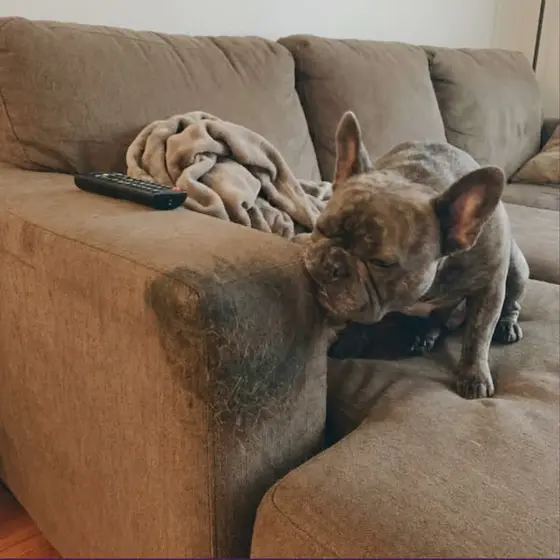
Everything I bought to heal my dog's skin was quietly destroying it, and the expensive stuff did it fastest. I didn't believe that for a long time. I thought I just hadn't found the right product yet. So I kept buying. The $12 oatmeal shampoo from the pet store. Worked for about three days, then she was back to chewing her paws raw. The $30 "vet formula" anti-itch spray. Made her smell like a chemical factory and changed nothing. The $45 hot-spot cream the reviews swore by. She licked it off before it could even dry. The $80 bag of limited-ingredient food. The $60 salmon oil. The prescription stuff the vet sold me that cost more than my own groceries. Every time, I told myself this was the one. Every time, I spent a little more, because surely the more expensive thing was the better thing. And every time, after a brief tease where her skin looked a little calmer, she'd end up worse than before I started. It took me embarrassingly long to notice the pattern. That it wasn't that none of them worked. It's that the harder I treated her skin, and the better the product I used to do it, the faster everything fell apart. I thought I was helping her. I was the reason it kept getting worse. And it was wearing on both of us. She was up half the night going at herself, which meant I was up too, lying in the dark listening to the scratching start, knowing neither of us was going back to sleep. During the day she was miserable and so was I, exhausted and short with everyone and quietly sure I was failing her. The thing that finally cracked it open wasn't a product. It was one sentence, from my sister, who I'd been ignoring for months because she kept pushing some supplement on me and I was done being sold things. She got tired of me complaining and just said it flat out. She said the itching was never actually a skin problem. That there was nothing wrong with my dog's skin at all, and every single thing I was buying to fix her skin was attacking something that was never broken in the first place. And I'll be honest, my first reaction was that she had no idea what she was talking about. Because how does that make any sense? My dog is scratching her skin. She's chewing her own paws raw. The red, the flaking, the raw spots, it's all right there on her skin. Of course it's a skin problem. What else could it possibly be? You don't scratch at something for two years for no reason. I figured my sister had read one article and thought she was an expert. So she explained it in a way I actually couldn't argue with, because every single person has felt it. She told me to think about a mosquito bite. You know exactly how it goes. It itches, so you scratch it. For one second it feels amazing. And then it gets redder, and more swollen, and itches even worse than before. And the more you scratch it, the worse it gets, but you can't stop scratching it. Now imagine scratching that bite every single day for two years and wondering why it never heals. That, she said, was what I was doing to my dog. Except I wasn't using my nails. I was using shampoos and sprays and creams. Her skin itched, so I kept putting things on it to "treat" it. And every single one of those products was just another scratch at the bite. It felt like I was helping. I was making it angrier and rawer every single time, and then reaching for a stronger product when it got worse, which only scratched it harder. That was the first thing in two years that explained the pattern. Because it explained the part that had been driving me insane, which was why the strongest, most expensive products made her the worst. Of course they did. They were the harshest. They were scratching the bite the hardest. I'd been paying a premium to make it worse, and then buying something even stronger when it didn't work. And here's the part that actually changed everything for me. She said the reason it never healed wasn't just that I kept scratching it. It's that her skin had lost the thing that protects it in the first place. Think about why some people get eaten alive by mosquitoes and others barely react. It's not about the bites. It's about what's going on under the skin. A healthy layer of skin shrugs a lot of that off. When that protection is worn down, every little thing in the air, the pollen, the dust, the everyday stuff, gets in and sets the skin off, and it stays itchy and raw no matter what you put on top of it. So her skin wasn't broken. There was never anything wrong with the skin itself. It had just lost its protection, and nothing I rubbed on the outside could put that back. Because that protection doesn't get built from the outside. It gets built from the inside, out of what her body actually has to build it with. And it turns out the main thing it's built from is collagen, which is the exact thing a dog makes less of as they get older, and basically stopped getting the day we all switched to feeding them out of a bag instead of the way dogs used to eat. So the protection slowly wears away, nothing comes in to rebuild it, and the dog itches forever while we stand there scratching the bite with creams and wondering why it never holds. The thing my sister had been trying to hand me for months was a liquid collagen. It's called Sturdywell 5X Collagen Complex. And the whole idea is the opposite of everything I'd been doing. It doesn't sit on top of her skin, and it doesn't scratch the bite one more time. It's a few drops on her food, five types of collagen to actually rebuild that protection from the inside, plus hyaluronic acid to keep her skin from drying out. You feed the skin what it needs to protect itself again, instead of making it angrier from the outside. I want to be honest, because I'd want someone to be honest with me. I only tried it because I was exhausted and out of ideas, and a small, petty part of me wanted to be able to tell my sister it didn't work. I expected nothing. And it's not fast. It builds up slowly, the way anything you feed does, and the first couple weeks I felt like an idiot for buying one more thing, because nothing happened and the little voice went, told you so. Then around week three, I realized I'd slept through the night. I didn't even clock why at first. Then it happened again, and it hit me that the chewing sound just wasn't waking me up anymore. The raw spots on her belly slowly calmed down. The fur on the paw she'd licked bald started filling back in. Her coat, which I hadn't even noticed had gone dull and rough, went soft again. And one night she was just asleep next to me. Not chewing, not scratching, not shifting around miserable. Just out, like a normal dog, like none of it had ever happened. I sat there feeling stupid about how emotional it made me. The part I can't get over is that for two years I was the one making it worse. Not the dog, not bad luck. Me, doing more and more of the exact thing that was breaking her skin down, and paying extra for the privilege. So if your dog is still itching and you've got the same graveyard of half-used sprays and shampoos under your sink, I'm not going to try to convince you. I didn't believe it either. I'll just say that everything I bought worked on the outside, and the one thing that finally worked did something underneath, and that was the whole difference. I'll leave the link to the one we use below. I just wish I'd stopped attacking her skin a lot sooner.
Linda Thompson Facebook and Instagram ad
Linda Thompson ran this image ad since Jun 27, 2026, 133 days so far.
Ad copy
Nobody tells you the hardest part of having a dog isn't the chewing or the potty training. For me it was the part where she slowly stopped letting either of us sleep. And I mean slowly. That's the thing. It didn't start as a problem. It started as a little scratching after dinner. A bit of licking at her paws while we watched TV. The kind of thing every dog does. I didn't think about it once. Then it was most evenings. Then it was during the night too. I'd hear the jingle of her collar tags in the dark, that little shake, and then the scratching, and I'd half wake up and go back to sleep. Then it was a few times a night. Then it was most of the night, every night. I don't even know when it crossed the line from "my dog scratches sometimes" to "neither of us has slept properly in months. " There was no single night it happened. It just crept, a little worse each week, until I was lying awake at 2 a. m. listening to her tear at herself in the dark, both of us exhausted, and somehow this had quietly become normal. That's the part that gets me looking back. How normal it felt. Because here's what I told myself the whole time. She's fine. It's just a little scratching. All dogs scratch. She'll grow out of it. It's probably the season, it'll pass. I had a reason ready for every single night, and not one of them made her stop. What I didn't understand back then is that this kind of thing doesn't just sit still. I found out later that dogs don't actually grow out of this, and that the scratching itself is part of why it keeps going. Every time she scratched, she did a little more damage to her skin, and the more damaged it got, the more it itched, so she scratched more. It feeds itself. It was never going to just stop on its own. It was going to keep getting worse, which is exactly what it did. And it wasn't only her. That's the part I didn't want to admit. I was wrecked. I'd lie there at two, three in the morning listening to that wet licking sound and the jingle of her tags, knowing I had work in a few hours, knowing I wasn't going back to sleep. I was tired all the time. Short with my husband over nothing. Foggy at work. And then I'd feel awful for being frustrated, because she was the one suffering, not me, so what right did I have to be exhausted. Turns out I wasn't imagining it, and I wasn't being dramatic. I read later that something like one in three people say their pet regularly disrupts their sleep, and most of them don't even realize how much. We just blame everything else and stumble through the day tired. It's not in your head. A dog who can't settle at night means nobody in the house sleeps. So there we were. She was miserable and getting worse, I was running on empty and feeling guilty for minding, and the whole thing was slowly turning into just how our life was. What finally made me take it seriously wasn't a vet. It was finding out how common this actually is, and that I'd been treating a real problem like a personality trait. Skin and itching issues are apparently the single most common reason dogs end up at the vet, and have been for over a decade. I had no idea. I thought I had one weirdly itchy dog. It turned out I had an extremely normal problem that I'd just never taken seriously, because every individual night it was easy to wave off as nothing. And once I actually looked into why it happens, the thing that had made no sense for months finally clicked. The way it was explained that finally landed for me was a mosquito bite. You know how it goes. It itches, so you scratch it, and for a second it feels great, and then it's redder and more swollen and itches worse, and the more you scratch the worse it gets. Now imagine scratching that same bite every night for months. That's basically what was happening to her, except the reason she couldn't stop wasn't that her skin was broken. It's that her skin had lost the thing that protects it. A dog's skin has a barrier, a layer whose whole job is to keep the everyday stuff, the pollen, the dust, all of it, from getting in and setting the skin off. When that layer is doing its job, that stuff just bounces off. When it wears thin, everything gets in, and the skin stays irritated and itchy no matter what you do on the surface. That's why none of the surface stuff ever fixes it for long, and honestly why some of it made things worse. The barrier is the real thing, and it's not built from the outside. It's built from the inside, mostly out of collagen, which is the structural building block of skin, and which dogs make less of as they get older. That's the whole reason I ended up trying the thing I give her now. It's a liquid collagen called Sturdywell 5X Collagen Complex, and the idea is simple, it gives her skin the building blocks it uses to support that barrier, from the inside, instead of me throwing one more thing at the surface. It's five types of collagen plus hyaluronic acid for moisture, and it's just a few drops on her food, so there was no fighting her, no pills, nothing to lick off. I'm not going to make some big dramatic claim about it, because that's not really the point of why I'm writing this. It supports her skin and coat from the inside, the way feeding the right thing does, slowly. That's all I'll say about it. The reason I'm actually writing this is the two years I wasted first. Two years of telling myself it was nothing, that she'd grow out of it, that some scratching is just normal. Two years of both of us not sleeping while I waved it off night after night, because in the moment it never felt big enough to take seriously. So if you've got a dog who scratches a little more every month, and you keep telling yourself it's just a phase, please don't do what I did and wait two years to look into it. It is not just a phase. It does not just stop on its own. And it is almost certainly costing you more sleep than you've let yourself admit. I'll leave the link to what we use below. Mostly I just want you to take it seriously sooner than I did.
Placements and targeting
More ads from Linda Thompson
Everything I bought to heal my dog's skin was quietly destroying it, and the expensive stuff did it fastest. I didn't believe that for a long time. I thought I just hadn't found the right product yet. So I kept buying. The $12 oatmeal shampoo from the pet store. Worked for about three days, then she was back to chewing her paws raw. The $30 "vet formula" anti-itch spray. Made her smell like a chemical factory and changed nothing. The $45 hot-spot cream the reviews swore by. She licked it off before it could even dry. The $80 bag of limited-ingredient food. The $60 salmon oil. The prescription stuff the vet sold me that cost more than my own groceries. Every time, I told myself this was the one. Every time, I spent a little more, because surely the more expensive thing was the better thing. And every time, after a brief tease where her skin looked a little calmer, she'd end up worse than before I started. It took me embarrassingly long to notice the pattern. That it wasn't that none of them worked. It's that the harder I treated her skin, and the better the product I used to do it, the faster everything fell apart. I thought I was helping her. I was the reason it kept getting worse. And it was wearing on both of us. She was up half the night going at herself, which meant I was up too, lying in the dark listening to the scratching start, knowing neither of us was going back to sleep. During the day she was miserable and so was I, exhausted and short with everyone and quietly sure I was failing her. The thing that finally cracked it open wasn't a product. It was one sentence, from my sister, who I'd been ignoring for months because she kept pushing some supplement on me and I was done being sold things. She got tired of me complaining and just said it flat out. She said the itching was never actually a skin problem. That there was nothing wrong with my dog's skin at all, and every single thing I was buying to fix her skin was attacking something that was never broken in the first place. And I'll be honest, my first reaction was that she had no idea what she was talking about. Because how does that make any sense? My dog is scratching her skin. She's chewing her own paws raw. The red, the flaking, the raw spots, it's all right there on her skin. Of course it's a skin problem. What else could it possibly be? You don't scratch at something for two years for no reason. I figured my sister had read one article and thought she was an expert. So she explained it in a way I actually couldn't argue with, because every single person has felt it. She told me to think about a mosquito bite. You know exactly how it goes. It itches, so you scratch it. For one second it feels amazing. And then it gets redder, and more swollen, and itches even worse than before. And the more you scratch it, the worse it gets, but you can't stop scratching it. Now imagine scratching that bite every single day for two years and wondering why it never heals. That, she said, was what I was doing to my dog. Except I wasn't using my nails. I was using shampoos and sprays and creams. Her skin itched, so I kept putting things on it to "treat" it. And every single one of those products was just another scratch at the bite. It felt like I was helping. I was making it angrier and rawer every single time, and then reaching for a stronger product when it got worse, which only scratched it harder. That was the first thing in two years that explained the pattern. Because it explained the part that had been driving me insane, which was why the strongest, most expensive products made her the worst. Of course they did. They were the harshest. They were scratching the bite the hardest. I'd been paying a premium to make it worse, and then buying something even stronger when it didn't work. And here's the part that actually changed everything for me. She said the reason it never healed wasn't just that I kept scratching it. It's that her skin had lost the thing that protects it in the first place. Think about why some people get eaten alive by mosquitoes and others barely react. It's not about the bites. It's about what's going on under the skin. A healthy layer of skin shrugs a lot of that off. When that protection is worn down, every little thing in the air, the pollen, the dust, the everyday stuff, gets in and sets the skin off, and it stays itchy and raw no matter what you put on top of it. So her skin wasn't broken. There was never anything wrong with the skin itself. It had just lost its protection, and nothing I rubbed on the outside could put that back. Because that protection doesn't get built from the outside. It gets built from the inside, out of what her body actually has to build it with. And it turns out the main thing it's built from is collagen, which is the exact thing a dog makes less of as they get older, and basically stopped getting the day we all switched to feeding them out of a bag instead of the way dogs used to eat. So the protection slowly wears away, nothing comes in to rebuild it, and the dog itches forever while we stand there scratching the bite with creams and wondering why it never holds. The thing my sister had been trying to hand me for months was a liquid collagen. It's called Sturdywell 5X Collagen Complex. And the whole idea is the opposite of everything I'd been doing. It doesn't sit on top of her skin, and it doesn't scratch the bite one more time. It's a few drops on her food, five types of collagen to actually rebuild that protection from the inside, plus hyaluronic acid to keep her skin from drying out. You feed the skin what it needs to protect itself again, instead of making it angrier from the outside. I want to be honest, because I'd want someone to be honest with me. I only tried it because I was exhausted and out of ideas, and a small, petty part of me wanted to be able to tell my sister it didn't work. I expected nothing. And it's not fast. It builds up slowly, the way anything you feed does, and the first couple weeks I felt like an idiot for buying one more thing, because nothing happened and the little voice went, told you so. Then around week three, I realized I'd slept through the night. I didn't even clock why at first. Then it happened again, and it hit me that the chewing sound just wasn't waking me up anymore. The raw spots on her belly slowly calmed down. The fur on the paw she'd licked bald started filling back in. Her coat, which I hadn't even noticed had gone dull and rough, went soft again. And one night she was just asleep next to me. Not chewing, not scratching, not shifting around miserable. Just out, like a normal dog, like none of it had ever happened. I sat there feeling stupid about how emotional it made me. The part I can't get over is that for two years I was the one making it worse. Not the dog, not bad luck. Me, doing more and more of the exact thing that was breaking her skin down, and paying extra for the privilege. So if your dog is still itching and you've got the same graveyard of half-used sprays and shampoos under your sink, I'm not going to try to convince you. I didn't believe it either. I'll just say that everything I bought worked on the outside, and the one thing that finally worked did something underneath, and that was the whole difference. I'll leave the link to the one we use below. I just wish I'd stopped attacking her skin a lot sooner.
Similar skincare ads
✨ Apply Non-Invasive Facial Sculpting Techniques With Precision, Safety, and Holistic Professional Care. In our Facial Sculpting Therapist Certification, the teachings bring together facial anatomy, skin science, manual sculpting methods, lymphatic support, holistic facial care, device-assisted modalities, hygiene, ethics, and client communication. Rather than presenting facial sculpting as a miracle solution or a one-size-fits-all technique, this training teaches a grounded, professional, and responsible approach — combining technical precision with client comfort, aesthetic awareness with ethical practice, and manual skill with holistic sensitivity. Because the program is fully online, you can join from anywhere in the world. No advanced medical background is required — this course is open to beauty therapists, estheticians, massage therapists, spa and wellness professionals, holistic practitioners, and anyone who wants to offer structured, client-centered facial sculpting sessions. And with accreditation from IPHM, CMA, and CPD, insurance eligibility via ICHAP, and CEU credits via NCCAP, this certification is a solid foundation for a credible, insurable practice. Course Highlights — 10 Modules: ▪ Module 1 – Foundations of Facial Sculpting Therapy ▪ Module 2 – Applied Facial Anatomy and Physiology for Sculpting ▪ Module 3 – Skin Science, Assessment, and Treatment Planning ▪ Module 4 – Core Manual Techniques for Facial Sculpting ▪ Module 5 – Advanced Manual Methods — Buccal, Intraoral, and Specialized Techniques ▪ Module 6 – Device-Assisted Facial Sculpting Modalities ▪ Module 7 – Integrative and Holistic Approaches to Facial Sculpting ▪ Module 8 – Hygiene, Safety, Ethics, and Professional Conduct ▪ Module 9 – Client Communication, Cultural Competence, and Practice Management ▪ Module 10 – Integrating Skills into Professional Facial Sculpting Practice 🎧📄 Nearly 10 hours of audio and 11 downloadable PDFs. Lifetime access on any device. 🌿 Weekly live Q&A and access to a private community of practitioners. 🤗 ✨ Interactive quizzes, guided feedback, and direct instructor access. 🏅 Insurance eligible via ICHAP. CEU credits via NCCAP. Rated 4.82 on Trustpilot. 30-day money-back guarantee. Start your journey today and become a Certified Facial Sculpting Therapist. Now is the moment to combine beauty, relaxation, and holistic wellbeing into a professional practice that is safe, refined, and genuinely client-centered. ➔ naturalistico.com/en/learn/course/3076/facial-sculpting-therapist-certification
💪✨ Gentle, hydrating retinol 💧 Shea Butter + Ceramides for deep moisture
Keep exploring
Find more ads like this
Search millions of real ads by keyword, niche and format, and save the winners to your swipe file.
