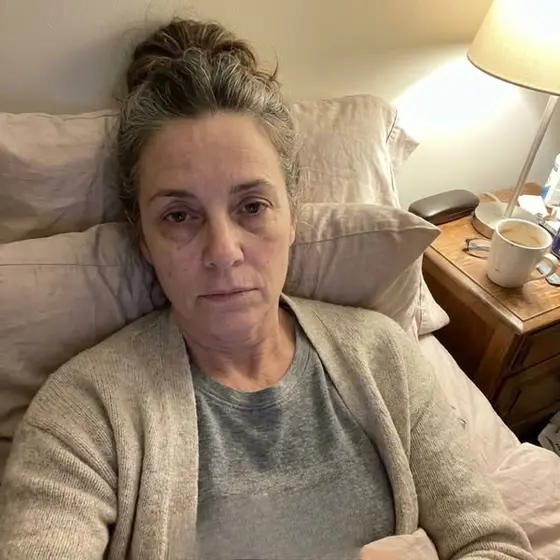
Two hours of actual sleep last night, by my own rough count. I want to be precise about what I mean, because I think this specific thing gets flattened into "I'm tired" far too easily, and "tired" doesn't begin to cover it. I know what insomnia is. This isn't that. I fell asleep last night. I was, by any external measure, asleep for most of the night. What I wasn't, is rested — and at this point in my life, those two words have almost nothing to do with each other. The hard part stopped being the tiredness itself a long time ago. I adjusted to tired the way you adjust to anything chronic — not happily, but functionally. The actual hard part, the part that still genuinely unsettles me some mornings, is that rest doesn't fix it anymore. I could sleep nine hours tonight, a full uninterrupted stretch, the kind of night that would leave almost anyone else feeling like a new person by morning, and I would still very likely wake up tomorrow feeling close to exactly how I feel right now. The math that's supposed to govern sleep — hours in equals function out — simply doesn't apply to whatever's happening in my body once the lights go off. I've read enough about this by now to know roughly why. Deep sleep is the stage where actual repair happens — not light sleep, not REM, the deep stage specifically, the one where tissue recovers and the nervous system genuinely resets. I know fibromyalgia disrupts access to that stage specifically, which means a full night, by the clock, can pass without my body ever reaching the depth where any of that repair work actually occurs. I'm asleep. I'm just not getting what sleep is supposed to deliver, and there's apparently real sleep-lab data confirming that's not just my own perception of things. Knowing the mechanism hasn't made the mornings easier, if I'm honest. What it has done is stop me from running the same exhausting internal interrogation I used to run on myself for years — am I doing something wrong, should I be exercising more, is this anxiety, do I need a different mattress, a different bedtime, a different supplement, a different specialist. I've tried versions of most of those. None of them touch a problem that was never about my sleep hygiene to begin with. It was always about a stage of sleep my body has trouble accessing, full stop, independent of anything I'm doing right or wrong around it. What I'd actually want someone reading this to take away isn't a tip. It's permission to stop blaming yourself for something that was never within your behavioral control. You can do everything right by every conventional sleep rule and still wake up feeling exactly like I do most mornings, because the rules were written for a nervous system that reaches deep sleep reliably. Yours, like mine, doesn't. I came across a detailed breakdown of this exact mechanism recently, written by a doctor who clearly understands it at a level beyond what most general sleep advice ever touches — and who also goes into why the specific things I tried over the years, the different mattresses and supplements included, were never actually positioned to fix this, because none of them were built to reach the stage of sleep that's actually the problem. There are several other points about fibromyalgia in the same piece worth reading in full, not just this one. If you've ever slept what should be a full, good night and woken up feeling cheated out of it anyway, I'd really encourage you to read what's written there. It explained something to me that nine years of trying different bedtime routines never did.

Linda Harrison Facebook and Instagram ad
Linda Harrison ran this image ad since Jun 26, 2026, 134 days so far, targeting United Kingdom.
Ad copy
Two hours of actual sleep last night, by my own rough count. I want to be precise about what I mean, because I think this specific thing gets flattened into "I'm tired" far too easily, and "tired" doesn't begin to cover it. I know what insomnia is. This isn't that. I fell asleep last night. I was, by any external measure, asleep for most of the night. What I wasn't, is rested — and at this point in my life, those two words have almost nothing to do with each other. The hard part stopped being the tiredness itself a long time ago. I adjusted to tired the way you adjust to anything chronic — not happily, but functionally. The actual hard part, the part that still genuinely unsettles me some mornings, is that rest doesn't fix it anymore. I could sleep nine hours tonight, a full uninterrupted stretch, the kind of night that would leave almost anyone else feeling like a new person by morning, and I would still very likely wake up tomorrow feeling close to exactly how I feel right now. The math that's supposed to govern sleep — hours in equals function out — simply doesn't apply to whatever's happening in my body once the lights go off. I've read enough about this by now to know roughly why. Deep sleep is the stage where actual repair happens — not light sleep, not REM, the deep stage specifically, the one where tissue recovers and the nervous system genuinely resets. I know fibromyalgia disrupts access to that stage specifically, which means a full night, by the clock, can pass without my body ever reaching the depth where any of that repair work actually occurs. I'm asleep. I'm just not getting what sleep is supposed to deliver, and there's apparently real sleep-lab data confirming that's not just my own perception of things. Knowing the mechanism hasn't made the mornings easier, if I'm honest. What it has done is stop me from running the same exhausting internal interrogation I used to run on myself for years — am I doing something wrong, should I be exercising more, is this anxiety, do I need a different mattress, a different bedtime, a different supplement, a different specialist. I've tried versions of most of those. None of them touch a problem that was never about my sleep hygiene to begin with. It was always about a stage of sleep my body has trouble accessing, full stop, independent of anything I'm doing right or wrong around it. What I'd actually want someone reading this to take away isn't a tip. It's permission to stop blaming yourself for something that was never within your behavioral control. You can do everything right by every conventional sleep rule and still wake up feeling exactly like I do most mornings, because the rules were written for a nervous system that reaches deep sleep reliably. Yours, like mine, doesn't. I came across a detailed breakdown of this exact mechanism recently, written by a doctor who clearly understands it at a level beyond what most general sleep advice ever touches — alongside several other points about fibromyalgia in the same piece that I think are worth reading in full, not just this one. If you've ever slept what should be a full, good night and woken up feeling cheated out of it anyway, I'd really encourage you to read what's written there. It explained something to me that nine years of trying different bedtime routines never did.
Placements and targeting
More ads from Linda Harrison
People ask if today's a good day or a bad day, and I've genuinely stopped knowing how to answer that, because the framework itself doesn't match what's actually happening in my body anymore. I know the language for this. I know "baseline" versus "flare," the distinction between widespread pain and an acute episode, I've had this conversation with enough rheumatologists and read enough on my own that I could probably teach a continuing education class on my own nervous system at this point. What I don't think gets said enough, even among people who understand the mechanism perfectly well, is what it actually does to a person to live inside a baseline that never resets. There's no morning where the burning simply isn't there to greet me. There's no version of a day where the ache in my shoulders clocks out, even briefly, the way actual physical exertion eventually does in a normal body. What changes isn't presence versus absence. It's only ever volume. Some mornings it's a low, manageable hum I can think past long enough to function. Other mornings it's the only thing in the room, louder than every conversation happening around it. But the dial never goes to zero. It never has, not once, not for an hour, in longer than I can accurately remember anymore. I used to wait for the good days the way you wait for a weekend — something earned, something coming, a finish line on the other side of enough bad ones. I had to consciously stop doing that. Waiting for a kind of relief that isn't structurally available to me wasn't hope. It was a slow-motion way of disappointing myself on a schedule, so I'd rather just be honest about what's happening than keep performing optimism about a reset that was never coming. What I have instead is something closer to honest accounting. Today is a quiet one, comparatively. Not catastrophic, not my worst version, just the actual baseline, on a morning calm enough that I can sit up, get the coffee made, maybe make it through the rest of the day without anyone noticing anything's different. I think there's a specific, particular loneliness in being asked "good day or bad day?" by people who genuinely care and not having an honest answer that doesn't either alarm them or undersell what's actually going on. So mostly I just say "I'm okay," and what I actually mean by that has very little overlap with what most people mean when they say it. I came across an article recently — written by a doctor, going through several of the actual physiological reasons this baseline never resets, including the deep-sleep disruption that means even a full eight hours in bed doesn't give the body the repair window it needs to come back from anything. I'd read around this topic plenty over the years. This had a few specifics in it I hadn't seen laid out quite this clearly before. If this unbroken, never-actually-zero version of pain is something you live inside too, I think the rest of what's written there is worth your time. There's more in it than just this one piece.
I cancelled on my daughter again this weekend, and I genuinely lost count years ago of how many times that exact sentence has come out of my mouth. I texted her Friday night. Three words longer than I wanted, because I kept trying to find a version of "I can't come" that didn't sound like an excuse, even though we both know by now it isn't one. She said it was fine. She always says it's fine, and she means it — that's not the part that gets to me. The part that gets to me is that I remember being the person who never had to send that text. The one who organized the dinners instead of missing them. The one friends called when they needed help moving, not the one quietly backing out because her body had a different plan that day. I don't know the proper word for grieving a version of yourself that isn't dead, just unavailable most of the time. She's not gone. She surfaces, sometimes, on the days my body allows it — fewer of those lately than there used to be, though I've stopped tracking the exact ratio because it wasn't doing me any good to know the number. This morning is one of the days she didn't surface. Nowhere I need to be, because I already cancelled the place I was supposed to be. I used to be the one who couldn't sit still if she tried — the one setting up tables before everyone else arrived, the one who left every gathering last because there was always one more thing to help clean up. Somewhere across the last several years, not in one dramatic moment I could point to and grieve properly, just in a slow accumulation of smaller ones, that version of me quietly became someone I used to be, past tense, the way you'd talk about an old job or an old apartment. What's actually hardest isn't even the cancelling itself anymore. I've made a kind of peace with the cancelling. What's hardest is watching the people who love me adjust their expectations accordingly, without ever saying so out loud. Nobody's cruel about it. They're patient, they're understanding, "it's fine" is said and meant every single time. But there's a specific, quiet grief in watching someone stop being surprised when you cancel — in knowing that "she might not make it" became the baseline assumption instead of the exception, and that nobody did anything wrong by adjusting to that. I'm the one who has to live inside the adjustment they made on my behalf. I'm not writing any of this for reassurance that I'm still a good daughter, a good friend. I know I am, on the days my body lets me be one. I'm writing it because I suspect a lot of people are carrying a version of this exact thing — the slow, undramatic disappearance of being the reliable one — and almost nobody puts language to that particular grief, because it doesn't arrive with anything dramatic enough to talk about out loud. It just arrives as three-word texts on Friday nights, repeated for years. I came across an article recently, written by a neurologist, that talks about exactly this dimension of fibromyalgia alongside several of the physiological mechanisms behind it — the way this condition takes things from a life that nobody warns you about in advance, long before anyone explains the nervous system science underneath it. If any part of this — the cancelling, the version of yourself you're quietly missing — sounds like your life too, I'd really encourage you to read what she's written. There's more in it than I've covered here.
A coworker told me a few months ago that I "don't look sick at all," and I smiled and said thank you, because I've learned that's faster than explaining what's actually underneath that sentence. Underneath it is nearly everything this category has to offer, tried in sequence, over nine years. Gabapentin first — helped the burning a little, took something else in exchange, gained weight I never got fully rid of. Lyrica after that, when gabapentin stopped being enough on its own — worse fog, faster, not worth what it cost. Magnesium, more than one kind, more than one brand. A four-month elimination diet a naturopath was confident would change everything, tracked carefully in a notebook that now mostly just proves how much time I spent trying. Topical creams I can't even remember the names of anymore. A TENS unit that helped for the twenty minutes it was actually running and did nothing in the hours after. I don't list all of that for sympathy. I list it because "you don't look sick" lands very differently on someone who's been managing this for years versus someone newly diagnosed, and I think that distinction matters. For me, that sentence isn't really about my appearance. It's a small, accidental reminder that almost everything I've actually been through is invisible by design — not just the disease itself, which doesn't show up on a scan, but the years of effort behind trying to address it, none of which left any visible trace either. You can't see a notebook of failed attempts on someone in a hallway. You can't see eleven pounds gained and never quite lost, or a TENS unit gathering dust in a drawer, or the specific exhaustion of being disciplined about something for years with very little to show for the discipline. What I've noticed, the longer I live with this, is that my relationship with trying new things has fundamentally changed shape. I used to hope. Now I mostly just observe, the way you'd run an experiment you don't expect to work but feel obligated to run anyway. I don't say "I hope this helps" anymore. I say "I'll try it and see," and the distinction between those two sentences is the entire difference between who I was when this started and who I am nine years in. I'm not writing this looking for anyone to confirm I look sick enough, or tried hard enough, or suffered convincingly enough to deserve being believed. I know what I've been through. I'm writing it because I suspect a lot of people reading this have their own version of that exact coworker comment, landing on a version of themselves that doesn't visibly match what's actually happening underneath, and I don't think that specific gap gets talked about nearly enough. I came across an article recently, written by a neurologist, that goes through several of the actual mechanisms behind why fibromyalgia is this invisible — not just on a scan, but in everyday interactions like the one I had in that hallway — alongside a few other points I genuinely hadn't seen explained this clearly before, even after nine years of reading everything I could find on this myself. If "you don't look sick" is a sentence you've heard more times than you can count, I'd encourage you to read what's written there. I think it puts language to something you already know but rarely get to see said back to you so plainly.
Similar health and supplements ads
NO GYM, NO STRESS JUST DANCING! BOOST YOUR MOOD QUICKLY BURN CALORIES Take a quiz and get your dance plan in DanceFitMe
Keep exploring
Find more ads like this
Search millions of real ads by keyword, niche and format, and save the winners to your swipe file.