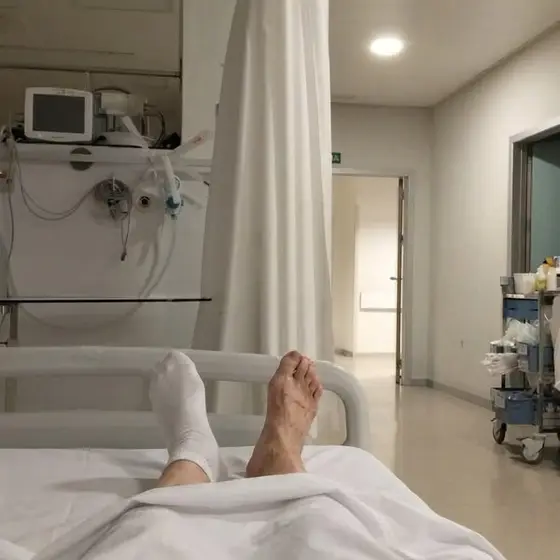
It's finally over. A brutal 7 year battle with Alzheimer's. My mother died three weeks ago. I'm writing this because her neurologist told me something that I can't stop thinking about. If you have sleep problems, this changes everything. I need to tell you what he said. Because if you have sleep problems, this changes everything. My mother was 71. She was diagnosed with Alzheimer's seven years ago. For the last four years she was in a care facility. I visited her every Sunday. Most Sundays she thought I was her sister. Some Sundays she didn't know me at all. She just stared. I'm 52.
Julia's Blog Facebook and Instagram ad
Julia's Blog ran this image ad since Jun 25, 2026, 2 days so far, targeting United Kingdom.
Ad copy
My heart attack nearly killed me four months ago. The same way my mother died at 62. I'm writing this because my cardiologist told me something that could have changed everything. If you have a family history of heart disease and you wake up at night, you need to read this. It's the conversation my mother never got. It's the one I almost didn't either. She died on a Sunday morning in 1997. Making roast chicken. The kind we'd had at her table every week of my childhood. My father found her. He was 64. He never really came back from it. I'm her only daughter. I was 32 when she died. I started counting down to 62 the year I turned 35. For thirty years I thought I was preparing. For ten years I was doing every single thing anyone had ever told me to do. I went on the Mediterranean diet in 2015. Olive oil, fish twice a week, no red meat. Three years. I walked four miles a day. Every morning. Through winter. Through the year my husband had his knee replacement and I went alone. I lost twelve pounds. Slow and steady. I had my LDL down to 102 by the time I was 60. Still high enough that my cardiologist had been pushing a statin for three years. I thought I had it covered. I thought I was the daughter who'd break the family pattern. But it was the 3 AM that I couldn't fix. I'd been waking up between 2 and 4 AM almost every night for fourteen years. Heart racing. Lying there counting beats. Some nights I'd fall back asleep by 4:30. Some nights I'd give up and start coffee at 5. I'd tried everything any article or podcast had suggested. I bought Olly Restful Sleep gummies at Target. $14.99 for a bottle of 50. Strawberry flavor. They worked the first two nights. By the third I was awake at 3:02 AM staring at the ceiling. I switched to Natrol melatonin 5mg from CVS. $9.49. Took it forty minutes before bed every night for two months. Vivid dreams. Still woke at 3. I doubled the dose. Still woke at 3. My sister sent me Calm magnesium powder, the raspberry-lemon one. $21.99 on Amazon. I drank it every night for three weeks. My stomach didn't like it. I switched to Doctor's Best high-absorption magnesium glycinate. $16.99. Better tolerance. No change in my sleep. I tried Nature's Way valerian root capsules. $9.49 at Whole Foods. Bottle still sitting in my pantry. I tried NOW Foods L-theanine 200mg. $14.99 on Amazon. Nothing. I bought a passionflower and lemon balm tincture at a local wellness shop. $38 for a small bottle. The clerk swore by it for sleep. I tried it for two weeks. I downloaded Calm. I downloaded Headspace. I paid for the annual subscriptions on both. I bought a $79 Hatch Restore on Amazon. The sunrise lamp with the white noise. By my count I'd spent close to four hundred dollars on sleep products over three years. My 3 AM wake-ups got worse, not better. I'd track my sleep on a Fitbit. My deep sleep was averaging under 28 minutes a night. The threshold for what most sleep researchers consider restorative is closer to 90. I felt guilty about it. Every article I read about sleep blamed the user. You're on your phone too late. You drink too much wine. You don't exercise enough. You don't have a bedtime routine. I had a bedtime routine. I read for forty minutes every night on a Kindle in warm-tint mode. I drank Yogi Bedtime tea. I went to bed at the same time. I exercised at the same hour daily. And I still woke up at 3 AM. With my heart racing. So I gave up on sleep. Quietly. I didn't tell my husband. I just decided this was how my body worked now. I figured I had bad sleep genes the way I had bad heart genes. Both came from my mother. Both were going to take me out the same way they took her out. I just didn't think it would happen yet. It happened on a Tuesday morning in February. I was 62. My birthday was eleven days behind me. I woke up at 4:43 AM. The exact same pattern. Heart racing. Lying there counting beats. Except this time the pain came too. A pressure in my chest like someone had set a bag of sand on it. My left jaw started to ache. Then my left arm. I woke my husband up. He drove me to the emergency room. We don't live in the city. The drive took eighteen minutes. I remember every one of them. The ER doctor said I'd had a STEMI. A major heart attack. They got me into the cath lab inside an hour. I had one stent placed in my left anterior descending artery. The interventional cardiologist told my husband afterward that women who present with chest pain at 4 AM have the worst outcomes. The combination of widow-maker location and time-of-day. Most don't survive. I survived because we lived eighteen minutes from a hospital with a cath lab. And because my husband didn't waste any time. I was discharged five days later. The follow-up appointment with my regular cardiologist was the second week of recovery. I sat in his office. He had my records open. He'd seen me for three years before this. He'd been pushing the statin. He didn't say I told you so. He said something else. "How do you sleep?" I told him the truth. Badly. I'd been waking up at 2 or 3 AM almost every night for the last fourteen years. He put his pen down. "Most heart attacks in women happen between 4 and 8 in the morning. Did you know that?" I didn't. "It's not random. There's a circadian pattern. And the women I see who have a 4 AM event almost always have a history of fragmented sleep." I asked him to explain. "During deep slow-wave sleep, three protective things happen at once. Your blood pressure drops 10 to 20 percent. Your heart rate variability resets to its parasympathetic baseline. Your magnesium-dependent cardiac electrical stability is restored. When you don't reach deep sleep, none of that happens. Your heart spends the night under load. Years of that, plus the magnesium depletion that happens with age and stress and statins, and you get a 4 AM event." He paused. "Your mother probably wasn't dying from her cholesterol that Sunday morning. She was probably dying from twenty years of nights her heart never got to reset. And you were hours away from dying the same way she did." I sat there. I couldn't speak. Because I'd been doing the exact same thing she had. For fourteen years. He continued. "There's a study in the Journal of the American Heart Association. Plasma magnesium inversely associated with sudden cardiac death in women." Sudden cardiac death. That's exactly how my mother died. "And the Nurses' Health Study followed seventy thousand women for two decades. Sleep five hours or less and you have a 25 percent higher risk of coronary heart disease." He looked at his notes again. "You've been waking at 3 AM for fourteen years. Your mother probably had the same pattern. Did she ever talk about her sleep?" I told him she had. For at least twenty years before she died. Every Sunday phone call she'd mention it. "I wake up at 2 or 3. Heart pounding. Can't get back." "And your grandmother. Did she sleep well?" Always up at 4 AM, my grandmother used to say. Always exhausted by mid-afternoon. "Three generations of women in your family with the same sleep pattern. Three generations of cardiovascular disease. That's not a coincidence." He turned the page on his notepad. "Genetics is real. But it accounts for maybe forty to sixty percent of cardiovascular risk. The rest is behavioral. And the most underrated behavior is sleep architecture." I asked him why none of the things I'd tried had worked. I told him about the Olly gummies. The Natrol. The Calm powder. The Doctor's Best glycinate. All of it. That's when he told me about the liver. "Your liver destroys 70 to 80 percent of anything you swallow before it reaches your bloodstream." He drew it on a notepad. "If you take 10mg of melatonin, you get maybe 2mg into circulation. And that 2mg spikes in your bloodstream within thirty minutes, then crashes. By 2 AM, it's gone." He flipped the page. "Same with oral magnesium. Your gut absorbs maybe 30 percent. The rest gives you loose stools at any dose that would actually saturate your cells. So you take a sub-therapeutic dose for years and your magnesium reserves stay depleted." I felt something shift in my chest. "Pills physically cannot support 8 hours of cardiovascular reset. Your body destroys them too fast. By 3 AM, when your heart needs the magnesium and the reset signal, there's nothing left in your system." That was the reason I'd been failing. For three years. For four hundred dollars. For fourteen years of 3 AM. It wasn't me. It wasn't my brain. It wasn't bad sleep genes. It was the delivery system. My liver was breaking down every supplement I swallowed before it could give my heart what it needed at night. I asked him: "So what do I do?" He said: "You need something that bypasses your liver. Through the skin. The patches release for 8 hours straight. They keep the magnesium and the melatonin signals active across the entire reset window." I asked him what brand. "There's only one I've seen that's actually formulated correctly for transdermal delivery. Most patches use molecules too big to absorb through the skin. They don't work. The brand I've watched my patients have success with is Drowzen." He told me he was putting me on a statin now too. Standard post-event protocol. He said the statin would handle the lipid load. But the statin alone wouldn't fix what got me into the cath lab in the first place. That part was the night. That part was the patches. I ordered Drowzen the same afternoon I left his office. Not because I was tired. Because I'd survived something I shouldn't have. And I wasn't going to give my heart another fourteen years to finish the job. First night home with patches on. I put one on my shoulder at 9 PM. Got into bed at 10:30. I expected to wake at 2 AM. I didn't. I slept until 6:14 in the morning. Second night. Same. Third night. Same. After two weeks I bought a Withings home blood pressure cuff. Started measuring at 7 AM every morning. My readings in the hospital had been running 142 over 88. By the third week of patches they were 124 to 128 over 76 to 80. After a month my resting heart rate had dropped from 78 to 68. After three months my 4 AM blood pressure readings, which I'd started tracking because I knew that was the window that nearly killed me, were averaging 120 over 74. My Fitbit deep sleep readings had gone from under 28 minutes to consistently over 75. Some nights over 90. My morning heart rate when I first sat up in bed had been running 82 to 88 in the hospital and the first weeks home. By month three it was 64 to 68. The hot flashes I'd been getting at 3 AM for fifteen years had stopped. I didn't notice for the first month. Then one morning I realized I hadn't woken up sweating in weeks. I went back to my cardiologist at the four month mark. He looked at my BP log. He looked at my recovery markers. He looked at me. "Whatever you're doing, keep doing it." The same ingredients I'd been swallowing in pills for three years. Melatonin. Magnesium. Valerian root. Hops. The same molecules I'd already paid four hundred dollars for. But now they're actually arriving where they need to go. Because they bypass my liver. Because they release steadily for 8 hours instead of spiking and crashing in two. Every night I sleep is a night my heart gets its reset. A night the blood pressure drops the way it's supposed to. A night the electrical stability holds. A night the artery they stented gets a break from the load it lives under during the day. My mother had sleep problems for twenty years before she died. I caught mine after fourteen. The difference between us is six years of damage I won't be adding to my heart from here on. She never had a chance. Nobody told her about the morning peak. Nobody told her about the reset window. Nobody told her about transdermal delivery. The science existed. The conversation didn't. I got the conversation. I'm still here. That's the only difference between us. If you've watched a parent die of a heart attack and you're approaching their age, you're not paranoid for being scared. You're paying attention. You should be. But the answer isn't just another prescription your mother was probably also on. You need something that wasn't in the cardiology playbook in 1996. Something that addresses the night, not just the cholesterol. You need something that bypasses your liver and your gut. That delivers steadily across the reset window. That gives your heart what it needs to do its overnight maintenance. That's transdermal patches. Drowzen specifically. The only brand I've found with a molecular profile actually formulated for skin absorption. I use them every night. Not as a sleep aid. As heart protection. Because I already had the heart attack. I survived. I'm not betting on a second one. You don't have to wait for the morning your husband drives you to the ER. Fix your sleep. Protect your heart. While there's still time. P.S. The brand I use is Drowzen. Four months since my heart attack. My morning blood pressure is the lowest it's been in twenty years. My resting heart rate has dropped fourteen points. My 4 AM readings are clean. I use them every night. Not as a sleep aid. As heart protection. 👉 https://drowzen.com/products/sleep-recovery-patches
Placements and targeting
More ads from Julia's Blog
It's finally over. A brutal 7 year battle with Alzheimer's. My mother died three weeks ago. I'm writing this because her neurologist told me something that I can't stop thinking about. If you have sleep problems, this changes everything. I need to tell you what he said. Because if you have sleep problems, this changes everything. My mother was 71. She was diagnosed with Alzheimer's seven years ago. For the last four years she was in a care facility. I visited her every Sunday. Most Sundays she thought I was her sister. Some Sundays she didn't know me at all. She just stared. I'm 52.
It's finally over. A brutal 7 year battle with Alzheimer's. My mother died three weeks ago. I'm writing this because her neurologist told me something that I can't stop thinking about. I need to tell you what he said. Because if you have sleep problems, this changes everything. My mother was 71. She was diagnosed with Alzheimer's seven years ago. For the last four years she was in a care facility. I visited her every Sunday. Most Sundays she thought I was her sister. Some Sundays she didn't know me at all. She just stared at the wall behind me. Not confused. Empty. I'm 52. I was her only d
Please STOP using Melatonin or Sleeping Pills if you have sleep problems. I'm going to explain why sleep problems give you a 30% higher risk of getting Alzheimer's. And why every solution you tried never worked. I had 6 years of sleep problems. I tried every solution on the market. None of them worked. And there's a real reason why. I'm going to explain that too. But first, let me tell you about the dangerous part of sleep problems. We thought it just made us tired. Exhausted. That's it. But a sleep scientist discovered something terrifying. Something nobody talks about. I found out abou
Create a free account to unlock every creative, video and landing page.
Sign up freeSimilar health and supplements ads
"I Got My Hands Back": From Fumbling to Fix-It Guy Again I used to be the guy who could fix anything. But then the stiffness started. That deep, constant tension in my wrists and hands. It got to the point where simple things - like turning a wrench or even maintaining a firm grip on the steering wheel during my commute - it felt like a major struggle. I felt myself pulling away from the hobbies that kept me sane. The hardest part? The quiet, embarrassing feeling of becoming less capable. I missed the adventurous, capable man I used to be. The Day I Failed My Own Project 💔 My true bre
Ein Kalender für dich, einer für deinen Lieblingsmenschen. Weil der Advent zu zweit einfach schöner ist. 🎄 Jetzt im Doppelpack: 67,90 €, nur 33,95 € pro Kalender. 🎁
🚨 This is the gut solution backed by over 20 clinical trials. 💙 Clinically backed and trusted by thousands across the UK, GutSupp is the simple daily sachet designed to support your gut health from the inside out. Simply stir it into your morning hot or cold drink and give your gut the reset it’s been waiting for. New subscribers from just £23.99/month. Tap below to get started.
Keep exploring
Find more ads like this
Search millions of real ads by keyword, niche and format, and save the winners to your swipe file.
