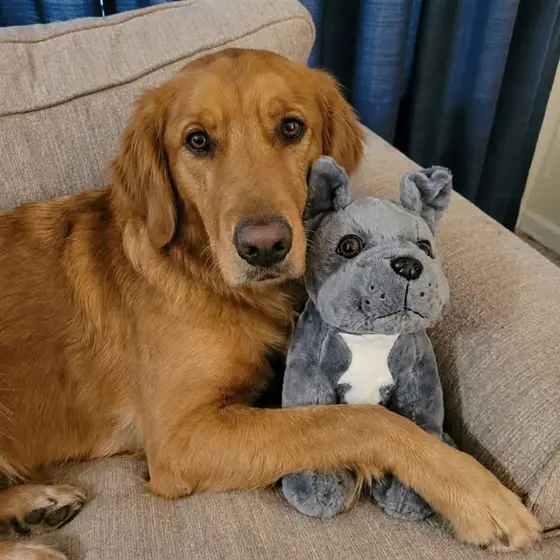
TAURINE FOR DOGS IS A SCAM!!! At least that's what I believed after giving my Golden Retriever taurine every single day for seven months and watching her die on a Tuesday morning with her head in my lap. Turns out taurine isn't a scam. But the four things I tried? Every single one of them failed her in a different way. And I'm only writing this because I see people in these groups doing exactly what I did. My name is Julia. I live in Phoenix with my husband and two kids. We had a dog named Bailey. A 10-year-old Golden. She'd been part of our family since my daughter was 3 years old. My son grew up thinking all dogs smelled like Bailey specifically. She was the first thing he looked for when he came home from school every day. About nine months ago Bailey started declining. Not dramatically. Just slower. Less herself. Stopped meeting my son at the door the way she always had. My husband said it was age. He said that every time I brought it up. "She's 10. Goldens slow down. You're going to spend a fortune on internet supplements for a dog who's just getting old." I knew Bailey. That wasn't what getting old looked like. I started researching. Found the studies on taurine deficiency and DCM in aging dogs. Found that AAFCO requires zero dietary taurine for dogs. Yeah..... ZERO content of the one nutrient they NEED to thrive. That dogs produce less of it every year as they age and the food has never been required to replace it. The science was real. The problem was real. I just needed the right product. So I started trying things. First Amazon. First one that came up. $52. Gave it to Bailey every single morning mixed into her food. Month one nothing changed. Month two the cough started. I also tried human taurine powder from a supplement store — someone said it was cleaner than dog-specific brands. Three weeks on that. Bailey still declining. Found out later that taurine metabolism works completely differently in dogs than in humans. The L-taurine formulated for human biology absorbs through a different pathway in canines and barely reaches the cells in any meaningful dose. I was giving her something her body fundamentally couldn't use. Nobody told me that before I bought it. So I switched to DoggySupps. I'd been seeing it all over Facebook. Clicked through to order and immediately noticed there was no ingredient label anywhere on the site. No third-party testing listed anywhere. I sent them an email asking what was actually in the product. No response. I tried it anyway because I was running out of time and I didn't know what else to do. Three weeks on DoggySupps. Bailey worse. Tracked down someone in a group who'd had DoggySupps independently tested. She sent me the results. Taurine content came back at 41% of what the label claimed. The rest was bulk filler material the lab identified as Chinese-origin binding compound — the kind used by overseas bulk manufacturers to cut expensive amino acids and increase volume. No regulation. No disclosure on the label. Just filler where the active ingredient was supposed to be. I switched to PawVita. Then I found out they were shipping from China... When I tried asking for a refund I barely got a response. Took me three weeks to get my money back. I went back to the vet at month six. Taurine blood level: 11 nmol/mL. Normal starts at 50. She'd been on something calling itself taurine every single day for six months. The vet tested the most recent product. Called me a week later. "The molecular form in this product has an absorption rate of 15 to 20 percent in dogs at best. Bailey has been ingesting 500mg a day. Her cells have been getting somewhere between 75 and 100mg. Not enough. Not even close to enough." "Why is this legal to sell as a 500mg dose?" "Because nobody is requiring them to test what reaches the cells. The label only has to reflect what's in the capsule. Not what absorbs." We started her on cardiac medications that afternoon. She rallied for about three weeks. My son came home one Thursday and she met him at the door and he got down on the floor with her and came to find me in the kitchen afterward. "Mom. She seems like she's getting better." She did. For three weeks she seemed better. Then she didn't. A Tuesday morning. My husband had left for work. Kids were at school. I found Bailey in the hallway breathing wrong. Called my husband on the way to the emergency vet. He turned around and met me there. They brought us into a room with her. My husband sat on the floor. I sat next to him. Bailey's head was in my lap. She stopped fighting sometime around 11:30. Taurine level at time of death: 8 nmol/mL. Her heart had been starving for months while I genuinely believed I was doing something about it. My son was at school until 3. My daughter until 3:30. My husband and I went home and waited. I will not describe that afternoon. If you have kids and a dog you already know what that's like. The emergency bill was like $3,900. I came home and put all four bottles on the kitchen counter and just sat there. Seven months. Four different products. Every single morning. She still died with critical taurine deficiency. About a week later I was awake at 2am — I still hadn't put her dishes away — and I saw a post in a senior dog group. Someone using Amazon taurine for months with no improvement. A reply stopped me cold. "Most of what's sold online is sourced from bulk manufacturers in China with no quality oversight, cut with compounds that block absorption, and verified by nobody before it goes in the bottle. The mg on the label means nothing if the molecular form doesn't absorb and there are fillers actively working against it." I got so angry. Why was I learning this now. Why did none of my vets over seven months ever ask which product I was using or whether it had been independently tested. Why does nobody tell you that the star rating on Amazon is completely meaningless if nobody's verifying what's actually in the capsule. Why is there an entire market selling something to dying dogs that has no requirement to prove it works at the cellular level. I spent three days going through every product I could find. Lab results people had shared. Reddit threads. Group posts. What I found was that most of what's being sold — the Amazon listings, the Facebook ads, the influencer recommendations — is sourced from Chinese bulk manufacturers with no external controls, cut with fillers to reduce manufacturing costs, and formulated for the cheapest possible production rather than for what actually reaches a dog's cells. A market that exists because most people don't check and most dogs can't tell you it's not working until it's too late. Bailey was in that market for seven months. Then I found a post from someone whose dog had actually gotten better. Actually improved bloodwork. They linked to a brand called HappyWags. I went to the site like I was looking for reasons not to trust it. Ingredient label: one ingredient, taurine, nothing else, no magnesium stearate, no rice flour, no binders. Certificate of Analysis: not one general document but one per batch, from an independent third-party lab, issued before each batch ships, available to read on the website. US-sourced. Not Chinese bulk with a rebranded label. Actual supply chain documentation. I ordered a bottle and took a sample directly to my vet before I gave a single scoop to either of my surviving dogs. Asked her to send it to the same lab that had tested everything else. She called me eight days later. "Sarah. 503 milligrams verified against a 500mg label. Zero contamination. No fillers. No binders. The molecular form absorbs at 90 to 95 percent in dogs. This is what 500mg is actually supposed to mean." I asked how it compared to what had failed Bailey. "Human taurine was delivering around 60 to 80 milligrams to Bailey's cells after the filler compounds did their job. This delivers 450 to 475. To the cells. That's not a minor difference." She paused. "I'm sorry. I should have asked what product you were using from day one. I didn't know the variance was this severe." We have two other dogs. Rosie and Cooper, both seniors, both starting to show early signs. I started them on HappyWags the next morning without telling my husband anything had changed. Week two Rosie started meeting me at the back door again. I didn't say anything. Just watched. Week three Cooper dropped his rope toy at my son's feet on a Wednesday evening. My son picked it up, looked at me, threw it. Cooper ran. I stood in the doorway. Week four my husband came home and both dogs ran to the door. He stopped in the entryway and put his bags down. "Something is different with these dogs." I hadn't told him anything. He noticed on his own. He's the one who reorders now. Sets the reminder himself. Checked last month before we ran low and ordered without me saying a word. My husband who spent seven months telling me I was wasting money on internet supplements for an old dog. He literally reorders without being asked. HE ASKS if we're running out. Week six bloodwork. Rosie: taurine 56 nmol/mL, up from 21. Cooper: taurine 53 nmol/mL, up from 17. Cardiac markers stable. Vet said his heart sounds better than three months ago. "Whatever you switched to — don't stop." I'm only sharing this because I see people in these groups every single day buying from Amazon because it ships fast, buying whatever shows up in their feed because the website looks legitimate, looking at the milligrams on the label and thinking they've done something meaningful. Please hear me when I say the milligrams mean nothing if the product doesn't absorb. Nothing. Before you give your dog another scoop of whatever you're currently using — does it have a full ingredient label showing everything in the container, not just marketing language? Does it have an independent third-party lab issued per batch? Is it US-sourced with an actual supply chain or is it Chinese bulk material in a branded bottle? Did anyone respond when you emailed asking what's actually in it? HappyWags is the only one that passed them all, and my vet's independent lab confirmed it. happywags.co/products/taurine Because Bailey deserved taurine that actually reached her cells. And so does your dog. Just try HappyWags, if it doesn't work for you they have a 60-day money back guarantee. And they actually respond to emails. happywags.co/products/taurine You have nothing to risk but everything to gain. Don't make my mistake buying random Chinese taurine from Amazon and thinking it's doing something. I wasted 6 months doing that and Bailey was suffering the whole time. If your dog is currently on taurine and not improving it is almost certainly not that taurine doesn't work. It's because you're using cheap underdosed taurine. Your dog deserves the real thing.
Julia Peterson Facebook and Instagram ad
Julia Peterson ran this image ad since Jun 26, 2026, 134 days so far.
Ad copy
I've bred Golden Retrievers for 22 years. 340 puppies. I stay in touch with every single family. I track every health issue. Every vet visit. Every death. Last year I finally analyzed 22 years of data. Families who listened: 14.1 year average lifespan. Families who forgot: 9.3 years. Same litters. Same parents. Literal siblings. The difference? ONE thing I told them the day they took their puppy home. My name is Julia. I've been breeding Goldens in Virginia since 2009. Not a puppy mill. Not a business. A passion that got out of hand. Every puppy I place, I interview the family first. Home visits. Vet references. The whole process. And I don't disappear after they drive away. I check in at 6 months. At 1 year. Then annually until the dog passes. I have a spreadsheet with 340 rows. Every puppy. Every family. Every outcome. For 17 years I thought I was just being sentimental. Then Poppy died. Poppy was from my 2016 litter. Beautiful red coat. Endless energy. The sweetest temperament I'd ever seen. I placed four puppies from that litter with families. The fifth one — Poppy — I kept for myself. She was supposed to be my forever dog. And because she was mine — because she was right here with me every day — I got lazy. I told every family to follow my protocol. Wrote it in my 8-page welcome packet. Page 6. Third paragraph. "Add daily taurine supplementation to support heart function. Critical for this breed." I'd call families at 4 months to make sure they'd reordered. I'd remind them at annual check-ins. But Poppy? She was already home. Already healthy. Already perfect. I'd add the powder when I remembered. Skip it when I was busy. Figured she'd be fine. She was with me every day. I'd catch it if something was wrong. I didn't catch it. Poppy collapsed on a Tuesday morning. I rushed her to the emergency vet. Heart failure. Severe. Too late to reverse. She died in my arms that night. She was 7. I'm supposed to be the expert. I'm the one who writes the protocol. Who lectures families about compliance. Who calls to make sure they've reordered. And I let my own dog die because I was too busy protecting everyone else's. I buried Poppy in my backyard, next to the garden where she used to dig holes. And I finally did something I should have done years earlier. I analyzed my data. I spent three weeks going through every record. Cross-referencing lifespans with whether families followed my protocol. What I found made me sick. The average lifespan of a Golden Retriever in America is 10.7 years. My puppies averaged 11.4 years. Good, not great. But when I split them into two groups, the gap was staggering. Families who followed my protocol: 14.1 years. Families who stopped after the first year: 9.3 years. Same parents. Same genetics. Same starting health. 4.8 years difference. I pulled individual litters to make sure I wasn't imagining it. My 2015 flower litter — Daisy, Rose, Lily, and Violet. Four females. Same mom and dad. Daisy: Still alive at 10. Active. Healthy. Rose: Died at 7. Heart failure. Lily: Still alive at 10. Slowing down but strong. Violet: Died at 8. Heart failure. Two thriving. Two dead. I called all four families. The Daisy family: "Oh yes, we still add that powder to her food every morning. We never stopped." The Rose family: "The powder? We did that for maybe six months. Then we ran out and forgot to reorder." The Lily family: "We've done everything you told us since the day we brought her home." The Violet family: "I honestly don't remember any powder. Did you mention that?" Same litter. Same genetics. Same starting point. The only variable was whether they followed one instruction. And then I thought about Poppy. Same breeding program. Same bloodline. Same protocol I gave everyone else. I just didn't follow it myself. 340 families got my instructions. Poppy got my laziness, the guilt eats me up. She died younger than the puppies I gave away. After I found this pattern I dug deeper. 87 puppies have died since I started tracking. Cause of death for 61 of them? Heart-related. Average age at death for heart-related cases: 8.4 years. Average age at death for everything else: 13.2 years. Heart failure was killing my puppies 5 years early. And it was almost entirely preventable. I started making calls. First to breeders I respected. Old-timers with 30+ years of experience. "Do you recommend taurine supplementation?" Every single one said yes. Then I called three veterinary clinics. "Do you recommend taurine for healthy Golden Retrievers?" Two said no. One said: "Only if there's a diagnosed deficiency." By then the deficiency has already damaged the heart. You're treating disease, not preventing it. The breeders knew. The shelters knew. Service dog organizations have known since the 1980s. Pet vets kept saying "the food is complete and balanced." My spreadsheet says otherwise. 14.1 years versus 9.3 years. Same litters. Same genetics. One instruction. After this discovery I rewrote my entire welcome packet. Page 1. First paragraph. Bold and highlighted. "CRITICAL: Daily taurine supplementation is required, not optional. This single instruction will add 4-5 years to your dog's life. Do not skip. Do not forget. Do not stop." I include a supply with every puppy now. Since I changed my process, compliance has gone from 50% to 94%. But here's what haunts me. What about the families who threw away my packet? Who never saw page 6? How many of those dogs died at 8 when they could have lived to 14? Last fall a family called about Cooper. They'd bought him from me in 2017. "Ellen, Cooper's really slowing down. He's only 7 but he acts like he's 12. The vet says his heart is slightly enlarged." I overnighted them a bottle of HappyWags. Eight weeks later they sent me a video. Cooper sprinting across their backyard. Jumping for a frisbee. Acting like a puppy again. "Ellen, what was in that bottle? He's a different dog." That's what happens when you refill the tank before it's too late. Cooper's family caught it at 7. They'll get more years with him now. I didn't catch it with Poppy. She's gone. The supplement I include in every packet now is HappyWags. I researched carefully before putting my name on anything I hand to families. Single ingredient — pure taurine, nothing else in the container. Verified 500mg by an independent lab on every single batch before it ships. Made in the USA. No fillers. No binders. Nothing competing with absorption. My vet reviewed the batch documentation before I started recommending it. 503mg verified. Zero contamination. "This is the real thing," she said. That's the only kind of product I'll put my name on. Less than $70 for a month's supply. That's what stands between your dog and 4-5 extra years of life. I can't get Poppy back. She's buried in my backyard. Seven years old. Heart that gave out because I got lazy. 340 puppies. I told every single family what to do. The one I kept? I didn't listen to my own advice. Daisy is still alive at 10. Lily is still alive at 10. Poppy is gone. Same genetics. Same breeder. Same protocol. The only difference was me. Don't be me. HappyWags is the only taurine I trust for dogs and recommend to all owners, https://happywags.co/products/taurine I've tested countless Amazon taurine supplements, NONE of them passed my criteria. Most were either sourced from China or underdosed with fillers. Don't buy from Amazon. — Ellen Golden Retriever Breeder P.S. Daisy and Lily are still alive at 10. Rose and Violet died at 7 and 8. Same litter. Same parents. Same genetics. The difference was one scoop of powder every morning. Their families just didn't know it mattered. Now you do. https://happywags.co/products/taurine
Placements and targeting
More ads from Julia Peterson
I've been a dog sitter for going on 30 years. Hundreds of homes. Thousands of dogs. But one family I'll NEVER forget: The Aldridges. They had four dogs. Their ages? 12, 14, 15, and 17. I almost walked out of the job. I'd cared for and buried senior dogs enough already. But there was something very strange about the Aldridge dogs. They were as active as my 4-year-old Golden Retriever. I didn't think much of it at first. But then I noticed what they had me do every morning. One scoop of some peculiar white powder on every food dish. No label or anything. The instructions were only "Don't skip it!" And sure enough, I didn't. For the next 5 years. But one day I finally decided to ask what it was. And what Mrs. Aldridge told me changed everything I thought I knew about keeping dogs alive. My name is Julia Peterson. I've been a professional dog sitter in Ohio since 2006. And, well, I've seen it all. Puppies grow into seniors. Seniors slow down and eventually die. New puppies take their place. It's just a cycle you come to accept. But the Aldridges broke this cycle. I started sitting for them in late 2010. Their dogs were already old when I met them. Buster was 12. Chester was 14. Penny was 15. Mabel was 17. And every time I came back, they were all alive and kicking. Meanwhile, I was burying my own dogs. My first dog, a Golden named Honey who was just 4 when I met the Aldridges, died at 9 from heart failure. My second dog, a Lab mix named Duke, also made it to 9. Same thing. My third dog, Rosie, died at just 7. Vet had told me her heart was "severely enlarged" a year earlier. But the Aldridges' dogs just kept going and going. How? They ate the same food my dogs ate. Breathed the same air. Went on the same walks. What could possibly be so different about the Aldridge dogs? And then it hit me. The powder. If you've already buried a good dog too early, this is going to hurt to read. For 5 years, I followed Mrs. Aldridge's instructions exactly: Let the dogs out. Fresh water. One cup of kibble each. And then: One scoop of the white powder on top. "Don't skip it," she'd written in the instructions. Underlined twice. And I never did. But I never asked what it was either. I assumed it was some kind of vitamin. Or medication for the older ones. I didn't think it was my business. But after Rosie died, I finally asked them. "What's that white powder I put on their food every morning?" They looked at me like I'd asked why water is wet. "Taurine," they said. "You don't give your dogs taurine?" I'd never heard of it. They sat me down at the kitchen table and told me everything. Taurine is an amino acid. Dogs need it for their hearts, their eyes, their muscles. That's the main thing, but every system in their body uses it. Dogs can make some on their own. But not enough. And modern dog food only contains the bare minimum — just enough to prevent immediate problems, but never enough to keep their hearts strong for 17, 18, 19 years. So every day they run a deficit. Until their heart gives out much earlier than it could have. "My mother taught me," Mrs. Aldridge said. "All her dogs lived past 18. She learned it from a breeder in the 1970s. I guess people back then still knew these things." She pointed at Mabel, curled up on the couch. Twenty-one years old. "I've had dogs my whole life. Just one died before 16. Not one heart problem. Ever." A lightbulb went on in my head. I thought about my dogs. Three hearts that failed. And for FIVE years I'd held the answer in my hands every morning, giving it to dogs that weren't mine. If I'd only asked earlier, Honey, Duke, and Rosie could have still been here. I went home that night and cried. Then I started researching. And it turned out Mrs. Aldridge was right. The breeders knew about this. The shelters knew. Service dog organizations have been supplementing taurine since the 80s. Pet vets still say "the food is complete and balanced." It's not. The Aldridges' dogs were proof. My dead dogs were proof. So I called Mrs. Aldridge the next day. "Where do you buy it?" She gave me the name. I ordered it that night. Three weeks later, determined to make it right, I adopted a 6-year-old Golden named Bella. One scoop on her food every morning. Just like the Aldridges taught me. And I haven't missed a day since. Today Bella is 17 years old. Happy. Mostly healthy. Her joints aren't what they used to be, but her heart is still going. She ate the same foods and has the same vet. Just one difference. Taurine. After Mrs. Aldridge's recommendation ran out, I tried to find the same brand. All of the ones I tried were either clumpy or they upset my dog's stomach OR came from China. It was all unregulated on Amazon. Then I posted in a dog group on Facebook. "Where do you find pharmaceutical-grade taurine? The kind breeders and service dog organizations use?" Same answer. Over and over. HappyWags. "It's what my breeder recommends." "This is what the long-lived dog owners use." "I've used it for 8 years. My Lab is 16." I ordered it that night. Pure taurine powder. US-sourced. Single ingredient — nothing else in the container. Independently tested before every batch ships. Same pharmaceutical-grade standard I'd been looking for. One scoop on their food. Takes 10 seconds. My dog doesn't even notice. About $1 a day. Less than a coffee. Much less than a vet visit. But its effect on dogs? Invaluable. https://happywags.co/products/taurine The answer was in my hands all those years. Now it's in yours.
When I adopted Rosie the rescue coordinator pulled me aside before I signed the paperwork. "She's 8. Her heart is already showing some changes. I want to be honest with you — a year, maybe two. I just don't want you to be blindsided." That was four years ago. Last Tuesday Rosie ran the length of my backyard three times because a squirrel made the mistake of crossing her fence line. She's 12. I've always adopted senior dogs. I know most people don't. I know most people want the puppy, want the years, want the whole arc of a dog's life. I understand that. I want the dogs nobody else picks. Rosie had been in the shelter for four months when I found her. Eight years old, listed as "senior, some cardiac changes noted, good with other dogs, calm." Her photo showed a Golden mix sitting very still in a kennel, looking at the camera with the kind of tired patience that dogs develop when they've been passed over enough times. I drove two hours to meet her. She walked up to me slowly in the meet-and-greet room. Put her head against my knee. Didn't ask for anything. Just leaned. I signed the paperwork that afternoon. The coordinator's warning sat with me the whole drive home. A year. Maybe two. I had decided that was fine. I had decided whatever time Rosie had was time she'd spend on a couch with someone who loved her instead of in a kennel. If that was a year, it was a year. I was at peace with it. What I was not at peace with was watching her decline. Six months in she was slowing down noticeably. She'd never been a runner — that wasn't who she was. But she'd been a walker. Long, slow, sniffing-everything walks. Those got shorter. She started stopping partway through and looking at me like she'd given what she had for the day. Her breathing at rest seemed different. Just slightly. I watched her chest at night. I took her to my vet. The cardiac markers had worsened slightly from her intake exam at the shelter. "She's 8, going on 9," the vet said. "These changes are expected for a dog her age with her history. Keep her comfortable." Keep her comfortable. I drove home and sat in the driveway for a while. I posted in a senior rescue Facebook group that night. Not looking for miracles. Just asking if anyone had experience with cardiac support in older rescue dogs. Someone replied asking if I'd looked into taurine supplementation. Sent me some studies. Explained the mechanism — aging dogs produce less taurine every year, AAFCO requires zero in commercial food, the gap widens silently until the heart starts showing it. Told me that dogs in their 8th and 9th year are often severely depleted with no visible symptoms until the damage is already progressing. I read everything she sent. Then I ordered from Amazon. First taurine supplement I found with decent reviews. $36. Eight weeks on it. Rosie the same. She came back to the group. "What brand?" I told her. "That's the problem. Most Amazon taurine is sourced overseas with no accountability — independently tested brands in that category routinely come back at a fraction of their stated content. And human taurine from supplement stores doesn't absorb properly in dogs. The form matters as much as the dose." She'd gone through three brands before finding one with actual third-party lab verification. She sent me the link. A brand called HappyWags. I looked into it. Single ingredient — pure taurine, nothing competing with absorption. US-sourced. Every batch tested by an independent laboratory before it ships. Their test results were right on the website. Before I gave it to Rosie I brought a sample to my vet and asked her to run it through her diagnostic lab. She called me back a week later. "This is legitimately 503mg of verified pharmaceutical-grade taurine. Zero contamination. Zero fillers. I don't see this very often. Where did you find it?" I started Rosie on it the next morning. I want to tell you what happened because I am still not entirely sure how to explain it. Month one: her walks got longer. Not dramatically. But I noticed we were passing the corner we used to turn around at. Month two: she started meeting me at the door. Not every day. But some days I'd come home and she'd be right there. I'd stand in the doorway for a second. Just stand there. Month three: she started asking to go outside in the evenings. She'd been a morning walk dog and that was it — in the evening she'd sleep. She started standing by the back door at dusk and looking at me. Month four: I watched her trot — actually trot — across the yard after a bird that had landed near the fence. She hadn't moved like that since the day I met her. Month six: my vet listened to her heart at a routine visit and didn't say anything for a while. "Her cardiac markers have actually improved from our last visit. And the one before that." She looked up at me. "She's moving in the wrong direction for her age. In the best possible way." Year two on HappyWags: Rosie started running. Not laps around the yard — she's not that dog. But a real run when something interested her. Full stride. Like her body had remembered something. My neighbor stopped me on the street. "How old is she?" "Eleven." He looked at her. She was pulling at the leash toward something at the base of a tree. "She doesn't move like an eleven-year-old dog." No. She doesn't. Rosie is 12 now. Four years ago a rescue coordinator pulled me aside and told me to manage my expectations. A year, maybe two. I have had four years of mornings with this dog. Four years of her leaning against my knee the way she did in that meet-and-greet room. Four years of walks that have somehow gotten longer instead of shorter. Four years of watching a dog that everyone wrote off do things she wasn't supposed to be able to do anymore. Last month my vet used words I didn't expect. "Honestly Carol, whatever you've been doing — her heart looks like a dog four or five years younger than she is. She's aging backwards." Aging backwards. That's what it feels like from where I'm standing. I'm writing this for the people who do what I do. Who drive two hours to meet a dog other people skipped. Who sign paperwork knowing the window might be short. You already knew you were getting less time than most people get with a dog. I want you to know that what I found means you might get more than you were told. It won't work for every dog. I can't promise that. But Rosie was told she had a year or two and she is 12 years old and running after squirrels and I was not expecting that when I drove home from that shelter four years ago. If your rescue dog's vet has mentioned cardiac changes, or if your senior dog is slowing down in ways that feel like more than age — please don't start with Amazon taurine. I wasted eight weeks on it while Rosie kept declining. The brand that made a difference — the one my vet independently verified before it went near Rosie — is HappyWags. https://happywags.co/products/taurine The coordinator told me a year. Maybe two. I'll take four. I'll take every single one. P.S. The vet said "aging backwards." I've been thinking about those two words for a month. I don't know what's going to happen with Rosie — nobody does. But right now she's 12 and pulling at the leash toward something at the base of a tree and I am not going to stand here and pretend I was expecting this. Start tonight. Whatever time you have, give them the best version of it. https://happywags.co/products/taurine
My wife has been giving our dog HappyWags taurine for six months. I spent the first three months telling her it was a waste of money. I spent the last three months making sure we never run out. Here's what happened in between. I told her it was internet fear mongering about dog hearts. I told her Duke was 9 years old and slowing down because 9-year-old dogs slow down. I was wrong about both. I'm writing this from her phone right now so bear with me Duke is a 9-year-old Lab mix. He's been our dog for eight years. I'm not going to get dramatic about how much he means to our family because that's my wife's department. I'll just say that when I come home from work and he doesn't come to the door, I notice. He stopped coming to the door about a year ago. Not all at once. Gradually. He'd get up more slowly. Walks got shorter — he'd stop after half a mile and look back toward home like that was enough. He started coughing sometimes at night. Sleeping 20 hours a day. My wife started researching. She does this. She researches things until she understands them. She came to me with the taurine stuff — the AAFCO gap, the cardiac connection, the fact that aging dogs produce less taurine and the food isn't required to replace it. I listened. I said "hm." I did not take it seriously. She ordered HappyWags anyway. I saw the package. Saw the price. Said something I probably don't need to repeat here. She started mixing it into Duke's food every morning. I watched this happen with the energy of someone who has decided not to interfere but also not to be convinced. Three weeks in I noticed Duke was at the water bowl when I came downstairs. Not a big thing. He was just up earlier than usual. I didn't say anything. Week four he met me at the door. I hadn't seen that in months. I went and found my wife in the other room. "Did you let Duke out of somewhere or something?" "No. Why?" "He was at the door." She looked at me for a second. "I know," she said. Week five I watched him do something I hadn't seen in at least a year. He picked up his tennis ball and brought it to me. Just walked over and dropped it at my feet and looked at me. I threw it. He ran after it. I threw it again. He brought it back. We did this for about ten minutes. I sat on the kitchen floor and threw a tennis ball for my dog for the first time in a year and tried to think of an alternative explanation for what I was watching. I couldn't come up with one. Week six my wife came home from work and Duke ran to the door. She didn't say "I told you so." She just looked at me from across the room with a face that communicated the same information more efficiently. Week eight I took Duke to the vet for a routine checkup. She listened to his heart. Checked his bloodwork. Looked at the results. "His cardiac markers have improved since the last visit. Whatever you've changed, keep doing it." I told her about the taurine. She nodded. "Pharmaceutical-grade taurine at a verified dose does make a clinical difference. Most of what people use isn't actually verified. The form and the dose both matter." I drove home and told my wife her supplement was working. She was very gracious about it. Much more gracious than I deserved. Here is what I've since learned because I looked into it after the fact because that's what I do when I've been wrong about something. Most taurine supplements for dogs are not pharmaceutical-grade. Most are sourced from CHINESE manufacturers with no independent quality control. The dose on the label often has nothing to do with what's in the bottle — independent testing of popular brands regularly shows them at a fraction of their stated content. Some have fillers that block taurine absorption. Some are formulated for human biology and don't absorb properly in dogs at all. HappyWags is US-sourced. Single ingredient — nothing competing with absorption. Every batch independently tested before it ships. Their documentation is on the website. This is what my wife found when she researched it. This is why she picked this specific product instead of whatever was cheapest on Amazon. She'd done the work. I told her it was internet fear mongering about dog hearts. It was not internet fear mongering about dog hearts. Duke is asleep under my desk right now. He was at the door this morning when I left for work. He walked the full mile with me last week. The cough is gone. He's himself. If your wife or partner has been trying to get you to try this and you've been the holdout — I'm telling you from the position of someone who was wrong for four months while the dog kept declining — just get it. It's $35. It's not a scam. The documentation is real. The vet confirmed it. And if it doesn't work there's a 90-day guarantee so the $35 comes back. My wife researched this properly. She was right. I'm writing this because she asked me to three months ago and also because Duke brought me his tennis ball this morning for the first time in over a year and I don't have a better explanation for that than the thing she's been putting in his food every morning. https://happywags.co/products/taurine EDIT: Their customer service is actually amazing they always respond to us. They emailed us a discount code so check if it works for you: WAGS10
Similar health and supplements ads
NO GYM, NO STRESS JUST DANCING! BOOST YOUR MOOD QUICKLY BURN CALORIES Take a quiz and get your dance plan in DanceFitMe
Keep exploring
Find more ads like this
Search millions of real ads by keyword, niche and format, and save the winners to your swipe file.
