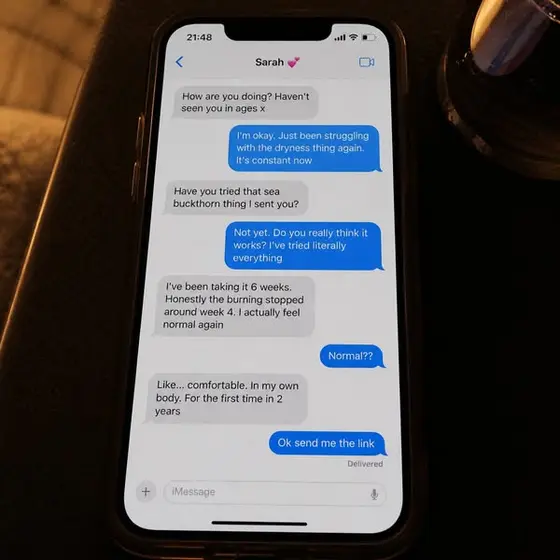
I'm a nutritionist. I help women with dryness after menopause every single week. For two years, I couldn't fix my own. Here's what I found.
I've been a certified nutritionist for 18 years, and dryness after menopause is one of the most common things women come to me about. The discomfort that never goes away. The irritation that makes you shift in your chair all day. The burning that flares up every afternoon for no reason.
The intimacy that went from something you enjoyed to something you dread — or avoid entirely. The quiet distance it creates between you and your partner, even when neither of you says a word about it.
I've sat across from hundreds of women dealing with this. I've watched them tear up in my office describing what it feels like to be uncomfortable in their own body every single hour of the day. I've listened to them say they feel like they've lost something — something they can't quite name — and they were never told it was coming.
About three years ago, it happened to me. I was 54. My own body started doing the exact same thing I'd been helping other women manage for almost two decades.
At first it was subtle. A dryness I'd never experienced before. Not just during intimacy — during everything. Sitting at my desk. Driving. Walking the dog. This constant, low-level awareness that something wasn't right. I thought it was temporary. I thought my body would adjust.
It didn't adjust. It got worse.
Within six months the dryness was constant. Then came the burning — this irritation that would flare up every afternoon and make me squirm through client appointments. Then the intimacy changed. It went from comfortable to uncomfortable to painful. And then I started avoiding it entirely. Not because I didn't want my husband Rob. Because I didn't want the pain.
He noticed. Of course he noticed. He stopped reaching for me because he could tell I was pulling away. And this awful, unspoken distance opened up between us. We still loved each other. We still talked and laughed and held hands. But something was gone. And every night when we got into bed, I could feel it.
One night he said, very quietly, "I feel like I'm losing you." I sat on the edge of the bed and cried. Because he wasn't losing me. My body had just changed. And I — a nutritionist who helps women with this exact problem — had no idea how to fix it in myself.
My doctor offered me HRT. Estrogen cream. She said it was the gold standard for vaginal atrophy.
But I already knew I wasn't going to take it. I'd watched too many of my clients struggle with the reality of hormone therapy. The women whose family history ruled it out entirely.
The ones who tried it and dealt with side effects — bloating, headaches, breast tenderness, breakthrough bleeding. The ones who stayed on it for years and worried constantly about the long-term risks. And the ones who went on it, came off it, and found the dryness came back worse than before because the tissue had become dependent on the estrogen.
For what? You get relief while you're on it, but you haven't fixed anything. You've just rented the solution. The moment you stop, the dryness returns — often worse.
Because HRT treats the symptom. It doesn't address why the tissue can't hold moisture on its own.
I wasn't about to trade one problem for another.
So I did what I always do. I went to work on it myself. I'm a nutritionist. This is literally my job.
I tried evening primrose oil. Vitamin E suppositories. Hyaluronic acid supplements. Flaxseed oil. Probiotics formulated for vaginal health. Every "dryness after menopause" supplement I could find. I changed my clients' protocols and I changed my own.
Nothing moved the needle. Not for me, and honestly, not meaningfully for most of my clients either. Some women reported slight improvement for a few days. But the dryness always came back. The burning always came back. The discomfort during intimacy — always there.
I was starting to accept this was just what life looked like now. Loose clothes. Avoiding spin class. Lubricant that worked for ten minutes and then disappeared. And this growing distance between me and Rob that I didn't know how to close.
Then about four months ago, I was at a women's health conference in San Diego. Not as a speaker — just attending. During a break, I ended up talking to another nutritionist named Claire. She's based in Denver. Works almost exclusively with postmenopausal women. We started comparing notes and I mentioned that dryness was the one thing I couldn't crack for my clients — or myself.
She looked at me like I'd said something strange. She said, "You haven't come across the Sea Buckthorn research?"
I said I knew about Sea Buckthorn. It's a berry. Rich in Omega-7. I'd seen it in some supplement blends. I hadn't looked into it seriously because it seemed like one of those trendy ingredients that shows up in everything for a year and then disappears.
Claire said, "Pull up PubMed tonight. Search 'sea buckthorn vaginal atrophy Maturitas.' Read the Larmo study. Then call me."
That night, in my hotel room, I looked it up. And what I found made me angry. Not at Claire. At myself. Because this research has been sitting there since 2014 and I'd never come across it in 18 years of practice.
Here's what the study found.
Published in Maturitas — a respected, peer-reviewed medical journal. 116 postmenopausal women. Randomised. Double-blind. Placebo-controlled. That's the gold standard of clinical evidence. Three months.
Women taking Sea Buckthorn oil were 3.1 times more likely to improve their vaginal tissue integrity compared to placebo. Not "reported feeling a bit better." Their actual tissue — the epithelial lining — measurably improved. The vaginal health index improved. Mucosal resilience improved. Hydration markers improved. And side effects were comparable to the sugar pill. Meaning essentially none.
The researchers specifically concluded that Sea Buckthorn oil may represent a "potential non-estrogen alternative" for women who cannot or do not want hormone therapy.
I sat on the edge of my hotel bed and read that line three times.
Then I started understanding the mechanism, and it's the part that made everything click — because it explains why lubricants don't work, why HRT is a band-aid, and why most women are stuck.
Here's what's actually happening in your body. After menopause, when estrogen declines, your vaginal tissue doesn't just get "dry" the way your skin gets dry in winter. It's not a surface moisture problem. The mucosal cells that line the vaginal wall lose their lipid structure — the fatty layer that holds moisture inside each cell. The cells thin out. They can't retain water. The tissue becomes fragile, dehydrated, and irritated from the inside out.
Think of it like a sponge.
A healthy sponge is plump, soft, and holds water easily. But leave a sponge out in the sun for a year. It dries out. Shrinks. Gets stiff and brittle. Now pour water on it.
What happens? The water runs right off. It beads on the surface. The sponge can't absorb it — because its internal structure has changed.
That's what lubricant does. It pours water on a dried-out sponge. It wets the surface for a few minutes, and then it's gone. Because the tissue underneath has lost the structure it needs to hold moisture.
That's what HRT does too, in a way. Estrogen plumps the tissue while you're taking it — like holding the sponge underwater. But it doesn't rebuild the sponge's own structure. The moment you let go — the moment you stop HRT — the tissue dries back out. Often worse than before.
Omega-7 — the fatty acid in Sea Buckthorn oil — works completely differently. It integrates directly into the cell membranes. The actual walls of the cells. It rebuilds the lipid structure that estrogen used to maintain. So instead of pouring water on a dried-out sponge, you're rehydrating the sponge itself. Restoring its ability to hold moisture on its own. Naturally. Without hormones. Without external application. From the inside.
That's why the clinical trial didn't just show women "felt" better. The tissue itself measurably improved. Because Omega-7 isn't masking the symptom. It's addressing the structural problem.
I called Claire the next morning. I said, "Why does nobody know about this?"
She laughed. She said, "Because there's no pharmaceutical company behind a berry. Nobody's paying to promote it."
Then she told me the part I wish I'd known before I wasted six weeks on a supplement that did nothing.
She said she'd tried Sea Buckthorn once before — a bottle from a health food store. Took it for over a month. No improvement.
I said, "Then how is it working for you now?"
She said, "Dosing."
She told me the Maturitas trial used 3 grams of Sea Buckthorn oil per day. Three grams. She checked the label on the health food store brand she'd tried. 500 milligrams. A sixth of the clinical dose. She said it's like taking a sixth of an Advil and wondering why your headache's still there.
She started looking for a supplement that actually matched the clinical dose. Most didn't come close. The ones at CVS and Walgreens? 500 milligrams to one gram. The ones on Amazon with thousands of reviews? Same. She said the supplement industry does this constantly — they put just enough of the ingredient on the label for you to recognise the name, but nowhere near enough inside the capsule for it to do what the research says it can do.
Then she found Senora Silk. Full clinical dose. The exact amount used in the Maturitas trial. One softgel a day.
She said by week three, the irritation started easing. By week six, the constant dryness she'd been aware of every single day for over two years just... quieted. By week ten, she told me something I'll never forget. She said, "I feel like myself again. I didn't know that was still available to me."
I ordered it on my phone during that conversation. $49.99 for a month's supply. One softgel a day. I figured I'd already wasted more on evening primrose oil and vitamin E capsules that did nothing.
I didn't tell Rob. I didn't tell my clients. I just started taking it every morning with my coffee and waited.
First two weeks — I'll be honest, not much. Maybe slightly less irritation in the afternoons. I knew from the research that Omega-7 accumulates gradually in cell membranes, so I wasn't expecting a miracle in week one. But I was watching.
End of week three — the burning that used to flare up every afternoon was less frequent. Not gone. But where it used to be daily, it was every other day. Then every third day. Something was shifting.
Week four — I went an entire day without thinking about the dryness. An entire day. I didn't even realise it until that evening. I just... hadn't been uncomfortable. I actually wrote the date in my journal.
Week six — this is when I knew it was real. The dryness that had been my constant background noise for nearly three years was quiet. Not completely silent. But so much better that I stopped organising my day around it. I went back to spin class. I wore jeans without wincing. I sat through a three-hour client workshop without shifting in my chair once.
Week eight — I'm going to be careful how I say this, but I think you'll understand. Rob reached for me one night. And I didn't pull away. Because there was nothing to pull away from. No discomfort. No bracing. No pain. I was just there. Present. With him. The way I used to be.
He put his arm around me afterwards and said, "There you are." Three words. I turned into the pillow so he wouldn't see me cry.
It's been three months now. One softgel every morning with my coffee. That's it.
The dryness that defined my every day for nearly three years is gone. The burning that made me squirm through my own client appointments is gone. The distance between Rob and me — the invisible wall that menopause built between us — is gone.
And here's the thing — he's still Rob. I'm still me. Nothing about our relationship changed except that I'm comfortable again. That's all it took. Comfort. I didn't know how much I'd lost until I got it back.
Now, as a nutritionist, here's what I need you to understand — because this is the part I got wrong for two years and I don't want you to make the same mistake.
Most women dealing with dryness after menopause are given three options: lubricant, vaginal moisturiser, or HRT. All three treat the surface or the symptom. None of them address why the tissue can't hold moisture anymore.
Lubricant wets the outside of a dried-out sponge. It runs off in minutes.
HRT holds the sponge underwater — it works while you're on it, but the tissue hasn't rebuilt its own structure. Stop and the dryness returns.
Omega-7 rehydrates the sponge itself. It rebuilds the lipid layer in your cell membranes so the tissue can retain moisture on its own. That's why the Maturitas trial showed actual tissue improvement — not just reported comfort. The cells themselves were healthier.
But — and this is critical — the dose has to be right. The Maturitas trial used 3 grams daily. Most Sea Buckthorn supplements on the market use 500 milligrams to one gram. A fraction of the dose that was proven to work. If you've tried Sea Buckthorn before and it didn't do anything, this is almost certainly why.
I wasted six weeks on a brand that was under-dosed by 80%. Claire wasted over a month on one that was even worse. The ingredient works. The research is clear. But the dose is everything.
Senora Silk uses the full clinical dose from the Maturitas trial. One softgel a day. Non-hormonal. No creams, no applicators, no mess. Every milligram listed on the label.
I've since started recommending it to my clients. Not all of them — only the ones dealing with dryness who can't or don't want HRT. The results have matched what the research predicted.
Most women notice reduced irritation within 3 to 6 weeks. Tissue comfort improves significantly by weeks 6 to 10. The ones who stick with it for the full 12 weeks — the clinical trial window — report the most meaningful change.
One client — Margaret, 62 — came in for her follow-up after eight weeks and said, "I stopped thinking about it. Every day, all day, for three years, I thought about it. And now I just... don't." She started crying in my office. I almost did too.
Another client told me her husband asked what had changed because she seemed happier. She said, "I'm not happier. I'm comfortable. I'd forgotten what that felt like."
If you're dealing with this — the dryness that never goes away, the burning, the discomfort, the pulling away from your partner, the feeling that something's been taken from you and no one told you it could be given back — please don't wait three years like I did.
You're not broken. Your tissue is dehydrated at the cellular level. And there's a compound — backed by a randomised, double-blind, placebo-controlled trial of 116 women — that addresses the actual problem. Not the surface. The structure.
Senora Silk has a 90-day money-back guarantee. That's the full clinical trial window — three months. If you don't feel a meaningful difference, you get every dollar back.
Here's where I got mine: https://trysenora.com/collections/supplements/products/senora-silk
They're running a sale right now — up to 40% off. I just ordered two extra bottles.
~ Josie Bright, CN, 57, Scottsdale, AZ
P.S. — A few things I wish I'd known before ordering:
When I first ordered Senora Silk, I didn't know they had a 90-day money-back guarantee. That matches the full clinical trial window. If it doesn't work, you get every dollar back. No forms, no hassle.
I wish I'd known that earlier — it would've saved me from wasting six weeks on that under-dosed brand from the health food store.
Most people pay full price, but right now they're running a promotion — up to 40% off. That's how I was able to stock up on extra bottles for myself and order some for my sister.
The only issue is supply. Senora Silk has been getting more popular — probably because nutritionists and women's health practitioners like me keep recommending it — and they can't always keep up with demand.
I want to be upfront: when you click the link below, they might be sold out. I've had clients tell me they had to wait for it to come back in stock. But I'd still suggest checking to see if there's any available.
If you're dealing with dryness that lubricants can't fix, burning that flares up every afternoon, discomfort that's changed your intimacy, or if HRT scares you because of the risks — I'd order some before they're gone again.
I went from three years of daily discomfort to feeling like myself again.
Rob said, "There you are." If there's even a chance this could work for you, it's worth trying.
👉 Check if Senora Silk is in stock: https://trysenora.com/collections/supplements/products/senora-silk