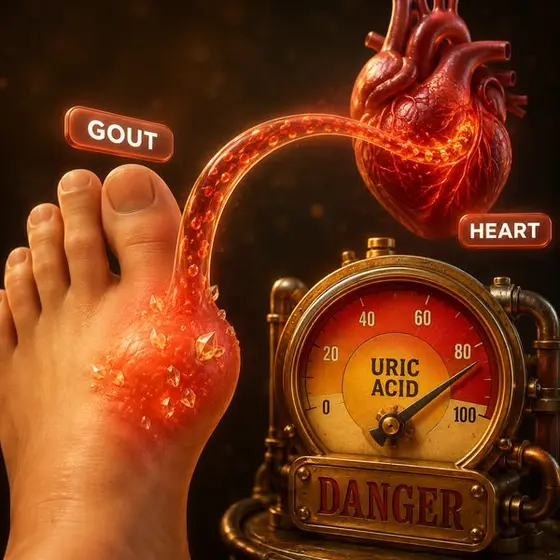
Joint Health News Facebook ad creative
purgelabs.shop
Tried Everything For Your Gout? It's Not Your Fault
Learn more

Joint Health News Facebook and Instagram ad

Joint Health News ran this carousel ad since Jun 27, 2026, 133 days so far.

First seen
Jun 27, 2026
Running for
133 days
Format
Carousel
Call to action
Learn more
Niche
Health and supplements
Countries
Not disclosed
Page likes
591

Ad copy

My older brother had gout. He died of a heart attack seven months ago. He was 58. I have gout too. Same daily medication. Same uric acid levels his doctor was "watching." Same blood pressure creeping up every year. After the funeral... I went looking for what killed him. What I found is the reason I'm still here. And the reason I'm writing this. ======== His name was Dan. He was a pipefitter for twenty-six years. Two grown kids. A wife he'd been married to since he was 22. Best guy at the grill in the family. Could turn a cheap cut of meat into something that made the whole block jealous. Never missed a football Sunday. Coached his son's Little League team for six straight years and never once complained about the early Saturday mornings. He was the dependable one. The one who showed up with his truck when you were moving. The one who crawled under your sink when something leaked. He was 58 years old. He should still be alive. ======== Dan got his first gout flare in his mid-40s. Woke up at 3 AM with his big toe on fire. Thought he'd broken it in his sleep somehow. By morning his foot was so swollen he couldn't get a shoe on. Got put on a daily uric acid medication. His doctor said it was the standard thing. Said his levels would stabilize. Said he'd feel like himself again. He didn't. The flares he blamed on eating the wrong thing. The stiffness he blamed on getting older. The weight he couldn't shift he blamed on the desk job they'd moved him to when his knees started going. The swelling that spread from his toe to his ankle to his knee — he blamed on overdoing it. His blood pressure started creeping up at his annual checkups. His doctor called it borderline. Said they'd watch it. Watched it for six years. Dan used to call me after those appointments. Frustrated. Saying his uric acid was "in range" but he still felt like he was 70 years old. I told him the same thing every time. "If your doctor says it's fine, it's fine." I wish I could take those words back. The last symptom he mentioned to me was the stairs. He said his heart would pound walking up to his bedroom at night. He thought he was just out of shape. He was going to start walking more in the mornings. Four weeks later he was gone. ======== It was a Saturday morning. His wife Karen called me from the hospital. She couldn't get the words out. Just kept saying his name. I drove sixty miles in a blur. Got there too late. Massive heart attack. They worked on him for thirty-five minutes. Couldn't get him back. The cardiologist met us in the family room afterward. Tired eyes. Soft voice. Said something I'll never forget. "Blood pressure creeping up. Some extra weight. Chronic inflammatory condition for years. We see this all the time in men his age. There's not much that could have been done." He said it the way you'd talk about the weather. Like my brother dying at 58 was just... what happens. There was an unfinished beer on his workbench in the garage. He'd been rebuilding a carburetor for his buddy's truck. There was a bag of charcoal by the back door he'd picked up for the weekend. He'd texted me two days earlier — "You coming Sunday? Got two ribeyes with our names on 'em." His daughter was getting married in October. He'd already bought the suit. None of those things are happening now. ======== Two weeks after Dan's funeral, I went to my own annual physical. The nurse wrapped the cuff around my arm. Frowned. Took it again. Pulled up my chart. Uric acid 7.8. Blood pressure 148 over 94. Up from 140 the year before. My doctor sat down across from me. Same tone. Same words I'd been hearing for years. "Mike, your uric acid's still high and your pressure's up. With your brother's history, I think we increase your dose and add a blood pressure medication. This happens to a lot of men your age." A lot of men my age. Like my brother. I sat in the parking lot afterward and couldn't turn the key. I'm 55. Same gout as Dan. Same daily pills. Same uric acid levels that are "being managed." Same blood pressure creeping up. Same heart pounding when I walk up the stairs at night... a symptom I'd been blaming on being out of shape. Just like he did. I knew, sitting in that car, that I was looking at the same trajectory. That if I did nothing, I was going to leave my wife and my kids the exact same way Dan left his. I drove home. Didn't fill the new prescriptions. I was going to find out what actually killed my brother. ======== That night I couldn't sleep. I went downstairs at 2 AM and opened my laptop. I wasn't searching for gout relief. I wasn't searching for joint pain. I was searching for what kills men with gout. What I found stopped me cold. A meta-analysis pooling over eight million people. Men with gout were 45% more likely to have a heart attack than a man the same age without it. 45%. Not five percent. Not ten. Forty-five. Nobody had ever told Dan. Nobody had ever told me. I kept digging. Found a thread with thousands of comments. The question... "Why don't Amish men get gout?" I almost scrolled past. Something made me click. Lancaster County, Pennsylvania. Gout and heart disease at a fraction of the rates seen in the rest of the state. Not a little lower. A fraction. Person after person in the comments. Stories. Studies. Pictures of Amish men in their 70s and 80s. Working sunup to sundown. Hauling timber. On their feet all day. Hands that could still grip and knees that still bent. Someone posted a Google Maps link. An Amish farm. I looked at the clock. 2:39 AM. By 5:30 AM I was in my car. By noon I was in Pennsylvania. ======== I didn't have an address. Just drove until I saw farmland. Turned down a dirt road when I spotted a hand-painted sign. "Vegetables and Preserves." First farm I came to, there was an old woman on the porch. Had to be pushing 80. Small. Thin. Gray hair pulled back under a white cap. She was shelling peas into a bowl so fast her fingers blurred. No swollen knuckles. No brace. Just easy, steady work. I parked and walked up to the porch. By the time I reached the steps my left foot had stiffened from the long drive — that familiar dull ache behind the big toe that never fully goes away between flares. "Excuse me," I said. "I don't want to bother you. But my brother had gout. He died of a heart attack seven months ago. He was 58. I have gout too. Same medication. Same numbers his doctor was watching. I'm scared I'm next." She set down the bowl. Looked at me for a long moment. "You came here for a reason," she said. "Come inside. I'll show you something." Her kitchen smelled like coffee and rising bread. She poured me a cup without asking. Pulled out a chair. "Your pills," she said. "They're fighting the wrong battle." I blinked. Not what I expected her to say. "The medication quiets the uric acid number enough to keep your doctor satisfied. That's all it does. The reason your joints keep swelling, the reason the pain keeps coming back, the reason you feel like you're 70 years old at 55... nobody's touching that." "I know it's uric acid," I said. "I've cut red meat. I've cut beer. I take the pills. I've done everything they told me to." She smiled. "Then you know more than most. But you don't know what that uric acid is actually doing inside you. Because nobody teaches it. And without that, none of the rest matters." She folded her hands on the table. "There are three things happening in your body right now. Not one. Not two. Three. And your medication only touches one of them." She held up three fingers. "First. Your body is making too much uric acid. The medication slows that down some. Fine. But that's only the faucet. Nobody's draining the tub." She folded one finger down. "Second. The uric acid that's already in your blood has been crystallizing in your joints for years. Tiny, sharp crystals. Like ground glass. Those crystals trigger an inflammatory fire every time they shift. That's your flare. But between flares, the crystals are still there. Still sharp. Still irritating the tissue. Still keeping the fire smoldering even when you don't feel it." She folded the second finger. "Third. Your kidneys are supposed to flush that uric acid out of your blood. That's their job. But your kidneys are overwhelmed. They can't keep up. So the acid stays. The crystals grow. And the cycle gets worse every year." She looked me in the eye. "Your medication turns down the faucet a little. It never clears the crystals. It never helps your kidneys drain the tub. And here's the part nobody told you — and the part that killed your brother." My chest tightened. She picked up two peas from her bowl. One in each hand. "This one is your toe. This one is your heart. Same acid feeds both." She set them side by side. "The uric acid isn't only in your joints. It's in your blood vessels. Every day. It strips away the lining that keeps your arteries flexible. It stiffens them. Narrows them. Raises your blood pressure point by point, year after year. The same fire that makes your big toe swell at 3 AM is quietly hardening your arteries every hour of every day — including right now, while you're sitting in this chair." I stared at her. "That's why your blood pressure keeps creeping up. That's why your heart pounds on the stairs. That's why your doctor wants to add another pill instead of asking what's driving all of it. Your uric acid number on the lab report might be 'managed.' But that number doesn't measure the crystals already in your joints. It doesn't measure the damage already in your arteries. It doesn't measure the fire." She leaned forward. "Your lab report measures what's floating in your blood right now. It can't measure what's already been deposited. Those are two different numbers. And the one that matters... the damage already done... nobody is measuring at all." She reached across the table. "Now here's what gout really is. It was never just your toe. Years of uric acid building up, crystallizing, triggering inflammation that started in the joint and spread. Like smoke filling a house one room at a time. Every flare. Every bad week. The same acid working on your joints and your arteries at the same time. Your uric acid number looks managed. Your body gets worse every year." She tapped the table once. "And here's the piece that will make you angry. Every part of you feels this acid. But one place pays the highest price. Your heart. The same inflammation stiffening your joints is stiffening your arteries. Year after year. That's where your blood pressure comes from. Your high pulse. The stairs. The numbers your doctor wants to medicate one at a time... never once asking what's fueling all of them." My eyes started to burn. "That is what killed your brother. Not his gout. Not his bad toe. The acid and the fire nobody put out. A heart that took that damage every single day for years while his doctor read his lab report and told him he was managed." I couldn't speak. "Now hear me clearly," she said. "I'm not telling you to throw your pills in the trash. A bad flare is a bad flare, and that's between you and your doctor. But understand what they are. They turn down the faucet. They never drain the tub. They never clear the crystals. They never put out the fire. And year after year, the strain on the very heart that fire is already working on keeps building. They were never going to save you. They couldn't save your brother." I asked her what does put it out. She stood. Walked to a shelf along the wall. Three dark glass jars. She set them on the table one at a time. "Three hundred years," she said. "The men and women on this land have used these three things together. My grandmother grew them. Her grandmother before her. Three generations of families working on their feet into their eighties. No swollen joints. No stiff mornings. No heart trouble." She pointed to the first jar. A pale, seed-filled tincture. "Celery seed," she said. "This one slows the faucet. Your body produces uric acid when it breaks down purines — from food, from your own cells turning over. Celery seed helps slow that production down. Not by blocking an enzyme the way your medication does and straining your liver in the process. By supporting your body's own pathway. Gently. Without the side effects." She pointed to the second jar. Deep red, almost burgundy. "Montmorency tart cherry," she said. "This one calms the fire. The crystals in your joints trigger an inflammatory cascade — enzymes, swelling, heat. Tart cherry is rich in anthocyanins, compounds that go directly after that cascade. Not by masking the pain signal. By calming the actual inflammation the crystals cause." I'd tried the juice from the grocery store. Did nothing. She must have read my face. "That's not what you think it is," she said. "What's in your grocery store is dust. The juice is pasteurized at high heat so it survives shipping and six months on a shelf. Heat destroys the anthocyanins. The compounds that actually calm the fire. By the time that bottle hits the shelf, what mattered is already gone. Then they cut what's left with sugar and water. The men who buy it get nothing. Their fire keeps burning. Their joints keep swelling." She pointed to the third jar. A greenish-brown powder. "Chanca piedra," she said. "The stone breaker. This is the one nobody knows about. Your kidneys are supposed to flush the uric acid out. But when they're overwhelmed, two things happen. The acid stays in your blood and keeps crystallizing. And it starts forming stones in the kidneys themselves. One-third of men with gout have kidney stones they don't even know about. Chanca piedra supports the kidneys' ability to flush. It helps drain the tub." She set all three jars in a line. "Three problems. Three plants. Your medication turns down the faucet. These three do what it never could. Slow the production. Calm the fire. Flush the acid. Together. Every day. The way the families on this land have done it for three hundred years." She looked me straight in the eye. "But there's one more piece. And this is the part that separates what works from what sits in a cabinet." She reached into a small tin on the shelf. Held up a few dark peppercorns. "Black pepper extract. BioPerine. Most supplements pass straight through you. Your body barely absorbs them. This forces the door open. Makes your body actually take in what you just swallowed. Without it, you're paying for capsules that end up in the toilet." I asked her if anyone sold all four of these together, the way she was describing. She nodded. "My daughter. Spent years getting the ratios right. All three plants. Plus the black pepper. Clinically dosed. Third-party tested. One capsule, everything working together the way it's supposed to." She wrote the name on a piece of paper and handed it to me. PURGE. ======== I ordered it from her kitchen table. Bottle arrived four days later. I took the first two capsules that evening. Sat on my back porch after dinner. Waited. ======== Week one. The first thing I noticed was the stairs. I went up to my bedroom one night and realized halfway up that my heart wasn't pounding. The same stairs that had been making me grip the handrail and pause at the landing for months. I went up. Then back down. Then up again. Just to make sure. That's when I started losing it. Because that was the symptom Dan mentioned to me four weeks before he died. And it was already gone. Week two. The morning stiffness loosened. That locked-up, rusted-hinge feeling in my big toe that usually lasted until ten in the morning — gone by the time I finished my coffee. I stood up from the kitchen chair without bracing on the armrest. Didn't even think about it. Week three. Walked the dog up the hill behind my house. Dan's dog, actually. Karen couldn't bear to keep him after, so he came to live with us. Made it to the top without stopping. No pounding. No catch in my chest. I stood at the top of that hill thinking about Dan. About every walk he didn't get. Every hill he didn't make it up. Every Sunday he wasn't at. Week five. Saturday night. Fired up the grill. Ribeye. Two cold beers with my buddy from work. Went to bed fully expecting to wake up at 3 AM with my toe screaming. That's how it had worked for years — enjoy yourself on Saturday, pay the price on Sunday. Woke up at 7. Walked to the bathroom. Looked down at my foot. Nothing. No swelling. No heat. No glass-in-the-joint fire. I stood in the bathroom staring at my own feet like a man who'd just witnessed something he couldn't explain. Month two. Follow-up appointment. The nurse wrapped the cuff. Frowned. Did it again. "130 over 82. Pulse 72." My doctor walked in. Pulled up my chart. Stopped. Scrolled. Looked at me. "Mike. What did you change?" I told him. The Amish woman. The three plants. The celery seed, the tart cherry, the chanca piedra. The black pepper extract that makes it all absorb. He wrote it down. Said keep doing whatever I was doing. Uric acid: 5.4. Down from 7.8. He cancelled the blood pressure prescription. Month four. No flare in four months. First time in six years. I got down on the floor to play with my granddaughter. Got back up without grabbing the couch. Without that grinding, bracing, please-God-let-me-stand-up feeling that used to make me avoid getting down there in the first place. My wife pulled me aside that night and said I looked like myself again for the first time in years. I went into the garage so she wouldn't see me lose it. Month seven. Full panel. Blood pressure 122 over 78. Resting heart rate 68. Uric acid 4.9. Morning pain — what morning pain. No new prescriptions. No dose increases. No more numbers to medicate one at a time. Just two capsules of PURGE every morning. ======== I'm alive. My numbers are better than they've been in fifteen years. My heart is safe. My knees carried me up that hill. I ate a steak last Saturday and woke up fine on Sunday. I should be celebrating. But Dan is still dead. Christmas this year had an empty chair. His daughter got married in October and her father wasn't there to walk her down the aisle — his brother did it, and I could barely get through the speech. Karen called me last week and cried because she'd almost texted Dan's old number to ask him something about the truck. I get my life back. Dan doesn't get his. There is no version of this story where I get to fully celebrate. Every win I've had in the last seven months is a win Dan didn't get. And the worst part... the part that keeps me up at 3 AM... he could have had this. If anyone had told him about the fire. If anyone had told him that his lab report was only half the picture. If anyone had told him that his heart was taking damage for years while his doctor said he was managed. He would still be here. ======== So I'm writing this. Not because I want to sell you anything. Because if you're reading this... you're sitting where Dan sat. Gout. A daily medication. Uric acid levels your doctor says are "being managed." Blood pressure he said to "watch." Heart pounding on the stairs that you've been blaming on getting older. You have every single one of his qualifiers. And nobody is checking the one thing that actually matters. Your joints are full of crystals. That same acid is in your arteries. The pill only turns down the faucet. Your joints keep swelling. Your heart keeps straining. And every year that goes by it gets worse. Please. Don't be my brother. Your wife doesn't want to plan your funeral. Your kids don't want to carry your casket. Your grandkids deserve to know you. ======== This is what I found. 👉 PURGE Uric Acid Cleanse: https://purgelabs.shop/products/purge-uric-acid Three plants. Three jobs. Celery seed to slow uric acid production. Montmorency tart cherry to calm the inflammatory fire. Chanca piedra — the stone breaker — to support your kidneys in flushing the acid out. Plus BioPerine black pepper extract so your body actually absorbs it. 1,404mg Cleanse Complex. Clinically dosed. Third-party tested. Two vegan capsules a day. The only formula I've found that goes after all three problems instead of just managing one number on a lab report. Buy 2 Get 1 Free. 90-day money-back guarantee. If your joints don't loosen, if your flares don't slow, if your numbers don't move — full refund. No questions. 4.8 out of 5 stars. Over 23,000 customers. ======== Real reviews from men like me: "My uric acid went from 8.1 down to 5.6 in three months. My doctor looked at the chart and asked what I was taking. First time he's ever asked me that." "Morning stiffness was a 7 every single day for four years. I'm at a 2. I got on the floor with my grandson for the first time in I don't know how long." "I started this for my gout. My blood pressure dropped 16 points as a bonus. Had no idea the two were connected." "Fired up the grill Saturday, had two beers and a ribeye. Woke up Sunday and walked downstairs like a normal human being. No flare. No punishment. I almost didn't believe it." "My husband refuses to see a doctor. I left this on the counter and he takes it every morning now. He's moving so much better and dinner isn't a standoff anymore. I feel like I've got my husband back." ======== I tried ordering another bottle last month. Backordered for six days. If it's in stock when you click, don't wait. ======== P.S. Last week I was at Dan's house helping Karen clean out the garage. On his workbench, behind a socket set and an empty coffee mug, I found a half-empty bottle of grocery-store cherry capsules and an unopened jug of tart cherry juice. He'd been trying. Looking for something. Same as the rest of us. He just never made it to the right one in time. I sat on the stool at his workbench and held those bottles for a long time. If he'd known about the three plants. If anyone had told him his lab report was only half the story. If he'd had this. He'd be at Christmas this year. Your family wants you at Christmas. 👉 https://purgelabs.shop/products/purge-uric-acid

Placements and targeting

FacebookInstagramAudience NetworkMessengerThreads

More ads from Joint Health News

Full Joint Health News profile
Joint Health News
Joint Health News
+1
Inactive133 days
purgelabs.shop
Tried Everything For Your Gout? It's Not Your Fault
Learn more

My older brother had gout. His kidneys shut down. He died nine months ago. He was 61. I have gout too. Same daily medication. Same uric acid levels his doctor was "managing." Same kidney function numbers that were "a little off but nothing to worry about yet." After the funeral... I went looking for what destroyed his kidneys. What I found is the reason mine are still working. And the reason I'm writing this. ======== His name was Steve. He drove a truck for twenty-eight years. Two grown kids. A wife he'd been married to since he was 24. Toughest man I've ever known. The kind of guy who'd work a twelve-hour shift, come home, and still go out back to split firewood because it needed doing. Never complained. Never called in sick. Missed his daughter's school play once in eighteen years and talked about it like he'd committed a crime. He was the reliable one. Every family has one. The guy who shows up. He was 61 years old. He should still be showing up. ======== Steve got his first gout flare in his early 40s. Woke up one night with his big toe feeling like someone had driven a nail through it. Couldn't walk for three days. His doctor put him on allopurinol and told him to watch his diet. Said his uric acid would come down. Said the flares would stop. They didn't. They got less frequent — from every month to every few months. Enough that Steve figured the medication was working. But they never went away entirely. And every time one hit, it was worse than the last. The stiffness between flares he blamed on the truck. The fatigue he blamed on the schedule. The back pain he blamed on loading docks. His kidney numbers started slipping at his annual physicals. Not dramatically. Just a little. His doctor said his creatinine was "slightly elevated." Said his GFR was "on the lower end of normal." Said they'd keep an eye on it. Kept an eye on it for eight years. Steve used to call me after those appointments. Frustrated. Saying his uric acid was "controlled" but he felt like he was getting old way too fast. I told him the same thing every time. "If your doctor says it's fine, it's fine." I wish I could take those words back. The last thing he mentioned to me before it all went sideways was his ankles. Said they'd been swelling by the end of every shift. Figured it was the hours on his feet. Was going to try compression socks. That wasn't his feet. That was his kidneys dying. ======== The call came on a Wednesday. His wife Angela called me from the hospital. I could hear machines in the background. She couldn't get through a sentence. His kidneys had failed. Both of them. Acute on chronic, the doctor said. Meaning the damage had been building for years — silently, invisibly — and something finally pushed them over the edge. I drove four hours in a blur. Got to the hospital and found him hooked to a dialysis machine. He was awake. Gray. A tube in his arm thicker than a pencil. He looked at me and the first thing he said was, "They told me the gout was managed." The nephrologist met the family in the hallway. Tired eyes. Soft voice. Said something I'll never forget. "Chronic uric acid elevation. Kidneys were losing function for years. His labs showed the trend but it was gradual. By the time he presented with acute failure, we were looking at less than 15% function. He'll need dialysis three times a week. Possibly a transplant if he qualifies." He said it the way you'd talk about the weather. Like my brother's kidneys dying at 61 was just... what happens. Steve did dialysis for four months. Three times a week. Four hours each session. Hooked to a machine that did what his kidneys could no longer do. He shrank. Not just weight. He shrank as a person. The man who split firewood after a twelve-hour shift couldn't walk to the mailbox without sitting down halfway. His body rejected the first access site. They put a second one in his chest. It got infected. Three weeks in the hospital. He died on a Tuesday morning. Angela was holding his hand. His kids were on their way but didn't make it in time. There was an unfinished woodworking project in his garage — a bookshelf for his granddaughter's room. The wood was already cut and sanded. Stain sitting on the shelf, picked out, ready to go. She'll never have that bookshelf. ======== Two weeks after Steve's funeral, I went to my own annual physical. The nurse wrapped the cuff around my arm. Frowned. Took it again. Pulled up my chart. Uric acid 7.6. Blood pressure 144 over 91. Creatinine slightly elevated. GFR 68 — technically still "normal" but down from 82 three years earlier. My doctor sat down across from me. Same tone. Same words I'd been hearing for years. "Tom, your uric acid's still elevated and your kidney function has dipped a bit. With your brother's history, I think we increase your allopurinol dose, add a kidney-protective medication, and start monitoring your labs quarterly instead of annually. This happens to a lot of men your age." A lot of men my age. Like my brother. I sat in the parking lot afterward and couldn't turn the key. I'm 57. Same gout as Steve. Same daily medication. Same uric acid levels that are "controlled." Same kidney function quietly declining year by year. Same swollen ankles I'd been blaming on long days... the same symptom Steve blamed on his truck. Just like he did. I knew, sitting in that car, that I was looking at the same road. That if I did nothing, I was going to end up in that same hospital, hooked to that same machine, shrinking the same way Steve shrank until there was nothing left. I drove home. Didn't fill the new prescriptions. I was going to find out what actually killed my brother's kidneys. ======== That night I couldn't sleep. I went downstairs at 2 AM and opened my laptop. I wasn't searching for gout relief. I wasn't searching for joint pain. I was searching for what destroys the kidneys of men with gout. What I found stopped me cold. A study following thousands of patients with chronic kidney disease. Each 1 mg/dL rise in uric acid increased the risk of kidney failure by 28%. Patients in the highest bracket had over three and a half times the risk. Not 10% more. Not 20%. Over three hundred and fifty percent. And here's the part that made my stomach drop: one-third of men with gout already have kidney stones. Two-thirds of them don't know it. Nobody had ever told Steve. Nobody had ever told me. I kept digging. Found a thread with thousands of comments. The question... "Why don't Amish men get kidney stones?" I almost scrolled past. Something made me click. Lancaster County, Pennsylvania. Kidney stone rates a fraction of the national average. Gout almost unheard of. And something else buried in the thread — these were communities where men worked physical jobs into their 70s and 80s. On their feet. On their knees. No dialysis centers. No transplant lists. Someone posted a Google Maps link. An Amish farm. I looked at the clock. 2:51 AM. By 6 AM I was in my car. By noon I was in Pennsylvania. ======== I didn't have an address. Just drove until I saw farmland. Turned down a dirt road when I spotted a hand-painted sign. "Vegetables and Preserves." First farm I came to, there was an old woman on the porch. Had to be pushing 80. Small. Thin. Gray hair pulled back under a white cap. She was shelling peas into a bowl so fast her fingers blurred. No swollen ankles. No brace. Just easy, steady work. I parked and walked toward the porch. By the time I reached the steps my ankles were tight from the long drive — that heavy, waterlogged feeling I'd been blaming on sitting too long. "Excuse me," I said. "I don't want to bother you. But my brother had gout. His kidneys failed. He died nine months ago. He was 61. Same medication I'm on. His labs always looked managed. My doctor wants to put me on more pills and start checking my kidneys every three months. I'm scared I'm next." She set down the bowl. Looked at me for a long moment. "You came here for a reason," she said. "Come inside. I'll show you something." Her kitchen smelled like coffee and rising bread. She poured me a cup without asking. Pulled out a chair. "Your pills," she said. "They're fighting the wrong battle." I blinked. Not what I expected her to say. "The medication brings your uric acid number down on the lab report. That's all it does. But the reason your kidneys are failing — the reason your brother's kidneys failed — that pill never touches. Nobody told you about the second half. And without the second half, the number on the report doesn't matter." She folded her hands on the table. "There are two things happening in your kidneys right now," she said. "The function your doctor can measure on a lab test. And the damage building underneath that nobody measures until it's too late." She held up two fingers, separated. "They are NOT the same thing. Your GFR number — the one your doctor watches — only shows what your kidneys can do right now, today. It can't show what's been deposited inside them. It can't show the crystals forming in the tubules. It can't show the slow scarring that's been building for years. You can have a GFR that's 'in range' while your kidneys are filling up with damage that will take them down." I stared at her. "Every day, your kidneys are supposed to filter uric acid out of your blood. That's one of their main jobs. But when there's too much acid for too long, it starts crystallizing inside the kidney itself. Not just in your joints. Inside the organ that's supposed to be cleaning it out. Tiny crystals. Forming in the tubes. Scratching the lining. Triggering inflammation. Scarring the tissue. Year after year. Silent. Invisible on the lab report." My chest tightened. "And here's the part no one has told you," she said. "It's a cycle. The more crystals form in the kidneys, the less they can flush. The less they flush, the more uric acid stays in the blood. The more acid in the blood, the more crystals form — in your joints AND in your kidneys. The spiral tightens. Every year. And nobody sees it because the GFR drops so slowly the doctor just says 'we'll keep an eye on it.'" She picked up two peas from her bowl. One in each hand. "This one is your toe. This one is your kidney. Same acid destroys both. Your medication brings the number down on the test. But it never clears the crystals already in the kidney. It never supports the kidney's ability to flush. It never breaks the cycle." She leaned forward. "That's why your kidney function keeps slipping even though your uric acid is 'controlled.' That's why your ankles swell by the end of the day. That's why your doctor wants to monitor more often instead of asking what's causing all of it. Your uric acid number on the lab report might look fine. But that number doesn't measure the crystals already deposited inside the kidney itself. It doesn't measure the scarring. It doesn't measure the cycle." She looked me straight in the eye. "Your lab report measures what's floating in your blood right now. It can't measure what's already been deposited inside the organs. Those are two different numbers. And the one that matters... the damage already done inside the kidney... nobody is measuring at all." She reached across the table. "Now here's what this really is. It was never just your toe. Years of uric acid building up, crystallizing, depositing everywhere — joints, kidneys, blood vessels. The toe screams. You go to the doctor. He sees the gout. Gives you a pill for the number. But the crystals in your kidneys? Nobody's looking. The stones forming silently? Nobody's checking. One-third of men with gout already have stones they don't know about. And the ones who don't have stones yet have crystal damage in their tubules that's quietly stealing kidney function year after year." She tapped the table once. "That is what killed your brother's kidneys. Not his gout. Not his medication. Crystals deposited inside the kidneys for a decade while his doctor read his lab report and said he was controlled. A cycle nobody broke. Damage nobody measured. Kidneys that filled up for years while everyone watched the wrong number." I couldn't speak. "Now hear me clearly," she said. "I'm not telling you to throw your pills in the trash. What you take is between you and your doctor. But understand what they are. They bring the number down on the test. They never clear the crystals. They never support the kidney's ability to flush. They never break the cycle. That job needs something else. And without it, the number on the report means nothing while the damage keeps building underneath." I asked her what breaks the cycle. She smiled. A small smile. "Three hundred years. The families on this land have used three things together. My grandmother grew them. Her grandmother before her. Three generations of men and women on this land — no kidney trouble, no swollen joints, no dialysis — working into their eighties." She stood. Walked to a shelf along the wall. Pulled down three dark glass jars. Set them on the table one at a time. She pointed to the first one. A greenish-brown powder. "Chanca piedra," she said. "In South America they call it 'the stone breaker.' This is the piece nobody knows about. And it's the most important one." She held it up. "Your kidneys are overwhelmed. They can't flush the uric acid fast enough, so it crystallizes. Chanca piedra supports the kidneys' ability to flush. It helps them do the job they were meant to do. It supports the breakdown of the crystals and stones that are forming inside the kidney. Not by forcing anything. By supporting the organ's own capacity." She set it down and pointed to the second jar. A pale, seed-filled tincture. "Celery seed," she said. "This one slows the faucet. Your body makes uric acid when it processes purines — from food, from your own cells. Celery seed helps slow that production. The less acid your body dumps into the blood, the less your kidneys have to filter. You're easing the load on the very organ that's drowning." She pointed to the third jar. Deep red, almost burgundy. "Tart cherry," she said. "Montmorency. This one calms the fire. The crystals in your kidneys and your joints trigger inflammation — enzymes, swelling, damage. The anthocyanins in tart cherry go after that inflammation directly. Not the pain signal. The actual fire that's scarring the kidney tissue and eating your joints." I'd tried tart cherry juice from the grocery store. Did nothing. She must have read my face. "That's not what you think it is," she said. "What's in your grocery store is dust. The juice is pasteurized at high heat so it survives shipping and six months on a shelf. Heat destroys the anthocyanins. The compounds that actually calm the fire. By the time that bottle hits the shelf, what mattered is already gone." She set all three jars in a line. "Three problems. Three plants. Your medication brings the number down on the test. These three do what it never could. Flush the crystals. Slow the production. Calm the fire. Together. Every day. The cycle breaks. The kidneys breathe. The damage stops building." She looked me straight in the eye. "But there's one more thing. And this is what separates the men who get results from the ones who take handfuls of supplements and nothing changes." She reached into a small tin. Held up dark peppercorns. "Black pepper extract. They call it BioPerine. Your body is terrible at absorbing plant compounds. Most supplements pass right through. The celery seed, the cherry, the chanca piedra — without this, half of it never gets in. BioPerine opens the door. Makes your body take in what you swallowed. Without it, you're paying for capsules that end up in the toilet." I asked her if anyone combined all four of these together. She nodded. "My daughter. Spent years getting the ratios right. All three plants. The black pepper. Clinically dosed. Third-party tested. Everything working together the way it's supposed to." She wrote the name on a piece of paper and handed it to me. PURGE. ======== I ordered it from her kitchen table. Bottle arrived four days later. I took the first two capsules that evening. Sat on my back porch after dinner. Waited. ======== Week one. The first thing I noticed was the ankles. I took my shoes off after work one evening and looked down. They weren't swollen. I pressed my thumb into the skin above my ankle — no dent. No puffiness. No waterlogged feeling. I did it again. Just to make sure. That's when I started losing it. Because the swollen ankles were the last thing Steve mentioned before his kidneys went. And they were already going down. Week two. The morning stiffness in my toe loosened. Pain used to be a 6 the second my feet hit the floor. That week it was a 3. I kept checking, sure I was imagining it. I wasn't. Week three. I stood up from the couch one Sunday and realized I hadn't braced. Hadn't grabbed the armrest. Hadn't done the mental countdown — three, two, one, push — that I'd been doing for years. Just... stood up. My wife watched it happen from the kitchen. Didn't say anything. But I saw her face. Week five. Saturday night. My buddy's birthday. Had two beers and a plate of ribs. The kind of night that used to guarantee a 3 AM flare — toe on fire, heart pounding, lying there wondering how I'd walk in the morning. Woke up at 7. Walked to the bathroom. Looked down. Nothing. Week eight. Walked the full loop around the park with my wife. Twenty-five minutes. No ankle swelling afterward. No heaviness. No shoes that suddenly felt tight. Month two. Follow-up appointment. The nurse wrapped the cuff. Frowned. Did it again. "128 over 80. Pulse 70." My doctor walked in. Pulled up my chart. Stopped. Scrolled back. Scrolled forward. Looked at me. "Tom. What did you change?" I told him. The three plants. The celery seed, the tart cherry, the chanca piedra. The black pepper for absorption. He typed. Nodded slowly. Uric acid: 5.2. Down from 7.6. GFR: 78. Up from 68. He looked at the screen for a long time. "Your kidney function improved," he said. "That doesn't happen often." He paused. "Let's hold the new prescriptions. Keep doing what you're doing. I want to see you in three months." He cancelled the quarterly monitoring. Put me back on annual. Month four. Full panel. Blood pressure 124 over 78. Uric acid 4.7. GFR 82 — back to where it was three years ago. Creatinine normal. No ankle swelling in four months. No flares in four months. No new medications. No dose increases. No kidney specialist referral. Just two capsules of PURGE every morning. Month seven. GFR 84. Stable. Uric acid 4.9. Blood pressure 122 over 76. My doctor said he wants to study what I'm doing. I told him to start with PURGE. ======== I'm here. My kidneys are working. My numbers are back to where they were years ago. My ankles don't swell. My joints don't ache. I had ribs and a beer last Saturday and woke up fine on Sunday. I should be celebrating. But Steve is still gone. Christmas this year had an empty chair. His granddaughter's room still doesn't have that bookshelf — the wood is still sitting in his garage, cut and sanded, stain picked out, waiting for hands that will never finish the job. Angela called me last week and cried because she found one of his work gloves behind the dryer. I get my kidneys back. Steve doesn't get his. There is no version of this story where I get to fully celebrate. Every good lab result I've had in the last seven months is a result Steve didn't get. And the worst part... the part that keeps me up at 3 AM... he could have had this. If anyone had told him about the cycle. If anyone had told him that his lab report was only half the picture. If anyone had told him that his kidneys were filling up for a decade while his doctor said he was controlled. He would still be here. ======== So I'm writing this. Not because I want to sell you anything. Because if you're reading this... you're sitting where Steve sat. Gout. A daily medication. Uric acid levels your doctor says are "managed." Kidney function that's "a little off." Ankles that swell by the end of the day that you've been blaming on long hours. Lab numbers your doctor said to "keep an eye on." You have every single one of his qualifiers. And nobody is checking the one thing that actually matters. Your kidneys are filling up with crystals. The cycle is tightening. The damage is building underneath numbers that look "in range." The medication brings the number down on the test. It never clears what's already inside the kidneys. It never breaks the cycle. And every year that goes by it gets worse. Please. Don't be my brother. Your wife doesn't want to watch you on a machine. Your kids don't want to see you shrink. Your grandkids deserve the full version of you. ======== This is what I found. 👉 PURGE Uric Acid Cleanse: https://purgelabs.shop/products/purge-uric-acid Three plants. Three jobs. Chanca piedra — the stone breaker — to support your kidneys in flushing the crystals and breaking the cycle. Celery seed to slow uric acid production and ease the load. Montmorency tart cherry to calm the inflammatory fire that's scarring your joints and your kidneys. Plus BioPerine black pepper extract so your body actually absorbs it. 1,404mg Cleanse Complex. Clinically dosed. Third-party tested. Two vegan capsules a day. The only formula I've found that addresses all three parts of the cycle — production, inflammation, and flushing — instead of just managing one number on a lab report. Buy 2 Get 1 Free. 90-day money-back guarantee. If your ankles don't settle, if your numbers don't move, if you don't feel the difference — full refund. No questions. 4.8 out of 5 stars. Over 23,000 customers. ======== Real reviews from men like me: "My creatinine had been creeping up for three years. My doctor had me on quarterly monitoring. Four months on PURGE, my GFR went from 64 to 76. He said whatever I'm doing, don't stop." "Uric acid from 8.4 to 5.1. But the real win was the ankle swelling going away. I hadn't been able to see my ankle bones in two years." "I started this for gout. What I didn't expect was my kidney numbers improving. My doctor actually smiled at my last appointment. First time that's happened." "My father lost his kidneys to gout at 63. I'm 52 and I refuse to follow him. Four months in. Uric acid down. Kidney function stable. No flares. I actually feel like I have a future." "My wife bought this for me after she read about the kidney connection. Best thing she's ever put on my counter. I can wear my boots again without them being tight by noon." ======== I tried ordering another bottle last month. Backordered for six days. If it's in stock when you click, don't wait. ======== P.S. Last month I was at Steve's house helping Angela clear out the garage. On his workbench, next to the stain and the unfinished bookshelf, I found a half-empty bottle of cranberry capsules and an unopened box of some kidney support tea from the health food store. He'd been trying. Looking for something. Same as the rest of us. He just never found the right combination in time. I sat on his stool at that workbench and held those bottles for a long time. Looked at the bookshelf he'd never finish. The stain he'd already picked out. If he'd known about the cycle. If anyone had told him his lab report was only half the picture. If he'd had this. He'd be finishing that bookshelf right now. Your family wants you to finish your projects. 👉 https://purgelabs.shop/products/purge-uric-acid

Joint Health News
Joint Health News
+1
Inactive134 days
purgelabs.shop
Allopurinol Turns The Tap Off. It Doesn't Drain The Tub😳
Learn more

If you're on Allopurinol — and your uric acid number looks fine on paper but you've started quietly noticing things about yourself that weren't there three years ago — there's a reason. And it's not "just getting older." What I'm about to tell you took me four years to figure out. It cost me four years of my life. I want to save you the next four of yours. Here's what's actually happening right now to a lot of men on Allopurinol — and what nobody in the rheumatology office is going to mention to you at your six-month checkup: One — Your blood number looks great. That's the part everybody focuses on. The pharmacist congratulates you. Your doctor congratulates you. You stop bringing it up at home. Two — Underneath the "fine" blood number, something else is changing slowly. It happens so gradually you write it off as age, as work stress, as a bad night's sleep. Then at year three or four, you catch yourself in a mirror or a photograph and realize what's actually going on. And three — The pill that's keeping your number "in range" is doing nothing for the deposits already in your joints. It's nothing for the lumps quietly forming. And there is a 1-3% chance that the same pill is, right now, walking your liver or your skin toward a problem that nobody is screening you for. I know this because I was on it for four years. Let me tell you what year four looks like. My name is Frank. I'm 64. I'm a recently retired electrician — 41 years on the tools — and I got my first gout flare at 58. The first one came out of nowhere on a Thursday. I went to bed fine, woke up at 4 AM with what I thought was a broken toe. I'd dropped a panel cover on my foot at work the week before, so I figured it was that, finally catching up to me. By Friday morning the toe was the color of a plum and I couldn't get a sock on. I drove to urgent care with my work boot unlaced. "Gout," the doctor said. "Classic presentation. We'll start you on Allopurinol." I asked him about diet first. He said diet was about 30% of the problem and it wouldn't be enough on its own. He wrote me a prescription for 100mg a day with a plan to titrate up to 300mg. He told me I'd probably be on it for the rest of my life. I was 60. I thought, Okay. Daily pill. Better than the flares. So I started. Year one — the flares stopped almost completely. One break-through flare around month seven, but it was mild. I figured I was a success story. My blood number dropped from 8.7 to 5.9. My GP was thrilled. He said, "Whatever you're doing, keep doing it." I kept doing it. Year two — my dose got bumped to 200mg because my number crept back up to 6.4. I didn't think anything of it. Doctor said it was normal for the body to adjust. The flares stayed gone. I considered myself lucky. Year three — I started getting tired in a way I hadn't been before. Falling asleep in my recliner before the 10 o'clock news. I blamed my schedule. My wife blamed my age. We were both wrong but neither of us knew it yet. That same year my GP added Lisinopril for "borderline" blood pressure. 134/85. I'd never had blood pressure issues in my life. He said it was probably just age. I'd hear that phrase a lot over the next year. Year four — three things happened. The first was the lumps. I noticed them around Christmas. Two small, hard bumps on the second knuckle of my right hand. About the size of corn kernels under the skin. They didn't hurt. I'd been wearing my wedding ring for 38 years and that month it started catching when I'd take it off at night. I figured my hands were just changing with age. The second was the itch. A dry patch developed on my forearm. Nothing dramatic. The kind of thing you put cream on and forget about. Except the cream wasn't really making it go away. The third was the tiredness, which had stopped being something I could explain. I brought it up at my appointment that March. "Doc, I'm tired. I'm not exercising any less. I'm not eating any worse. I'm just tired. And these are showing up on my hand." He looked at the bumps. He felt them. "Tophi," he said. "Old crystal deposits working their way out. It's residual, from before we got you on the drug. Don't worry about it. Your uric acid is great." He didn't even bring up the itch or the fatigue. He typed a note. He sent me home. Two weeks later, I was sitting at my kitchen table at 11 PM with my laptop open. I'd typed in "Allopurinol tophi still forming after 4 years". I read three articles in a row and put the laptop down. The lumps weren't "residual." Tophi do not appear on a body that's been at goal uric acid for four years. New tophi mean the drug is keeping the blood number low while the joints are still depositing crystals. The blood number — the only thing my doctor was checking — was lying to all of us. Then I clicked into a Reddit thread where another guy had typed almost the exact words I'd typed. Forty-five replies. Most of them said the same thing. "You're not crazy. The blood number isn't the disease. The crystals already in your joints are. And Allopurinol doesn't touch them." I scrolled to one comment that was four paragraphs long. A retired rheumatology nurse had written it. She said something I have not been able to forget. "Allopurinol turns the tap off. It doesn't drain the tub. If your tub had years of crystals sitting in it before the tap was turned off — and most patients' tubs do — those deposits are still sitting there. Your immune system still reacts to them. They still grow. They still trigger silent kidney filtration. The pill keeps your bloodwork pretty. It does not stop the damage already in motion." I sat there reading it three times. Then I went into the bathroom and looked in the mirror. Tired. Itchy. Two corn kernels on my knuckle. This wasn't what I'd signed up for. So I did what most men my age don't do, which is admit I might have been wrong. I started reading. Not "natural alternatives." I'm 64. I'm not chasing miracle cures. I just wanted to understand what was actually happening in my joints, what the pill was and wasn't doing, and whether anything could support the process my body was clearly struggling with on its own. Here's what I learned in about six weeks of evening reading. Allopurinol works by slowing down the enzyme in your liver that makes new uric acid. That's it. That's the whole mechanism. It is genuinely good at that one job. But uric acid is only one part of the picture. Your body does three things with uric acid. It makes it — from the steak, the beer, the seafood. It stores it, as sharp crystalline deposits in the soft tissue around your joints. And it has to flush it out, through your kidneys. A daily pill works on the first lever. It slows production. But it does nothing for the crystals already lodged in your joints, and it does nothing for the kidney pathway that's supposed to be clearing the backlog. That's why — after four years on the drug, with a number that "looks fine" — the deposits were still there. The tub still hadn't drained. So I asked a different question. Not "what lowers the blood number" — I already had something doing that. I asked: what supports all three jobs at once? The research kept pointing me back to the same combination. Three plants. Each with a different job. The first is celery seed. It contains compounds that work on the same enzyme Allopurinol targets — xanthine oxidase, the enzyme that produces uric acid. It's thought to slow the rate at which your body manufactures it in the first place. The second is Montmorency tart cherry. Not cherry juice from the supermarket — that's loaded with fructose, which is itself a uric acid trigger. The concentrated anthocyanins in a properly dosed tart cherry extract support the antioxidant environment in your joints. Less inflammation means the stored crystals stir up less reaction. The third is chanca piedra — which translates literally as "stone breaker." It's been used in traditional medicine for centuries specifically for its support of the kidneys and urinary tract. The kidneys are the organ responsible for flushing uric acid out of the body. Allopurinol doesn't touch this pathway. Chanca piedra does. Make less. Calm the storage. Flush the rest. That's three plants, three jobs. And it's the job that a single-ingredient product — or a single pharmaceutical — structurally cannot do. There was just one catch. Most products in this category cut corners. The tart cherry is under-dosed. The chanca piedra is an afterthought. The celery seed is present but not at any meaningful concentration. And they're packed into a formula with no BioPerine — the black pepper extract that research suggests significantly improves the absorption of herbal compounds. I'd actually tried a couple of these. I took them for a few weeks, felt nothing, put them in the cabinet, forgot about them. Most men my age have a story like that. But here's what I didn't know then. The dose matters. The combination matters. The bioavailability matters. And if any one of those three things is missing, you're essentially paying for colored powder in a capsule. I went back through the labels of everything in my cabinet. Sure enough — either the doses were too low, or one of the three plants was missing entirely, or there was no absorption support. I emailed a few supplement companies and asked a simple question: what's the actual milligram dose of each active, and is there a Certificate of Analysis from a third-party lab? Most never responded. One sent a brochure with no numbers. One said "proprietary." Proprietary. They wouldn't tell me what dose of the thing I was supposed to put in my body every day. Then I found the brand a guy on the Reddit thread had mentioned in a follow-up reply. PURGE Uric Acid Cleanse. 1,404mg complex — celery seed, Montmorency tart cherry, chanca piedra, with parsley and BioPerine black pepper extract for absorption. Third-party tested. cGMP certified. Soft vegan capsules. 23,000+ customers. 4.8 stars. And a 90-day money-back guarantee. I ordered a bottle. Three days later it arrived. I started taking two capsules in the morning and kept taking my Allopurinol exactly as my GP had prescribed. I am going to tell you exactly what happened, in order, because I think you need to hear it. Week two — the dry patch on my forearm started fading. My wife pointed it out one morning while I was making coffee. I almost didn't notice. Week four — the tiredness lifted. I was getting through a 10 PM news broadcast for the first time in two years. Week six — I had a GP appointment that I'd booked months earlier. My uric acid came back at 4.9. The lowest it had ever been. I was still on the same Allopurinol dose. He looked at me and said, "Whatever you're doing on top, keep doing it." I told him about PURGE. He nodded and wrote something in my chart. Week ten — I noticed I could feel the smaller of the two knuckle bumps with my thumb. It had gotten smaller. Not gone. Smaller. I checked it again the next morning to make sure I wasn't imagining it. I wasn't. Month four — my rheumatologist (a different doctor than my GP) wanted to talk. He'd seen my labs. He said, "Frank, your numbers are better than they have ever been. The fatigue you'd been mentioning to your GP — has that changed?" I told him yes. He looked at me for a long moment and said, "I'd like to try tapering you down. 200 to 100. Let's see what your body does without the higher dose." He didn't say to stop the supplement. We dropped me to 100mg. Eight weeks later he dropped me again to alternating days. Six weeks after that — at month nine — he took me off Allopurinol entirely. That was seven months ago. I have not had a flare. My uric acid this morning was 5.4. My blood pressure is 121/78. The bumps on my knuckle are softer and visibly smaller. My wedding ring fits again. The dry skin on my forearm is gone. The tiredness I'd been blaming on age was not age. I'm 64. I feel 54. Here's what I want to say to the man reading this who is currently on Allopurinol and quietly nodding at half of what I just wrote. You are not crazy. You are not imagining the tiredness. You are not imagining the lumps. You are not imagining the way your skin has been a little drier, or your concentration a little softer, or your wedding ring a little tighter. The pill is doing the one job it was designed to do — managing your blood number. It is not supporting the other two jobs: calming what the stored crystals are stirring up, or helping the kidneys flush the backlog through. I am not telling you to stop taking your medication. I would never say that. That decision is between you and your doctor, the way mine was between me and mine. My rheumatologist tapered me intentionally, over months, after watching my labs change. What I am telling you is that there is more to this picture than a blood number and a daily pill. And there is a specific combination — three plants, each doing a different job — that the research suggests reaches the parts of the process that the pharmaceutical cannot. If you've been on the drug for two, three, four years and you've been quietly wondering whether some of what you've been writing off as "age" is actually the trade you didn't know you were making — you can do something about it. Order a bottle of PURGE. Keep taking your Allopurinol exactly as prescribed. Watch what changes. Bring it up at your next appointment. If you don't see anything change in 90 days — full refund. No questions asked. You risk nothing. You do not have to spend the next four years the way I spent the last four. → https://purgelabs.shop/products/purge-uric-acid — Frank P.S. Before you order anything else, pull out whatever uric acid supplement is currently in your cabinet — or think back to the last one you tried. Check the label. Is it just tart cherry? Just celery seed? Is there a dose listed at all? Most of what's out there is one plant, at the wrong dose, with no absorption support. One plant cannot do three jobs. That's why it didn't work. Don't write off the category because of a product that was never built to do the full job. P.P.S. If you're not the one on Allopurinol — if you're his wife, his daughter, his brother — and you've been watching what I described above quietly happen to someone you love over the last few years, you already know whether this letter is for him. Send it to him. Don't tell him to read it. Just send it. He'll know what to do.

Joint Health News
Joint Health News
+1
Inactive1 day
purgelabs.shop
People With Gout Are 3.4x More Likely To Die From Kidney Failure Before 70😢
See details

I saw a statistic that made me sick. People with elevated uric acid are 3.4 times more likely to die from kidney failure before 70 than people the same age with healthy levels. Not twice as likely. Not 2 times. 3.4. I didn't believe it when I read it. I'd had gout for nine years and not one doctor had ever mentioned my kidneys. But here's the truth. Your GP runs uric acid tests. Your nephrologist runs kidney tests. The damage sits between them... and nobody is paid to look there. That's why most of us never heard this. That's why my father never heard it either. My father was part of that statistic. Eleven years on Allopurinol. Kidney failure killed him at 67. I'm 54. Last month my doctor told me to start Allopurinol and add a blood pressure pill. I refused. And what I found instead... in a Reddit thread at 2 AM... took me from a uric acid of 9.1 and crawling to the bathroom on my hands and knees during flares... to 5.8 and walking the dog two miles a day pain-free. No Allopurinol. No BP pill. But to understand why I was desperate enough to sit at my laptop until 4 AM scrolling through medical forums, you have to know what I watched that medication do to my father. And what I didn't know it was quietly setting up to do to me too. For ELEVEN YEARS... over a decade... my father was trapped on Allopurinol. Started at 100mg. His rheumatologist called it "the gold standard." Said he'd be on it for life, but that was fine because his uric acid would stay normal. His uric acid did stay normal. Everything else fell apart. Within the first two years tophi started forming on his fingers. Chalky little lumps the size of pearls. Doctor said it was just "residual crystals working their way out." By year five his ankles were so deformed he couldn't tie his own shoes. We bought him slip-ons for his birthday and he cried at the kitchen table. His energy? Gone. This was a man who ran a roofing business for 35 years, up on ladders at 6 AM. By year seven he was asleep in his recliner before the news. His ankles swelled. His face got puffy. His blood pressure climbed. They added Lisinopril. Then a second blood pressure pill. Then a third. And every time we brought up the kidneys, the rheumatologist said the same thing. "His uric acid is in the normal range, Daniel. The kidney decline is just age. The blood pressure is just genetics." He was 60. Not 90. My mother said it was like watching him disappear one lab number at a time. They had him on that medication for ELEVEN YEARS. Eleven years of his eGFR slipping a point a year. Eleven years of his doctor telling him his uric acid was perfect. Eleven years of appointments where they'd add another pill... but never once... not ONE TIME... did anyone say, "Maybe the drug we put him on is the thing damaging his kidneys." And then stage 4 kidney failure took him anyway. 67 years old. Sixty-seven. Died on a Tuesday after his second dialysis session of the week. At the funeral my mother grabbed my hand and said something I'll never forget. "For eleven years they told him the pill was protecting his kidneys, Daniel. They were wrong the whole time." So fast forward to three months ago. I'm 54. Diagnosed with gout at 45. I've been a good patient. Cut out red meat. No beer. No shellfish. Walk 8,000 steps. I've tried four different natural supplements. Apple cider vinegar. Baking soda water. A gallon of water a day for three years. My uric acid is still 9.1. I had two flares in six months. Bedridden. Crawling. Sheets propped up like a tent because cotton on my big toe felt like a knife. I go to my annual physical. Nurse does the bloodwork. Uric acid 9.1. BP 138/89. Creatinine creeping up. Doctor pulls up my chart. Looks at me. "Daniel, your uric acid is way too high. Your kidneys are at risk right now from the crystals. We need to start you on Allopurinol. And I'd like to add a low-dose BP pill." My chest tightened. Allopurinol. Eleven years of watching my father shuffle around in slippers because his ankles wouldn't fit in his work boots. Eleven years of his ring sitting in a dish because his fingers were too lumpy to wear it. And then dialysis killed him anyway. "No," I said. She blinked. "Excuse me?" "I'm not doing it. My father was on Allopurinol for eleven years. I watched what it did to his kidneys. And I watched the kidney failure kill him anyway." She gave me that look. "Daniel, we need to lower your uric acid. The crystals are damaging your kidneys right now…" "What's the point of adding the same pill that didn't save him?" She didn't have an answer. I told her to give me three months. She wasn't happy. Wrote something in my chart. I didn't care. For three months I did everything right. Cut my carbs in half. Doubled my water. Added celery juice. Took another "clinical strength" uric acid supplement from Amazon. Three months later I went back. Uric acid 8.8. Down 0.3. Creatinine the same. BP the same. Doctor pulled out her prescription pad again. "Daniel, it's time." "Give me three more months." "Daniel—" "Three more months." She sighed. I didn't care what she wrote. That night I couldn't sleep. I kept thinking about my father. Same uric acid number. Same flares. Same doctor pulling out the same pad three decades earlier. At 2 AM I gave up. Went downstairs. Opened my laptop. I started searching. Why Allopurinol users still progress to kidney failure. Why men with "controlled" uric acid still grow tophi. Why every natural supplement I'd tried did absolutely nothing. Every site said the same thing. Take your Allopurinol. Cut purines. Drink water. Lose weight. I'd done all of it except the pill. So I kept digging. Looking for people who'd actually solved this. Not managed it. Solved it. That's when I found the comment. Buried fifty replies deep in an r/gout thread. The title... "Why doesn't any uric acid supplement actually work?" I almost scrolled past. But something made me click. A retired nutritional biochemist had written a 2,000 word reply. Three hundred upvotes. Comment after comment underneath. Stories. Lab reports. Pictures of men in their 60s with normal eGFR and clean joint scans. I read the whole thing twice. By 4 AM I'd ordered a bottle of what he recommended. Three days later it arrived. I took two capsules with breakfast. About 30 minutes in I felt it. My ankle, the one that had been quietly throbbing every morning for nine months... quieted. The dull twinge I'd been scanning for before standing up... softer. I went into the bathroom and looked at my big toe. Less red. Too early. Week one. Morning stiffness gone. I walked to the mailbox without limping for the first time since spring. Week three. Bloodwork. Uric acid down to 7.6. From 9.1. The lab tech ran it twice because she didn't believe the previous number. Week five. I ate a steak at my son's birthday dinner. Half a beer. Waited three days for the flare. Nothing came. Week seven. Bloodwork again. 5.8. Normal range. For the first time in nine years. I checked it three days in a row because I didn't believe it. 5.8. 5.9. 5.7. A 3.3 point drop in seven weeks. Without Allopurinol. Without another diet change. Without another pill. My follow-up was at the end of month two. The nurse drew the blood. Wrapped the cuff. Did it. Frowned. Did it again. "BP 118 over 76. Pulse 64." Doctor walked in. Pulled up my chart. Stopped. Scrolled. Looked at me. "Daniel. What did you change?" I told her. The Reddit thread. The biochemist. The three-plant formula. Why this one was different from everything I'd tried before. She typed. Nodded slowly. "Let's run your kidney panel again in four weeks. If your eGFR holds... no Allopurinol. No BP pill." Four weeks later my eGFR was 94. Same as a healthy 30-year-old. No Allopurinol. No BP pill. That was four months ago. My uric acid this morning? 5.6. Five months without a flare. Without another prescription. Without giving up another food. My blood pressure stays in the 118 to 122 range. My resting heart rate is 64. My ankles are flat. I sleep with a normal blanket on my foot for the first time since 2017. Last Saturday I went hiking with my son. Three miles. Climbed a small ridge. My foot didn't twinge once. I didn't tell him I was holding back tears the whole way down. I drove out to my dad's grave that night. Sat there for an hour. Told him I wasn't going to make the same trade he made. If you're reading this, you probably see yourself in my story. Your uric acid is high and your doctor has mentioned Allopurinol — or you're already on it. Your flares are getting closer together. You've tried cherry juice. You've tried celery supplements. You've tried apple cider vinegar. You've cut red meat. You've cut beer. You've watched a father, an uncle, a brother go down the same road. Pill, tophi, dialysis chair. Nothing has touched your numbers. But now you know why. You weren't taking the right combination at the right dose with the right absorption support. You were taking one plant, at the wrong dose, with no way for your body to actually use it. Here's what the biochemist explained — and what changed everything for me once I understood it. Your body does three things with uric acid. It makes it — from the red meat, the beer, the seafood. It stores it, as sharp crystalline deposits in the soft tissue around your joints. And it has to flush it out, through your kidneys. A daily pharmaceutical works on the first lever only. It slows production. But it does nothing for the crystals already lodged in your joints, and it does nothing to support the kidney pathway that's supposed to clear the backlog. That's why men with "controlled" numbers still grow tophi. That's why the kidneys still deteriorate. The tap is off but the tub never drains. A supplement that only uses one plant has the same problem. Cherry juice alone only works on one part of the process — and the fructose in it is itself a uric acid trigger. Celery seed alone only slows production. Chanca piedra alone only supports the kidney flush. One plant. One lever. Not enough. The formula that worked for me addresses all three at once. Celery seed contains compounds thought to inhibit xanthine oxidase — the same enzyme Allopurinol targets — which slows how much new uric acid your body produces in the first place. Montmorency tart cherry — not cherry juice from the supermarket, which is full of fructose — delivers concentrated anthocyanins that support the antioxidant environment in your joints, calming the reaction that stored crystals trigger. Chanca piedra — the "stone breaker," used for centuries for its support of kidney and urinary function — backs the pathway your body uses to actually flush uric acid out. The part nobody else is supporting. Make less. Calm the storage. Flush the rest. Three plants. Three jobs. And it only works because all three are present, properly dosed, and supported by BioPerine black pepper extract — which research suggests significantly improves the absorption of herbal compounds into the bloodstream. Remove any one of those elements and you're back to one lever. Which is why every single supplement I tried before did nothing. I went back through the labels of everything in my cabinet. Sure enough — either a plant was missing entirely, or the doses were too low to matter, or there was no absorption support. Just powder in a capsule. The brand I found — PURGE Uric Acid Cleanse — has all three plants at a combined 1,404mg, with BioPerine. Third-party tested. cGMP certified. Soft vegan capsules. 23,000+ customers. 4.8 stars. And a 90-day money-back guarantee. Two capsules a day. Try PURGE for 30 days. Check your uric acid at day 21. Check your morning stiffness when you put weight on your foot. Ask your doctor for an eGFR and creatinine recheck at day 60. If the number isn't moving, if your flares haven't stopped, if your markers haven't improved... full refund. No questions. You're at a crossroads. One path. Start the Allopurinol. Watch your eGFR slip a point a year. Add the BP pill when your pressure climbs. Add the second BP pill when it climbs again. Watch the tophi grow anyway. Spend the next 15 years taking a pile of pills while the real damage to your kidneys keeps happening. End up where my father did. Another path. Try what I tried. Support all three jobs your body is trying to do — slow production, calm the joint environment, back the kidney flush. Let your body work the way it was designed to. Track your numbers. See what changes in 60 days. I chose the second path. It gave me my body back. And it may have saved my kidneys. The medical system isn't coming to save you. Your GP isn't looking at your kidneys until they're already broken. Your nephrologist won't see you until your eGFR is in the 30s. Nobody is looking at your kidneys. Every year you spend on a single-lever approach is another year your filters silently clog. Another year closer to becoming the statistic I refuse to be. My father didn't have this information. You do. → https://purgelabs.shop/products/purge-uric-acid — Daniel P.S. I felt the difference within 30 minutes of my first dose. Uric acid went 9.1 → 7.6 → 5.8 in seven weeks. Zero flares in five months. Avoided the Allopurinol and the BP pill. Your timeline might be different. But you won't know until you try. P.P.S. My older brother Mike started PURGE six weeks after I did. He's 58, four years on Allopurinol already. His rheumatologist took him off it last month. He called me crying. "I'm not going to end up like Dad." Neither am I. Neither should you.

Joint Health News
Joint Health News
+1
Inactive134 days
purgelabs.shop
Everyone with gout flare-ups needs to see this ☝️
Learn more

I saw a statistic that made me sick. Men who've had a gout flare are 4 times more likely to have a heart attack than a normal man the same age. Not 10% more likely. Not two times. Four. I'd had gout for almost 15 years and not one doctor had ever mentioned my heart. But here's the truth. Your rheumatologist runs uric acid tests. Your cardiologist runs cardiac panels. The problem sits between them... and nobody is paid to look there. That's why most of us never heard this. That's why my father never heard it either. My father was part of that statistic. Nineteen years on Allopurinol. Heart attack killed him at 71. I'm 58. Last month my doctor told me to raise my Allopurinol dose and start a statin. I refused. And what I found instead... on an Amish farm in Lancaster County, Pennsylvania... took me from flares every four weeks that had me crawling to the bathroom at 3 AM... to zero flares in four months and a uric acid number my doctor called "remarkable." No statin. No dose increase. But to understand why I was desperate enough to drive five hours to an Amish farm on a Tuesday morning, you have to know what I watched that medication do to my father. And what I didn't know it was quietly doing to me too. For 19 YEARS... almost two decades... my father was trapped on gout medication. Started with Allopurinol. His doctor called it "the gold standard." Said he'd be on it for life, but that was fine because his uric acid would stay controlled. His uric acid did stay controlled. Everything else fell apart. Within the first year the flares were less frequent but never gone. He'd go two months clean and then wake up at 2 AM unable to put weight on his right foot. Doctor said it was dietary triggers. By year five his energy was gone. This was a man who ran a hardware store for 30 years, on his feet from 7 AM. He was shuffling to the couch after dinner and asleep before 8. His kidney function started slipping around year eight. Long-term uric acid deposits do that. So his doctor added Lisinopril. Now it was a gout pill and a kidney pill. Two medications, same doctor, same chart, nobody connecting what was actually happening. And every time we brought it up, his doctor said the same thing. "His uric acid looks fine, Michael. The flares are from dietary triggers. He needs to cut out the red meat and the beer." He hadn't had a beer in six years. Cut out red meat three years before that. Diet wasn't the problem. My mother said it was like watching him disappear one flare at a time. They had him on those medications for NINETEEN YEARS. Nineteen years of the flares coming back anyway. Nineteen years of planning around the possibility that next week might be a bad week. Nineteen years of appointments where they'd adjust his dose or add another pill... but never once... not ONE TIME... did anyone say, "Maybe something is wrong that these medications aren't fixing." And then the heart attack took him anyway. 71 years old. Seventy-one. Died in his recliner on a Sunday afternoon watching football. At the funeral my mother grabbed my arm and said something I'll never forget. "For 19 years they told him his uric acid was fine, Michael. They were wrong the whole time." So fast forward to four months ago. I'm 58. Diagnosed with gout at 43. I've been a good patient. Take my Allopurinol every morning. No alcohol. No shellfish. No red meat. Drink 80 ounces of water a day. Low-purine diet for six months. Basically vegetarian for a year and a half. I'm still having flares every four to six weeks. I go to my annual physical. Nurse does the weight. Wraps the cuff. 146/91. Pulse 82. Doctor pulls up my chart. Looks at me. "Michael, your uric acid is sitting at 7.2. Your blood pressure is up. Your cholesterol isn't where I'd like it. With your history, I think we should increase the Allopurinol and start you on a statin." My chest tightened. Allopurinol. Nineteen years of watching my father plan his life around the next flare. Nineteen years of him taking every pill on schedule. Nineteen years of his doctor telling him his numbers were fine while the flares kept coming. And then the heart attack took him anyway. "No," I said. He blinked. "Excuse me?" "I'm not doing it. My father was on Allopurinol for 19 years. I watched what it did to him. And I watched the heart attack kill him anyway." He leaned back. "Michael, we need to get your uric acid down and protect your heart. The statin—" "What's the point of more pills if they didn't save him?" He didn't have an answer. I told him to give me three months. He wasn't happy. Wrote something in my chart. I didn't care. For three months I did everything right. Cut my diet down even further. Drank more water than felt humanly possible. Added vitamin C. Took every supplement the forums recommended. Three months later I went back. Uric acid at 7.0. Down two tenths. Blood pressure the same. Doctor pulled out his prescription pad again. "Michael, it's time." "Give me three more months." "Michael—" "Three more months." He sighed. I didn't care what he wrote. That night I couldn't sleep. I kept thinking about my father. Same medication. Same labs coming back "in range" every year right until the Sunday afternoon they called me. At 2 AM I gave up. Went downstairs. Opened my laptop. I started searching. What actually causes gout to keep coming back when you're on medication and doing everything right. Why the flares never stop. Why uric acid settles in joints for years even when blood levels look controlled. Every site said the same thing. Take your Allopurinol. Drink more water. Eat less purine. Reduce stress. I'd done all of it. So I kept digging. Looking for people who'd actually solved this. Not managed it. Solved it. That's when I found the thread. A Reddit post with over 3,000 comments. The title... "Why don't Amish men get gout?" I almost scrolled past. But something made me click. Lancaster County, Pennsylvania. Gout rates a fraction of the national average. Not a little lower. A fraction. Person after person in the comments. Stories. Studies. Pictures of Amish men in their 70s and 80s, lean, mobile, doing hard physical work sunup to sundown. Someone posted a Google Maps link. An Amish farm. I looked at the clock. 2:39 AM. By 5:30 AM I was in my car. By noon I was in Pennsylvania. I didn't have an address. Just drove until I saw farmland. Turned down a dirt road when I spotted a hand-painted sign. "Vegetables and Preserves." First farm I came to, there was an old man on the porch working a piece of equipment I didn't recognize. Had to be in his mid-80s. Lean. Straight-backed. His hands moved like he'd done this ten thousand times. No stiffness. No hesitation. Just easy, steady work. I parked and walked up to the porch. By the time I reached the steps I was winded. "Excuse me," I said. "I don't want to bother you. But how old are you?" He looked up with steady, clear eyes. "Eighty-three." I stood there. 58 years old. Out of breath from crossing a yard. And this man 25 years older moving like someone half his age. "I'm 58," I said. "I have gout. My doctor wants me on more medication. My father took those pills for 19 years. A heart attack killed him at 71." He set down his work. Looked at me for a long moment. "You came here for a reason," he said. "Come inside. I'll show you something." His kitchen smelled like coffee and sawdust. He poured me a cup without asking. Pulled out a chair. "Your pills," he said. "They're fighting the wrong battle." I didn't understand. "Allopurinol stops your body from making uric acid. That's all it does. But the reason your body is overproducing it — or not clearing it fast enough — that part nobody's touching." He folded his hands on the table. "Uric acid isn't the problem. It's the signal. Your body makes too much when inflammation is running too high. The pill lowers the number. But the fire that's driving the number keeps burning." He tapped the table once. "And here's what your doctor isn't telling you. When uric acid crystals form in a joint, they don't disappear when your blood level comes down. They sit there. Weeks. Months. Sometimes years. Every time your body gets inflamed — a bad meal, a hard week, a cold — those crystals trigger a flare. The medication doesn't touch the crystals already in your joints." I stared at him. "So the reason you keep flaring on medication is that you have years of crystal deposits the pill never cleared. Your blood level looks controlled. Your joints are still full of what built up before. And they'll stay full until something addresses the inflammation directly — and helps your body actually clear what's already lodged in there." He shook his head slowly. "And here's the part that will make you angry. Allopurinol doesn't reduce inflammation. It lowers production. Those are two different things. The crystals stay. The joint damage accumulates. And your immune system keeps triggering the same inflammatory response that strains your blood vessels, raises your blood pressure, and puts constant stress on your heart." He looked me straight in the eye. "That's why gout patients end up with heart attacks. It's not a coincidence. It's the same inflammation. Shows up in your toe. Shows up in your coronary artery. Same fire. Different room." My eyes started to burn. "That's why you still flare when your numbers look right. That's why your blood pressure keeps creeping up. And no water fixes it. No diet fully fixes it. Because none of those things do all three things you actually need — put out the fire, break down the crystals already sitting in the joint, and help your body flush the acid it can't clear on its own." He reached across the table and tapped once. "That is what killed your father. His uric acid was 'in range.' But the crystals were still there. The inflammation kept running. And his heart paid for it every day while his doctor told him he was fine." I asked him how he knew. He smiled. A small smile. "My grandfather grew tart cherries on this land. His grandfather before him. Three hundred years of men on this farm with clear joints. We didn't need a study to tell us what we could see." Tart cherry. I'd tried the juice from the grocery store for two months. Did nothing. He must have read my face. "That's not what you think it is," he said. "What's in your grocery store is dust." He stood up. Walked to a shelf along the wall. Pulled down a dark glass jar. Inside was a deep red concentrate, almost burgundy. "The grocery store juice is pasteurized at high heat because it has to survive shipping and a six-month shelf life. Heat destroys the anthocyanins. Those are the compounds that actually block the inflammatory enzymes — the same enzymes your joints are lit up with. By the time that bottle reaches the shelf, most of what mattered is gone." He held up the jar. "Real Montmorency tart cherry has to be processed cold to keep those anthocyanins intact. That puts out the fire. But here's what took my son years to understand — tart cherry alone isn't enough. It calms the inflammation, but it doesn't break down the crystals already sitting in your joints, and it doesn't help your kidneys flush the acid your body keeps overproducing. For that you need more than one thing working at once." He counted them off on his fingers. "Chanca piedra. The old people here call it the stone-breaker. It's been used for three hundred years to help the body break down the crystal and stone deposits that build up in the joints and the kidneys. That's the piece that goes after what's already lodged in there — the part your pills never touch. "Celery seed. It helps your kidneys do the job they're failing at — actually flushing the uric acid out instead of letting it recirculate and settle. Parsley does the same. Together they open the drain your body keeps clogging. "And a little black pepper extract — the kind they call BioPerine — so your body actually absorbs all of it instead of passing it straight through." He set the jar down. "Most supplements give you one of these. A scoop of cheap heat-dried tart cherry powder, ground with filler, and that's it. The men who buy it get nothing. Their joints stay full. Their inflammation keeps running. Their doctors keep raising the dose." He looked at me. "But get all of it working together — block the fire, break the crystals, flush the acid — at the right dose... that's where everything changes. Instead of just lowering your numbers, you finally clear out what's been triggering the flares for years. And the strain on your blood vessels finally lets up." I asked him if anyone sold it the way he was describing. He nodded. "My son. Spent years getting it right. The cold-extracted tart cherry, the chanca piedra, the celery seed — all in the right amounts. Third-party tested in the USA. No fillers." He wrote the name on a piece of paper and handed it to me. PURGE. I ordered it from his kitchen table. Bottle arrived a few days later. I took the first capsules that evening. Sat on my back porch. Waited. What happened over the next few weeks changed my life. Week one. No flare. The twinges in my right big toe started to go quiet for the first time in years. Week two. Uric acid at 6.4. Down from 7.0. I tested it twice. 6.4 both times. Week three. Still no flare. Somewhere around day 18 I realized I hadn't thought about my foot when I got out of bed that morning. Hadn't braced for it. Just stood up and walked to the bathroom. Week four. Uric acid at 5.9. I sat in my car in the parking lot and looked at the number for a long time. 5.9. Actually in range. Not "technically controlled but still flaring" in range. My follow-up was at the end of month two. The nurse weighed me. Wrapped the cuff. Did it. Frowned. Did it again. "128 over 82. Pulse 71." Doctor walked in. Pulled up my chart. Stopped. Scrolled. Looked at me. "Michael. What did you change?" I told him. The Amish farmer. His son's company. The cold-extracted tart cherry. The chanca piedra. The celery seed. The way all of it worked together instead of just chasing the number. He typed. Nodded slowly. "Let's run your full panel in four weeks. If the uric acid holds and your cholesterol comes down... we hold on the statin and the dose increase." Four weeks later my uric acid was 5.7. LDL down 22 points. No statin. No dose increase. That was four months ago. My uric acid this morning? 5.4. Zero flares in four months. Without another pill. Without another cut to my diet. Without living in fear of what next week might bring. My blood pressure runs 122 to 130 now. My resting heart rate is 68. I sleep through the night. Last weekend I hiked a trail I used to do with my father before the gout got bad. Five miles. Uneven ground. I kept waiting for that familiar warning sensation in my toe. It never came. I sat at the trailhead afterward and thought about him. I called my mother that night. Told her my numbers. Long silence. "Your father tried everything they told him to try, Michael. He just never found this." If you're reading this, you probably see yourself in my story. Your labs are "controlled" and you still flare every few weeks. Your doctor has mentioned a higher dose, or a statin, or asked about your kidneys in the same breath as your uric acid. You've tried the low-purine diet. You've tried celery seed on its own. You've tried the grocery store tart cherry juice. You've tried drinking more water than any human being should reasonably drink. They didn't work. But now you know why. You were only ever hitting one piece of the problem at a time. Heat-dried tart cherry powder with the anthocyanins cooked out of it — so the inflammation never got blocked. Nothing to break down the crystals already sitting in your tissue. Nothing to help your kidneys actually flush the acid out. So the flares kept coming. And your heart has been absorbing that inflammation this whole time... just like my father's was... while your doctor watched the uric acid number and called you controlled. PURGE is different. It doesn't just chase the number. It goes after all three pieces at once. Cold-extracted Montmorency tart cherry to block the inflammation. Chanca piedra — the stone-breaker — to help your body break down the crystal deposits that keep triggering your flares. Celery seed and parsley to help your kidneys finally flush the uric acid they can't clear on their own. Plus BioPerine black pepper extract so your body actually absorbs all of it. The full 1,404 mg PURGE Cleanse Complex per serving. Third-party tested. Made in the USA. No artificial fillers, no junk, no BS. Just two vegan capsules a day. Try PURGE for 90 days. Watch what happens to your joints. Check your resting heart rate before bed. Ask your doctor for a basic cardiac panel at day 60. If the uric acid isn't moving, if the flares haven't slowed, if your markers haven't improved... full refund. No questions. You're at a crossroads. One path. Keep taking the Allopurinol. Keep having flares every few weeks and calling it managed. Add the statin when your cholesterol goes up. Add the Lisinopril when your kidneys start showing strain. Spend the next 20 years managing numbers while the real fire never gets put out. End up where my father did. Another path. Try what I tried. Block the inflammation Allopurinol doesn't touch. Break down the crystals that have been triggering your flares for years. Help your kidneys flush the acid your body can't clear. Protect your heart at the same time. Track your numbers. See what changes in 90 days. I chose the second path. It gave me my joints back. And it may have saved my life. The medical system isn't coming to save you. Your rheumatologist isn't looking at your heart. Your cardiologist isn't looking at your uric acid. Nobody is looking at the inflammation connecting both. Every year you wait is another year of crystal deposits accumulating. Another year of low-grade inflammation stressing your blood vessels. Another year closer to becoming the statistic I refuse to be. My father didn't have this information. You do. —Michael Delaney https://purgelabs.shop/products/purge-uric-acid?fbclid=fbclid P.S. My uric acid dropped from 7.0 to 5.9 by week four. Zero flares in four months. No statin and no dose increase at the two-month follow-up. LDL down 22 points at month three. Your timeline might be different. But you won't know until you try. P.P.S. My older brother Dan started PURGE six weeks after I did. He's 62. Gout since his mid-40s. His last uric acid came back at 5.6 — lowest it's ever been on or off medication. He called me last week, holding back tears. "I'm not going to end up like Dad." Neither am I. Neither should you.

See all 11 ads

Create a free account to unlock every creative, video and landing page.

Sign up free

Similar health and supplements ads

28-Day Fun Weight Loss Challenge
+2
Inactive1 day
easy-quiz.dancefit.me
7 MIN HOME DANCE PLAN FOR BEGINNERS
Learn more

NO GYM, NO STRESS JUST DANCING! BOOST YOUR MOOD QUICKLY BURN CALORIES Take a quiz and get your dance plan in DanceFitMe

28-Day Fun Weight Loss Challenge
+2
Inactive7 days
easy-quiz.dancefit.me
7 MIN HOME DANCE PLAN FOR BEGINNERS
Learn more

NO GYM, NO STRESS JUST DANCING! BOOST YOUR MOOD QUICKLY BURN CALORIES Take a quiz and get your dance plan in DanceFitMe

28-Day Fun Weight Loss Challenge
+2
Inactive8 days
easy-quiz.dancefit.me
7 MIN HOME DANCE PLAN FOR BEGINNERS
Learn more

NO GYM, NO STRESS JUST DANCING! BOOST YOUR MOOD QUICKLY BURN CALORIES Take a quiz and get your dance plan in DanceFitMe

28-Day Fun Weight Loss Challenge
+2
Inactive4 days
easy-quiz.dancefit.me
7 MIN HOME DANCE PLAN FOR BEGINNERS
Learn more

NO GYM, NO STRESS JUST DANCING! BOOST YOUR MOOD QUICKLY BURN CALORIES Take a quiz and get your dance plan in DanceFitMe

See all ads

Create a free account to unlock every creative, video and landing page.

Sign up free

Keep exploring

Free plan, no card needed

Find more ads like this

Search millions of real ads by keyword, niche and format, and save the winners to your swipe file.

Start free