If you're on Allopurinol — and your uric acid number looks fine on paper but you've started quietly noticing things about yourself that weren't there three years ago — there's a reason. And it's not "just getting older."
What I'm about to tell you took me four years to figure out.
It cost me four years of my life.
I want to save you the next four of yours.
Here's what's actually happening right now to a lot of men on Allopurinol — and what nobody in the rheumatology office is going to mention to you at your six-month checkup:
One — Your blood number looks great. That's the part everybody focuses on. The pharmacist congratulates you. Your doctor congratulates you. You stop bringing it up at home.
Two — Underneath the "fine" blood number, something else is changing slowly. It happens so gradually you write it off as age, as work stress, as a bad night's sleep. Then at year three or four, you catch yourself in a mirror or a photograph and realize what's actually going on.
And three — The pill that's keeping your number "in range" is doing nothing for the deposits already in your joints. It's nothing for the lumps quietly forming. And there is a 1-3% chance that the same pill is, right now, walking your liver or your skin toward a problem that nobody is screening you for.
I know this because I was on it for four years. Let me tell you what year four looks like.
My name is Frank. I'm 64. I'm a recently retired electrician — 41 years on the tools — and I got my first gout flare at 58.
The first one came out of nowhere on a Thursday. I went to bed fine, woke up at 4 AM with what I thought was a broken toe. I'd dropped a panel cover on my foot at work the week before, so I figured it was that, finally catching up to me.
By Friday morning the toe was the color of a plum and I couldn't get a sock on. I drove to urgent care with my work boot unlaced.
"Gout," the doctor said. "Classic presentation. We'll start you on Allopurinol."
I asked him about diet first. He said diet was about 30% of the problem and it wouldn't be enough on its own. He wrote me a prescription for 100mg a day with a plan to titrate up to 300mg. He told me I'd probably be on it for the rest of my life.
I was 60. I thought, Okay. Daily pill. Better than the flares.
So I started.
Year one — the flares stopped almost completely. One break-through flare around month seven, but it was mild. I figured I was a success story. My blood number dropped from 8.7 to 5.9. My GP was thrilled. He said, "Whatever you're doing, keep doing it." I kept doing it.
Year two — my dose got bumped to 200mg because my number crept back up to 6.4. I didn't think anything of it. Doctor said it was normal for the body to adjust. The flares stayed gone. I considered myself lucky.
Year three — I started getting tired in a way I hadn't been before. Falling asleep in my recliner before the 10 o'clock news. I blamed my schedule. My wife blamed my age. We were both wrong but neither of us knew it yet.
That same year my GP added Lisinopril for "borderline" blood pressure. 134/85. I'd never had blood pressure issues in my life. He said it was probably just age. I'd hear that phrase a lot over the next year.
Year four — three things happened.
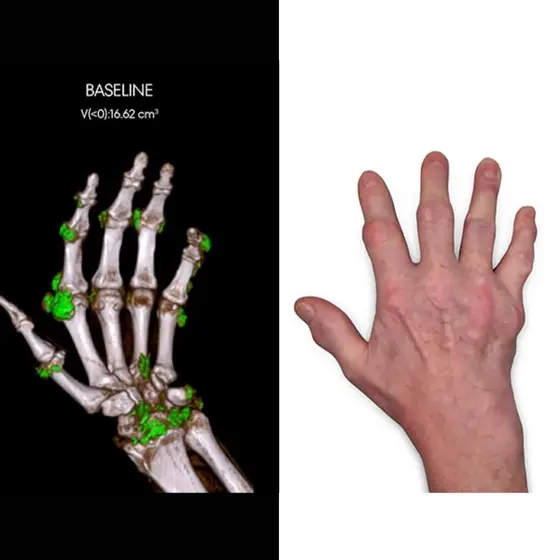
The first was the lumps. I noticed them around Christmas. Two small, hard bumps on the second knuckle of my right hand. About the size of corn kernels under the skin. They didn't hurt. I'd been wearing my wedding ring for 38 years and that month it started catching when I'd take it off at night. I figured my hands were just changing with age.
The second was the itch. A dry patch developed on my forearm. Nothing dramatic. The kind of thing you put cream on and forget about. Except the cream wasn't really making it go away.
The third was the tiredness, which had stopped being something I could explain.
I brought it up at my appointment that March.
"Doc, I'm tired. I'm not exercising any less. I'm not eating any worse. I'm just tired. And these are showing up on my hand."
He looked at the bumps. He felt them. "Tophi," he said. "Old crystal deposits working their way out. It's residual, from before we got you on the drug. Don't worry about it. Your uric acid is great."
He didn't even bring up the itch or the fatigue. He typed a note. He sent me home.
Two weeks later, I was sitting at my kitchen table at 11 PM with my laptop open. I'd typed in "Allopurinol tophi still forming after 4 years".
I read three articles in a row and put the laptop down.
The lumps weren't "residual." Tophi do not appear on a body that's been at goal uric acid for four years. New tophi mean the drug is keeping the blood number low while the joints are still depositing crystals.
The blood number — the only thing my doctor was checking — was lying to all of us.
Then I clicked into a Reddit thread where another guy had typed almost the exact words I'd typed. Forty-five replies. Most of them said the same thing.
"You're not crazy. The blood number isn't the disease. The crystals already in your joints are. And Allopurinol doesn't touch them."
I scrolled to one comment that was four paragraphs long. A retired rheumatology nurse had written it. She said something I have not been able to forget.
"Allopurinol turns the tap off. It doesn't drain the tub. If your tub had years of crystals sitting in it before the tap was turned off — and most patients' tubs do — those deposits are still sitting there. Your immune system still reacts to them. They still grow. They still trigger silent kidney filtration. The pill keeps your bloodwork pretty. It does not stop the damage already in motion."
I sat there reading it three times.
Then I went into the bathroom and looked in the mirror. Tired. Itchy. Two corn kernels on my knuckle.
This wasn't what I'd signed up for.
So I did what most men my age don't do, which is admit I might have been wrong. I started reading.
Not "natural alternatives." I'm 64. I'm not chasing miracle cures. I just wanted to understand what was actually happening in my joints, what the pill was and wasn't doing, and whether anything could support the process my body was clearly struggling with on its own.
Here's what I learned in about six weeks of evening reading.
Allopurinol works by slowing down the enzyme in your liver that makes new uric acid. That's it. That's the whole mechanism. It is genuinely good at that one job.
But uric acid is only one part of the picture.
Your body does three things with uric acid. It makes it — from the steak, the beer, the seafood. It stores it, as sharp crystalline deposits in the soft tissue around your joints. And it has to flush it out, through your kidneys.
A daily pill works on the first lever. It slows production. But it does nothing for the crystals already lodged in your joints, and it does nothing for the kidney pathway that's supposed to be clearing the backlog.
That's why — after four years on the drug, with a number that "looks fine" — the deposits were still there. The tub still hadn't drained.
So I asked a different question. Not "what lowers the blood number" — I already had something doing that. I asked: what supports all three jobs at once?
The research kept pointing me back to the same combination. Three plants. Each with a different job.
The first is celery seed. It contains compounds that work on the same enzyme Allopurinol targets — xanthine oxidase, the enzyme that produces uric acid. It's thought to slow the rate at which your body manufactures it in the first place.
The second is Montmorency tart cherry. Not cherry juice from the supermarket — that's loaded with fructose, which is itself a uric acid trigger. The concentrated anthocyanins in a properly dosed tart cherry extract support the antioxidant environment in your joints. Less inflammation means the stored crystals stir up less reaction.
The third is chanca piedra — which translates literally as "stone breaker." It's been used in traditional medicine for centuries specifically for its support of the kidneys and urinary tract. The kidneys are the organ responsible for flushing uric acid out of the body. Allopurinol doesn't touch this pathway. Chanca piedra does.
Make less. Calm the storage. Flush the rest.
That's three plants, three jobs. And it's the job that a single-ingredient product — or a single pharmaceutical — structurally cannot do.
There was just one catch.
Most products in this category cut corners. The tart cherry is under-dosed. The chanca piedra is an afterthought. The celery seed is present but not at any meaningful concentration. And they're packed into a formula with no BioPerine — the black pepper extract that research suggests significantly improves the absorption of herbal compounds.
I'd actually tried a couple of these. I took them for a few weeks, felt nothing, put them in the cabinet, forgot about them. Most men my age have a story like that.
But here's what I didn't know then.
The dose matters. The combination matters. The bioavailability matters. And if any one of those three things is missing, you're essentially paying for colored powder in a capsule.
I went back through the labels of everything in my cabinet. Sure enough — either the doses were too low, or one of the three plants was missing entirely, or there was no absorption support.
I emailed a few supplement companies and asked a simple question: what's the actual milligram dose of each active, and is there a Certificate of Analysis from a third-party lab?
Most never responded. One sent a brochure with no numbers. One said "proprietary."
Proprietary. They wouldn't tell me what dose of the thing I was supposed to put in my body every day.
Then I found the brand a guy on the Reddit thread had mentioned in a follow-up reply.
PURGE Uric Acid Cleanse.
1,404mg complex — celery seed, Montmorency tart cherry, chanca piedra, with parsley and BioPerine black pepper extract for absorption. Third-party tested. cGMP certified. Soft vegan capsules. 23,000+ customers. 4.8 stars.
And a 90-day money-back guarantee.
I ordered a bottle.
Three days later it arrived. I started taking two capsules in the morning and kept taking my Allopurinol exactly as my GP had prescribed.
I am going to tell you exactly what happened, in order, because I think you need to hear it.
Week two — the dry patch on my forearm started fading. My wife pointed it out one morning while I was making coffee. I almost didn't notice.
Week four — the tiredness lifted. I was getting through a 10 PM news broadcast for the first time in two years.
Week six — I had a GP appointment that I'd booked months earlier. My uric acid came back at 4.9. The lowest it had ever been. I was still on the same Allopurinol dose. He looked at me and said, "Whatever you're doing on top, keep doing it." I told him about PURGE. He nodded and wrote something in my chart.
Week ten — I noticed I could feel the smaller of the two knuckle bumps with my thumb. It had gotten smaller. Not gone. Smaller. I checked it again the next morning to make sure I wasn't imagining it.
I wasn't.
Month four — my rheumatologist (a different doctor than my GP) wanted to talk. He'd seen my labs. He said, "Frank, your numbers are better than they have ever been. The fatigue you'd been mentioning to your GP — has that changed?" I told him yes. He looked at me for a long moment and said, "I'd like to try tapering you down. 200 to 100. Let's see what your body does without the higher dose."
He didn't say to stop the supplement.
We dropped me to 100mg. Eight weeks later he dropped me again to alternating days. Six weeks after that — at month nine — he took me off Allopurinol entirely.
That was seven months ago.
I have not had a flare. My uric acid this morning was 5.4. My blood pressure is 121/78. The bumps on my knuckle are softer and visibly smaller. My wedding ring fits again. The dry skin on my forearm is gone.
The tiredness I'd been blaming on age was not age.
I'm 64. I feel 54.
Here's what I want to say to the man reading this who is currently on Allopurinol and quietly nodding at half of what I just wrote.
You are not crazy. You are not imagining the tiredness. You are not imagining the lumps. You are not imagining the way your skin has been a little drier, or your concentration a little softer, or your wedding ring a little tighter.
The pill is doing the one job it was designed to do — managing your blood number. It is not supporting the other two jobs: calming what the stored crystals are stirring up, or helping the kidneys flush the backlog through.
I am not telling you to stop taking your medication. I would never say that. That decision is between you and your doctor, the way mine was between me and mine. My rheumatologist tapered me intentionally, over months, after watching my labs change.
What I am telling you is that there is more to this picture than a blood number and a daily pill. And there is a specific combination — three plants, each doing a different job — that the research suggests reaches the parts of the process that the pharmaceutical cannot.
If you've been on the drug for two, three, four years and you've been quietly wondering whether some of what you've been writing off as "age" is actually the trade you didn't know you were making — you can do something about it.
Order a bottle of PURGE. Keep taking your Allopurinol exactly as prescribed. Watch what changes. Bring it up at your next appointment.
If you don't see anything change in 90 days — full refund. No questions asked. You risk nothing.
You do not have to spend the next four years the way I spent the last four.
→ https://purgelabs.shop/products/purge-uric-acid
— Frank
P.S. Before you order anything else, pull out whatever uric acid supplement is currently in your cabinet — or think back to the last one you tried. Check the label. Is it just tart cherry? Just celery seed? Is there a dose listed at all? Most of what's out there is one plant, at the wrong dose, with no absorption support. One plant cannot do three jobs. That's why it didn't work. Don't write off the category because of a product that was never built to do the full job.
P.P.S. If you're not the one on Allopurinol — if you're his wife, his daughter, his brother — and you've been watching what I described above quietly happen to someone you love over the last few years, you already know whether this letter is for him. Send it to him. Don't tell him to read it. Just send it. He'll know what to do.