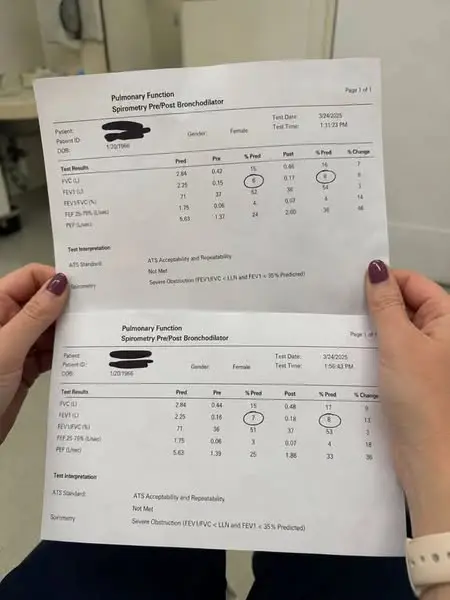
Jennifer Collins Facebook ad creative
airovine.com
Smoke All You Want Just Clean Your Lungs Daily
Learn more

Jennifer Collins Facebook and Instagram ad

Jennifer Collins ran this image ad since Jun 26, 2026, 134 days so far.

First seen
Jun 26, 2026
Running for
134 days
Format
Image
Call to action
Learn more
Niche
Health and supplements
Countries
Not disclosed
Page likes
1,479

Ad copy

This just might save your life. I can't stand these doctors who keep telling COPD patients their numbers are stable while their lung function quietly drops another point every quarter. I'm Jennifer Collins. I've been a respiratory floor nurse for 15 years. I've watched smokers lose lung function in real time. I've sat beside patients and explained what oxygen dependency means. I've watched people give up stairs. I've watched someone lose the ability to walk to their own mailbox. I've watched a man cry when I told him his FEV1 was at 31 percent. So when a patient came to my floor six months ago, COPD for nine years, on Trelegy and a rescue inhaler, following every instruction to the letter, and his morning clearing routine had stretched to forty minutes while his breathlessness on a flat walk had gotten worse, I sat down and told him the truth. His medications were managing his airways. His lungs were not clearing. He looked at me and said: "So what do I do?" I told him what I always tell patients at that point. Stay consistent with the inhalers. Reduce irritant exposure. We may need to talk about adjusting the regimen. He nodded. Three months later he came back. His FEV1 was up 9 points. His morning routine had dropped from forty minutes to eight. His breathlessness on a flat walk was almost gone. I looked at his chart. Looked at him. "What did you change?" He reached into his jacket and set a small amber bottle on my desk. Wildcrafted Mullein. Liquid extract. 2000mg equivalent in a sublingual base, combined with Bromelain and Cordyceps. Called Airovine. I picked it up the way I pick up anything a patient brings me. Skeptically. Read the label. Set it down. Told him I was glad his numbers had improved and that we would continue monitoring. That night I couldn't stop thinking about the FEV1. FEV1 does not move like that. Not in three months. Not without a significant intervention. Not in a patient who had been declining for two years. Not when oxygen dependency was starting to whisper its way into every conversation. At 11:30 PM I started reading. Here is what I found. And here is the thing I should have understood years earlier. Your inhaler measures one thing. Airway diameter. It relaxes the muscles around your airways and forces them open for a few hours. That is all it does. It does not touch what is coating the inside of those airways. It does not see the tar and mucus layer bonded to your bronchial walls. It does not reach the cemented buildup that has been sitting there for months or years. It does not wake the cilia buried underneath it. It opens the tube. It does not clean the walls. A managed inhaler routine can be working exactly as prescribed while your airways are still caked with a layer of hardened mucus that nothing you are taking has ever reached. Both things are completely true at the same time. Because the inhaler is measuring airway diameter. Your lung tissue is paying the price of what is coating it from the inside. This is what produces the morning heaviness that never fully lifts. This is what sends you to the oxygen concentrator. The tiny hairs lining your airways, the cilia, whose entire job is to sweep your lungs clean every single minute of every day, have been buried under a hardened mucus layer for months or years. They have stopped moving. The buildup keeps stacking. That morning heaviness is not a warning sign that something might happen. It is evidence that the clearing system has already failed. And here is what your FEV1 score is not telling you about why. Your airways have a natural cleaning system. It runs continuously. Every minute of every day, microscopic hairs called cilia line your airway walls and sweep mucus, particles, and debris up and out of your lungs before they can build up. In healthy airways, this system keeps pace with whatever comes in. Particles get swept out. Mucus stays thin and mobile. Breathing stays clear. In airways damaged by smoking, COPD, or years of irritant exposure, this system breaks down. The cilia get buried under layers of mucus and tar that harden over time. They stop moving. The sweeping stops. The buildup has nowhere to go, so it stays. Layer on layer. Year on year. Cemented against the airway walls. Your medications cannot restart buried cilia. Your inhaler cannot break up cemented mucus. All the inhaler does is force more air through a tube whose walls are still caked. And the harder it forces, the more the walls stay exactly where they are. Think of it like a chimney that hasn't been swept in twenty years. The fire still burns. But airflow is restricted. Everything feels heavier. Most solutions focus on forcing more air through the flue. Nobody sweeps the walls. Your FEV1 is measuring the size of the opening. It is not measuring the walls. The morning heaviness and the declining lung function are made of walls. Now, your medications. Inhalers work on the muscle layer wrapped around your airways. They force the tube open. That is a real, useful thing and your doctor is not wrong to prescribe it. But they do not touch the coating. The cemented mucus layer is still pressed against your airway walls. The debris keeps building. The cilia stay buried. The airway keeps narrowing over time. Because the drug that opened the tube did not clear the walls. And here is what stopped me cold at midnight, reading in my home office with 15 years of respiratory nursing behind me. The research on how to clear that coating exists. It has been published. Peer-reviewed. Sitting in databases that a 15-minute appointment leaves no time to read. There are specific compounds that break down the cemented mucus layer directly. That dissolve the protein bonds holding it in place. That wake the buried cilia back up so they can start sweeping again. And in 15 years of respiratory nursing, in hundreds of conversations with COPD patients watching their FEV1 drop and their mornings get longer, not once had I mentioned them. Not because I was hiding them. Because the gap between published research and clinical practice is not malice. It is time. It is money. It is a system that funds what it can patent and leaves everything else sitting in journals. You cannot patent a wildcrafted herb. So no pharmaceutical company funds the trials that would land it on a sales representative's desk. No sales rep walks it into my office. The studies stay in databases. The patients keep coming in with morning routines that stretch longer every year. With FEV1 scores that drop another point each quarter. With the fear of oxygen dependency growing bigger every visit. That is not your fault. You used the inhalers. You tracked the numbers. You kept every appointment. You were not failing the system. The system was only giving you half the answer and never telling you the other half existed. Let me tell you what clears the walls. Wildcrafted Mullein, not the dried powder in most supplement capsules, not the generic drops ranked number one on Amazon, true wildcrafted Verbascum thapsus, harvested from plants in their natural environment, contains active compounds called saponins and mucilaginous polysaccharides. These compounds do something your medications do not. They go directly to the airway lining and dissolve the tar and mucus coating the way soap dissolves grease on a pan. Not by forcing more air through a narrowed passage. By breaking apart the buildup at a molecular level and clearing the walls. A study published in the Journal of Ethnopharmacology found that mullein saponins have measurable mucolytic activity, meaning they physically break apart the mucus matrix. A second study in Phytotherapy Research documented mullein's effect on respiratory inflammation across multiple trials. A third paper on saponin compounds confirmed their action as a natural surfactant, the chemical term for a substance that breaks down fats and oily residues. Which is exactly what tar is at a chemical level. This is not fringe research. This is peer-reviewed science sitting in plain sight. When the cemented layer breaks apart, when the airway walls finally get cleared, the cilia underneath can move again. The natural sweeping system restarts. The morning heaviness lifts. Breathing finds a depth it has not had in years. But Mullein alone is not the full answer. The cemented mucus layer is not just stuck because it is thick. It is stuck because it is chemically bonded to your airway walls by protein bonds. Breaking up the mucus matrix is only part of the job. You also need to dissolve the glue. That is where Bromelain comes in. Bromelain is a proteolytic enzyme extracted from pineapple stems. Its job is to break protein bonds specifically. In a respiratory formula, it is dissolving the chemical glue holding the cemented layer pressed against your airway walls. And then Cordyceps militaris. A compound with documented research on ciliary function and oxygen utilisation at the cellular level. The buried cilia getting the signal to start moving again. The sweeping system that went quiet finally restarting. The walls get cleared. The cilia wake up. Your lungs finish the job they have been trying to do for years. The chimney is finally swept. The system works again. Now. You have probably tried mullein before. You drank the tea. You found a well-reviewed bottle online and took it faithfully for months and watched nothing change. I need you to understand exactly why. First. You were almost certainly using the wrong form. The mullein in most supplement capsules is dried, heat-processed powder that has been sitting in a warehouse for months. The active saponin compounds, the ones that actually break apart the cemented mucus layer, are sensitive to heat and time. By the time you swallowed that capsule, most of what made mullein work in the studies was already degraded. You were not taking the wrong amount. You were taking the wrong form. True wildcrafted mullein, harvested from plants in their natural environment at peak potency, maintains the active compound concentration that clinical research actually used. Second. Even real wildcrafted mullein in a dry capsule will likely do nothing. When you swallow a capsule, it goes to your stomach. Stomach acid destroys the majority of the active compounds before they travel anywhere near your airways. Whatever survives gets absorbed into the bloodstream and distributed everywhere. Arms. Legs. Organs. By the time any trace reaches your airway tissue, the concentration is almost nothing. Your airways are not downstream from your stomach. A capsule has to survive your entire digestive system before it has any chance of reaching the one place it actually needs to go. The Journal of Ethnopharmacology and multiple respiratory pharmacology reviews document this clearly. Without direct airway delivery, the compounds never arrive at the cemented layer in any meaningful concentration. Your mullein did not fail because mullein does not work. It failed because it was never delivered. That patient who set the amber bottle on my desk? He was taking Airovine. True wildcrafted Mullein. Verbascum thapsus, harvested from plants in their natural environment where they develop maximum therapeutic compounds. Not dried powder. Not a heat-processed extract. The real thing. Dosed at 2000mg equivalent per dose. The potency that corresponds directly to the published research on respiratory mucus clearance. The dosing level where the active saponins are present in concentrations that can actually break down the cemented layer. Combined with Bromelain to dissolve the protein bonds holding the cemented layer in place. And Cordyceps to wake the buried cilia back up. The only formula combining all three compounds in a single sublingual liquid specifically formulated for airway delivery. Suspended in a clean sublingual base. Two drops held under the tongue for 30 seconds. The membrane under the tongue is one of the most absorbent in the body. The active compounds enter directly into the tissue and reach the airway lining without passing through the stomach. Without being destroyed by digestive acid. Without being diluted across five liters of blood before they arrive. No capsule delivers this. No tea delivers this. No swallowed supplement of any kind delivers this. The delivery is the mechanism. And the mechanism is the whole answer. Third-party tested. GMP-certified. Made in an FDA-registered facility in the USA. Every batch verified for purity and potency. I went home that night and ordered a bottle. Week 1, the tightness in my chest eased. I had carried a low-grade heaviness for years and written it off as occupational exposure. What I noticed first was not a number. It was that I stopped hunching over the sink between my first cough and my coffee. Easier. Looser. Steadier breathing from the first hour of the day. That night I went to bed at 10:30. I woke at 6:45. I had not stirred once. Not coughing. Not choking. Not with that 3am throat-clearing fit I had been having for years. I slept through the night for the first time in 14 months. Week 2, my morning routine went from 20 minutes to 6. I tested it three mornings in a row because I did not believe it. Week 3, I stopped reaching for my rescue inhaler before climbing the stairs to the third floor. I actually walked up without slowing at the second landing. Week 6, my morning routine was consistently two clears and a sip of coffee. I had not had mornings like that in over two years. Week 10, my pulmonary function test came back. FEV1 at 89%. Up from 78%. My doctor stared at it. Ran another spirometry. Same number. "Your FEV1 is consistently up 11 points." "Yes." "Your morning cough is gone." "Yes." She looked up at me. "What did you do?" "Wildcrafted Mullein. 2000mg equivalent, sublingual, combined with Bromelain and Cordyceps. There are studies. I brought them." I handed her a folder with six published papers. She flipped through them. Read for five minutes. Closed the folder. "Your oxygen saturation on exertion improved. Your FVC is up 8 points." I nodded. "Keep doing whatever you're doing." That patient I sent home three months earlier, the one with the amber bottle on my desk, came back for his follow-up. FEV1 up 9 points. Morning routine down from forty minutes to eight. The breathlessness on a flat walk was gone. I sat across from him and told him the truth again. This time it was different news. "Your lungs are clearing." He smiled. "The walls got swept." I have recommended Airovine to six patients since. Every single one has come back and told me the same thing. Better sleep within the first week. Shorter morning routine within two. Stable energy throughout the day. Easier breathing on stairs within the first month. One patient cried when she told me she had slept lying flat in her own bed for the first time in two years. Another patient's FEV1 climbed from 67% to 76% in three months. His pulmonologist told him to keep taking whatever he was taking. But here is what I need you to understand about why most Mullein products fail. It is not because the mechanism is wrong. The mechanism is published, replicated, and real. It is because most products get three things wrong. They use the wrong form. Dried powder capsules with degraded saponin content are the industry standard, not the exception. Without wildcrafted sourcing and proper extraction, the active compounds that break down cemented mucus simply are not there. They are catastrophically underdosed. Research uses mullein at the equivalent of 1500 to 2500mg of high-potency extract per dose. Most capsules contain 400 to 600mg of dried herb. That is not a small gap. That is the difference between a therapeutic dose and a decorative amount. They use the wrong delivery format. A compound that needs to reach airway tissue in a swallowed capsule is not going to get there. The stomach acid, the liver metabolism, the bloodstream dilution. Most of it never arrives. The research on this is not ambiguous. The delivery method matters as much as the compound. The difference between the generic capsule I would have dismissed six months ago and Airovine is the difference between none of this working and a patient's FEV1 climbing 9 points in 90 days. The difference between living in fear of an oxygen concentrator and getting your mornings back. Same mechanism. Completely different execution. If you are sitting with a managed inhaler routine while your FEV1 quietly drops another point each quarter, while the morning heaviness still hasn't lifted, while the clearing still takes longer than it should and nothing you have tried has touched the deep layer, while the fear of oxygen dependency is becoming your constant companion, try Airovine risk-free. 60-day money-back guarantee. No questions asked. If your morning routine does not shorten, if the heaviness does not lift, if your breathing does not improve, if you see no difference in 60 days, you pay nothing. Most patients who see real movement in their lung function are the ones who committed to at least eight weeks. That is how long it takes to give the cemented layer a real chance to break apart and clear. That is how long it takes for the cilia to fully restart their sweeping. That is how long it takes to start feeling the difference in how your mornings begin. The 60-day guarantee means those eight weeks cost you nothing if the breathing does not change. Here is what happens if it does. Your morning routine starts shortening between weeks 2 and 4. Your sleep improves within the first week. The deep heaviness that has been setting the tone for your whole day begins to lift. Your energy levels out through the morning. And at your next pulmonary function test, the one where your doctor has been saying your numbers are stable for two years, she pauses. Looks at the numbers. Looks at you. Asks what you changed. You tell her. She pulls something up on her computer. Is quiet for a moment. Then she uses a word you have not heard in years of appointments. "Improving." Not stable. Improving. Two drops under the tongue every morning. That is the whole protocol. They sell out. It is a small company sourcing wildcrafted Mullein from certified harvests and formulating it properly. If you see out of stock, sign up for the notification. If it is available, order now. There is a promotion running currently. Three bottles at a significant discount, which is the commitment window where the lung function actually moves. If you are dealing with: A morning clearing routine that stretches longer every year. Breathlessness on walks that used to be nothing. Waking up multiple times every night to clear your chest. A chest that feels heavy and tight when you wake. An FEV1 that drops a point or two every time you go back for a test. An inhaler that helps for a few hours but never seems to actually fix anything. The fear of oxygen dependency growing bigger each time you visit the pulmonology clinic. Give it 60 days. Track your morning routine. Note your sleep, your energy, your breathlessness on stairs. Go back for your next function test. If the numbers do not move, you get your money back. But if they do, if your morning routine shortens, if your FEV1 holds or climbs, if the heaviness lifts, if your doctor pauses over your results and says the word you have been waiting to hear for years, you will understand why I now have a standing conversation with every COPD patient who walks onto my floor. The airways are being opened. The walls were never cleared. You know now that they can be. Get Airovine while it is still available. Jennifer Collins, RN, Respiratory Floor, 15 years

Placements and targeting

FacebookInstagramAudience NetworkMessengerThreads

More ads from Jennifer Collins

Full Jennifer Collins profile
Jennifer Collins
Jennifer Collins
+1
Inactive134 days
airovine.com
Wildcrafted Mullein 2000mg Equivalent with Bromelain and Cordyceps
Learn more

This just might save your life. I can't stand these doctors who keep telling COPD patients their numbers are stable while their lung function quietly drops another point every quarter. I'm Jennifer Collins. I've been a respiratory floor nurse for 15 years. I've watched smokers lose lung function in real time. I've sat beside patients and explained what oxygen dependency means. I've watched people give up stairs. I've watched someone lose the ability to walk to their own mailbox. I've watched a man cry when I told him his FEV1 was at 31 percent. So when a patient came to my floor six months ago, COPD for nine years, on Trelegy and a rescue inhaler, following every instruction to the letter, and his morning clearing routine had stretched to forty minutes while his breathlessness on a flat walk had gotten worse, I sat down and told him the truth. His medications were managing his airways. His lungs were not clearing. He looked at me and said: "So what do I do?" I told him what I always tell patients at that point. Stay consistent with the inhalers. Reduce irritant exposure. We may need to talk about adjusting the regimen. He nodded. Three months later he came back. His FEV1 was up 9 points. His morning routine had dropped from forty minutes to eight. His breathlessness on a flat walk was almost gone. I looked at his chart. Looked at him. "What did you change?" He reached into his jacket and set a small amber bottle on my desk. Wildcrafted Mullein. Liquid extract. 2000mg equivalent in a sublingual base, combined with Bromelain and Cordyceps. Called Airovine. I picked it up the way I pick up anything a patient brings me. Skeptically. Read the label. Set it down. Told him I was glad his numbers had improved and that we would continue monitoring. That night I couldn't stop thinking about the FEV1. FEV1 does not move like that. Not in three months. Not without a significant intervention. Not in a patient who had been declining for two years. Not when oxygen dependency was starting to whisper its way into every conversation. At 11:30 PM I started reading. Here is what I found. And here is the thing I should have understood years earlier. Your inhaler measures one thing. Airway diameter. It relaxes the muscles around your airways and forces them open for a few hours. That is all it does. It does not touch what is coating the inside of those airways. It does not see the tar and mucus layer bonded to your bronchial walls. It does not reach the cemented buildup that has been sitting there for months or years. It does not wake the cilia buried underneath it. It opens the tube. It does not clean the walls. A managed inhaler routine can be working exactly as prescribed while your airways are still caked with a layer of hardened mucus that nothing you are taking has ever reached. Both things are completely true at the same time. Because the inhaler is measuring airway diameter. Your lung tissue is paying the price of what is coating it from the inside. This is what produces the morning heaviness that never fully lifts. This is what sends you to the oxygen concentrator. The tiny hairs lining your airways, the cilia, whose entire job is to sweep your lungs clean every single minute of every day, have been buried under a hardened mucus layer for months or years. They have stopped moving. The buildup keeps stacking. That morning heaviness is not a warning sign that something might happen. It is evidence that the clearing system has already failed. And here is what your FEV1 score is not telling you about why. Your airways have a natural cleaning system. It runs continuously. Every minute of every day, microscopic hairs called cilia line your airway walls and sweep mucus, particles, and debris up and out of your lungs before they can build up. In healthy airways, this system keeps pace with whatever comes in. Particles get swept out. Mucus stays thin and mobile. Breathing stays clear. In airways damaged by smoking, COPD, or years of irritant exposure, this system breaks down. The cilia get buried under layers of mucus and tar that harden over time. They stop moving. The sweeping stops. The buildup has nowhere to go, so it stays. Layer on layer. Year on year. Cemented against the airway walls. Your medications cannot restart buried cilia. Your inhaler cannot break up cemented mucus. All the inhaler does is force more air through a tube whose walls are still caked. And the harder it forces, the more the walls stay exactly where they are. Think of it like a chimney that hasn't been swept in twenty years. The fire still burns. But airflow is restricted. Everything feels heavier. Most solutions focus on forcing more air through the flue. Nobody sweeps the walls. Your FEV1 is measuring the size of the opening. It is not measuring the walls. The morning heaviness and the declining lung function are made of walls. Now, your medications. Inhalers work on the muscle layer wrapped around your airways. They force the tube open. That is a real, useful thing and your doctor is not wrong to prescribe it. But they do not touch the coating. The cemented mucus layer is still pressed against your airway walls. The debris keeps building. The cilia stay buried. The airway keeps narrowing over time. Because the drug that opened the tube did not clear the walls. And here is what stopped me cold at midnight, reading in my home office with 15 years of respiratory nursing behind me. The research on how to clear that coating exists. It has been published. Peer-reviewed. Sitting in databases that a 15-minute appointment leaves no time to read. There are specific compounds that break down the cemented mucus layer directly. That dissolve the protein bonds holding it in place. That wake the buried cilia back up so they can start sweeping again. And in 15 years of respiratory nursing, in hundreds of conversations with COPD patients watching their FEV1 drop and their mornings get longer, not once had I mentioned them. Not because I was hiding them. Because the gap between published research and clinical practice is not malice. It is time. It is money. It is a system that funds what it can patent and leaves everything else sitting in journals. You cannot patent a wildcrafted herb. So no pharmaceutical company funds the trials that would land it on a sales representative's desk. No sales rep walks it into my office. The studies stay in databases. The patients keep coming in with morning routines that stretch longer every year. With FEV1 scores that drop another point each quarter. With the fear of oxygen dependency growing bigger every visit. That is not your fault. You used the inhalers. You tracked the numbers. You kept every appointment. You were not failing the system. The system was only giving you half the answer and never telling you the other half existed. Let me tell you what clears the walls. Wildcrafted Mullein, not the dried powder in most supplement capsules, not the generic drops ranked number one on Amazon, true wildcrafted Verbascum thapsus, harvested from plants in their natural environment, contains active compounds called saponins and mucilaginous polysaccharides. These compounds do something your medications do not. They go directly to the airway lining and dissolve the tar and mucus coating the way soap dissolves grease on a pan. Not by forcing more air through a narrowed passage. By breaking apart the buildup at a molecular level and clearing the walls. A study published in the Journal of Ethnopharmacology found that mullein saponins have measurable mucolytic activity, meaning they physically break apart the mucus matrix. A second study in Phytotherapy Research documented mullein's effect on respiratory inflammation across multiple trials. A third paper on saponin compounds confirmed their action as a natural surfactant, the chemical term for a substance that breaks down fats and oily residues. Which is exactly what tar is at a chemical level. This is not fringe research. This is peer-reviewed science sitting in plain sight. When the cemented layer breaks apart, when the airway walls finally get cleared, the cilia underneath can move again. The natural sweeping system restarts. The morning heaviness lifts. Breathing finds a depth it has not had in years. But Mullein alone is not the full answer. The cemented mucus layer is not just stuck because it is thick. It is stuck because it is chemically bonded to your airway walls by protein bonds. Breaking up the mucus matrix is only part of the job. You also need to dissolve the glue. That is where Bromelain comes in. Bromelain is a proteolytic enzyme extracted from pineapple stems. Its job is to break protein bonds specifically. In a respiratory formula, it is dissolving the chemical glue holding the cemented layer pressed against your airway walls. And then Cordyceps militaris. A compound with documented research on ciliary function and oxygen utilisation at the cellular level. The buried cilia getting the signal to start moving again. The sweeping system that went quiet finally restarting. The walls get cleared. The cilia wake up. Your lungs finish the job they have been trying to do for years. The chimney is finally swept. The system works again. Now. You have probably tried mullein before. You drank the tea. You found a well-reviewed bottle online and took it faithfully for months and watched nothing change. I need you to understand exactly why. First. You were almost certainly using the wrong form. The mullein in most supplement capsules is dried, heat-processed powder that has been sitting in a warehouse for months. The active saponin compounds, the ones that actually break apart the cemented mucus layer, are sensitive to heat and time. By the time you swallowed that capsule, most of what made mullein work in the studies was already degraded. You were not taking the wrong amount. You were taking the wrong form. True wildcrafted mullein, harvested from plants in their natural environment at peak potency, maintains the active compound concentration that clinical research actually used. Second. Even real wildcrafted mullein in a dry capsule will likely do nothing. When you swallow a capsule, it goes to your stomach. Stomach acid destroys the majority of the active compounds before they travel anywhere near your airways. Whatever survives gets absorbed into the bloodstream and distributed everywhere. Arms. Legs. Organs. By the time any trace reaches your airway tissue, the concentration is almost nothing. Your airways are not downstream from your stomach. A capsule has to survive your entire digestive system before it has any chance of reaching the one place it actually needs to go. The Journal of Ethnopharmacology and multiple respiratory pharmacology reviews document this clearly. Without direct airway delivery, the compounds never arrive at the cemented layer in any meaningful concentration. Your mullein did not fail because mullein does not work. It failed because it was never delivered. That patient who set the amber bottle on my desk? He was taking Airovine. True wildcrafted Mullein. Verbascum thapsus, harvested from plants in their natural environment where they develop maximum therapeutic compounds. Not dried powder. Not a heat-processed extract. The real thing. Dosed at 2000mg equivalent per dose. The potency that corresponds directly to the published research on respiratory mucus clearance. The dosing level where the active saponins are present in concentrations that can actually break down the cemented layer. Combined with Bromelain to dissolve the protein bonds holding the cemented layer in place. And Cordyceps to wake the buried cilia back up. The only formula combining all three compounds in a single sublingual liquid specifically formulated for airway delivery. Suspended in a clean sublingual base. Two drops held under the tongue for 30 seconds. The membrane under the tongue is one of the most absorbent in the body. The active compounds enter directly into the tissue and reach the airway lining without passing through the stomach. Without being destroyed by digestive acid. Without being diluted across five liters of blood before they arrive. No capsule delivers this. No tea delivers this. No swallowed supplement of any kind delivers this. The delivery is the mechanism. And the mechanism is the whole answer. Third-party tested. GMP-certified. Made in an FDA-registered facility in the USA. Every batch verified for purity and potency. I went home that night and ordered a bottle. Week 1, the tightness in my chest eased. I had carried a low-grade heaviness for years and written it off as occupational exposure. What I noticed first was not a number. It was that I stopped hunching over the sink between my first cough and my coffee. Easier. Looser. Steadier breathing from the first hour of the day. That night I went to bed at 10:30. I woke at 6:45. I had not stirred once. Not coughing. Not choking. Not with that 3am throat-clearing fit I had been having for years. I slept through the night for the first time in 14 months. Week 2, my morning routine went from 20 minutes to 6. I tested it three mornings in a row because I did not believe it. Week 3, I stopped reaching for my rescue inhaler before climbing the stairs to the third floor. I actually walked up without slowing at the second landing. Week 6, my morning routine was consistently two clears and a sip of coffee. I had not had mornings like that in over two years. Week 10, my pulmonary function test came back. FEV1 at 89%. Up from 78%. My doctor stared at it. Ran another spirometry. Same number. "Your FEV1 is consistently up 11 points." "Yes." "Your morning cough is gone." "Yes." She looked up at me. "What did you do?" "Wildcrafted Mullein. 2000mg equivalent, sublingual, combined with Bromelain and Cordyceps. There are studies. I brought them." I handed her a folder with six published papers. She flipped through them. Read for five minutes. Closed the folder. "Your oxygen saturation on exertion improved. Your FVC is up 8 points." I nodded. "Keep doing whatever you're doing." That patient I sent home three months earlier, the one with the amber bottle on my desk, came back for his follow-up. FEV1 up 9 points. Morning routine down from forty minutes to eight. The breathlessness on a flat walk was gone. I sat across from him and told him the truth again. This time it was different news. "Your lungs are clearing." He smiled. "The walls got swept." I have recommended Airovine to six patients since. Every single one has come back and told me the same thing. Better sleep within the first week. Shorter morning routine within two. Stable energy throughout the day. Easier breathing on stairs within the first month. One patient cried when she told me she had slept lying flat in her own bed for the first time in two years. Another patient's FEV1 climbed from 67% to 76% in three months. His pulmonologist told him to keep taking whatever he was taking. But here is what I need you to understand about why most Mullein products fail. It is not because the mechanism is wrong. The mechanism is published, replicated, and real. It is because most products get three things wrong. They use the wrong form. Dried powder capsules with degraded saponin content are the industry standard, not the exception. Without wildcrafted sourcing and proper extraction, the active compounds that break down cemented mucus simply are not there. They are catastrophically underdosed. Research uses mullein at the equivalent of 1500 to 2500mg of high-potency extract per dose. Most capsules contain 400 to 600mg of dried herb. That is not a small gap. That is the difference between a therapeutic dose and a decorative amount. They use the wrong delivery format. A compound that needs to reach airway tissue in a swallowed capsule is not going to get there. The stomach acid, the liver metabolism, the bloodstream dilution. Most of it never arrives. The research on this is not ambiguous. The delivery method matters as much as the compound. The difference between the generic capsule I would have dismissed six months ago and Airovine is the difference between none of this working and a patient's FEV1 climbing 9 points in 90 days. The difference between living in fear of an oxygen concentrator and getting your mornings back. Same mechanism. Completely different execution. If you are sitting with a managed inhaler routine while your FEV1 quietly drops another point each quarter, while the morning heaviness still hasn't lifted, while the clearing still takes longer than it should and nothing you have tried has touched the deep layer, while the fear of oxygen dependency is becoming your constant companion, try Airovine risk-free. 60-day money-back guarantee. No questions asked. If your morning routine does not shorten, if the heaviness does not lift, if your breathing does not improve, if you see no difference in 60 days, you pay nothing. Most patients who see real movement in their lung function are the ones who committed to at least eight weeks. That is how long it takes to give the cemented layer a real chance to break apart and clear. That is how long it takes for the cilia to fully restart their sweeping. That is how long it takes to start feeling the difference in how your mornings begin. The 60-day guarantee means those eight weeks cost you nothing if the breathing does not change. Here is what happens if it does. Your morning routine starts shortening between weeks 2 and 4. Your sleep improves within the first week. The deep heaviness that has been setting the tone for your whole day begins to lift. Your energy levels out through the morning. And at your next pulmonary function test, the one where your doctor has been saying your numbers are stable for two years, she pauses. Looks at the numbers. Looks at you. Asks what you changed. You tell her. She pulls something up on her computer. Is quiet for a moment. Then she uses a word you have not heard in years of appointments. "Improving." Not stable. Improving. Two drops under the tongue every morning. That is the whole protocol. They sell out. It is a small company sourcing wildcrafted Mullein from certified harvests and formulating it properly. If you see out of stock, sign up for the notification. If it is available, order now. There is a promotion running currently. Three bottles at a significant discount, which is the commitment window where the lung function actually moves. If you are dealing with: A morning clearing routine that stretches longer every year. Breathlessness on walks that used to be nothing. Waking up multiple times every night to clear your chest. A chest that feels heavy and tight when you wake. An FEV1 that drops a point or two every time you go back for a test. An inhaler that helps for a few hours but never seems to actually fix anything. The fear of oxygen dependency growing bigger each time you visit the pulmonology clinic. Give it 60 days. Track your morning routine. Note your sleep, your energy, your breathlessness on stairs. Go back for your next function test. If the numbers do not move, you get your money back. But if they do, if your morning routine shortens, if your FEV1 holds or climbs, if the heaviness lifts, if your doctor pauses over your results and says the word you have been waiting to hear for years, you will understand why I now have a standing conversation with every COPD patient who walks onto my floor. The airways are being opened. The walls were never cleared. You know now that they can be. Get Airovine while it is still available. Jennifer Collins, RN, Respiratory Floor, 15 years

Jennifer Collins
Jennifer Collins
+1
Inactive134 days
airovine.com
I'm a therapist. COPD gave me depression. I couldn't fix myself.
Learn more

I spent thirty years as a therapist helping people through chronic illness and depression. Then COPD gave me both. And I had no idea what to do with myself. I was diagnosed with COPD at 57. I am 59 now. For thirty years I sat across from people whose bodies had turned against them. Chronic illness. Degenerative conditions. The slow grief of losing the life you planned. I helped them name what they were feeling. I helped them find their way back to themselves. I thought that knowledge would protect me. It did not. Two years of inhalers. Two years of Mucinex. Two years of the morning routine at the sink that nobody in my life knew about because explaining it felt like too much. Two years of saying fine when people asked how I was because the real answer was too long and too heavy for a Tuesday morning. I did everything my pulmonologist told me to do. I took the medications. I did the breathing exercises. I cut back on the things that made it worse. And the numbers stayed stable. FEV1 at 61%. That word again. Stable. As if stable meant the same thing as okay. As if holding a position that was already diminished was something worth celebrating. But here is what stable did not cover. The walk I stopped suggesting after dinner because I was tired of calculating whether I could manage it and tired of the look on my husband's face when I said maybe not tonight. The phone calls I stopped returning because talking for twenty minutes left me winded and embarrassed and I did not want to explain that to people who remembered me differently. The morning I stood in front of the mirror and did not recognise the woman looking back at me. Not because of how she looked. Because of how she moved. Carefully. Slowly. Always with one eye on the nearest chair. I had gone from being an active, busy woman to an invalid in the space of two years. I was shocked at myself. Depressed in a way I had no language for, and I am a woman who has spent her entire career giving other people language for exactly this. Totally unable to accept this as a norm. This is no life, I kept thinking. And then feeling guilty for thinking it. Because I knew, professionally, that this was grief. I knew the stages. I knew the frameworks. I knew what I would have said to a patient sitting across from me with this exact story. But knowing the map does not mean you can read it when you are lost inside it. I did not call it depression. I called it adjusting. I called it being realistic. I told myself that acceptance was part of managing a chronic condition and that what I was feeling was normal and that everyone in my situation probably felt this way. But at 2am when I could not sleep and the house was quiet and I lay there running through the list of things I used to do without thinking that I now did not do at all, I knew the word I was avoiding. I had lost myself somewhere inside the managing. And the thought I could not shake was this. If this was year two and this was where I was, what did year five look like. Year eight. The rooms getting smaller. The phone going quieter. The version of myself that used to fill spaces shrinking further back into the corner until there was nothing left of her to find. I did not let myself finish that thought. I just lay there until the ceiling got light. The irony was not lost on me. A therapist who could not therapist her way out of her own darkness. My daughter noticed before I admitted it. She sat across from me at the kitchen table one Sunday and said something quietly that I have not forgotten. "Mum. You used to fill a room. Now you sit in the corner of it." I did not say anything. I looked at my hands. She asked if I had ever talked to anyone. Not about the COPD. About how I was feeling about the COPD. I almost laughed. I had spent thirty years being that person for others. The idea that I needed one myself had not fully landed until she said it out loud. She found a therapist for me. Not a general therapist. One who specialised in people living with chronic illness. Someone who had spent years sitting across from people whose bodies had changed in ways their minds had not yet caught up with. Her name was Dr. Sarah Vance. I sat in her waiting room and felt something I had not felt since my training. Nervous. Uncertain. Completely without the professional distance that usually sits between me and a difficult conversation. I went in expecting to talk about grief and coping strategies and breathing through difficult emotions. What I did not expect was what she said about forty minutes in. I had been describing my mornings. The sink. The clearing. The twenty minutes before I could start my day. The heaviness that never fully lifted no matter what I took. The ceiling that every supplement seemed to hit. She listened to all of it. Then she said something that made me sit forward in my chair. "What you are describing physically is directly connected to what you are describing emotionally. The heaviness you feel in your chest every morning is not separate from the heaviness you feel about your life. They are feeding each other. And I have heard this exact description from other patients who found something that helped both." I asked her what she meant. She explained that in COPD lungs the body's natural clearing system becomes overwhelmed over time. Mucus that should be expelled builds up in layers. The surface layer is what Mucinex thins, what the inhaler moves around, what the morning routine at the sink partially clears. I nodded. I knew that part. But underneath that surface layer, pressed hard against the airway walls, is a second layer. Older. Denser. Hardened into place over months and years. Burying the cilia, the microscopic hairs that are supposed to sweep the lungs clean every minute of every day, until they stop moving entirely. That is the heaviness that survives every clearing session. That is the weight that sets the tone for the whole day before the day has even started. I sat forward in my chair. And then she said the part that connected everything. "When breathing costs more than it should, every single morning, the emotional weight of that compounds. The dread of the morning becomes the dread of the day. The loss of ease in your breathing becomes the loss of ease in your life. I have seen patients whose mood shifted significantly once the physical burden on their airways reduced. Not because the depression was imaginary. Because it was being driven, in part, by something physical that had never been properly reached." I asked what she meant by properly reached. She said everything her patients had swallowed for their airways, every capsule, every tea, every supplement, was being destroyed by stomach acid before it arrived anywhere near the chest. Less than one percent of anything swallowed reaches airway tissue at a meaningful concentration. The active compounds get distributed across the entire bloodstream, diluted to almost nothing, and what little survives can only work on the surface layer. The cemented layer underneath it has never been touched by anything those patients swallowed. I thought about the two years of supplements sitting on my bathroom counter. None of it had ever arrived. She had heard about something different from a patient six months earlier. A woman who had described the same mornings, the same ceiling, the same emotional weight. Who had found a sublingual drop. Under the tongue. Absorbed directly into the tissue, bypassing the stomach entirely. Reaching the deep airway layer at the concentration that actually matters, with the three ingredients that address the whole problem. Wildcrafted Mullein at 2000mg to break down the hardened mucus coating cemented against the airway walls. Bromelain to dissolve the protein bonds holding that layer physically in place. Cordyceps to wake the buried cilia back up so the lungs begin clearing themselves the way they were designed to. That patient had come back three months later and said something Dr. Vance had not forgotten. "My mornings are lighter. And when my mornings are lighter, everything else feels lighter too." Dr. Vance wrote the name on a piece of paper and slid it across the desk. Airovine. She was careful about how she said the next part. She was not recommending it as a clinician. She was sharing what one patient had shared with her, in the same spirit that patient had shared it. As one person telling another about something that had helped when nothing else had reached far enough. I ordered it that night. I did not tell my husband. I had learned to keep the hoping quiet. He had watched me try things and be disappointed and I was not going to ask him to hope with me one more time. The first five days, nothing I could name. Day seven, my morning was shorter. Not dramatically. But I noticed. Eight minutes less at the sink. I stood there afterwards and just breathed. Week two, I slept through the night. Once. Then three nights running. I had been waking at 3am for so long that sleeping through felt like something had been returned to me that I had stopped expecting to get back. Week three, my morning routine dropped from twenty-three minutes to nine. I timed it on my phone because I needed the number. I needed something outside my own hope to confirm it was real. Week four was the morning that changed everything. I came downstairs and my husband was at the kitchen table with his coffee. He looked up at me and something crossed his face that I had not seen in a long time. "You look different," he said. "Different how?" He thought about it for a moment. "Like you walked in instead of arrived." I did not know what that meant exactly. But I knew what he was seeing. I had come down the stairs without thinking about the stairs. I had walked into the kitchen without calculating the kitchen. I had just come downstairs the way people come downstairs when they are not managing themselves every step of the way. I went back to Dr. Vance three weeks later. She asked how I was. I told her about the mornings. The sleeping. The stairs. My husband's face. She listened to all of it. Then she said: "Tell me something. When did you last fill a room?" I thought about what my daughter had said. About sitting in the corner. "Last Tuesday," I said. "My granddaughter's birthday. I was the loudest person there." She smiled. Closed her notebook. "That is what I was hoping you would say." I still have COPD. I want to be clear about that. My lungs are not new and I am not going to tell you they are. But the mornings are different. The heaviness that used to be the first thing I felt every single day has lifted in a way that two years of everything else never produced. And something else has lifted with it. The version of myself that sat in the corner of rooms has quietly stepped back out. If you are reading this and you recognise something in it. Not just the breathlessness. The withdrawal. The phone calls you stopped returning. The plans you stopped making. The person you used to be that you have been mourning without quite admitting that is what you are doing. I need you to understand something. It might not be that you have lost yourself. It might be that something physical has been making every morning harder than it should be, for long enough, that the emotional weight of it has become its own separate burden. And that something physical might never have been properly reached. Airovine is a maximum potency sublingual drop. Two drops under the tongue, held for thirty seconds. No stomach acid. No digestive system stripping out what your airways actually need. The active compounds reach the cemented layer directly, at the concentration that actually matters. Wildcrafted Mullein at 2000mg to break down the hardened mucus coating against the airway walls. Bromelain to dissolve the protein bonds holding that layer in place. Cordyceps to wake the buried cilia back up so your lungs begin clearing themselves the way they were designed to. Lighter mornings do not just mean less mucus. They mean less dread. Less planning around breathlessness. Less of the version of yourself that sits in the corner. Others who have been where you are, two years of doing everything right and still losing ground emotionally, have found that when the physical burden finally lifts, the emotional weight moves with it. Not instantly. Not completely. But enough to fill a room again. Enough to be the loudest person at a granddaughter's birthday. Enough to walk downstairs instead of arriving at the bottom of them. Try it for 60 days. If your mornings do not start to feel different, if the heaviness does not begin to lift, if nothing changes, they will refund every dollar. No questions. You keep the bottle either way. Every morning that starts the same way is another morning the version of yourself you are mourning stays in the corner. That version does not have to stay there. But she will not come back on her own. You already know what the heavy mornings feel like. You already know what they do to everything that comes after. The question is whether something has finally reached far enough to change them. 👉 https://airovine.com/pages/besthealthhack-com-5-reasons-this-works Patricia P.S. The first week will probably feel like more of the same. Day seven was when I first noticed the morning getting shorter. Week two was when my husband noticed something had changed before I told him anything. Give it the full time it needs. P.P.S. Dr. Vance told me at our last session that the patient who first told her about Airovine had said something she kept coming back to. "I spent two years treating my lungs. I did not know I also needed to reach what the lungs were doing to everything else." That is the thing I wish someone had told me at the beginning. The physical and the emotional are not two separate problems. They are one problem with two faces. And when you finally reach the physical one properly, the other one starts to move too.

Jennifer Collins
Jennifer Collins
+1
Inactive134 days
airovine.com
I'm a therapist. COPD gave me depression. I couldn't fix myself.
Learn more

I spent thirty years as a therapist helping people through chronic illness and depression. Then COPD gave me both. And I had no idea what to do with myself. I was diagnosed with COPD at 57. I am 59 now. For thirty years I sat across from people whose bodies had turned against them. Chronic illness. Degenerative conditions. The slow grief of losing the life you planned. I helped them name what they were feeling. I helped them find their way back to themselves. I thought that knowledge would protect me. It did not. Two years of inhalers. Two years of Mucinex. Two years of the morning routine at the sink that nobody in my life knew about because explaining it felt like too much. Two years of saying fine when people asked how I was because the real answer was too long and too heavy for a Tuesday morning. I did everything my pulmonologist told me to do. I took the medications. I did the breathing exercises. I cut back on the things that made it worse. And the numbers stayed stable. FEV1 at 61%. That word again. Stable. As if stable meant the same thing as okay. As if holding a position that was already diminished was something worth celebrating. But here is what stable did not cover. The walk I stopped suggesting after dinner because I was tired of calculating whether I could manage it and tired of the look on my husband's face when I said maybe not tonight. The phone calls I stopped returning because talking for twenty minutes left me winded and embarrassed and I did not want to explain that to people who remembered me differently. The morning I stood in front of the mirror and did not recognise the woman looking back at me. Not because of how she looked. Because of how she moved. Carefully. Slowly. Always with one eye on the nearest chair. I had gone from being an active, busy woman to an invalid in the space of two years. I was shocked at myself. Depressed in a way I had no language for, and I am a woman who has spent her entire career giving other people language for exactly this. Totally unable to accept this as a norm. This is no life, I kept thinking. And then feeling guilty for thinking it. Because I knew, professionally, that this was grief. I knew the stages. I knew the frameworks. I knew what I would have said to a patient sitting across from me with this exact story. But knowing the map does not mean you can read it when you are lost inside it. I did not call it depression. I called it adjusting. I called it being realistic. I told myself that acceptance was part of managing a chronic condition and that what I was feeling was normal and that everyone in my situation probably felt this way. But at 2am when I could not sleep and the house was quiet and I lay there running through the list of things I used to do without thinking that I now did not do at all, I knew the word I was avoiding. I had lost myself somewhere inside the managing. And the thought I could not shake was this. If this was year two and this was where I was, what did year five look like. Year eight. The rooms getting smaller. The phone going quieter. The version of myself that used to fill spaces shrinking further back into the corner until there was nothing left of her to find. I did not let myself finish that thought. I just lay there until the ceiling got light. The irony was not lost on me. A therapist who could not therapist her way out of her own darkness. My daughter noticed before I admitted it. She sat across from me at the kitchen table one Sunday and said something quietly that I have not forgotten. "Mum. You used to fill a room. Now you sit in the corner of it." I did not say anything. I looked at my hands. She asked if I had ever talked to anyone. Not about the COPD. About how I was feeling about the COPD. I almost laughed. I had spent thirty years being that person for others. The idea that I needed one myself had not fully landed until she said it out loud. She found a therapist for me. Not a general therapist. One who specialised in people living with chronic illness. Someone who had spent years sitting across from people whose bodies had changed in ways their minds had not yet caught up with. Her name was Dr. Sarah Vance. I sat in her waiting room and felt something I had not felt since my training. Nervous. Uncertain. Completely without the professional distance that usually sits between me and a difficult conversation. I went in expecting to talk about grief and coping strategies and breathing through difficult emotions. What I did not expect was what she said about forty minutes in. I had been describing my mornings. The sink. The clearing. The twenty minutes before I could start my day. The heaviness that never fully lifted no matter what I took. The ceiling that every supplement seemed to hit. She listened to all of it. Then she said something that made me sit forward in my chair. "What you are describing physically is directly connected to what you are describing emotionally. The heaviness you feel in your chest every morning is not separate from the heaviness you feel about your life. They are feeding each other. And I have heard this exact description from other patients who found something that helped both." I asked her what she meant. She explained that in COPD lungs the body's natural clearing system becomes overwhelmed over time. Mucus that should be expelled builds up in layers. The surface layer is what Mucinex thins, what the inhaler moves around, what the morning routine at the sink partially clears. I nodded. I knew that part. But underneath that surface layer, pressed hard against the airway walls, is a second layer. Older. Denser. Hardened into place over months and years. Burying the cilia, the microscopic hairs that are supposed to sweep the lungs clean every minute of every day, until they stop moving entirely. That is the heaviness that survives every clearing session. That is the weight that sets the tone for the whole day before the day has even started. I sat forward in my chair. And then she said the part that connected everything. "When breathing costs more than it should, every single morning, the emotional weight of that compounds. The dread of the morning becomes the dread of the day. The loss of ease in your breathing becomes the loss of ease in your life. I have seen patients whose mood shifted significantly once the physical burden on their airways reduced. Not because the depression was imaginary. Because it was being driven, in part, by something physical that had never been properly reached." I asked what she meant by properly reached. She said everything her patients had swallowed for their airways, every capsule, every tea, every supplement, was being destroyed by stomach acid before it arrived anywhere near the chest. Less than one percent of anything swallowed reaches airway tissue at a meaningful concentration. The active compounds get distributed across the entire bloodstream, diluted to almost nothing, and what little survives can only work on the surface layer. The cemented layer underneath it has never been touched by anything those patients swallowed. I thought about the two years of supplements sitting on my bathroom counter. None of it had ever arrived. She had heard about something different from a patient six months earlier. A woman who had described the same mornings, the same ceiling, the same emotional weight. Who had found a sublingual drop. Under the tongue. Absorbed directly into the tissue, bypassing the stomach entirely. Reaching the deep airway layer at the concentration that actually matters, with the three ingredients that address the whole problem. Wildcrafted Mullein at 2000mg to break down the hardened mucus coating cemented against the airway walls. Bromelain to dissolve the protein bonds holding that layer physically in place. Cordyceps to wake the buried cilia back up so the lungs begin clearing themselves the way they were designed to. That patient had come back three months later and said something Dr. Vance had not forgotten. "My mornings are lighter. And when my mornings are lighter, everything else feels lighter too." Dr. Vance wrote the name on a piece of paper and slid it across the desk. Airovine. She was careful about how she said the next part. She was not recommending it as a clinician. She was sharing what one patient had shared with her, in the same spirit that patient had shared it. As one person telling another about something that had helped when nothing else had reached far enough. I ordered it that night. I did not tell my husband. I had learned to keep the hoping quiet. He had watched me try things and be disappointed and I was not going to ask him to hope with me one more time. The first five days, nothing I could name. Day seven, my morning was shorter. Not dramatically. But I noticed. Eight minutes less at the sink. I stood there afterwards and just breathed. Week two, I slept through the night. Once. Then three nights running. I had been waking at 3am for so long that sleeping through felt like something had been returned to me that I had stopped expecting to get back. Week three, my morning routine dropped from twenty-three minutes to nine. I timed it on my phone because I needed the number. I needed something outside my own hope to confirm it was real. Week four was the morning that changed everything. I came downstairs and my husband was at the kitchen table with his coffee. He looked up at me and something crossed his face that I had not seen in a long time. "You look different," he said. "Different how?" He thought about it for a moment. "Like you walked in instead of arrived." I did not know what that meant exactly. But I knew what he was seeing. I had come down the stairs without thinking about the stairs. I had walked into the kitchen without calculating the kitchen. I had just come downstairs the way people come downstairs when they are not managing themselves every step of the way. I went back to Dr. Vance three weeks later. She asked how I was. I told her about the mornings. The sleeping. The stairs. My husband's face. She listened to all of it. Then she said: "Tell me something. When did you last fill a room?" I thought about what my daughter had said. About sitting in the corner. "Last Tuesday," I said. "My granddaughter's birthday. I was the loudest person there." She smiled. Closed her notebook. "That is what I was hoping you would say." I still have COPD. I want to be clear about that. My lungs are not new and I am not going to tell you they are. But the mornings are different. The heaviness that used to be the first thing I felt every single day has lifted in a way that two years of everything else never produced. And something else has lifted with it. The version of myself that sat in the corner of rooms has quietly stepped back out. If you are reading this and you recognise something in it. Not just the breathlessness. The withdrawal. The phone calls you stopped returning. The plans you stopped making. The person you used to be that you have been mourning without quite admitting that is what you are doing. I need you to understand something. It might not be that you have lost yourself. It might be that something physical has been making every morning harder than it should be, for long enough, that the emotional weight of it has become its own separate burden. And that something physical might never have been properly reached. Airovine is a maximum potency sublingual drop. Two drops under the tongue, held for thirty seconds. No stomach acid. No digestive system stripping out what your airways actually need. The active compounds reach the cemented layer directly, at the concentration that actually matters. Wildcrafted Mullein at 2000mg to break down the hardened mucus coating against the airway walls. Bromelain to dissolve the protein bonds holding that layer in place. Cordyceps to wake the buried cilia back up so your lungs begin clearing themselves the way they were designed to. Lighter mornings do not just mean less mucus. They mean less dread. Less planning around breathlessness. Less of the version of yourself that sits in the corner. Others who have been where you are, two years of doing everything right and still losing ground emotionally, have found that when the physical burden finally lifts, the emotional weight moves with it. Not instantly. Not completely. But enough to fill a room again. Enough to be the loudest person at a granddaughter's birthday. Enough to walk downstairs instead of arriving at the bottom of them. Try it for 60 days. If your mornings do not start to feel different, if the heaviness does not begin to lift, if nothing changes, they will refund every dollar. No questions. You keep the bottle either way. Every morning that starts the same way is another morning the version of yourself you are mourning stays in the corner. That version does not have to stay there. But she will not come back on her own. You already know what the heavy mornings feel like. You already know what they do to everything that comes after. The question is whether something has finally reached far enough to change them. 👉 https://airovine.com/pages/health-insider Patricia P.S. The first week will probably feel like more of the same. Day seven was when I first noticed the morning getting shorter. Week two was when my husband noticed something had changed before I told him anything. Give it the full time it needs. P.P.S. Dr. Vance told me at our last session that the patient who first told her about Airovine had said something she kept coming back to. "I spent two years treating my lungs. I did not know I also needed to reach what the lungs were doing to everything else." That is the thing I wish someone had told me at the beginning. The physical and the emotional are not two separate problems. They are one problem with two faces. And when you finally reach the physical one properly, the other one starts to move too.

Jennifer Collins
Jennifer Collins
+1
Inactive134 days
airovine.com
Wildcrafted Mullein 2000mg Equivalent with Bromelain and Cordyceps
Learn more

This just might save your life. I can't stand these doctors who keep telling COPD patients their numbers are stable while their lung function quietly drops another point every quarter. I'm Jennifer Collins. I've been a respiratory floor nurse for 15 years. I've watched smokers lose lung function in real time. I've sat beside patients and explained what oxygen dependency means. I've watched people give up stairs. I've watched someone lose the ability to walk to their own mailbox. I've watched a man cry when I told him his FEV1 was at 31 percent. So when a patient came to my floor six months ago, COPD for nine years, on Trelegy and a rescue inhaler, following every instruction to the letter, and his morning clearing routine had stretched to forty minutes while his breathlessness on a flat walk had gotten worse, I sat down and told him the truth. His medications were managing his airways. His lungs were not clearing. He looked at me and said: "So what do I do?" I told him what I always tell patients at that point. Stay consistent with the inhalers. Reduce irritant exposure. We may need to talk about adjusting the regimen. He nodded. Three months later he came back. His FEV1 was up 9 points. His morning routine had dropped from forty minutes to eight. His breathlessness on a flat walk was almost gone. I looked at his chart. Looked at him. "What did you change?" He reached into his jacket and set a small amber bottle on my desk. Wildcrafted Mullein. Liquid extract. 2000mg equivalent in a sublingual base, combined with Bromelain and Cordyceps. Called Airovine. I picked it up the way I pick up anything a patient brings me. Skeptically. Read the label. Set it down. Told him I was glad his numbers had improved and that we would continue monitoring. That night I couldn't stop thinking about the FEV1. FEV1 does not move like that. Not in three months. Not without a significant intervention. Not in a patient who had been declining for two years. Not when oxygen dependency was starting to whisper its way into every conversation. At 11:30 PM I started reading. Here is what I found. And here is the thing I should have understood years earlier. Your inhaler measures one thing. Airway diameter. It relaxes the muscles around your airways and forces them open for a few hours. That is all it does. It does not touch what is coating the inside of those airways. It does not see the tar and mucus layer bonded to your bronchial walls. It does not reach the cemented buildup that has been sitting there for months or years. It does not wake the cilia buried underneath it. It opens the tube. It does not clean the walls. A managed inhaler routine can be working exactly as prescribed while your airways are still caked with a layer of hardened mucus that nothing you are taking has ever reached. Both things are completely true at the same time. Because the inhaler is measuring airway diameter. Your lung tissue is paying the price of what is coating it from the inside. This is what produces the morning heaviness that never fully lifts. This is what sends you to the oxygen concentrator. The tiny hairs lining your airways, the cilia, whose entire job is to sweep your lungs clean every single minute of every day, have been buried under a hardened mucus layer for months or years. They have stopped moving. The buildup keeps stacking. That morning heaviness is not a warning sign that something might happen. It is evidence that the clearing system has already failed. And here is what your FEV1 score is not telling you about why. Your airways have a natural cleaning system. It runs continuously. Every minute of every day, microscopic hairs called cilia line your airway walls and sweep mucus, particles, and debris up and out of your lungs before they can build up. In healthy airways, this system keeps pace with whatever comes in. Particles get swept out. Mucus stays thin and mobile. Breathing stays clear. In airways damaged by smoking, COPD, or years of irritant exposure, this system breaks down. The cilia get buried under layers of mucus and tar that harden over time. They stop moving. The sweeping stops. The buildup has nowhere to go, so it stays. Layer on layer. Year on year. Cemented against the airway walls. Your medications cannot restart buried cilia. Your inhaler cannot break up cemented mucus. All the inhaler does is force more air through a tube whose walls are still caked. And the harder it forces, the more the walls stay exactly where they are. Think of it like a chimney that hasn't been swept in twenty years. The fire still burns. But airflow is restricted. Everything feels heavier. Most solutions focus on forcing more air through the flue. Nobody sweeps the walls. Your FEV1 is measuring the size of the opening. It is not measuring the walls. The morning heaviness and the declining lung function are made of walls. Now, your medications. Inhalers work on the muscle layer wrapped around your airways. They force the tube open. That is a real, useful thing and your doctor is not wrong to prescribe it. But they do not touch the coating. The cemented mucus layer is still pressed against your airway walls. The debris keeps building. The cilia stay buried. The airway keeps narrowing over time. Because the drug that opened the tube did not clear the walls. And here is what stopped me cold at midnight, reading in my home office with 15 years of respiratory nursing behind me. The research on how to clear that coating exists. It has been published. Peer-reviewed. Sitting in databases that a 15-minute appointment leaves no time to read. There are specific compounds that break down the cemented mucus layer directly. That dissolve the protein bonds holding it in place. That wake the buried cilia back up so they can start sweeping again. And in 15 years of respiratory nursing, in hundreds of conversations with COPD patients watching their FEV1 drop and their mornings get longer, not once had I mentioned them. Not because I was hiding them. Because the gap between published research and clinical practice is not malice. It is time. It is money. It is a system that funds what it can patent and leaves everything else sitting in journals. You cannot patent a wildcrafted herb. So no pharmaceutical company funds the trials that would land it on a sales representative's desk. No sales rep walks it into my office. The studies stay in databases. The patients keep coming in with morning routines that stretch longer every year. With FEV1 scores that drop another point each quarter. With the fear of oxygen dependency growing bigger every visit. That is not your fault. You used the inhalers. You tracked the numbers. You kept every appointment. You were not failing the system. The system was only giving you half the answer and never telling you the other half existed. Let me tell you what clears the walls. Wildcrafted Mullein, not the dried powder in most supplement capsules, not the generic drops ranked number one on Amazon, true wildcrafted Verbascum thapsus, harvested from plants in their natural environment, contains active compounds called saponins and mucilaginous polysaccharides. These compounds do something your medications do not. They go directly to the airway lining and dissolve the tar and mucus coating the way soap dissolves grease on a pan. Not by forcing more air through a narrowed passage. By breaking apart the buildup at a molecular level and clearing the walls. A study published in the Journal of Ethnopharmacology found that mullein saponins have measurable mucolytic activity, meaning they physically break apart the mucus matrix. A second study in Phytotherapy Research documented mullein's effect on respiratory inflammation across multiple trials. A third paper on saponin compounds confirmed their action as a natural surfactant, the chemical term for a substance that breaks down fats and oily residues. Which is exactly what tar is at a chemical level. This is not fringe research. This is peer-reviewed science sitting in plain sight. When the cemented layer breaks apart, when the airway walls finally get cleared, the cilia underneath can move again. The natural sweeping system restarts. The morning heaviness lifts. Breathing finds a depth it has not had in years. But Mullein alone is not the full answer. The cemented mucus layer is not just stuck because it is thick. It is stuck because it is chemically bonded to your airway walls by protein bonds. Breaking up the mucus matrix is only part of the job. You also need to dissolve the glue. That is where Bromelain comes in. Bromelain is a proteolytic enzyme extracted from pineapple stems. Its job is to break protein bonds specifically. In a respiratory formula, it is dissolving the chemical glue holding the cemented layer pressed against your airway walls. And then Cordyceps militaris. A compound with documented research on ciliary function and oxygen utilisation at the cellular level. The buried cilia getting the signal to start moving again. The sweeping system that went quiet finally restarting. The walls get cleared. The cilia wake up. Your lungs finish the job they have been trying to do for years. The chimney is finally swept. The system works again. Now. You have probably tried mullein before. You drank the tea. You found a well-reviewed bottle online and took it faithfully for months and watched nothing change. I need you to understand exactly why. First. You were almost certainly using the wrong form. The mullein in most supplement capsules is dried, heat-processed powder that has been sitting in a warehouse for months. The active saponin compounds, the ones that actually break apart the cemented mucus layer, are sensitive to heat and time. By the time you swallowed that capsule, most of what made mullein work in the studies was already degraded. You were not taking the wrong amount. You were taking the wrong form. True wildcrafted mullein, harvested from plants in their natural environment at peak potency, maintains the active compound concentration that clinical research actually used. Second. Even real wildcrafted mullein in a dry capsule will likely do nothing. When you swallow a capsule, it goes to your stomach. Stomach acid destroys the majority of the active compounds before they travel anywhere near your airways. Whatever survives gets absorbed into the bloodstream and distributed everywhere. Arms. Legs. Organs. By the time any trace reaches your airway tissue, the concentration is almost nothing. Your airways are not downstream from your stomach. A capsule has to survive your entire digestive system before it has any chance of reaching the one place it actually needs to go. The Journal of Ethnopharmacology and multiple respiratory pharmacology reviews document this clearly. Without direct airway delivery, the compounds never arrive at the cemented layer in any meaningful concentration. Your mullein did not fail because mullein does not work. It failed because it was never delivered. That patient who set the amber bottle on my desk? He was taking Airovine. True wildcrafted Mullein. Verbascum thapsus, harvested from plants in their natural environment where they develop maximum therapeutic compounds. Not dried powder. Not a heat-processed extract. The real thing. Dosed at 2000mg equivalent per dose. The potency that corresponds directly to the published research on respiratory mucus clearance. The dosing level where the active saponins are present in concentrations that can actually break down the cemented layer. Combined with Bromelain to dissolve the protein bonds holding the cemented layer in place. And Cordyceps to wake the buried cilia back up. The only formula combining all three compounds in a single sublingual liquid specifically formulated for airway delivery. Suspended in a clean sublingual base. Two drops held under the tongue for 30 seconds. The membrane under the tongue is one of the most absorbent in the body. The active compounds enter directly into the tissue and reach the airway lining without passing through the stomach. Without being destroyed by digestive acid. Without being diluted across five liters of blood before they arrive. No capsule delivers this. No tea delivers this. No swallowed supplement of any kind delivers this. The delivery is the mechanism. And the mechanism is the whole answer. Third-party tested. GMP-certified. Made in an FDA-registered facility in the USA. Every batch verified for purity and potency. I went home that night and ordered a bottle. Week 1, the tightness in my chest eased. I had carried a low-grade heaviness for years and written it off as occupational exposure. What I noticed first was not a number. It was that I stopped hunching over the sink between my first cough and my coffee. Easier. Looser. Steadier breathing from the first hour of the day. That night I went to bed at 10:30. I woke at 6:45. I had not stirred once. Not coughing. Not choking. Not with that 3am throat-clearing fit I had been having for years. I slept through the night for the first time in 14 months. Week 2, my morning routine went from 20 minutes to 6. I tested it three mornings in a row because I did not believe it. Week 3, I stopped reaching for my rescue inhaler before climbing the stairs to the third floor. I actually walked up without slowing at the second landing. Week 6, my morning routine was consistently two clears and a sip of coffee. I had not had mornings like that in over two years. Week 10, my pulmonary function test came back. FEV1 at 89%. Up from 78%. My doctor stared at it. Ran another spirometry. Same number. "Your FEV1 is consistently up 11 points." "Yes." "Your morning cough is gone." "Yes." She looked up at me. "What did you do?" "Wildcrafted Mullein. 2000mg equivalent, sublingual, combined with Bromelain and Cordyceps. There are studies. I brought them." I handed her a folder with six published papers. She flipped through them. Read for five minutes. Closed the folder. "Your oxygen saturation on exertion improved. Your FVC is up 8 points." I nodded. "Keep doing whatever you're doing." That patient I sent home three months earlier, the one with the amber bottle on my desk, came back for his follow-up. FEV1 up 9 points. Morning routine down from forty minutes to eight. The breathlessness on a flat walk was gone. I sat across from him and told him the truth again. This time it was different news. "Your lungs are clearing." He smiled. "The walls got swept." I have recommended Airovine to six patients since. Every single one has come back and told me the same thing. Better sleep within the first week. Shorter morning routine within two. Stable energy throughout the day. Easier breathing on stairs within the first month. One patient cried when she told me she had slept lying flat in her own bed for the first time in two years. Another patient's FEV1 climbed from 67% to 76% in three months. His pulmonologist told him to keep taking whatever he was taking. But here is what I need you to understand about why most Mullein products fail. It is not because the mechanism is wrong. The mechanism is published, replicated, and real. It is because most products get three things wrong. They use the wrong form. Dried powder capsules with degraded saponin content are the industry standard, not the exception. Without wildcrafted sourcing and proper extraction, the active compounds that break down cemented mucus simply are not there. They are catastrophically underdosed. Research uses mullein at the equivalent of 1500 to 2500mg of high-potency extract per dose. Most capsules contain 400 to 600mg of dried herb. That is not a small gap. That is the difference between a therapeutic dose and a decorative amount. They use the wrong delivery format. A compound that needs to reach airway tissue in a swallowed capsule is not going to get there. The stomach acid, the liver metabolism, the bloodstream dilution. Most of it never arrives. The research on this is not ambiguous. The delivery method matters as much as the compound. The difference between the generic capsule I would have dismissed six months ago and Airovine is the difference between none of this working and a patient's FEV1 climbing 9 points in 90 days. The difference between living in fear of an oxygen concentrator and getting your mornings back. Same mechanism. Completely different execution. If you are sitting with a managed inhaler routine while your FEV1 quietly drops another point each quarter, while the morning heaviness still hasn't lifted, while the clearing still takes longer than it should and nothing you have tried has touched the deep layer, while the fear of oxygen dependency is becoming your constant companion, try Airovine risk-free. 60-day money-back guarantee. No questions asked. If your morning routine does not shorten, if the heaviness does not lift, if your breathing does not improve, if you see no difference in 60 days, you pay nothing. Most patients who see real movement in their lung function are the ones who committed to at least eight weeks. That is how long it takes to give the cemented layer a real chance to break apart and clear. That is how long it takes for the cilia to fully restart their sweeping. That is how long it takes to start feeling the difference in how your mornings begin. The 60-day guarantee means those eight weeks cost you nothing if the breathing does not change. Here is what happens if it does. Your morning routine starts shortening between weeks 2 and 4. Your sleep improves within the first week. The deep heaviness that has been setting the tone for your whole day begins to lift. Your energy levels out through the morning. And at your next pulmonary function test, the one where your doctor has been saying your numbers are stable for two years, she pauses. Looks at the numbers. Looks at you. Asks what you changed. You tell her. She pulls something up on her computer. Is quiet for a moment. Then she uses a word you have not heard in years of appointments. "Improving." Not stable. Improving. Two drops under the tongue every morning. That is the whole protocol. They sell out. It is a small company sourcing wildcrafted Mullein from certified harvests and formulating it properly. If you see out of stock, sign up for the notification. If it is available, order now. There is a promotion running currently. Three bottles at a significant discount, which is the commitment window where the lung function actually moves. If you are dealing with: A morning clearing routine that stretches longer every year. Breathlessness on walks that used to be nothing. Waking up multiple times every night to clear your chest. A chest that feels heavy and tight when you wake. An FEV1 that drops a point or two every time you go back for a test. An inhaler that helps for a few hours but never seems to actually fix anything. The fear of oxygen dependency growing bigger each time you visit the pulmonology clinic. Give it 60 days. Track your morning routine. Note your sleep, your energy, your breathlessness on stairs. Go back for your next function test. If the numbers do not move, you get your money back. But if they do, if your morning routine shortens, if your FEV1 holds or climbs, if the heaviness lifts, if your doctor pauses over your results and says the word you have been waiting to hear for years, you will understand why I now have a standing conversation with every COPD patient who walks onto my floor. The airways are being opened. The walls were never cleared. You know now that they can be. Get Airovine while it is still available. Jennifer Collins, RN, Respiratory Floor, 15 years

See all 14 ads

Create a free account to unlock every creative, video and landing page.

Sign up free

Similar health and supplements ads

28-Day Fun Weight Loss Challenge
+2
Inactive1 day
easy-quiz.dancefit.me
7 MIN HOME DANCE PLAN FOR BEGINNERS
Learn more

NO GYM, NO STRESS JUST DANCING! BOOST YOUR MOOD QUICKLY BURN CALORIES Take a quiz and get your dance plan in DanceFitMe

28-Day Fun Weight Loss Challenge
+2
Inactive7 days
easy-quiz.dancefit.me
7 MIN HOME DANCE PLAN FOR BEGINNERS
Learn more

NO GYM, NO STRESS JUST DANCING! BOOST YOUR MOOD QUICKLY BURN CALORIES Take a quiz and get your dance plan in DanceFitMe

28-Day Fun Weight Loss Challenge
+2
Inactive8 days
easy-quiz.dancefit.me
7 MIN HOME DANCE PLAN FOR BEGINNERS
Learn more

NO GYM, NO STRESS JUST DANCING! BOOST YOUR MOOD QUICKLY BURN CALORIES Take a quiz and get your dance plan in DanceFitMe

28-Day Fun Weight Loss Challenge
+2
Inactive4 days
easy-quiz.dancefit.me
7 MIN HOME DANCE PLAN FOR BEGINNERS
Learn more

NO GYM, NO STRESS JUST DANCING! BOOST YOUR MOOD QUICKLY BURN CALORIES Take a quiz and get your dance plan in DanceFitMe

See all ads

Create a free account to unlock every creative, video and landing page.

Sign up free

Keep exploring

Free plan, no card needed

Find more ads like this

Search millions of real ads by keyword, niche and format, and save the winners to your swipe file.

Start free