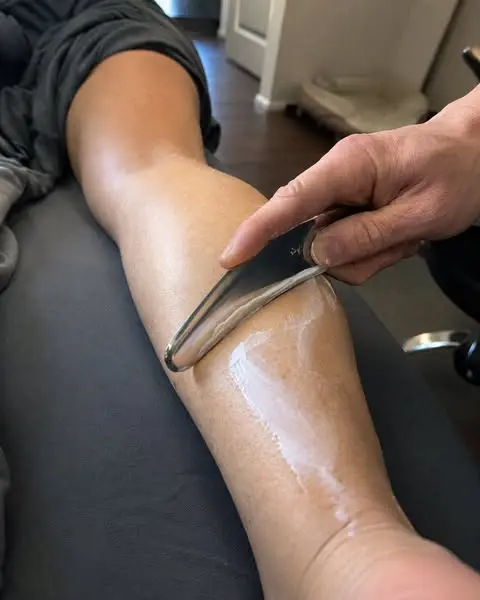
Humans have been scraping their sore legs with tools for thousands of years.
Modern runners replaced it with a $600 vibrating gun.
One of those two things is backed by clinics today.
I'll give you a second to guess which one.
...
If you guessed the gun, the sleek one, the one with the app, the one that sounds like a power drill at 5 a.m., I understand why. That's the one they sold you. That's the one I watched a thousand runners carry into my clinic like it was supposed to save them.
I'm a sports physiotherapist. Eleven years on the inside.
And I need to tell you something I wasn't allowed to say while I was billing your insurance.
The thing in your closet that died three weeks after the warranty? It was never built to reach the part of your leg that's actually hurting you.
Not because it's a bad machine, but because it's aimed at the wrong layer.
I knew that. Every clinician I trained with knew that. We just weren't permitted to bill for the thing that does reach it, so we handed you a foam roller, a stretch sheet, and a $60 copay, and we booked you for next Tuesday.
And the whole time, sitting in a drawer in every serious sports medicine room in the country, was a tool so old the Greek Olympians used a version of it in 776 BC.
I'm about to show you both tools. The ancient one and the expensive one.
And I'm going to tell you exactly why the recovery industry needs you to keep buying the wrong one.
Let me describe your morning. Tell me how close I get.
Before your feet hit the floor, you run the inventory. Shins. Achilles. Heel. Calves. You do it without thinking now. It's the first thing your body says to you every day, before coffee, before anything.
Then you stand up.
And the first fifty steps to the bathroom feel like walking on a piece of Lego. A knife in the heel. You've stopped mentioning it to anyone, because what's left to say?
You've tried everything. I mean that literally, because I've seen the closet.
The foam roller. The textured one and the smooth one. The lacrosse ball that bruised you. The compression sleeves. The TENS unit with the pads that won't stick anymore. And the gun. The $600 gun that pounds the skin and never once reached the knot, the one you keep "coming back to in a day or two," which is a quiet way of admitting it only works after the pain already left on its own.
None of it fixed anything. It just took turns making you feel like you were doing something.
So you booked the physio. You did the responsible thing.
Forty, sixty, seventy-five dollars a visit. Two, three times a week. Seven hundred dollars a month, some months. For twelve real minutes of a therapist whose attention was split with the patient in the next room, and a sheet of stretches you could've found on YouTube for free.
And then one day, and you remember the exact appointment, your therapist looked at you with that practiced softness and said the sentence.
"Have you thought about whether marathons are still right for your body?"
You drove home from that one. I know what that drive is like, because I'm the reason a hundred people took it.
Maybe you sat in the car afterward. Maybe your shins clicked the whole long run and you knew, really knew, another training cycle was about to drain out of your legs. Maybe somebody at home asked, gently, whether running is even fun for you anymore, or just a list of body parts you're managing now.
And you didn't have an answer.
Here's what nobody in my position will tell you to your face.
You weren't failing. You weren't too old. You weren't soft.
You were treating the wrong layer of your own leg, because every tool you were handed, including the one I handed you, was built for the wrong layer on purpose.
Let me show you which one.
The wrong layer has a name. It just isn't muscle.
For your whole running life you've been sold the muscle story. Sore muscle, pound the muscle. Tight muscle, roll the muscle. Every device in that closet is a muscle device.
But the thing seizing up your calf at mile one isn't muscle.
It's fascia.
Fascia is the thin connective webbing that wraps and separates every muscle in your body. When it's healthy, those layers glide over each other like wet silk. When it's damaged, they stop gliding. They stick. They dry out and adhere, like a film of glue dried between two sheets of paper.
I started calling it Fascia Glue, because that's what it behaves like.
And here's the part that should make you angry.
You can pound glued sheets of paper with a vibrating gun all day. You can stretch them. You can ice them. The glue does not break. You cannot vibrate your way through an adhesion any more than you can shout a stuck door open.
That's why nothing worked. Not because you didn't try hard enough, but because every tool you owned was aimed at the muscle, and the damage was one layer deeper, in tissue none of those tools were ever engineered to touch.
I want to be honest about how I know this.
I knew it because I watched it not work, for eleven years, on hundreds of runners I genuinely wanted to help. I learned the protocol that does reach fascia in my training. And then I learned the part they don't print in the brochure: the insurance codes wouldn't pay for it. So I couldn't bill it. So I didn't offer it. I offered the stretches that were billable and booked you for Tuesday.
That's the confession. That's the thing I wasn't allowed to say in the treatment room.
Now, the tool.
To work on fascia, you don't pound it. You scrape it. A smooth, contoured edge drawn across the tissue creates a shearing force that the glue actually responds to. It has a clinical name now: IASTM, or Instrument-Assisted Soft Tissue Mobilization.
But it isn't new. It's the oldest recovery method humans have.
The Greek Olympians scraped their legs clean with a curved bronze tool called a strigil, after every training session, in 776 BC. Han Dynasty healers were scraping tissue with smoothed stone four thousand years before that, and the Chinese word for it literally means "to scrape away disease." In the 1990s a frustrated athlete named David Graston, who couldn't fix his own knee with the therapy on offer, machined his own scraping tools out of steel, and the technique came roaring back into elite sports medicine under his name.
Five thousand years of humans scraping sore legs. Then, about thirty years ago, a corporation handed you a vibrating gun instead and told you that was the upgrade.
It wasn't an upgrade. It was a detour. And it was a profitable one.
So, the question your hook asked. Which of the two tools is backed by clinics today?
It was never the gun.
But here's where I'll stop you before you order a $19 scraper off Amazon and email me an angry review.
Because raw scraping alone, cold steel on dry tissue, has two problems. It can bruise you, and it can only do one of the four things fascia actually needs to let go.
This is the piece I spent two years working out after I quit.
Dried glue doesn't respond to force. It responds to heat. Warm an adhesion and the fascia softens at the molecular level, and now the scraping edge slides through tissue that would've fought a cold tool. So the scraping needed heat built in.
It needed the muscle underneath woken up, too, with real electrical activation to pull blood and lymph back into a region that's been starved and stiff. Not the surface tingle of a TENS pad, but the deeper cellular activation elite sports science has used for decades.
And it needed micro-vibration, not as the main event, but as the thing that lets the edge penetrate the fascia without breaking the skin. Vibration is what makes a scraping tool safe to use on your own legs, at home, every day.
Scrape. Heat. Activate. Vibrate.
Four mechanisms. Each one documented on its own. None of them, until now, stacked into a single tool a runner could hold in one hand.
That's the RunnersBlade.
It's the protocol I couldn't bill you for, the one sports clinics charge two hundred dollars a session to deliver, built into a medical-grade tool you run over a shin or a heel for eight minutes, in your kitchen, before anyone else is awake.
I didn't build a better massage gun. I refused to build another massage gun. I built the thing the massage gun was distracting you from.
Now picture the part that actually matters to you. Not how it feels while it's running, because every vibrating toy feels fine for ten minutes. I mean the next morning.
You run the inventory before your feet hit the floor, the way you always do.
And the first step doesn't have the knife in it.
The fifty-step limp to the bathroom is just walking. The shins don't click on the long run. The calves don't show up like concrete at mile one. You catch yourself, three weeks in, realizing you haven't done the morning inventory at all, because you forgot to be afraid.
That's not a recovery product. That's the thing you've actually been trying to buy this whole time: the next race you don't have to pull out of. The bucket-list start line you reach without dread. The quiet, private proof, to the spouse, to the rival, to the therapist who told you to quit, that you were right not to.
You get to be the runner who didn't get old. The one still lacing up at 70, at 75. The one who dies with their shoes on.
You weren't trying to fix a leg. You were trying to keep a life.
I know what you're doing right now. You're a skeptic with an open wallet. You've been burned enough times that hope itself feels expensive.
Good. Stay skeptical. Let me answer the things you're already thinking.
"It's just a fancy massage gun." No. A massage gun does one thing, which is vibrate the muscle. This does the one thing a gun can't: scrape the fascia, and it heats and activates the tissue while it does. Different layer, different mechanism. That's the whole point.
"Theragun didn't work, so why would this?" Because Theragun was aimed at the layer that was never the problem. You're not buying a better version of the thing that failed. You're buying the thing it was pointed away from.
"Will it hurt? Will it burn me? Is the EMS safe?" It's built for daily home use. The vibration is what lets the edge work without bruising, and the heat is warm, not scalding. Like any tool with heat and electrical stimulation, there are people who shouldn't use it without a doctor's sign-off. If you have a pacemaker, are pregnant, or have an open injury or stress fracture, talk to your physician first. That's not fine print. That's me being the clinician I still am.
"It'll die after the warranty like my last one." It's zinc-alloy, medical-grade, and it ships with a 2-year warranty. Not a charging-stand-replacement runaround, but a real one.
And now the listen-to-the-runners part, because my word isn't the point. The next morning is.
The masters runner, 14 weeks out from a race he refused to miss, who messaged me that he ran the inventory one morning and there was nothing on the list. The woman who'd limped to her bathroom every morning for over a year and forgot, for the first time, to be scared of the floor. They never talk about how it feels during the eight minutes. They talk about waking up. That's the only review that's ever mattered in this sport.
So here's the math you already know how to do.
You've spent four hundred, eight hundred, twelve hundred dollars on the closet. Seven hundred dollars in a single month on copays for stretches and a shrug.
The RunnersBlade is less than the cost of three of those copays. It comes with a 60-day money-back guarantee. Use it every morning for two months, and if you still run the inventory and find the pain on the list, send it back and pay nothing.
That means there's no gamble left here. The only thing the guarantee costs you is finding out.
But I want to be straight with you about the real decision, because it isn't really about a tool.
Doing nothing isn't staying neutral. You know that. Doing nothing is choosing the next lost cycle. The next start line you watch from the couch in a boot. The slow slide toward the morning your body finally makes the choice for you, and you become the one in the run club everybody quietly stopped expecting to see.
You've watched that happen to someone. You swore it wouldn't be you.
This is the part where you get to be right.
Try the RunnersBlade for 60 days. Run the morning inventory. If the pain's still on the list, send it back.
You're not buying a recovery gadget. You're buying back the next decade of mornings, and the only thing standing between you and the first quiet one is the eight minutes you haven't tried yet.
Lace up. We're not done running.