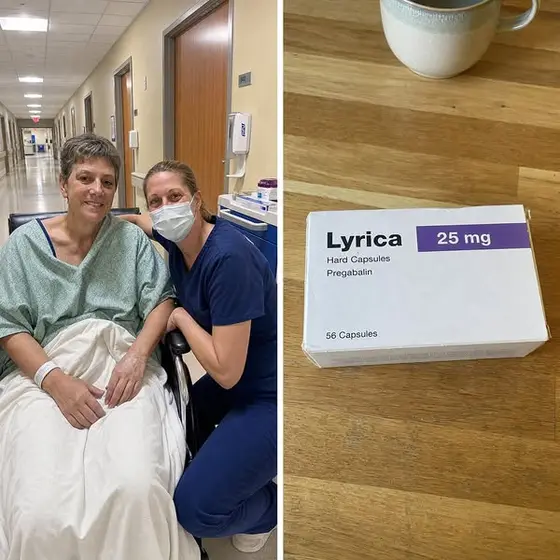
I'm a nurse and I've been handing fibromyalgia patients the same prescription pad for 22 years. Last month I refused to take anything from it myself.
I want to explain why. Because there's something I've been unable to say in my professional capacity for more than two decades. And until four months ago, I kept my mouth shut.
I'm not keeping it shut anymore.
My name is Elizabeth. I work in internal medicine and pain management at a hospital I'm not going to name. 22 years on the same floor. I have sat in more rooms than I can count while doctors told fibromyalgia patients their pain was "centrally mediated" and "best managed with lifestyle modification," which is medical language for we don't know what's causing this and we're out of ideas, but we're not going to say that out loud.
I have watched those patients leave with a new prescription and the specific kind of defeat that comes from asking for help and being handed something that won't actually help.
The first few years, I told myself the medications were doing something. By year ten I stopped telling myself that. By year fifteen I started keeping count.
I'm not going to share the number because it would sound like I'm making it up. Just trust me when I say it's a lot of people. A lot of women in their forties and fifties. A lot of patients who showed up willing to do whatever they were told. All of them on Lyrica or duloxetine or amitriptyline. All of them with pain scores their charts called "managed." All of them still quietly disappearing from their own lives anyway.
And I never said anything.
I want to be honest about that. You might be reading this and thinking I'm some kind of whistleblower. I'm not. I'm a nurse who took an oath, who has a license to protect, who has a mortgage, and who has been told since her first year on the floor that her job is to support the treatment plan, not question it.
That's not a metaphor. That's a real rule with real consequences.
When a doctor prescribes Lyrica for a fibromyalgia patient, my job is to explain the dosing schedule and hand over the discharge paperwork. If the patient asks whether I think it will help, I'm allowed to say their doctor knows best. I am not allowed to say what I actually think. I'm not allowed to tell them what I've seen. I'm not allowed to mention the patient from last month who's been on the same drug for six years and still can't get through a grocery run without sitting down on the floor.
If I do, I'm out of a job. Possibly out of a career.
So I learned to nod. To explain the side effect profile. To go home and try not to think about it. And then I'd come back the next shift and do it again.
That was the deal I made for 22 years.
Then last spring, a 44 year old woman I'd known for three years died by suicide.
She had fibromyalgia. She'd had it for eleven years.
She wasn't depressed when I first met her. She was frustrated. There's a difference, and I've spent enough years in this work to know what that looks like on a person's face. She was a kindergarten teacher. She had a husband and two daughters and a vegetable garden she talked about constantly. She wasn't someone whose life had fallen apart. She was someone whose body had stopped cooperating and nobody could tell her why.
Lyrica for two years. It blunted the pain enough that she could function but left her so foggy she said she felt like she was teaching through a window. They added duloxetine. The fog got worse. They tried amitriptyline for sleep. She gained weight. The pain came back anyway.
By the third year I knew her, the frustration had become something quieter. More settled. The kind of quiet that scares me more than frustration does.
She left a note that said she was tired of being told she wasn't trying hard enough.
I watched her husband bring their daughters to the funeral. And I couldn't hold up my end of the deal anymore.
Let me tell you what I've watched in 22 years before I get to what happened to me.
A 51 year old school principal. Fibromyalgia for eight years. Four medications, two pain management programs. She described her pain as something she'd made peace with because fighting it had cost her too much. She came in for a routine follow-up and mentioned almost in passing that she'd stopped driving at night because the cognitive fog had gotten to the point where she didn't trust herself after dark. She was 51. She said it the way you'd mention switching coffee brands. Like it was just the next thing to accept.
A 47 year old physical therapist who treated other people's pain for a living and couldn't manage her own. Four years on duloxetine. She said the most honest thing I'd heard in a long time: "It makes the pain quieter but it doesn't make it stop. And the quiet version of constant pain is still constant pain." Her doctor had recently suggested she consider whether her expectations for recovery were realistic. She asked me in the hallway whether I thought she'd ever feel like herself again. I told her I hoped so. I didn't say what I actually thought. I never did.
That was the deal.
Four months ago the deal ended.
I'd been having symptoms I recognized and didn't want to recognize. Pain in my shoulders and neck that moved without a clear cause. Sleep that left me more tired than before I went to bed. A heaviness in my thinking I kept blaming on shift work. Mornings where my body felt like it was operating through something thick.
I ignored it for two months. Then I couldn't anymore.
I went to my own doctor. She ran the standard panel, checked my thyroid, ordered an ANA. When everything came back normal she said the words I had heard a hundred times from the other side of the room.
"It could be fibromyalgia. I'd like to refer you to rheumatology, and in the meantime we can try a low dose of duloxetine to take the edge off."
22 years of nodding and smiling collapsed in about four seconds.
I drove home and sat at my kitchen table and I cried. Not because I was scared of the diagnosis. Because I knew exactly what came next. The referral. The prescription. The adjusting of expectations. The deal, now pointed directly at me.
I let the referral sit. I told my husband I needed time. He knows what I've watched for 22 years. He didn't push.
That week I did what I'd never allowed myself to do as a working nurse. I started reading. Not the clinical guidelines. Not the drug company literature. The original studies. The research buried in journals that never makes it to the floor because it complicates the story you're being paid to tell.
And I learned something I now cannot believe I didn't know.
The pain in fibromyalgia was never the problem. It was always a symptom of something nobody was addressing underneath.
I want to say that again because it took me a week to sit with it. The pain was never the thing to treat. The mechanism generating it was. And not one drug in the standard fibromyalgia protocol is built to touch that mechanism.
Here's what's actually happening.
Your nervous system has a volume dial. Under normal conditions pain signals travel from your body to your brain and arrive at roughly the right volume. A moderately painful thing feels moderately painful.
In fibromyalgia that dial has been turned up. The nervous system becomes hypersensitized. Pain signals arrive and get amplified beyond what the original signal warranted. A light touch feels like pressure. Pressure feels like pain. This isn't imagined. It's a nervous system wound so tight that normal input registers as distress.
The name for this is central sensitization. And it is driven by neuroinflammation.
Chronic inflammation in the central nervous system changes how pain is processed. A neuropeptide called substance P amplifies pain transmission and has been found consistently elevated in fibromyalgia patients. The higher the neuroinflammatory load, the higher the substance P, the higher the volume dial, and the harder it becomes for the body to turn it back down.
Then there is cortisol.
Cortisol is your body's primary inflammation regulator. In a healthy body it follows a rhythm. High in the morning, declining through the day, suppressed at night so restorative sleep can happen. That rhythm is how your body checks its own inflammatory activity. When it breaks, the neuroinflammation runs unchecked.
In fibromyalgia patients the cortisol rhythm is consistently dysregulated. Flat. The morning surge that should activate the anti-inflammatory response doesn't arrive properly. Neuroinflammation keeps running. Substance P stays elevated. The volume dial stays up.
Lyrica blocks pain signals partway up the line. Duloxetine adjusts the neurotransmitters that modulate how pain is processed. Both work downstream of the mechanism. They quiet some of the noise. They don't address the neuroinflammation generating it or the cortisol dysregulation allowing it to persist.
That's why they help but don't resolve. That's why patients describe being functional but not well. The dial got turned down a few notches. It never got fixed.
I had tried other things before I found what I'm about to tell you. Magnesium because it supports sleep and nervous system regulation. Doesn't address the neuroinflammatory load. Omega 3s because they reduce some circulating inflammation. Don't reach the central nervous system meaningfully. Turmeric because it's been marketed for inflammation for years. Doesn't move substance P or cortisol rhythm. Everything worked somewhere downstream. Nothing worked at the source.
I was two days away from making the rheumatology appointment when I found a series of peer-reviewed papers I hadn't known existed.
They were on earthing. Grounding. I'd heard the word and filed it the way most clinicians do. Not serious. Keep moving.
But these weren't blogs. They were published studies in journals I recognized, by researchers with institutional affiliations, with methodology I could evaluate. So I read them.
What they described stopped me completely.
The Earth carries a continuous negative electrical charge on its surface. A real measurable charge maintained by the planet's electromagnetic activity. For virtually all of human history, human bodies were in constant direct contact with it. Bare feet on soil. Sleeping close to the ground.
In the last century we insulated ourselves from it almost entirely. Rubber soles on every shoe. Elevated beds. Synthetic flooring.
That matters because chronic neuroinflammation is sustained by an excess of positively charged free radicals. These unstable molecules maintain inflammatory activity by stealing electrons from whatever they contact. In a grounded body, free electrons from the Earth are continuously available to neutralize those free radicals before they cause damage. The inflammatory activity quiets because its fuel is being removed.
That was the first part. The second part was cortisol.
Multiple studies on grounded subjects showed normalization of the cortisol rhythm. The flat dysregulated curve that fibromyalgia patients show started behaving the way it was supposed to. The morning surge returned. Nighttime suppression deepened. Subjects entered deep restorative sleep faster and stayed in it longer.
When cortisol normalizes, the body's own anti-inflammatory regulation comes back online. Substance P levels come down. The volume dial eases. Pain signals start arriving at something closer to their actual volume.
Grounding was addressing both drivers at once. The free radical load sustaining the neuroinflammation and the cortisol dysregulation preventing the body from regulating it. Not downstream. At the source.
I sat at my kitchen table at 1 AM and I thought about the kindergarten teacher.
She was on three medications for eleven years. They quieted the signal. Nobody addressed what was generating it. And she died believing she wasn't trying hard enough.
The thing that could have addressed it was electrons. From the ground. Available every night while she slept. And nobody told her.
That was when I stopped being a quiet nurse.
I ordered a GroundingWell sheet the next morning.
GroundingWell sheets are made from organic cotton with pure silver fiber woven directly into the fabric. Not a surface coating. Not something that washes away. The silver is in the weave, which means the conductivity is uniform across the entire surface and doesn't degrade over time. Silver is one of the most electrically conductive natural materials there is. The sheet connects through a grounding cord to the ground port of the wall outlet, which runs through the home wiring to the grounding rod in the soil outside.
You are connected to the Earth's electron supply all night, every night, while you sleep.
I'm a nurse. I don't trust feelings. I trust numbers. So I started tracking pain levels every morning on a 1 to 10 scale. Sleep quality. Cognitive clarity. Energy by early afternoon. I treated it like a patient chart. Systematic. Written down. I gave it 90 days.
Then the phases started.
End of week one. Nothing I could point to. I noted the numbers and went to work.
Week two. Sleep first. Not that I slept longer. That the sleep felt like it had done something. For months I had been waking up carrying the same heaviness I went to bed with. I started waking up without it. Not every morning. But enough mornings in a row that I stopped thinking it was chance.
That is the first phase. The free radicals sustaining the neuroinflammation start getting neutralized. The cortisol rhythm starts to shift. You don't feel the chemistry. You feel the noise beginning to lift.
Week three. The shoulder and neck pain that had been a daily presence started having gaps. Hours where I'd realize it wasn't there and then notice I'd realized it. When you've had something constant long enough, its absence feels louder than its presence ever did.
Week four. My husband said I seemed less braced. His exact word. Like something I'd been holding in my body had started to let go.
That is the second phase. The neuroinflammatory load is coming down. Substance P easing. The volume dial turning down on its own for the first time.
By the end of the first month my morning pain scores had dropped from an average of 6 to an average of 3. I was reaching for ibuprofen roughly half as often. The cognitive fog was lifting enough that I could feel the difference between thinking clearly and thinking through something thick. I hadn't known there was still a gap to notice.
That is the third phase. The numbers actually move. Not because something forced the signal down. Because the mechanism generating it is being addressed at the source.
I went back to my doctor at four months with my tracking log. She looked at it for a long time. Then at me.
"You didn't take the duloxetine."
"No."
She asked what I'd changed. I told her everything. The central sensitization. The neuroinflammation and substance P. The cortisol rhythm research. The grounding studies. The GroundingWell sheet. The 90 days of tracking.
She was quiet the way doctors get quiet when they're recalibrating in real time.
Then: "Your presentation is significantly different than it was four months ago. Keep doing it and come back in six weeks."
No rheumatology referral. No prescription.
I sat in my car in the parking lot and thought about the kindergarten teacher's daughters at the funeral. About the physical therapist asking me in the hallway whether she'd ever feel like herself again. About 22 years of nodding and smiling and going home and trying not to think about it.
The thing driving their condition had a mechanism and an answer the entire time. Nobody told them.
That is the fourth phase. The free radical load stays neutralized. The cortisol rhythm holds. The neuroinflammation doesn't rebuild. The volume dial stays down. Not because a drug is suppressing the signal. Because the source has been addressed.
I cried in that parking lot because I was off the hook. And because every patient I'd watched disappear into their own life should have been off the hook too.
That's why I'm writing this.
I cannot keep nodding and smiling and handing people a prescription that quiets the signal while the mechanism keeps running underneath. I cannot keep watching patients adjust their lives smaller and smaller around a condition that nobody is actually treating at the source. I cannot keep doing this anymore.
If you have fibromyalgia and you've been told the best available answer is a medication that takes the edge off, I want you to read this twice. The pain is not the problem. The neuroinflammation and cortisol dysregulation generating it are the problem. And there is not a single drug in the standard fibromyalgia protocol built to address either one of them.
If you're on Lyrica or duloxetine and you're functional but you wouldn't call what you're doing living, you're not failing the treatment. The treatment is failing you. You are downstream of the mechanism and nobody is working upstream.
If you've tried every supplement on the shelf and none of it moved your pain scores, that's because none of it was reaching the neuroinflammatory source or restoring the cortisol rhythm that's supposed to regulate it.
Grounding addresses both. GroundingWell is the only product I found built to deliver it properly. Organic cotton with real silver woven into the fabric so the conductivity holds through every wash and doesn't break down over time. A grounding cord included. Setup is ten minutes.
They offer a 90 day money back guarantee. Track your own pain scores morning and evening. If nothing shifts in 90 days, send it back. In 22 years of nursing I have never seen a pharmaceutical company offer to refund your money if their drug doesn't work. Not once.
You still have time. You don't have to be the patient I couldn't say anything to.
👉 https://www.groundingwell.com/products/groundingwell-bedsheet
~ Elizabeth Porter, RN, Internal Medicine and Pain Management, 22 years
P.S. I want to be clear. I'm not telling you to stop your medications. That is between you and your doctor. What I am telling you is that those medications are working downstream of the neuroinflammation and cortisol dysregulation that are driving your condition. Nobody is addressing the source. That is what I found. That is what changed my numbers. That is why I'm writing this when 22 years of training tells me to stay quiet.
P.P.S. I told two nurses on my floor. Both had been managing fibromyalgia symptoms for years and had stopped talking about it because they were exhausted by not being believed. One of them messaged me last week. Her morning pain scores had dropped enough that she'd started walking her dog again before her shift. She hadn't been able to do that in two years. She said she didn't know how to explain what had changed. I told her she didn't have to explain it. The walk was explanation enough.
P.P.P.S. If you have someone in your life who has been told for years that fibromyalgia is something to manage rather than something to address, please show them this. Not because I'm certain it will work the same way it worked for me. Because they deserve to know what the medications they've been handed are not reaching. The source has been running the whole time. Someone should have told them years ago. I'm telling them now.