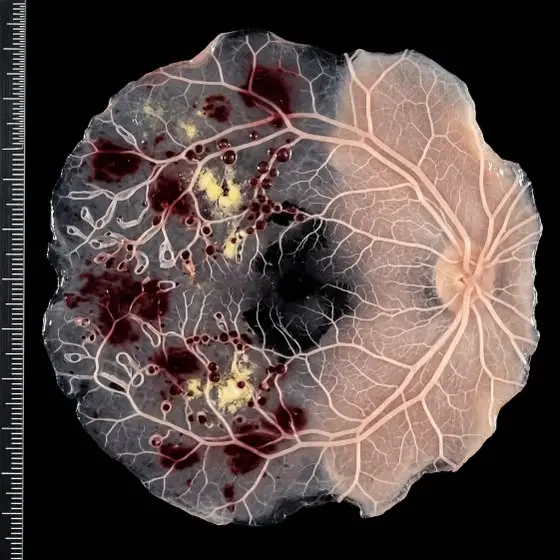
If you've noticed your vision getting blurrier every single month… not just tired eyes after a long day, actual blurring that stays no matter how much you rest, floaters drifting across your sight, or a dark spot forming right in the center of whatever you're looking at…
And your eye doctor ran a dilated exam, told you it's "diabetic changes in the retina," and sent you home with instructions to keep your blood sugar tight and come back in six months...
I'm about to tell you exactly what they're not telling you and why they'll NEVER give you the real answer.
And by the end of this, you're gonna be furious.
Because there are three things happening right now:
One…
Your eyes are sending you a distress signal that something is actively breaking down. And it has NOTHING to do with how well you're managing your blood sugar.
Two…
The medical system is gaslighting you into thinking this is just what happens when you're diabetic, that your scans are "mild background changes," that this is just something you monitor while it gets worse.
And three…
There's a multi-billion-dollar vision loss treatment industry that profits every single day your real problem stays hidden…
Because eye injections are a $13 billion industry and nobody makes money when you fix the upstream problem before you need their needles.
So let me tell you what happened with my mother.
Because her story is going to open your eyes to how broken this really is.
For THREE YEARS my mother Linda was watching her vision fall apart and every doctor she saw treated each piece in isolation while the whole thing crumbled.
She was 67 when she first noticed something wrong.
Sitting in her kitchen on a Sunday morning.
She picked up the newspaper and instead of the usual crisp black text, it was smeared.
Like someone had dragged a wet thumb across the ink.
A hazy blur right in the center of her vision.
She blinked. Rubbed her eyes. Looked again.
The blur was still there.
She thought it was a one-time thing. Tired eyes. Maybe she needed new glasses.
It wasn't a one-time thing.
Within two weeks it was every day. Morning. Afternoon. Under bright lights, in dim rooms.
Every single time she tried to read or focus on a face, the blur was there. Dense.
Persistent.
Refusing to clear.
She mentioned it to my father.
He said get new glasses.
She went to the optometrist and got a stronger prescription.
She was so careful about wearing them that she kept them on from morning until bed.
The blur: unchanged. If anything, worse — because now she could see the edges of everything sharply but the center was exactly the same, which meant whatever was causing it wasn't a focus issue.
She went to her ophthalmologist. The scans came back. Microaneurysms visible in both retinas.
Early leaking from damaged blood vessels. Her doctor looked at the images and said:
"You're showing signs of diabetic retinopathy. It's common in patients with type 2 diabetes. We'll monitor it every six months. Make sure you're keeping your blood sugar under control and staying on top of your A1C."
That was it.
No investigation into why a 67-year-old woman's retinal blood vessels were breaking down this quickly despite controlled blood sugar.
No assessment of what was driving the capillary damage producing the blur she was seeing every day.
No mention of the biological mechanism that was actively degrading her retinal vasculature — the microscopic blood vessels at the back of each eye that are supposed to nourish the photoreceptors giving you sharp, clear vision.
"We'll monitor it."
Monitor it getting worse. That was the plan.
The night vision went next.
Not just dimmer headlights.
Not the kind of glare where you squint and adjust.
This was a complete whiteout every time oncoming traffic passed — halos exploding off every light source, the road disappearing behind blinding starbursts that didn't clear. She'd been the one who drove everyone — grandkids to practice, friends to dinner, my father to his appointments.
Now she was making excuses to be home before dark because she didn't have the confidence to pull onto the highway after sunset.
My father noticed before she said anything. "You're different," he told her. "You won't go anywhere after five o'clock."
By month six: the floaters.
Dark specks multiplying across her field of vision like gnats she couldn't swat away. She'd be reading a recipe and a shadow would drift across the page.
She'd look up at the sky and see a swarm of dark threads swimming through the blue.
Her eyes looked the same from the outside — but inside, something was disintegrating and sending debris floating through her sight every waking moment.
By year one: the reading.
She'd always been a voracious reader — three books a week, crosswords every morning, handwritten letters to friends.
Now the words on the page were disappearing into a gray smudge.
Her ophthalmologist updated her prescription again.
Didn't connect it to the retinal vessel deterioration.
Didn't explain that the photoreceptors responsible for central detail vision were being starved of oxygen by leaking, damaged capillaries — and that without healthy blood supply, no lens on earth could bring those words back into focus.
A cycle nobody told her she was trapped in.
By year two: the retinal damage had progressed significantly.
Moderate nonproliferative diabetic retinopathy.
Her retina specialist — a new addition to her growing list of doctors — told her:
"We want to keep you off injections for as long as possible. Let's be aggressive with the blood sugar control and start monitoring you every three months."
Off injections. For as long as possible. Like it was a countdown, not a condition to reverse.
By year three: the faces.
She was the grandmother who never missed a thing — every smile, every scraped knee, every costume at the school play.
Now she was sitting in the front row and couldn't make out her own granddaughter's expression from ten feet away.
Her family started narrating things for her — gently, the way people do when they can see someone slipping.
Her world was shrinking. Not just the vision — her entire life.
She'd stopped going to her watercolor class because she couldn't mix colors accurately anymore. She'd stopped driving altogether.
My father said she looked ten years older than she was — not because of wrinkles, but because the light behind her eyes had gone out.
She told me once, sitting at her kitchen table, staring at her hands:
"I feel like my eyes are dying and everyone keeps telling me to manage my blood sugar better.
Nobody's asking why my eyes are still getting worse when my A1C is under control.
Nobody's trying to fix it.
They're all just watching me go blind."
Here's what she tried. And I need you to pay attention because you've probably tried most of this too.
Blood sugar management — metformin, then increased, then insulin added. Tight glycemic control reduces the rate at which high glucose damages retinal blood vessels, which slows the progression of diabetic retinopathy.
SLOWS.
Not stops. Not reverses.
Slows the rate at which her retina continued to deteriorate.
Her A1C came down to 5.7 — technically perfect. Her eyes continued their decline on their own schedule. Because A1C fights on Battlefield One — the bloodstream. It cannot reach Battlefield Two — inside the eye.
AREDS vitamins — the standard formula her ophthalmologist recommended. PreserVision, the blue box from the pharmacy. Her doctor confirmed what should be obvious: the AREDS2 nutrients provide baseline support for macular health.
They do absolutely nothing to stop the oxidative cascade actively destroying her retinal capillaries. They do nothing to address the damage happening on the second battlefield — inside the eye, behind the blood-retinal barrier. Her blur: unchanged. Her vessel leaking: still progressing. She was the most compliant patient with progressively failing vision you've ever seen.
Blue light glasses — wore them every minute in front of a screen. Her daughter-in-law bought her the most expensive pair she could find. The eye strain improved somewhat because blue light does irritate the retina. Her vision at the next check: deteriorated another line on the chart. Because blue light glasses reduce surface irritation. They don't address the capillary destruction happening deeper inside the eye.
Lutein supplements — generic capsules from the pharmacy shelf. The standard 10mg dose. Six months. Her vision test: unchanged. The lutein content was likely too low to rebuild meaningful macular pigment density — and without zeaxanthin and meso-zeaxanthin alongside it, the single carotenoid couldn't form the complete protective shield her retina needed.
Sunglasses — her retina specialist emphasized UV protection to slow oxidative damage from sunlight. She wore prescription polarized lenses every time she stepped outside. It reduced one source of photooxidative stress on her retina.
It did nothing to the internal oxidative cascade destroying her retinal blood vessels from within.
Bilberry capsules. Fish oil. Turmeric from the health food store — the ones with 95% curcuminoids on the label but no bioavailability enhancer, which means the curcumin passed through her gut largely unabsorbed.
Four hundred dollars of supplements across two years that looked good on paper and changed nothing in her vision tests.
Between the retina specialist visits, the optometrist visits, the blood sugar medications, the AREDS vitamins, and the supplements — she'd spent over $8,000 across three years.
Vision: still declining. Blur: every day.
The countdown to injections: still running.
At this point I'm not frustrated anymore. I'm angry.
Because I'm watching my mother — who is doing everything right, following every protocol, spending thousands — get worse while her doctors manage her retinal destruction with one intervention layered on top of another, each addressing a downstream symptom while the upstream cause runs completely undisturbed.
And that's when I started asking the questions nobody wants you to ask:
Why are her retinal blood vessels leaking?
What is physically degrading the microscopic capillary walls that are supposed to hold blood and fluid inside the vessels and out of her retina?
Why is her vision declining year over year despite perfect A1C numbers, AREDS vitamins, and UV protection — all of which are supposed to slow progression?
Why does every intervention her doctors prescribe address what's happening AFTER the capillary is destroyed — but not one of them addresses what's destroying the capillary?
What is the actual biological mechanism destroying her retinal tissue?
And why does NOBODY ever talk about it?
So I went looking. Not wellness blogs. Not supplement company marketing.
Peer-reviewed research on retinal capillary degradation, blood-retinal barrier integrity, and the biochemical cascade driving chronic diabetic vision deterioration.
And I found something that made everything click.
The retina processes approximately 10 million pieces of visual information per second through roughly 130 million photoreceptor cells — each fed by a network of microscopic capillaries so delicate they're only one cell thick, with walls so precise they allow oxygen and nutrients through while holding back blood cells and fluid.
When those capillary walls are intact, blood stays in the vessels. Clear vision.
When those capillary walls are damaged — when the endothelial cells break apart, when the structural proteins that hold the vessel walls together degrade — blood and fluid begin leaking into the retinal tissue. That's the blur. That's the dark spot. That's what you're seeing every time you try to read or look at a face.
But here's what nobody tells you:
Your A1C measures the sugar in your blood. But the damage to your eyes isn't happening in your blood — it's happening inside the eye itself, behind a wall your blood sugar simply can't reach.
That's why you can do everything right, bring your A1C down to a perfect 5.7 — and still sit in the chair and hear "there's new leaking." It feels like a punishment. It feels like you failed. You didn't.
The one thing no one explained: there are two battlefields.
Your insulin, pills, diet and finger-sticks all fight on the first one — your bloodstream. But the leaking, swelling and bleeding happen on the second battlefield, deep inside the eye, where nothing in your current treatment was ever built to go.
You haven't been losing. You've been fighting in the wrong place.
Specifically: the accumulation of reactive oxygen species — ROS — inside the retinal tissue itself. Free radicals that are chemically attacking the endothelial cells of the retinal capillary walls, corroding the vessel structure, destroying the blood-retinal barrier that keeps fluid out of the macula, and triggering a chronic inflammatory cascade that recruits immune cells which cause further damage as they attempt to clean up the oxidative wreckage.
The retina is among the most metabolically active tissue in the body. It processes enormous amounts of light energy through tiny, oxygen-hungry photoreceptor cells every waking second. This makes it extraordinarily vulnerable to oxidative damage — more so than almost any other tissue. And in diabetic patients, chronically elevated glucose has already weakened the vessel walls — making them exponentially more vulnerable to oxidative destruction even after blood sugar normalizes.
As you age — as your antioxidant defenses naturally decline — the oxidative burden on the retina begins to exceed the body's ability to neutralize it. The capillary wall proteins oxidize. Degrade. Lose their structural integrity. The vessels leak. Fluid pools. Vision blurs.
And it accelerates.
Because once the capillary wall is damaged, the inflammatory response it triggers produces more reactive oxygen species.
Which cause more vessel damage. Which triggers more inflammation.
A self-amplifying destruction cycle that runs inside the retina — getting worse month by month while your doctor measures the result (declining visual acuity, increasing retinal hemorrhages) without addressing the cause (oxidative degradation of the retinal vasculature).
Let that land for a second.
Your A1C does nothing to neutralize reactive oxygen species attacking the retinal capillaries. It manages glucose in the bloodstream — Battlefield One. It does not reach the oxidative cascade destroying your vision on Battlefield Two — inside the eye itself. That's why you can bring your A1C down to a perfect 5.7 and the blur doesn't change. That's why your doctor says "there's new leaking" even when your numbers are perfect.
AREDS vitamins provide baseline carotenoid support to the macula. They do not stop the oxidative cascade once it's already running. They do not repair the damaged capillary walls already leaking. They manage a nutritional deficiency while the oxidative destruction continues.
Blood sugar medications reduce the glucose-driven damage to retinal blood vessels, which slows the rate at which new capillaries are compromised. They do nothing to the oxidative process destroying the ones already damaged from within. That's why vision still declines on medication — just more slowly.
Every intervention she was given was downstream of the actual problem.
The oxidative degradation inside the retina was also driving everything else.
The night vision loss? The retina's rod cells are responsible for low-light sight. As retinal tissue is oxidatively degraded, the rod cells die first — they're the most metabolically demanding and the most vulnerable. Fewer rod cells. Less light sensitivity. Complete whiteout from headlights that no prescription lens can correct.
The floaters? Damaged retinal cells and leaking capillaries shed debris — dead fragments of photoreceptors and endothelial cells that break loose and drift through the vitreous fluid. Each dark speck you see floating across your vision is a piece of dead tissue from inside your own eye.
The central dark spot? The macula has the highest concentration of photoreceptors in the entire retina. When diabetic capillary damage starves these cells of oxygen and floods them with leaked fluid, the cone cells at the very center of your field of vision die first — because they're packed most densely and burn the most oxygen. Detail vision disappears. Which forces the remaining cones to work harder. Which exposes them to more oxidative stress. A cycle within a cycle.
The color fading? Damaged cone cells can no longer process the full spectrum of light wavelengths. As different cone populations die — red-sensing, green-sensing, blue-sensing — colors wash out, flatten, and eventually disappear. Your world is literally losing its color because the cells that create it are being oxidatively destroyed.
The headlight glare? Damaged retinal pigment epithelium can no longer absorb and recycle excess light properly. When bright light hits your retina, instead of being cleanly processed, it scatters through damaged tissue — creating halos, starbursts, and blinding glare. The oxidative stress that's destroying your photoreceptors is simultaneously wrecking the support cells that manage light processing.
She wasn't just diabetic. She wasn't just unlucky. Her retina was being oxidatively degraded — free radicals were chemically destroying the capillary walls and photoreceptors in a self-amplifying cascade that was blurring her vision, killing her night sight, filling her eyes with floaters, erasing faces, fading colors, and marching her toward blindness while every doctor she'd seen addressed the consequences without once targeting the oxidative destruction driving them.
And here's what made my blood boil.
The connection between oxidative stress and diabetic retinal degeneration is documented. The role of reactive oxygen species in retinal capillary destruction — independent of blood sugar levels — is in the research literature. It's published. It's replicated. It's cited in ophthalmology journals.
But the standard clinical protocol for diabetic retinopathy doesn't include a retinal oxidative stress assessment. Doesn't measure the specific biomarkers — macular pigment optical density, retinal antioxidant capacity — that would reveal whether oxidative degradation is driving the capillary destruction. Doesn't ask whether the ROS cascade can be interrupted before injections or blindness become the only options.
Because there's no pharmaceutical drug that normalizes oxidative stress inside retinal tissue specifically. You can't patent an eye-specific antioxidant protocol. There's no revenue in telling a diabetic woman that her blurring vision and declining eye chart scores are being driven by an oxidative cascade that specific botanical compounds can interrupt — even when her blood sugar is perfectly controlled.
There IS revenue in monitoring visits at $400 every three months. Blood sugar medications that slow progression without stopping it. Specialist referrals.
And eventually — when the leaking becomes diabetic macular edema or proliferative diabetic retinopathy, eye injections.
Every four to six weeks. $2,000 per injection.
For the rest of her life.
See how that works?
Manage each downstream symptom with a separate intervention. Never address the oxidative cascade degrading the retinal tissue that is generating every symptom. Keep her declining. Keep her returning. Until the needle becomes necessary.
So I kept digging.
Research on retinoprotective compounds. Studies on diabetic retinal oxidative stress reduction. Clinical evidence on what actually interrupts the ROS cascade in retinal tissue without pharmaceuticals.
And one specific combination of compounds kept appearing. Not in wellness content. In peer-reviewed ophthalmology and nutrition research.
Macular carotenoids — in combination with targeted retinal antioxidants.
Not the generic lutein from a drugstore bottle. Not a multivitamin with an eye health sticker. A specific combination of 15 compounds at clinical doses — specifically because of what they deliver together that no single ingredient achieves alone.
Three retinal carotenoids — Lutein at 20mg, Zeaxanthin at 2mg, and Meso-Zeaxanthin at 2mg — which are the ONLY nutrients that physically cross the blood-retinal barrier and embed directly into the macular tissue. They are the front-line defense on Battlefield Two — the only compounds proven to accumulate in the exact tissue being oxidatively destroyed. Most eye supplements include one carotenoid at half the dose. This delivers all three at clinical strength.
Alpha-Lipoic Acid — at 50mg — the one antioxidant studied directly for diabetic eyes and nerves that works in BOTH water-soluble and fat-soluble environments simultaneously. Not a single-phase antioxidant that only protects one type of cell structure. A dual-action compound that crosses into both the aqueous and lipid compartments of retinal cells — neutralizing reactive oxygen species in the exact tissues being oxidatively degraded, on both sides of the cellular membrane. The piece generic eye vitamins leave out entirely.
Astaxanthin — 6,000 times more powerful than Vitamin C at neutralizing singlet oxygen, the specific type of free radical generated by light energy hitting retinal tissue. Without adequate astaxanthin, the photoreceptors lose their ability to survive the constant oxidative bombardment they face every second your eyes are open. It crosses the blood-retinal barrier and stops the oxidative "rust" corroding fragile capillary walls from the inside.
Bilberry Extract and Ginkgo Biloba — anthocyanins that strengthen capillary walls from the structural level while simultaneously driving blood flow into the smallest retinal vessels. They modulate the inflammatory signaling cascade that amplifies oxidative damage within compromised retinal tissue. Strengthen the vessel walls and you interrupt the self-amplifying leakage cycle — the exact cycle driving diabetic retinopathy progression.
Saffron Extract, Taurine, and Luteolin — each targeting a different point in the oxidative destruction pathway. Saffron protects light-sensitive photoreceptor cells and improves their electrical signaling. Taurine shields retinal cells against light-induced damage. Luteolin calms the NF-κB inflammatory cascade that recruits immune cells causing secondary destruction.
Not one of these compounds alone. All fifteen. In a single formula. Working on different points of the same oxidative-inflammatory cascade simultaneously.
Not masking a symptom. Not slowing a decline. Interrupting the biochemical process that is actively destroying the retinal tissue — and giving the photoreceptors and capillary walls the raw materials they need to repair. Fighting on Battlefield Two — where the damage actually happens — for the first time.
My mother tried to find an eye formula that matched what the research described.
First: the bestselling one. Top of the Amazon results. Generic AREDS2 formula — PreserVision. Three months.
Vision test: dropped another line. Blur: unchanged.
Second: a health food store brand. "Clinical strength" on the label. $32 for a bottle. Two months.
Marginal improvement in her eye fatigue. Vision test: unchanged. Blur: unchanged. Floaters: unchanged.
She went back to the research. Read the dosing methodology.
The studies showing retinoprotective benefits and retinal oxidative stress reduction used all three carotenoids together — lutein, zeaxanthin, AND meso-zeaxanthin — at clinical doses, combined with specific antioxidants like alpha-lipoic acid and astaxanthin that cross the blood-retinal barrier.
She turned over both bottles.
Neither contained meso-zeaxanthin at all. Neither included alpha-lipoic acid or astaxanthin. Neither had more than 10mg of lutein.
She'd been taking the wrong formula at the wrong dose with the wrong combination for five months while her retina continued its decline.
And I'm reading through a diabetic retinopathy support group one night— she has another retina specialist appointment coming and her vision has dropped another half-line — and I see a man in the comments mention a company called Visiovance.
So I went to the site. Expecting to be disappointed.
And I nearly dropped my phone.
All three macular carotenoids — Lutein, Zeaxanthin, AND Meso-Zeaxanthin — the specific combination with the highest documented retinal penetration and protective effect in the research literature.
At 20mg Lutein per serving. Full clinical dose. Not the standard 5-10mg that every drugstore brand hides behind. The dose at which retinoprotective effects were actually measured in the AREDS2 trial and beyond.
Plant-based capsule designed for optimal absorption — taken with healthy fats to maximize carotenoid uptake, with every fat-soluble compound paired with its ideal cofactor for full bioavailability across the blood-retinal barrier.
Third-party tested. Every batch verified for carotenoid content, antioxidant potency, and purity. No proprietary blends. No mystery dosing. Every specification listed.
Not a generic eye supplement stacking lutein and zinc at doses that don't reach the retinal tissue. A precision-formulated retinoprotective formula that delivers 15 specific compounds shown in research to interrupt the oxidative cascade degrading the retinal tissue — at the doses and in the combination that actually allows them to cross onto Battlefield Two. The battlefield your blood sugar can't reach. The battlefield where your diabetic retinopathy is actually happening.
My mother started taking Visiovance.
After two weeks?
She called me on a Wednesday morning. "The blur is different. I know that sounds strange but it's lighter. Less dense. It used to be like looking through frosted glass. This morning I could make out the headlines on the newspaper. I sat there staring at the page."
The first visible sign that the oxidative assault on her retinal tissue was beginning to slow.
After three weeks?
"I drove to the grocery store at 6pm. The sun was low and I didn't even think about it until I was already in the parking lot. I don't remember the last time I went anywhere after dark without panic."
The carotenoids and astaxanthin integrating into the retinal tissue — interrupting the ROS cascade — allowing the surviving rod cells to function without constant oxidative assault. Better light processing. Better contrast adaptation. The crippling night-vision loss beginning to lift.
After four weeks?
The floaters. She was reading in her living room one afternoon and my father noticed before she did. "You haven't brushed at your eyes once," he said. She paused. Looked around the room. The dark specks that had swarmed her vision for two years — fewer. Fainter. The cellular debris from oxidative destruction — slowing. The retinal cells stabilizing instead of shedding fragments into her field of vision.
"I can see the clock on the wall from the couch," she told me. "I haven't been able to do that in two years."
After six weeks?
She picked up a medicine bottle and read the entire label. Fine print. No magnifying glass. Not from a new prescription. From her retinal photoreceptors beginning to restore their function as the oxidative assault on the capillary walls slowed, the leaking reduced, and the carotenoid shield rebuilt.
My father noticed and asked what changed.
After eight weeks?
"I read to the grandkids last night. The whole book. I didn't have to hand it to your father halfway through. Emma looked up at me and said Grammy can you see again? I almost cried."
The photoreceptor cells that had been dying under constant oxidative bombardment and oxygen starvation from leaking vessels — stabilizing as the antioxidant compounds reached the retinal tissue and the capillary walls strengthened. Her central vision emerging from the blur of damaged cells that had been disintegrating around her.
After ten weeks?
She went in for her three-month appointment. The one that had been a countdown for three years. The one where her vision dropped a line or two every time and her retina specialist's face got a little more serious.
She sat in the office. The retina specialist pulled up the scans.
Retinal hemorrhaging: reduced. Vessel leakage: decreased. Macular pigment density: increased.
He stared at the scan. Then at my mother. Then back at the scan.
"Your retinal scans have improved significantly. The leaking has reduced."
"Improved?"
"Your macular pigment layer is measurably thicker than three months ago. The microaneurysms appear stable — no new hemorrhaging. This is... this is not what I expected." Long pause. "Your visual acuity has also improved. You're reading two additional lines on the chart compared to your last visit. That's a significant improvement in central vision function."
"What does that mean?"
"It means whatever is happening to your retinal tissue — the diabetic damage has slowed, possibly reversed. The capillary walls appear more intact. The macular shield is... rebuilding."
My mother explained. Oxidative stress as the primary driver of diabetic retinal tissue degradation — independent of blood sugar. The ROS cascade amplified by NF-κB inflammatory signaling. The three carotenoids embedding in the macular tissue itself. The astaxanthin and alpha-lipoic acid neutralizing reactive oxygen species on both sides of the cell membrane. The bilberry strengthening capillary walls. The full antioxidant network interrupting the self-amplifying destruction cycle on Battlefield Two.
Her retina specialist was quiet for a long time.
"The role of oxidative stress in diabetic retinopathy progression — independent of glycemic control — is well-established in the literature. We don't have a pharmaceutical intervention that specifically targets it. We manage the downstream effects — leakage, swelling, vessel growth."
"There is an intervention," my mother said. "It's just not pharmaceutical."
Another long pause.
"Your improvement is clinically significant. I'd like to extend your monitoring interval to six months instead of three and recheck then."
Extend. Not add injections. Extend.
She walked to her car. Called me from the parking lot.
"Two extra lines on the chart. Vessel leaking reduced. Macular pigment rebuilding. He's pushing the next appointment to six months. Three years of decline and this is the first time — the first time — anything went in the other direction. And my A1C didn't even change. It was already at 5.7. It was never about the blood sugar."
I didn't say anything for a moment.
"Three years," she said. "Four doctors. $8,000. Every single one of them was watching my retina break down. None of them tried to fix the retina. They all just kept telling me to manage my blood sugar better — and my blood sugar was already perfect."
Total improvement at five months:
Visual acuity: improved by three full lines on the eye chart — enough to pass a driving test she'd been told she'd never pass again. Central blur: resolved. Clear, sharp central vision, no persistent haze, for the first time in over three years. Macular pigment density: measurably increased — back within healthy range for her age. Retinal hemorrhaging: stabilized — no new leaking on follow-up scans. Floaters: reduced by more than 80%. Barely noticeable. Night vision: restored enough to drive comfortably after dark with no glare sensitivity. Reading: returned to pre-decline baseline — books, recipes, medicine bottles, all without magnification. Color vision: brightened. Colors vivid and distinct again. Faces: clear from across the room — her granddaughter's expressions, the details she'd been missing for years, sharp and defined again. Monitoring interval: extended from every three months to every six months — her specialist saw no reason to watch it as closely.
Not from an injection managing the downstream consequence of retinal destruction.
From interrupting the oxidative cascade destroying the retina. Protecting the retinal tissue with barrier-crossing antioxidants that integrate directly into the cells. Fighting on Battlefield Two — where diabetic retinopathy actually happens — for the first time. Giving the eyes the biochemical raw materials to repair what had been degrading for years while everyone watched and told her to manage her A1C.
This is what they don't want you to know.
The second you interrupt the oxidative cascade driving your diabetic retinal degradation, you don't need their progression management. You don't need their "we'll monitor it every three months" while the vision drops line by line toward blindness. You don't need their injections fighting the downstream leakage effects of damaged capillaries that continue to degrade underneath.
The oxidative attack stops. The capillary walls stabilize. The blood stays in your vessels where it belongs. The blur disappears. The eyes recover function they'd been losing for years.
The way they would have — years ago — if someone had looked upstream of the eye chart number and asked what was chemically destroying the retina and why — instead of just telling you to manage your blood sugar better while the damage continued on a battlefield your A1C was never built to reach.
Now here's what you need to understand.
Photoreceptor damage doesn't wait for you to figure this out.
You don't regenerate photoreceptors. Once a photoreceptor is oxidatively destroyed beyond repair, it's gone. The remaining cells compensate — processing more light, working harder — which exposes them to MORE oxidative stress, which destroys THEM faster. This is why diabetic vision decline accelerates. It's not linear. It's exponential. And every month the oxidative cascade runs unchecked, you lose visual capacity you cannot get back.
The blur you're seeing isn't a minor annoyance. It's a real-time readout of retinal tissue being destroyed — photoreceptors dying and capillaries leaking every day the oxidative process continues.
The eye chart score your doctor checks every few months isn't just declining. It's declining at an accelerating rate because each lost photoreceptor increases the oxidative burden on the survivors.
And every intervention aimed at managing your blood sugar leaves the oxidative destruction inside the eye running unchecked on Battlefield Two.
So if you're dealing with ANY of this — blurring vision that won't clear no matter how tight your A1C is, an eye chart score that drops every time they check it, floaters multiplying by the month, night vision so destroyed you've stopped driving after dark, reading so difficult you've given up the books and recipes that made you you, faces you can't make out clearly anymore, colors fading from your world, a doctor who monitors your decline toward injections or blindness while telling you your blood sugar is fine — this is the time.
Not next year when the vision drops below legal driving limits and they start talking about injections. Not when blindness becomes "inevitable." Not when the photoreceptors you could have saved are gone.
Right now.
Visiovance 15-in-1 Advanced Eye Formula. All three macular carotenoids at full clinical doses. 20mg Lutein. Astaxanthin, Alpha-Lipoic Acid, Bilberry, Saffron, Ginkgo, Taurine, Luteolin, and full AREDS2 base. Designed specifically to fight on the battlefield your blood sugar can't reach. Third-party tested. Every batch verified. No proprietary blends. Every specification listed. Does not impact blood glucose levels.
90-day money-back guarantee. Use every capsule. If the blur doesn't clear, if the sharpness doesn't return, if you don't feel the difference in your vision — full refund. No questions asked.
Because your eye doctor isn't coming to investigate the oxidative cascade destroying your retina. There's no protocol for it. There's no pharmaceutical for it. There's no revenue in it. And your A1C — no matter how perfect it is — was never built to fight on the battlefield where your vision is actually being destroyed.
You have to fix this yourself.
👉 https://visiovance.com/products/visiovance-15-in-1-advanced-eye-formula