If you adopted a rescue dog who won't stop barking and lunging on walks — and you've started to wonder if you made a mistake adopting him — please read this first.
I'm Hayden. I'm 31, I'm a graphic designer in Portland, and my husband Dylan and I adopted our first dog together five months ago — a 2-year-old shelter mutt named Beans.
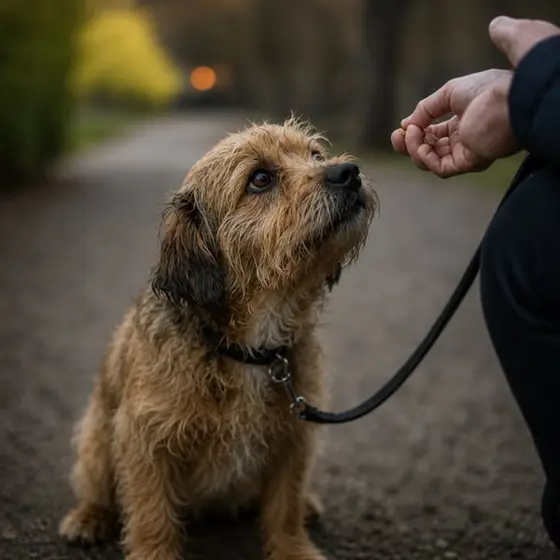
He's about 25 pounds, scruffy, looks like a stuffed animal with attitude. The shelter said he'd been there for almost a year.
We picked him because he came up to the kennel door and put his paw through the bars and looked at us like he'd been waiting. We love Beans more than I knew you could love a dog this fast.
But every walk with him is a nightmare.
Beans was anxious in the apartment for the first few days. He flinched when Dylan walked past him. He wouldn't eat unless one of us was sitting next to him.
But by the end of the first week, he started leaning against my leg in the evenings. He learned where his bed was. He started looking at us like we were his.
The walks were a different story.
The very first walk we took him on, another dog walked past us about three blocks from our apartment and Beans lost it.
I'd never seen anything like it in real life. I'd seen reactive dogs from a distance the way you'd see a stranger having a hard moment on the sidewalk — and walk past. I'd never been the person at the other end of the leash.
Beans went vertical at the end of the leash. Barking, lunging, every muscle locked.
The other dog's owner — a woman about my mom's age with a small white terrier — pulled her dog into someone's front yard to get away from us. She looked back at me as if she was checking I was okay. Or checking I was actually in control of the dog at the end of my leash. I wasn't sure which.
After that, every walk was a meltdown waiting to happen. Beans was barking at everyone and everything — every passing dog, every jogger, every kid on a scooter.
From week three, Dylan started doing all the walks because I'd started dreading them so much I couldn't get out the door.
At first we tried training. We hired a trainer and Dylan took Beans twice a week for six weeks — since I'd stopped doing walks by then, he handled all of it.
Beans listened. He learned the cues at home. He'd sit, stay, come — no problem.
Dylan even started carrying high-value treats on every walk to redirect Beans's attention the moment another dog appeared. It worked for about three seconds.
The moment Beans locked eyes on the trigger — another dog, a jogger, a kid on a scooter — the treats stopped mattering. He couldn't see them, couldn't smell them, couldn't hear Dylan. He went right back into the meltdown like none of the training had ever happened.
The trainer suggested prong collars or e-collars and being stricter with him, but Dylan didn't want to do that so we cancelled it.
After that I started looking at calming chews from the pet store. Two brands, both with melatonin as the active ingredient. From what I'd read, melatonin doesn't actually calm the barking — it just makes the dog drowsy.
I tried one anyway, out of desperation. Beans was sleepy in the apartment afterwards. On the walk that evening, he barked at the same dog at the same corner exactly the same way.
So we kept going. We tried a ThunderShirt. A no-pull harness. A pheromone collar. Two diffusers in the apartment. Dylan changed the walking routes.
Then he changed the walking times — out by six a.m., back before seven, again at ten at night when the streets were empty.
Nothing worked.
Last winter we took Beans in for his annual checkup and came home with a recommendation from the vet — trazodone before walks, and possibly Reconcile longer-term if things didn't improve.
We didn't even discuss it for very long. We'd both heard the stories — dogs on these meds who stopped barking because they stopped being much of anything. Sleeping more. Less curious. Dialed down.
The dog Dylan and I had at home — the one who leaned against my leg in the evenings, the one who put his paw through the kennel bars at us five months ago — was the entire reason we'd brought him home. We weren't ready to ask him to be less of himself just so he could be quiet on a walk.
But that was the whole list. Training. Treats. Chews. The shirt. The collar. The diffusers. The vet. And every walk was still a meltdown waiting to happen.
By month four I'd stopped enjoying anything that involved leaving the apartment with Beans. Dylan was doing every walk.
He came home one Tuesday with that look on his face you get when something just happened — a guy in our building had stopped him in the lobby to tell him "you need to control your dog" after Beans had gone off at his dog in the elevator that morning.
We'd already had two other neighbors in the building avoid us in the hallway. The dog mom in 3B who used to chat with me about Beans when we first moved in stopped saying hi. Our downstairs neighbor had left a note under our door about the barking when Beans saw something out the window.
Every walk Dylan came back from, I'd watch his face. The good days he'd shrug. The bad days he'd just sit on the couch with his coat still on for a while before he said anything.
We were both starting to feel like the bad neighbors in our own building.
About that time, Dylan and I were sitting on the couch one Saturday night. He brought it up first. He said, gently, the way you do when you're about to ask the question nobody wants asked: "Babe. Do you think we should call the rescue?"
The question I'd been turning over in my head every morning at six a.m. since Dylan had started doing the walks without me.
We had not been dog people six months ago. We had been people who had thought, in our early thirties, that maybe we were ready to be dog people.
Dylan had grown up with golden retrievers. I had grown up with a sister who was allergic and so no dog at all. We'd talked about it for months. We'd visited the shelter twice.
And then Beans had put his paw through the bars at us, and that had been that.
And here we were. Less than half a year in. Sitting on the couch on a Saturday night wondering if we'd made a mistake we couldn't undo.
The hardest part wasn't the logistics of returning Beans. The rescue we'd adopted him from had a return policy, no judgment, they'd take him back.
The hardest part was who that would make us. The people who'd given up on a dog they'd loved for five months because they couldn't figure out how to walk him. The people who'd posted his adoption photos on Instagram in October. The people who had told everyone we knew that we'd finally done it, we'd gotten our dog.
I went into the bathroom and cried with the door shut for twenty minutes.
When I came out, Dylan was on the floor next to Beans, scratching behind his ears the specific way Beans likes it. And Beans was looking at him like he'd been waiting his whole life for someone to scratch behind his ears that way.
We didn't make a decision that night. Dylan said, "Let me try one more thing this week." I asked what. He said he didn't know yet.
On Tuesday afternoon Dylan texted me at work. He'd called the rescue.
Not to return Beans. To ask if anyone there had ever dealt with a dog like him. The woman he spoke to, a volunteer named Mia who'd done Beans's home visit before we adopted him, stayed on the phone with him for almost an hour.
Mia told Dylan something nobody else had told us in five months.
"The barking and lunging on walks isn't a training problem," she said. "You can't train it out. It's a stress response. Some dogs' brains are naturally flooded with cortisol — the stress hormone — more than others. When a dog has cortisol levels constantly elevated, everything around them reads as a threat. They're not being bad. They're panicking. That's why they bark like that."
She kept going. She said that's why none of it had worked. The training. The treats. The shirt. The collar. The diffusers. All of them were aimed at the barking. None of them were aimed at the cortisol underneath driving it.
Beans had spent eleven months in a kennel before he came to us. His brain had been flooded with stress hormone for almost a year before he'd ever met us. Five months of being on our couch hadn't reset it. Nothing in our home was ever going to reset it on its own.
Then Mia told Dylan about something she recommended to other rescue adopters dealing with this. A way to actually aim at lowering the cortisol.
Melatonin-free calming chews called Doglette, made specifically for barking and reactive dogs. While every other solution is aimed at the barking — the symptom — this actually targets the root cause causing the barking. A natural solution without sedating or making the dog just drowsy.
Mia sent us a link to Doglette's site and told us to be patient. Because it's a natural solution, it actually takes time to work and lower the cortisol — at least two weeks. "Faster works only sedatives," she joked.
We looked at it together that night and we ordered it.
The chews arrived on Friday. Dylan gave Beans his first one Saturday morning — Beans took it like it was a treat.
The first week, nothing changed — just as Mia had said. Dylan came back from every morning walk with the same look. Beans went off at the same dogs at the same corners he'd been avoiding for months. The walks were still a nightmare.
Then around day twelve, Dylan came back from the morning walk looking different. He'd run into a small dog at the end of the block. Beans had started barking — and then he'd stopped. He'd stood. He'd looked. He'd given one more bark, mostly a warning, and then he'd looked at Dylan.
Dylan said in five months of walking Beans, Beans had never once looked at him while another dog was in sight. Not one time.
It wasn't a miracle. Beans still reacted to things. But Dylan kept coming back from walks with more to tell me. The explosions got shorter. The recovery got faster. The gap between Beans seeing a dog and Beans coming back to him kept widening.
Around week three I started coming on walks again. At first we went together, the three of us. Now I can take Beans out on my own.
I cried on the sidewalk the first time we walked past a beagle puppy and Beans gave it one bark and kept walking like it was nothing.
That was almost a year ago.
Beans still notices other dogs. He's a shelter mutt with a year of kennel running through him — that part doesn't just disappear. But he isn't barking at every dog on a walk anymore. He walks. He notices. He comes back to us. He greets dogs at the park instead of trying to launch through the fence at them.
We didn't give up. The version of us who would have done that — the version that almost did, on the couch in November — wasn't who we ended up being.
I'm writing this because if you can't even walk your dog around the block without them barking at everyone they see — please don't take five months to find what helped us.
You didn't make a mistake adopting them. They're not broken. They have a system stuck on high alert, and nothing you've tried so far has been pointed at the right thing.
This is what helped Beans:
👉 https://doglette.com/pages/calming-treats?_ab=0&key=1779295866685
— Hayden
P.S. If you order Doglette, give it two weeks before you decide it's not working. Mia said the same thing to Dylan when she sent us the link, and she was right — the first week we saw nothing. By day twelve Beans was a different dog on the leash. Worth knowing they have a 60-day refund window if it ends up not being for your dog... but I believe it will.
👉 https://doglette.com/pages/calming-treats?_ab=0&key=1779295866685