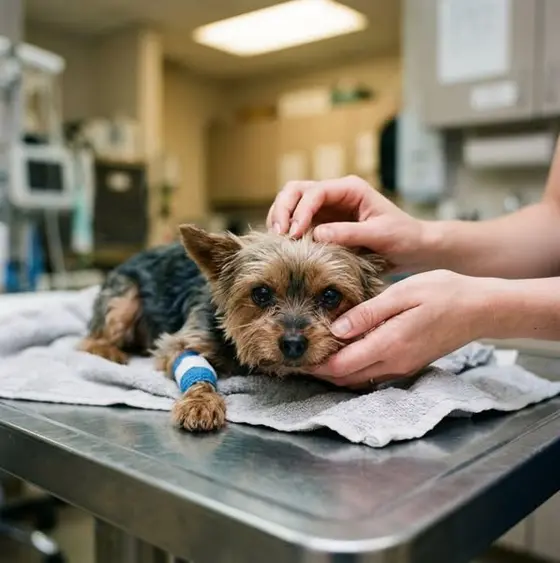
The word the vet used was "collapse." Tracheal collapse. I remember sitting in that small exam room with my Yorkie, Max, shaking on my lap, and hearing that word land in my chest like something final, something with a clear ending already built into it. Collapse. In my head, in that moment, it sounded like the kind of word you hear right before someone tells you there's nothing more to be done.
I genuinely thought I was about to lose him, not eventually, but soon, possibly that very week.
I want to walk you through that day, and then through everything I learned afterward, because I think a lot of Yorkie owners hear this exact diagnosis and feel exactly what I felt sitting in that chair, frozen, holding a trembling dog, certain the worst was already decided. I wish someone had been able to tell me, right then, what I know now, instead of letting me find it all out the slow, frightening way on my own.
Max had been honking for years by that point, this dry, goose-like cough that would come on when he got excited, or pulled a bit on his leash, or sometimes for no obvious reason at all, just out of nowhere mid-afternoon while he was lying on the couch. I had been told, more than once, at more than one routine visit, that it was probably just reverse sneezing, a common harmless quirk in small breeds, nothing to lose sleep over. So I didn't lose sleep over it. For years, honestly, I barely registered it as anything worth mentioning beyond a passing comment to my vet. Until the week it changed. The episodes started lasting longer than the usual quick burst. He seemed to be working harder to come out of them, his little chest heaving in a way that looked like real effort instead of a brief spasm. One evening he had one that didn't fully resolve for almost two full minutes, and I was in the car driving to an emergency vet before I'd even consciously decided to go, keys already in my hand before my brain had caught up with my body.
That's the night I heard the word collapse for the first time, attached directly to my dog, in a small fluorescent-lit room, with him trembling against my chest and me trying to hold completely still so he wouldn't feel how badly my hands were shaking too.
I went home that night and did exactly what I think most owners do in that exact situation. I opened my phone and started reading anything I could find, at the worst possible hour, in the worst possible emotional state, which is never, ever the way to absorb medical information calmly or accurately.
The first few things I read used words like progressive, and chronic, and irreversible, and I remember feeling like the floor had genuinely dropped out from under me with each new tab I opened. Progressive sounded like it only gets worse from here, no exceptions. Irreversible sounded like there was no fixing what was already broken inside him. I sat on my kitchen floor at one in the morning, dog asleep finally in the next room, convinced I was reading my own dog's obituary in advance, piecing together a future I hadn't actually confirmed with anyone qualified to tell me.
What I didn't understand yet, because panic is a genuinely terrible research assistant, is that there's an enormous, meaningful difference between a disease being chronic and a disease being a death sentence. Those are not remotely the same thing, and conflating them that night very nearly cost me weeks of completely needless despair before I calmed down enough to actually sit with what I was reading instead of just absorbing the scariest word on every page.
Here's what tracheal collapse actually is, explained the way I eventually came to understand it properly once I stopped reading alone at midnight in a panic and started asking real questions instead. The cartilage rings that hold a dog's windpipe open in a stable, reliable shape can weaken gradually over time in certain small breeds, Yorkies very much included, causing the trachea to flatten and narrow instead of staying open the way it's supposed to with every breath. That weakening is permanent in the specific sense that the cartilage itself doesn't simply heal back to its original firm shape on its own. But permanent does not mean untreatable, and it absolutely, definitively does not mean a dog can't go on to live a long, full, genuinely happy life with the condition properly understood and managed.
This was the piece that actually started to bring me back from the edge of that initial panic, the thing that finally let me exhale a little. Veterinary sources are remarkably consistent on this exact point, consistent in a way I desperately needed to hear that week and simply hadn't yet. The majority of dogs diagnosed with tracheal collapse, somewhere in the range of seventy percent or more by most estimates I came across, can be successfully managed with conservative, non-surgical treatment alone, nothing more drastic required. Weight management, carefully and consistently maintained. Switching from a collar to a harness to remove direct pressure from the neck entirely, permanently. Avoiding known triggers like extreme heat, secondhand smoke, and overexertion on hot days. Medication when episodes are more frequent or severe, specifically to help reduce airway inflammation and coughing when needed. Surgery exists for the most severe cases that genuinely don't respond to conservative management, but it is truly the exception rather than the rule for most dogs living with this condition, not the inevitable next chapter I had fully convinced myself it was that first terrifying night on my kitchen floor.
I also learned that dogs with mild to moderate tracheal collapse, managed appropriately and consistently, frequently go on to live completely normal lifespans for their breed, full stop. The condition affects quality of life day to day far more than it actually shortens that life, when it's properly understood and managed by an owner who knows exactly what to watch for and when to act. That specific distinction, quality of life versus length of life, was the thing I genuinely needed someone to say to me plainly that very first night, and nobody did, simply because I was reading alone on a kitchen floor at one in the morning instead of asking a calm, informed question to an actual vet during reasonable business hours the next day.
Once the panic finally faded enough for me to think with any real clarity, I went back to Max's vet with an actual written list of questions instead of just raw, undirected fear. We sat down and talked through a real, concrete management plan together instead of me silently assuming the absolute worst on his behalf at home. Harness instead of collar, immediately and permanently, no exceptions going forward. A careful, ongoing look at his weight, since extra pounds put direct additional mechanical pressure on an already compromised airway. A clear, specific list of warning signs that would genuinely mean a true emergency requiring immediate care, blue or pale gums, fainting, severe prolonged distress that doesn't resolve, versus the ordinary, manageable honking that simply needed monitoring rather than another frantic drive to the emergency room.
I also asked what else, realistically and practically, I could be doing every single day to support him proactively, not just react during episodes after they'd already started. That's when his vet and I talked through proactive airway support as part of his daily routine going forward, and after that specific conversation I went looking myself and found Weston Animal Co's Airway Support Soft Chews for Small Breeds online, formulated specifically for small breed airway health with Mullein Leaf, Elderberry, and Licorice Root, ingredients with real, documented histories in supporting clearer airways and calming chronically irritated respiratory tissue. I reviewed everything carefully with his vet first, specifically given his diagnosis and what we were already managing, and got a clear go ahead before actually starting him on them.
It has been a year and a half now since that terrifying night in the emergency room. Max is doing well. Genuinely, actually well, not in the cautious, heavily qualified way I half-expected to be writing about him a year and a half ago when I couldn't picture much past that first awful week. His episodes are shorter and noticeably less frequent than they were back then. He still does his little honk sometimes, and he always will, realistically, that part of his anatomy isn't going anywhere regardless of anything we do. But it no longer sends either of us spiraling into panic, because I finally understand what I'm actually looking at when it happens, and I know exactly what would genuinely tell me to worry versus what's simply part of living alongside this condition day to day.
If you have just been handed this exact diagnosis, or you're sitting up at one in the morning the way I once was, reading frightening words on a glowing phone screen and quietly convincing yourself the worst is already inevitable, please hear this from someone who has been exactly, precisely where you are right now. Tracheal collapse is a real, chronic condition that genuinely deserves to be taken seriously, and I am absolutely not telling you to dismiss it or downplay it. But it is not, for the overwhelming majority of dogs, the death sentence it can so easily sound like in that very first terrifying conversation in a small exam room. Ask your vet directly about a real, practical, concrete management plan. Ask specifically what conservative treatment actually looks like in practice before assuming surgery is the only path forward. Ask what genuine daily quality of life actually looks like for dogs managed well over time, because for most of them, it looks remarkably, reassuringly close to normal.
Max is asleep on my lap as I write all of this out, completely unaware of how much that one single word, collapse, once terrified me down to my core. I know so much more now than I did that night sitting alone on my kitchen floor. I wish I'd known it sooner, all of it, and I genuinely hope this finds someone who needs it before their own one in the morning.