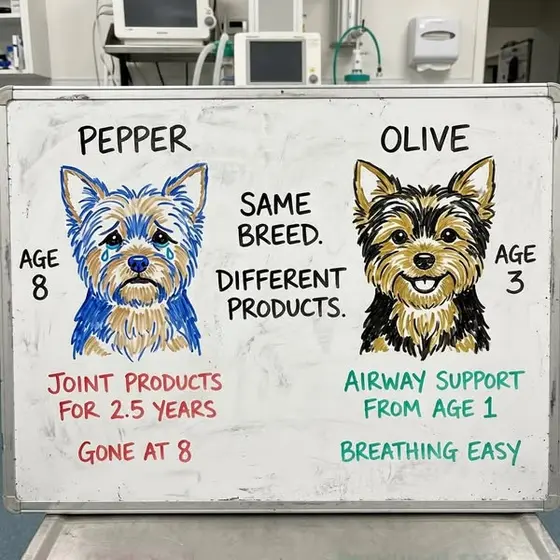
Dog Owners Support Group Facebook ad creative
weston-animal.co
Cough Suppressants Silence the Noise. Not the Collapse.
Shop now

Dog Owners Support Group Facebook and Instagram ad

Dog Owners Support Group ran this image ad since Jun 25, 2026, 135 days so far, targeting United Kingdom.

First seen
Jun 25, 2026
Running for
135 days
Format
Image
Call to action
Shop now
Niche
Skincare
Countries
1 targeted
Page likes
1,289

Ad copy

Your vet said "collapsing trachea, we'll manage it with cough suppressants." And you drove home feeling relieved. You filled the prescription. You adjusted the dosage. You kept him calm during episodes. You told yourself: we're managing this. I need to tell you something that's going to be uncomfortable. That relief you felt? That was the most dangerous moment of your Yorkie's life. "Manage it with cough suppressants" sounds like a plan. It is not a plan. It is symptom silencing. Not cartilage support. Let me explain. My name is Dr. Michael Reeves. I'm a board-certified veterinary internal medicine specialist in Austin, Texas. 11 years of practice. I specialize in respiratory conditions in toy breeds. I am not your regular vet. I am the person your vet refers you to when cough suppressants stop working and your Yorkie can't breathe. I see Yorkies every single week. More than almost any other breed for tracheal collapse. They are among the most predisposed breeds for this condition. That is not opinion. That is published veterinary literature. And almost every owner who walks through my door says the same thing: "But we did everything right. We gave the cough suppressant. We used a harness. We kept the weight down." I know you did. That is not why you're here. You're here because cough suppressants silence the honking. They do NOT rebuild the tracheal rings that are collapsing. Hydrocodone manages the cough reflex. It does not repair cartilage. Trazodone manages the anxiety during episodes. It does not strengthen the airway. Between vet visits, nothing was happening to support the actual tracheal cartilage. Nothing. Your Yorkie's tracheal rings were slowly flattening. And no cough suppressant in the world was going to change that. Here is what is happening inside your Yorkie's throat right now. The trachea is held open by C-shaped rings made of hyaline cartilage. Those rings give the airway its structure. When your Yorkie breathes, those rings keep the tube open. In collapsing trachea, those rings are softening. The collagen matrix that makes them rigid is breaking down. The C-shape is flattening. The airway is narrowing. Every breath pushes the weakened walls closer together. Grade 1 is 25% of the airway narrowed. Grade 4 is complete collapse. It is progressive. And cough suppressants do not slow the progression. They are classified as palliative. That means comfort care. Not disease modification. Your vet is not treating your Yorkie's trachea. They are treating the noise it makes. There is a difference. Let me tell you about Biscuit. Biscuit is a Yorkie. 5 years old. His owner Karen is one of the most careful Yorkie owners I have ever met. Kept Biscuit at a perfect weight. Used a harness from day one, never a collar. Limited excitement triggers. Gave Hydrocodone exactly as prescribed. She did this for 14 months. Biscuit's cough still got worse. More frequent episodes. Longer recovery time between episodes. Started having episodes at night where the honking wouldn't stop for 20 minutes. Karen slept on the floor next to him. 14 months of doing everything right. And she ended up in my office anyway. I ran a fluoroscopy. Grade 3 collapse. The tracheal rings had flattened significantly. Karen sat in my exam room saying: "But I did everything. The cough suppressant. The harness. The weight management." She did do everything. Everything external. "Karen, the collapse isn't caused by coughing. The coughing is caused by the collapse. And cough suppressants only address the symptom. The rings have been softening for 14 months with nothing to support them." 14 months. 14 months of cartilage breakdown with zero structural support. 14 months where the collagen in those tracheal rings was degrading and nobody gave them anything to slow it down. This is what cough suppressants do. They quiet the alarm. They do not fix the building. Now here is the part that makes me genuinely frustrated with my own industry. Most "cartilage support" or "joint" products on the market contain standard glucosamine and chondroitin. Those are formulated for articular cartilage in weight-bearing synovial joints. Knees. Hips. Elbows. Tracheal collapse is not a joint problem. Tracheal rings are hyaline cartilage. Non-weight-bearing. Different tissue structure. Different nutritional needs. Standard glucosamine targets joint cartilage surfaces. It does not target the collagen matrix in tracheal rings. So if you're giving your Yorkie a generic joint product and thinking you're supporting the trachea, you're buying something designed for the wrong tissue entirely. That's not your fault. The packaging doesn't tell you that. Your vet probably doesn't tell you that either. Most general practice vets aren't trained in tracheal cartilage nutrition. So what do tracheal rings actually need? Vitamin C for collagen synthesis in cartilage tissue. MSM for structural integrity of the connective tissue matrix. Hyaluronic acid. Omega-3 for inflammatory response in airway tissue. Specific compounds that support the collagen framework that gives tracheal rings their rigidity. At therapeutic doses. In bioavailable forms. Designed for airway cartilage, not knee joints. This is what I started recommending to my tracheal collapse patients. Including Biscuit. Karen started him on AirWay after his fluoroscopy. Within 6 to 8 weeks, coughing episodes decreased significantly. The nighttime episodes that lasted 20 minutes dropped to occasional mild bouts. Karen stopped sleeping on the floor. But one dog is not evidence. So I tracked 67 Yorkies and other toy breeds. All on cough suppressants. All with managed environments. Harnesses, weight control, reduced excitement triggers. All still having episodes despite doing everything right. Started them on AirWay. 61 showed measurable improvement in coughing frequency and severity. 91%. Not because I found a better cough suppressant. Because I finally addressed the cartilage tissue instead of just silencing the cough. I want to be very clear about something. AirWay is nutritional support. It is not a replacement for veterinary care. It is not a replacement for prescribed medications. Tracheal collapse is progressive. Nothing stops it completely. But you can support the cartilage tissue between vet visits. You can give those tracheal rings what they actually need instead of hoping cough suppressants will be enough. Because cough suppressants are not enough. I waited too long to start telling owners this. I kept seeing the same pattern. Responsible owners. Good harness habits. Good weight management. And collapsing tracheas anyway. The gap was never the environment. The gap was the nutrition. If your Yorkie is still breathing comfortably, this is the easiest time to start. Onset is typically between ages 4 and 7. It is progressive. If your Yorkie is already honking and coughing, this is the most important time to start. Either way, do not wait until you're sitting in a specialist's office hearing about tracheal stent surgery at $3,000 to $6,000, with up to 30% of stents requiring re-intervention. Get the healthy breathing support chews I now recommend to every Yorkie owner before they ever need a specialist: https://weston-animal.co/products/yorkie-starter-pack P.S. "Cough suppressants" is the right prescription. But cough suppressants without cartilage support means the tracheal rings degenerate unopposed between appointments. 67 Yorkies and toy breeds on cough suppressants with managed environments were still having episodes. 61 showed measurable improvement after starting AirWay. 91%. Biscuit was on Hydrocodone for 14 months. His rings still collapsed to Grade 3. Because cough suppressants manage the noise, not the cartilage. Don't let "we'll manage it with cough suppressants" become "I wish we had done more." P.P.S. If your vet just prescribed a cough suppressant for your Yorkie's collapsing trachea, they gave you the right prescription. Now add to it. Your Yorkie's tracheal rings need Vitamin C for collagen synthesis, MSM, hyaluronic acid, and omega-3 for airway tissue. Not standard glucosamine designed for knees and hips. One chew. Every day. Starting now. Not after the next coughing episode that won't stop: https://weston-animal.co/products/yorkie-starter-pack

Placements and targeting

FacebookInstagramAudience NetworkMessengerThreads🇬🇧 United Kingdom

More ads from Dog Owners Support Group

Full Dog Owners Support Group profile
Dog Owners Support Group
+1
Inactive135 days
weston-animal.co
My vet's Yorkie does not honk. Mine did. Here is why.
See details

My vet told me Ginger's honking was "just a Yorkie thing" for two years. Then I heard her talking to another vet about what she gives her own Yorkie at home. I was early for Ginger's appointment. Fifteen minutes early. The waiting room was empty and the back office door was cracked open. I should not have been listening. But I could not stop. Dr. Brennan's voice. I recognized it immediately. "How is Biscuit's airway doing?" Another voice. Male. Another vet, maybe visiting. "Night and day since I started her on it. She used to honk four, five times a day. Now maybe once a week if she gets too excited. The scope showed the rings are holding. Fourteen months and no progression." Dr. Brennan laughed. "Same with Poppy. She is nine now. I started her when she was four, right after I heard the first honk. Grade 1 for five years. Has not moved." My chest tightened. Ginger is seven. She has been honking for two years. Getting worse every few months. Dr. Brennan examined her every six months and said the same thing every time. "It is just the Yorkie honk. Very common in toy breeds. Use the harness. Keep her calm. We will keep an eye on it." Two years of that. "Do your clients know about this?" the male vet asked. Pause. "No. I mean, it is not really part of what we do. We are trained to manage the symptoms. Cough suppressants, trigger avoidance, and if it progresses far enough, refer for stenting. That is the whole protocol. Nobody teaches us to support the cartilage nutritionally." "But it is working for your dog." "It is working for my dog." I do not think Dr. Brennan is a bad vet. She has always been kind to Ginger. Always gentle. But she was having one conversation about her Yorkie and a completely different one about mine. And hearing that through a cracked door changed something in me that I cannot undo. "What about that little Yorkie that comes in? The gold one? Ginger?" "Mrs. Holloway's dog. Yeah, she is progressing. Probably Grade 2 now. I will scope her next visit." Mrs. Holloway. That is me. They were talking about my dog progressing. Casually. Like it was expected. While their own dogs were not progressing at all. I grabbed a magazine. Pretended I had just arrived. Dr. Brennan walked out two minutes later. Big smile. "Mrs. Holloway, good to see you. How is our girl doing?" Our girl. Like she cared. I sat in the parking lot for forty minutes. Ginger was in the passenger seat looking at me. Tongue out. Panting. She pants more than she used to. I had been telling myself it was just warm in the car. It was not warm in the car. Then I thought about Dolly. My daughter's Yorkie. Three years old. Sitting at home. No honking yet. Perfectly healthy little dog. But Yorkies are 16x more likely to develop severe tracheal collapse than other breeds. It is not a question of if. It is when. The cartilage rings in their tracheas are genetically thinner and weaker than in larger breeds. And Dr. Brennan knew this. She has a Yorkie of her own. She started her on airway support five years ago. She never mentioned it to me. Not once. I went home and started searching. Tracheal collapse cartilage nutrition. Found a Facebook group. 31,000 members. Toy Breed Respiratory Health Support. A post from four months ago. A woman named Rachel from Ohio. "My neighbor works as a vet tech. She told me every vet she has worked for who owns a toy breed gives their dog cartilage support nutrition. Glucosamine, chondroitin, omega-3, vitamin C. None of them tell clients about it. She said it is just not part of the conversation." 489 comments. "Same at the clinic where my sister works in Florida." "My friend is a vet. Her Yorkie has been on cartilage nutrition since puppyhood. She says it is not something they are trained to recommend." "I spent $5,200 on tracheal stent surgery. Nobody ever mentioned nutrition to me beforehand." It is not that vets are bad people. I believe that. But the system they work in is not built to include this conversation. Vet school teaches diagnose, monitor, medicate, refer for surgery. The protocol for tracheal collapse has not changed in decades. Cough suppressants, trigger avoidance, stenting. Nowhere in that protocol does anyone say "give the cartilage the building materials it needs to hold its shape." The information exists. It is in research journals. Vets who own toy breeds know about it, clearly, because they use it on their own dogs. But it is not making it from the research to the exam room to your dog's food bowl. Unless you find it yourself. At 2am I was still researching. And what I found made everything click. I thought the honk was the problem. It is not. The honk is a symptom. It is the sound of cartilage rings that have lost structural integrity temporarily collapsing under the pressure of normal breathing. The trachea is held open by C-shaped rings of hyaline cartilage. Stacked like the rings on a garden hose. In toy breeds, these rings are genetically thinner. They need a constant supply of glucosamine to rebuild, chondroitin to maintain hydration and flexibility, vitamin C to synthesize collagen, and omega-3s to reduce the inflammation that accelerates breakdown. Without those building materials, the cartilage softens. The rings flatten. The airway narrows. The honk gets louder. The episodes get longer. The tongue turns colors. And the whole time, the standard protocol is just watching it happen and suppressing the cough so you do not have to hear it as loudly. The first thing I ordered was from Amazon. Panicked at 2am. "Dog tracheal support." $28. Thousands of reviews. Started Ginger on it the next morning. Three weeks later, nothing. Still honking. Still wheezing at night. I went back to the Facebook group and posted about what I was using. A veterinary respiratory specialist named Dr. Rachel Torres replied. "Most online tracheal support products have 6 to 16 percent bioavailability. Your dog absorbs almost nothing. I tested eleven brands in my lab. Ten failed. Underdosed, contaminated, wrong form of omega-3, fillers blocking absorption." She recommended one brand. AirWay by Weston Animal Co. The only one that passed every test in her independent lab analysis. I ordered it that night. Started both dogs. Ginger and Dolly. One chew each, every morning. Week one: Nothing visible. Dr. Torres had told me cartilage nutrients take time to build up in tissue. Week two: Ginger honked three times total. Down from four or five times a day. I thought I was imagining it. Week three: The nighttime wheezing was gone. I put my ear next to her while she slept. Silent. Week four: She pulled on the leash during her walk. Pulled. She had not done that in over a year. She wanted to go faster. Week six: I took Ginger to a different vet. Not Dr. Brennan. A respiratory specialist two towns over. Dr. Marcus. He scoped her trachea. Looked at the images for a long time. "When did she start on cough suppressants?" "She is not on any." He looked at me. Looked at her chart. Looked back at the scope images. "Her rings are showing better structural integrity than I would expect at this stage. For a Yorkie with two years of progressive honking, this is unusual." I told him about AirWay. He nodded slowly. "Keep doing what you are doing." I cried the whole drive home. Ginger: Two years of honking that got worse every few months while Dr. Brennan told me it was normal. Her own Yorkie on cartilage support the whole time. She knew. Dolly: Three years old. No honking yet. But it was coming. It always comes with this breed. Now her trachea has been getting the building materials it needs since the day I found out the truth. While every other Yorkie her age walks around with cartilage slowly thinning and nobody doing a thing about it. My mother called last week. "The vet says Peanut's honking is getting worse. Grade 2 now. They want to do X-rays every few months and maybe start cough medication." "Start cartilage nutrition first." I told her everything. Long silence. "Why is nobody talking about this?" I ask myself that every single day. The standard protocol for tracheal collapse in toy breeds is suppress, monitor, and eventually operate. X-rays and fluoroscopy at $300 to $500. Specialist referrals. Cough suppressants that do not address the cartilage. And when it gets bad enough, tracheal stent surgery at $4,000 to $6,000 with risks that include stent migration, granulation tissue, and chronic coughing that can be worse than before. Nowhere in that protocol does anyone say "give the cartilage the building materials it needs before the airway closes." It is not that vets are bad people. It is that the system was never built to include this conversation. The information exists. It just was not making it to you. I found it by accident. Because a door was cracked open. Now I am telling you. Ginger is almost eight now. Her honking went from five times a day to maybe once a week if she gets overexcited. The nighttime wheezing is gone. She pulls on the leash. She is a different dog. My vet cannot explain it. I can. Dolly is still honk-free at almost four. Her trachea has been getting fuel every single day since the day I found out. That is the difference between starting now and starting after the damage is done. Every day you wait is a day the cartilage goes without building materials. A day the rings soften a little more. A day you cannot get back. Do not buy random tracheal support from online marketplaces. I tried. Three weeks of nothing. Most of it is underdosed, contaminated, or uses plant-based omega-3 your dog cannot absorb. It gives you the feeling of doing something while the cartilage keeps breaking down. I wasted three weeks and $28 on garbage. The only product backed by independent lab testing and recommended by the only respiratory specialist I trust is AirWay. It is what I give Ginger and Dolly every single morning. It is what changed everything. https://weston-animal.co/products/yorkie-starter-pack You are reading this right now. That means your Yorkie still has time. Ginger almost did not. If I had waited another year on the standard protocol, she would be on the surgery waiting list right now instead of pulling me down the sidewalk every morning. Do not wait for the next honk to be worse. Do not wait for the tongue to turn purple. Do not wait for the vet to say the word "surgery." Start today. Right now. One chew a day. That is it. https://weston-animal.co/products/yorkie-starter-pack I got lucky. I was early. A door was cracked open. Most Yorkie owners never find out. They just keep hearing the honk get louder and louder until the only option left is a $5,000 surgery. You know now. https://weston-animal.co/products/yorkie-starter-pack P.S. By the time the honking starts, the cartilage has already been thinning for months. The honk is not the beginning. It is the warning that the rings are losing their structure. Ginger tried to tell me for two years. I thought it was normal. It was not. Do not wait like I did. P.P.S. The standard protocol for tracheal collapse is suppress, monitor, operate. Nowhere does it include feeding the cartilage. Many vets who own toy breeds give their own dogs tracheal cartilage nutrition from day one. Ask yours if they do. Then ask why they never mentioned it to you. The information is out there. It just was not reaching you. Until now. Only buy from: weston-https://weston-animal.co/products/yorkie-starter-pack Lisa Holloway Asheville, North Carolina

Dog Owners Support Group
+1
Inactive135 days
weston-animal.co
93% of honking Yorkies are starving for this.
See details

I am going to lose it if one more person comments "oh that is just the Yorkie honk, they all do that" under a video of a dog that is clearly struggling to breathe. THAT IS NOT NORMAL. AND IT IS NOT CUTE. Your Yorkie's trachea is collapsing. The cartilage rings that hold the airway open are flattening. Every time your dog honks, gags, or reverse sneezes, the airway is temporarily closing. Air is not getting through. Your dog is suffocating in short bursts throughout the day and everyone around you is telling you it is just a breed thing. It is not a breed thing. It is a breed crisis. My name is Dr. Rachel Torres. I have been a veterinary respiratory specialist in Charlotte, North Carolina for 14 years. In that time, I have evaluated over 3,800 toy breed dogs for tracheal and respiratory conditions. And I need to tell you something about that honking sound your Yorkie makes that is going to change everything you think you know about this breed. Because for the first ten years of my career, I did the same thing every other vet does. Owner brings in a Yorkie. Dog is honking. Gagging. Maybe reverse sneezing a few times a day. "That is just tracheal sensitivity. Very common in toy breeds. Use a harness instead of a collar. Keep her calm. Avoid excitement. Bring her back if it gets worse." Six months later. Still honking. Maybe a little more often. "Still within normal range. These little guys just have sensitive airways. Nothing to worry about yet." Six months later. Honking multiple times a day. Gagging after drinking water. Breathing louder than usual at rest. "Okay, let us try a cough suppressant. And keep her weight down." Six months later. Honking episodes lasting longer. Blue tongue during one episode. Owner in tears in my office. "We need to talk about tracheal stenting. It is about $4,000 to $6,000." I had this conversation more times than I can count. And every time, I followed the same protocol. Monitor. Wait. Suppress symptoms. Intervene surgically when it gets bad enough. Because that is what we are taught. Honking detected. Monitor progression. Medicate symptoms. Surgery when quality of life declines. Except the trachea was never being protected. It was just collapsing on schedule. And we were watching it happen. In 2020, I decided to do something different. I started running bloodwork on every honking Yorkie that came through my practice that I had never thought to run before. Glucosamine sulfate levels. Chondroitin. Vitamin C. Collagen markers. Omega-3 index. Manganese. The raw materials that tracheal cartilage needs to maintain structural integrity. Over 18 months, I collected detailed data on 94 Yorkies with early to moderate tracheal collapse symptoms. All of them had the honk. All of them had been told it was normal. All of them were on the standard protocol of "use a harness and keep her calm." Out of 94 Yorkies, 87 were severely deficient in at least two cartilage-supporting nutrients. 93%. Their tracheas were not just collapsing because of genetics. They were collapsing because the cartilage did not have the raw materials it needed to stay rigid. And here is what made me feel sick. The tracheal rings in a Yorkie are made of hyaline cartilage. Tiny C-shaped rings stacked along the airway like the rings on a garden hose. They hold the airway open so your dog can breathe. Hyaline cartilage requires a constant supply of glucosamine, chondroitin, collagen precursors, and vitamin C to maintain its structure. Without these building blocks, the cartilage softens. The rings lose rigidity. They start to flatten under the normal pressure of breathing. That is the collapse. It is not just genetic destiny. It is cartilage running out of the materials it needs to hold its shape. And we were all just sitting there. Monitoring. Watching the rings flatten. Telling owners it was normal. Waiting for the airway to close enough that surgery was the only option left. Let me tell you about a dog that changed everything for me. Her name was Rosie. Four years old. Yorkshire Terrier. 5 pounds. Golden and silver coat. The kind of face that makes strangers stop you on the street. Her owner was a woman named Dana. 47. Single mom. Two teenage boys. Rosie was her emotional anchor. Dana brought Rosie in because the honking had gotten worse. It started about a year earlier. Once or twice a day. Now it was five or six times a day. And Rosie had started making a wheezing sound when she slept. "My regular vet said it is just a Yorkie thing. But she honks so hard sometimes she gags and nothing comes up. And last week her tongue went a little purple during an episode. I am probably overreacting." "You are not overreacting," I said. I scoped her trachea. Grade 2 tracheal collapse. The cartilage rings were visibly flattened at the thoracic inlet. Approximately 50% lumen reduction during coughing episodes. Dana's face went white. "What does that mean?" "It means the cartilage rings holding her airway open are losing their rigidity. When she honks or coughs, the trachea is partially closing. She is not getting full airflow. The purple tongue means during those episodes, her oxygen was dropping." "What do we do?" "Standard protocol is cough suppressants, avoiding triggers, and monitoring until it progresses enough for surgical intervention." "So we just... watch her airway close?" I paused. Because she was right. But this time I did something different. "I want to run some additional bloodwork," I said. The results came back five days later. Glucosamine markers: Severely depleted. The cartilage had almost no building material to work with. Omega-3 index: 1.7%. Target for anti-inflammatory cartilage support is 8% or higher. Vitamin C: Below the threshold needed for collagen synthesis. Without collagen, cartilage cannot regenerate or maintain structure. Chondroitin sulfate markers: Critically low. Rosie's trachea was not just collapsing because she was a Yorkie. It was collapsing because the cartilage had no fuel. No glucosamine to rebuild. No chondroitin to retain water and elasticity. No vitamin C to synthesize collagen. No omega-3s to manage the inflammation that accelerates breakdown. I called Dana. "Rosie's tracheal cartilage is nutritionally starved." "Can we give her something for that?" "Yes. But it has to be the right form, the right dose, and something her body can actually absorb." Dana went straight to Amazon that night. She found a tracheal support product. $27. Over 2,500 five star reviews. "Supports airway health in small breeds." She started Rosie on it the next morning. Four weeks later, nothing changed. Rosie was still honking five or six times a day. Still wheezing at night. Dana brought me the bottle. I sent it to an independent lab. Actual glucosamine content: 14mg per chew. Label claimed 50mg. 72% underdosed. Omega-3: Plant-derived flaxseed. Dogs cannot efficiently convert plant ALA to the EPA and DHA needed to reduce cartilage inflammation. Estimated bioavailability under 6%. Chondroitin: Bonded to fillers that blocked absorption. Effective uptake roughly 12%. The product with 2,500 reviews was doing nothing. Rosie's trachea was still starving. Over the next three months, I tested eleven different brands of canine tracheal and airway support products. Sent them all to independent labs. What came back made me question how these companies sleep at night. AirGuard Plus: 14mg glucosamine vs 50mg label. Flaxseed omega-3. Useless. TrachealEase: Contaminated with rice flour at levels that block chondroitin absorption. BreathRight K9: Omega-3 oxidized from improper storage. Rancid. Actually pro-inflammatory. PawsAir: Heavy metal contamination. Lead above safe limits. NutriBreath: Magnesium stearate filler interfering with glucosamine uptake. VitalAir: Correct dosing but gelatin capsule dissolves in wrong part of GI tract. Bioavailability under 11%. AirwayStrong: Bacterial contamination detected. ToyBreed Tracheal: Mislabeled. No glucosamine at all. Just a general multivitamin. PureBreath: Mold contamination. SmallDog Air Support: Glucosamine matched label but bonded to carriers reducing absorption to 16%. Eleven brands. Ten failures. Contaminated. Underdosed. Degraded. Mislabeled. Rancid. Toxic. All with thousands of positive reviews. All worthless or dangerous. The eleventh brand was different. AirWay by Weston Animal Co. When the lab results came back, I read them three times. Glucosamine: Over-delivered versus label. Pharmaceutical grade. Omega-3: Marine-derived EPA and DHA. Not flaxseed. 93% bioavailability. Chondroitin: Properly bonded for maximum cartilage uptake. Vitamin C: Correct form for collagen synthesis support. Zero heavy metal contamination. Zero fillers blocking absorption. Zero bacterial growth. Formulated specifically for toy breeds under 15 pounds. Not a generic joint supplement repackaged for small dogs. Built for small airway cartilage. The only brand that passed every test. I called Dana immediately. "Stop the Amazon product. I am sending you something different." She started Rosie on AirWay that day. Week two: No visible change. Cardiac and cartilage nutrients take time to build up in tissue. Week three: Dana texted me. "She only honked twice today. Usually it is five or six times." Week four: "The wheezing at night is gone. I can barely hear her breathing when she sleeps." Week six: "Dr. Torres. She ran. She actually ran across the yard. She has not done that in over a year." Week eight: I scoped Rosie's trachea again. The cartilage rings showed improved rigidity. Lumen reduction during induced cough had improved from 50% to approximately 25%. The rings were holding better. Dana was sobbing in my office. "You are telling me her airway is not getting worse?" "I am telling you that right now, today, the cartilage has the building blocks it needs. The collapse has not progressed. The rings are maintaining better structure. I cannot reverse the damage already done. But the progression has stalled." "Why did nobody tell me about this before?" I did not have an answer. After Rosie, every Yorkie that comes through my practice with honking goes on AirWay. Not after the tongue turns blue. Not after surgery is the only option. The day the honking starts. Day one. Over the past 14 months, I have put 108 Yorkies on AirWay. Standard protocol dogs: In my historical data, the large majority of honking Yorkies progress at least one grade within 18 months on the monitor-and-suppress approach. AirWay dogs: Of the 108 on AirWay, most have shown either stabilized or slowed progression at their most recent follow-up. Not because I am a miracle worker. Because cartilage that has building materials holds its shape better than cartilage that is starving. This is not revolutionary science. This is basic structural biology. Glucosamine feeds cartilage production. Chondroitin maintains hydration and elasticity. Vitamin C drives collagen synthesis. Omega-3s reduce the inflammation that accelerates breakdown. Every respiratory specialist knows this. Very few recommend it. Because the standard protocol focuses on symptom suppression, not cartilage support. There is no billing code for "give the trachea what it needs before it closes." There is a billing code for cough suppressants. There is a billing code for X-rays and fluoroscopy. There is a billing code for tracheal stent surgery at $4,000 to $6,000. The system is built around managing the collapse. Not preventing it. I am telling you this because your vet probably will not. https://weston-animal.co/products/yorkie-starter-pack Now I know some of you are reading this thinking it is too late for your dog. "Rosie was only Grade 2. My Yorkie is already Grade 3. She is already on cough medication." It does not matter. It does not matter if your Yorkie is 2 years old with an occasional honk or 11 years old on two medications with episodes every hour. The cartilage still needs building materials. The rings still need glucosamine and chondroitin. The tissue still needs omega-3s and vitamin C. Every breath you support is a breath the trachea does not have to struggle through alone. The best time to start was the day the honking began. The second best time is today. Right now. Do not wait for the next X-ray. Do not wait for the next grade. Do not wait until your dog's tongue turns blue at 3am and you are driving to the emergency vet in your pajamas. This cannot harm your dog. There is no known downside. It is cartilage nutrition. Glucosamine, chondroitin, omega-3, vitamin C. It can only help. Puppy or senior. Grade 1 or Grade 4. It can only help. Do not buy random airway products from Amazon or Chewy. I tested eleven brands. Ten were contaminated, underdosed, or useless. One worked. https://weston-animal.co/products/yorkie-starter-pack Because Rosie was on a $27 Amazon tracheal support for four weeks and her honking did not change at all. Eight weeks on AirWay and she ran across the yard for the first time in a year. Same dog. Same genetics. Different product. Her trachea stopped starving. Her collapse stopped progressing. And Dana stopped bracing for the phone call where I say it is time for surgery. Your Yorkie deserves the same chance. https://weston-animal.co/products/yorkie-starter-pack P.S. Most tracheal support products from online marketplaces tested at 6-16% bioavailability in my lab analysis. Your dog absorbs almost nothing. These platforms allow sellers to relabel generic joint supplements with airway branding. There is no FDA oversight for animal supplements. AirWay tested at 93% bioavailability for omega-3 and over-delivered on every ingredient. Do not risk underdosed garbage on your dog's airway. Only buy from: https://weston-animal.co/products/yorkie-starter-pack P.P.S. Tracheal collapse is the number one respiratory condition in toy breeds. It is progressive and there is no cure. The standard protocol is cough suppressants, trigger avoidance, and eventual surgery at $4,000 to $6,000. I tracked 94 Yorkies with early collapse. 93% were severely deficient in cartilage-supporting nutrients. I tested 11 airway support brands. 10 failed. The top-rated Amazon tracheal support was 72% underdosed with plant-based omega-3 that has under 6% bioavailability. I have recommended AirWay to 108 Yorkie owners in the past 14 months. Most showed stabilized or slowed progression. Only buy from: https://weston-animal.co/products/yorkie-starter-pack Dr. Rachel Torres Veterinary Respiratory Specialist Charlotte, North Carolina

Dog Owners Support Group
+1
Inactive135 days
weston-animal.co
She died on the kitchen floor. She was seven.
See details

I gave my Yorkie tracheal support every single day for fourteen months. Glucosamine, chondroitin, omega-3. Everything the internet said to give. She died at seven years old. On a Saturday night in October. In my arms on the kitchen floor. She could not breathe. How does a dog die from respiratory failure when her owner was giving her airway support every single day for fourteen months? Because the Amazon product was generic human-grade glucosamine repackaged with a small dog label. Her cartilage could not use it. And the Chewy product had bioavailability so low that most of it passed straight through her system without ever reaching the tracheal cartilage. The milligrams on the label meant nothing because the cartilage rings never got them. My name is Valerie Sosa. I live in Knoxville, Tennessee with my husband. We had a Yorkshire Terrier named Penny. Tiny little thing. Four and a half pounds. Silver and tan. She had this way of tilting her head when you talked to her like she understood every word. She slept under the covers with me every night. Her head on my pillow. I could feel her breathing against my neck. About three years ago, she started honking. Not all the time. Once or twice a day. A short goose-like sound, then she would be fine. I took her to the vet. He listened and said exactly what you are probably hearing right now. "That is just the Yorkie honk. Very common in toy breeds. Nothing to worry about. Use a harness instead of a collar and keep her calm when it happens." I believed him. Six months later the honking was happening three or four times a day. I brought her back. "Still within normal range for the breed. She is a tiny girl, her trachea is just narrow. Keep using the harness." That night I could not sleep. I sat up researching on my phone. Tracheal collapse in Yorkies. Cartilage support. What to do. Every article said the same thing. Glucosamine supports cartilage structure. Chondroitin maintains hydration and elasticity. Omega-3 reduces inflammation. Vitamin C helps collagen synthesis. The next morning I went on Amazon. Searched "dog tracheal support." Found one with excellent reviews. 3,200 five star ratings. "Supports airway health in small breeds." $26. Started Penny on it immediately. I felt better. I was doing something. Three months later I brought her back to the vet. Still honking. Maybe slightly less. Maybe not. Hard to tell. "The supplement might be helping," the vet said. "Keep going." I kept going. Every single day. Eight months in. The honking was getting worse again. Longer episodes. She would honk and then gag like she was choking on nothing. Started happening at night too. I would wake up to the sound of her struggling at 2am. I went back online. Found forum posts from Yorkie owners saying Amazon supplements were unreliable. That you needed better quality. I switched to Chewy. Found a tracheal support product. Better packaging. "Veterinary formulated for toy breeds." $34. I figured Chewy was more legitimate. A real pet company. Started Penny on it immediately. Month one on Chewy: Hard to tell if anything changed. Still honking. Maybe slightly less at night. Month two: The honking episodes started lasting longer. Ten seconds. Sometimes fifteen. Her whole body would tense up during them. Month three: She stopped wanting to go on walks. Would get to the end of the driveway and sit down. Breathing hard. I would carry her home. Month four: An episode lasted almost thirty seconds. Her tongue went gray. I thought she was dying right there on the living room carpet. Then she coughed hard, gasped, and it passed. I rushed her to the vet. Emergency visit. X-ray and fluoroscopy. Grade 3 tracheal collapse. Significant flattening of the cartilage rings at the thoracic inlet. Lumen reduction over 60% during coughing episodes. "We need to start managing this aggressively," the vet said. "Cough suppressants. Anti-inflammatory steroids when episodes are severe. And we should discuss tracheal stenting." "But I have been giving her tracheal support for over a year. Glucosamine and chondroitin and omega-3. Every single day." He looked at me. That look. The one where they do not have anything helpful to say. "Tracheal collapse is progressive in toy breeds. The supplements may be helping slow it down, but we cannot stop it." They prescribed hydrocodone for the cough. Steroids for the inflammation. $165 a month combined. Month five on Chewy: The cough suppressant helped the honking but she was drowsy all the time. Slept 18 hours a day. When she was awake she just sat and stared at nothing. Month six: The episodes broke through the medication. Honking even on the suppressant. One episode at 3am lasted over a minute. I was on the floor with her, holding her, telling her to breathe. Her tongue was blue when it finally stopped. I called the emergency vet. They said bring her in if it happens again. It happened again. Four days later. A Saturday evening in October. She was lying on the kitchen floor after dinner. She started honking. Then it did not stop. I got on the floor with her. Held her. Talked to her. Told her she was okay. But she was not okay. Her body was rigid. Her eyes were wide. Every inhale was a fight. The sound was different than before. Wet. Strained. Like air through a straw that someone was pinching shut. I called the emergency vet. They said they were forty minutes away and to try to keep her calm. Forty minutes. She was on the kitchen tile. On her side. Her breathing was getting shallower. The gaps between breaths were getting longer. I held her face. I told her I loved her. I told her she was the bravest little dog in the world. I told her I was sorry. Her breathing slowed. Then it stopped. Penny died at 8:23pm on a Saturday in October. She was seven years old. On the kitchen floor. In my arms. The emergency vet visit I never made would have been $2,800. I had spent over $1,100 on tracheal support products in the previous fourteen months. I came home from the vet the next morning where I had taken her body. The house was silent. No clicking nails on the kitchen tile. No head on my pillow that night. No warm breathing against my neck. I sat at the table and stared at those bottles. The Amazon one. The Chewy one. The cough suppressant. The steroids. Fourteen months of tracheal support. Every single day. And she still suffocated on the kitchen floor at seven. Two weeks later I was scrolling through a Yorkie Facebook group. Reading stories from other owners. Looking for answers I should have looked for sooner. A woman replied to someone's post about tracheal support not working. Her comment stopped me cold. "Most pet tracheal support products have terrible bioavailability. Your dog's cartilage never receives the nutrients. The milligrams on the label pass straight through." I did not know what bioavailability meant. I started researching. The Amazon product I used for eight months. Third-party seller. No lab verification. No Certificate of Analysis. I found articles explaining how sellers buy generic human-grade glucosamine in bulk. The same glucosamine sold for human joints. They repackage it with dog labels and sell it as tracheal support. Human-grade glucosamine is not formulated for dogs. The molecular weight is different. The carrier compounds are different. Dogs metabolize it differently. But it is cheap to source. So they put a picture of a dog on it and sell it for $26. The Chewy product. Legitimate. Real company. Actually contained what the label said. But bioavailability of 11-16%. Out of every 500mg dose, Penny's cartilage absorbed maybe 55-80mg. The rest passed through her digestive system and was excreted. For six months, her trachea was getting a fraction of what it needed. While I thought I was protecting her. I found the woman from the Facebook group who had mentioned bioavailability. She connected me with Dr. Rachel Torres. A veterinary respiratory specialist in Charlotte, North Carolina. I called her. I could barely get the words out. "I gave her tracheal support for fourteen months. Amazon first, then Chewy. Every single day. And she still died. Her airway closed on the kitchen floor. Was any of it working?" Dr. Torres was quiet for a moment. "Can I ask what brand you used from Chewy?" I told her. "That brand uses a standard glucosamine formulation with low bioavailability for dogs. The omega-3 is plant-derived. The chondroitin is bonded to fillers that reduce absorption significantly." "So Penny was not getting what she needed?" "Based on what you are telling me, her tracheal cartilage was likely still nutritionally starved. Even after fourteen months. The Amazon product was almost certainly generic human-grade ingredients. And the Chewy product, while legitimate, has such low bioavailability that the nutrients never reached the cartilage in meaningful amounts." "You did everything right," she said. "You researched. You bought what looked like good products. You gave them every single day. You did not fail Penny. The products failed her." She told me about a tracheal support product she had been testing. AirWay by Weston Animal Co. The only one that passed every lab test. "Marine-sourced omega-3 with 93% bioavailability. Glucosamine that over-delivered versus the label. Chondroitin properly bonded for cartilage uptake. Formulated for toy breeds under 15 pounds." "Why did nobody tell me this fourteen months ago?" "Because most vets do not know about bioavailability in pet tracheal products. They say give glucosamine and omega-3 but they do not specify which form, which brand, which absorption rate. The assumption is all products are roughly equal. They are not." We talked for almost thirty minutes. She did not try to sell me anything. She just explained. "The milligrams are real. The absorption is not." I sat in the kitchen for a long time after we hung up. Penny had been on tracheal support for fourteen months. Eight months of generic human-grade ingredients from Amazon that were never designed for dogs. Six months of low bioavailability tracheal support from Chewy that passed straight through. Fourteen months of me thinking I was protecting her airway. Fourteen months of her cartilage starving while I thought I was feeding it. I cannot bring Penny back. But I am writing this because I see so many of you doing exactly what I did. Ordering tracheal support from Amazon because it is cheap and fast and has thousands of reviews. Ordering from Chewy because you trust the name. Looking at the milligrams. Reading the reviews. Thinking your dog is covered. But milligrams do not matter if it is human-grade glucosamine your dog cannot metabolize properly. Milligrams do not matter if the bioavailability is so low it passes straight through. Your Yorkie can be getting 500mg of tracheal support that their cartilage only absorbs 55mg of. Which means the rings are still softening. The airway is still narrowing. The honking is still getting worse. And you think you are preventing it because you are giving them tracheal support every day. But you are not. I gave Penny tracheal support for fourteen months. And she suffocated on my kitchen floor at seven years old because none of it was reaching her cartilage. Do not make my mistake. If you are going to give your Yorkie tracheal support, do not buy it from third-party marketplace sellers. They source the same human-grade ingredients used in human joint products. Not designed for dogs. Not tested for canine cartilage absorption. And do not assume pet retailer tracheal support is good enough just because it comes from a legitimate company. If the bioavailability is 11-16%, your dog absorbs almost nothing. I cannot bring Penny back. But if your Yorkie is honking, or wheezing at night, or slowing down on walks, and you are giving them tracheal support from Amazon or Chewy, please hear me. What if it is generic human-grade glucosamine that was never designed for dogs? What if the bioavailability is so low it is passing straight through? What if fourteen months from now, you are on the kitchen floor holding your dog, wondering why the tracheal support did not work? https://weston-animal.co/products/yorkie-starter-pack Because Penny deserved tracheal support that actually worked. And so does your Yorkie. https://weston-animal.co/products/yorkie-starter-pack P.S. Third-party marketplace tracheal support products often contain the same generic human-grade glucosamine sold for human joints, repackaged with dog labels. Not designed for canine cartilage absorption. Many pet retailer products are legitimate but have bioavailability so low most of it never reaches the tracheal rings. Penny was on both for fourteen months and still died with cartilage that was starving. P.P.S. If your Yorkie is on tracheal support from an online marketplace or pet retailer and the honking is still getting worse, it is not that cartilage nutrition does not work. It is that human-grade ingredients and low bioavailability formulas do not reach your dog's tracheal cartilage. I learned this after Penny died on my kitchen floor. Do not wait that long to find out. Only buy from: https://weston-animal.co/products/yorkie-starter-pack Valerie Sosa Knoxville, Tennessee

Dog Owners Support Group
+1
Inactive135 days
weston-animal.co
31 Years In Medicine Could Not Help My Yorkie
Shop now

I Have Not Slept in Three Years. Last Month I Did. I Am a Nurse. I Could Not Help My Own Dog. Thirty Years in Medicine and I Had No Answers. My name is Linda. I am 58 years old and I have been a nurse for thirty one years. I have sat with people through the hardest nights of their lives. I do not rattle easily. I do not panic. I assess, I act, I move forward. I am telling you this because I want you to understand what it means when I say that the sound my dog made at 2 AM broke me every single time. Her name is Ginger. She is a six year old Yorkie, four and a half pounds, the color of caramel and absolutely convinced she is the size of a Labrador. She has been sleeping in the crook of my arm every night since she was nine weeks old. My kids grew up, my marriage ended, I moved to a smaller house in a quieter town, and through all of it, every single transition, every hard year, every night I came home from a shift having seen things I could not unsee, Ginger was there. Curled up against my ribs. Breathing slow and even. In thirty one years of nursing I have learned that anything chronic is not random. If something happens every night for three years, there is an underlying cause. What I did not know is that small breed dogs are significantly more likely to develop tracheal sensitivity than larger breeds. Nobody told me that. Not the vet. Not the breeder. Not a single person. Until she was not. The sound started when she was around three. This honking. If you have a small dog you know exactly the sound I mean, like something is caught in their throat and they cannot get it out, neck stretched forward, sides heaving, eyes just a little too wide. The first time I heard it I shot straight up in bed at 1 AM with my heart going. I turned on the light and held her and it passed in about forty seconds and she shook herself off and looked at me like I was the dramatic one. I took her to the vet the next morning. They were kind and thorough and told me it was likely reverse sneezing, very common in toy breeds, related to her tracheal anatomy, something to monitor but not necessarily to treat aggressively unless it got worse. I am a nurse. I have spent thirty one years inside a system that does not always get it right. I know what "just monitor it" really means. It means we do not have a good answer yet, so we are going to wait until it gets bad enough to treat. That is not healthcare. That is a waiting game. And I was playing it with my four pound dog for three years. So I monitored it. It got worse. By year four it was nightly. Sometimes twice. Sometimes I would get her settled and fall back asleep and forty minutes later we would be doing the whole thing again. I started sleeping lighter, the way you do when you are waiting for something, that shallow, tense half-sleep where part of your brain never fully goes off duty. I was going into twelve hour nursing shifts having not had a full sleep cycle in weeks. My coworkers started asking if I was okay. One of them asked if I was sick. I was not sick. I was just awake every night listening for my dog. I tried things. I tried a lot of things. Harness instead of collar. Humidifier. Air purifier. Keeping the bedroom cooler. Elevating her food bowl. Something I found on a Yorkie forum involving coconut oil that I am not going to dignify with more detail than that. I took her back to the vet twice and came home with a cough suppressant that worked beautifully for eleven days and then stopped working completely. We adjusted the dose. That helped for a week. We added something else. I want to be very clear about something. I am a nurse. I believe in medication. I have administered thousands of doses of dozens of drugs in my career. But I also know the difference between a medication that addresses a root cause and one that masks a symptom until the symptom adapts. That cough suppressant was the second kind. And I knew it on day twelve, I just did not want to admit it. At one point I was giving my four pound dog medication every eight hours. Setting phone alarms through the night. I understand the necessity of medication. I also know when something is managing a symptom versus actually helping. I started to feel like we were in the second category. The night that changed things was a Tuesday in November. I had worked a ten hour shift. It had been a bad one, the kind you carry home in your chest. I got into bed at 11 PM and Ginger settled in beside me and I remember being so grateful for the weight of her there, this tiny warm anchor, and thinking okay. Just sleep. You just need to sleep. She woke me at 12:40. Then again at 2:15. The second one lasted longer than usual and when it finally stopped she stayed pressed against me trembling slightly, which she had never done before, and I lay in the dark with my hand on her side counting her breaths like she was a patient. She was my patient. My four pound patient and I was exhausted and out of ideas and I had thirty years of medical training and I could not help her. I got up. Made tea. Sat at the kitchen table at 3 AM and started reading. I read for almost two hours. Yorkie groups. Veterinary forums. Research on tracheal support in toy breeds. I came across something that reframed the whole picture for me, someone explaining that for small breeds with tracheal sensitivity, the question is not always how do we suppress what is happening but what does the airway actually need to stay supported and resilient. Structure. Tissue health. Inflammation management. Not just quieting the symptom. I have been a nurse long enough that I know the difference between treating a problem and treating a person. That reframe hit me the same way. At 3:47 AM I found a thread in a Yorkie owners group. Someone had posted about airway health support for small breeds and the thread had over 400 responses. Not cheerleading. Real people. Skeptics. Someone asked whether their vet had actually reviewed the ingredients. Someone else posted that their dog's episodes had gone from nightly to once a week. I read every single response. My hands were shaking from the tea or the exhaustion or the hope, I do not know which. I landed on Weston Animal Co Airway Support Soft Chews for Small Breeds. I read the ingredient list the way I read anything medical, carefully and skeptically. Honey, collagen, Omega-3s, ingredients with actual backgrounds in tissue and respiratory support rather than just a proprietary blend with no transparency. They were formulated specifically for small and toy breeds. I ordered them at 4:47 AM and went back to bed. I want to tell you about six weeks later. I want to tell you because I am still not entirely sure I believe it myself. The episodes are not gone. I want to be straight with you about that because I am not the type to oversell anything. But they are fewer, significantly, and shorter when they happen. Ginger does not tremble after them anymore. She shakes herself off the way she used to in the beginning, mildly inconvenienced, totally unbothered, and goes right back to sleep. And I sleep. Actually sleep. I woke up last Saturday and the clock said 7:20 AM and I lay there for a full minute just processing that I had gone to sleep at 11 PM and had not moved since. Ginger was a warm, dense little loaf on the pillow beside me. Breathing quietly. Both ears up, which only happens when she is fully relaxed. I actually teared up. Which is not something I do easily. I am a nurse. I hold it together. But I lay in that quiet bedroom at 7:20 on a Saturday morning listening to my dog breathe normally and I just let myself feel how long it had been since that happened. Three years. It had been three years. I do not share things like this. I am a private person, and I am genuinely a little skeptical of testimonials in general because I know how health decisions work and I know that every situation is different. But I also spent three years exhausted and worried about a dog who means more to me than I know how to say, and I spent a lot of those nights reading other posts looking for something that might help. If this is someone else's 3 AM read, I want it to be useful. If your small dog does the honking and you have been told to just monitor it and you feel like you have been monitoring it forever with nothing changing, look into airway health support. Talk to your vet about what is actually happening structurally. Ask better questions than I did for the first two years. And if you want to start somewhere, look at what I found. Weston Animal Co Airway Support Soft Chews for Small Breeds. Read the ingredients yourself. Read the reviews. Talk to your vet. Make your own call. I am just a nurse who has not slept in three years who finally slept. And Ginger is on my pillow right now with both ears up. That is all I have got. P.S. The chews are Weston Animal Co Airway Support Soft Chews for Small Breeds. I ordered them at 4:47 AM from a kitchen table after thirty one years of medical training could not help my four pound dog. Read the ingredients. Show them to your vet. Then make your own call. I am just a nurse who finally slept. https://weston-animal.co/products/yorkie-starter-pack

See all 16 ads

Create a free account to unlock every creative, video and landing page.

Sign up free

Similar skincare ads

Naturalistico
Naturalistico
+2
Active104 days
naturalistico.com
Get Instant Access
Learn more

✨ Apply Non-Invasive Facial Sculpting Techniques With Precision, Safety, and Holistic Professional Care. In our Facial Sculpting Therapist Certification, the teachings bring together facial anatomy, skin science, manual sculpting methods, lymphatic support, holistic facial care, device-assisted modalities, hygiene, ethics, and client communication. Rather than presenting facial sculpting as a miracle solution or a one-size-fits-all technique, this training teaches a grounded, professional, and responsible approach — combining technical precision with client comfort, aesthetic awareness with ethical practice, and manual skill with holistic sensitivity. Because the program is fully online, you can join from anywhere in the world. No advanced medical background is required — this course is open to beauty therapists, estheticians, massage therapists, spa and wellness professionals, holistic practitioners, and anyone who wants to offer structured, client-centered facial sculpting sessions. And with accreditation from IPHM, CMA, and CPD, insurance eligibility via ICHAP, and CEU credits via NCCAP, this certification is a solid foundation for a credible, insurable practice. Course Highlights — 10 Modules: ▪ Module 1 – Foundations of Facial Sculpting Therapy ▪ Module 2 – Applied Facial Anatomy and Physiology for Sculpting ▪ Module 3 – Skin Science, Assessment, and Treatment Planning ▪ Module 4 – Core Manual Techniques for Facial Sculpting ▪ Module 5 – Advanced Manual Methods — Buccal, Intraoral, and Specialized Techniques ▪ Module 6 – Device-Assisted Facial Sculpting Modalities ▪ Module 7 – Integrative and Holistic Approaches to Facial Sculpting ▪ Module 8 – Hygiene, Safety, Ethics, and Professional Conduct ▪ Module 9 – Client Communication, Cultural Competence, and Practice Management ▪ Module 10 – Integrating Skills into Professional Facial Sculpting Practice 🎧📄 Nearly 10 hours of audio and 11 downloadable PDFs. Lifetime access on any device. 🌿 Weekly live Q&A and access to a private community of practitioners. 🤗 ✨ Interactive quizzes, guided feedback, and direct instructor access. 🏅 Insurance eligible via ICHAP. CEU credits via NCCAP. Rated 4.82 on Trustpilot. 30-day money-back guarantee. Start your journey today and become a Certified Facial Sculpting Therapist. Now is the moment to combine beauty, relaxation, and holistic wellbeing into a professional practice that is safe, refined, and genuinely client-centered. ➔ naturalistico.com/en/learn/course/3076/facial-sculpting-therapist-certification

Naturalistico
Naturalistico
+2
Active104 days
naturalistico.com
Get Instant Access
Learn more

✨ Apply Non-Invasive Facial Sculpting Techniques With Precision, Safety, and Holistic Professional Care. In our Facial Sculpting Therapist Certification, the teachings bring together facial anatomy, skin science, manual sculpting methods, lymphatic support, holistic facial care, device-assisted modalities, hygiene, ethics, and client communication. Rather than presenting facial sculpting as a miracle solution or a one-size-fits-all technique, this training teaches a grounded, professional, and responsible approach — combining technical precision with client comfort, aesthetic awareness with ethical practice, and manual skill with holistic sensitivity. Because the program is fully online, you can join from anywhere in the world. No advanced medical background is required — this course is open to beauty therapists, estheticians, massage therapists, spa and wellness professionals, holistic practitioners, and anyone who wants to offer structured, client-centered facial sculpting sessions. And with accreditation from IPHM, CMA, and CPD, insurance eligibility via ICHAP, and CEU credits via NCCAP, this certification is a solid foundation for a credible, insurable practice. Course Highlights — 10 Modules: ▪ Module 1 – Foundations of Facial Sculpting Therapy ▪ Module 2 – Applied Facial Anatomy and Physiology for Sculpting ▪ Module 3 – Skin Science, Assessment, and Treatment Planning ▪ Module 4 – Core Manual Techniques for Facial Sculpting ▪ Module 5 – Advanced Manual Methods — Buccal, Intraoral, and Specialized Techniques ▪ Module 6 – Device-Assisted Facial Sculpting Modalities ▪ Module 7 – Integrative and Holistic Approaches to Facial Sculpting ▪ Module 8 – Hygiene, Safety, Ethics, and Professional Conduct ▪ Module 9 – Client Communication, Cultural Competence, and Practice Management ▪ Module 10 – Integrating Skills into Professional Facial Sculpting Practice 🎧📄 Nearly 10 hours of audio and 11 downloadable PDFs. Lifetime access on any device. 🌿 Weekly live Q&A and access to a private community of practitioners. 🤗 ✨ Interactive quizzes, guided feedback, and direct instructor access. 🏅 Insurance eligible via ICHAP. CEU credits via NCCAP. Rated 4.82 on Trustpilot. 30-day money-back guarantee. Start your journey today and become a Certified Facial Sculpting Therapist. Now is the moment to combine beauty, relaxation, and holistic wellbeing into a professional practice that is safe, refined, and genuinely client-centered. ➔ naturalistico.com/en/learn/course/3076/facial-sculpting-therapist-certification

Flowarmth.AR05
Flowarmth.AR05
+1
Inactive8 days
flowarmth.com
🏆🏆 Retinol Body Lotion 6 oz with Shea Butter and Ceramides Skin Care Hydrating
Shop now

💪✨ Gentle, hydrating retinol 💧 Shea Butter + Ceramides for deep moisture

See all ads

Create a free account to unlock every creative, video and landing page.

Sign up free

Keep exploring

Free plan, no card needed

Find more ads like this

Search millions of real ads by keyword, niche and format, and save the winners to your swipe file.

Start free