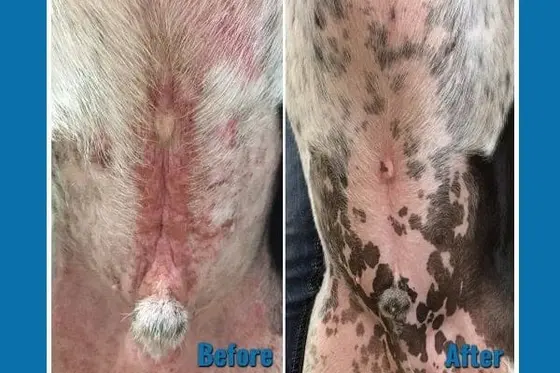
If you've put your dog on Apoquel and watched it work, then slowly stop working, then need doubling... if you've done the Cytopoint shots and noticed the gaps between flare-ups getting shorter every time... if you've paid for the allergy panel, the immunotherapy drops, the prescription kibble at $135 a bag, the medicated shampoos, the salmon oil, the "skin and coat" chew with the vet's face on the box — and your dog is STILL scratching, still licking the paws raw, still breaking out in hot spots, still cycling through ear infections every six weeks...
Then before you spend another dollar or fill another script, I need you to understand why every single one of those solutions failed.
Because they didn't fail by accident. They failed for the same reason. And it's a reason no vet in that entire chain ever said to your face.
I'm about to tell you exactly what they're not telling you, and why they'll NEVER give you the real answer.
And by the end of this, you're gonna be furious.
Because here's what's actually going on:
One — Every product you tried targets your dog's immune system or the surface of their skin. Not one of them touched the thing actually producing the dysfunction: a barrier that has structurally collapsed and is letting allergens flood in. That's why they all stalled out.
Two — The entire system is built to treat the symptom (the itch) with JAK inhibitors like Apoquel, treat the allergy with immunotherapy, treat the infections with antibiotics — and treat nothing structural. So you can do everything right, spend thousands, and still get nowhere, because the cause was never on the table.
Three — There's a multi-billion-dollar pet-allergy industry that profits every single day your dog's real problem stays hidden behind a $98-a-month prescription that blocks one signal and wears off the moment you stop. The failed solutions aren't a bug in the system. They're the business model.
So let me tell you what happened with my sister Megan's dog, Cooper, because her story is gonna open your eyes to how broken this really is.
For THREE YEARS my sister Megan was watching her golden retriever Cooper disappear — and every vet she saw treated the skin.
Cooper was diagnosed with atopic dermatitis at age 5. Already showing inflammation, already breaking out. Her vet told Megan to start Apoquel, manage the triggers, monitor. Standard protocol. Nothing about anything else.
Eight months later it started breaking through.
At first it was small. The morning calm that used to last started shrinking. Cooper would settle, then she'd be back on a paw within minutes. Then she'd be up scratching at 11pm. Then Megan couldn't remember the last full night either of them had slept.
Then it got worse.
The licking that never stopped. The pink stains on the paw fur. The wet spots on the dog bed. She started watching Cooper for it, which somehow made it worse. The ear infections every six weeks like clockwork — yeast, then bacteria, then yeast again. The hot spots that opened faster than they could close. My mother didn't say anything for months. Then one night she said it gently, the way you'd say it about a dog you've loved for years: "Is she okay?"
Megan said yes. She wasn't.
She went to her primary vet first. Bloodwork, skin scrape. "Mild atopy, common for the breed. Stay on the Apoquel. Try to manage the environment." CADESI score — the standardized atopic dermatitis severity score every vet derm uses — sitting at 12.
She got the Apoquel anyway. Worked the first three months. Then started working unpredictably. Doubled the dose. Worked again. Then started working unpredictably at the doubled dose.
She went to a veterinary dermatologist. Allergy panel, $580. "Highly reactive to 14 environmental allergens. Common picture. Stay on the Apoquel, consider immunotherapy."
She went to a holistic "pet allergy" clinic — one of the chains with the billboard. They sold her a six-month elimination-and-immunotherapy protocol. Hydrolyzed prescription kibble at $135 a bag. Sublingual drops at $90 a month. Itching came down slightly. The hot spots stayed exactly the same. She came off the protocol after six months because nothing structural had moved.
She tried a Cytopoint cycle. $300 a shot, every six weeks. Worked for the first stretch. Then the gaps between flare-ups started shrinking.
She started a "skin support" supplement regimen. Salmon oil, oatmeal baths, biotin chews. Coat slightly shinier. ED of the skin — the breakdown — unchanged.
Four different vets. Three years. Two prescriptions. One immunotherapy protocol. A Cytopoint cycle. Supplements from four different sources.
And every six months when she went back for the derm recheck, the CADESI kept climbing. 12. Then 24. Then 38. Her coat kept thinning. The bald patches around her eyes kept spreading.
Not one — NOT ONE — of those allergy workups ever assessed the integrity of Cooper's skin barrier. Not one of them ever asked why a barrier that's supposed to keep allergens out had stopped doing it.
Megan called me from her car after the dermatologist appointment. Couldn't get the words out for a minute. Then she said:
"The kids stopped asking to bring her places. They just stopped. Dave doesn't say anything about the bills anymore, he just pays them. And she flinches now when the kids reach for her ears."
The itching was just the surface of it. The real damage was what it was doing to the rest of the house.
Cooper stopped greeting people at the door. She started living in the corner, working on a paw. The dog who used to swim in the lake every weekend wouldn't sit through a meal without dragging her face across the carpet. Megan's 8-year-old asked her one night, real quiet, "Is Cooper sick? Why doesn't she come play anymore?"
Megan started planning the family's weekends around the dog instead of with her. She stopped letting Cooper on the good furniture because of the staining and the shedding. And every time she did, she felt like she was giving up another inch of the dog she'd raised from a puppy.
She told me one night, when I finally pushed her, that she felt like she was failing her. She was crying when she said it.
And every vet told her the same thing.
"The CADESI is in the moderate range." "The Apoquel works most of the time." "Some dogs just have severe atopy." "Have you tried a stricter elimination diet?"
One of them — and this is the one that made me want to put my fist through a wall — suggested Cooper might need to live in a permanent soft cone to stop the self-trauma during flares. A permanent cone of shame. On a 7-year-old golden retriever. Megan walked out of that appointment.
Not one of them ever asked the question that turned out to be the only question that mattered.
What if Cooper's skin wasn't overreacting because her immune system was broken?
What if her barrier was the reason her immune system was overreacting at all?
Three years of dermatology workups. Three years of allergy panels. Three years of Apoquel, Cytopoint cycles, immunotherapy drops, prescription kibble, "skin support" chews, holistic clinics with billboards.
And not one vet in that entire chain ever looked at the coat thinning year over year, looked at the barrier breaking down in the exact same spots every flare, and said: Megan. Cooper's skin barrier might be the reason none of this is working.
So here's the full list of what they kept telling her to try. And I need you to pay attention, because you've probably tried most of this too — and every single one failed for the exact same reason, which I'll show you in a minute.
Apoquel at the doubled dose — worked sometimes, didn't work others. Blocks one itch signal. Did not rebuild anything underneath.
Cytopoint every six weeks — slightly more reliable for a stretch. Same ceiling. The gaps kept shrinking.
Salmon oil and omega-3s — "skin support." Six months. Coat a little shinier. The breakdown kept escalating.
Hydrolyzed prescription diet at $135 a bag — twelve-week elimination, strict, no cheating. Basically nothing changed.
Allergy panel + immunotherapy drops — $580 panel, $90 a month for nine months. Nothing.
A "premium skin and coat" chew from one of the big brands — $54 a month. Five months. Nothing.
Twice-weekly medicated baths at the vet — chlorhexidine, oatmeal. Soothing for an hour, inflamed by morning.
Between the prescriptions, the Cytopoint, the derm co-pays, the holistic clinic, the supplements, the medicated baths, the prescription kibble, and the immunotherapy — she spent over $7,800 across three years.
Cooper's skin was worse than when she started. The household was strained in a way Megan couldn't put words to. Her CADESI was 38 and climbing. And every specialist she saw was treating the part of Cooper that wasn't actually broken.
At this point I'm not frustrated anymore. I'm angry.
Because I'm watching my sister — a woman who raised this dog from a puppy — slowly lose the animal that used to be the center of her family. While four different categories of vet throw pills and panels and protocols at the immune system. While the actual structure producing the dysfunction sits right there on the surface, breaking down in the same spots every flare, and nobody on the allergy side of Cooper's care has even thought to look at it.
Managing. The. Itch.
Not asking what's reaching the skin. Not asking why the wall stopped holding. Not asking what's letting a flood of allergens into the smallest, thinnest, most exposed tissue on the dog's body every single day.
And that's when I started asking the questions nobody wants you to ask:
Why do veterinary dermatologists work up allergies without ever assessing barrier integrity?
Why does an atopic dermatitis diagnosis on the chart never trigger a single intervention to rebuild the barrier — only drugs to suppress the immune response it's provoking?
Why is the entire field of "pet allergy" treated as if the immune system overreacts in a vacuum — disconnected from the collagen barrier that's supposed to keep allergens from ever reaching it?
Why does every "skin and coat" supplement on the market target biotin and fish oil at the surface — when the upstream cause of half the itching walking into derm offices is a structurally collapsed barrier?
And why does NOBODY ever explain to an atopic-dog owner that the same thinning barrier letting allergens flood the skin is also why the ears keep flaring, why the hot spots keep opening, why the coat keeps thinning, and why the Apoquel keeps needing to work harder every year?
So I went down a rabbit hole. A deep one.
I started researching the connection between skin-barrier dysfunction, collagen depletion, and atopic dermatitis severity.
Every mainstream veterinary site gave me the same recycled answer. "Atopy is multifactorial. Manage the triggers. Consider JAK inhibitors. Be patient."
JAK inhibitors. While the published dermatology research was screaming the actual answer.
Then I found it.
Not a blog. Not a pet influencer. The veterinary dermatology literature — the research on barrier dysfunction, transepidermal water loss, and allergen penetration in atopic dogs.
And it laid out — in language so clear I couldn't believe nobody in three years of Cooper's appointments had said it to Megan's face — exactly how a collapsing collagen barrier causes the entire allergy cascade.
The collagen-barrier–immune axis.
Now pause for a second.
You know what's insane?
Every conversation about dog allergies focuses on the immune system. Reactivity. Cytokines. IL-31. JAK inhibitors. Histamine. Allergen sensitivity. That's the model. That's why every workup is an immune workup. That's why every drug targets the immune response. That's why every supplement promises "skin support" or "calms the itch."
But nobody — and I mean NOBODY — in standard allergy care asks what the barrier is doing. Whether the wall that's supposed to keep allergens out has thinned to the point where everything gets through. Whether the immune system is "overreacting" or simply responding, correctly, to a flood of allergens that should never have reached it in the first place.
And that's not an accident.
Here's what I learned.
Your dog's skin is the largest barrier organ in their body, and it's built, in large part, out of collagen. When that barrier is intact, allergens land on it and bounce off. Pollen, dust mites, dander — they hit a sealed surface and never reach the immune system. The dog is exposed to the exact same allergens as every other dog and simply doesn't react, because nothing is getting through.
Every part of a calm, non-itchy dog depends on that wall holding.
Now consider what happens when the barrier depletes.
From around age two, dogs lose somewhere between 7 and 10% of their collagen every single year. The barrier thins. Micro-gaps open between the skin cells. Moisture leaks out — transepidermal water loss — and the surface dries and cracks. And allergens that used to bounce off now push straight through the gaps, into the skin, into circulation, into direct contact with an immune system that was never supposed to meet them.
But here's the part nobody told Megan.
The first thing a depleting barrier loses isn't its ability to look shiny. The first thing it loses is the quiet structural work — the sealing, the moisture retention, the keeping-allergens-out. The stuff that doesn't show up on any allergy panel because nobody is testing the barrier at all.
Subclinical barrier breakdown starts long before the dog looks "severe." The CADESI may still read moderate. The coat may only be slightly thin. The vet calls it "manage and monitor." Meanwhile:
The barrier thins. Moisture loss accelerates. Allergens penetrate further. The immune system is flooded and escalates. The inflammation it produces damages the barrier further — which lets in more allergens — which provokes more inflammation. A self-feeding loop nobody is breaking, because nobody is treating the barrier.
And here's the detail that mirrors what the cardiology people figured out about humans years ago. The barrier fails first where it's thinnest and most exposed — the paws, the ear canals, the belly, the muzzle, the folds. Which is the exact map of where atopic dogs break down first. The paws she's licking. The ears flaring every six weeks. The bald patches around the eyes. That's not a coincidence. That's the thinnest sections of the wall giving out first.
Cooper's allergy panel read "reactive to grass and dust mites."
But the reason she was drowning in those allergens wasn't that she was uniquely allergic. It was that her barrier had thinned to the point where grass and dust mites that bounce off a healthy dog were pouring straight into her skin.
The cascade fails not at the immune system. It fails at the barrier.
And here's the critical part. The part that explains exactly why every immune-side intervention Megan tried failed.
Apoquel doesn't rebuild a single strand of collagen. Cytopoint doesn't close a single micro-gap. Immunotherapy doesn't restore moisture retention. The prescription diet doesn't repair the wall. Medicated baths wash the surface while the structure underneath keeps thinning.
None of them address the structure producing the dysfunction. You can flood the immune system with JAK inhibitors and the barrier is still letting allergens pour in every minute of every day.
The allergy workup is treating a downstream symptom. The actual mechanism is in the barrier.
And here is what enraged me most.
The veterinary world knows this. Barrier dysfunction in canine atopic dermatitis — the thinning, the moisture loss, the allergen penetration — is documented in the dermatology literature. Atopic dogs have measurably weaker barriers and higher transepidermal water loss than dogs without the condition. The mechanism is replicated. The connection is not contested.
But the clinical protocol for atopy doesn't include a single step to rebuild the barrier. The urologist doesn't check the liver, and the dermatologist doesn't rebuild the wall. They suppress the immune response and adjust the dose.
Because there's no patentable pharmaceutical for collagen-barrier repair. You can't patent rebuilding the structure of skin. There's no money in telling an owner that her dog's immune system isn't defective — that her barrier has collapsed and is letting allergens flood in — and that there's a category of compound the research has documented for years that addresses the actual mechanism.
There IS money in Apoquel at $98 a month. Cytopoint at $300 a shot. Allergy panels at $580. Immunotherapy at $90 a month for a year. Prescription kibble at $135 a bag. Derm consults every six weeks. Cyclosporine and steroids when nothing else "works." Referrals across multiple fields, each managing a piece of a problem nobody is treating at the source.
See how that works?
Run an allergy panel. Treat the immune system. Add an Apoquel. Add a Cytopoint. Suggest immunotherapy. Suggest cyclosporine. Suggest a cone. Never assess the barrier that's producing the dysfunction. Never address the mechanism. Never resolve the cause — only manage the consequence.
Because the second you rebuild the barrier, the wall starts keeping allergens out again. The flood stops. The immune system stops being provoked. The inflammation drops. The self-feeding loop breaks.
The itching stops. Not because something at the immune system got suppressed. Because the structure that's supposed to keep the outside out is finally back up.
That's what happened with Cooper. But before I tell you that, I need to tell you what I found in the research.
I kept digging. Reading dermatology research on barrier repair. On the role of the different collagen types in skin structure. On moisture retention and healing. On the difference between the collagen that builds the protective layer, the collagen that mends damaged tissue, and the collagen that calms the inflammation underneath.
And I found compounds that kept appearing — not in "skin and coat" marketing, in the actual research — as specific interventions for the structural barrier breakdown that was producing the downstream allergy cascade.
Collagen. But not collagen the way the supplement shelf does it.
Not the dusting of "collagen" buried in a chew. Not Type I from chicken hide — chicken being one of the most common canine allergens, which is the last thing you'd feed an allergy dog. Not heat-processed powder a dog absorbs maybe 20% of.
The specific thing the research pointed to: all three collagen types, at clinical doses, in a form the dog can actually absorb.
Type I rebuilds the protective structural layer — the wall that physically keeps allergens out.
Type III mends the damaged tissue and closes the raw, scratched, broken skin — the hot spots.
Type II calms the body-wide inflammation that fuels the itch while the wall rebuilds underneath.
And the form is the whole game. A cold-pressed liquid — no high heat to destroy the actives — is absorbed at up to 98%, versus as little as 20% from a heat-processed chew. From a hypoallergenic marine source instead of chicken, so it rebuilds the barrier without adding the exact allergen you're trying to keep out.
Then the supporting cast hits the same three failures of a broken barrier — structure, moisture, inflammation — simultaneously.
MSM — a natural anti-inflammatory that eases the itch and discomfort while the collagen rebuilds. Relief during the repair, not just after.
Hyaluronic Acid — locks moisture into the healing skin so it stays supple and mends faster. Dry, cracked skin heals slowly; HA keeps it moving.
Vitamin C — the cofactor collagen synthesis literally cannot run without. It switches your dog's own collagen factory back on, so you're not just adding collagen, you're restoring the body's ability to build its own.
As the structural collagen rebuilds, the moisture returns, and the inflammation drops — the three pathways of barrier failure collapse together. And as the barrier recovers, the environment the immune system lives in changes. Allergens stop getting through. The flood stops. The overreaction it was never an overreaction stands down.
The itching — which was never an immune defect — stops.
Megan tried to find a formula that matched what the research actually described.
First: the highest-rated "skin and coat" chew on Amazon. Thousands of reviews. 4.7 stars. Eight weeks. Nothing changed. Looked at the label: biotin and fish oil. Not a milligram of real collagen in it. Fairy dust with good reviews.
Second: a "premium collagen" chew at $54 a month, marketed for "skin, coat and joints." Ten weeks. Maybe slightly less flaking. Itching unchanged. Looked at the label: Type I collagen only, sourced from chicken hide, heat-processed, behind a proprietary blend that hid the dose. No Type II. No Type III at a meaningful level. No hyaluronic acid. And chicken — an allergen — in a product for allergy dogs.
She went back to the research. Read the methodology.
The studies showing barrier rebuild used all three collagen types, at clinical doses, in an absorbable form, from a hypoallergenic source. The form isn't an add-on. It's the difference between collagen reaching the skin and collagen passing straight through. Heat destroys it. Chicken sabotages it. It doesn't matter how many milligrams are printed on the chew if your dog can't absorb it and the source is itself a trigger.
She flipped over both bottles. No three-collagen-type profile on either. No absorption claim. No hypoallergenic source. No standardization.
She'd been giving the wrong type, in the wrong form, from the wrong source, with two of the three repair pathways missing entirely. Not because the research was wrong. Because what was on the supplement shelf wasn't what the research used.
Then I found a thread in an atopic-dog owners' group that stopped me completely.
A woman wrote: "My doodle was diagnosed at 4 and the itching destroyed three years of our life before anyone connected it to her barrier. Three vets. Two rounds of immunotherapy. Doubled Apoquel. A Cytopoint cycle that got tighter every time. None of it fixed the actual problem because none of it rebuilt her skin. Then I started reading about the barrier instead of the allergy. The barrier wasn't a side issue — it was the source. I found a liquid collagen that addressed all three repair pathways at once. Twelve weeks in: scratching gone, hot spots healed, off Apoquel entirely. My vet asked me what I'd changed."
I froze.
She continued: "The allergy workup never finds the barrier. That's why every owner in this group has the same story. Years of pills, years of panels, years of derm visits. Nobody rebuilds the structure producing the dysfunction. When I finally rebuilt the barrier, everything came back."
The replies:
"Diagnosed at 5. Itching started at 4. Three years of Apoquel and Cytopoint. Nothing reversed the underlying problem. Twelve weeks on this: scratching down to almost nothing, ears clear for the first time in over a year, off Apoquel and the coat is thicker than it's been since she was a puppy."
"Coat regrew, the bald patches around his eyes filled in, hot spots stopped recurring, and the dog we had before the allergies came back. My kids noticed before I told them."
"Two years of derm workups, $4,800 in panels and immunotherapy, no answer. Started this. Three months: barrier holding, no new hot spots, ear flares stopped. The skin was the answer the entire time."
My hands were shaking.
Someone listed the formula:
Hydrolyzed Collagen Peptides, Types I & III — 900mg — rebuilds the protective structural layer that keeps allergens out, and mends the damaged tissue that closes hot spots and raw, scratched skin.
UC-II Type II Collagen — 40mg — a clinically studied dose that calms the body-wide inflammation fueling the constant itch, and supports the joints while it's at it.
MSM — 400mg — a strong natural anti-inflammatory that eases the itch and discomfort during the rebuild, not just after.
Hyaluronic Acid — 50mg — locks moisture into healing skin so it stays supple and mends faster.
Vitamin C — 50mg — the cofactor collagen synthesis can't run without; switches the dog's own collagen-building back on.
Marine collagen base, chicken-free — hypoallergenic, so it rebuilds the barrier without adding the most common canine allergen. Cold-pressed liquid — absorbed at up to 98%, versus as little as 20% from heat-processed chews.
Third-party tested. Made in the USA. GMP-certified, NASC-standard facility. Every ingredient listed with exact amounts. No proprietary blends.
"How do you know it's working before the vet recheck?" someone asked.
"Week two: the dry flaking and dandruff clear and the coat starts to feel soft again — the barrier holding moisture and starting to rebuild. Week three: the licking and paw-chewing drop — fewer allergens reaching the skin. Week four: hot spots start closing for real — the tissue repair kicking in. Week six: the ear flare that was 'due' on the six-week pattern just doesn't come. Week twelve: the CADESI recheck confirms what you already knew weeks ago."
The brand was Pluto. I ordered it for Cooper that night.
After two weeks?
Megan texted me at 6:30 in the morning. "Her skin." The dandruff she'd been brushing out for as long as she could remember had cleared, and when she ran her hand down Cooper's back, the coat felt soft instead of dry and brittle. She sat on the floor with her for ten minutes. Then she texted me.
After four weeks?
The hot spot under Cooper's tail — the one that had cycled open and scabbed and reopened for over a year — closed. Clean pink skin where there'd been a raw lesion the week before. Megan called me from her car on a Monday afternoon. She said, "It's actually closing this time." And then she cried.
After six weeks?
The ear infection that had been due — every six weeks for over a year — didn't come. Megan checked the ears every morning expecting the familiar redness. Clear. Then a week later, still clear. Then two weeks, still clear.
After eight weeks?
She dropped the Apoquel dose. From the doubled dose back to the original. Held her breath for the flare. It didn't come. Two weeks later she stopped it entirely. No rebound. The morning pill ritual — for the first time in two years — wasn't necessary. The fur around Cooper's eyes started filling in. Cooper started sleeping through the night.
After twelve weeks?
Full derm recheck and a fresh CADESI.
CADESI: down into mild range, from 38. Coat fully restored, thicker and shinier than Megan had seen it in years. Ears clear. Hot spots healed and not recurring. Off Apoquel for over a month. No Cytopoint since the eight-week mark.
In twelve weeks — without doubling anything, without a new injection, without a stronger drug — Cooper's atopic dermatitis had regressed from severe to mild, her barrier had rebuilt, and the dog Megan had raised from a puppy had come back.
Her vet derm looked at the results.
"This is... unusual. CADESI doesn't typically drop this far on continued therapy, and you've come off the Apoquel. What changed?"
"I rebuilt her barrier," Megan said. "Her immune system was never the broken thing. Her skin had thinned to where every allergen was pouring straight in. The minute the barrier started holding again, everything downstream came back."
"What did you rebuild it with?"
"Liquid collagen. All three types — the structural one, the repair one, the anti-inflammatory one. In a form she could actually absorb, from a source that isn't chicken. It's barrier dysfunction. It's in the dermatology literature. Nobody rebuilds it because there's no drug for it."
Silence.
"Whatever you're doing — continue. Keep her off the Apoquel for now. I'd like to recheck her in eight weeks."
Continue.
Not three more years of Apoquel and Cytopoint and immunotherapy and prescription kibble while the barrier kept collapsing.
Not a permanent cone. Not the conversation about whether she'd be on lifetime medication.
Continue — because the actual mechanism was finally being treated.
Now here's what I need you to understand.
Barrier breakdown doesn't wait for you to figure this out.
Every month that barrier keeps thinning — losing collagen, losing moisture, letting more allergens through — the immune system gets provoked harder. The inflammation damages the wall further. The hot spots open faster. The ear flares come tighter. And the itching that started as occasional becomes the constant dysfunction it actually is.
And here's the part that should worry every owner reading this.
Chronic barrier breakdown in a dog isn't just a skin problem. It's the gateway to the rest of it — the recurrent yeast and bacterial infections, the antibiotic courses that wipe everything else out, the cyclosporine and oclacitinib stacked on top of the Apoquel, the organ-stressing steroid bursts, the "some dogs just need lifetime management." The same barrier failure driving the itch you can see is driving the cascade you can't yet.
The scratching is telling you the truth. The Apoquel is masking what it's saying.
So if you're dealing with ANY of this — itching that started young and never fully went away, weakening patchy fur, recurring ear infections every four to six weeks, hot spots that keep coming back, paws stained pink from constant licking, dry flaky skin, a dull thinning coat, plus an Apoquel script that worked at first and now doesn't, or a Cytopoint schedule that's getting tighter every cycle — this is the time.
Not next year when the dose needs to double again. Not when your vet starts talking about stacking cyclosporine. Not when you're sitting in a specialist appointment listening to "some dogs just have severe atopy."
Right now.
The brand is Pluto.
Advanced Liquid Collagen. Hydrolyzed Collagen Peptides, Types I & III — 900mg. UC-II Type II Collagen — 40mg. MSM — 400mg. Hyaluronic Acid — 50mg. Vitamin C — 50mg. Marine collagen base, chicken-free, cold-pressed for up to 98% absorption.
Every ingredient listed with exact amounts. Third-party tested. Made in the USA. No proprietary blends. No hidden doses. No chicken. A few drops on the food once a day — natural bacon flavor, so most dogs read it as a treat and never notice it's there.
60-day money-back guarantee. Watch the flaking. Watch the coat. Watch the scratching and the licking and the ear cycles and the hot spots. If the barrier doesn't start rebuilding and your dog doesn't start coming back — you pay nothing. Even if the bottle's empty.
From $28.49 a bottle on subscribe-and-save — not $98 a month like Apoquel, not $300 a shot like Cytopoint, not $135 a bag like prescription kibble. Buy 2 Get 1 Free or Buy 3 Get 2 Free to stock the full rebuild, because the barrier doesn't reform in 30 days and most owners stay on it through the whole recovery.
Megan spent $7,800 on Apoquel, Cytopoint, allergy panels, immunotherapy, prescription kibble, holistic clinics, and supplements across three years while Cooper's skin kept declining. Then she rebuilt the structure that was actually producing the dysfunction — and in twelve weeks her dog came back.
Cooper's skin was never the broken thing.
It was the downstream consequence of a broken barrier.
Rebuild the barrier, and the rest of her comes back.
👉 plutopets.co/products/advanced-liquid-collagen-for-dogs