My dog got her first "mild allergies" diagnosis at one year old.
I didn't even know what that meant.
Just a word the vet used while she scratched a note on the chart. A line on the visit summary that said "atopic tendency — monitor" with the box ticked for a recheck.
I Googled it at midnight. Read about canine atopic dermatitis. Felt the specific relief of having a name for the thing that had been confusing me — the scratching, the head-shaking, the one red ear.
Atopic dermatitis. An allergic skin condition. Common in her breed.
Okay. Manageable. We'd go to the vet.
First visit. Family vet. Olive was 1.
She was kind. Unhurried. Looked at Olive, asked about her food, her shampoo, her environment.
"Mild allergies. Very common in French bulldogs. Nothing to worry about."
She handed me a printed sheet. Switch to a limited-ingredient food. Wipe her paws after walks. Bathe with the oatmeal shampoo.
"Keep her off the grass when the pollen's high. Recheck in six months."
I did it.
I switched the food. Wiped the paws. The scratching eased a little.
I didn't think about it again.
She was 1. She had a little itchy skin. I changed her food. The next recheck was a little better.
Case closed.
Second visit. Same vet. Olive was 2. A year later.
The red ears came back on a Wednesday morning.
I recognized something was off immediately this time. Called the office. Got her in the next week.
Same vet. Same exam. Same result.
Scratching back, worse than the first time. A new hot spot on her flank.
"Sometimes these flare up again. It's not unusual."
Same printed sheet. Try a stricter diet. More paw-wiping.
The recheck was a little better.
She told me to make sure I was bathing her weekly. Keeping her off the lawn. Using the wipes.
I nodded. I was already doing all of those things but I nodded anyway.
I left thinking — okay, twice. That's just bad luck.
Third visit. Same vet. Olive was 3. Eight months later.
This time I was frustrated.
I'd been doing everything right. New limited-ingredient food. Weekly baths. Paws wiped after every single walk. Salmon oil on her dinner. Keeping her off the grass like it was lava.
And here we were again.
Same vet. She looked at the chart before looking at Olive.
"She's had a few of these," she said.
Yes. I know. That's why we're here.
"Some dogs are just more prone to atopy. Breed, environment, a lot of factors."
She suggested a "skin and coat" chew this time. Over the counter. Said some patients did well on it.
"If this keeps happening we might want to refer you to a dermatologist."
I went home with the supplement bottle.
Gave her the chew.
The next recheck was slightly better.
I sat on my bathroom floor the night I got that result and made myself a promise that if it came back again I'd push harder. Ask more questions. Not just take the printout and leave.
Six months later it came back.
Fourth visit. Veterinary dermatologist. Olive was 4.
I felt hopeful walking into that office.
A specialist. Someone whose entire job was skin. Someone who'd have answers my regular vet didn't.
She was efficient. Professional. Asked thorough questions. Reviewed the history — three rounds of flares in three years, all responding to changes then recurring.
She ran a full allergy panel this time. Environmental, food, the works. Sent it to the lab.
Came back two days later. "Reactive to 14 allergens. Grass, dust mites, storage mites."
"Classic recurrent atopy," she said. "Very common in this breed."
She gave me a more structured protocol. A hydrolyzed prescription diet. A baseline itch score documented in the chart. A recheck in six months.
Then she said something I held onto for months afterward.
"If this comes back again we'll look at longer-term options."
Longer-term options.
That sounded like progress. That sounded like someone thinking ahead.
I followed the protocol.
The next recheck was a little better.
I waited.
Fifth visit. Dermatologist. Olive was 5. Nine months later.
She didn't look surprised to see us.
That was the first thing I noticed. Not a flicker of surprise. Just a slight tightening around her eyes as she pulled up the chart.
"Another flare," she said.
Yes. Another one.
This time she started Olive on Apoquel. Ruled out mange, infection, everything else. Just atopy. Again.
"A lot of dogs do really well on this," she said. "It'll get the itch under control."
I went home with a prescription and an itch score I was told was now "managed."
I felt something I hadn't felt in over two years.
Hope.
Sixth visit. Dermatologist. Olive was 5. Six months later.
The Apoquel had worked. For a while.
For the first three months her scratching was the quietest it had been since the beginning. I'd started to relax. Started to believe it was over.
Then at month four — the red ears came back. The 11pm paw-licking. The dull, flat mood where she stopped greeting us at the door.
I finished the bottle thinking maybe she just needed a longer run. The next recheck showed the itch breaking through. We stayed on it.
Month five — worse.
The dermatologist examined her.
The flares were breaking through on the standard dose. The Apoquel I'd been giving daily for six months had stopped holding the line.
Olive had stopped responding to her own medication.
The vet looked at me across the table.
"This happens sometimes. We can increase the dose. Or add a Cytopoint injection."
I stared at her.
"So what now?"
"We double the Apoquel and add the Cytopoint."
Olive was 5. She'd been on some form of protocol — chews, prescription food, medication — almost continuously for four years. Her coat was thinning. There were bald patches around her eyes. She was bloated and miserable and chewing herself raw.
And now her atopy was outrunning the medication I'd been giving her to control it.
I drove home and cried in my car for the first time about this.
Not from one thing. From the specific despair of realizing the treatment had stopped working.
Seventh visit. New dermatologist. Olive was 6. Second opinion.
I found her through a recommendation. Better reviews. Longer appointments. A reputation for actually listening.
I brought the full history. Printed it out. Every exam, every protocol, every product and how long we'd used it.
She read through it carefully. Asked good questions. I felt seen in a way I hadn't in any of the previous appointments.
Then she said:
"You've both had a really rough time. I want to try a different approach. There's a newer protocol stacking cyclosporine alongside the Apoquel that some dogs respond well to."
Cyclosporine. I'd read about it online. An immunosuppressant. Stronger than the JAK inhibitor.
She also recommended a specific probiotic. Suggested cutting every possible food trigger. Gave me a printed sheet.
I left with four new things to try.
I tried all of them. Perfectly. For six months.
The flares slowed. Stayed mostly stable for a stretch.
That felt like progress.
Then they crept back.
Then came faster.
Olive was 6. I had now spent over $7,000 on supplements, specialist visits, prescriptions, and food.
And we were back where we started.
Eighth visit. Dermatologist. Olive was 6. The skin recheck.
My second dermatologist looked closer after I mentioned the new thing.
Not just the scratching. The skin itself. The patches on her belly and inside her back legs had gone dark and thick and leathery over the last few months. Rough to the touch. Different.
She examined it under the light without expression. Took photos. Pulled them up on her screen.
I sat in the room for that conversation alone.
Olive was 6. I'd come to that appointment by myself because I hadn't told anyone how bad it had gotten. I hadn't wanted to worry my family. Hadn't wanted my partner to know how scared I was.
She turned the screen toward me and pointed.
Lichenification. The chronic inflammation had started laying down permanent changes in the skin — thickened, darkened, leathery. Not reversible on its own. Not yet the worst case, but the pattern was set.
"If this continues," she said, "you're looking at permanent skin damage. Lifelong immunosuppression. In dogs this young, that's a long road of escalating drugs and recurring infections."
She said it plainly. Not unkindly. Just plainly.
"She's only six. We need to take this seriously."
I nodded.
I kept nodding while she talked about stacking medications, about rechecks every few months, about monitoring.
I kept nodding until I was outside.
Then I sat on the bench outside the clinic and I didn't cry. I just sat there.
Six years old. Permanent skin changes setting in. From a "mild allergy." From the thing six vets had told me was common, manageable, nothing to worry about.
I called my mum on the way home.
Told her everything for the first time.
She cried. I didn't. I'd already used everything up sitting on that bench.
Ninth visit. Holistic vet. Olive was 6. Trying everything.
At this point I'd accepted that conventional care wasn't going to fix this.
Not because the vets were bad. But because every single one of them had treated the itch. Not the reason for the itch. Not the pattern. Not the why.
Just the symptom. Every time. Change the food, suppress the immune system, monitor. Send her home. See her again in six months when it comes back.
The holistic vet was warm. Unhurried. She spent ninety minutes with us at the first appointment — longer than all the other skin appointments combined.
She talked about the gut-skin axis. About the microbiome. About how years of antibiotics for the ear infections and processed food had likely disrupted the systems that were supposed to keep Olive's immune system calibrated.
This was the first time anyone had talked about anything other than the surface of her skin in six years of appointments.
She put Olive on an elimination diet. A gut repair protocol. A high-dose probiotic. Extra supplements.
$390 a month.
I followed it perfectly for four months.
Her gut seemed better. The dinnertime bloat eased slightly. Her energy came up a notch.
The flares continued.
Not as fast — but they continued.
I was spending $390 a month and still watching her skin get worse.
I stopped after five months. Not because the vet was wrong about the gut. Looking back — she wasn't wrong. She was closer to the truth than anyone else I'd seen.
But something was still missing.
I found the research at 11:30pm on a Tuesday.
Not from a vet. Not from the holistic practitioner. Not from a forum.
I found it myself because I'd stopped sleeping properly and was spending the hours I used to sleep reading everything I could find.
It was the veterinary dermatology literature on the skin barrier and atopic dermatitis. Not a wellness blog. Not a supplement company's page. The actual research.
And it laid out something that no vet — not one in nine visits across five years — had ever explained to me.
The itch doesn't start in your dog's immune system.
It builds through a specific, documented, five-stage chain that starts at the barrier.
Stage 1 — collagen depletion. The skin barrier is built from collagen. From around age two, dogs lose 7 to 10% of it every single year. The structural wall thins.
Stage 2 — the breach. As the collagen depletes, micro-gaps open between the skin cells, and the moisture seal fails. The barrier dries, cracks, and loses water — every crack another opening.
Stage 3 — allergen penetration. Allergens that used to land on an intact wall and bounce off now pour straight through the gaps — into the skin, into circulation, into direct contact with the immune system.
Stage 4 — the inflammation loop. The flooded immune system overreacts. The inflammation it produces degrades the barrier further — which lets in more allergens — which drives more inflammation. A self-feeding loop that gets worse every season.
Stage 5 — visible symptoms. The scratching. The hot spots. The ear infections. The thinning coat. You take her to the vet. You get the diet sheet. You get the Apoquel.
But the damage didn't start at Stage 5.
It started at Stage 1.
And every "manage the triggers" protocol I'd ever followed addressed Stage 5 — while Stages 1 through 4 ran completely undisturbed. Because none of them rebuilt the collagen barrier that was feeding the whole loop.
I read that part four times.
Every protocol I had ever followed had managed the downstream symptom of a wall that was crumbling a little more every single day.
Not because the protocols were wrong. Because suppressing the itch without rebuilding the barrier leaves the breach wider open every cycle.
I had been in a loop for five years where the treatment was treating the symptom while the mechanism kept running.
The holistic vet had been right about one thing — the body's calibration mattered. But calming the immune system from the gut wasn't enough without also rebuilding the wall the allergens were pouring through.
I needed all of it at once.
Rebuild the structure. Reseal the moisture. Calm the inflammation. So the barrier could finally hold.
Then I read about collagen. The real mechanism. Not "collagen is good for skin and coat." The specific biology.
The barrier is built from collagen — Type I forms the protective structural layer, Type III mends damaged tissue, and the right form calms the inflammation underneath. Fed in a form the body can absorb, it rebuilds the wall from the inside. This is documented.
But collagen is fragile.
Heat destroys it. The high-temperature processing used to make most chews and powders denatures the protein and strips the absorbable fraction down to a fraction of what the research is based on.
And almost every "collagen for dogs" on the market — every product I'd ever considered — is heat-processed, or made from chicken. Because it's cheap. Because it's fast. And chicken is one of the most common canine allergens.
The collagen is destroyed before the bottle is sealed. Or it's made from the exact protein half of atopic dogs react to.
I had looked at collagen chews for years and dismissed them as useless.
I'd been right — about those.
Real collagen works.
Dead collagen doesn't. And chicken collagen feeds the fire.
I found Pluto at 1am.
I was skeptical the way you get skeptical after years of trying things that don't work. That specific exhausted skepticism where you've stopped getting excited and you've started just assessing.
I read the label.
Hydrolyzed Collagen Peptides, Types I & III — 900mg. Cold-pressed, not heat-processed — so the protein survives and is absorbed at up to 98% instead of as little as 20%. Type I rebuilds the structural wall — Stage 1. Type III mends the damaged, scratched tissue and closes the hot spots.
Hyaluronic Acid — 50mg. The moisture-seal restorer — Stage 2. Locks water back into the barrier so it stops drying and cracking open.
UC-II Type II Collagen — 40mg. A clinically studied dose that calms the body-wide inflammation fueling the itch — Stage 4 — so the loop stops feeding itself.
MSM — 400mg. Anti-inflammatory relief while the wall rebuilds. Comfort during the repair, not just after.
Vitamin C — 50mg. The cofactor collagen synthesis can't run without — switches Olive's own collagen-building back on so the barrier keeps rebuilding itself.
Marine collagen base, chicken-free. Hypoallergenic — it rebuilds the wall without feeding the allergy.
Every amount listed. No proprietary blends. No fillers. No chicken. Third-party tested. Made in the USA.
And it actually delivers the collagen intact.
Not another dead collagen chew next to the prescription bottle.
Something I'd actually give her every day, because the collagen in it is the collagen the research is based on — not the denatured fraction in every pet-store bag.
I ordered it.
Not with hope exactly. With something more like — I've read the mechanism. The mechanism makes sense. I'm going to do this properly and pay attention to what happens.
Week two.
The morning check I'd normalized — the automatic scan of her ears and paws and belly I'd been doing every single morning for years — quieter.
I noticed it on a Thursday. Got to lunchtime and realized I hadn't done it once.
I didn't know when checking her over had become so automatic that I'd stopped noticing I was doing it. I just knew that on that Thursday there was nothing to find.
I texted my mum. "Something might be happening. Too early to say."
Week three.
The red ears that had shown up every few mornings for two years.
They didn't show up.
I waited three more days. Checked every morning. Still clear.
Texted my mum: "Three weeks. Ears are clean. I'm scared to say it out loud."
Week four.
The 11pm paw-licking that had been the soundtrack of the house for three years.
It didn't happen.
Not reduced. Just — didn't appear. The house was quiet at 11pm for the first time in years.
I stood in the bathroom that night just listening to the quiet.
This hasn't happened since before all of this started.
Week six.
I booked a weekend away. For the first time in three years I didn't pack the medicated wipes, the spare Apoquel, the cone "just in case." Didn't look up the nearest emergency vet at the destination. Didn't build the whole trip around the possibility of a flare.
I just booked it.
On the drive there I realized I hadn't thought about Olive's skin once that morning.
I looked out the window and I cried. Not from sadness. From the specific relief of something being gone that you'd stopped believing would ever leave.
Week eight.
I had people over without the calculation.
Without running the assessment I'd run for two years — would she break out, would she be up scratching, would I be apologizing for the smell of the medicated shampoo. She lay in the middle of the room with her belly up. Her coat was filling in. The bald patches around her eyes were growing back.
That's the thing nobody tells you in any vet's office. What years of this does to your life with your dog. The trips you don't take. The mornings that start with dread. What it feels like to get that back.
Three months later.
I went back to the dermatologist who'd told me about the permanent skin changes.
She examined Olive. Looked at the belly and the back legs — the skin that had gone dark and thick and leathery.
The lichenification had softened. The skin was lighter, suppler. The coat was full. The itch score had dropped into mild range. No flares in three months. We'd already tapered the Apoquel with her sign-off two months earlier — and nothing had come back.
She looked at me.
"What changed?"
I told her everything. The research. The five-stage barrier chain. The collagen depleting from Stage 1 while everyone treated the itch at Stage 5. The dead, heat-processed, chicken-based collagen I'd dismissed for years. The cold-pressed marine collagen at clinical dose. The Type I rebuilding the wall, the Type III closing the tissue, the hyaluronic acid resealing the moisture, the Type II calming the loop.
She listened without interrupting.
When I finished she was quiet for a moment.
"Skin-barrier dysfunction in atopic dermatitis is documented," she said. "We don't have a pharmaceutical to rebuild the barrier. So it doesn't make it into standard of care."
"I know," I said.
"Her skin looks better than it did six months ago."
"I know."
Long pause.
"Keep doing what you're doing."
I walked out of that building and stood on the same bench I'd sat on a year earlier, when she'd told me about the permanent damage.
Same bench. Different dog.
Not because someone had finally fixed her.
Because I'd finally understood what was actually wrong — and rebuilt all of it at once, instead of treating the itch at the end of the chain while the chain kept crumbling.
It's been eight months now.
Itch score in normal range.
The skin changes reversed.
The morning scan — gone.
Trips — back. People over — back. The version of me who planned her whole life around her dog's skin — gone.
I spent five years and over $7,000 across nine appointments before I found the research at 11pm on a Tuesday that explained more about what was happening to my dog than every vet combined.
I'm not angry about that anymore.
I'm just telling you so you don't spend five years finding out the same way I did.
If your dog's flares keep coming back — if you're doing everything right and they still come back — it is not your fault.
It's not her food.
It's not bad luck.
It's a five-stage chain that medicine treats at Stage 5 while Stages 1 through 4 run completely undisturbed.
The collagen chews at the pet store, on Amazon, at the big-box vet — most of them are heat-processed or made from chicken. The collagen's degraded before it reaches the bag, or it's built from the allergen itself. You are not giving medicine. You are giving collagen-flavored placebo.
Real collagen — cold-pressed, all three types, marine, intact — rebuilds the barrier at Stage 1 where the whole chain starts.
Hyaluronic acid reseals the moisture barrier at Stage 2 so it stops cracking open.
Type II collagen and MSM calm the inflammation at Stage 4 so the loop stops feeding itself.
And vitamin C switches your dog's own collagen-building back on, so the wall keeps rebuilding after you stop.
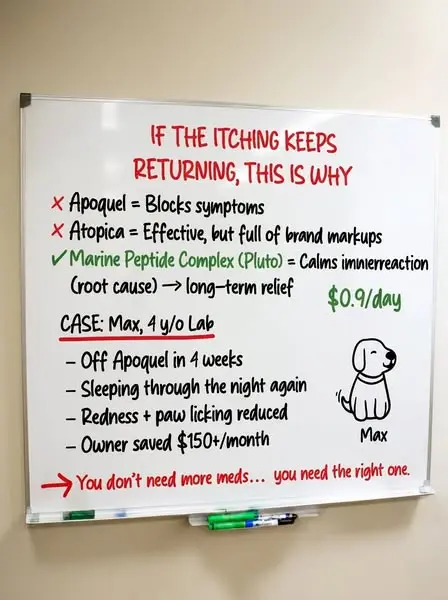
That's Pluto Advanced Liquid Collagen.
A cold-pressed liquid — a few drops on the food, natural bacon flavor, so the actives actually reach the skin and your dog takes it without a fight.
60-day money-back guarantee. If the pattern doesn't break — full refund. Even empty bottles. No questions asked.
Because your vet isn't going to explain the skin-barrier chain or why the collagen you've been buying is dead on arrival. There's no protocol for it. There's no pharmaceutical for it. There's no revenue in it.
From $28.49 a bottle on subscribe & save — Buy 2 Get 1 Free, or Buy 3 Get 2 Free. The link is below.
👉 plutopets.co/products/advanced-liquid-collagen-for-dogs