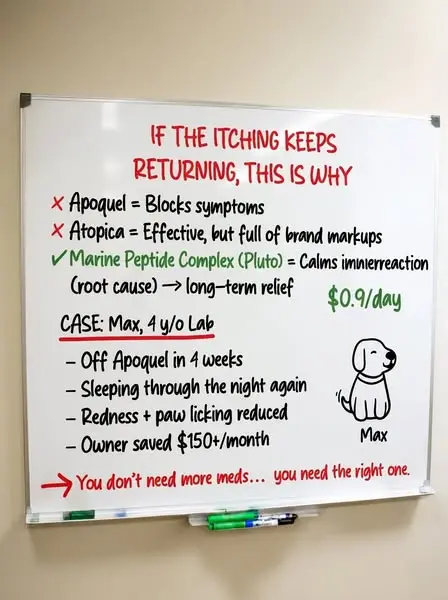
Dog Nutritionist - Daniel Brooks Facebook ad creative
plutopets.co
Help your dog
See details

Dog Nutritionist - Daniel Brooks Facebook and Instagram ad

Dog Nutritionist - Daniel Brooks ran this image ad since Jun 26, 2026, 134 days so far, targeting Worldwide, Croatia, Lithuania and 3 more countries.

First seen
Jun 26, 2026
Running for
134 days
Format
Image
Call to action
See details
Niche
Skincare
Countries
6 targeted
Page likes
609

Ad copy

Apoquel keeps the scratching technically under control but the licking, the ear infections, the hot spots keep getting worse. The Cytopoint injection lasts six weeks but the gaps between flare-ups keep shrinking. If your dog's allergy medication worked fine for years and then quietly stopped — here's what changed inside their gut, why it happens the moment immune tolerance shifts, and what I tell every owner stuck in this cycle instead. — — — For TWO YEARS my sister Megan was watching her golden retriever Cooper become a different dog. Cooper was diagnosed with atopic dermatitis at age 5. Vet put her on Apoquel immediately. Told her the medication would handle it. Within the first six months Cooper was comfortable. The scratching dropped. Megan thought it was solved. By month nine the flares started breaking through. By month fourteen the Apoquel needed to be doubled to hold the line. By year two her CADESI score — the standardized atopic dermatitis severity score every vet derm uses — had climbed from 12 to 38. Severe. On medication. On the doubled dose. And along with the breakthrough flares came everything else. The licking that never stopped. Cooper would settle on the couch and within five minutes she'd be working on a paw. Megan would call her name and she'd look up like she didn't even realize she was doing it. The pink stains on the paw fur. The wet spots on the dog bed. The sound that became the soundtrack of the house — the soft rhythmic sound of a dog working her own paw raw at 11pm while everyone else tried to sleep. The ear infections every six weeks like clockwork. Yeast. Then bacteria. Then yeast again. Antibiotic course. Topical drops. Three weeks of clear ears. Then it started again. The vet bills stacked. Megan's husband Dave stopped asking what they cost. The hot spots that wouldn't heal. One on her flank. One under her tail. One behind her left ear that she scratched into a wound the size of a quarter in a single night. The cone went on. The cone came off two weeks later. Within ten days a new spot opened somewhere else. The fur loss. Bald patches around her eyes. Bald patches on her belly. Megan was vacuuming clumps every morning. The fur loss wasn't dramatic — it was the slow accumulation that meant something was wrong and had been wrong for a long time. The personality change. Cooper used to be the dog who greeted everyone at the door tail-wagging. Now she was the dog in the corner gnawing on a paw, who flinched when the kids reached for her ears because her ears hurt. Megan's 8-year-old asked her one night, real quiet, "Is Cooper sick? Why doesn't she come play anymore?" And the relationship piece — the part Megan didn't talk about but I watched happening. The kids stopped asking to bring Cooper on outings. Dave got quietly frustrated about the vet bills and tried not to show it. The dog who'd been the center of family weekends for five years became the dog the family planned around because she couldn't sit through a meal without rubbing her face on the carpet. Cooper's CADESI was technically in the "managed" range when she was on the doubled Apoquel. Her vet derm looked at that score every visit and told Megan the medication was working. Cooper was tearing herself open on a doubled Apoquel dose and the medication was working. — — — And every single vet told her the same thing. "The CADESI is in the moderate range. The Apoquel is doing its job." "Try a stricter elimination diet." "Have you considered immunotherapy?" "Some dogs just have severe atopy. We can increase the dose again." One of them — and this makes me want to put my fist through a wall — suggested Cooper might need to stay in a permanent soft cone to prevent self-trauma during flares. A permanent cone of shame. On a 7-year-old golden retriever who used to swim in the lake every weekend. Megan walked out of that appointment. She went through four vets in two years. Not one — NOT ONE — ever looked beyond Cooper's skin and asked what was happening upstream that was driving her immune system into permanent overreaction. — — — So here's what they kept telling her to try. And I need you to pay attention because you've probably tried all of this too. Salmon oil and omega-3 supplements for "skin support" — six months — coat slightly shinier and the inflammation kept escalating. The fish oil was reaching the skin but the immune system was still being primed to overreact by something nobody was looking at. Chlorhexidine and oatmeal shampoo protocols — twice-weekly baths — soothing for an hour and back to inflamed by morning. Addressing surface irritation without touching the actual cascade producing it. Hydrolyzed prescription diet at $135 a bag every two weeks — twelve-week elimination trial, strict, no cheating, no treats — basically nothing changed. Removing potential trigger proteins while the actual mechanism kept running. Allergy panel + sublingual immunotherapy drops — $580 panel that came back showing Cooper was "highly reactive to 14 environmental allergens," $90 a month for nine months of drops — nothing. Trying to retrain the immune system at the surface while the upstream cause kept driving overreaction. The $54-a-month "premium allergy support" chew from the brand with the veterinarian endorsements — quercetin, nettle leaf, colostrum at unspecified dose — five months — nothing. Marketing-grade ingredients at homeopathic doses, none of which addressed the actual cascade. Between the medications, the Cytopoint at $300 a shot, the dermatology consults, the prescription kibble, the immunotherapy protocol, and the supplements — Megan had spent over $7,800 in two years. Still scratching. Still licking. Still flaring. Still on a doubled Apoquel dose. Still hearing the soft rhythmic sound at 11pm every night. And every vet telling her the medication was doing its job. — — — At this point I'm not frustrated anymore. I'm angry. Because I'm watching my sister — who is following every instruction, spending thousands, switching diets, applying every shampoo, giving every drop — watch her dog get worse every six months while her vet looks at a CADESI score and shrugs. Managing. The. Scratch. Not asking what's priming the immune system to overreact in the first place. Not asking what's flooding the bloodstream with inflammatory triggers. Not asking why a dog on a doubled JAK inhibitor dose was still tearing herself open. Just adjusting the medication. Suggesting more elimination diets. Checking the CADESI. Calling it managed. And that's when I started asking the questions nobody wants you to ask. Why does every atopy protocol focus on the skin when the skin is the largest barrier organ in the body — the place where systemic immune dysfunction shows up, not the place where it originates? Why does every allergy supplement target nitric oxide, biotin, or skin barrier when 70% of a dog's immune system lives in the gut-associated lymphoid tissue? Why do vets increase the Apoquel dose when the medication is already blocking the IL-31 cytokine — and the dog keeps flaring anyway? And why does NOBODY ask what's happening inside the gut — at the exact place where the immune system is being trained, every day, with every meal — while the visible scratching stays "managed" and every other symptom of immune dysregulation keeps compounding? — — — So I went down a rabbit hole. A deep one. I started researching not how to support the skin — that had been tried seven different ways — but why a dog on a doubled dose of a JAK inhibitor was still flaring. Why the Apoquel had worked for the first year and then quietly stopped. Why the CADESI looked managed while everything else got worse. And every mainstream veterinary site gave me the same recycled answers. Adjust the dose. Stricter elimination. Try immunotherapy. Manage triggers. Be patient. Then I found a line in a peer-reviewed veterinary immunology paper that stopped me cold. Apoquel is a Janus kinase inhibitor. It blocks one specific signaling pathway — JAK1 — that mast cells use to produce IL-31, the cytokine that drives the itch sensation. It blocks ONE downstream signal. It does not address the immune system's overreactive set point. It does not reduce systemic inflammatory cytokine load. It does not repair the gut barrier that's been priming the immune system to overreact for years. It silences ONE alarm bell while every other alarm in the building keeps going off. The immune dysregulation happens in the gut. And the gut runs the immune system's calibration on the same intestinal lining that processes every meal, every microbial exposure, every environmental contact your dog makes. I had to read that three times. The same lining. Not a related one. The same one. Your dog's immune system is being calibrated — every single day, every single meal — by the same intestinal barrier that's been quietly degrading for years from antibiotics, processed kibble, dysbiosis, and chronic inflammation. Here's why that matters so much. Your dog's gut treats every meal as a calibration moment. The gut decides — based on the integrity of its lining, the diversity of its microbiome, and the signaling capacity of its associated lymphoid tissue — whether a passing protein is food (tolerated) or a threat (attacked). This decision then trains the systemic immune system on how to behave. In a healthy dog with an intact gut barrier, this works beautifully. Beef protein passes through, the gut signals tolerance, the immune system stands down. Grass pollen lands on the skin, the immune system has been trained to ignore harmless environmental antigens, no reaction. Real bacterial threat enters, the immune system attacks. Calibrated. Discriminating. Working as designed. But in a dog with a compromised gut barrier — what veterinary immunologists call "leaky gut" — the calibration fails. Tight junction proteins between intestinal cells loosen. Partially-digested proteins leak into circulation. Bacterial endotoxin (LPS) leaks into circulation. Microbial fragments leak into circulation. The systemic immune system suddenly sees a flood of material it was never supposed to encounter. And it does what it has to do. It treats everything as a threat. It can't tell the difference anymore. In your 20s — I mean in your puppy years — this wasn't a problem. The gut was intact. The microbiome was diverse. The immune system was being calibrated correctly with every meal. But the gut doesn't stay sealed automatically. It degrades. Every course of antibiotics for an ear infection wipes the microbiome. Every bag of processed kibble feeds dysbiosis. Every chronic stressor — boarding, separation, environmental — disrupts the barrier. Year over year, the leakage grows. For most chronic atopic dogs whose Apoquel has stopped working as well as it used to — the gut barrier is now operating at somewhere between 30 and 50% of normal function. Not because the diagnosis is wrong. Not because the medication is wrong. Because the gut has been quietly priming the immune system into Th2 dominance for years, and the JAK inhibitor never touched any of it. CADESI doesn't measure any of this. It measures what's on the skin — downstream of the immune cascade. The score looks managed. The gut keeps leaking. The Th2 cytokines keep flooding. The mast cells stay hair-trigger sensitized. And every other expression of immune dysregulation — the ear infections, the hot spots, the fur loss, the licking, the restless nights — keeps escalating while one cytokine signal stays blocked. And here's what makes it completely invisible on every standard test. Allergy panels measure WHAT your dog reacts to. They do not measure WHY the immune system is set to overreact. Two dogs can have identical allergy panels. One has a healthy gut and only reacts to actual antigens. One has a leaky gut and reacts to everything. You cannot tell the difference from standard testing. The dysfunction is hidden underneath numbers that look like "she's allergic to grass and dust mites." That's why Cooper's CADESI was technically managed at the moderate range while she tore herself open. That's why the ear infections kept recurring on a doubled Apoquel dose. Yeast overgrowth secondary to chronic inflammation in a dog whose immune system was running on permanent high alert. No JAK inhibitor calms an immune system that's being constantly flooded with bacterial LPS. That's why the hot spots. Localized mast cell degranulation in a dog whose mast cells were sensitized into hair-trigger reactivity by years of Th2 priming from the gut. That's why the fur loss. Chronic peripheral inflammation cycling through skin tissue that had been inflamed long enough to disrupt hair follicle function. That's why the personality change. A dog living in chronic physical discomfort, cortisol elevated for months on end, sleep disrupted by constant pruritus — that's not a behavioral issue, that's a dog whose nervous system was being remodeled by chronic inflammation. And here's the detail that should have been the first question every vet asked. Cooper's symptoms had been getting worse year over year. Not suddenly. Year by year. Which is exactly what happens when the gut barrier degrades gradually — slowly leaking more endotoxin, slowly priming the immune system further toward Th2 dominance, slowly making the mast cells more reactive, with no standard test catching the progression. She wasn't flaring because she had "severe atopy." She wasn't getting worse because her allergies were "intensifying." She wasn't on a permanent path to a soft cone forever because some dogs just don't respond. Her gut had been priming her immune system into overreaction for two years while the Apoquel blocked one downstream signal and four vets kept doubling the dose of a medication that never touched the actual mechanism. — — — And here's the part that made my blood boil. The relationship between intestinal permeability and atopic dermatitis severity through Th2 immune dysregulation is in the veterinary immunology literature. The way a compromised gut barrier drives chronic mast cell sensitization in atopic dogs has been documented in peer-reviewed research. The mechanism isn't theoretical. It's published. It's replicated. It exists. But the clinical protocol for canine atopic dermatitis that has stopped responding to Apoquel doesn't include a stool microbiome panel. Doesn't evaluate intestinal permeability markers. Doesn't ask whether the gut-immune calibration system is failing before the JAK inhibitor even gets its turn. Because there's no patentable pharmaceutical for intestinal barrier repair and oral tolerance restoration. You can't patent whole-food bioactive nutrition. There's no revenue in telling a dog owner that her dog's skin isn't broken — that her gut is failing to teach immune tolerance and that the Apoquel dose increase she just got is still blocking one downstream signal in a cascade that's being driven from the gut. There IS revenue in doubling the Apoquel dose at $98 a month. Cytopoint injections at $300 a shot every six weeks. Prescription hydrolyzed kibble at $135 a bag every two weeks. Allergy panels at $580. Immunotherapy drops at $90 a month for a year. Specialist derm consults every six weeks where they look at the CADESI and call it managed while the dysregulation runs undisturbed. Adjust the dose. Never seal the gut. Keep the patient returning indefinitely. — — — So I kept digging. Looking specifically for what could restore gut barrier integrity and oral tolerance at the place the calibration was actually happening — inside the intestinal lining itself. Not at the skin. Not at the cytokine signal. At the upstream organ that had been priming the entire cascade for years. And I found compounds that kept appearing in peer-reviewed veterinary immunology and gastroenterology research — not pet supplement marketing — as the specific answer. Type II Chicken Collagen at 90% concentration. And bone broth peptides at therapeutic dose. Not marketed for atopy. Not sold as an allergy supplement. Researched specifically for what happens to immune tolerance when the gut barrier is rebuilt and when the immune system gets re-exposed to native, undenatured Type II collagen through the oral route. Here's why this combination is the missing piece every other supplement misses. Type II chicken collagen — when delivered in its undenatured form at 90% concentration — engages a specific immune pathway called oral tolerance. The gut-associated lymphoid tissue encounters the collagen, recognizes it as a safe dietary protein, and signals the systemic immune system to dial down its inflammatory response. Published veterinary research has documented this mechanism specifically in dogs with chronic inflammatory conditions. The collagen acts like a reset switch on the immune system's threat threshold. But oral tolerance only works if the gut barrier is intact enough to process the signal correctly. A leaky gut can't engage oral tolerance — it's leaking too much other inflammatory material to ever calm down. That's where bone broth peptides come in. Bone broth delivers glycine, proline, hydroxyproline, and glutamine — the four specific amino acids the intestinal lining uses to rebuild tight junction proteins. Without these in therapeutic doses, the tight junctions stay loose and the leakage continues. With them, the lining begins to physically reseal within weeks. The two together — bone broth peptides physically resealing the gut barrier while Type II collagen engages oral tolerance and resets the immune system's set point — address the mechanism from both directions simultaneously. Then the supporting cast amplifies the same pathways: Green Lipped Mussel at 300mg — delivers ETA omega-3, a unique anti-inflammatory fatty acid not found in fish oil or salmon oil, with published research showing significant improvement in inflammation outcomes in atopic dogs. Lion's Mane and Reishi mushrooms at 100mg each — beta-glucan immunomodulators that shift Th2-dominant immune responses toward Th1/Treg balance. This is the specific mechanism that calms hair-trigger mast cells. Ashwagandha at 50mg — adaptogen that regulates the cortisol-immune feedback loop. Chronic stress from constant discomfort potentiates allergic disease, and ashwagandha is the published-research counter. Plus pumpkin seed, kelp, cranberry, beef liver, green tea, and parsley — all targeted at the same gut-immune-skin axis from different angles. Not a "skin and coat" formula. Not biotin and fish oil dressed up. A 12-ingredient whole-food bioactive stack built around the only ingredients that actually engage gut barrier repair and oral tolerance restoration — the mechanism the research has been documenting for years. — — — My sister tried to find a gut-immune supplement that matched what the research described. First — the highest-rated "skin and coat" chew on Amazon. Five stars. Thousands of reviews. Eight weeks. Nothing moved. Same scratching. Same flares. Same ear infections. On the chew. Getting worse. Exactly the same pattern as everything else she'd tried. Second — a "premium allergy support" formula at $54 a month from a brand with veterinarian endorsements. Ten weeks. Slightly less inflammation maybe. Hot spots and licking unchanged. She went back to the research. Read the methodology. Every study showing the actual gut-immune-skin level effects — gut barrier repair, oral tolerance engagement, Th2 cytokine reduction — used specific ingredients at specific doses. Bone broth peptides at 200mg. Type II chicken collagen at 90% concentration (not generic collagen — most "collagen for dogs" supplements use Type I from hide, which doesn't engage oral tolerance). Green Lipped Mussel at 300mg (not fish oil or salmon oil — most don't include GLM at all). Mushroom extracts at therapeutic doses (not "mushroom blend" at homeopathic levels). She flipped over both bottles. Both used fish oil instead of Green Lipped Mussel. Neither had Type II chicken collagen. Neither had bone broth peptides at therapeutic dose. Neither had Lion's Mane or Reishi. One had a proprietary blend hiding everything. She'd taken eighteen weeks of supplements that contained almost none of the specific ingredients the research used — at doses that were either homeopathic or hidden behind "proprietary blend" labels. Eighteen weeks of products that couldn't reach the mechanism at any meaningful level. Wrong ingredients. Wrong doses. Wrong forms. Eighteen weeks of products marketed for "skin support" while the actual cascade ran undisturbed. Between the Apoquel, the Cytopoint, the prescription diet, the immunotherapy, the specialist consults, and two rounds of under-formulated allergy chews — she'd spent over $7,800 in two years. — — — I was scrolling through my phone late one night — because Cooper's next derm appointment was coming and the vet was now floating the idea of stacking cyclosporine on top of the Apoquel — and I saw a woman in an atopic doodle support group mention a small brand called Pluto. Different woman. Different city. Different breed. Same story. Same CADESI that the Apoquel "managed" while everything else degraded. Same Cytopoint cycle getting tighter. Same generic fish oil that did nothing. She'd found the gut. Tried Pluto. Posted what happened. Twelve weeks in: CADESI down significantly, off Apoquel entirely, no Cytopoint for two months, hot spots fully healed, fur regrown, ears clear for the first time in over a year. Someone in the thread asked about the formulation. "Twelve whole-food bioactive ingredients. Green Lipped Mussel at 300mg — the only omega-3 source that has ETA. Beef bone broth at 200mg for the tight junction repair amino acids. Lion's Mane and Reishi at 100mg each for Th2 modulation. Type II Chicken Collagen at 90% concentration — the specific form that engages oral tolerance, this is the one most supplements skip. Plus pumpkin seed, kelp, cranberry, ashwagandha, beef liver, green tea, and parsley. Every ingredient listed with the exact amount. No proprietary blends. Beef-flavored powder you sprinkle on the food. Cooper would actually eat it. The generic allergy chews are missing all of this. This one isn't." I went to their site. Ready to be disappointed like I had been every other time. Green Lipped Mussel 300mg. Beef Bone Broth Powder 200mg. Lion's Mane Mushroom 100mg. Reishi Mushroom 100mg. Pumpkin Seed 75mg. Kelp Powder 75mg. Cranberry Extract 75mg. Ashwagandha Extract 50mg. Beef Liver Powder 35mg. Green Tea Extract 30mg. Type II Chicken Collagen Powder at 90% Collagen 20mg. Parsley Powder 20mg. Twelve ingredients. Every amount listed. No proprietary blends. Beef-flavored powder. Made in the USA. Not a "skin and coat" chew. Not a generic allergy support. A targeted formula built around the specific bioactive peptides that engage gut barrier repair and oral tolerance — paired with the exact supporting stack the research showed amplifies the effect from every direction. — — — My sister started Cooper on Pluto Peptide Powder. After two weeks? Cooper's stools — which had been intermittently loose for as long as Megan could remember — firmed up. Two consecutive days of formed stool. Then four. Then a week. She texted me on a Tuesday morning. "I think her stomach is finally working." Not a CADESI change. Not a visible skin change. The first marker of gut barrier reseal — the first sign that something inside Cooper had shifted in a direction it hadn't been moving in for years. The gut wasn't fully sealed yet. But the chronic dysbiosis that had been driving the leakage was beginning to shift. The flood of endotoxin into circulation was starting to drop. The immune system was beginning to feel the first reduction in baseline priming after months of operating at max alert. After three weeks? The licking dropped. Not stopped. Dropped. Cooper would settle on the couch and stay settled for twenty minutes before going back to her paw. Then thirty. The soft rhythmic sound at 11pm got quieter. Th2 cytokine load dropping as the gut barrier resealed. Mast cells less hair-trigger sensitized. The IL-31 signal that Apoquel was blocking — being produced at lower volume from upstream. The medication starting to do its job more effectively because the immune system was being primed less aggressively. After four weeks? The hot spot under her tail — the one that had cycled open and scabbed and reopened for over a year — started healing for real. Megan sent me a photo of clean pink skin where there had been a raw lesion the week before. "I think it's actually closing this time." After six weeks? The ear infection that had been due to recur — based on the every-six-weeks pattern Cooper had been on for over a year — didn't recur. The ears stayed clear. Megan checked them every morning expecting to find the familiar redness and discharge. Clear. Then a week later, still clear. Then two weeks, still clear. The chronic yeast overgrowth that had been secondary to chronic immune dysregulation was finally clearing because the immune dysregulation itself was clearing. After eight weeks? Megan dropped the Apoquel dose. From the doubled dose back to the original. Held her breath waiting for the flare. It didn't come. Two weeks later she stopped the Apoquel entirely. No rebound. No breakthrough flare. The morning ritual of giving Cooper a pill — for the first time in two years — wasn't necessary. The fur around her eyes started filling in. The bald patches on her belly started growing back. Cooper started sleeping through the night. After twelve weeks? Full derm recheck and a fresh CADESI. CADESI — down significantly into mild range. Coat fully restored. Ears clear. Hot spots fully healed. Off Apoquel for over a month. No Cytopoint since the eight-week mark. Stools consistently formed. The dog who had been on a doubled JAK inhibitor at the start of this — was off all of it. Her vet derm pulled up the previous chart. Looked at the current exam. Looked at Megan. "Cooper's CADESI has dropped more in twelve weeks than I've seen in dogs on continued Apoquel therapy. What changed?" Megan explained it. The gut as the upstream calibration site for the immune system. The Apoquel blocking IL-31 downstream while the gut kept leaking inflammatory triggers that primed everything else. The Type II chicken collagen at 90% concentration engaging the oral tolerance pathway. The bone broth peptides resealing the tight junctions. The Green Lipped Mussel providing ETA omega-3. The mushroom extracts shifting Th2 toward Treg balance. Her vet typed notes slowly. "The relationship between intestinal permeability and atopic dermatitis severity through Th2 immune dysregulation is documented in the veterinary immunology literature. It's not part of the standard derm protocol because there's no pharmaceutical intervention for it. We typically address the visible inflammation with JAK inhibitors and adjust dose." "There's not a pharmaceutical for it," Megan said. "There's a whole-food bioactive one. And it sealed the gut." Long pause. "Cooper's atopic dermatitis severity has improved more in twelve weeks than in two years of dose adjustments and prescription interventions. I want to see her again in eight weeks. Whatever you're doing — keep doing it." She walked to her car. Got in. Then she called me. "CADESI is in mild range. She said keep doing it. Two years. Four vets. $7,800. On a doubled Apoquel dose. Getting worse every six months. Every single one of them adjusting the medication while the gut leaked underneath." Her husband Dave came home that evening and stopped in the kitchen and looked around. The house was quiet. He said: "When did she stop scratching?" Cooper walked over to him and curled up at his feet — something she hadn't done in over a year because she was too uncomfortable to lie still. — — — Total improvement at five months: CADESI in mild range. Off Apoquel. Off Cytopoint. Off the prescription hydrolyzed kibble. Stools consistently formed. Ears clear for four months running. Hot spots fully healed and not recurring. Fur fully regrown including the bald patches around her eyes. Sleeping through the night. Greeting the kids at the door again. Chasing tennis balls in the yard. The dog Megan had raised from a puppy — back. Not from another dose increase sending more JAK inhibitor into a system that was being primed by the gut. From sealing the gut. — — — This is what they don't want you to know. Because the second you seal your dog's gut and restore immune tolerance you don't need their lifelong Apoquel scripts at $98 a month. You don't need their $300 Cytopoint injections every six weeks. You don't need their $135 prescription hydrolyzed kibble. You don't need their $580 allergy panels or their $90 a month immunotherapy drops or their derm consults every six weeks checking a CADESI score that was never measuring what was actually broken. The gut seals. The immune system recalibrates. The Th2 priming drops. The mast cells stop being hair-trigger. The cytokine flood ends. The visible disease — the scratching, the licking, the hot spots, the ear infections, the fur loss — quiets down because the upstream cause is finally addressed. The way it would have years ago — if someone had looked upstream of the skin and asked why the immune system had been set to overreact in the first place. — — — Now here's what I need you to understand. The gut doesn't seal itself. Every month it stays leaky is another month of bacterial endotoxin and partially-digested proteins flooding your dog's bloodstream and priming their immune system further into Th2 dominance. Another month of mast cells getting more hair-trigger sensitized. Another month of the Apoquel needing to work harder to suppress one downstream signal while the upstream flood continues. Another month of the ear infections and the hot spots and the licking and the fur loss compounding. And every month your vet gets closer to the conversation about stacking cyclosporine or oclacitinib on top of Apoquel. Or organ-damaging steroid bursts. Or the permanent soft cone suggestion. Or "some dogs just have severe atopy and need lifetime management." So if you're dealing with ANY of this — chronic scratching that started in puppyhood or early adulthood, recurring ear infections every four to six weeks, hot spots that keep coming back, paws stained pink from constant licking, intermittent loose stools or chronic GI symptoms, fur loss around eyes or muzzle or belly, plus an Apoquel script that worked at first and now doesn't, or a Cytopoint schedule that's getting tighter every cycle — this is the time. Not next month when the dose needs to double again. Not when your vet floats stacking cyclosporine. Not when you're sitting in a specialist appointment listening to "some dogs just have severe atopy." Right now. Pluto Peptide Powder. Green Lipped Mussel 300mg — the only omega-3 source with ETA. Beef Bone Broth Powder 200mg — the tight junction repair amino acids. Lion's Mane 100mg and Reishi 100mg — Th2 to Treg modulation. Type II Chicken Collagen at 90% concentration 20mg — the specific form that engages oral tolerance and resets the immune system's threat threshold. Plus Pumpkin Seed, Kelp, Cranberry, Ashwagandha, Beef Liver, Green Tea, and Parsley supporting the same gut-immune-skin axis from every direction. Twelve ingredients. Every amount listed. No proprietary blends. Beef-flavored powder you sprinkle on their food. Made in the USA. $27 per pack — not $98 a month like Apoquel. Not $300 a shot like Cytopoint. Not $135 a bag like prescription kibble. Subscribe and save to lock in lower pricing — because the gut doesn't fully reseal in 30 days and most owners stay on it through the full recovery. Money-back guarantee. Use it every day. Watch the stools. Watch the scratching. Watch the licking and the ear cycles and the hot spots. If the gut doesn't start sealing, if the cycles don't break, if your dog doesn't start coming back — full refund. No questions asked. Because your vet isn't coming to seal the gut. There's no protocol for it. There's no pharmaceutical for it. There's no revenue in it. You have to seal it yourself. 👉 plutopets.co/products/wellbeing-peptide-powder-for-dogs

Placements and targeting

More ads from Dog Nutritionist - Daniel Brooks

Full Dog Nutritionist - Daniel Brooks profile
Dog Nutritionist - Daniel Brooks
+1
Inactive134 days
plutopets.co
Help your dog
See details

Apoquel keeps the scratching technically under control but the licking, the ear infections, the hot spots keep getting worse. The Cytopoint injection lasts six weeks but the gaps between flare-ups keep shrinking. If your dog's allergy medication worked fine for years and then quietly stopped — here's what changed inside their gut, why it happens the moment immune tolerance shifts, and what I tell every owner stuck in this cycle instead. — — — For TWO YEARS my sister Megan was watching her golden retriever Cooper become a different dog. Cooper was diagnosed with atopic dermatitis at age 5. Vet put her on Apoquel immediately. Told her the medication would handle it. Within the first six months Cooper was comfortable. The scratching dropped. Megan thought it was solved. By month nine the flares started breaking through. By month fourteen the Apoquel needed to be doubled to hold the line. By year two her CADESI score — the standardized atopic dermatitis severity score every vet derm uses — had climbed from 12 to 38. Severe. On medication. On the doubled dose. And along with the breakthrough flares came everything else. The licking that never stopped. Cooper would settle on the couch and within five minutes she'd be working on a paw. Megan would call her name and she'd look up like she didn't even realize she was doing it. The pink stains on the paw fur. The wet spots on the dog bed. The sound that became the soundtrack of the house — the soft rhythmic sound of a dog working her own paw raw at 11pm while everyone else tried to sleep. The ear infections every six weeks like clockwork. Yeast. Then bacteria. Then yeast again. Antibiotic course. Topical drops. Three weeks of clear ears. Then it started again. The vet bills stacked. Megan's husband Dave stopped asking what they cost. The hot spots that wouldn't heal. One on her flank. One under her tail. One behind her left ear that she scratched into a wound the size of a quarter in a single night. The cone went on. The cone came off two weeks later. Within ten days a new spot opened somewhere else. The fur loss. Bald patches around her eyes. Bald patches on her belly. Megan was vacuuming clumps every morning. The fur loss wasn't dramatic — it was the slow accumulation that meant something was wrong and had been wrong for a long time. The personality change. Cooper used to be the dog who greeted everyone at the door tail-wagging. Now she was the dog in the corner gnawing on a paw, who flinched when the kids reached for her ears because her ears hurt. Megan's 8-year-old asked her one night, real quiet, "Is Cooper sick? Why doesn't she come play anymore?" And the relationship piece — the part Megan didn't talk about but I watched happening. The kids stopped asking to bring Cooper on outings. Dave got quietly frustrated about the vet bills and tried not to show it. The dog who'd been the center of family weekends for five years became the dog the family planned around because she couldn't sit through a meal without rubbing her face on the carpet. Cooper's CADESI was technically in the "managed" range when she was on the doubled Apoquel. Her vet derm looked at that score every visit and told Megan the medication was working. Cooper was tearing herself open on a doubled Apoquel dose and the medication was working. — — — And every single vet told her the same thing. "The CADESI is in the moderate range. The Apoquel is doing its job." "Try a stricter elimination diet." "Have you considered immunotherapy?" "Some dogs just have severe atopy. We can increase the dose again." One of them — and this makes me want to put my fist through a wall — suggested Cooper might need to stay in a permanent soft cone to prevent self-trauma during flares. A permanent cone of shame. On a 7-year-old golden retriever who used to swim in the lake every weekend. Megan walked out of that appointment. She went through four vets in two years. Not one — NOT ONE — ever looked beyond Cooper's skin and asked what was happening upstream that was driving her immune system into permanent overreaction. — — — So here's what they kept telling her to try. And I need you to pay attention because you've probably tried all of this too. Salmon oil and omega-3 supplements for "skin support" — six months — coat slightly shinier and the inflammation kept escalating. The fish oil was reaching the skin but the immune system was still being primed to overreact by something nobody was looking at. Chlorhexidine and oatmeal shampoo protocols — twice-weekly baths — soothing for an hour and back to inflamed by morning. Addressing surface irritation without touching the actual cascade producing it. Hydrolyzed prescription diet at $135 a bag every two weeks — twelve-week elimination trial, strict, no cheating, no treats — basically nothing changed. Removing potential trigger proteins while the actual mechanism kept running. Allergy panel + sublingual immunotherapy drops — $580 panel that came back showing Cooper was "highly reactive to 14 environmental allergens," $90 a month for nine months of drops — nothing. Trying to retrain the immune system at the surface while the upstream cause kept driving overreaction. The $54-a-month "premium allergy support" chew from the brand with the veterinarian endorsements — quercetin, nettle leaf, colostrum at unspecified dose — five months — nothing. Marketing-grade ingredients at homeopathic doses, none of which addressed the actual cascade. Between the medications, the Cytopoint at $300 a shot, the dermatology consults, the prescription kibble, the immunotherapy protocol, and the supplements — Megan had spent over $7,800 in two years. Still scratching. Still licking. Still flaring. Still on a doubled Apoquel dose. Still hearing the soft rhythmic sound at 11pm every night. And every vet telling her the medication was doing its job. — — — At this point I'm not frustrated anymore. I'm angry. Because I'm watching my sister — who is following every instruction, spending thousands, switching diets, applying every shampoo, giving every drop — watch her dog get worse every six months while her vet looks at a CADESI score and shrugs. Managing. The. Scratch. Not asking what's priming the immune system to overreact in the first place. Not asking what's flooding the bloodstream with inflammatory triggers. Not asking why a dog on a doubled JAK inhibitor dose was still tearing herself open. Just adjusting the medication. Suggesting more elimination diets. Checking the CADESI. Calling it managed. And that's when I started asking the questions nobody wants you to ask. Why does every atopy protocol focus on the skin when the skin is the largest barrier organ in the body — the place where systemic immune dysfunction shows up, not the place where it originates? Why does every allergy supplement target nitric oxide, biotin, or skin barrier when 70% of a dog's immune system lives in the gut-associated lymphoid tissue? Why do vets increase the Apoquel dose when the medication is already blocking the IL-31 cytokine — and the dog keeps flaring anyway? And why does NOBODY ask what's happening inside the gut — at the exact place where the immune system is being trained, every day, with every meal — while the visible scratching stays "managed" and every other symptom of immune dysregulation keeps compounding? — — — So I went down a rabbit hole. A deep one. I started researching not how to support the skin — that had been tried seven different ways — but why a dog on a doubled dose of a JAK inhibitor was still flaring. Why the Apoquel had worked for the first year and then quietly stopped. Why the CADESI looked managed while everything else got worse. And every mainstream veterinary site gave me the same recycled answers. Adjust the dose. Stricter elimination. Try immunotherapy. Manage triggers. Be patient. Then I found a line in a peer-reviewed veterinary immunology paper that stopped me cold. Apoquel is a Janus kinase inhibitor. It blocks one specific signaling pathway — JAK1 — that mast cells use to produce IL-31, the cytokine that drives the itch sensation. It blocks ONE downstream signal. It does not address the immune system's overreactive set point. It does not reduce systemic inflammatory cytokine load. It does not repair the gut barrier that's been priming the immune system to overreact for years. It silences ONE alarm bell while every other alarm in the building keeps going off. The immune dysregulation happens in the gut. And the gut runs the immune system's calibration on the same intestinal lining that processes every meal, every microbial exposure, every environmental contact your dog makes. I had to read that three times. The same lining. Not a related one. The same one. Your dog's immune system is being calibrated — every single day, every single meal — by the same intestinal barrier that's been quietly degrading for years from antibiotics, processed kibble, dysbiosis, and chronic inflammation. Here's why that matters so much. Your dog's gut treats every meal as a calibration moment. The gut decides — based on the integrity of its lining, the diversity of its microbiome, and the signaling capacity of its associated lymphoid tissue — whether a passing protein is food (tolerated) or a threat (attacked). This decision then trains the systemic immune system on how to behave. In a healthy dog with an intact gut barrier, this works beautifully. Beef protein passes through, the gut signals tolerance, the immune system stands down. Grass pollen lands on the skin, the immune system has been trained to ignore harmless environmental antigens, no reaction. Real bacterial threat enters, the immune system attacks. Calibrated. Discriminating. Working as designed. But in a dog with a compromised gut barrier — what veterinary immunologists call "leaky gut" — the calibration fails. Tight junction proteins between intestinal cells loosen. Partially-digested proteins leak into circulation. Bacterial endotoxin (LPS) leaks into circulation. Microbial fragments leak into circulation. The systemic immune system suddenly sees a flood of material it was never supposed to encounter. And it does what it has to do. It treats everything as a threat. It can't tell the difference anymore. In your 20s — I mean in your puppy years — this wasn't a problem. The gut was intact. The microbiome was diverse. The immune system was being calibrated correctly with every meal. But the gut doesn't stay sealed automatically. It degrades. Every course of antibiotics for an ear infection wipes the microbiome. Every bag of processed kibble feeds dysbiosis. Every chronic stressor — boarding, separation, environmental — disrupts the barrier. Year over year, the leakage grows. For most chronic atopic dogs whose Apoquel has stopped working as well as it used to — the gut barrier is now operating at somewhere between 30 and 50% of normal function. Not because the diagnosis is wrong. Not because the medication is wrong. Because the gut has been quietly priming the immune system into Th2 dominance for years, and the JAK inhibitor never touched any of it. CADESI doesn't measure any of this. It measures what's on the skin — downstream of the immune cascade. The score looks managed. The gut keeps leaking. The Th2 cytokines keep flooding. The mast cells stay hair-trigger sensitized. And every other expression of immune dysregulation — the ear infections, the hot spots, the fur loss, the licking, the restless nights — keeps escalating while one cytokine signal stays blocked. And here's what makes it completely invisible on every standard test. Allergy panels measure WHAT your dog reacts to. They do not measure WHY the immune system is set to overreact. Two dogs can have identical allergy panels. One has a healthy gut and only reacts to actual antigens. One has a leaky gut and reacts to everything. You cannot tell the difference from standard testing. The dysfunction is hidden underneath numbers that look like "she's allergic to grass and dust mites." That's why Cooper's CADESI was technically managed at the moderate range while she tore herself open. That's why the ear infections kept recurring on a doubled Apoquel dose. Yeast overgrowth secondary to chronic inflammation in a dog whose immune system was running on permanent high alert. No JAK inhibitor calms an immune system that's being constantly flooded with bacterial LPS. That's why the hot spots. Localized mast cell degranulation in a dog whose mast cells were sensitized into hair-trigger reactivity by years of Th2 priming from the gut. That's why the fur loss. Chronic peripheral inflammation cycling through skin tissue that had been inflamed long enough to disrupt hair follicle function. That's why the personality change. A dog living in chronic physical discomfort, cortisol elevated for months on end, sleep disrupted by constant pruritus — that's not a behavioral issue, that's a dog whose nervous system was being remodeled by chronic inflammation. And here's the detail that should have been the first question every vet asked. Cooper's symptoms had been getting worse year over year. Not suddenly. Year by year. Which is exactly what happens when the gut barrier degrades gradually — slowly leaking more endotoxin, slowly priming the immune system further toward Th2 dominance, slowly making the mast cells more reactive, with no standard test catching the progression. She wasn't flaring because she had "severe atopy." She wasn't getting worse because her allergies were "intensifying." She wasn't on a permanent path to a soft cone forever because some dogs just don't respond. Her gut had been priming her immune system into overreaction for two years while the Apoquel blocked one downstream signal and four vets kept doubling the dose of a medication that never touched the actual mechanism. — — — And here's the part that made my blood boil. The relationship between intestinal permeability and atopic dermatitis severity through Th2 immune dysregulation is in the veterinary immunology literature. The way a compromised gut barrier drives chronic mast cell sensitization in atopic dogs has been documented in peer-reviewed research. The mechanism isn't theoretical. It's published. It's replicated. It exists. But the clinical protocol for canine atopic dermatitis that has stopped responding to Apoquel doesn't include a stool microbiome panel. Doesn't evaluate intestinal permeability markers. Doesn't ask whether the gut-immune calibration system is failing before the JAK inhibitor even gets its turn. Because there's no patentable pharmaceutical for intestinal barrier repair and oral tolerance restoration. You can't patent whole-food bioactive nutrition. There's no revenue in telling a dog owner that her dog's skin isn't broken — that her gut is failing to teach immune tolerance and that the Apoquel dose increase she just got is still blocking one downstream signal in a cascade that's being driven from the gut. There IS revenue in doubling the Apoquel dose at $98 a month. Cytopoint injections at $300 a shot every six weeks. Prescription hydrolyzed kibble at $135 a bag every two weeks. Allergy panels at $580. Immunotherapy drops at $90 a month for a year. Specialist derm consults every six weeks where they look at the CADESI and call it managed while the dysregulation runs undisturbed. Adjust the dose. Never seal the gut. Keep the patient returning indefinitely. — — — So I kept digging. Looking specifically for what could restore gut barrier integrity and oral tolerance at the place the calibration was actually happening — inside the intestinal lining itself. Not at the skin. Not at the cytokine signal. At the upstream organ that had been priming the entire cascade for years. And I found compounds that kept appearing in peer-reviewed veterinary immunology and gastroenterology research — not pet supplement marketing — as the specific answer. Type II Chicken Collagen at 90% concentration. And bone broth peptides at therapeutic dose. Not marketed for atopy. Not sold as an allergy supplement. Researched specifically for what happens to immune tolerance when the gut barrier is rebuilt and when the immune system gets re-exposed to native, undenatured Type II collagen through the oral route. Here's why this combination is the missing piece every other supplement misses. Type II chicken collagen — when delivered in its undenatured form at 90% concentration — engages a specific immune pathway called oral tolerance. The gut-associated lymphoid tissue encounters the collagen, recognizes it as a safe dietary protein, and signals the systemic immune system to dial down its inflammatory response. Published veterinary research has documented this mechanism specifically in dogs with chronic inflammatory conditions. The collagen acts like a reset switch on the immune system's threat threshold. But oral tolerance only works if the gut barrier is intact enough to process the signal correctly. A leaky gut can't engage oral tolerance — it's leaking too much other inflammatory material to ever calm down. That's where bone broth peptides come in. Bone broth delivers glycine, proline, hydroxyproline, and glutamine — the four specific amino acids the intestinal lining uses to rebuild tight junction proteins. Without these in therapeutic doses, the tight junctions stay loose and the leakage continues. With them, the lining begins to physically reseal within weeks. The two together — bone broth peptides physically resealing the gut barrier while Type II collagen engages oral tolerance and resets the immune system's set point — address the mechanism from both directions simultaneously. Then the supporting cast amplifies the same pathways: Green Lipped Mussel at 300mg — delivers ETA omega-3, a unique anti-inflammatory fatty acid not found in fish oil or salmon oil, with published research showing significant improvement in inflammation outcomes in atopic dogs. Lion's Mane and Reishi mushrooms at 100mg each — beta-glucan immunomodulators that shift Th2-dominant immune responses toward Th1/Treg balance. This is the specific mechanism that calms hair-trigger mast cells. Ashwagandha at 50mg — adaptogen that regulates the cortisol-immune feedback loop. Chronic stress from constant discomfort potentiates allergic disease, and ashwagandha is the published-research counter. Plus pumpkin seed, kelp, cranberry, beef liver, green tea, and parsley — all targeted at the same gut-immune-skin axis from different angles. Not a "skin and coat" formula. Not biotin and fish oil dressed up. A 12-ingredient whole-food bioactive stack built around the only ingredients that actually engage gut barrier repair and oral tolerance restoration — the mechanism the research has been documenting for years. — — — My sister tried to find a gut-immune supplement that matched what the research described. First — the highest-rated "skin and coat" chew on Amazon. Five stars. Thousands of reviews. Eight weeks. Nothing moved. Same scratching. Same flares. Same ear infections. On the chew. Getting worse. Exactly the same pattern as everything else she'd tried. Second — a "premium allergy support" formula at $54 a month from a brand with veterinarian endorsements. Ten weeks. Slightly less inflammation maybe. Hot spots and licking unchanged. She went back to the research. Read the methodology. Every study showing the actual gut-immune-skin level effects — gut barrier repair, oral tolerance engagement, Th2 cytokine reduction — used specific ingredients at specific doses. Bone broth peptides at 200mg. Type II chicken collagen at 90% concentration (not generic collagen — most "collagen for dogs" supplements use Type I from hide, which doesn't engage oral tolerance). Green Lipped Mussel at 300mg (not fish oil or salmon oil — most don't include GLM at all). Mushroom extracts at therapeutic doses (not "mushroom blend" at homeopathic levels). She flipped over both bottles. Both used fish oil instead of Green Lipped Mussel. Neither had Type II chicken collagen. Neither had bone broth peptides at therapeutic dose. Neither had Lion's Mane or Reishi. One had a proprietary blend hiding everything. She'd taken eighteen weeks of supplements that contained almost none of the specific ingredients the research used — at doses that were either homeopathic or hidden behind "proprietary blend" labels. Eighteen weeks of products that couldn't reach the mechanism at any meaningful level. Wrong ingredients. Wrong doses. Wrong forms. Eighteen weeks of products marketed for "skin support" while the actual cascade ran undisturbed. Between the Apoquel, the Cytopoint, the prescription diet, the immunotherapy, the specialist consults, and two rounds of under-formulated allergy chews — she'd spent over $7,800 in two years. — — — I was scrolling through my phone late one night — because Cooper's next derm appointment was coming and the vet was now floating the idea of stacking cyclosporine on top of the Apoquel — and I saw a woman in an atopic doodle support group mention a small brand called Pluto. Different woman. Different city. Different breed. Same story. Same CADESI that the Apoquel "managed" while everything else degraded. Same Cytopoint cycle getting tighter. Same generic fish oil that did nothing. She'd found the gut. Tried Pluto. Posted what happened. Twelve weeks in: CADESI down significantly, off Apoquel entirely, no Cytopoint for two months, hot spots fully healed, fur regrown, ears clear for the first time in over a year. Someone in the thread asked about the formulation. "Twelve whole-food bioactive ingredients. Green Lipped Mussel at 300mg — the only omega-3 source that has ETA. Beef bone broth at 200mg for the tight junction repair amino acids. Lion's Mane and Reishi at 100mg each for Th2 modulation. Type II Chicken Collagen at 90% concentration — the specific form that engages oral tolerance, this is the one most supplements skip. Plus pumpkin seed, kelp, cranberry, ashwagandha, beef liver, green tea, and parsley. Every ingredient listed with the exact amount. No proprietary blends. Beef-flavored powder you sprinkle on the food. Cooper would actually eat it. The generic allergy chews are missing all of this. This one isn't." I went to their site. Ready to be disappointed like I had been every other time. Green Lipped Mussel 300mg. Beef Bone Broth Powder 200mg. Lion's Mane Mushroom 100mg. Reishi Mushroom 100mg. Pumpkin Seed 75mg. Kelp Powder 75mg. Cranberry Extract 75mg. Ashwagandha Extract 50mg. Beef Liver Powder 35mg. Green Tea Extract 30mg. Type II Chicken Collagen Powder at 90% Collagen 20mg. Parsley Powder 20mg. Twelve ingredients. Every amount listed. No proprietary blends. Beef-flavored powder. Made in the USA. Not a "skin and coat" chew. Not a generic allergy support. A targeted formula built around the specific bioactive peptides that engage gut barrier repair and oral tolerance — paired with the exact supporting stack the research showed amplifies the effect from every direction. — — — My sister started Cooper on Pluto Peptide Powder. After two weeks? Cooper's stools — which had been intermittently loose for as long as Megan could remember — firmed up. Two consecutive days of formed stool. Then four. Then a week. She texted me on a Tuesday morning. "I think her stomach is finally working." Not a CADESI change. Not a visible skin change. The first marker of gut barrier reseal — the first sign that something inside Cooper had shifted in a direction it hadn't been moving in for years. The gut wasn't fully sealed yet. But the chronic dysbiosis that had been driving the leakage was beginning to shift. The flood of endotoxin into circulation was starting to drop. The immune system was beginning to feel the first reduction in baseline priming after months of operating at max alert. After three weeks? The licking dropped. Not stopped. Dropped. Cooper would settle on the couch and stay settled for twenty minutes before going back to her paw. Then thirty. The soft rhythmic sound at 11pm got quieter. Th2 cytokine load dropping as the gut barrier resealed. Mast cells less hair-trigger sensitized. The IL-31 signal that Apoquel was blocking — being produced at lower volume from upstream. The medication starting to do its job more effectively because the immune system was being primed less aggressively. After four weeks? The hot spot under her tail — the one that had cycled open and scabbed and reopened for over a year — started healing for real. Megan sent me a photo of clean pink skin where there had been a raw lesion the week before. "I think it's actually closing this time." After six weeks? The ear infection that had been due to recur — based on the every-six-weeks pattern Cooper had been on for over a year — didn't recur. The ears stayed clear. Megan checked them every morning expecting to find the familiar redness and discharge. Clear. Then a week later, still clear. Then two weeks, still clear. The chronic yeast overgrowth that had been secondary to chronic immune dysregulation was finally clearing because the immune dysregulation itself was clearing. After eight weeks? Megan dropped the Apoquel dose. From the doubled dose back to the original. Held her breath waiting for the flare. It didn't come. Two weeks later she stopped the Apoquel entirely. No rebound. No breakthrough flare. The morning ritual of giving Cooper a pill — for the first time in two years — wasn't necessary. The fur around her eyes started filling in. The bald patches on her belly started growing back. Cooper started sleeping through the night. After twelve weeks? Full derm recheck and a fresh CADESI. CADESI — down significantly into mild range. Coat fully restored. Ears clear. Hot spots fully healed. Off Apoquel for over a month. No Cytopoint since the eight-week mark. Stools consistently formed. The dog who had been on a doubled JAK inhibitor at the start of this — was off all of it. Her vet derm pulled up the previous chart. Looked at the current exam. Looked at Megan. "Cooper's CADESI has dropped more in twelve weeks than I've seen in dogs on continued Apoquel therapy. What changed?" Megan explained it. The gut as the upstream calibration site for the immune system. The Apoquel blocking IL-31 downstream while the gut kept leaking inflammatory triggers that primed everything else. The Type II chicken collagen at 90% concentration engaging the oral tolerance pathway. The bone broth peptides resealing the tight junctions. The Green Lipped Mussel providing ETA omega-3. The mushroom extracts shifting Th2 toward Treg balance. Her vet typed notes slowly. "The relationship between intestinal permeability and atopic dermatitis severity through Th2 immune dysregulation is documented in the veterinary immunology literature. It's not part of the standard derm protocol because there's no pharmaceutical intervention for it. We typically address the visible inflammation with JAK inhibitors and adjust dose." "There's not a pharmaceutical for it," Megan said. "There's a whole-food bioactive one. And it sealed the gut." Long pause. "Cooper's atopic dermatitis severity has improved more in twelve weeks than in two years of dose adjustments and prescription interventions. I want to see her again in eight weeks. Whatever you're doing — keep doing it." She walked to her car. Got in. Then she called me. "CADESI is in mild range. She said keep doing it. Two years. Four vets. $7,800. On a doubled Apoquel dose. Getting worse every six months. Every single one of them adjusting the medication while the gut leaked underneath." Her husband Dave came home that evening and stopped in the kitchen and looked around. The house was quiet. He said: "When did she stop scratching?" Cooper walked over to him and curled up at his feet — something she hadn't done in over a year because she was too uncomfortable to lie still. — — — Total improvement at five months: CADESI in mild range. Off Apoquel. Off Cytopoint. Off the prescription hydrolyzed kibble. Stools consistently formed. Ears clear for four months running. Hot spots fully healed and not recurring. Fur fully regrown including the bald patches around her eyes. Sleeping through the night. Greeting the kids at the door again. Chasing tennis balls in the yard. The dog Megan had raised from a puppy — back. Not from another dose increase sending more JAK inhibitor into a system that was being primed by the gut. From sealing the gut. — — — This is what they don't want you to know. Because the second you seal your dog's gut and restore immune tolerance you don't need their lifelong Apoquel scripts at $98 a month. You don't need their $300 Cytopoint injections every six weeks. You don't need their $135 prescription hydrolyzed kibble. You don't need their $580 allergy panels or their $90 a month immunotherapy drops or their derm consults every six weeks checking a CADESI score that was never measuring what was actually broken. The gut seals. The immune system recalibrates. The Th2 priming drops. The mast cells stop being hair-trigger. The cytokine flood ends. The visible disease — the scratching, the licking, the hot spots, the ear infections, the fur loss — quiets down because the upstream cause is finally addressed. The way it would have years ago — if someone had looked upstream of the skin and asked why the immune system had been set to overreact in the first place. — — — Now here's what I need you to understand. The gut doesn't seal itself. Every month it stays leaky is another month of bacterial endotoxin and partially-digested proteins flooding your dog's bloodstream and priming their immune system further into Th2 dominance. Another month of mast cells getting more hair-trigger sensitized. Another month of the Apoquel needing to work harder to suppress one downstream signal while the upstream flood continues. Another month of the ear infections and the hot spots and the licking and the fur loss compounding. And every month your vet gets closer to the conversation about stacking cyclosporine or oclacitinib on top of Apoquel. Or organ-damaging steroid bursts. Or the permanent soft cone suggestion. Or "some dogs just have severe atopy and need lifetime management." So if you're dealing with ANY of this — chronic scratching that started in puppyhood or early adulthood, recurring ear infections every four to six weeks, hot spots that keep coming back, paws stained pink from constant licking, intermittent loose stools or chronic GI symptoms, fur loss around eyes or muzzle or belly, plus an Apoquel script that worked at first and now doesn't, or a Cytopoint schedule that's getting tighter every cycle — this is the time. Not next month when the dose needs to double again. Not when your vet floats stacking cyclosporine. Not when you're sitting in a specialist appointment listening to "some dogs just have severe atopy." Right now. Pluto Peptide Powder. Green Lipped Mussel 300mg — the only omega-3 source with ETA. Beef Bone Broth Powder 200mg — the tight junction repair amino acids. Lion's Mane 100mg and Reishi 100mg — Th2 to Treg modulation. Type II Chicken Collagen at 90% concentration 20mg — the specific form that engages oral tolerance and resets the immune system's threat threshold. Plus Pumpkin Seed, Kelp, Cranberry, Ashwagandha, Beef Liver, Green Tea, and Parsley supporting the same gut-immune-skin axis from every direction. Twelve ingredients. Every amount listed. No proprietary blends. Beef-flavored powder you sprinkle on their food. Made in the USA. $27 per pack — not $98 a month like Apoquel. Not $300 a shot like Cytopoint. Not $135 a bag like prescription kibble. Subscribe and save to lock in lower pricing — because the gut doesn't fully reseal in 30 days and most owners stay on it through the full recovery. Money-back guarantee. Use it every day. Watch the stools. Watch the scratching. Watch the licking and the ear cycles and the hot spots. If the gut doesn't start sealing, if the cycles don't break, if your dog doesn't start coming back — full refund. No questions asked. Because your vet isn't coming to seal the gut. There's no protocol for it. There's no pharmaceutical for it. There's no revenue in it. You have to seal it yourself. 👉 plutopets.co/products/wellbeing-peptide-powder-for-dogs

Dog Nutritionist - Daniel Brooks
+1
Inactive134 days
plutopets.co
Help your dog
See details

I'm a veterinary dermatologist, and last week a client told me she wants to taper her dog off Apoquel. Not because she gave up on treatment. Because of something that happened during her dog's recheck that I've never seen in 17 years of practice. I've been treating canine skin disease for 17 years. I've seen every stage of atopic dermatitis, every flare pattern, every trajectory of decline. I can tell within 30 seconds of looking at a dog on my exam table what direction she's heading. Last week, I couldn't. A woman came in expecting the usual. Her cocker spaniel's itch score had been stuck in the moderate-to-severe range for five years. Recurring ear infections every six weeks despite "managing the triggers." The dog was on the doubled Apoquel dose — the standard escalation for atopy that stops responding. She looked the way most of my chronic atopic patients look — patchy coat, raw belly, that defeated heaviness in the way she moved. Except she didn't. I pulled up her chart and looked at the dog. And I just… stopped. Her itch score had dropped from 38 to 9. The bald patches around her eyes had filled in. Her coat — thin across the back for years — was full and shining. Her ears, which I'd treated for recurrent yeast more times than I could count, were clean and quiet. The skin on her belly, raw from years of licking, had closed over. And the dog herself — flat and withdrawn for as long as I'd known her — was up on the table wagging. I looked at the owner. "What have you been doing differently?" "Nothing crazy. Just something my sister told me about." I didn't believe her. "New medication? Did your primary vet change the dose? Did you start immunotherapy?" "Nothing like that. Just this one thing I've been putting on her food for five months." I pulled up her previous exams and compared them side by side. Her trajectory had reversed by what looked like four years. The barrier function I'd watched degrade season after season had recovered. The flare cycle had stopped. I sat back in my chair. "I'm going to be honest with you. I don't think she needs the doubled dose anymore." The owner looked confused. "But her atopy—" "Her skin is doing its job better than it has since I diagnosed her. Her barrier is holding allergens out in a way I haven't seen on any dose of any drug." Long pause. "So what do I do now?" "Talk to your vet about tapering. But keep doing whatever you're doing — because it's working better than anything I was about to adjust." She walked out. And I spent the rest of the week wondering what she knew that I didn't. Here's what bothers me. I've been in veterinary dermatology my whole career. I know every drug, every protocol, every escalation that's supposed to work. And I see the same thing in my office every single day. Dogs — young ones, middle-aged ones, seniors — with progressing atopic dermatitis. The scratching that no dose fully stops. The dog settling on her bed and within minutes working at a paw, a flank, an ear. The owner who hasn't had a full night's sleep in months because of the soft rhythmic sound at 11pm. The ear infections that come back every six weeks no matter what. Yeast, then bacteria, then yeast again. Drops, antibiotics, antifungals. Three weeks clear. Then it starts over. The coat that keeps thinning. Bald patches around the eyes, on the belly, along the back. Owners vacuuming clumps every morning, watching their dog go threadbare in slow motion. The hot spots that won't heal. The dull, defeated dog who used to greet everyone at the door and now lies in the corner. The owner who says, quietly, "She's just not the same dog anymore." And the worst part? Their itch scores say "managed." Every vet tells them it's nothing serious. The score is "moderate." The panel shows she's "reactive to grass and dust mites." They get told to try a stricter diet. Take salmon oil. Keep her on Apoquel. Come back in six months. Labeled non-compliant when the flares keep breaking through. Told it's the season. Told some dogs just have sensitive skin. That's what I see all day long. Dogs slowly losing their skin, their coat, and their comfort despite owners doing everything right and being told there's nothing to do but stay the course. And I help them. Temporarily. I adjust the Apoquel. Add a Cytopoint when the flares break through. Order another panel. Then they come back six months later still scratching, still cycling through ear infections, coat still thinning. Score looks "managed." The dog looks miserable. Because the medication manages one signal downstream. It doesn't address why the skin itself can't keep allergens out anymore. The collagen barrier that's thinned to the point of leaking. The allergens flooding through a wall that's supposed to stop them. The skin sitting in a state of chronic breach that no JAK inhibitor — and no generic collagen chew — can rebuild on its own. I've suspected this for years. But I'd never seen a dog who'd actually reversed course. Until last week. I called the owner that evening. "I know this is unusual. But I can't stop thinking about your dog's exam. What are you actually giving her?" She didn't hesitate. "Something that rebuilds the skin barrier. A liquid you put on the food." We talked for 40 minutes. She told me she'd spent years trying everything. She tried salmon oil — the supplement every vet on the planet recommends for skin and coat. Eight months. The coat got slightly shinier. The scratching never moved. She tried a "high-potency skin and coat" chew. Numbers shifted slightly. Then plateaued. She tried a strict hydrolyzed elimination diet for ten months. The dog dropped a little weight. The itch score went from 92 to 84. The flares continued. She tried medicated baths twice a week. The skin calmed for an hour and was inflamed again by morning. Didn't touch the ears or the hot spots. She tried a "complete allergy support" chew from Amazon — the one with every ingredient in the world on the label. Did nothing. "Expensive treats," she called them. She said she was about to accept this was just her dog's life now. Just existing. Watching the rechecks get worse year by year, waiting for the day someone floated cyclosporine or a permanent cone. A shell of the dog she used to be. But five months ago, something changed. She told me she'd started researching why collagen works for some dogs and fails for most. Not products. Mechanisms. She learned something that made everything click. She learned that when an atopic dog's itch score is "managed" but she's still scratching, still losing coat, still cycling through ear infections — it's not because collagen doesn't work. It's because collagen, the way most products deliver it, can barely reach the skin — and even when it does, it only addresses one piece of a multi-piece problem. And here's what she found that most vets — including me — had overlooked. Collagen is the most abundant protein in the body and the literal building material of the skin barrier. Every "skin and coat" product on the shelf gestures at it. Every owner with an itchy dog has been told some version of "support the skin." So why does canine atopic dermatitis keep getting worse — one of the most common reasons dogs come through my door, and climbing every year — while millions of owners dutifully feed their dogs collagen chews every morning? Because of two things nobody talks about. The first: collagen has an absorption problem so severe that most of what you feed never reaches the skin. The collagen in most chews is heat-processed during manufacturing, which destroys much of the active protein — a dog may absorb as little as 20% of what's on the label. And most "collagen for dogs" is made from chicken — one of the most common canine allergens. So you're feeding an allergy dog the exact protein half of them react to, in a form that barely arrives. That's why you can feed a generic collagen chew for a year and watch the itch score barely move. Not because collagen doesn't work. Because most of it never gets there. The second: a broken skin barrier isn't a one-pathway problem. It's a multi-pathway problem. A generic collagen chew addresses, at best, the structural layer. That's it. One pathway. But a failing barrier involves several mechanisms working against the dog simultaneously. The structural collagen matrix that's thinned and let allergens in. The damaged tissue — hot spots, raw skin — that can't close on its own. The moisture seal that's failed, so the barrier dries, cracks, and breaches further. And the chronic inflammation degrading the whole wall faster than it can rebuild. You can feed the strongest collagen on the market. If the moisture seal stays broken, the tissue stays unrepaired, and the inflammation keeps running, the barrier doesn't heal. The allergens keep pouring in. The hot spots keep cycling. The wall gets thinner, not thicker. That's why she'd watched her dog's score barely budge for years. "That's what I discovered," she told me. "I wasn't doing collagen wrong. I was doing one piece of the actual solution — in a form that never reached her skin." "So what did you do?" I asked. "I stopped trying to support her skin with one thing and started rebuilding the whole barrier at once — in a form she could actually absorb." She said she needed to give the skin what it actually needed — properly absorbed collagen, all the types, plus the co-factors that complete the repair. Because without every pathway open, no amount of any single ingredient rebuilds the wall. You can't rebuild the structural barrier without the collagen that physically forms it. You can't close the hot spots without the collagen that mends damaged tissue. You can't stop the cracking if the moisture seal is gone. You can't calm the wall if the inflammation keeps degrading it. And you can't use any of the collagen you feed if it's destroyed by heat before it arrives — or made from the allergen itself. You have to rebuild the barrier from the inside. But here's the part that surprised me. She wasn't feeding a shelf full of supplements. She was using one formula built around a handful of compounds that addressed every pathway at once. Hydrolyzed Collagen Peptides, Types I & III — 900mg. Two pathways in one. Type I rebuilds the protective structural layer — the wall that physically keeps allergens out. Type III mends the damaged tissue and closes the hot spots and raw, scratched skin. Not Type I alone, the way most products do it. Both, at a dose that actually rebuilds. UC-II Type II Collagen — 40mg. A clinically studied dose that calms the body-wide inflammation fueling the constant itch while the wall rebuilds underneath. The pathway every generic chew ignores. MSM — 400mg. A strong natural anti-inflammatory that eases the itch and discomfort during the rebuild. Relief while the barrier heals, not just after. Hyaluronic Acid — 50mg. The moisture-seal restorer. This is the pathway nobody talks about. When the barrier can't hold water, it dries and cracks, and every crack is another door for allergens — which is exactly why the dog stays itchy and flaky even when you're "doing everything right." HA locks moisture back in. The wall stays supple and closes instead of cracking open. Vitamin C — 50mg. The cofactor collagen synthesis cannot run without. It switches the dog's own collagen factory back on — so you're not just adding collagen, you're restoring the body's ability to rebuild its own barrier. And the part that makes all of it actually work: it's a cold-pressed liquid, not a heat-processed chew — absorbed at up to 98% instead of as little as 20%. And it's marine collagen, not chicken — so it rebuilds the wall without feeding the allergy. "Most skin supplements give you biotin and fish oil and call it a day," she said. "Or collagen from chicken, cooked to death so barely any survives. They never address why the skin can't use it in the first place." "The wall is down. The tissue is raw. The moisture's gone. Nothing gets rebuilt." That's the part no one talks about. She explained that in atopic dermatitis, the barrier loses the collagen it's built from, thins, and starts leaking moisture out and allergens in. Chronic inflammation degrades the structure further. The wall becomes disorganized, cracked, permeable. The ears, the paws, the belly — the thinnest, most exposed skin — break down first. And the whole organ sits in an environment that becomes more inflamed, more breached, more reactive every year. Medication manages one downstream signal — the itch. But the skin tissue itself, where the actual healing needs to happen? Nobody rebuilds that. "You can give Apoquel, feed collagen chews, run the elimination diet, bathe twice a week," she said. "But without rebuilding every pathway, the barrier stays broken." "No structure. No moisture. No repair. The allergens keep coming." "I learned that the hard way." "I was doing everything right on the surface," she told me. "Apoquel twice a day. Hydrolyzed diet. Medicated baths. Salmon oil. Fish oil chews. The whole protocol." "And her score would stabilize for a month, then climb again." "The ears would clear for three weeks, then flare." "The coat kept thinning." "Every recheck showed the same broken barrier." "And the vet kept saying her score was 'managed.'" "What changed?" I asked. "I stopped chasing the itch and started rebuilding the wall that was actually broken — in a form she could absorb." She told me most skin supplements focus on "supporting the coat" — biotin, fish oil, a dusting of cheap collagen — while completely ignoring that every pathway of the barrier needs to be rebuilt at once. "The formula I found is all three collagen types, plus MSM, hyaluronic acid, and vitamin C — in a cold-pressed marine liquid that actually absorbs," she said. "Not random skin herbs. Compounds that specifically work together to rebuild what's actually broken in the barrier." "That's when everything clicked." "Once her skin could actually hold a barrier again, everything started moving." "The scratching dropped." "The ears stopped flaring." "Her coat came back." "Like her skin finally had what it needed to do its own job." "And that's what changed her exam?" I asked. "That's what let her barrier rebuild," she said. "For the first time in five years." I didn't even ask the brand at first. I figured I'd research it myself. Then she said, "I know you're going to look it up, so I'll just tell you. It's called Pluto." I'd seen barrier-repair discussed in the dermatology literature. Never in a properly absorbed formula at clinical doses, with all three collagen types working together, from a source that doesn't feed the allergy. She pulled up the label. The compounds I'd want to see if I were designing it myself were right there: Collagen Types I & III — the structural rebuild and the tissue repair UC-II Type II Collagen — for the inflammation fueling the itch MSM — anti-inflammatory relief during the rebuild Hyaluronic Acid — for the moisture seal Vitamin C — to switch the dog's own collagen-building back on Marine source, chicken-free, cold-pressed — for up to 98% absorption instead of 20%, with no allergen to feed the disease I looked at it as a dermatologist who knows what atopy does to barrier function. The ingredient selection addressed the actual mechanism. Not just the inflammation. Every pathway at once — in a form that actually reaches the skin. "How long did it take to work?" "The first two weeks, honestly, not much. I almost convinced myself it was another waste of money. By week three, the scratching dropped. She could settle on her bed and stay settled. I hadn't realized how constant the licking had been until it stopped. By week four, the early ear redness was gone. Cleared completely — the first time in over a year I hadn't been wiping out her ears every few days. Week six — the hot spot under her tail, the one that had opened and scabbed and reopened for three years, finally closed. Clean skin where there'd been a raw patch. By week eight, her coat started filling in. The bald patches around her eyes. The thin spots on her back. New growth coming in where there'd been bare skin. By month three, she was a different dog. Greeting us at the door again. Sleeping through the night. Back to herself in a way I'd stopped believing was possible. Month five — the exam you saw. Itch score down. Ears clear. Coat full. Her skin actually holding allergens out for the first time since her diagnosis." She showed me the dog's history. Five months ago: score climbing, ears flaring, coat thinning despite the "optimized" protocol. Last week: the dog I'd seen in my office. Everything moving in the right direction. "I almost didn't try it," she said. "Because it seemed too simple." "But that's exactly why it works. It doesn't try to replace what her skin does. It rebuilds every pathway of the barrier so her skin — and even the medication — can actually do their jobs." I ordered a bottle that night. Not for a patient. For my own dog. She's 6, a mild atopic. Borderline. Her itch score has hovered in the low range for two years. A little flaking, a dull patch on her back, a bit of gunk in one ear I'd learned to clean out and ignore. I follow the protocol I recommend to clients. I bathe her. I feed the fish oil. Her numbers were stable. Better than most. But she had the dryness. The dull coat I'd blamed on age. The occasional paw-chewing I'd blamed on boredom. The ear I was cleaning more often than I wanted to admit. The thin spot on her back that never quite filled in. I was managing. Not improving. Week one: I didn't expect anything, and I didn't see much. Week three: the flaking started clearing, and her coat felt different under my hand — soft instead of dry. Week five: the paw-chewing stopped, and the ear I'd been wiping out stayed clean. Week eight: the thin patch on her back had filled in. Her coat was the fullest I'd seen it in two years. The dryness was gone. Week ten: a colleague at the practice stopped me in the hall and asked what I'd changed about my own dog. Said she looked like a different animal. Glossier. Brighter. She was right. My dog's skin had regained something I hadn't realized she'd lost. That intact barrier. That full coat. That comfort. The version of her I'd quietly assumed was just gone with age. Not from a medication change. Not from a stricter protocol. From rebuilding every pathway of the barrier so her skin could finally do the job it was built to do. If your dog is scratching despite a "managed" score… If her ears keep flaring every six weeks no matter what… If her coat keeps thinning and the hot spots keep coming back… If her skin is dry and flaky despite "borderline" labs… If your vet says she's fine but you know something is wrong… It's not the medication's fault. It's not your fault. It's that the barrier your dog's skin depends on can't be rebuilt with a single heat-processed, chicken-based collagen chew that never reaches the skin. Your dog's skin didn't break down because of age. And collagen didn't fail because it doesn't work. The single-pathway, barely-absorbed approach you've been told to use was never going to rebuild the wall. You can't fix that with a higher dose of Apoquel. The medication blocks one itch signal. But it can't rebuild a single strand of the barrier letting the allergens in. You can't fix it with a generic collagen chew. It addresses one pathway at best. And if 80% of it never reaches the skin and it's made from the allergen itself, the barrier never gets what it needs. You can't fix it with another elimination diet. That reduces the food triggers. But it doesn't rebuild the wall that's letting in everything from the outside. You have to rebuild the barrier from the inside. You need properly absorbed Collagen Types I & III to rebuild the structural wall and close the damaged tissue. UC-II Type II Collagen to calm the inflammation fueling the itch. MSM for relief while the wall rebuilds. Hyaluronic Acid to restore the moisture seal so the barrier stops cracking open. Vitamin C to switch your dog's own collagen-building back on. And all of it in a cold-pressed marine liquid — absorbed at up to 98%, with no chicken to feed the allergy. All of it together. Targeting the actual mechanism. Most skin supplements address one pathway while ignoring the rest. And if your dog's barrier has broken down on every front — which it has, if she's been atopic for any length of time — no generic collagen chew, no higher dose of Apoquel, no diet change will rebuild the wall the allergens are pouring through. That's why rebuilding every pathway at once is the unlock. Then the barrier holds. Then the allergens stay out. Then even the medication starts working the way it's supposed to. Your vet managed the symptom. This rebuilds the barrier. I'm a veterinary dermatologist. I've been doing this for 17 years. I prescribe medications that block one downstream signal and tell owners to feed collagen chews. But I can't rebuild a dog's barrier from the outside. That has to come from within. This is what's working for my own dog — and for the spaniel whose owner asked to taper her off Apoquel because her skin was actually rebuilding for the first time in five years. If you want to try what we're using: plutopets.co/products/advanced-liquid-collagen-for-dogs Most dogs show a real difference within 2 to 4 weeks, with the deeper changes — full coat regrowth, ears staying clear — coming over 8 to 12 weeks. I spent years helping owners manage their dogs' decline. Five months ago, I started rebuilding my own dog's barrier from the inside. The difference showed up in her coat and her comfort before anyone noticed it in the exam room. Not because I changed her medication. Because her skin finally had every pathway working again. A cold-pressed liquid, marine collagen, chicken-free. A few drops on the food once a day — natural bacon flavor, so dogs take it without a fight. Third-party tested. Made in the USA. Every dose on the label. No proprietary blends. No fillers. From $28.49 a bottle on subscribe & save — Buy 2 Get 1 Free, or Buy 3 Get 2 Free. 60-day money-back guarantee. That's all. 👉 plutopets.co/products/advanced-liquid-collagen-for-dogs

See all 35 ads

Create a free account to unlock every creative, video and landing page.

Sign up free

Similar skincare ads

Naturalistico
Naturalistico
+2
Active104 days
naturalistico.com
Get Instant Access
Learn more

✨ Apply Non-Invasive Facial Sculpting Techniques With Precision, Safety, and Holistic Professional Care. In our Facial Sculpting Therapist Certification, the teachings bring together facial anatomy, skin science, manual sculpting methods, lymphatic support, holistic facial care, device-assisted modalities, hygiene, ethics, and client communication. Rather than presenting facial sculpting as a miracle solution or a one-size-fits-all technique, this training teaches a grounded, professional, and responsible approach — combining technical precision with client comfort, aesthetic awareness with ethical practice, and manual skill with holistic sensitivity. Because the program is fully online, you can join from anywhere in the world. No advanced medical background is required — this course is open to beauty therapists, estheticians, massage therapists, spa and wellness professionals, holistic practitioners, and anyone who wants to offer structured, client-centered facial sculpting sessions. And with accreditation from IPHM, CMA, and CPD, insurance eligibility via ICHAP, and CEU credits via NCCAP, this certification is a solid foundation for a credible, insurable practice. Course Highlights — 10 Modules: ▪ Module 1 – Foundations of Facial Sculpting Therapy ▪ Module 2 – Applied Facial Anatomy and Physiology for Sculpting ▪ Module 3 – Skin Science, Assessment, and Treatment Planning ▪ Module 4 – Core Manual Techniques for Facial Sculpting ▪ Module 5 – Advanced Manual Methods — Buccal, Intraoral, and Specialized Techniques ▪ Module 6 – Device-Assisted Facial Sculpting Modalities ▪ Module 7 – Integrative and Holistic Approaches to Facial Sculpting ▪ Module 8 – Hygiene, Safety, Ethics, and Professional Conduct ▪ Module 9 – Client Communication, Cultural Competence, and Practice Management ▪ Module 10 – Integrating Skills into Professional Facial Sculpting Practice 🎧📄 Nearly 10 hours of audio and 11 downloadable PDFs. Lifetime access on any device. 🌿 Weekly live Q&A and access to a private community of practitioners. 🤗 ✨ Interactive quizzes, guided feedback, and direct instructor access. 🏅 Insurance eligible via ICHAP. CEU credits via NCCAP. Rated 4.82 on Trustpilot. 30-day money-back guarantee. Start your journey today and become a Certified Facial Sculpting Therapist. Now is the moment to combine beauty, relaxation, and holistic wellbeing into a professional practice that is safe, refined, and genuinely client-centered. ➔ naturalistico.com/en/learn/course/3076/facial-sculpting-therapist-certification

Naturalistico
Naturalistico
+2
Active104 days
naturalistico.com
Get Instant Access
Learn more

✨ Apply Non-Invasive Facial Sculpting Techniques With Precision, Safety, and Holistic Professional Care. In our Facial Sculpting Therapist Certification, the teachings bring together facial anatomy, skin science, manual sculpting methods, lymphatic support, holistic facial care, device-assisted modalities, hygiene, ethics, and client communication. Rather than presenting facial sculpting as a miracle solution or a one-size-fits-all technique, this training teaches a grounded, professional, and responsible approach — combining technical precision with client comfort, aesthetic awareness with ethical practice, and manual skill with holistic sensitivity. Because the program is fully online, you can join from anywhere in the world. No advanced medical background is required — this course is open to beauty therapists, estheticians, massage therapists, spa and wellness professionals, holistic practitioners, and anyone who wants to offer structured, client-centered facial sculpting sessions. And with accreditation from IPHM, CMA, and CPD, insurance eligibility via ICHAP, and CEU credits via NCCAP, this certification is a solid foundation for a credible, insurable practice. Course Highlights — 10 Modules: ▪ Module 1 – Foundations of Facial Sculpting Therapy ▪ Module 2 – Applied Facial Anatomy and Physiology for Sculpting ▪ Module 3 – Skin Science, Assessment, and Treatment Planning ▪ Module 4 – Core Manual Techniques for Facial Sculpting ▪ Module 5 – Advanced Manual Methods — Buccal, Intraoral, and Specialized Techniques ▪ Module 6 – Device-Assisted Facial Sculpting Modalities ▪ Module 7 – Integrative and Holistic Approaches to Facial Sculpting ▪ Module 8 – Hygiene, Safety, Ethics, and Professional Conduct ▪ Module 9 – Client Communication, Cultural Competence, and Practice Management ▪ Module 10 – Integrating Skills into Professional Facial Sculpting Practice 🎧📄 Nearly 10 hours of audio and 11 downloadable PDFs. Lifetime access on any device. 🌿 Weekly live Q&A and access to a private community of practitioners. 🤗 ✨ Interactive quizzes, guided feedback, and direct instructor access. 🏅 Insurance eligible via ICHAP. CEU credits via NCCAP. Rated 4.82 on Trustpilot. 30-day money-back guarantee. Start your journey today and become a Certified Facial Sculpting Therapist. Now is the moment to combine beauty, relaxation, and holistic wellbeing into a professional practice that is safe, refined, and genuinely client-centered. ➔ naturalistico.com/en/learn/course/3076/facial-sculpting-therapist-certification

Flowarmth.AR05
Flowarmth.AR05
+1
Inactive8 days
flowarmth.com
🏆🏆 Retinol Body Lotion 6 oz with Shea Butter and Ceramides Skin Care Hydrating
Shop now

💪✨ Gentle, hydrating retinol 💧 Shea Butter + Ceramides for deep moisture

See all ads

Create a free account to unlock every creative, video and landing page.

Sign up free

Keep exploring

Free plan, no card needed

Find more ads like this

Search millions of real ads by keyword, niche and format, and save the winners to your swipe file.

Start free