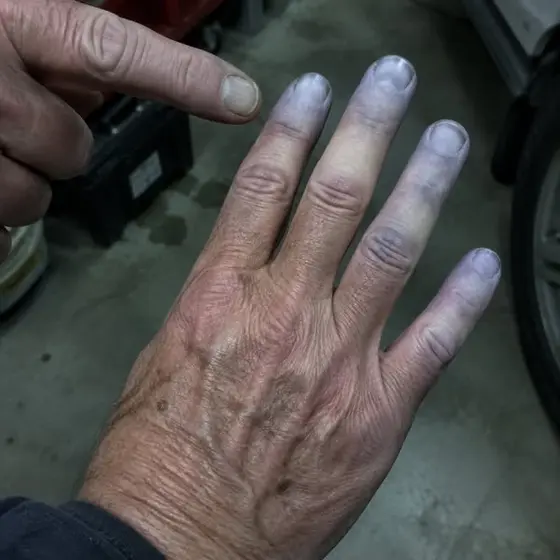
My dad had a stroke in his garage when he was 67. Mum found him on the floor by the workbench, and he never said my name properly again.
I'm 66.
For six years I've watched my own blood pressure do what his did for years before that garage: creep up a few points every year, tablets or no tablets.
I know, because I have 1,412 of my readings in a spreadsheet on my laptop. Morning and evening, both arms, for just under two years. My wife used to call it the most boring document ever created by a human being. She stopped saying that once she worked out what it really was.
It was a countdown. Every row was one more day closer to the age Dad was on that garage floor.
Row 1,104 is where the countdown stopped. I've been an engineer for 41 years, and in all that time I've never seen a line on a graph bend the way that one did.
I'm going to show you what happened at row 1,104, and why I think the reason it happened is the most important thing nobody ever explained to me about my own blood pressure.
My name is Derek. I'm 66. I spent most of my working life at Rolls-Royce in Derby, first on turbine blades and later running test cells, where my whole job was working out why a system was doing something it shouldn't. I'm not a supplement man. Until last year the only thing in our bathroom cabinet was paracetamol and my wife's hand cream.
I tell you that so you understand how much it took to get me to write this.
My blood pressure first came up at a works medical when I was 59. 148 over 92. The occupational health nurse told me to see my GP. My GP put me on ramipril, and when that didn't bring it down enough she added amlodipine. Both did what they said on the tin. The numbers came down.
For a while.
What I noticed, because I notice things like this, was the drift. Every six months or so the baseline would creep up two or three points. Not dramatically, just steadily, the way a bearing wears.
So I did what any engineer would do. I started logging.
Two readings every morning, two every evening. Date, time, arm, systolic, diastolic, pulse, and a notes column for anything that might matter: bad night's sleep, curry, the grandchildren staying over.
After six months I plotted it.
There was a clear upward trend, about four points a year on the top number, even on two tablets. And there was something else, which turned out to be the clue I didn't understand yet.
My readings were jumpy. On a calm morning I might get 134. Then I'd walk up the stairs, sit down, wait five minutes as you're meant to, and get 151. A bit of stress at the garage over the car, and the evening number would be through the roof. My system wasn't just running high. It was running badly. It couldn't absorb a load.
In a turbine you'd call that a control problem. When the output swings wildly every time conditions change, the first thing you check isn't the engine. It's the feedback loop.
I didn't know it then, but I'd just described the exact problem.
At my next review I showed my GP the graph. She looked at it politely for about ten seconds and said, "That's very thorough, Derek. Let's think about a third tablet."
A third tablet.
I drove home and sat in the car on the drive for a good while. Dad had been on three tablets by the end. I wasn't angry with her. She had ten minutes, and the guidelines say if two drugs aren't enough, you add a third. But I've spent 41 years being told that when a system's misbehaving, you add another component to compensate, and I've spent 41 years knowing that's how you end up with a system that fails in a way nobody can diagnose.
You don't fix a fault by putting tape over the warning light. You find the fault.
So I went looking for the fault.
I want to be clear that I didn't start by looking for a supplement. I'd have laughed at you. I started with one question, written on a sheet of A4 and stuck to the fridge, which my wife still teases me about:
What is the body's own mechanism for controlling blood pressure, and why is mine failing?
It took me about three weeks of evenings with a pot of tea and a lot of medical papers I had to read twice.
Here's what I found, put the way I'd explain it to an apprentice.
Your blood vessels aren't rigid pipes. They're living tissue, and they adjust their own diameter all day long. When you climb the stairs, they widen to take the extra flow. When you sit down, they settle. That's how pressure stays stable even though the demand on the system changes every minute.
The component doing that adjusting is the lining of the blood vessel, a layer of cells one cell thick called the endothelium. And the control signal it sends is a gas, nitric oxide. When the lining senses more flow, it releases nitric oxide, the muscle in the vessel wall relaxes, and the vessel opens. It's a beautifully simple feedback loop.
Now here's the fault.
Over the years, that lining is exposed to oxidative stress, which is a build-up of unstable molecules that do damage wherever they land. The best