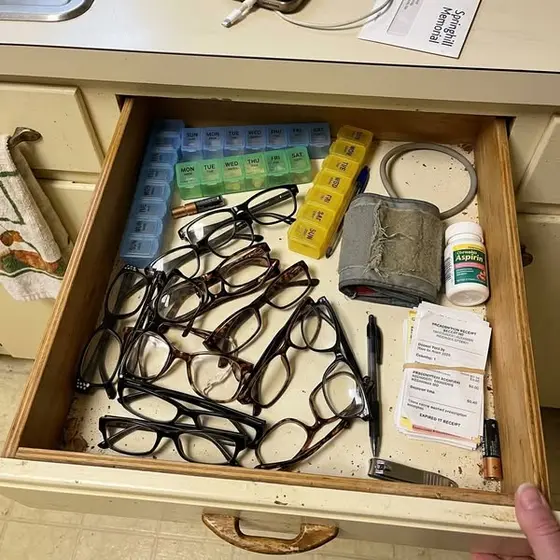
Cholesterol Support Group Facebook ad creative
alevia.com
Feel Like Yourself Again
Learn more

Cholesterol Support Group Facebook and Instagram ad

Cholesterol Support Group ran this image ad since Jun 26, 2026, 134 days so far.

First seen
Jun 26, 2026
Running for
134 days
Format
Image
Call to action
Learn more
Niche
Health and supplements
Countries
Not disclosed
Page likes
10,597

Ad copy

I found my mother's medication list folded inside a Bible in her nightstand the day after we buried her. It was on a piece of yellow legal pad paper, the kind she used for grocery lists, in her tight little handwriting. 14 medications. Doses next to each one. Times of day in the margins. The names of three different cardiologists at the top. She'd been carrying that list in her purse for the last 8 years of her life and I never knew. I sat down on her side of the bed and read it twice. And then I read it a third time. And then I went to her kitchen drawer, the one to the left of the sink where she kept her reading glasses, and I started counting. 14 pairs of cheap reading glasses. The kind from the spinning rack at Walgreens. Black ones, tortoise shell ones, a pair with rhinestones on the temples that I'd never seen her wear. Three pill organizers. One for the week. One for the month. A small one for travel. A blood pressure cuff with the velcro worn soft. A bottle of children's aspirin she'd been chewing one of every morning for as long as I could remember. And my mother, Janelle Adeyemi Carter, had died at 67 of a stroke in the breakfast nook of her own kitchen on a Tuesday morning in February. My name is Tamika. I'm 56 years old. I live in a small ranch house off Old Shell Road in Mobile, Alabama, about 12 minutes from the house my mother lived in for 38 years. I'm a probate paralegal. I have been one for 28 years. I know how to clean out a dead person's house. I've helped clients do it dozens of times. I knew exactly what boxes to bring. I knew which days the Salvation Army would pick up furniture. I knew to bring a Sharpie and label everything for my sisters. What I didn't know was that I would find her medication list in a Bible and have to sit down on the edge of her bed and cry like a child. My mother was not a sick woman. That's the part that I want you to understand before I tell you the rest of this. She walked 2 miles a day around the loop at Langan Park. She made her own collard greens and she didn't put a hambone in them anymore because her doctor told her to cut back on sodium. She went to Sunday service at Stewart Memorial AME. She volunteered Tuesdays at the community library shelving children's books. She drank her coffee black. She didn't smoke. She had two glasses of red wine on Saturday nights and that was it. She was on 14 medications anyway. Three for blood pressure. Two for cholesterol. One for her thyroid. A blood thinner. A water pill. Something for her kidneys because of the water pill. Something for her stomach because of all the other pills. A statin. A second statin when the first one stopped working. And three I had to Google because I'd never even heard of them. This is the part nobody warns you about. Your mother starts taking one pill in her 50s for blood pressure that was "just a little high." By her 60s she's on five. By her late 60s she's on 14 and her cardiologist is talking about adding a 15th. And the whole time she's walking 2 miles a day and skipping the hambone and saying, baby, this is just what people my age have to do. I rode in the front seat of her Buick to her appointments for the last 3 years of her life. I sat in those waiting rooms with the Keurig machine and the year old issues of Coastal Living and I watched my mother nod at every new prescription like she was being handed homework. She'd come out, look at me, and shrug. She'd say, Tamika, what am I supposed to do. He's the doctor. In January, exactly one month before she died, her cardiologist told her her LDL was up again. He said they needed to "explore other options." He used those words. Explore other options. As if a 67 year old woman who was already on two cholesterol medications was supposed to have a hearty appetite for exploration. She had a stroke on February 11. In her breakfast nook. Holding a coffee cup. My father heard the cup hit the floor from the bathroom. She was gone before the ambulance got to Springhill Memorial. 3 weeks after the funeral I went to my own primary care doctor for my annual. I'd been putting it off for 14 months. I knew it. She knew it. My husband Derrick knew it. I'm 56. I work at a desk all day. I do not walk 2 miles around Langan Park. I eat too much takeout from the Vietnamese place on Airport Boulevard because Derrick works late at his shop and I don't feel like cooking for one. I sat in the chair across from Dr. Henley and she pulled up my numbers and her face did the thing. The thing where she's about to tell you something but she's pretending she isn't. She said, Tamika, your LDL is 187. She said, your blood pressure is 142 over 91. She said, your A1C is creeping into a place we need to watch. I started laughing. I actually laughed in her face. Not because it was funny. Because I had buried my mother 3 weeks earlier with 14 pills in her purse and now I was sitting in a doctor's office about to be handed my first prescription. I said, Dr. Henley, my mother just died. She said, I know. I said, my mother was on 14 medications and walked 2 miles a day and died at 67. She said, I know. I said, I am not doing that. I am not doing what she did. Dr. Henley is a good woman. She's about my age. She has a daughter at Auburn. She put her pen down and she looked at me and she said, Tamika, I hear you. But these numbers are real. Let's start with a low dose statin and we'll talk about the rest. She wrote me a prescription. I took it. I never filled it. I drove home from that appointment and I sat in my car in my driveway for an hour and 20 minutes. The car was off. The sun was going down. Derrick's truck wasn't home yet. And I made a promise out loud to my mama that I was not going to walk her road. I started reading that night. I'm a paralegal. Reading is what I do. I read contracts and probate filings and case law for a living, and I am very good at telling the difference between a source that knows what it's talking about and a source that's selling me something. I read for 3 weeks. I read at night after Derrick went to bed. I read on my lunch break in the car. I read studies and forum threads and the boring medical literature that most people don't bother with. I learned a few things I want to share with you because I wish someone had told my mother. What I learned was that the way your body manages cholesterol and the way your body manages blood pressure are not 14 separate problems with 14 separate solutions. They're one problem with one root. The arteries in your body have a thin inner lining. Smooth, slippery, alive. When that lining is healthy, blood flows clean. Cholesterol moves through without sticking. Pressure stays steady because the vessels stay flexible. But there's a process happening inside every adult body where that lining gets irritated. Slowly. Decade by decade. By the time you're in your 50s and 60s, the irritation has been building for 30, 40 years. The lining stiffens. The body responds the only way it knows how, by sending repair cells to patch things up. Those patches are what eventually become the plaque your doctor measures with a number. The cholesterol number itself isn't the disease. It's the smoke. The fire is the irritation in the lining. Statins work on the smoke. They lower the number. They don't do much about the fire. That's why my mother could be on two cholesterol medications and still have her LDL "creeping up" 8 years into treatment. The medicines were chasing the number. The fire was still burning. I read about a lot of things in those 3 weeks. Omega 3s. Fiber. Beet root. Hawthorn. Magnesium. CoQ10. All things I'd heard of. All things that have something behind them but nothing that landed like a real answer. And then on a Saturday morning in late March, sitting at my kitchen table with my second cup of coffee, I came across a research summary about a small green fruit I'd never heard of. Amla. The Indian gooseberry. Grown on trees on family farms across India and Nepal. It has been used in Ayurvedic medicine for something like 3,000 years. It is one of the most concentrated natural sources of a particular kind of vitamin C in the world. But more than that, it carries a family of plant compounds called polyphenols that have been studied for their role in supporting healthy vascular function. The lining of the arteries. The very thing I'd been reading about. The way the research framed it stopped me cold. Amla works on the fire, not the smoke. It supports the arterial lining. It supports the body's own regulation of cholesterol synthesis in the liver. It supports the smooth muscle in the vessel walls that keeps blood pressure flexible instead of stiff. It's not a drug. It's not pretending to be one. It doesn't override the body. It supports what the body is already trying to do. I sat in my kitchen and I cried for the second time in a month. Because what if my mother had known. What if somebody had told her in 1998 when she got that first prescription that there was a 3,000 year old fruit on the other side of the world that worked on the cause and not the symptom. She would have eaten it for breakfast every day for the rest of her life. I went down the rabbit hole all the way that weekend. I found a company in Texas called Alevia. They make a pure amla extract in a capsule. No fillers. No fluff. They source the fruit from family farms in India, they test it independently in the United States, and they put it in a clean capsule with nothing else added. They had a 90 day money back guarantee. I'll tell you the truth because lying to you wouldn't help either of us. I have been burned before. I bought my mother a turmeric supplement from a TV ad in 2019 that did nothing. I bought her fish oil pills the size of my pinky that she gagged on every morning for 2 months. I bought myself an ashwagandha capsule from the vitamin store at Bel Air Mall that gave me a rash on my chest. But this was different. The mechanism made sense. The science was thirty years old, not thirty days. And the guarantee meant if it didn't do anything I wasn't out anything but a few weeks of patience. I ordered a bottle on a Sunday night. It came on Wednesday. I started taking one every morning with my coffee, sitting at the same table where I'd read about it. The first 2 weeks I felt nothing. I almost stopped at day 11. I called my sister Renee in Atlanta and told her about it and she said, baby, give it the full time. Mama always said you don't pull up a plant after 2 weeks to see if the roots are growing. I kept taking it. Week 3, I noticed I was sleeping through the night. I hadn't slept through the night in maybe 6 years. I'd been waking up at 3:14 in the morning like clockwork to use the bathroom and then lying there for an hour. I just stopped doing that. Week 4, my rings fit different. I'd been taking my wedding band off at night for 3 years because my fingers swelled. I forgot to take it off one Tuesday and woke up and it was fine. Week 6, I walked the dog around the block and I didn't have to stop at the corner to catch my breath. I'd been stopping at the corner for so long it had become a habit. I just walked past it. Week 9, I went back to Dr. Henley. I told her I hadn't filled the statin. She started to fuss. Then she pulled up my labs. My LDL had dropped 31 points. My blood pressure was 124 over 79. My A1C was back in the normal range. She sat there with her glasses on the end of her nose and she said, Tamika, what did you do. I told her. I told her exactly what I'd been doing. I told her about Alevia Amla. I told her about the reading. I told her about my mother's medication list in the Bible. She didn't argue with me. She didn't push the statin. She closed my chart and she said, keep doing what you're doing. We'll check again in 3 months. That was 7 months ago. I'm not going to lie to you and tell you I'm a different woman. I'm still 56. I still work at a desk. I still eat too much pho on Tuesday nights when Derrick is at the shop. But I'm not on a single prescription. I take one capsule of Alevia Amla every morning with my coffee. I take a fish oil at night. That's it. That's my whole list. I went to my mother's grave on what would have been her 68th birthday. I sat there on the grass with a coffee from the McDonald's drive thru and I told her everything I'd learned. I told her about the fire and the smoke. I told her I was sorry I didn't know in time. I told her I was going to make sure my sisters knew. I told her I was going to make sure my daughter Jasmine, who is 31 and already has higher blood pressure than I want her to have, knew too. I sat there for an hour and I talked to my mama like she was on the other side of the kitchen table. I'm telling you all of this because if you're a Black woman in your 50s or 60s, if you watched your mother or your grandmother or your auntie disappear into a medication list, if you've been told that the road you're on is just what happens to women like us, please hear me. That is not the only road. There is another one. I am walking it. If you want to look at it for yourself, the company is Alevia. The product is Alevia Amla. They sell it from their own website and they have that 90 day money back guarantee, which is the only reason I had the courage to start. If it hadn't done anything for me I would have sent it back and gone back to square one. I called their customer line one time with a shipping question and the woman who answered was a real person in Texas who didn't rush me off the phone. I take it every morning. My sister Renee takes it now. My cousin Doreen in Birmingham takes it. My daughter Jasmine started taking it last month. Four generations of women in my family have been buried with their pill bottles. I am breaking the chain. If you're sitting in a doctor's office and they're handing you your first prescription and something in your chest is telling you "wait," please listen to that voice. Listen to it before it gets quieter. 90 days. If it doesn't do anything, they send your money back. That's the whole deal. 👉 alevia.com/amla/33 P.S. I want to say this clearly. I'm not telling you to stop your medications. If you're on something, talk to your doctor. I never started mine in the first place, so I had nothing to come off of. But the women I know who have made changes did it with their doctor's involvement, slowly, over months, with their labs checked. Be smart. Be patient. Don't be reckless on my account. P.P.S. My mother's medication list is folded in the front of my own Bible now. I keep it there to remind me what I'm walking away from. Every morning when I take my one capsule with my coffee I think about her. I think about the 14 pairs of reading glasses. I think about the way the cardiologist used the word "explore" like he was inviting her on a vacation. She deserved better. So do you. P.P.P.S. If you have a daughter, please give her a bottle too. Don't wait until she's where I was. Whatever is happening in our blood, in our vessels, in our arteries, it didn't start at 56. It started at 26. The earlier she supports it the easier it stays supported. I wish my mother had known to give one to me when I was Jasmine's age. She didn't know. Now you do. 👉 alevia.com/amla/33

Placements and targeting

FacebookInstagramAudience NetworkThreads

More ads from Cholesterol Support Group

Full Cholesterol Support Group profile
Cholesterol Support Group
Inactive134 days
alevia.com
Feel Like Yourself Again
Learn more

The Christmas card I mailed to my cousin Patty in November came back to my house in February with a yellow sticker on it that said DECEASED. I'm going to start there because that's where it started for me, and because if I try to ease into this I'll never write it. I came in from the mailbox on a Wednesday afternoon. It was raining. I had on my husband's old Carhartt jacket because I'd run out without my coat, and I had the mail in one hand and a bag of groceries from Kroger in the other. I dumped both on the kitchen counter and I started sorting the mail the way I always do, and there it was. The card I'd sent back at the beginning of November, in my own handwriting, with a yellow forwarding sticker slapped over Patty's address. DECEASED. Return to sender. I stood at that counter for a long time. The groceries sat there. A bag of frozen peas slowly thawed against my elbow. I didn't move. My name is Cheryl. I'm 57 years old. I live in a town called Findlay, Ohio, in a 2 story house on a street where I've lived since 1998. I work as a billing supervisor for a regional medical group. My husband Tom is 60 and he sells industrial pumps for a company out of Toledo. We have 2 grown sons, Adam and Ryan, both married, both out of state. My cousin Patty was 53. We grew up across the street from each other in Lima. Our mothers were sisters and they raised us almost like twins. Patty was 4 years younger but she always seemed older to me because she had this calm, settled quality even as a kid. She married a quiet man named Glen who worked for the post office. They never had children. They had a small house on a corner lot in Marion, with a little brick walkway and a flower bed full of daylilies that came up every June whether anybody planted them or not. I had not seen Patty in person in almost 3 years. We talked. Not as much as we used to. The kind of cousin relationship where you mean to call and the weeks turn into months. Christmas cards. A birthday text. A long phone call once a year that always ended with one of us saying we needed to do this more often. The last time I'd talked to her was in May. She'd called on my birthday. We talked for 38 minutes. She told me Glen had retired in March and they were thinking about driving out to see his sister in North Carolina. She said her knees had been bothering her. She said she'd been feeling tired in a way she couldn't explain. I asked if she'd been to the doctor and she said yes, her cholesterol was a little high, they'd put her on something, she was fine. She said she was fine. I let her say she was fine because she'd always been fine and there was no reason to push. The next time I would have heard from Patty was that Christmas card I sent in November. The card came back in February. I called my mother that night. My mother is 81 and lives in an assisted living place in Lima. She didn't know. Nobody in our family knew. Glen had not called anyone. I have wondered a lot about that since, what was happening with Glen, who Patty had been to him, why he didn't pick up the phone. I don't have answers to any of those questions and I don't think I'm going to get them. What I found out later, through Patty's sister-in-law on Glen's side who I tracked down through Facebook, was that Patty had a heart attack at home on a Saturday morning in late January. She was 53 years old. She was making coffee. Glen was outside. By the time he came back in, she was on the kitchen floor. That was the call. That was the entire story. A coffee pot still going on the counter. A mug she'd already gotten out of the cabinet. A sister-in-law who answered my Facebook message at 11:47 at night and gave me the details I had no other way of getting. I sat on the edge of my bed in the dark with my phone in my hand for an hour. I want to say something here, because I think it's the heart of why I'm writing this. Patty and I were the same person, biologically. That is not me being dramatic. We had the same maternal grandparents. Our mothers were sisters. Both of those sisters had heart issues, late in life, and our grandmother Loretta died of a heart attack at 67. Our family had a chart. My mother had drawn it out for us once at Thanksgiving in 2009, on the back of a paper placemat, with little arrows showing who'd had what. I was on the same branch as Patty. I had the same blood pressure tendencies as her. I had the same cholesterol issues as her. I had been told by my own doctor for the past 4 years that my numbers were "borderline" and that we'd "keep an eye on them." I had been keeping an eye on them by going in for a panel once a year, looking at the printout, frowning at it, putting it in a drawer with the other ones, and going on with my life. Patty had been doing the same thing. She had been one step further down the road. She'd been on a low dose statin for about 18 months. Her sister-in-law told me Patty had complained about feeling foggy on it, like her thoughts moved slower, but she'd been told that was unrelated, and to keep taking it, and her doctor had increased the dose at her last visit. My doctor had not put me on anything yet. My doctor had said we could try some lifestyle changes first. I had tried. I had cut out the half and half in my coffee. I had walked at lunch a few times a week. My next appointment was in March. The appointment was 5 weeks away when I got the card back. I made the appointment for the next morning instead. I went in on a Thursday and I sat across from a doctor I'd been seeing for 11 years and I told him my cousin had died of a heart attack at 53, in her kitchen, on a Saturday morning, with the same family history I have. I told him my numbers had been borderline for 4 years. I asked him what we were actually going to do. He pulled up my chart. He looked at it for a long time. He said the standard thing, which is that he wanted to put me on a statin. He said the statin would lower my LDL number by about 30%. He said that was the standard of care for someone in my situation, and that he should have probably suggested it sooner, given my family history. I asked him a question I had never thought to ask before. I asked him what the LDL number actually meant. Like, the actual mechanism. What happens with the cholesterol that becomes a problem. He blinked at me a little. I think he wasn't used to that question. He answered it though. He explained that LDL by itself isn't really the issue. The issue is when LDL gets oxidized inside your blood vessels. Oxidized LDL is what gets stuck on the artery walls and starts the plaque process. Regular LDL just does its job. It's the oxidation that turns it dangerous. I said, so the statin lowers the LDL number, but does the statin do anything about the oxidation. He said, well, no. The statin lowers the production. It doesn't address oxidation directly. I said, so we're lowering the total amount but we're not really addressing the part that becomes dangerous. He said, that's one way to put it. I said, what addresses the oxidation. He said, antioxidants. Diet. Lifestyle. There are things in the research, he said, but most of them don't have the kind of clinical track record that prescription medications do. I left with the prescription. I filled it. I took the first one. I am not telling you not to listen to your doctor and I am not telling you to throw out your medication. What I'm telling you is that I went home, and I sat at my kitchen table, and I started reading. I read for 4 nights in a row. Most of what I read was beyond me, frankly. I was a billing supervisor, not a biochemist. But I read enough to understand the basic chain. Cholesterol becomes a problem when it gets oxidized. Oxidized cholesterol is what builds up. The standard medical approach is to lower the total amount. The other approach, which doesn't get talked about as much in a regular doctor's office, is to address the oxidation itself. The thing I kept running into, in different articles and forum posts and a few research summaries I read 3 times each before I felt like I followed them, was a fruit called amla. Indian gooseberry. It contained a class of compounds called emblicanins, and those compounds appeared to do something I hadn't seen attributed to anything else I'd read about. They appeared to help protect cholesterol from oxidation in the bloodstream. The research I was reading wasn't anecdotal. There were actual clinical trials. People with elevated lipids, given amla extract, twice a day, for 12 weeks. The results showed improvements in total cholesterol, in LDL specifically, in triglycerides, and in markers of oxidative stress. That last part is what got me. Markers of oxidative stress. That was the piece my doctor had said wasn't really being addressed. I kept going. I read about the cycle, which I'd never had explained to me before. When your cells are under chronic oxidative stress, your body actually produces more cholesterol as a kind of repair signal. It's trying to patch damage. So oxidation drives cholesterol production. And then that new cholesterol is also vulnerable to oxidation. And then more is needed. And the whole thing feeds itself. If you only lower the production, you've turned down one side of the loop. If you can also reduce the oxidation, you start to turn down the other side. That made sense to me in a way the pamphlet at the doctor's office never had. I ordered Alevia Amla on a Sunday night. It came on Wednesday. I took my first 2 capsules with my coffee on Thursday morning, the same morning I took my statin. I'm telling you that part on purpose. I did not stop my prescription. I'm not a doctor. I'm a 57 year old woman whose cousin had just died, and I was going to use everything I could responsibly use. I want to tell you what changed and I want to be honest about it. The first 3 weeks, I didn't notice anything. I'd read the trials. I knew this stuff was supposed to work over months, not days. So I wasn't expecting the world. I just kept taking the capsules and writing the date on a sticky note on the fridge so I'd know when I'd started. Around week 4, my morning energy was different. I'd gotten used to a kind of low grade fog in the mornings that I'd been blaming on being 57 and on the statin and on a hundred other things. That fog started to lift. Not all at once. Just less. I'd be at my desk at work and realize at 11 in the morning that I had not yet thought about needing more coffee, which was not normal for me. Around week 6, my husband Tom said something at dinner. He said, "You're laughing more lately." I said, am I. He said yes. He said it had been a while. I sat with that for the rest of the evening. I had not realized I'd stopped laughing. I had not realized I had been quieter for the last year or two. The kind of quieter that you don't notice from the inside but the people who live with you do. Around week 10, I went in for a follow up panel. My doctor came in with the printout and he sat down and he said, what are you doing. I told him. He said, well, keep doing it. My total cholesterol had come down 38 points. My LDL specifically had come down 27 points. My triglycerides had come down even further. My HDL had ticked up 4 points, which he said was small but real and which he said was "not nothing." He said the statin alone did not usually get those numbers in 10 weeks. He said he was going to make a note in my chart. He said he had not personally suggested amla to a patient before but that he had read about it in 2 of the medical newsletters he subscribed to. He said, "Whatever you're doing is working." I drove home from that appointment and I cried in my car in the parking lot for about 15 minutes. I cried because I was relieved. I cried because Patty wasn't here. I cried because I have a younger brother named Mark who is 51 and who has the same family history and who has been ignoring his own numbers for 6 years and I was going to send him a bottle that night when I got home. I cried because I almost didn't read that night I got the card back. I almost just put the card in a drawer. I almost just made the next March appointment and gone in and accepted the prescription and gone home and put the bottle on the shelf next to my multivitamin and lived another 4 years on borderline numbers. I had been one good ignored Christmas card away from being Patty. I am telling you this because I think there are a lot of women like me out there. You have a family chart that scares you a little. You have a doctor who looks at your numbers and tells you they're borderline. You have a drawer full of past printouts that you don't want to look at again. You have a cousin or a sister or an aunt or a mother whose story is sitting in the back of your mind and you don't say it out loud, but you wonder sometimes. I want to tell you that there is more to this conversation than a single number on a piece of paper. Your body produces cholesterol on purpose. It's a transporter. It's a building material. It only becomes the kind of cholesterol that hurts you when it gets oxidized in your bloodstream by stress and inflammation and damage. The standard medical approach is to lower the production. That works, partially. It moves the number. But it doesn't address the oxidation that turns the cholesterol you do have into the dangerous version. Amla appears, based on the research that exists right now, to address the part the medication doesn't. That's not me telling you to stop your medication. I haven't stopped mine. That's me telling you there's another rung on the ladder that nobody talks about in a 15 minute appointment. Alevia Amla is what I take. I take 2 capsules every morning with my coffee. I have been taking them for 4 months. My cholesterol is the lowest it has been in 8 years. My morning energy is back. I have been laughing more. My husband noticed it before I did. The company offers a 90 day money back guarantee. 90 days. That was 3 months. It was the same window of time the trials I read about had used. If it doesn't do anything for you, you call them, you send the bottle back, and you get a refund. There's no risk. There's just a chance. I want to tell you something else. I sent a bottle to my brother Mark in February, the day after my doctor visit, with a note that said, please. He has been taking it for 6 weeks. He's not a Facebook person. He doesn't talk about supplements. But last week on the phone, he said he'd had his blood drawn at his last physical and his doctor had asked him what he'd changed. He said he'd told his doctor about the amla, and his doctor had said, hm. That was the whole story. His doctor had said, hm. That was enough for me. I keep the Christmas card I mailed to Patty in a folder in my desk drawer. The one with the yellow DECEASED sticker on the front. I don't know why I kept it. I think I keep it because I don't want to forget what it felt like to stand at that counter with the groceries on my elbow and realize I had been one number away from the same thing. I kept it because I'm 57 and I have a husband who needs me and 2 sons who need me and a mother who needs me and a brother who needs me and a future I want to be in. I kept it because the next card I send, I want to come to me, signed. That's all I have. If you have a chart. If you have a number. If you have a cousin. If you have a feeling. Don't wait until February. 👉 https://alevia.com/amla/33 P.S. I want to say one more time that I did not stop my prescription medication. I take both. The amla is not instead of. It's in addition to. Talk to your doctor. Tell them what you're doing. Let them see your bloodwork over time and let them tell you what they see. That's what I did, and that's what I'd want you to do. P.P.S. The 90 day guarantee is the part that mattered. I'm a careful person with money. I have been a billing supervisor for 22 years. I do not buy things off the internet on faith. The fact that I could try this for 3 months, the same window the trials use, and send it back if nothing happened, is the only reason I clicked the button that Sunday night. The company stands behind it. So I tried it. P.P.P.S. My brother Mark called me last Saturday and said he wanted to come visit Tom and me sometime this summer. He has not visited us in 4 years. I almost didn't say anything. I was afraid I'd ruin it by making it a big deal. I just said okay, that sounds great. Then I went into the bathroom and cried for about 5 minutes. P.P.P.P.S. If you read this far, I'm guessing you have a Patty in your life. Or you're afraid you might be one. I hope you're not. I hope you read this and decide to do something small while it's still small. 👉 alevia.com/amla/33

Cholesterol Support Group
Inactive134 days
alevia.com
Feel Like Yourself Again
Learn more

My brother Dean called me on a Sunday afternoon in April and said the words I'd been dreading for 6 months. "It's time. Dad's moving to Birchwood on the 19th. We have to clean out the garage." I sat on the couch in my living room in Erie and I looked out the window at my own garage and I felt the weight of 47 years settle on my chest. Our father had lived in the same house in Mentor, Ohio since 1978. The garage had been his cathedral. He'd built workbenches along three walls, hung pegboards above them, organized every screw and bolt and washer into glass baby food jars with the lids screwed to a board overhead. He'd taught both of his sons how to change oil in that garage. How to wire an outlet. How to sharpen a chisel. How to know when a piece of wood was worth saving. Dean was 61. I was 57. Our father was 84 and his hands had been shaking for 4 years and he couldn't remember his grandkids' names anymore and the doctor had told us last fall that it was time. Birchwood was a memory care unit on the west side of Cleveland. It had a courtyard. It had nurses on every floor. It did not have a garage. I drove out to Mentor the next Saturday morning. Took the turnpike. Stopped at a Bob Evans for breakfast and ate eggs I didn't taste. Got there at 9:42 AM. Dean's pickup was already in the driveway. The house looked the same as it had every Saturday morning of my childhood. White siding, black shutters, a maple tree in the front yard that my father planted the summer Dean was born. The lawn was overgrown. The mailbox was leaning slightly to the left. Dad hadn't been able to mow in 2 years and Dean had been driving over every other Saturday to do it but Dean had a bad back and the lawn kept getting away from him. I stood in the driveway for a minute. Looked at the garage door. The white paint was peeling along the bottom panel. There was a dent near the handle from the time Dean backed into it with our mother's Buick in 1984 and our father didn't yell at him, just shook his head and said "you'll fix it, son" and then taught him how to pop a dent. Dean came out of the side door of the garage holding a coffee cup. "You ready?" I wasn't ready. I'm going to tell you what we found in that garage and what it did to both of us. Because I think there's something in this story that other people need to hear, and I'm 57 years old and I'm tired of pretending I don't know what I know. My name is Mark. I'm an accountant. I've worked for the same firm in Erie, Pennsylvania for 24 years. I have a wife named Rhonda and two grown daughters and a basset hound named Petey who's getting up there. My brother Dean is an HVAC tech. He's lived in the same house in Painesville for 30 years and he has 4 kids and 7 grandkids and a wife named Carol who calls me sweetheart even though she didn't grow up in our family. Our father was a tool and die maker for 41 years at a shop in Willoughby. Steady hands. Quiet man. The kind of dad who didn't talk much but who showed up. Every basketball game. Every parent teacher conference. Every flat tire I ever had on the side of a road in three different states between 1984 and 2003. He'd drive however far it took. He started having heart palpitations in 2008. He was 68. The doctor put him on a statin for cholesterol because his number was 217 and that was higher than the cardiologist liked. Dad didn't argue. Dad never argued with doctors. Dad took the pill every morning with his coffee and his vitamin and his baby aspirin and he didn't think about it again for 16 years. Dean and I helped him into Birchwood on April 19th and on April 27th we stood in his garage and we started sorting through 47 years of a man's working life. The first 2 hours were fine. We made piles. Keep. Donate. Trash. Dean took the table saw because he had room for it. I took the radial arm saw because I'd always loved that saw. We agreed Dean's oldest son would get the workbench because he was building a house outside Akron and he'd actually use it. Then Dean opened the cabinet above the laundry sink. It was a small white cabinet. Two doors. Inside were the things our mother had kept there before she passed in 2016. Hand soap. A bottle of Goo Gone. A box of latex gloves. And behind those, pushed all the way to the back, was a Reebok shoebox. Dean pulled the shoebox out. Set it on the workbench. Lifted the lid. It was full of pill bottles. Not 5 or 6. Not a dozen. There must have been 30 of them. Orange prescription bottles. Some of them had a few pills left. Some were empty. Most had labels that were faded but readable. Lipitor. Crestor. Pravachol. Zetia. Lisinopril. Metoprolol. Plavix. Nexium. Ambien. Tramadol. Gabapentin. Cymbalta. Dean started reading the labels out loud. His voice was flat at first. Then it wasn't. "Jesus Christ, Mark. Look at the dates." I looked. The earliest bottle was from 2009. The most recent was from February. He'd been hiding the empty bottles in a shoebox in the laundry cabinet for 16 years. Tucked behind the soap. Where my mother wouldn't see them. Where his sons wouldn't see them. Dean sat down on a 5 gallon bucket. Put his face in his hands. And my brother, who I have not seen cry since 1991 when our mother had her first cancer scare, started crying in our father's garage. I picked up a 16mm box wrench off the workbench because I didn't know what else to do with my hands. I held it. Turned it over. Set it back down. Picked it up again. After a minute Dean wiped his face with the back of his sleeve. "Mark, do you remember when he stopped fishing?" I did remember. Dad had a 16 foot Lund and a spot up on Mosquito Lake he'd been going to since 1986. He stopped going around 2017. Said he was tired. Said the boat was too much trouble. Said he'd rather watch the Indians on TV. We'd believed him. We'd sold the boat for him in 2019. "Do you remember when he stopped doing his own oil changes?" I remembered that too. Around 2015. He said his hands were too stiff. Said it wasn't worth the bother when Jiffy Lube would do it for $40. "Do you remember when he stopped going to the wood show in Cleveland every fall?" He'd gone every October for 22 years. He stopped in 2019. Dean looked at me. His eyes were red. "Mark, I'm on Lipitor." I knew he was. He'd told me 4 years ago at a family cookout, kind of casually, like it was nothing. The doctor put him on it. His number was 198 and they wanted it under 150. He'd been on it ever since. I knew he was. Because I was on it too. I'd been on Crestor for 5 years. My number had been 224 when I turned 52 and the doctor said the family history was a problem and prescribed me a 10mg dose and bumped me up to 20mg the next year when my number didn't move fast enough. I'd been telling myself I was just getting older. I was 57. I'd put on 18 pounds in 5 years. My golf swing had gone to hell. I was sleeping 9 hours a night and waking up tired. My wife had been asking me lately if I was depressed. I'd been telling her I was fine. I sat down on the cold concrete floor of my father's garage next to my brother and we looked at each other. "Mark, what did we just find?" I said the only thing I could think to say. "We found Dad." We sat there for a long time. The sun was coming through the small window above the workbench and there was sawdust in the air and the whole place smelled like 3 in 1 oil and aged pine and a man's working life. After a while Dean said, "Carol's been telling me to look into something. Some berry. I told her she was being ridiculous. I'm gonna call her." He stepped outside. I could hear him through the side door. He was on the phone for maybe 15 minutes. When he came back in he was holding his phone and he looked different. "Mark, you need to hear this." He sat down next to me on the concrete and he put his phone on speaker and Carol's voice came through. My sister in law has a calm way about her, the kind of voice that makes you trust her. She'd been a hospice nurse for 18 years before she retired. She told us about a fruit called Amla. I'd never heard of it. Neither had Dean. She said it was an Indian gooseberry, a small green fruit that grows on trees in South Asia, and that she'd started reading about it 6 months ago because one of her old hospice colleagues had recommended it to her after Carol started having joint pain in her hands. She said the human research on it was actually pretty interesting. Studies had looked at what it did in people with cardiometabolic concerns. The results she'd seen had to do with how the body handles cholesterol, oxidative stress, and inflammation. She wasn't telling us to throw away our prescriptions. She was very clear about that. She said anyone on a statin needs to talk to their doctor before changing anything. But she said that what she'd found, after months of reading, was that there was a fruit that had been studied in real people and it seemed to support healthy cholesterol levels and healthy inflammation responses without doing the kinds of things to the body that some pharmaceuticals do. Dean was nodding. I was listening. She said the issue with statins, the part that nobody really talks about at the prescription counter, is that they work by blocking an enzyme in your liver that's involved in making cholesterol. That same enzyme is also involved in making something called CoQ10, which your muscles and your heart and your brain need to make energy. So when you block one, you're also reducing the other. That's not a fringe theory. That's on the manufacturer insert. For some people, she said, that's no big deal. For other people, especially people who've been on statins for a decade or more, it can show up in ways that get blamed on aging. Tired muscles. Brain fog. Joint stiffness. Loss of stamina. The slow erosion of feeling like yourself. "And Dean," Carol said, "I've watched your father for 20 years. He didn't get old. He got pharmaceutical." Dean was quiet. I'm going to tell you what I learned in the next 3 weeks because I think it matters and because I think other people are sitting in their fathers' garages right now looking at their own pill bottles wondering the same thing we wondered. Amla is a fruit that's been used in Ayurvedic medicine for 3,000 years. The English name is Indian gooseberry. It's small, green, sour, and packed with vitamin C, polyphenols, and a class of compounds called tannins that have been studied for their effects on inflammation and cholesterol. In the human studies I read, Amla has been associated with improvements in lipid markers including LDL cholesterol, triglycerides, and total cholesterol. It's been linked to lower hsCRP, which is one of the main markers doctors use to measure inflammation in the body. It's been studied for its effects on endothelial function, which is a fancy way of saying how well the inside of your blood vessels works. Here's the part that hit me hardest, sitting in my own garage 3 weeks later reading studies on my laptop at midnight. Statins block the production of cholesterol by interrupting a pathway in your liver. That pathway also produces other things your body needs. So while you're lowering one number, you may be quietly draining another system. Amla doesn't work that way. The research suggests Amla supports healthy cholesterol levels through different pathways. It seems to help the body handle oxidative stress and inflammation, which are part of what makes high cholesterol dangerous in the first place. The damage from cholesterol isn't really about the number on a piece of paper. It's about whether that cholesterol becomes oxidized and whether it triggers inflammation in your blood vessels. That's what actually causes the problem. A fruit that helps with the oxidation and the inflammation, the part underneath the number, is doing something different than a drug that just lowers the number. I'm not a doctor. I'm an accountant. I'm telling you what I read and what I came to understand. I called Dean on a Tuesday night. I said, "I want to try this." He said, "Carol's been on it for 5 months. I started taking it last week. I want you to do it too." I ordered Alevia Amla on a Wednesday. Why Alevia. I'm going to tell you because I looked at a lot of options and the ones I found on Amazon were either too cheap to trust or had ingredient lists that made me nervous. Alevia uses a clean form of the fruit, the kind used in the actual studies, in a dose that lines up with the research. The bottle had a 90 day money back guarantee, which mattered to me, because I was about to spend my own money on a fruit I'd never heard of based on a phone call from my sister in law in my dead father's garage. I took my first capsule on a Friday morning at 6:45 AM. With my coffee. The same way my dad had taken his Lipitor every morning for 16 years. I want to be honest with you. The first 10 days I felt nothing. I'd convinced myself it wasn't going to work and I was going to feel stupid. Then on day 14, I was carrying a load of mulch from the truck to the side yard and I made 4 trips before I had to stop and I realized I'd been making 2 trips and stopping for 6 months. Just 2. Day 22, I went to bed at 10:30 and woke up at 6:15 and got out of bed without sitting on the edge for 5 minutes first. Day 31, I walked the dog 2 miles instead of the usual half mile and I wasn't winded. Day 40, my wife told me my color looked better. She said, "Mark, you look like yourself." I haven't told my doctor yet. I'm seeing him in June for my annual. We're going to talk about it. I'm not telling anyone to stop taking what their doctor prescribed. I'm not telling Dean to throw his Lipitor in the trash. We're both being careful. We're both taking it slow. What I'm telling you is what we found in our father's garage. And what we wish we'd found 16 years ago. My father is 84 and he doesn't know my daughter's name anymore. He sits in a chair at Birchwood and he watches the birds outside his window and his hands tremble when he tries to hold a coffee cup. The doctor at Birchwood told us last week that the tremor probably isn't Parkinson's. He said it might be a long term effect of medications. He said that very gently. Like he was saying something he wasn't supposed to say. I drove home from that appointment and I sat in my garage for an hour before I went inside the house. If you're on a statin and you feel like you're disappearing, talk to your doctor. Don't stop your medication on your own. But ask the question. Ask if there's another way. Read about Amla. Read the human studies. Read what it's been associated with. Read the research brief on Alevia's website. Read it twice if you have to. Then make your own choice. Like a grown man with his own life and his own body and his own father's shoebox in the back of his head. P.S. Dean and I split the shoebox. He took half the bottles and I took half. We didn't throw them away. They're in my garage in a Reebok shoebox on a shelf above my own workbench. I see them every time I go in there. I think that's the point. P.P.S. The 90 day money back guarantee is what got me to click the order button. I want to say that out loud. If you try Alevia Amla and you don't feel a difference in 90 days, you send the bottles back and you get your money back. No questions. That's the deal. I respect a company willing to put their money where their mouth is, especially with a product that asks you to trust it for 4 to 6 weeks before you really feel anything. P.P.P.S. Dean called me last Sunday. He said his hands felt different in the morning. He said he stood in his own garage and picked up a hammer and the grip felt the way it used to. He didn't say anything else. He didn't need to. I knew exactly what he meant. P.P.P.P.S. If you're a man in your 50s or 60s and you've been telling your wife you're fine for the last 5 years and you both know you're not fine, this is for you. Don't wait for the shoebox. 👉 https://alevia.com/amla/33

Cholesterol Support Group
Inactive134 days
alevia.com
Feel Like Yourself Again
Learn more

My husband has been quietly moving the family photo on the refrigerator for almost a year and I didn't notice until last month. There are two photos held up by the same magnet from a barbecue place in Macon. The one in front is from 2019. He's standing at our nephew's high school graduation in a navy blue button down, tan from a summer of yard work, smiling that real smile of his where his eyes crinkle up at the corners. The one behind it is from 2024. Last Christmas. He's sitting on our couch holding our newest grandbaby. His face is puffier. His skin has this grey, almost waxy look to it. His smile is the polite one, the one he uses for our pastor's wife. I never thought twice about which photo was in front. Until I came home one Tuesday in February to put away groceries and I saw the 2019 photo sitting on the counter, face down, like he'd been holding it. And the 2024 photo was tucked behind a Christmas card from our insurance agent, half hidden. He walked into the kitchen behind me, saw the photo on the counter, and slid it back onto the fridge in front of the newer one. Casual. Like he was just straightening up. He didn't know I'd seen. My name is Patricia. Most people call me Pat. I'm 56 years old and I've been married to my husband Glenn for 32 years this September. We live in a brick house on a quiet street in Florence, South Carolina, with a magnolia tree in the front yard that Glenn planted the year our oldest was born. Glenn just turned 61. He worked for the city for 28 years, in the water department, before he took early retirement two years ago when his hip started giving him trouble. Now he putters. He fixes things for our neighbors. He watches our grandkids on Thursdays. He is the most steady, unbothered man I have ever known. Glenn doesn't complain. Glenn doesn't make a fuss. When his daddy passed in 2017, he cried one time, in the truck, on the way home from the funeral home, and never spoke about it again. So when I saw him hiding a photograph of himself, I knew something was wrong. Because Glenn doesn't have vanity. Glenn has never once in 32 years asked me how an outfit looked. Glenn cuts his own hair with clippers in the bathroom and considers that sufficient. For Glenn to be ashamed of how he looked in a photo, something had cracked open in him that he wasn't telling me about. I didn't say anything that night. I made pork chops and rice and we watched Jeopardy and he fell asleep in the recliner at 8:45 like he does most nights. But I sat on the couch and I looked at him. And I started doing the math. He'd been more tired lately. Not exhausted. Just slower. Going to bed earlier. Coming up the porch steps with a little pause at the top that he hadn't had before. He'd stopped going to the gym at the Y back in October. He said his knee was bothering him. I'd believed him because Glenn doesn't lie. He'd been wearing his blue sweatshirt almost every day. The big loose one. Even on days when it wasn't that cold. I went back through my phone and I scrolled through every photo of him I had from the last two years. And I saw it. It wasn't sudden. That's what I want you to understand. It was so slow that I'd been right next to him for the whole thing and I'd missed it. His face had been changing. Slowly. Month by month. A little fuller in the jaw. A little duller around the eyes. The healthy color he used to have, the kind of color you get from being outside all the time, had faded into something more grey. I had been looking at him every single day and I had not seen what he could see in a photograph. I didn't sleep that night. The next morning I told him I'd made him an appointment with Dr. Aaron Whitfield, who has been our family doctor since the kids were little. Glenn looked up from his oatmeal and said, "What's the appointment for, Patty?" And I said, "Because I love you and I need you to humor me." He held my eyes for a long second. Then he said, "Alright." That was it. That's a 32 year marriage in one sentence. Dr. Whitfield ran a full panel. Blood work, the whole thing. We had to wait a week for the results. That was the longest week of my recent life. When Dr. Whitfield called us back into his office, he had his reading glasses on his nose and a printout in his hand, and he looked at both of us and said, "Glenn, your cholesterol numbers are not good." He went through it. Total cholesterol. The bad kind, the LDL. The good kind, the HDL, which was lower than it should have been. The triglycerides, which were higher than they should have been. He said the words "significantly elevated" three times. He said Glenn's numbers had probably been drifting like this for years, but it had accelerated since he retired and stopped moving as much. He said cholesterol is the kind of thing that doesn't usually announce itself. It just sits in your blood, year after year, and quietly does things to your circulation that you don't feel until something serious happens. He said Glenn was lucky we'd caught it before something serious happened. He wrote a prescription for a statin. Glenn looked at the prescription pad. He looked at me. He looked at Dr. Whitfield. He said, "Doc, my brother Earl has been on those statins for 11 years. He says his legs feel like cement most days. I don't want that." Dr. Whitfield, to his credit, said, "I hear you. Take the prescription home. Sit with it. Read about it. Come back in 3 months and we'll talk." We drove home in silence. When we pulled into our driveway, Glenn turned the truck off but didn't get out. He just sat there with both hands on the wheel. He said, "Patty, I don't want to be old yet." I reached over and I held his hand and I didn't say anything because there was nothing to say. That night, after he went to bed, I sat at the kitchen table with my laptop and I started reading. I read for 4 hours. I read about cholesterol. About what it actually is. About why it matters. About what statins do and what some of the side effects are and why Earl, Glenn's brother, might feel the way he feels. I read about how the body manages cholesterol naturally. About the liver. About something called bile acid sequestration, which sounds complicated but isn't. I read about how cholesterol isn't just a number, it's part of a much bigger story about how the whole circulatory system is working. About inflammation in the blood vessels. About oxidative stress. About the slow drift of a body's internal balance over the decades of a man's life. I read about diet. About fiber. About exercise. And then, somewhere around 11 at night, on a website I'd never been to before, I came across a paragraph about a fruit I'd never heard of. Amla. Indian gooseberry. A small green sour berry that grows on a tree in northern India and has been used in traditional medicine over there for thousands of years. I almost closed the tab. I'm not the kind of woman who goes looking for ancient miracle berries on the internet. I make casseroles. I'm in the choir. I'm a practical person. But I kept reading. Because the language on this website wasn't woo woo. It was citing actual research papers. It was talking about specific things in specific bodies. What it said was this. Amla is one of the most concentrated natural sources of vitamin C on earth. But it's not just the vitamin C. It's the polyphenols, the tannins, a whole family of plant compounds that work together as some of the most studied natural antioxidants there are. And what the research has been looking at, for years now, is the relationship between amla and the markers your doctor measures when he draws your blood. Specifically, amla has been studied for its association with healthy lipid profiles. Cholesterol. Triglycerides. The whole picture. The way it works, as best I understood it sitting there in my pajamas at 11:30 at night, has to do with how the liver processes fats and how the blood vessels handle the inflammation and oxidative wear that comes from decades of being alive. When the liver is supported in doing what it's already trying to do, it can clear cholesterol more efficiently. When the blood vessels aren't constantly fighting low-grade oxidative stress, the cholesterol that is moving through them is less likely to do damage. It's not a magic fix. The research isn't framed that way and the people writing about it aren't promising anything dramatic. It's framed as supporting what your body is already trying to do. Helping the natural systems do their jobs. The way a tune up helps a car run better. The car was already running. It just runs better when the engine is breathing right. I read about this for another 2 hours. And the more I read, the more it made sense to me. Because here's the thing nobody had really explained to Glenn or me, in 32 years of doctor's visits. Cholesterol numbers aren't really about cholesterol the way we tend to think about it. We think of cholesterol as this bad thing floating around in our blood that the statin pushes down. Like emptying a bucket. But cholesterol is actually a substance your body makes on purpose, every single day, because it needs it for hundreds of things. The number on the lab printout isn't about how much cholesterol exists. It's about whether the system that manages it is in balance. When the system drifts out of balance, the number goes up. The statin pushes the number down by interfering with the manufacturing. But it doesn't fix the underlying drift. What amla seemed to be associated with, in the research, was supporting the underlying balance. Helping the liver and the blood vessels and the antioxidant systems all stay in tune with each other. That made sense to me in a way that the statin conversation hadn't. I found a brand called Alevia. What I liked about them, sitting at my kitchen table at almost 2 in the morning, was that they didn't oversell. The bottle was just amla. Concentrated organic amla. No proprietary blend. No 14 other ingredients. Made in the United States, third party tested. The website didn't promise anything. It talked about supporting cardiovascular wellness. Supporting healthy circulation. Working with the body's natural antioxidant defenses. It was the first thing I'd read in a week that didn't talk down to me. I ordered two bottles. I told Glenn about it the next morning, over coffee, because I am not the kind of wife who sneaks things into her husband's vitamin organizer. I said, "Glenn, I read about this for half the night and I want to try it. Dr. Whitfield said we have 3 months before we have to make the statin decision. I want to use those 3 months. Will you take it with me?" He looked at his coffee. He said, "Patty, if you spent half the night reading about it, that's good enough for me. I'll take it." That's a 32 year marriage in another sentence. The bottles came on a Friday. We started Saturday morning. One capsule each, with breakfast. We made some other changes too, because I wasn't going to put it all on a berry. We started walking after dinner. Just to the end of the street and back at first, because Glenn's hip. Then a little farther. We swapped out the white bread for the seedy kind. I stopped frying things in butter and started using olive oil. But the amla was the thing I was watching. Week 1, nothing. Of course nothing. Bodies don't change in a week. Week 2, nothing I could point to. Week 3, Glenn said his energy felt a little different in the afternoons. He said he wasn't crashing at 2 the way he had been. He said it casually, the way he says everything. Week 4, he came in from working in the front yard, sweat on his forehead, and he said, "Patty, I worked out there for an hour and a half and I'm not wiped out." Week 5, the blue sweatshirt was in the laundry basket and didn't come back out for a couple of days. He'd been wearing his old polos again. Week 6, my sister Jeanine came to visit from Charlotte and she hadn't seen Glenn since Thanksgiving. She hugged him hello and then she pulled back and she said, "Glenn, you look different. Did you lose weight?" He hadn't really lost weight. Maybe a few pounds. But Jeanine wasn't seeing weight. She was seeing the same thing I'd seen on the refrigerator photos. The grey was lifting. The waxy quality of his skin was going back to something more like the man I'd married. Week 8, he walked all the way down to the corner store and back without his cane. Week 10, we went to Dr. Whitfield for the 3 month follow up. He drew blood. We waited a week for the results. When the call came, I was sitting in the kitchen with the speakerphone on. Dr. Whitfield said, "Glenn, I don't know what you've been doing, but your numbers have moved in the right direction. Significantly. Your LDL is down. Your HDL is up. Your triglycerides came down quite a bit." He said, "I want to see you in another 3 months. Keep doing what you're doing." Glenn didn't say anything for a long time. He just sat at the table. Then he said, "Doc, can I hold off on the statin?" And Dr. Whitfield said, "Glenn, at these numbers, with this trajectory, I'm comfortable holding off. We'll keep watching it." When we hung up, Glenn looked at me across the table. His eyes crinkled at the corners. Not the polite smile. The real one. The 2019 smile. I cried into my coffee mug. I'm writing this because last week I noticed something. The photos on the refrigerator have been swapped. The 2024 one is in front now. He must have done it sometime in the last couple of weeks. Except, looking at it again with fresh eyes, the man in that Christmas 2024 photo doesn't look like the same man anymore. The puffy face isn't the face Glenn has now. The grey skin isn't his skin now. The polite smile isn't his smile now. He's not hiding the photo behind a Christmas card. He's letting it sit there in front because he's proud of how far he's come from it. That's the thing about this season of life that nobody warns you about. You don't fall apart all at once. You drift. Quietly. Year after year. And the people who love you are right next to you the whole time and they don't see it because they're looking at you with eyes that haven't refreshed since you were 45. But you see it. In photos. In mirrors. In the way your reflection catches you off guard in a store window. And you start hiding. Moving the photo. Putting on the loose sweatshirt. Skipping the family gathering because you don't want to be the version of yourself you've become. If that sounds like you, or like someone you love, I want you to know that what helped Glenn wasn't a miracle. It wasn't a quick fix. It wasn't a prescription. It was a small green berry from northern India that has been used by ordinary people for thousands of years, plus walks after dinner and seedy bread and a wife who wouldn't let it go. Alevia Amla is what we take. One capsule a day. With breakfast. We've been on it almost 9 months now. If you want to try it, they offer a 90 day money back guarantee. You don't pay if it doesn't work for you. They make it easy. I called them once with a question about my auto delivery and a real human being answered the phone in under a minute, which is more than I can say for our cable company. The link is below. Glenn doesn't move the photos anymore. That's the part I keep coming back to. The man I married has been hiding for a year, and now he's not hiding. P.S. I want to say something to the wives. We are usually the ones who notice. We are usually the ones reading at the kitchen table at 11 at night. We are usually the ones who do the worrying out loud so our husbands don't have to. If you are doing this right now, you are not crazy and you are not nagging. You are the early warning system in a body's life. Trust what you see. Order the bottle. P.P.S. The 90 day guarantee means you have plenty of time to actually see whether it does anything. It took 4 to 6 weeks before I could point to real changes in Glenn. Don't judge it on week 1. Give it the time the bottle is designed to be given. P.P.P.S. Glenn wanted me to mention that he is not, in fact, vain. He says he was not hiding photos, he was "organizing" them. I will let him have that one. 👉 https://alevia.com/amla/33

See all 6 ads

Create a free account to unlock every creative, video and landing page.

Sign up free

Similar health and supplements ads

28-Day Fun Weight Loss Challenge
+2
Inactive1 day
easy-quiz.dancefit.me
7 MIN HOME DANCE PLAN FOR BEGINNERS
Learn more

NO GYM, NO STRESS JUST DANCING! BOOST YOUR MOOD QUICKLY BURN CALORIES Take a quiz and get your dance plan in DanceFitMe

28-Day Fun Weight Loss Challenge
+2
Inactive7 days
easy-quiz.dancefit.me
7 MIN HOME DANCE PLAN FOR BEGINNERS
Learn more

NO GYM, NO STRESS JUST DANCING! BOOST YOUR MOOD QUICKLY BURN CALORIES Take a quiz and get your dance plan in DanceFitMe

28-Day Fun Weight Loss Challenge
+2
Inactive8 days
easy-quiz.dancefit.me
7 MIN HOME DANCE PLAN FOR BEGINNERS
Learn more

NO GYM, NO STRESS JUST DANCING! BOOST YOUR MOOD QUICKLY BURN CALORIES Take a quiz and get your dance plan in DanceFitMe

28-Day Fun Weight Loss Challenge
+2
Inactive4 days
easy-quiz.dancefit.me
7 MIN HOME DANCE PLAN FOR BEGINNERS
Learn more

NO GYM, NO STRESS JUST DANCING! BOOST YOUR MOOD QUICKLY BURN CALORIES Take a quiz and get your dance plan in DanceFitMe

See all ads

Create a free account to unlock every creative, video and landing page.

Sign up free

Keep exploring

Free plan, no card needed

Find more ads like this

Search millions of real ads by keyword, niche and format, and save the winners to your swipe file.

Start free