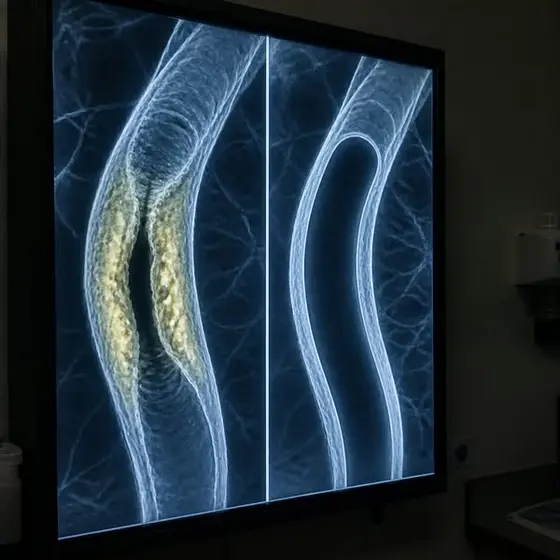
Amelia Bennett Facebook ad creative
trynevo.com
Support your body naturally
See details

Amelia Bennett Facebook and Instagram ad

Amelia Bennett ran this image ad since Jun 27, 2026, 133 days so far.

First seen
Jun 27, 2026
Running for
133 days
Format
Image
Call to action
See details
Niche
Health and supplements
Countries
Not disclosed
Page likes
56

Ad copy

The Day My Doctor Handed Me A Statin Prescription, I Tore It Up In Front Of Her. She Said My Arteries Were As Good As Gone. Here's What Happened Instead. There is a critical, shrinking window between a cholesterol number creeping up and arteries that no longer come back — where your future is decided. Miss it, and you are looking at a lifetime of daily pills, muscle pain, brain fog, and watching your energy disappear year by year. Catch it, and you can keep your heart, your memory, and your independence for decades. And right now, if your GP has handed you a high cholesterol number and a prescription for a statin, you are quietly losing that window. Every day you wait, the cholesterol inside your blood is getting more damaged. And the damage may never fully reverse. But here's what no doctor will tell you. You don't need to take their drug. And you don't need to give up the things you love. And I say this as someone who watched what happened on the other side. Because there are three things happening right now. One, your cholesterol is getting damaged in your bloodstream, and the protocol they've handed you doesn't address why. Two, the medical system is putting you on a drug that forces your liver to stop making cholesterol for life and calling it "the gold standard." And three, there is a billion pound industry that profits every single day you stay on their management carousel. So let me tell you what happened with my brother-in-law. Because his story is going to open your eyes to how broken this really is. For six years — six straight years — my brother-in-law did everything they told him. Statin every night before bed. CoQ10 the next morning to try to soften the muscle pain. A second medication when the numbers crept back up. Then a third when his triglycerides wouldn't shift. His GP called it "the gold standard." Said it was the only intervention with real evidence. Said he'd need to stay on it for life, but that was fine because it would protect his heart. Within the first year, the number on the chart did come down. His LDL was lower. His GP said they were making progress. But my brother-in-law wasn't himself anymore. He used to be the one who organised every family Sunday. Roast on the table by one o'clock, his grandchildren chasing each other round the garden, him at the barbecue in summer with a pair of tongs and a terrible apron. That was him. By year three, he had stopped hosting. Stopped inviting people over. Stopped going for his morning walk. "Too tired," he'd say. "Too foggy. Easier if people come to me." The statin was eating him from the inside. Aching legs every morning. Constant muscle weakness. Liver enzymes climbing at every quarterly check. A fog so thick he'd lose the thread of a conversation halfway through. My sister told me he sat on the settee during his granddaughter's fourth birthday party because he couldn't get down on the floor with her. Not because anything was hurting that day. Because he was frightened that if he got down, he wouldn't be able to get back up in front of everyone. And you know what the doctors said when she told them what this was doing to him? "That's normal. People adjust." "We can try adjusting the dose." "The benefits outweigh the side effects." So he kept taking it. Year after year. Watching his muscles waste away. Slowly disappearing from the life he had built. And then the numbers kept getting worse anyway. Total cholesterol climbing by year four. Triglycerides through the roof. Blood pressure pills added. A stronger statin tried by year six. Five medications a day. He never hosted Sunday roast again. And he ended up at the Royal in Manchester at 63 with chest pressure, with the cardiologist already telling my sister a procedure was probably coming. In the hospital waiting area, she grabbed my hand and said something I will never forget. "They took everything he loved for six years. And his arteries failed him anyway." So fourteen months later, when I sat in my own GP's office and watched her pull up my bloodwork, I already knew what was coming. LDL elevated. Total cholesterol over 7.0 mmol/L. Triglycerides up — the same pattern that had lit up my brother-in-law's results at his diagnosis. She looked up from the screen and said: "I want you on a statin. We need to get ahead of this before it causes a cardiac event. If you don't start now, you'll be looking at a procedure inside five years and a serious event inside ten. Your arteries are as good as gone." She slid the prescription across the desk. I looked at it. The same drug they put my brother-in-law on. Same protocol. Same future. I picked it up. And I tore it in half. Then in half again. Her face went still. "Excuse me?" "I'm not taking it," I said. She gave me the look GPs give difficult patients. "This isn't a negotiation. Without the statin, your cholesterol is going to keep building up in your arteries. You'll have a heart attack by 65. You're playing a very dangerous game." I told her I needed three months. She wasn't happy. Wrote something in my notes. Probably flagged me as non-compliant. I didn't care. She was offering me my brother-in-law's life. Six years of daily pills that wasted his muscles and climbed his liver enzymes. Foggy through every Sunday dinner. Watching his energy drain while his grandchildren grew up without him on the floor beside them. All that compliance. And his arteries failed him anyway. I refused to disappear from my own life. So I went looking for something different. I started the way any desperate person starts. Down a forum rabbit hole at midnight. I wasn't looking for miracle cures. I was looking for an answer. A reason. Something that actually explained why people who did everything right still ended up with chest pressure and procedures and a list of medications a mile long. Most of what I found was useless. Then I hit a thread. A man describing the same conversation with the same kind of doctor. Same diagnosis. Same prescription. But eight months later, his cholesterol had come all the way down. His LDL had dropped over 40%. His energy had come back. He was back on his allotment, working for hours without stopping. He hadn't taken the statin. Hadn't taken any of it. The comments were a mix of people calling him a liar and people desperately asking how. He pointed them all to one name. A man called Frank. I found his profile. A handful of comments. He had mentioned a town. A small furniture restoration business he ran from a workshop behind his house. I looked at the clock. 2:51 AM. By six I was in my car. By early afternoon I had driven up past Birmingham, past Wolverhampton, into Shropshire. By late afternoon I was parked on a quiet lane outside a stone workshop with the doors propped open. I walked in. A man at a bench, working a hand plane along the edge of a cabinet door. About sixty-five. Easy posture. Steady hands. Good colour in his face. Breathing easily. No bracing on the bench when he reached for a different tool. I told him who'd sent me. He looked up. Set down the plane. "You drove here," he said. Not a question. "Three and a half hours," I said. He nodded toward a stool beside the bench. "Sit down." I told him about the bloodwork. About the prescription I'd torn up. About my brother-in-law. He listened without saying a word. Then he stood up. Walked the length of the workshop. Walked back. Easy stride. No shortness of breath. The way you walk when your heart has nothing wrong with it at all. "Eight months ago," he said, "I couldn't walk to the postbox without my chest getting tight." I stared at him. "Same diagnosis as you," he said. "Same drug they offered me. My GP told me I'd be on a statin for life and that I'd probably need a stent inside five years. Said my arteries were already starting to narrow and there was nothing anyone could do to stop it. Just slow it down." He took a slow, deep breath. Looked at me. "Let's get a cup of tea. We'll talk after." There was a little café two doors down. He ordered tea. I did the same. First time in months I sat down somewhere without thinking about how my heart was going to feel when I stood back up. Frank leaned back in his chair and said the sentence that confirmed everything I had spent two years wondering about. "Your body isn't making too much cholesterol. Your cholesterol is getting damaged. Stop the damage, and the number drops on its own." He broke it down. Your body makes cholesterol every single day. It's supposed to. Cholesterol does important jobs. Building cells. Protecting your brain. Keeping your hormones running. Here's how it works. Your liver makes cholesterol and sends it out through your blood. Think of it like a delivery route. Cholesterol goes out, drops off what your cells need, and moves on. Simple. But something goes wrong on the route. Your blood is full of unstable molecules called free radicals. They come from stress, processed food, pollution, sugar, just getting older. And they attack your cholesterol while it's travelling through your bloodstream. They damage it. Damaged cholesterol doesn't finish the route. It doesn't move on. It turns sticky. It clings to the walls of your arteries. And once it's stuck, it stays stuck. More damaged cholesterol comes along and sticks right next to it. Layer after layer. That's plaque. That's the blockage. That's the heart attack. And here is the part that explains why your number won't come down no matter what you try. All that cholesterol stuck to your artery walls? Your body doesn't know it's stuck. It just knows it sent cholesterol out and it never came back. So it does what any good system does when a delivery doesn't arrive. It sends more. Your body keeps manufacturing replacement cholesterol to make up for what it's losing to the buildup. More gets damaged. More gets stuck. More gets replaced. A cycle that feeds itself. And the longer it runs, the higher your number climbs. And here is what nobody tells you at the GP's surgery. A statin doesn't address this. It just forces your liver to stop making cholesterol. It doesn't stop the damage. It doesn't pull the stuck cholesterol off your artery walls. And the way it lowers production also blocks CoQ10 — the molecule your heart, your muscles, and your brain need for energy. That's the muscle pain. The brain fog. The exhaustion. That is why my brother-in-law's number improved in year one. They turned the production down. But the damage in his bloodstream was never stopped. The cholesterol still in his blood kept getting damaged. Kept sticking. Year after year. Until it didn't matter how much they suppressed his liver anymore. That is why people comply perfectly with statins and still have heart attacks. Still need procedures. Still end up in a hospital waiting room. The protocol was never wrong about cholesterol being a problem. It was wrong about suppression being the answer. I told Frank about everything I'd already tried. Fish oil. Porridge every morning. Garlic capsules. Plant sterols. Berberine. Stack after stack from Holland and Barrett. All of it had failed. Frank explained why. Fish oil works in your bloodstream. It can nudge your triglycerides down. But it can't stop your cholesterol from getting damaged. It's working downstream from where the problem actually happens. Porridge works in your gut. It grabs some cholesterol before it enters your blood. But it can't protect the cholesterol already circulating through your arteries. Can't stop it from sticking. Garlic, plant sterols, berberine, red yeast rice. They all work somewhere else. In the gut. On the surface. None of them stop the damage that makes your cholesterol turn sticky and cling to your artery walls in the first place. "Then how?" I asked. Frank put down his tea. "Your body already has a mechanism designed to stop this," he said. "It's called nitric oxide. Your artery walls produce it naturally. When it's present in sufficient amounts, it does something remarkable — it protects your LDL cholesterol from being oxidised by free radicals in the first place." He let that land. "When nitric oxide shields your cholesterol from oxidation, the cholesterol doesn't turn sticky. It doesn't cling to your artery walls. It completes the delivery route the way it's supposed to. Your body stops overproducing to replace what it was losing. The cycle breaks. The number drops — not because something forced your liver to shut down, but because your body simply doesn't need to keep sending more." "So how do you get more nitric oxide?" I asked. "Dietary nitrates," he said. "Beetroot is the most concentrated natural source of dietary nitrates on the planet. When you consume them, your body converts them directly to nitric oxide. Oxford, Cambridge, Imperial College London — they have all published on this. The research isn't fringe. It's peer-reviewed and it's consistent." I had tried beetroot. I told him that. He nodded like he'd expected me to say exactly that. "Most people have," he said. "And most people got nothing from it. Because the product they bought couldn't deliver the mechanism." He explained. The clinical research showing genuine cardiovascular benefit — the studies from the universities he'd named — used 400 to 500 milligrams of dietary nitrates daily. That's the dose that produces measurable results. That's the number that moves LDL, improves blood pressure, restores endothelial function. But dietary nitrates are fragile. Heat destroys them. And standard supplement manufacturing uses heat — because it's cheaper, faster, and extends shelf life. By the time that beetroot capsule has been spray-dried and packaged, up to 90% of the dietary nitrates have been cooked out. The label says "Beetroot Extract 500mg." It doesn't say how much of that is dietary nitrate. Because there's almost none left. "I rang Boots," Frank said. "Rang the number on the Holland and Barrett bottle. Neither of them could tell me how much dietary nitrate their product contained. Because they don't standardise it. Because they can't — the processing destroyed it." He tried three different brands. Moved his numbers barely at all. "Then I found Nevo Nutrition," he said. Cold-extracted. No heat at any stage of processing. The dietary nitrates survive intact all the way into the capsule. Standardised to 800 milligrams of dietary nitrates per serving. Nearly double the minimum dose used in the university research. Not the amount of beetroot powder. The actual nitrate content — verified, declared, consistent batch to batch. Third-party tested. Certificate of Analysis published on the website. You can see exactly what is in every batch before you order. Single ingredient. Pure organic beetroot. No rice flour. No magnesium stearate. No silicon dioxide. No fillers that interfere with absorption or dilute the dose. Made in the UK. Pharmaceutical-grade facility. Not a warehouse abroad with a British-sounding name. "The reason every other beetroot supplement failed you," Frank said, "is the same reason it failed me. The active compound was destroyed before it ever reached you. Nevo is the only one I found that actually delivers what the research requires." I ordered it from the car park outside that café. I didn't tell anyone. Didn't want to build hopes up after watching my brother-in-law's story. Week two. The tightness in my chest that I had quietly been living with for over a year started to ease. Not gone. But noticeably lighter. I walked upstairs one evening and realised I hadn't thought about it. Week three. I got up one Sunday morning and realised I hadn't felt that heavy, sluggish feeling for days. I just got up and made a pot of tea. My head was clear. Week four. I went for a walk with my husband for the first time in two years. We did three miles along the canal. Both of us. My chest didn't tighten once. Six weeks. I went back for bloods. My GP pulled up my results. LDL down over 35%. Total cholesterol down 24%. Triglycerides cut almost in half. HDL up. She stared at the screen. She asked if I had filled the statin prescription. I told her no. I never had. She wrote something down. She didn't write me a new one. Ten weeks. I was at my nephew's wedding in Yorkshire. I danced with my husband for forty minutes on the dance floor. No chest pressure. No fatigue. No groaning getting in and out of the car on the drive home. Six months. I was on my knees in the garden again. Getting down on the floor with my grandchildren and getting back up without thinking about it. Driving over to help my brother-in-law in his garden — which he hadn't been able to touch properly in years, because the statin had taken his legs. He watched me lift a bag of compost and asked what I was taking. I told him. He ordered it that evening. Now here is what I need you to understand. Stop spending money on fish oil and porridge and garlic capsules that work in the wrong place. The problem is not the amount of cholesterol your liver is making. The problem is that the cholesterol travelling through your bloodstream is being attacked by free radicals, turning sticky, and clinging to your artery walls — while your body keeps sending more to replace what it's losing to the buildup. The solution is not suppressing your liver with a drug that also destroys CoQ10. The solution is giving your body what it needs to produce nitric oxide — so your LDL cholesterol stops getting oxidised in the first place. So it stops turning sticky. So it completes the route. So your body stops overproducing. So the number drops on its own. That is the mechanism. That is what the research from Oxford, Cambridge, and Imperial actually shows. And the only product that delivers the clinical dose of dietary nitrates — cold-extracted, standardised to 800mg per serving, third-party tested, single ingredient, made in the UK — is Nevo Nutrition. Three capsules every morning with a glass of water. That's it. No daily pills that wreck your muscles. No CoQ10 chasers to manage the damage. No giving up the things you love. Track how you feel at week two. Track it again at week three. Watch the energy come back. Watch the heaviness lift. Watch yourself walk upstairs without thinking about it. If nothing changes in 90 days, you pay nothing. Full refund. No questions asked. But if you are like Frank, like me, and like the people in that forum thread: The chest tightness easing by week two. The heaviness lifting by week three. The energy coming back by month two. The fog clearing. The walks getting longer. The life you've been quietly putting on hold starting to come back to you. 👉 https://trynevo.com/products/premium-beetroot-capsules P.S. About Frank. I went back to Shropshire six months later. Same workshop. Same bench. He was finishing a final coat on a chest of drawers when I walked in. He'd been at it since seven that morning. Eight hours on his feet, both hands working a brush as steady as a man twenty years younger. He set down the brush and looked up. I told him my latest numbers. LDL down. Total cholesterol down. Resting heart rate the lowest it had been in a decade. He smiled. "Same as mine," he said. We walked to the café and got tea. He'd been in his workshop every weekend. Walking five miles a day. Sleeping through the night. His grandchildren came to stay most school holidays now. He got down on the floor with them. He got back up. So did I. Your body isn't making too much cholesterol. Your cholesterol is getting damaged. Stop the damage. 👉 https://trynevo.com/products/premium-beetroot-capsules

Placements and targeting

FacebookInstagramAudience NetworkMessengerThreads

More ads from Amelia Bennett

Full Amelia Bennett profile
Amelia Bennett
Amelia Bennett
+1
Inactive133 days
trynevo.com
Support your body naturally
See details

The Day My Doctor Handed Me A Statin Prescription, I Tore It Up In Front Of Her. She Said My Arteries Were As Good As Gone. Here's What Happened Instead. There is a critical, shrinking window between a cholesterol number creeping up and arteries that no longer come back — where your future is decided. Miss it, and you are looking at a lifetime of daily pills, muscle pain, brain fog, and watching your energy disappear year by year. Catch it, and you can keep your heart, your memory, and your independence for decades. And right now, if your GP has handed you a high cholesterol number and a prescription for a statin, you are quietly losing that window. Every day you wait, the cholesterol inside your blood is getting more damaged. And the damage may never fully reverse. But here's what no doctor will tell you. You don't need to take their drug. And you don't need to give up the things you love. And I say this as someone who watched what happened on the other side. Because there are three things happening right now. One, your cholesterol is getting damaged in your bloodstream, and the protocol they've handed you doesn't address why. Two, the medical system is putting you on a drug that forces your liver to stop making cholesterol for life and calling it "the gold standard." And three, there is a billion pound industry that profits every single day you stay on their management carousel. So let me tell you what happened with my brother-in-law. Because his story is going to open your eyes to how broken this really is. For six years — six straight years — my brother-in-law did everything they told him. Statin every night before bed. CoQ10 the next morning to try to soften the muscle pain. A second medication when the numbers crept back up. Then a third when his triglycerides wouldn't shift. His GP called it "the gold standard." Said it was the only intervention with real evidence. Said he'd need to stay on it for life, but that was fine because it would protect his heart. Within the first year, the number on the chart did come down. His LDL was lower. His GP said they were making progress. But my brother-in-law wasn't himself anymore. He used to be the one who organised every family Sunday. Roast on the table by one o'clock, his grandchildren chasing each other round the garden, him at the barbecue in summer with a pair of tongs and a terrible apron. That was him. By year three, he had stopped hosting. Stopped inviting people over. Stopped going for his morning walk. "Too tired," he'd say. "Too foggy. Easier if people come to me." The statin was eating him from the inside. Aching legs every morning. Constant muscle weakness. Liver enzymes climbing at every quarterly check. A fog so thick he'd lose the thread of a conversation halfway through. My sister told me he sat on the settee during his granddaughter's fourth birthday party because he couldn't get down on the floor with her. Not because anything was hurting that day. Because he was frightened that if he got down, he wouldn't be able to get back up in front of everyone. And you know what the doctors said when she told them what this was doing to him? "That's normal. People adjust." "We can try adjusting the dose." "The benefits outweigh the side effects." So he kept taking it. Year after year. Watching his muscles waste away. Slowly disappearing from the life he had built. And then the numbers kept getting worse anyway. Total cholesterol climbing by year four. Triglycerides through the roof. Blood pressure pills added. A stronger statin tried by year six. Five medications a day. He never hosted Sunday roast again. And he ended up at the Royal in Manchester at 63 with chest pressure, with the cardiologist already telling my sister a procedure was probably coming. In the hospital waiting area, she grabbed my hand and said something I will never forget. "They took everything he loved for six years. And his arteries failed him anyway." So fourteen months later, when I sat in my own GP's office and watched her pull up my bloodwork, I already knew what was coming. LDL elevated. Total cholesterol over 7.0 mmol/L. Triglycerides up — the same pattern that had lit up my brother-in-law's results at his diagnosis. She looked up from the screen and said: "I want you on a statin. We need to get ahead of this before it causes a cardiac event. If you don't start now, you'll be looking at a procedure inside five years and a serious event inside ten. Your arteries are as good as gone." She slid the prescription across the desk. I looked at it. The same drug they put my brother-in-law on. Same protocol. Same future. I picked it up. And I tore it in half. Then in half again. Her face went still. "Excuse me?" "I'm not taking it," I said. She gave me the look GPs give difficult patients. "This isn't a negotiation. Without the statin, your cholesterol is going to keep building up in your arteries. You'll have a heart attack by 65. You're playing a very dangerous game." I told her I needed three months. She wasn't happy. Wrote something in my notes. Probably flagged me as non-compliant. I didn't care. She was offering me my brother-in-law's life. Six years of daily pills that wasted his muscles and climbed his liver enzymes. Foggy through every Sunday dinner. Watching his energy drain while his grandchildren grew up without him on the floor beside them. All that compliance. And his arteries failed him anyway. I refused to disappear from my own life. So I went looking for something different. I started the way any desperate person starts. Down a forum rabbit hole at midnight. I wasn't looking for miracle cures. I was looking for an answer. A reason. Something that actually explained why people who did everything right still ended up with chest pressure and procedures and a list of medications a mile long. Most of what I found was useless. Then I hit a thread. A man describing the same conversation with the same kind of doctor. Same diagnosis. Same prescription. But eight months later, his cholesterol had come all the way down. His LDL had dropped over 40%. His energy had come back. He was back on his allotment, working for hours without stopping. He hadn't taken the statin. Hadn't taken any of it. The comments were a mix of people calling him a liar and people desperately asking how. He pointed them all to one name. A man called Frank. I found his profile. A handful of comments. He had mentioned a town. A small furniture restoration business he ran from a workshop behind his house. I looked at the clock. 2:51 AM. By six I was in my car. By early afternoon I had driven up past Birmingham, past Wolverhampton, into Shropshire. By late afternoon I was parked on a quiet lane outside a stone workshop with the doors propped open. I walked in. A man at a bench, working a hand plane along the edge of a cabinet door. About sixty-five. Easy posture. Steady hands. Good colour in his face. Breathing easily. No bracing on the bench when he reached for a different tool. I told him who'd sent me. He looked up. Set down the plane. "You drove here," he said. Not a question. "Three and a half hours," I said. He nodded toward a stool beside the bench. "Sit down." I told him about the bloodwork. About the prescription I'd torn up. About my brother-in-law. He listened without saying a word. Then he stood up. Walked the length of the workshop. Walked back. Easy stride. No shortness of breath. The way you walk when your heart has nothing wrong with it at all. "Eight months ago," he said, "I couldn't walk to the postbox without my chest getting tight." I stared at him. "Same diagnosis as you," he said. "Same drug they offered me. My GP told me I'd be on a statin for life and that I'd probably need a stent inside five years. Said my arteries were already starting to narrow and there was nothing anyone could do to stop it. Just slow it down." He took a slow, deep breath. Looked at me. "Let's get a cup of tea. We'll talk after." There was a little café two doors down. He ordered tea. I did the same. First time in months I sat down somewhere without thinking about how my heart was going to feel when I stood back up. Frank leaned back in his chair and said the sentence that confirmed everything I had spent two years wondering about. "Your body isn't making too much cholesterol. Your cholesterol is getting damaged. Stop the damage, and the number drops on its own." He broke it down. Your body makes cholesterol every single day. It's supposed to. Cholesterol does important jobs. Building cells. Protecting your brain. Keeping your hormones running. Here's how it works. Your liver makes cholesterol and sends it out through your blood. Think of it like a delivery route. Cholesterol goes out, drops off what your cells need, and moves on. Simple. But something goes wrong on the route. Your blood is full of unstable molecules called free radicals. They come from stress, processed food, pollution, sugar, just getting older. And they attack your cholesterol while it's travelling through your bloodstream. They damage it. Damaged cholesterol doesn't finish the route. It doesn't move on. It turns sticky. It clings to the walls of your arteries. And once it's stuck, it stays stuck. More damaged cholesterol comes along and sticks right next to it. Layer after layer. That's plaque. That's the blockage. That's the heart attack. And here is the part that explains why your number won't come down no matter what you try. All that cholesterol stuck to your artery walls? Your body doesn't know it's stuck. It just knows it sent cholesterol out and it never came back. So it does what any good system does when a delivery doesn't arrive. It sends more. Your body keeps manufacturing replacement cholesterol to make up for what it's losing to the buildup. More gets damaged. More gets stuck. More gets replaced. A cycle that feeds itself. And the longer it runs, the higher your number climbs. And here is what nobody tells you at the GP's surgery. A statin doesn't address this. It just forces your liver to stop making cholesterol. It doesn't stop the damage. It doesn't pull the stuck cholesterol off your artery walls. And the way it lowers production also blocks CoQ10 — the molecule your heart, your muscles, and your brain need for energy. That's the muscle pain. The brain fog. The exhaustion. That is why my brother-in-law's number improved in year one. They turned the production down. But the damage in his bloodstream was never stopped. The cholesterol still in his blood kept getting damaged. Kept sticking. Year after year. Until it didn't matter how much they suppressed his liver anymore. That is why people comply perfectly with statins and still have heart attacks. Still need procedures. Still end up in a hospital waiting room. The protocol was never wrong about cholesterol being a problem. It was wrong about suppression being the answer. I told Frank about everything I'd already tried. Fish oil. Porridge every morning. Garlic capsules. Plant sterols. Berberine. Stack after stack from Holland and Barrett. All of it had failed. Frank explained why. Fish oil works in your bloodstream. It can nudge your triglycerides down. But it can't stop your cholesterol from getting damaged. It's working downstream from where the problem actually happens. Porridge works in your gut. It grabs some cholesterol before it enters your blood. But it can't protect the cholesterol already circulating through your arteries. Can't stop it from sticking. Garlic, plant sterols, berberine, red yeast rice. They all work somewhere else. In the gut. On the surface. None of them stop the damage that makes your cholesterol turn sticky and cling to your artery walls in the first place. "Then how?" I asked. Frank put down his tea. "Your body already has a mechanism designed to stop this," he said. "It's called nitric oxide. Your artery walls produce it naturally. When it's present in sufficient amounts, it does something remarkable — it protects your LDL cholesterol from being oxidised by free radicals in the first place." He let that land. "When nitric oxide shields your cholesterol from oxidation, the cholesterol doesn't turn sticky. It doesn't cling to your artery walls. It completes the delivery route the way it's supposed to. Your body stops overproducing to replace what it was losing. The cycle breaks. The number drops — not because something forced your liver to shut down, but because your body simply doesn't need to keep sending more." "So how do you get more nitric oxide?" I asked. "Dietary nitrates," he said. "Beetroot is the most concentrated natural source of dietary nitrates on the planet. When you consume them, your body converts them directly to nitric oxide. Oxford, Cambridge, Imperial College London — they have all published on this. The research isn't fringe. It's peer-reviewed and it's consistent." I had tried beetroot. I told him that. He nodded like he'd expected me to say exactly that. "Most people have," he said. "And most people got nothing from it. Because the product they bought couldn't deliver the mechanism." He explained. The clinical research showing genuine cardiovascular benefit — the studies from the universities he'd named — used 400 to 500 milligrams of dietary nitrates daily. That's the dose that produces measurable results. That's the number that moves LDL, improves blood pressure, restores endothelial function. But dietary nitrates are fragile. Heat destroys them. And standard supplement manufacturing uses heat — because it's cheaper, faster, and extends shelf life. By the time that beetroot capsule has been spray-dried and packaged, up to 90% of the dietary nitrates have been cooked out. The label says "Beetroot Extract 500mg." It doesn't say how much of that is dietary nitrate. Because there's almost none left. "I rang Boots," Frank said. "Rang the number on the Holland and Barrett bottle. Neither of them could tell me how much dietary nitrate their product contained. Because they don't standardise it. Because they can't — the processing destroyed it." He tried three different brands. Moved his numbers barely at all. "Then I found Nevo Nutrition," he said. Cold-extracted. No heat at any stage of processing. The dietary nitrates survive intact all the way into the capsule. Standardised to 800 milligrams of dietary nitrates per serving. Nearly double the minimum dose used in the university research. Not the amount of beetroot powder. The actual nitrate content — verified, declared, consistent batch to batch. Third-party tested. Certificate of Analysis published on the website. You can see exactly what is in every batch before you order. Single ingredient. Pure organic beetroot. No rice flour. No magnesium stearate. No silicon dioxide. No fillers that interfere with absorption or dilute the dose. Made in the UK. Pharmaceutical-grade facility. Not a warehouse abroad with a British-sounding name. "The reason every other beetroot supplement failed you," Frank said, "is the same reason it failed me. The active compound was destroyed before it ever reached you. Nevo is the only one I found that actually delivers what the research requires." I ordered it from the car park outside that café. I didn't tell anyone. Didn't want to build hopes up after watching my brother-in-law's story. Week two. The tightness in my chest that I had quietly been living with for over a year started to ease. Not gone. But noticeably lighter. I walked upstairs one evening and realised I hadn't thought about it. Week three. I got up one Sunday morning and realised I hadn't felt that heavy, sluggish feeling for days. I just got up and made a pot of tea. My head was clear. Week four. I went for a walk with my husband for the first time in two years. We did three miles along the canal. Both of us. My chest didn't tighten once. Six weeks. I went back for bloods. My GP pulled up my results. LDL down over 35%. Total cholesterol down 24%. Triglycerides cut almost in half. HDL up. She stared at the screen. She asked if I had filled the statin prescription. I told her no. I never had. She wrote something down. She didn't write me a new one. Ten weeks. I was at my nephew's wedding in Yorkshire. I danced with my husband for forty minutes on the dance floor. No chest pressure. No fatigue. No groaning getting in and out of the car on the drive home. Six months. I was on my knees in the garden again. Getting down on the floor with my grandchildren and getting back up without thinking about it. Driving over to help my brother-in-law in his garden — which he hadn't been able to touch properly in years, because the statin had taken his legs. He watched me lift a bag of compost and asked what I was taking. I told him. He ordered it that evening. Now here is what I need you to understand. Stop spending money on fish oil and porridge and garlic capsules that work in the wrong place. The problem is not the amount of cholesterol your liver is making. The problem is that the cholesterol travelling through your bloodstream is being attacked by free radicals, turning sticky, and clinging to your artery walls — while your body keeps sending more to replace what it's losing to the buildup. The solution is not suppressing your liver with a drug that also destroys CoQ10. The solution is giving your body what it needs to produce nitric oxide — so your LDL cholesterol stops getting oxidised in the first place. So it stops turning sticky. So it completes the route. So your body stops overproducing. So the number drops on its own. That is the mechanism. That is what the research from Oxford, Cambridge, and Imperial actually shows. And the only product that delivers the clinical dose of dietary nitrates — cold-extracted, standardised to 800mg per serving, third-party tested, single ingredient, made in the UK — is Nevo Nutrition. Three capsules every morning with a glass of water. That's it. No daily pills that wreck your muscles. No CoQ10 chasers to manage the damage. No giving up the things you love. Track how you feel at week two. Track it again at week three. Watch the energy come back. Watch the heaviness lift. Watch yourself walk upstairs without thinking about it. If nothing changes in 90 days, you pay nothing. Full refund. No questions asked. But if you are like Frank, like me, and like the people in that forum thread: The chest tightness easing by week two. The heaviness lifting by week three. The energy coming back by month two. The fog clearing. The walks getting longer. The life you've been quietly putting on hold starting to come back to you. 👉 https://trynevo.com/products/premium-beetroot-capsules P.S. About Frank. I went back to Shropshire six months later. Same workshop. Same bench. He was finishing a final coat on a chest of drawers when I walked in. He'd been at it since seven that morning. Eight hours on his feet, both hands working a brush as steady as a man twenty years younger. He set down the brush and looked up. I told him my latest numbers. LDL down. Total cholesterol down. Resting heart rate the lowest it had been in a decade. He smiled. "Same as mine," he said. We walked to the café and got tea. He'd been in his workshop every weekend. Walking five miles a day. Sleeping through the night. His grandchildren came to stay most school holidays now. He got down on the floor with them. He got back up. So did I. Your body isn't making too much cholesterol. Your cholesterol is getting damaged. Stop the damage. 👉 https://trynevo.com/products/premium-beetroot-capsules

Amelia Bennett
Amelia Bennett
+1
Inactive133 days
trynevo.com
Support your body naturally
See details

I'm going to say something that nobody with high cholesterol wants to hear and I don't care if it upsets you. Lowering your number isn't going to save your heart. Not the statin your GP keeps pushing. Not the porridge. Not the fish oil. Not cutting out red meat. Not the treadmill at six in the morning. NONE OF IT IS GOING TO STOP WHAT IS ACTUALLY HAPPENING. I know because I watched my father-in-law do all of it. Every single thing they told him. Six straight years. Statin every night without missing a dose. Egg whites instead of eggs. Walked four miles a day. His number looked beautiful on the chart. And his heart gave out anyway. Sixty-three years old. Massive heart attack on a Sunday afternoon. Because he spent six years chasing the wrong target. And the worst part. Two years later my own LDL came back at 5.8 mmol/L. Right around the age he was when his started climbing. Same kind of number. Same GP pulling out the same prescription pad. And I almost let it happen to me, because I was still listening to the same advice that did nothing for him. I'm done being polite about this. If your number is climbing and you're sitting there debating whether to start a pill you'll be on for the rest of your life, you're wasting time your arteries don't have. Read this entire post. Every word. Because the answer is in here, and it isn't another six years of doing everything right while the danger builds anyway. My name is Gary. I'm 57. I live in Derby with my wife Linda and our two grown kids. I'm not an unhealthy man. I walk. I eat better than most blokes my age. I read the labels before I buy anything. That's what made the diagnosis so hard to take. My father-in-law Ray was 57 when he got his. The GP told him his LDL was too high and started him on a statin that same appointment. No real conversation. LDL over 5.5 mmol/L. Family history. The cardiologist called the statin "the gold standard." Said it was "the only thing with real evidence behind it." Said it would protect his heart. Ray did exactly what they told him. Took it every single night. Cut out the Sunday fry-ups he loved. Cut out the cheese. Walked his four miles whether it was raining or dark or freezing. For six years. In year one, the number dropped. The GP said they were winning. Handed him a printout with a green arrow on it. But Ray didn't feel like he was winning. His legs ached. Deep, in the muscle, the kind that made the stairs in his own terraced house feel like a climb he had to think about before he started. He told the GP. "That's normal," they said. "Probably just age." By year three, the man who used to carry his grandchildren on his shoulders couldn't lift one with both arms. He started saying his head felt foggy. Forgetting names. Losing his train of thought in the middle of a sentence. "That isn't the medication," they told him. "We see this in men your age." You know what they said when he asked if there was another way? "The number is good. Keep doing what you're doing." So he stayed compliant. Year after year. A green arrow on the chart. A man slowly fading in the chair across from me at every family Christmas. And then it happened anyway. Sunday afternoon. Watching the match. He stood up to get a glass of water and went down. His number was perfect that week. His arteries were full of plaque. He died with cholesterol levels his GP was proud of. At his funeral, my wife took my hand and said something I will never forget. "They spent six years lowering a number. And the thing that actually killed him, nobody ever touched it." Two years ago, I went in for my annual health check. The GP pulled up my results. "Gary, your LDL is 5.8 mmol/L. We need to start you on a statin." She started writing the prescription. "This is the safest thing for your heart." My chest went tight. I saw Ray on the stairs. Saw him forgetting my kids' names. Saw him on the floor on a Sunday afternoon with a perfect number on his chart. "No," I said. She blinked at me. "I watched my father-in-law do exactly that for six years. His number was perfect. His heart still gave out. So I'm not signing up for the side effects he had for an outcome that didn't even save him." She gave me the look they save for difficult patients. "Give me ninety days," I said. She wasn't happy. I didn't care. For three months I did everything else right. Cleaned up my diet even further. More vegetables. Almost no red meat. No fried food. Doubled my walking. Started taking fish oil and a fibre supplement, the two everybody in every forum swears by. Three months later I went back. LDL: 5.5 mmol/L. Down 0.3. After ninety days of salad and walking and fish oil capsules that made me burp for an hour after every meal. Zero point three. The GP pulled out the prescription pad again. "Gary, I really do think it's time." I drove home with that prescription on the passenger seat and felt something snap. I had cleaned up. Walked every day. Taken the supplements everyone recommends. And the only answer left was to start the exact drug that hollowed out a man I loved, for a result that didn't even keep him alive. That night I couldn't sleep. I kept doing the maths. Ray had his heart attack at 63. I was 57 with a 5.8 LDL and a prescription sitting on my kitchen counter. At half two in the morning I gave up trying. Went downstairs. Opened my laptop. I started researching everything. What actually causes a heart attack. Not the number. The actual event. Why some people have high cholesterol their whole lives and clean arteries, and others don't. What is actually happening at the cellular level when plaque builds up. Every mainstream site said the same four things. Lower your number. Eat less fat. Exercise more. Take a statin. I had done three of those four. I refused to do the one that broke the man before me. So I kept digging. Looking for people who had actually solved this. Not just pushed a number down on a chart. Solved the thing underneath it. That's when I found the thread. A long discussion of people who had brought their cholesterol down and kept their arteries clean without a statin. And in the comments, one name kept coming up. A retired cardiovascular pharmacist called Bernard. People kept saying: "Ask Bernard what he takes. Bernard knows the chemistry." Twenty comments. Thirty. All pointing to the same man. Someone mentioned the town he lived in. A café he had coffee at every morning. I looked at the clock. 2:47 AM. By seven I was in my car. By half eleven I was in Shrewsbury, walking into a small café on the high street. I didn't have an address. Just a town and the name of a café. I asked the woman behind the counter if a regular named Bernard came in. She pointed to a table by the window. A man about ten years older than me. Reading glasses pushed up on his head. Working a crossword. Looked sharp. Looked well. Colour in his face, the kind you stop noticing until you see someone who's lost it, and then you notice immediately. I walked over. He looked up. "You've driven a long way," he said. Not a question. "Four hours," I said. He nodded at the chair across from him. "Sit down." I told him about Ray. About my number. About the prescription on my passenger seat. About three months of clean eating and daily walking that had moved nothing. He listened without saying a word. Then he pulled out his phone and laid it on the table. Years of his own bloodwork. Line after line. "This was me at sixty-two," he said. "LDL 5.9 mmol/L. Cardiologist wanted me on a statin immediately." He scrolled down. "This is me now. LDL 3.1. HDL up. Triglycerides down. No statin. Never took one." I stared at the numbers. "Mine was 5.8 two years ago," I said. "Near enough the same as where I started," he said. I looked at the dates. The drop. The fact that he was sitting across from me sharp and well at seventy-two with clean arteries. "What are you taking," I said. He folded the crossword. "Finish your coffee first," he said. "Then I'll explain it properly. Because if I just hand you a name you won't believe it and you won't stick with it." The next thing he said changed everything. "The cholesterol isn't what's clogging your father-in-law's arteries," he said. "The damaged cholesterol is. And lowering the amount does nothing to stop the damage. That's why he died with a perfect number." He broke it down. Your body makes cholesterol every day. It's supposed to. It builds your cells, protects your brain, keeps everything running. Your liver sends it out through your blood like a delivery route. Drops off what your cells need and moves on. Simple. But your blood is also full of unstable molecules called free radicals. They come from stress, processed food, sugar, pollution, just getting older. And they attack your cholesterol while it's travelling through your bloodstream. They damage it. Damaged cholesterol doesn't finish the route. It doesn't move on. It turns sticky. It clings to the walls of your arteries. And once it's stuck, it stays stuck. More damaged cholesterol comes along and sticks right next to it. Layer after layer. That's the plaque. That's the blockage. That's the heart attack. And it gets worse. All that cholesterol stuck to your artery walls — your body doesn't know it's stuck. It just knows it sent cholesterol out and it never came back. So it does what any good system does when a delivery never arrives. It sends more. Your body keeps manufacturing replacement cholesterol to make up for what it's losing to the buildup. More gets damaged. More gets stuck. More gets replaced. A cycle that feeds itself. And the longer it runs, the higher your number climbs. He looked at me. "Now you understand why nothing you tried worked." "Your statin forces your liver to stop making cholesterol. The number drops on the chart. Your GP smiles. But the cholesterol still in your blood is still getting damaged. Still sticking. Still building. The drug lowered the amount. It never touched the damage." "And the way it lowers production, it blocks a pathway in the liver that also produces CoQ10 — the molecule your heart and muscles and brain need for energy. That's Ray's leg pain. That's the brain fog. That's the exhaustion. That was never ageing. That was the drug." "Your fish oil nudges your triglycerides. It can't stop the damage." "Your fibre works in your gut. Grabs a little cholesterol before it gets into your blood. But it can't protect what's already circulating. Can't stop it from sticking." He tapped the table. "Every single thing you tried was aimed at the amount. Not one of them stopped the damage that drives the amount up. Ray spent six years lowering the amount. Nobody ever stopped the damage. So the plaque kept building while his chart looked perfect." I sat there with my coffee going cold. "So what stops the damage," I said. He smiled for the first time. "Your body already has a molecule specifically designed to stop it," he said. "It's called nitric oxide." He explained it the way only someone who spent decades in cardiovascular pharmacology can. Your artery walls produce nitric oxide naturally. It is not a supplement. It is not a drug. It is something your endothelium — the delicate inner lining of your blood vessels — makes on its own when it has what it needs. And when nitric oxide is present in sufficient quantities, it does something the statin never does. It protects your LDL cholesterol from being oxidised by free radicals in the first place. When your cholesterol isn't being oxidised, it doesn't turn sticky. It doesn't cling to your artery walls. It completes the delivery route. Your body stops overproducing to replace what it was losing. The cycle breaks. The number drops on its own — not because a drug forced your liver to shut down, but because your body simply doesn't need to keep sending more. "So how do you raise nitric oxide," I said. "Dietary nitrates," he said. "Beetroot is the most concentrated natural source of dietary nitrates on the planet. When you consume them, your body converts them directly to nitric oxide. Oxford, Cambridge, Imperial College London — they've all published the research. This isn't fringe science. It's peer-reviewed and consistent." I told him I'd tried beetroot. Beetroot juice. Beetroot capsules from Holland and Barrett. He nodded like he'd expected that. "Nearly everyone has. And nearly everyone got nothing from it. Because the product they bought couldn't deliver the mechanism." He explained exactly why. The clinical research showing genuine cardiovascular benefit — the studies from those universities — used 400 to 500 milligrams of dietary nitrates daily. That is the dose that produces measurable results in the bloodwork. That is the number that moves LDL, improves blood pressure, and restores endothelial function. But dietary nitrates are fragile. Heat destroys them. And standard supplement manufacturing uses heat at every stage — because it is cheaper, faster, and extends shelf life. By the time that beetroot capsule has been spray-dried and sealed into a pot, up to 90% of the dietary nitrates are gone. The label says "Beetroot Extract 500mg." It does not say how much of that is dietary nitrate. Because there is almost none left. "I rang Boots," Bernard said. "Rang the number on the Holland and Barrett bottle. Neither of them could tell me the dietary nitrate content of their product. Because they don't standardise it. Because the processing destroyed it before they could." He tried three different brands over two months. His numbers barely moved. Then he found Nevo Nutrition. Cold-extracted. No heat at any stage of processing. The dietary nitrates survive intact. Standardised to 800 milligrams of dietary nitrates per serving. Nearly double the minimum dose used in the university research. Not the weight of the beetroot powder. The actual nitrate content — verified, declared, the same in every batch. Third-party tested. Certificate of Analysis published on their website. You can check exactly what is in the product before you order. Single ingredient. Pure organic beetroot. No rice flour. No magnesium stearate. No silicon dioxide. No fillers that dilute the dose or interfere with absorption. Made in the UK. Pharmaceutical-grade facility. "The reason every other beetroot product failed you," Bernard said, "is the same reason it failed me. The nitrates that do the work were destroyed before the capsule was sealed. Nevo is the only one I found that actually delivers what the research requires." Then he said the thing that made me trust him. "There is no patent on a vegetable," he said. "There is no profit structure built around getting you on nitrates for life. No insurance code. No sales rep visiting surgeries. So GPs who know about this research quietly mention it to the patients who ask the right questions, and the bloodwork does the rest of the talking." He wrote nothing on the corner of his crossword. He just said the name. Nevo Nutrition. "Three capsules every morning," he said. "That is it. No punishing diet. No giving up the things you enjoy. Stop the damage. Watch the number follow." I ordered it from the car park outside that café. I didn't tell Linda. Didn't want to build hopes up after watching Ray's story play out for six years. Week one. The two o'clock fog I had been putting down to just getting older. Lifting. Steady energy through the evening for the first time in longer than I could remember. Week three. I caught myself taking the stairs two at a time without thinking about it. Stopped on the landing and stood there for a moment. Week six. Bloodwork. LDL: 4.1 mmol/L. Down from 5.8. My GP ran it twice. Said nothing for a moment. Then: "What are you doing differently?" Week ten. LDL: 3.4 mmol/L. HDL up. Triglycerides down. She closed the file. Looked at me directly. "Whatever you're doing, keep doing it." That was five months ago. I never started the statin. I went on a five-day walking trip in the Lakes in September, ate like a normal person, and my next results held steady. Linda noticed before the labs did. Said my energy was back. Said I was sharper. Said I was laughing more at the dinner table. I think about Ray almost every day. Because now I understand what happened to him. For six years his number looked perfect on a chart. But the damage never stopped. Free radicals kept turning his cholesterol into the sticky kind. It kept sticking. The plaque kept building. And the drug that lowered his number never once touched the thing that was actually closing his arteries. He didn't die because his cholesterol was high. He died because everyone spent six years lowering a number and nobody ever stopped the damage underneath it. His GP told him the statin was the gold standard. It wasn't. It was the only tool the GP had. And it was aimed at the wrong target. I'm writing this because I see the same thing playing out for thousands of people my age across this country. Annual health check. High LDL. Statin prescription. Some comply and lose their energy and their strength to side effects while the plaque builds anyway. Some refuse and just gamble they'll be the lucky one. Both groups are losing. Because both groups are fighting the number. The number was never the danger. The damage is. And every day it goes unaddressed — whether your chart looks good or not — your arteries are getting closer to the edge. You don't have to spend the next twenty years swallowing a pill that steals your legs and your memory. You don't have to gamble with a cardiac event while you wait and hope. You need to address the damage that is turning your cholesterol into plaque, before that plaque decides your future for you. Because I almost started a drug that hollowed out a man I loved, chasing a number that didn't even save him. And Ray never got the chance to know there was another way. Don't let that be your story. Don't spend six years lowering a number and feeling worse, for a gold standard that didn't save the man before you. Don't wait until a Sunday afternoon decides it for you. Address the damage while you still have the window. 👉 https://trynevo.com/products/premium-beetroot-capsules P.S. A lot of people have messaged me asking where to get it. I always order straight from the Nevo website. There are underdosed, heat-processed imitations on Amazon and in health shops. They don't work. They never worked. The nitrates that matter have been cooked out before the capsule is sealed. Don't waste your time or money on them. P.P.S. I felt the difference by week three. Saw real movement in my labs by week six. Hit a healthy range by week ten. No statin. No side effects. No giving up the life I've built. LDL 5.8 down to 3.4 mmol/L. The bloodwork doesn't lie. P.P.P.S. Ray took his statin perfectly for six years. His number looked great the entire time. And his arteries closed anyway, because lowering the amount never stopped the damage that was sticking to his walls. He died at 63 with a chart his GP was proud of. If your number is climbing and your GP just handed you the statin speech, you have a window right now. Don't waste it lowering a number while the real danger keeps building underneath. 👉 https://trynevo.com/products/premium-beetroot-capsules

Amelia Bennett
Amelia Bennett
+1
Inactive133 days
trynevo.com
Support your body naturally
See details

I'm a cardiologist, and last week a patient of mine asked me if she could stop taking her statin. Not because she'd given up on treatment. Because of something that showed up on her follow-up labs that I've never seen in 24 years of practice. I've been treating heart disease for 24 years. I've watched thousands of women in their 40s, 50s, and 60s walk into my clinic after their bloodwork scared them. Usually I can look at a panel for thirty seconds and tell you where someone is headed. Last week, I couldn't. A woman came in expecting the usual. Her LDL had been sitting around 4.3 mmol/L for three years. Triglycerides elevated. Blood pressure creeping into the low 140s. She was on 20mg Rosuvastatin and I'd been planning to push her to 40mg at this visit. She walked in looking the way most of my perimenopausal patients look. Tired. A little puffy around the eyes. Like she hadn't slept properly in months. Except her labs looked nothing like I expected. Her LDL had dropped from 4.3 to 3.4 mmol/L. Her triglycerides had fallen significantly. Her blood pressure that morning was 116 over 72 — the best reading I'd seen on her in years. And her carotid intima-media thickness, which I'd been tracking annually, had come down for the first time since I started measuring it. I looked at her. "What have you been doing differently?" "Nothing dramatic. Just something my daughter told me to try." I didn't believe her at first. "Different statin? Has your GP added something? Are you on ezetimibe now? Who's prescribing?" "Nothing like that. Just this one thing I've been taking for about five months." I pulled her notes back and compared the last three years of bloodwork side by side. The trajectory had reversed. Not stalled. Reversed. I sat back. "I'm going to be honest with you. I don't think you need to go up to 40mg. I'd be comfortable stepping you down to 10mg and seeing what your numbers do in eight weeks." She looked confused. "But my cholesterol..." "Your cholesterol is doing something I usually only see when I add a second or third medication. And I haven't added anything." Long pause. "So what do I do now?" "Keep doing whatever you're doing. It's working better than the next step I was about to push on you." She left my clinic. And I spent the rest of the week thinking about what she knew that I didn't. Here's what bothers me. I've been in cardiology my whole adult life. I know every drug, every dosing protocol, every combination, every escalation pathway. I know the NICE guidelines. I know the trials. And I see the same thing in my clinic every single day. Women in their 40s, 50s, and 60s with bloodwork that keeps getting worse even though they're doing everything right. When they ask me if there's anything they can do besides more medication, the most honest answer I've had for 24 years is no. Stay on your statin. Add another when your numbers stop responding. And here's a referral if you end up needing a procedure. That's been the conversation. I couldn't stop thinking about her labs. So I rang her that evening. "I know this is unusual. But I can't stop thinking about your numbers. What are you actually taking?" She didn't hesitate. "Beetroot capsules. My daughter had read about them and sent me a link. I know how that sounds." I said I'd look into it and ring her back. I hung up and opened PubMed. I'd heard patients mention beetroot before. I'd always given them the same answer I gave most supplement questions — that I didn't know enough about it to recommend for or against, and the evidence was mixed. That night I looked at it properly for the first time. Here's what I found. And I'm going to walk you through it the way I walked through it that evening, because it changed how I think about something I've been doing for 24 years. The first study I came across was from Oxford. Clean methodology. Controlled design. The mechanism was dietary nitrates converting to nitric oxide in the body. I knew nitric oxide. Every cardiologist knows nitric oxide. What I hadn't fully joined together was what happens when your body stops producing enough of it — and what restoring it actually does to a panel like my patient's. Let me explain it properly. Your endothelium is the single-cell-thick lining of your blood vessels. It is extraordinarily fragile and extraordinarily important. One of its primary jobs is to produce nitric oxide — the molecule that keeps your arterial walls relaxed, elastic, and protected. When you're younger, your endothelium produces nitric oxide efficiently. Your arteries stay flexible. Blood pressure is well-regulated. And critically — your LDL cholesterol moves through your bloodstream the way it's supposed to, completing its delivery route without getting damaged. That changes with age. With chronic inflammation. With high blood pressure. With perimenopause. Here is what I hadn't been taught to frame this way. LDL cholesterol is not inherently dangerous. Oxidised LDL is dangerous. Your bloodstream is full of free radicals — unstable molecules generated by stress, processed food, environmental pollution, sugar, decades of normal living. When nitric oxide production declines, your artery walls lose their protective function. Free radicals attack LDL cholesterol in transit. They oxidise it. Oxidised LDL is structurally different — it becomes sticky. It no longer completes its route. It clings to artery walls. More oxidised cholesterol comes along and sticks beside it. Layer after layer. That is plaque. And here is the part that explains my patient's years of climbing numbers despite her statin. Your body doesn't know the cholesterol is stuck. It just knows it sent cholesterol out and it never came back. So it does what any functional system does when a delivery doesn't return. It manufactures more. More gets oxidised. More gets stuck. More gets replaced. A self-feeding cycle. And the longer it runs, the higher the number on the printout climbs. The statin lowers the amount leaving the liver. It does not stop the oxidation. The cholesterol still circulating is still being attacked by free radicals. Still turning sticky. Still building up. Nitric oxide intervenes upstream of all of this. When your endothelium has sufficient nitric oxide, it protects LDL from being oxidised in the first place. Cholesterol that isn't oxidised doesn't turn sticky. It doesn't cling to artery walls. It completes the route. Your body stops overproducing to replace what it was losing. The number drops — not because production was suppressed by a drug, but because the damage driving the overproduction has stopped. That is a completely different mechanism from a statin. And it is what the Oxford research, the Imperial College research, the Cambridge research all points to when they look at dietary nitrates and cardiovascular outcomes. I read for three hours that night. Then I went looking at why most patients who'd tried beetroot had reported no results. This is the part that explained everything. The clinical studies showing genuine cardiovascular benefit used 400 to 500 milligrams of dietary nitrates daily. That is the dose at which you see measurable effects on endothelial function, LDL, blood pressure, and arterial flexibility. But dietary nitrates are fragile. They are destroyed by heat. And standard supplement manufacturing uses heat at every stage of processing — spray drying, granulation, encapsulation — because it is cheaper and extends shelf life enormously. By the time a standard beetroot capsule reaches a patient, up to 90% of the dietary nitrates have been degraded. The label says "Beetroot Extract 500mg." It says nothing about dietary nitrate content — because there is almost none left to declare. I looked at every major brand available through Boots, Holland and Barrett, Amazon. None of them disclosed their dietary nitrate content. When I found the one brand that did, I understood immediately why it was the only one producing results in patients. Nevo Nutrition. Cold-extracted — no heat at any stage, so the nitrates survive intact into the capsule. Standardised to 800 milligrams of dietary nitrates per serving. Nearly double the minimum dose the university research identified as clinically effective. Third-party tested, with a Certificate of Analysis published on their website. Single ingredient — pure organic beetroot, no fillers, no flow agents. Made in the UK under pharmaceutical-grade manufacturing standards. This is not the same product as what is sitting on the shelf at your local pharmacy. It cannot be compared to it. The active compound is either there or it isn't. With every heat-processed product, it isn't. I rang my patient back. "Which beetroot capsules specifically?" "Nevo Nutrition. My daughter spent a few weeks looking into it before she suggested it. She was quite particular about the brand." I looked them up as we spoke. Everything matched. I'll be honest about what I did next, because I think it matters. I'm 54. I've been in perimenopause for two years. I'd been watching my own numbers the way I watch my patients'. With that quiet professional dread of knowing exactly what the trajectory means. My LDL had gone from 3.1 at 48 to 3.9 at 53. My morning blood pressure readings had been creeping into the 130s. My mother had a cardiac event at 61. I knew I was getting close to the conversation I'd been having with other women for 24 years. That evening I had a reason to try something different first. I ordered Nevo Nutrition that night. Three capsules every morning, no other changes, and I would check my own labs at twelve weeks. Month one, the first thing I noticed was my sleep. I had been waking at two or three in the morning with my heart racing once or twice a week for the better part of a year. A pounding quality that would leave me lying there in the dark. It stopped. Not gradually. It just stopped. Month two, my morning blood pressure came in under 122 for the first time since 2021. I checked it four mornings in a row before I recorded it. By week twelve, I had my labs checked. My LDL had come down from 3.9 to 3.2 mmol/L. My triglycerides had dropped measurably. My average blood pressure was 119 over 71. I'm a cardiologist. I know what a lipid shift like this looks like when it comes from a medication. I know what placebo looks like in bloodwork. This was not placebo. A colleague stopped me in the corridor last month and asked what I'd changed. Said my complexion looked better. Asked if I'd started HRT. I hadn't started HRT. I suspect that by restoring nitric oxide function in the arterial endothelium, circulation to the capillaries closer to the skin improved as a downstream effect. The literature on nitric oxide and microcirculation supports it. If you're where I was eight months ago — numbers climbing, medication starting to feel like the inevitable next step — this is what I would try first. Not as a reason to ignore a statin if your cardiologist has told you that you genuinely need one. But as what I wish I had known about before my own numbers started moving. For 24 years, the best I could honestly offer most of my patients was a slower decline. Lower the LDL with a drug that suppresses production but leaves the oxidation untouched. Watch the bloodwork improve on paper while the underlying process continues. I had never seen anything interrupt the oxidation itself until I looked properly at what dietary nitrates do when delivered at the right dose, through a formulation that actually preserves them. Most of my patients who ask me about this now found out about it before I did. I've written Rosuvastatin prescriptions thousands of times. I just wanted you to know what I was seeing in my clinic — and in my own bloodwork — before it was your turn to have that conversation. — Dr. Catherine Webb, MB ChB, FRCP Consultant Cardiologist, 24 years 👉 https://trynevo.com/products/premium-beetroot-capsules P.S. The product I'm taking is Nevo Nutrition Premium Beetroot Capsules. Cold-extracted. Standardised to 800mg dietary nitrates per serving. Third-party tested. Single ingredient. Made in the UK. Take three capsules with breakfast. Most beetroot products on the market are heat-processed and provide a fraction of the clinical nitrate dose. They will not produce the results described here. Nevo is the only formulation I've found that matches what the university research actually used. Do not substitute another brand and expect the same outcome — the active compound has to survive manufacturing for any of this to work. P.P.S. I noticed the sleep improvement within the first month. Blood pressure improvements by month two. Measurable LDL movement by week twelve. No change to my statin status — I wasn't on one, and I'm still not. If your cardiologist has you on medication, do not stop without discussion. But if you are in the window where your numbers are climbing and medication is being discussed, this is what I would want you to have tried first. The 90-day refund guarantee means there is no financial risk in finding out. 👉 https://trynevo.com/products/premium-beetroot-capsules

Amelia Bennett
Amelia Bennett
+1
Inactive133 days
trynevo.com
Support your body naturally
See details

After 2 years of watching my cholesterol climb while every doctor pushed a statin I was terrified to take, a woman sitting in our waiting room asked me one question that no one in the medical system had ever thought to ask. Her question, and what she explained after I answered, changed everything I believed about why my numbers kept going up. I'm sharing this because I spent 2 years doing everything right and my cholesterol still went up at every blood draw. If you've been eating porridge, swallowing fish oil capsules, walking 30 minutes a day, doing everything they tell you to do, and your cholesterol is still climbing, this might be the most important thing you read this year. I'm 47. I've worked as the office coordinator at a physiotherapy clinic for nine years. Busy practice, on my feet most of the day, always moving. I've always been the health-conscious one in my family. I read nutrition labels. I cook at home more evenings than not. I exercise three or four days a week. I've never smoked. I'm not overweight. So when my GP told me my cholesterol was high at 44, I didn't believe her. It started with a routine blood panel. My total cholesterol came back at 6.1 mmol/L. LDL was 4.1. My GP said it was "a little elevated" and suggested I focus on diet and exercise. I was already doing both, but I made changes anyway. More vegetables. Less red meat. Porridge every morning. Fish oil capsules. An extra session at the gym each week. Six months later, I went back for a follow-up. Total cholesterol: 6.4 mmol/L. LDL: 4.4. It went up. Despite everything I'd changed. My GP frowned. Said we should keep monitoring. Maybe cut back further on saturated fat. Try adding plant sterols. I did. All of it. Six months after that: total cholesterol 6.7. LDL: 4.8. Still climbing. She started talking about Atorvastatin. I felt something cold settle in my chest when she said that word. Not because I didn't know what it was. Because I did. My mother took Atorvastatin for eight years. She started at 58. Her GP told her it was the gold standard. Safe and effective. She'd need it for life, but that was fine because it would protect her heart. And it did lower her numbers. Within four months her LDL dropped from 5.8 to 2.9. Her GP was thrilled. "LDL is 2.9. Excellent. Stay the course, Susan. The medication is doing exactly what it should." Stay the course. She stayed the course for eight years. The muscle pain started around year two. Her legs first. This deep, relentless ache that no amount of rest would fix. She'd struggle to climb the stairs to bed at night, gripping the banister so hard her knuckles went white. She'd been an avid gardener her whole life. Runner beans, tomatoes, sweet peas — she'd spend hours on her knees in the soil every spring. By year three on the medication, the garden grew weeds. She couldn't kneel. Couldn't grip the tools. Couldn't get back up without help. Then her mind started slipping. Not dramatically. Not the way you see in films. Just a slow dimming. She'd lose a word mid-sentence. Forget why she'd walked into a room. Ask me the same question she'd asked ten minutes ago. She was 63 years old and the sharpest person I knew, and I watched her become someone who couldn't follow a recipe she'd been making since I was a child. I mentioned it to her GP. He looked at her chart. "Her cholesterol is excellent. The cognitive changes are likely age-related. Very common in women over 60." Age-related. She was 63. She'd been sharp as a tack at 58 before the medication. But her LDL was 2.9 and the GP was happy, so nobody investigated further. Her energy disappeared. She slept ten, eleven hours a night and still woke up exhausted. The woman who used to be up at half five every morning, who'd have half the house sorted before I left for school, couldn't get out of bed before nine. She stopped going to lunch with her friends. Stopped her book club. Stopped doing anything that required leaving the house. I watched my mother shrink. Not physically. Spiritually. The medication took her numbers down to a level her GP celebrated every six months. And while he celebrated, she lost her garden, her mind, her energy, and her life as she knew it. All while her cholesterol was "perfect." She's still alive. She's 66 now. Still on the medication. Still foggy. Still stiff. Still sleeping until nine. Her garden is still weeds. I visit her every Sunday and I see what that drug did. Not what it gave her. What it took. So when my GP pulled out her prescription pad and wrote "Atorvastatin 20mg," I didn't feel relief. I felt dread. "I'd like to try other options first," I said. She gave me that look GPs give when you disagree with them. Patient but frustrated underneath. "Your LDL is 4.8 with a strong family history. We really shouldn't wait on this." "Three more months," I said. "Let me try." She wasn't happy. Made a note in my records. I didn't care. I went home and tore apart everything I could find about lowering cholesterol naturally. I tripled down on fish oil. Four grams a day. The large capsules that made me burp for an hour after every meal. I ate porridge every single morning. Proper oats, not instant. Thirty minutes on the hob before work. I added plant sterols. Berberine. Garlic capsules. Red yeast rice for two months before I read that it's essentially a statin in disguise with the same side-effect profile, and I stopped. I cut red meat completely. Ate more salmon than I thought possible. Added walnuts, flaxseed, almonds to everything. I walked every day. Every single day for three months. Rain or shine. Before work or after. Even when I didn't want to. I did everything they tell you to do. Three months later, I sat in my GP's office waiting for my results. Total cholesterol: 6.9 mmol/L. LDL: 5.1. I stared at the numbers. It hadn't just not improved. It had gotten worse. Significantly worse. Despite doing more than I'd ever done in my life. My GP looked at me across the desk. "Your LDL is now 5.1. This is getting into territory I'm not comfortable watching. I'm writing the prescription. I'd really like you to fill it this time." She slid the paper across the desk. Atorvastatin 20mg. I took it. Folded it. Put it in my bag. I drove home gripping the steering wheel, tears streaming down my face. Not from sadness. From frustration. From fear. From the feeling of being trapped between two paths that both felt wrong. Path one: take the drug that destroyed my mother's quality of life. Watch my muscles ache. Watch my mind dim. Hand over my body to a medication I didn't trust and pray the side effects didn't eat me alive the way they ate her. Path two: do nothing and watch my number climb every six months toward the heart attack that took my grandfather at 61. I didn't fill the prescription. But I didn't sleep either. For the next few weeks, I lived with a low-grade dread that never fully went away. Every time I felt a twinge in my chest, my heart would race. Every time I got winded going upstairs, I'd think: is this it? Is this the one? I'd lie in bed at night doing maths I had no business doing. My grandfather died at 61. My mother's cholesterol was out of control by 58. I was 47 and my LDL was 5.1. How many years did I have before the numbers caught up with me? My husband would roll over at 2 AM and find me on my phone, reading article after article about cholesterol, statins, cardiac events, risk calculators. He stopped asking what I was looking at. He just put his hand on my back and waited until I put the phone down. My kids noticed I was different. My 13-year-old said, "Mum, are you OK? You seem worried about something." I smiled and said I was fine. I wasn't fine. I was terrified. And I couldn't explain to a 13-year-old that I was afraid of a number on a blood test that might mean I didn't see her finish school. That's what high cholesterol does. It doesn't hurt. It doesn't show up as a rash or a limp or something you can point to and say "that's the problem." It just sits there, invisible, while you carry the weight of knowing something is wrong inside you and feeling powerless to fix it. And I probably would have stayed in that cycle — caught between a prescription I didn't want and a number I couldn't control — if it wasn't for a conversation I never expected to have. About three months ago, a woman named Anne started coming to our clinic every Monday and Thursday. She was bringing her father in for rehabilitation after a hip operation. She was in her late fifties. Warm. Quiet. The kind of person who listened more than she talked. I didn't know anything about her at first. She was just a family member. We'd say hello when she signed in. Small talk while her father was in with the physio. The weather. The car park. That was it. But one afternoon she was sitting in the waiting area while we finished her father's session. I'd just got off the phone with my GP's receptionist. They were calling about the prescription again. I must have looked worse than I thought, because when I hung up, Anne was looking right at me. "Bad news?" she asked. I shook my head. "No. Just my cholesterol. It keeps going up. They want me on medication and I don't want to take it." She was quiet for a second. Then she said something I didn't expect. "How long has it been climbing?" "About two years. No matter what I do." "What have you tried?" I almost laughed. "Everything. Fish oil. Porridge every morning. Plant sterols. Garlic. Berberine. Exercise every day. I cut out red meat. I've spent a fortune on supplements. My LDL was 4.1 two years ago. Now it's 5.1." She nodded slowly. Like she'd heard this exact list a hundred times before. "Has anyone ever explained to you why none of it worked? Not just that it didn't. But why." Nobody had. Not in two years. Every GP just adjusted the advice or pushed the prescription harder. "I spent twenty-four years as a cardiovascular pharmacist," she said. "I watched hundreds of people just like you do exactly what you did. Fish oil. Porridge. Diet changes. Supplements. Exercise. Everything the system tells you to do. And I watched almost every single one of them end up on a statin anyway — because nobody ever explained what was actually happening to their cholesterol." I stopped what I was doing. "What do you mean?" She looked at me for a moment. Then she said, "Sit with me for a minute. I want to explain something." I came around the desk and sat down across from her. "Your body makes cholesterol every single day," she said. "It's supposed to. Cholesterol does important work. Building cells. Protecting your brain. Keeping your organs running. Your liver sends it out through your bloodstream like a delivery route. It goes out, drops off what your cells need, and moves on. Simple." I was listening. Really listening. Because in two years, no doctor had ever said anything like this to me. "But something happens on the route," she said. "Your blood is full of unstable molecules called free radicals. They come from stress. Processed food. Pollution. Sugar. Just getting older. And they attack your cholesterol while it's travelling through your bloodstream. They damage it." "Damaged cholesterol doesn't finish the route," she said. "It doesn't move on. It becomes sticky. It clings to the walls of your arteries. And once it's stuck, it stays stuck. More damaged cholesterol comes along and sticks right next to it. Layer after layer. That's plaque. That's the blockage. That's the heart attack." "And here's why your number keeps climbing," she said. "All that cholesterol stuck to your artery walls? Your body doesn't know it's stuck. It just knows it sent cholesterol out and it never came back. So it does what any good system does when a delivery doesn't arrive. It sends more. Your body keeps manufacturing replacement cholesterol to make up for what it's losing to the buildup." I stared at her. "More gets damaged. More gets stuck. More gets replaced. A cycle that feeds itself. And the longer it runs, the higher your number climbs." "And the fish oil?" I asked. Because I'd been taking four grams a day for months and nothing had changed. "Fish oil works in your bloodstream," she said. "It can help with triglycerides. But it can't stop your cholesterol from getting damaged. It's working downstream from where the problem actually happens." "The porridge?" "Works in your gut. It grabs some cholesterol before it enters your blood. But it can't protect the cholesterol already circulating. Can't stop it from sticking." "The garlic? The berberine? The plant sterols?" "They all work somewhere else. In the gut. On the surface. In absorption. None of them stop the damage that makes your cholesterol sticky in the first place." She paused. "Every single thing you've tried has been aimed at the amount. Nothing has stopped the damage that's driving the amount up." "What about statins?" I asked. Because that prescription was still sitting in my bag. "Statins force your liver to stop producing cholesterol," she said. "The number drops on the chart. Your GP says brilliant. But the cholesterol still in your blood? Still getting damaged. Still sticking. Still building up. The drug lowered the amount. It didn't stop the damage." She leaned forward slightly. "And the way it lowers production — by blocking a pathway in your liver — that same pathway also produces CoQ10. The molecule your heart, muscles, and brain need for energy. That's the muscle pain. The brain fog. The exhaustion people describe. That's not ageing. That's the drug." Everything she described matched what I'd watched happen to my mother. Every single symptom. "I know," she said quietly. "Because I went through something similar. Twenty-four years of dispensing those medications. I understood the pharmacology better than most of the GPs writing the prescriptions. And when my own cholesterol climbed to 7.1, I realised I'd been looking at the wrong thing for my entire career. The number was never the real problem. The damage was." That night I couldn't stop thinking about what she said. The delivery route that never finished. The cholesterol getting attacked in transit. Sticking to the walls. The body sending more to replace what was lost. The cycle. Every supplement working in the wrong place. The statin forcing the number down while the damage continued underneath. It explained everything. Why my number kept climbing despite doing everything right. Why my mother's numbers were "perfect" while her body fell apart. The number was never the real problem. The next time Anne came in with her father, I pulled her aside. "All right. Let's say you're right. What do I actually do?" "Most cholesterol supplements work downstream," she said. "They reduce absorption or lower triglycerides. But if your cholesterol is getting damaged in your bloodstream and sticking to your artery walls, none of that touches the actual problem. You need something that stops the damage where it happens." "Here's what most people don't know," she said. "Your body has a molecule specifically designed to protect your artery walls from this kind of damage. It's called nitric oxide. Your endothelium — the thin inner lining of your blood vessels — produces it naturally. When nitric oxide is present in sufficient amounts, it keeps your artery walls relaxed and healthy. And critically: it protects LDL cholesterol from being oxidised by free radicals in the first place." "When oxidation is stopped at the source, cholesterol doesn't turn sticky. It doesn't cling to artery walls. It doesn't trigger the buildup cycle. The delivery route completes. Your body stops overproducing to replace what it was losing. Your number comes down — not because something forced your liver to reduce production, but because the damage driving the overproduction has stopped." "So how do you raise nitric oxide?" I asked. "Dietary nitrates," she said. "Beetroot is the most concentrated natural source of dietary nitrates known. When you consume dietary nitrates, your body converts them to nitric oxide. Oxford, Cambridge, Imperial College London — they've all published on this. The research is solid. And it's not just your cholesterol that responds. Blood pressure comes down. Endothelial function improves. The whole arterial system benefits." "So why isn't every GP recommending beetroot?" I asked. "Because most beetroot supplements don't work," she said. "And that's not a trivial problem — it's the whole reason this mechanism stays off most people's radar." She explained it clearly. "The clinical research showing genuine cardiovascular benefit used 400 to 500mg of dietary nitrates daily. That's the dose that produces measurable results. But dietary nitrates are fragile. Standard supplement manufacturing uses heat processing — it's cheap, it's fast, it extends shelf life. Heat destroys up to 90% of the dietary nitrates before the capsule is even sealed." "So I go to Boots," I said. "I buy beetroot extract—" "And the label says beetroot extract 500mg. But it doesn't tell you how much of that is dietary nitrate. I've called the customer service lines. They can't tell you either. The nitrates that should do the work have been cooked out in manufacturing. You're essentially taking expensive red powder." "I tried the Boots brand," she said. "Then the Holland and Barrett one. Neither moved my numbers. Because they couldn't — the active compound wasn't there at a meaningful dose." "There's only one brand I found that's cold-extracted — no heat at any stage, so the nitrates survive intact. And they're the only one that standardises each batch to 800mg of dietary nitrates per serving. Nearly double the minimum clinical dose. Third-party tested. Certificate of Analysis published on the website. Single ingredient — just organic beetroot, no fillers, no flow agents. Made in the UK." "It's called Nevo Nutrition," she said. "That's the one that changed my numbers. And the reason it worked when the others didn't isn't a mystery — it's the only one that actually delivers what the research requires." I looked it up that night. Everything she'd said checked out. The dietary nitrate mechanism. The Oxford and Imperial research. The nitric oxide pathway protecting LDL from oxidation. The destruction of nitrates through heat processing. The dosing gap between what clinical studies used and what most products provide. Study after study pointing to the same conclusion: the number isn't the real problem. The damage is the problem. And dietary nitrates — at the right dose, preserved through cold extraction — stop the damage at the source. After two years of supplements that didn't work and a prescription I was afraid to fill, what was one more try? I ordered a bottle that same evening. When it arrived, I started taking three capsules with breakfast. I told myself not to expect anything. I'd been disappointed too many times for that. Week one. I noticed something I wasn't expecting. Not a cholesterol change — too early for that. An energy shift. That mid-afternoon crash I'd been dragging through for the past year, the one where I'd stare at my desk at half two and feel like my brain had been wrapped in cotton wool — it was lighter. Not gone. But noticeably lighter. I felt more alert heading into the afternoon than I had in months. I'd fooled myself before. I didn't let myself think about it. Week two. I woke up on a Saturday morning and realised I'd slept through the night without my usual 2 AM wake-up. The one where I'd lie in the dark doing mental arithmetic about my cholesterol numbers while my husband slept beside me. I just slept. Woke at twenty past six feeling rested for the first time in weeks. Then came week three. I ran my numbers at a walk-in clinic. Sat in the car waiting. Total cholesterol: 6.2 mmol/L. Down from 6.9. LDL: 4.4. Down from 5.1. I checked the printout three times. Then I sat in the car park staring at it. 0.7 off my LDL. In three weeks. After two years of nothing moving in the right direction. After fish oil and porridge and garlic and plant sterols and every other thing that didn't shift the needle, my LDL had dropped 0.7 in three weeks. I started crying and I couldn't have told you exactly why. It was just such a relief. Such an ordinary piece of paper with numbers on it. But those numbers meant I wasn't trapped anymore. My husband noticed before I said anything. Not the numbers. He noticed me. "You seem lighter," he said one morning over coffee. He wasn't talking about the scales. He was talking about the weight I'd been carrying. The dread. The 2 AM panic. The look on my face every time I thought about my blood results. Over the following weeks, the numbers kept moving. Week six: total cholesterol 5.7 mmol/L. LDL 3.9. HDL had climbed. Triglycerides were dropping. I tested every two weeks. I couldn't help it. I needed to see the numbers moving. I needed to know it wasn't a fluke. It wasn't a fluke. My three-month follow-up with my GP arrived. She drew blood. Ran the full panel. I sat in the consulting room waiting. My leg bouncing. She walked in and pulled up my results on her screen. Looked at the screen. Then at me. Then back at the screen. "Total cholesterol 5.1 mmol/L. LDL 3.2." She scrolled. "HDL up. Triglycerides down." She pulled up my history. Looked at the progression. The 6.1 two years ago. The 6.4. The 6.7. The 6.9 that had been climbing steadily no matter what I did. And then 5.1. She closed the window halfway. "What happened?" I told her about Nevo. About dietary nitrates. About the free radicals attacking cholesterol in the bloodstream and turning it into the sticky, artery-clogging kind. About the cycle of overproduction. About the nitric oxide mechanism — how it protects LDL from oxidising in the first place. About the research from Oxford and Imperial. About why most beetroot supplements fail — heat processing, no nitrate standardisation, doses a fraction of what the clinical studies used. About Nevo's cold extraction and 800mg standardised nitrate content. She typed notes. Nodded slowly. "Well." She looked up. "Whatever you're doing, these numbers are very good. I see no need for Atorvastatin at this time. Let's recheck in three months." No Atorvastatin necessary. I walked to my car. Got in. Sat there. Then rang my husband. "5.1 total. LDL 3.2. She's not writing the prescription." I heard his breath catch. Then, quietly: "Thank God." That was four months ago. My total cholesterol this week: 5.0 mmol/L. LDL: 3.1. Stable. Healthy. No medication. No muscle pain. No brain fog. No exhaustion. No CoQ10 being drained from my heart. No pharmaceutical cascade. No becoming my mother. My morning routine doesn't start with dread anymore. It starts with three capsules and a glass of water. That's it. I went to a barbecue at my sister's last weekend. Burgers. Potato salad. Halloumi. And I ate. Not guiltily. Not calculating every gram of saturated fat while pretending to enjoy myself. I ate like a person who isn't afraid of food anymore. Because my cholesterol isn't climbing. The cycle is broken. I wore a dress to my nephew's wedding last month. One I'd bought two years ago and never worn because I was convinced the stress of the day would trigger something. I wore it. I danced. I didn't think about my cholesterol once the entire night. My daughter asked me to go for a long bike ride last Sunday. I did. Eight miles along the canal. I wasn't winded. I wasn't afraid. I wasn't running through risk calculators in my head while pretending to enjoy the scenery. I just rode. Wind in my face. My daughter laughing beside me. My husband was at the gate when we got back. His eyes were wet. "When's the last time you two did that?" he asked. I couldn't remember. That might sound like a small thing. A bike ride with your daughter. But there is a version of me from six months ago who would have said no. Who would have stayed home. Who would have sat on the sofa scrolling through NHS risk calculators while her daughter rode alone. That version was quietly, slowly, losing her life to a number on a chart. I still see Anne whenever she brings her father in for his sessions. Last week she watched me moving through the clinic — carrying files, laughing with patients, not stopping to catch my breath. She just smiled. She knew. I need to be clear. This isn't a cure. And it's not a replacement for your GP. But it addresses what two years of fish oil, porridge, garlic, berberine, plant sterols, and daily exercise never touched. The damage. The oxidation. The reason your cholesterol keeps climbing no matter what you do. The reason the number on the chart was never the real problem. Nevo Nutrition uses cold extraction to preserve the dietary nitrates at every stage of processing. Standardised to 800mg nitrates per serving — nearly double the minimum dose used in clinical cardiovascular research. Single ingredient. Third-party tested with a published Certificate of Analysis. Made in the UK. That matters. Because most beetroot supplements on the shelf are heat-processed and provide a fraction of the clinical dose. Some don't disclose their nitrate content at all. They're the difference between something that actually stops the damage and something that sits in your kitchen cupboard doing nothing. That's why Anne told me not to bother with anything else. She'd already been through that. They're currently offering a Buy 2 Get 1 Free bundle. 90 days to try it. If nothing changes, full refund. No questions asked. But if it works? If by week one the afternoon fog is lighter and your energy isn't crashing at half two? If by week two you're sleeping through the night without lying awake doing cholesterol maths in the dark? If three weeks in you run your numbers and see them moving in the right direction for the first time in years? If a month from now your GP is pulling up your file and asking what you've changed? If three months from now you're sitting in that consulting room and she closes her laptop and says "No medication necessary at this time"? You'll wish you'd started sooner. I know I do. 👉 https://trynevo.com/products/premium-beetroot-capsules Your cholesterol isn't broken. It's being damaged. And now there's something that stops the damage at the source — the one thing nobody in the medical system thought to tell you. — Sarah Thornton, Physiotherapy Clinic Coordinator, Leeds P.S. I felt the energy shift within the first week. Saw measurable LDL improvement by week three. Reached a healthy range by my three-month GP appointment. She said no medication necessary. That was four months ago. My LDL holds steady at 3.1 mmol/L. P.P.S. I tried fish oil, plant sterols, garlic, berberine, and porridge every day for two years before this. None of it worked because none of it stopped the oxidation. That's the only thing that matters. Don't dismiss the mechanism because other approaches failed — they were all working on the wrong problem. P.P.P.S. Anne's numbers came down from 7.1 to 4.8 mmol/L over three months. Her GP was initially sceptical. Now he's reading the research she printed for him. Not because anyone paid him to. Because he saw her bloodwork. If there's even a chance this could work for you the way it worked for us, the 90-day guarantee means you risk nothing: https://trynevo.com/products/premium-beetroot-capsules

See all 259 ads

Create a free account to unlock every creative, video and landing page.

Sign up free

Similar health and supplements ads

28-Day Fun Weight Loss Challenge
+2
Inactive1 day
easy-quiz.dancefit.me
7 MIN HOME DANCE PLAN FOR BEGINNERS
Learn more

NO GYM, NO STRESS JUST DANCING! BOOST YOUR MOOD QUICKLY BURN CALORIES Take a quiz and get your dance plan in DanceFitMe

28-Day Fun Weight Loss Challenge
+2
Inactive7 days
easy-quiz.dancefit.me
7 MIN HOME DANCE PLAN FOR BEGINNERS
Learn more

NO GYM, NO STRESS JUST DANCING! BOOST YOUR MOOD QUICKLY BURN CALORIES Take a quiz and get your dance plan in DanceFitMe

28-Day Fun Weight Loss Challenge
+2
Inactive8 days
easy-quiz.dancefit.me
7 MIN HOME DANCE PLAN FOR BEGINNERS
Learn more

NO GYM, NO STRESS JUST DANCING! BOOST YOUR MOOD QUICKLY BURN CALORIES Take a quiz and get your dance plan in DanceFitMe

28-Day Fun Weight Loss Challenge
+2
Inactive4 days
easy-quiz.dancefit.me
7 MIN HOME DANCE PLAN FOR BEGINNERS
Learn more

NO GYM, NO STRESS JUST DANCING! BOOST YOUR MOOD QUICKLY BURN CALORIES Take a quiz and get your dance plan in DanceFitMe

See all ads

Create a free account to unlock every creative, video and landing page.

Sign up free

Keep exploring

Free plan, no card needed

Find more ads like this

Search millions of real ads by keyword, niche and format, and save the winners to your swipe file.

Start free